22 Christiana Moschou, BA in Theatre Studies from
University of Athens, MA in Psychopedagogy of Inclusion form Aristotle University of Thessaloniki, is currently PhD candidate in Educational Research at Veracruz State University. Ioanninon 41-43, Chalandri, 15234, Greece
Email:[email protected]
Roberto Anaya Rodriguez, BA in Developmental Psychology from University of San Luis Potosí, MA and PhD in Social Sciences from Autonomous University of Juarez City, currently researcher at Educational Research Institute, Veracruz State University. Instituto de Investigaciones en Educación Universidad Veracruzana. Campus Sur
Paseo 112, Lote 2, Sección 2A, Edificio B, 3er piso Col. Nuevo Xalapa
Xalapa, Ver. México CP 91097 Email:[email protected]
Christiana Moschou, Roberto Anaya Rodriguez
The Formation of Citizenship Through Community Theatre. A Study in Aguascalientes, Mexico
- This article discusses a theatrical method in civic education.
- An intervention of Community Theatre was realized at Aguascalientes City. - Students started to change their attitude.
- Community Theater creates a space, where democratic behavior is possible - Community Theatre can be an alternative method in teaching citizenship.
Purpose: The aim of the research was to examine if adolescents can develop abilities of democratic interaction through Community Theatre.
Design/methodology: Firstly,two instruments were applied, a questionnaire covering socio-moral problems, of the students and a Questionnaire, covering the Educational Ideologies of the professors. Then, a theatrical intervention was realized at middle-school students in Aguascalientes City, based on the objectives of the formation of Citizenship as stated at the National Curriculum.
Findings: Students themselves stated a change in their attitude during the intervention, which was also observed and registered at the field diary and at the written evaluations. For this reason, we claim that Community theater could be used as a transdisciplinary method for teaching democratic skills, as it creates a public sphere where the students can develop democratic behavior.
Research limitations: Further studies on the subject are required, especially concerning the time and the sample as the research had a two-month duration and was conducted at a limited population.
Practical implications: The contribution of this project was the introduction of Community Theatre at the service of the Citizenship Education, promoting the artistic education as a means of the formal education in the search for personal and social democratic development and could be considered in an educational reform.
Keywords:
Democracy, citizenship, education, community theatre, theatre of the oppressed, moral development
1 Introduction
The general question that guides this research is whether democratic abilities can be developed in adolescent stu-dents through Community Theatre and more specifically through the Theatre of the Oppressed. To put it under an educative context, ‘Can the artistic educational activities be combined with civic and ethic education within a theatrical vehicle in order to favor the formation of de-mocratic citizens?’ In this respect, the general objective
is to examine the Theatre of the Oppressed as an alternative method to promote the teaching of demo-cracy and the formation of the democratic skills within the context of these two disciplines.
Democracy, citizenship, public sphere, and the eman-cipation of the people, all contributed to the Theatre of the Oppressed of Boal (1979), inspired by the pedagogy of the oppressed of Freire (1970). Since its first steps, the Theatre of the Oppressed has stood alongside the poor and has declared the political dimension of art. Boal wanted to create a new style of theatre outside the traditional limitations that enforce the oppression, and create a tool for the emancipation of the poor, i.e. to prove them capable of changing the situation they are pushed into. Its main principles are the unification of actors and audience (as its form), the oppression (as its basic subject) and the change of society (as its objective). There are similarities between this type of theatre and the public sphere, exactly as Habermas (1991 and 1996) described it, as the scene is utilized to create a minimized version of “reality” and help intervening without threat, since theatre acting is a realistic portrayal, and yet still not an actual reality (Somers, 2008). Recent investi-gations have established that this particular structure of the theatrical setting serves to teach certain aspects of democracy and citizenship. (Pigkou - Repousi, 2012; Charalambous, 2012).
23
including diversity, sense of justice, participation and also an active attitude towards life, while it is also promoting the artistic education as a means of the formal education in the search for personal and social democratic deve-lopment.
2 Theoretical framework
The main concepts of this research are: democracy, the public sphere, the formation of citizenship, the theatre as a means for personal and social change, among others. These concepts originate from different academic fields, such as political studies, civic education and the art of theatre. In this section we will examine the formation of citizenship in an educational system that has declared its objective for education in democracy; the group dyna-mics is the theoretical background which helps us explain the phenomena that exist in a group of students and the sociological aspects of social roles; Community Theatre and the Theatre of the Oppressed are conceived as the method introduced by this research.
2.1 Citizenship and educational system
Within the realm of the public sphere, participation is the determining agent in all types of democracy, under-standing democracy like a social, politic and cultural system, when the public power and authority is shared between the different groups of the society (Touraine, 2002), and the public sphere like the place where those groups can make their interests done (Arendth,1997; Habermas, 1991).In the case of Latin America, democracy has been extremely limited due to authoritarian regimes (Anaya 2012). For that reason, it is important to consider a notion that co-exists with democracy, the citizen.
Marshall and Bottomore’s concept (2005) regarding citizenship indicates three different dimensions, the civil, the political and the social. The civil dimension includes individual freedoms. The political dimension is composed of aspects such as participation in the political process, in organizations etc. The social dimension includes social systems like education, as well as social and cultural networks among others. The political dimension is known for the lack of participation on behalf of the citizens, thus it is important to contemplate an educative project regarding the formation of citizens who will construct the conditions necessary to constitute a democratic society.
According to the article 39 of the Mexican Constitution: “The national sovereignty resides essentially in and originates from the people. All of the public power ema-nates from the people and is constituted for its own benefit. The people has any time the right to alter or modify the form of its government.”. Thus the democratic regime and citizenship are two concepts interdependent where democracy without citizens and their participation is meaningless.
An extended research by the Instituto Federal Electoral (IFE, 2014) took place in Mexico with the objective the elaboration of a Mexican citizenship as part of the National Strategy of Civic Education for the Development of Democratic Political Culture in Mexico (Estrategia Nacional de Educación Cívica para el Desarrollo de la
Cultura Política Democrática en México, ENEC) the years 2011-2015. In the results, it can be observed that the Mexicans have no confidence at the democratic insti-tutions. The researchers justify the phenomenon by the following argument:
“It is very possible that one of the reasons for which the political participation is limited in Mexico, has to do with the distrust and the alienation between the citizens and the government, as well as within the citizens them-selves. […] Finally, although the majority of Mexicans prefer a democratic government to other government forms, the idea of the majority on this type of govern-ance highlights the public attitude: in our democracy many play, but only a few win” (Federal Electoral Institute, 2014, p.199).
Related to the circumstances formerly described, the formation of citizenship and democracy education remain as an aim of Mexican educational system. The General Law of Education (Diario Oficial de la Federación, 13thof July, 1993; last reform published in 11-09-2013) declares democracy as a students’ objective: “The education conducted by the State, its decentralized organizations and any individual with official schooling authorization or acknowledgement, will have as an aim, other than the ones established in the second paragraph of the 3rd article of the Political Constitution of the United States of Mexico, the following: […] V.- To infuse the knowledge and practice of democracy as the form of administration and coexistence that allows everyone to participate in the decision making, concerning society’s improvement; VI.- To promote the values of justice, observance of the Law and equality for everyone under it; to promote the culture of legality, peace and absence of violence under whichever type of its [society’s] mani-festations, as well as the knowledge of Human Rights and self-respect” (7th article).
In the Mexican school education, the course in charge to educate the future citizens is Formación Cívica y Ética, meaning Civic and Ethic Formation. In the objectives of the course one can read “The purpose of this course is for students to take ethical positions and commitments linked to their personal and social development, in a framework of human rights and democratic political culture” (Secretaría de Educación Pública, 2013). But is this course effective? How do students react in front of a moral dilemma? Is the educational context, regarding the educational ideologies, helping the students to reach this goal?
2.2 Students´ moral development and teachers´ educational ideologies.
This research considers the ethical perspective like a referent of the democratic skills development, which can show some results of the civic education. Also, considers the teachers´ educational ideology an important contex-tual element at the students´ skills development.
24
ethical evolution, based on the cognitive developmentmodel of Piaget, by which the adolescent constructs a moral rationalization in order to be able to explain the social interactions.
The theoretical model of moral development of Kohlberg is divided in three levels and six steps:
Level 1. Preconventional morality: Morality is not internalized; it is based on the consequence of an action. Stage 1. Obedience and punishment: the consequence defines the action.
Stage 2. Individualism and interchange: the individuals have different interest and distinct points of view. Level 2. Conventional Morality: Morality is internalized and fixed.
Stage 3. Interpersonal relationship: The acceptance of a group defines just.
Stage 4. Maintenance of social order: Morality is defined by rules/laws.
Level 3. Postconventional Morality: Morality is developed in its complexity, under ethics and the common good. Stage 5. Social contract and individual rights: A fundamental right is more important than a law which constitutes a temporary contract.
Stage 6. Universal principles: Justice is based on abstract principles similar to peace, freedom, etc.
After a review based on empirical data of various inves-tigations, a reconfiguration of the stages into 3 schemes was proposed (Rest, Narvaez, Thoma & Bebeau, 2000, p. 389), respectively:
a) Personal Interest, derived from stages 2 and 3, which is developed during childhood and is completed at the age of twelve;
b) Maintaining Norms, derived from stage 4 and [this scheme] represents the discovery of society, the greatest cognitive advance of adolescence, and finally
c) Postconventional thinking, derived from the stages 5 and 6, where moral obligations must be based on shared ideals, be fully reciprocal and open to scrutiny.
In order to be able to identify the characterization of the context in which the students interact, it is important to acknowledge how the teachers working with the intervention students perceive education. Thus, it is important to know their ideological characterization of the educational context, for which the taxonomy of O’Neil (1981) and his work on the ideologies of education prove useful. He divides ideologies into two general categories: Conservative ones and liberal ones, further divided into three subcategories.
Conservative educational ideologies:
• Educational fundamentalism: The original knowledge is the one that derives from the past and helps to maintain a society.
• Educational intellectualism: Knowledge is self-worth power, based on reason and the development of the intellectual.
• Educational conservatism: Knowledge is based on values and maintains the social order.
Liberal educational ideologies:
•Educational Liberalism: Knowledge searches practical solutions. Technological development is a central factor.
•Educational Liberationism: Knowledge heads for reform and social change, empowering the most vulnerable.
•Educational Anarchism: Knowledge comes from exploration outside the institutionalized traditions, and seeks for freedom as a human virtue.
2.3 Community theatre
Apart from the previously mentioned concepts, which provide a theoretical framework, knowledge of social psychology also needs to be included in this study as a framework for action and intervention planning. This research has in its core the social interaction of teenagers and therefore it is important to examine the phenomena of group dynamics and the community. These aspects of social relations are examined through the students' performance on Community Theatre.
As concerning to theatre, since its origins we can identify the concepts of collegiality, ritual, community and catharsis, among others (Bakonikola, 2004). Along this last concept, catharsis, the spectator sets free from negative emotions, as the conflict is resolved on stage. In the ancient tragedies we watch a conflict of ideals, prin-ciples and cultures, outside any axiological classification. It is an internal battle that humanity experiences when one chooses his/her path in life; i.e., the formation of character of a person and the motives that drive those actions. In the end, there isn’t good or evil, there is only the responsibility that follows the actions and the implicit diversity of virtues in the conflict and catharsis.
In these terms we reach the conclusion that the spec-tator of ancient dramas, according to the dialectic form of position-opposition-composition, reaches superior le-vels of awareness. For that reason, tragedy was taught, since it was offering a lesson to the participants (the audience) who identified themselves with the heroes emotionally and vividly. This was a teaching method different to those of the modern times, in which the roots of theatre are to be found in its rituality and the concept of catharsis (Bakonikola, 2004).
Additionally, the theatre was born the same historic moment of the institution of democracy. The demos, during the theatre festivals of the Great Dionisia, parti-cipated in a form of citizenship education and formation, during which they were being introduced to the public sphere of Athenian democracy. The moral development and the citizen participation were achieved, as the public life and the concerns of the people were represented in the dramas.
25
existence and searches for balance between existence and chaos.
Theatre intends to promote social inclusion, diversity, and an active attitude towards life. It leads to the acquisition of skills, knowledge and attitudes which in turn would lead to personal and social development (Moschou, 2015). Furthermore, theatre is an artistic crea-tion and a piece of art. For these reasons, Applied Theatre can be considered as an educative intervention, as well as Community Theatre (created by the commu-nity for the commucommu-nity). Defined as Commucommu-nity Theatre, is the type of theatre which puts in the centre of its interest community itself. The goal isn't to create an artistic performance, but to use the theatrical art in order to give voice to the people of the community. It is a political theatre, often radical, which forms part of the -so called-Applied Theatre.
It is part of our argumentation that there is a line connecting the different forms of theatrical expression such as Drama therapy, Psychodrama, Sociodrama, Drama in Education, Theatre in Education, Community Theatre etc. They all have in common the use of theatre techniques as a means of personal and social change; all of these theatre genders can be called Applied Theatre (Blatner, 2007).
In Applied Theatre (Somers, 2001), the theatrical experience and structure of the drama try to use the social phenomena to change the perspective of the participants in a given situation. The principles of Applied Theatre are the following:
1. We utilize theatre to create a miniature version of
reality and observe the structure while changing the parameters.
2. Our identity can be seen as a story in which we
create ourselves. It changes constantly and is influenced by other stories and experiences.
3. Entering the world of fantasy through theatre
enables us to change behavior along with the theatrical act as we comprehend our own personal history.
4. Knowing that theatrical reality is not an actual
reality, allows us to act without being threatened.
Community Theatre in Latin America was introduced by the Brazilian director, artist and activist Agusto Boal, who established its techniques in the 60´s and named this sub-gender “Theatre of the Oppressed” (Boal, 1979). The Theatre of the Oppressed has always sided itself with the poor and stated the political dimension of art. The prin-ciple axis is the unification of the actors and the audi-ence, which reveals the oppression and achieve social change.
Boal (1979) argues that the completed product of the theatre, from the tragedies to the urban drama, increases power and oppression. While the theatrical product that is created by all who participate, the audience along with actors, generates the opposite effect. A new term names the main agent: spect-actor (Boal, 2001). The techniques of the Theatre of the Oppressed are: Newspaper Theatre, Forum Theatre, Invisible Theatre, Image Theatre, Analytic Theatre and Playback Theatre.
In his book “Games for actors and non-actors” (Boal, 2002), Boal proposes practical examples and dramatic exercises and describes how to perform Theatre of the Oppressed by all its techniques. As this type of theatre does not accept distinction between the spectator and the actor, there is a ludic manner to motivate the spectator to act and liberate him/herself. He/she is asked to enact, in order not to create art, but to change his/her life. According to Boal the Theatre of the Oppressed indeed has a social objective, as it tries to reveal the oppression mechanics and discover, along with the people, the manner to liberate them from this oppression. In order to achieve this goal, theatrical scene serves as a rehearsal for real life.
Community Theatre has been applied to a personal therapeutic context via the technique of “Rainbow of desire” (Boal, 1995) and an educational one as an inter-vention to increase awareness, regarding social issues (Zoniou & Govas, 2010; Forcades, 2012).
The basic dynamics of the Theatre of the Oppressed is conflict, which is not considered to have negative quali-ties. The drama of this kind doesn't try to mitigate the differences to achieve an ephemeral peace inside an oppressive situation. On the contrary, strengthening the abilities of communication and the dialogue, it clarifies the oppression (Zoniou & Govas, 2010). The conflict guides towards the change of the oppressive situation and to liberation. Conflict is utilized to reflect on the mechanisms of oppression, understand reality, and rebel to achieve justice.
In the paper presented, we relate the utility of the Theatre of the Oppressed with the educational context, in the sense that school is a space where the adolescents learn obedience rather than developing their critical thinking and free acting. For example, whenever class-mates have a conflict, they are urged to ask forgive-ness without inquiring the reason of the conflict, rather than encouraged to comprehend the problem and reflect upon the situation in order to identify which cause gene-rated such problems in their relation (Santos, 2015); meanwhile in the core of the Theatre of the Oppressed, one can find the concepts of desire and necessity for the person to act and change his/her situation.
Concluding the theoretical framework and before passing on to methodology, it would be useful to des-cribe the research. According to the previous descripti-ons of the virtues of Community Theatre as a tool for social change, this project seeks to determine its usefulness in the development of democratic abilities through a new instrument, as is the Theatre of the Oppressed, in the educational context.
26
3.Methodology3.1 Type of study
This paper illustrates a research composed in three steps (Hernandez, 2010). The first step consists of the data collection of students’ moral development stage as well as professors’ educational ideology, by two different questionnaires. The information obtained from this first step is treated quantitatively, which permitted the re-searchers to elaborate profiles of the categories implied by the subjects of the inquiry, using the mean scores or statistical averages for every one of the subcategories of ideology and moral development. These profiles offer a qualitative description of the considered variables. The second step constitutes the theatrical intervention, which is designed considering the results of the first step. In this phase, the data collected is from participative obser-vation and students' discourse, both registered in a field journal and an observation protocol, as well as the ana-lysis of actions taken. The third step is anaana-lysis, referring to the level of moral development of the stu-dents, with the additional goal to identify the various diverse types of existing relationships. Regarding the latter, it would be interesting to identify what type of story the students are choosing to perform -implying, how they interact with their peers, family and adults.
3.2 Hypothesis
The research hypotheses are:
• The adolescent students in Mexico have not
sufficiently developed abilities of democratic social interaction to resolve conflicts in their daily lives.
• The adolescent students in Mexico can develop
abilities of democratic social interaction through Community Theatre.
3.3 Sample
The election of the sample was realized in three steps. At first, it was conceptualized as a sample, defined by the target group, considering the stage of development (ado-lescence), the education system and the citizenship edu-cation, a process whereby the whole group of middle-school third grade adolescents were defined as such (i.e. the research sample). Secondly, the schools were given instructions and volunteered to take part in the study; the criteria for participating in the research were to be a public school, situated in the urban zone of Aguascalientes city. Finally, a sample of availabilities was chosen, functional for the intervention and the data collection. One of the available schools was selected ran-domly. Between the two classrooms of third-graders, one was also randomly picked and within it, a group of 20 students was formed by drawing a lot. The final sample was the students of the third grade of a public middle school, in Mexico, in the State of Aguascalientes, amongst the urban zone of the capital city.
3.4 Techniques and instruments
The research is a combination of field observations with empirical data, for which these following instruments were implemented:
• Questionnaire covering socio-moral problems, the Defining Issues Test (DIT) introduced by James Rest (1993), which provides scores from stages 2 to 6 in the Kohlberg´s theory of moral development, see subchapter 2.2. • Inventory of Educative Ideologies from William O’Neill (1981) in order to collect information about their professors, which provides scores for the six educational ideologies, as described above, subchapter 2.2.
• Techniques of Community Theatre and Theatre of the Oppressed in order to realize the intervention with the students, which are described below, subchapter 4.6. • Observation protocol elaborated by the authors, which would allow a better interpretation of the actions demonstrated during the intervention and their
correspondence to the democratic abilities, as described in subchapter 4.5.1.
• Field journal and evaluations, written by the
students who participated at the intervention. The field journal consists in writing about the daily events during the intervention, and the evaluations consist in three open form questions that are described in the partial results, chapter 5.
3.5 Categories of analysis
The categories contained in this research are the moral development, the educative ideologies, and the demo-cratic abilities, namely. The categories of analysis emerge from the concept of citizenship, which involves a set of thinking and interaction skills, by which individuals solve their problems in a democratic manner; the education system offers the best field to develop them. Moral development and educative ideologies have already been described (subchapter 2.2).
3.5.1 Democratic abilities
The formation of citizenship in Mexico´s school system occurs from the course Civic and Ethic Formation (Ecudación Cívica y Ética) taught at elementary and middle school (Secretaría de Educación Pública, 2011a, 2011b and 2013), and it states eight civic and ethic skills:
1. Knowledge and self-protection
2. Self-regulation and responsible exercise of liberty 3. Respect and appreciation of diversity
4. Sense of belonging to the community, nation, and humanity
5. Peaceful conflict resolution 6. Social and political participation 7. Adherence of laws and a sense of justice 8. Comprehension and appreciation for democracy
Among those skills, three democratic abilities were chosen:
• Conflict resolution
• Respect to diversity
27
An additional ability could be
• Active participation
These abilities embody the core of civic skills with an orientation to the social interaction complex, which im-plies conflict and are related with the democratic resolu-tion of it. They are not examined in theory, but in acresolu-tion; in other words, the research studied how the students apply each one of them in conflict situations.
Apart from the democratic abilities, we observed the practical conception of democracy, i.e. how is a demo-cratic life style applied or realized in everyday conflicts. This category was created to restore the fragmented concept of democracy: The educational programs refer to democratic concepts (e.g. fighting against racism; Secretaría de Educación Pública, 2013) but not to the de-mocratic processes as such (discussion, assembly type organization, dialectic dynamics). The implied sub-categories are the following:
• Style of decision making (Authoritarian or Democratic)
• Type of democratic process for agreements (Representative, Participative, Or Direct)
• Type of leadership (Authoritarian, Laissez faire, or Democratic)
• Attitudes towards the minority (Respect of diversity, synthesis and inclusion).
4.6 The theatrical intervention
The theatre as a tool for intervention, favors the students to use previous knowledge and experience to strengthen comprehension and communication. Also, theatre pre-sents the other as someone else who confronts a situ-ation of conflict and through the medium of interaction can resolve it, by analyzing alternatives and taking deci-sions. Finally, by enacting, the students can explore actions, ideas and emotions.
The theatrical intervention consists in analyzing diffe-rent problems of the students’ everyday life and explores the alternatives on the scene, through theatre. It was conducted within the previously described sample, and was concluded in 10 sessions, each one lasting 120 minu-tes. The actual intervention was constructed according the following steps:
1st session: Introduction to the group; the art of theatre and the enactment.
2nd session: Exercises to establish confidence in the group of peers.
3rd session: Exercises on theatrics and the role.
4th session: Exercises that facilitate the metamorphosis and the intervention.
5th-6th-7th session: Introduction to the techniques of the Theatre of the Oppressed, Image Theatre and Forum Theatre
8th- 9th session: Development of Forum Theatre along with the stories of the students.
10th session: Presentation of Forum Theatre at the students of the third grade.
4 Partial results of the preliminary analysis
The school in which the research was conducted is situated in the urban zone of Aguascalientes, in the west side of the city. It has 12 teachers and two groups from each grade. In the third grade, there are 72 students split into two groups, and we worked with one half of one of the groups.
Regarding the inventory of the educational ideologies (Illustration 1), the study contains all professors that teach at the group of the intervention, the director, the sub-director and the psychologist responsible for the school's social work, who was also the assessor of the group. The ideologies with less influence are anarchism and fundamentalism. There is certain influence of in-tellecttualism and conservatism. The dominating ideo-logy by far is that of educational liberalism, which shows the trust in the modern world, based on the progression of technology, the society organized by laws, the indi-viduals who contribute to the progress and a focus on positive knowledge and science. It is worth mentioning that educative liberalism presents a smaller standard deviation, which indicates an agreement on principles within the teachers' group. The extended influence, to the grade of ideological dominance, of liberalism has been also demonstrated in other studies (Anaya, 2009 and 2012).
Illustration1: Educational Ideologies of the professors
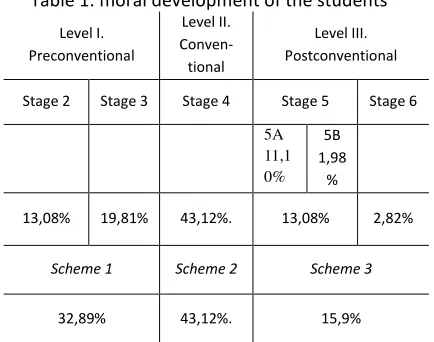
The Defining Issues Test (DIT) questionnaire was ans-wered by all students from the third grade. Of the 72 students who responded to the questionnaire, of which 39% corresponded to males and 61% to females, an 82% resulted valid. Regarding the age, 62.7% of the students are 14 years of age, meanwhile 28.8% are 13 years of age, and the rest of the 8.5% are older than 14. The table below (table 1) presents the observed results to the moral development of the students.
-4 -2 0 2 4 6 8 10 12 14
m
ea
n
s
co
re
s
Professors' Educational Ideologies
28
Table 1: moral development of the students
Level I. Preconventional
Level II. Conven-tional
Level III. Postconventional
Stage 2 Stage 3 Stage 4 Stage 5 Stage 6 5A
11,1 0%
5B 1,98 %
13,08% 19,81% 43,12%. 13,08% 2,82%
Scheme 1 Scheme 2 Scheme 3
32,89% 43,12%. 15,9%
It can easily be observed at the analyzed data that the second scheme, which consists in maintaining the norms and corresponds to the fourth stage, is the one that excels, meanwhile the first scheme which corresponds to personal interests was the second most developed, and the third scheme consisted of rationalization of demo-cratic principles is presented as the least developed. Other investigations have declared similar results (Anaya, 2009; Barba, 2004).
The adolescents participating at the research show the lowest percentage at the post-conventional level. Within this result, an important variation at the 5th stage of social contract and individual rights has been observed, divided into two categories:
- 5A Morality of social contract - 5B Morality of intuitive humanism
The sixth stage, in which what is considered fair is based on abstract principles like peace, justice, etc., takes a relatively low percentage. The performance of the ado-lescents on the post-conventional level indicates smaller capacity for peaceful conflict resolution with a sense of justice and appreciation of diversity; this inquiry verifies the hypothesis of the investigation.
The predominance of the second scheme, that of the maintenance of the norm, suggests that in conflict situ-ations the students will probably react in conventional forms, which might also be the desirable outcome consi-dering these very forms are welcomed by the insti-tutions. The significant intensity of the first scheme suggests that the students consider the elements that fit and determine the context of the particular group of peers to be conventional, therefore conflict resolution can be approached not only through pacific and insti-tutionalized means. Finally, the third scheme is presented as the one with the minor development at the students' profile, a fact that demonstrates an area of opportunity for our intervention, in the sense of a need for further education on democratic principles.
As an alternative method for data collection, two evaluations were conducted by the participants of the intervention, one in the middle of the intervention, before 5th session, and one at the end of research, after
the Forum Theatre presentation. Three open form ques-tions were presented at the students, to provide freely their responses:
• Can you describe the class?
• What comments do you have about the class?
• What have you learned during this class?
In the first evaluation, it can be observed that 95% of the students mentioned that they had learned a way of democratic co-living, and a 63% stated an obtainment of knowledge regarding the Art of Theatre. The three cate-gories mostly referred in the evaluations were: Self-awareness, democratic interaction and communal coo-peration. These categories are linked in a direct way with the peaceful conflict resolution. In the following table (table 2) the categories along with the sub-categories contained, as well as the percentages that each one of them obtained in the evaluations of the students are presented.
Table 2: categories of democratic comprehension, emerged from the evaluations
Comprehension of democracy and conflict resolution
Cate-gories
Self-awareness
Democratic interaction
Communal Coopera-tion
Theatre
sub- cate-gories
-overcome shyness -Expression of emotions -Self-esteem
-Inclusion &coexistence -Tolerance and respect -Empathy
-Communi-cation -Confi-dence -Collective work
-Improvi-sations -Create a character -Enact 1st
Eval-uation
74% 79% 79% 63%
2nd Eval-uation
74% 58% 74% 68%
29
In the first evaluation, peaceful conflict resolution was mentioned only by one student of the group, but during the second evaluation, more than half of the students focused on this aspect. The self-awareness category appears to be the highest in percentages, along with the communal cooperation. Likewise, in the second eva-luation the category of democratic interaction, which is represented by inclusion and coexistence, obtains lower percentages. This could be explained by the fact that stu-dents oriented their answers solely towards the verify-cation of the exercises and not in the process itself; for example, they did not take into account (in their evalu-ation) the fact that an assembly was established in order to make decisions on interventions during the Forum Theatre session.
In other words, we can say there is a distance between the conceptual learning and the skills development; the students of the sample did mention democratic skills when democracy was considered as the content, but they didn't when it was the form. The fact that the students didn't conceptualize their actions could imply more time to reflect on the actions, specifically about the way they take decisions.
Another element that results as one of great importance is that of the daily life: The students in their evaluations mention that the intervention helped them resolve conflicts in their daily lives, as in a better communication with their friends in real time, and a better interaction with their families.
Concluding the analysis of evaluations, from the pers-pective of the students as registered in their responses, this group reached learning goals of the course Civic and Ethic Formation, as they are stated in the national curriculum, through a means of hands-on education, transforming possibilities into capabilities.
It is also important to mention that the knowledge on theatre emerging from the intervention appears signi-ficantly high in both the first and second evaluation.
As for the stories the students represented in the Forum Theatre, there were four of them, the two involve-ing domestic violence:
- The father shoves his wife, throws her to the ground and hits her. The son runs to call for help from his uncles. The father runs away.
- The daughter washes the dishes. The mother enters, calls her an imbecile and throws the plates to the floor. The other members of the family, the father and the brother, appear apathetic.
Two more were involving outdoors (also out-of-school) violence:
- Two women fight over a man, which makes him feel proud. - A street fight is described: Two men meet up to fight and solve their issues.
In the observation protocol, the interactions of the students were noted and were summarized by the fo-llowing points: The students formed an assembly to pro-pose solutions of the presented conflict. Everyone had
the right to speak; they discussed all together the solutions, which led to a consensus. Therefore, their type of decision-making was a democratic one, even acquiring the characteristics of direct democracy. During the assembly, a leadership emerged, by some students whose initiative coordinated the assembly. The leaders met the characteristics of a democratic leadership, since they facilitated the participation of their companions and tried to include and synthesize all the different opinions expressed.
As for the group of students that participated in the intervention, it could be said that the research hypothesis was verified. The students had not developed sufficiently the abilities of social democratic interaction for conflict resolutions in their daily lives, which could be verified not only by the results of the DIT instrument, but also by their stories. The presented results favor the consi-deration that Community Theatre and the Theatre of the Oppressed used as communication tools, can offer a means for the adolescents to develop abilities of social democratic interaction, specifically on conflict resolution in daily life. The results shown above, as well as the characteristics of the students’ own responses as regis-tered in the field journal, both provide evidence to support this thesis. Some examples of what the students declared are the following:
- I learned how to treat people. - I learned how to resolve a fight.
- I liked it because in real life you can’t change what is done. - We found solutions.
- We avoided conflicts.
- It’s emotional (exciting) to get into the role.
- If someone has a problem, you can help him or her to solve it.
- I learned how to interact differently, with less violence. - I liked the improvisation.
- From something bad, you can learn something good. - All the scenes we talked about, I have seen them or lived them. There is sexism and other forms of violence but it is not necessary to start brawling.
In the last session, we set up an event for all the students of the third grade where the participants in the intervention instructed the exercises to their classmates. In the Image Theatre session, when the students in groups formed a collective statue representing a conflict, all teams demonstrated conflicts of high levels of physical violence. This indicated that the adolescents lead a life surrounded by violence, to which they answer back with violent reactions.
5 Discussion, conclusion
30
achieve a democratic education on citizenship.
The conflict management is an important ability found in the course of Civic and Ethic Formation for basic edu-cation (Secretaría de Educación Pública, 2011b), as it is included in the 8 competencies mentioned in the course objective (p. 9). All these skills were addressed through the intervention and were converted into actual abilities instead of being taught theoretically; they were present-ed by the students through action, i.e. the students applied each one of those during the situations of conflict recreated within the class. As a result, the Community Theatre could be added to the active teaching of democratic skills as a new, alternative tool.
The interactions of the students were analyzed, as was the behavior they chose, when confronting situations in which they had to demonstrate their democratic skills. These interactions are important because the formation of citizenship requires participation and active reflection on the social process by the citizens, who are the only ones to guarantee democracy. The above-mentioned dynamic is the very essence of democracy and, in this sense, the project considers that education should be committed into becoming a factor of social progress.
It can be argued that, according to the results and, above anything, according to the discourse of the students and the attitudes adopted during the class, the evidence are consisted with the stated hypothesis. Nevertheless, more time is necessary in order to change the predominant social and cognitive schemes of the adolescents and establish different social representations regarding conflict resolution. The goal is not a mere change in behavior, but a conjunction of beliefs, images, values and meanings that a participative citizenship requires in general. The conduction of wider studies that could provide stronger evidence is essential for the Mexican society to advance into a society which respects the people, life, and human rights.
Finally, we hope that this research can prove of assis-tance with the understanding of the educative process in a subject that is crucial to the whole of society, com-bining different fields of knowledge: humanities, social sciences and the arts. This type of transdisciplinary research is meant to restore fragmented knowledge in the academic fields of humanities and of social sciences (Wallerstein, 1997; Gibbons et al., 1994); to find a common ground within the different fields and to en-hance the social and academic dialogue, through creating synthesis of meanings and practices.
References
Anaya, R. (2009). Razonamiento moral e ideología educativa. Alumnosy profesores de escuela secundaria [Moral reasoning and educational ideology. Students and professors in middle school]. In: Alvarez, I. (Ed). De lapolítica a la sociedad. 7 reflexiones desde la frontera. México: UACJ.
Anaya, R. (2012). Educación democrática y formación de ciudadanía. Razonamiento moral e ideología educativa
en instituciones formadoras y actualizadoras de docentes en el estado de Chihuahua [Democratic education and formation of citizenship.Moral reasoning and educational ideology in teacher forming institutes at the state of Chihuahua]. Unpublished doctoral dissertation, Universidad Autónoma De Ciudad Juárez, Juárez.
Arendt, A. (1997). ¿Qué es la Política? Barcelona: Paidós.
Bakonikola, H. (2004). Moments of Ancient Greek Tragedy. Athens: Kardamitsa.
Boal, A. (2001). Hamlet and the Baker´s son: My life in Theatre and Politics. London: Routledge.
Boal, Α. (1979). Theatre of the Oppressed. London: Pluto Press.
Boal, Α. (1995). The Rainbow of Desire: The Boal Method of Theatre and Therapy. London: Routledge.
Boal, Α. (2002). Games for Actors and Non-Actors. London: Routledge.
Castoriadis, C. (1975). L'institution imaginaire de la société [The imaginairy institution of the society]. Paris: Seuil.
Charalambous, Ch. (2012). Drama/Theatre Education for Democracy: The Role of Aesthetic Communities,
unpublished doctoral dissertation, University of Warwick, Institute of Education, Coventry.
Connell, R. W. (1992). Citizenship, Social Justice and Curriculum, International Studies in Sociology of Education, 2 (2), 133-146
Crick, F. (1998). Education for citizenship and the teaching of democracy in schools: Final report of the Advisory Group on Citizenship. London: Qualifications and Curriculum Authority
Erikson, E. H., (1968). Identity: Youth and crisis. New York: Norton.
Forcadas, J. (2012), Praxis del Teatro del Oprimido en Barcelona [Praxis of the Theatre of the Oppressed in Barcelona]. Barcelona: Fornde teatre Pa'tothom.
Forsyth, D. R., (2010). Group dynamics. (5th edition). Belmont: Thomson-Wadworth.
Freire, P. (1970). Pedagogy of the Oppressed. New York: Continuum.
Gibbons et al. (1994). La nueva producción del conocimiento [The new production of knowledge]. Pomares: España.
Habermas J. (1991). The Structural Transformation of the Public Sphere. Cambridge: MIT press.
Habermas, J. (1996). Between Facts and Norms: Contributions to a Discourse Theory of Law and
Democracy. (William Rehg, trans). Cambridge: MIT Press.
31
science pholisophy]. Juárez: Universidad Autónoma de Ciudad Juárez.
Kohlberg, L. Power, F.C. y Higgins, A. (1997). La educación moral, según Lawrence Kohlberg [The moral education according to Lawrence Kolhberg]. Barcelona: España.
Levinson, B. (2005). Citizenship, Identity, Democracy: Engaging the Political in the Anthropology of Education.
Anthropology and Education Quarterly, 36 (4), 329-340,
Lewin, K. Lippitt, R. White K.R. (1938) Patterns of aggressive behavior in experimentally created social climates, The journal of social psychology, 10(2).
Marshall, T. & Bottomore, T. (2005). Ciudadanía y clase social [Citizenship and social class]. Buenos Aires: Losada.
Mead, G. H., (1967). Mind, self and society. Phoenix (Ed.) Chicago and London: University of Chicago Press.
Moschou, Ch. (2015) Social inclusion and theatre, school celebration as intervention for the integration of children with special educational needs. Education & Theatre. 15 (1).
O’Neill, W. (1981). Educational ideologies: contemporary expressions of educational philosophy. Santa Mónica, Cal. USA. Edit. Goodyear Publisching Co.
Pefanis, G. (2012). Philosophical remarks of Castoriadis on Attic tragedy. Logeion, a journal of ancient theatre. (2). p. 256-283.
Pigkou-Repousi, M. (2012). Ensemble Theatre and Citizenship Education How Ensemble Theatre Contributes to Citizenship Education. Unpublished doctoral
dissertation University of Warwick, Institute of Education, Coventry.
Rest, J. (1993). Manual for the DIT. (3rd edition). Minneapolis: University of Minesota, Centre for the Study of Ethical Development.
Rest, J., Narvaez, D., Thoma, S. y Bebeau, M. J. (2000) “A neo-kohlbergian approach to morality research”. Journal of Moral Education, 29 (4), p. 381-395.
Santos, B. (2015). Conflict: the question of Forum Theatre. Education and Theatre. 16(1), p. 36-39.
Secretaría de Educación Pública. (2011a). Plan de estudios 2011. Educación Básica [Plan of studies. Basic Education]. México, D.F.
Secretaría de Educación Pública. (2011b). Programas de estudio 2011. Guía para el Maestro. Educación Básica. Secundaria. Formación Cívica y Ética [Programs of Studies 2011. Teacher´s guide. Basic Education. Middle school. Civic and Ethic Formation]. México, D.F.
Secretaría de Educación Pública. (2013). Programa Integral de Formación Cívica y Ética para la educación básica [Integral Program of Civic and Ethic Formation for Basic Education]. México, D.F.
Touraine, A. (2002). Igualdad y diversidad. Las nuevas tareas de la democracia. España: FCE.
Wallerstein, I. (1997). Abrir las ciencias sociales: informe de la Comisión Gulbenkian para la reestructuración de las ciencias sociales [Opening the social sciences: report at the Gulbenkian Commission for restoring social sciences].
México: Siglo XXI.