Research
Article
Performance
evaluation
of
composite
Web
services
Lynda
Mokdad
1,
Jalel
Ben
O
thman
2and
Abdelkrim
Abdelli
3,∗1Lab.LACL,UniversityofParis-EstLACL(EA4219),UPECF-94010Créteil,France
2Lab.L2TI,UniversityofParis13-L2TI(EA3043),UP13F-93430Villetaneuse,France
3Lab.LSI,USTHBuniversityofAlgiers,Algeria
Abstract
Composite Web service architectures are demanding much guarantee on the Quality of Service (QoS) in
order to meet user requirements. Performance evaluation of these architectures has become therefore a very
challenging issue, as the task is very complex due to synchronization inside the orchestration of services.
We propose in this paper to use stochastic automata networks which a is powerful formalism as it provides
semantics to specify synchronization within a very smart formalism. Contrary to previous approaches, the
modeling and the performance evaluation of a variable number of remote service invocation become possible. The reported simulation results advocate the use of our approach in the performance evaluation of composite Web service architectures.
Keywords: StochasticAutomataNetworks(SAN),MarkovChain,responsetimes,CompositeWebservices,performance
evaluation.
Received on 25 September 2014; accepted on 10 February 2015; published on 04 June 2015
Copyright© 2015 A. Abdeli et al., licensed to ICST. This is an open access article distributed under the terms of the Creative Commons Attribution licence (http://creativecommons.org/licenses/by/3.0/), which permits unlimited use, distribution and reproduction in any medium so long as the original work is properly cited.
doi:10.4108/inis.2.4.e4
1. Introduction
Theuseofwebservicesiscontinuouslygrowingandthe technologicalandeconomicpotentialisnotyettapped. Thewebserviceshavebecomeinrecenttimesbyfarthe technologyapplicationintegrationparexcellenceasitis nowfeasibletohostbasicwebservicesonasmartphone withoutrequiringadditionaltechnologies.
Web Services are software components that can be accessed overthe Internet using well established web mechanisms.Forinstance,intheITdomaintheimpact ofXMLWebServiceshasincreasedduringrecentyears, sincetheExtensibleMarkupLanguage(XML)hasbeen enforcedasametalanguageforstructuredinformation anditsrepresentation[1].
Web services are self-descriptive loosely coupled and interact with each other. They are defined and describedregardlessoftheirplatforms,implementation details. The biggest advantage of Web Services lies in their simplicity in expression, communication and servicing. The componentized architecture of Web Services also makes them reusable, thereby reducing thedevelopmenttimeandcosts[2].
Unlikeitspredecessors,suchastheCommonRequest BrokerArchitecture(CORBA),RemoteMethod Invoca-tion (RMI) and DistributedComponent Object Model (DCOM),webserviceshaverespondedsatisfactorilyto
interoperability in the context of distributed systems, as well as to the scale of the Internet. Indeed, Web ser-vices can be seen as the standardized way to distribute services on the Internet. It uses Internet protocols to communicate and uses a standard language to describe its interface. The success of Web services is in fact due to the use of Internet technology as a communication infrastructure and the availability of a working frame-work based on a set of standards which are [3]:
• SOAP (Simple Object Access Protocol) a com-munication protocol for structuring the messages exchanged between software components [4]
• W SDL (Web Services Description Language)
a specification for describing Web services interfaces [6]; and finally
• U DDI (Universal Description Discovery and
Integration) a specification for publishing and localization of Web services [5].
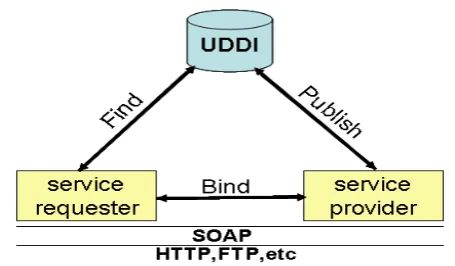
Thereare,twokeyplayers,inWebservicesarchitecture: Theserviceprovider(whichpublishestheservice),and theservicerequester.Athirdactor,theserviceregistry, may be associated with this pair, but its presence is notessentialasthe servicerequesterneeds onlyto be awareoftheaddressoftheserviceprovider.Thesethree participants must be ableto interact with each other.
on Industrial Networks And Intelligent Systems
Figure 1. Deployment, research and invocation of web service
Hence, three types of interconnection have defined, as illustrated by the the figure1.
Living in a competitive world, businesses are nat-urally interested in information technology support-ing them for competitive advantage. As cooperation becomes increasingly important for companies, new challenges arise for the support of business to business scenarios by information technology. The emergence of Web services marks the beginning of a new evolution in this context. This development, a priori technical and architectural introduced a true revolution in how to design and build information systems. Therefore, it became possible to develop an application of high-level by federating some Web services already provided on the Internet by various organizations; hence the concept
of composite Web service.
In actual fact, available services on the Internet have limited functionalities which do not always meet the user requirements. Therefore, services must often be composed to build more complex services to achieve specific user requirements. In their turn, these new created services are potential candidates for another composition [7]. A composite Web service may be distributed over a network, running on different platforms, implemented in different programming languages and offered by different vendors.
A Web service is said to be composite when its execution involves interactions with other Web services in order to call for their functionalities. The composition of Web services specifies which services need to be invoked, in what order, and how to manage the exceptions. Clearly, it describes a business process, involving different web services.
There are several languages to describe a composition which are classified into two major groups: non-semantic approaches and non-semantic approaches [8]. Within this context, BPEL4WS (Business Process Execution Language for Web Services), has emerged among non semantic approaches, whereas OWL-S (Web Ontology Language for OWL-Services) becomes the representative standard of semantic approaches.
However, existing models have been also used to model and compose web services, such as: workflows graphs, Petri nets and currently programming languages as Java and C.
The composition languages show two levels of abstraction:
The abstract level (the abstract process), where the
description of a process does not indicate the internal behavior of the parts involved in the process; and
the executable level (the executable process), where
the description is complete and specifies the order of execution of activities, the list of partners, the messages exchanged and treatment of exceptions. These languages provide two methods of execution: orchestration and choreography.
Orchestration: It describes the interaction of services
at message level, including the business logics and the order of execution of interactions. The services run independently of the context of business processes. Only the coordinator of the orchestration needs to be aware about the orchestration.
Choreography: Unlike the first way to compose Web
services, the choreography has no central coordinator. Each Web services involved in the composition knows the conditions of the execution of its operations and with which other services the interaction have to take place.
The BP EL4W S has become a standard composition
of business processes. It allows the manipulation of services as activities and processes. A process
BP EL4W S, is a container where we find a list of
external partners, declarations of data exchanged with these partners, managing exceptions and more importantly, the list of activities of the process.
The composition can be made at the time of design of composite Web services, or at runtime. At time of design, the composition is manual, and all the web services that take part, are known as well as their execution order. At runtime, the composition is dynamic and automatically performed and only a specification of the required abstract services is given. Hence, services must first be discovered, then selected and integrated. Microsoft BizTalk Server and BEA WebLogic are examples of platforms of static composition and eFlow and StarWSCoP are platforms for dynamic composition [9].
environment which is very dynamic (the Web) and thus, theirQoS values are frequently changing due to updating in elementary services (disappearance of a service for example) or a change in the environment of their execution (a heavy load on the system). This shows the importance of dynamic service composition since services are selected and adapted dynamically at runtime, with services previously discovered to meet user requirements. Consequently, it becomes necessary to integrate, in the web services, such non-functional properties (QoS) in order to distinguish them at runtime [10], [11].
As the market capture of Web services is increasing significantly, in the past years, the applications are quite welcoming the ability to provide secure and reliable communication in the vulnerable and volatile mobile networks. Performance evaluation of these architectures is essential but complex due to synchronization inside the orchestration of services. Consequently, the increasing complexity of such architectures requires the development of methods and tools in order to monitor and evaluate their QoS. In fact, the QoS degradation can lead to serious consequences including a significant economic impact.
We propose in this paper to address this issue. We mainly focus on the composite Web service (CWS) response time computation, where the requests are decomposed into sub-queries to different elementary Web services and then merged into a final result. This includes the following models:
• parallel invocation of a constant number of elementary Web services merged by a federating component;
• parallel invocation of a variable number of elementary Web services merged by a federating component.
To this aim, we consider Stochastic Automata Network (SAN), to model such architectures. Contrarily to other probabilistic models, as Markov’s chains for instance, SANs area verypowerful toolas theycanspecifysystemswithcomplexsynchronization requirementsinaverycompactandelegantway.Hence, it becomes possible to specify the composition of a variable number of web services, when it is hard to achieve with other models. To advocate the use of our approach, we provide some empirical studies by simulating the obtained models to compute response times.
Thisremainderofthepaperisorganizedasfollows. In Section 2, we give the related work. In Section 3, wegive abrief introduction toSAN model.Insection 4, we describe our different models to specify web servicescomposition,whereinSection5,wegivesome
numerical results. Finally, we conclude and give future research perspectives in Section6.
2. Related works
In the literature, performance evaluation of Web services have been conducted either by using tests or formal methods.
As concerns testing Web services, XML specification and SOAP protocol have been studied in [13–15] by testing and measuring their response times. In [13] a comparative study of existing protocols, like RMI, RMI/IIOP or CORBA/IIOP, is presented. A critical study of XML-based protocols for Web services is presented and binary encoded protocol has been proposed instead of text XML-based ones in [14]. In [16], information about past workflow executions is collected in a log. Starting from this log a continuous Markov chain is derived, in order to compute the execution response time and the cost of this workflow.
In [11], the composite Web service response time is considered as a response time of fork and join model. This model states that a single Internet application can invoke in parallel a set of elementary Web services and gather their responses from all these launched services in order to return the results to a client. In this considered study, authors analyze the effects of exponential response times based on their earlier work in [17].
An exact analysis of fork and join system is possible when the system is significantly simplified. This is the case for example when the job arrival process in the system follows a Poisson distribution with execution task having exponential distribution and the number of queues is equal to two. The exact computation response time of a such system can be found in [18], [19] and [20]. An approximation technique has been proposed in the case where the number of servers is greater than two and the servers are homogeneous [20]. This last study is extended in [21]. General arrival process and services times are considered in [22]. The most general case is considered in [23]. In this work, upper and lower bounds are proposed by assuming that the response times in each queue are mutually independent. Two approximation techniques are presented: one is based on a decomposition approach and the other is based on an iterative solution method.
authors consider workflow with transition execution time having exponential distributions, and formulas have been proposed for each refinement rule (sequence, parallel, synchronization and loop execution pattern).
Response time of a Web service middleware is considered in [26], which follows a fork and join model of execution. The author proposes that while performing a join operation, servers with slow response times can be eliminated to maximize the performances. The work is more oriented towards studying fork and join model in order to understand how to optimally merge the results from various servers. In [27] we have proposed a generic transformation of the studied Markov chain which guarantees that the response time of the new Markov chain is an upper bound of the initial Markov chain response time. We instantiate this transformation in three ways, where each obtained new Markov chain is parameterized by a “quantitative” parameter. By an appropriate choice of the parameter, the recurrence equation systems can be resolved with an algorithm withO(n) andO(n√n) respectively space complexity and time complexity, wherenis the number of invoked elementary Web services. However, some synchronization in the invocation of a variable number of web services can not be handled by the proposed models.
3. Stochastic Automata Networks
Stochastic Automata Networks have been introduced as an efficient method to represent complex systems with interacting components such as parallel systems or distributed systems [12]. This method automatically provides an analytic derivation of Markov chain generator matrix using tensor algebra. The SAN seems to be more efficient than Queueing Networks or Stochastic Petri Nets to model systems with a large number of states and complex synchronization.
Queueing Networks give a very compact represen-tation of systems with resource contention among independent customers. Analytical methods and well known algorithms may be used to obtain either analyt-ical or numeranalyt-ical results. However, queueing networks are inefficient whenever complex synchronization con-straints are to be taken into account. On the other side, stochastic Petri Nets have been defined to represent synchronization constraints of parallel systems or pro-tocols. However, they do not generally yield compact models as they build the transition matrix without any knowledge about its properties.
In the SAN approach, the dynamic behavior of each system component is modeled by an automaton and the interactions between the different components by labels on the directed edges which may represent synchronization events and transition rates [12]. A Stochastic Automata Network is a set of automata.
Each automaton Ai is defined by the tuple (Si, L, Qi)
where Si is the set of states of the automaton. Qi
is the transition function of the automaton Ai which
associates a label from L to every arc of Ai. Labels
describe the rate and the type of the transition. The rate may be dependent of the others automata states. There are 2 types of transitions:localandsynchronized. A local transition occurs only within the automaton, whereas the synchronized transition occurs in several automata at the same time. An automaton itself is not Markovian. The Markovian assumption holds only for the global SAN behavior if we assume exponential distribution and independence for the firing of the transitions.
The transition rate matrix Q is automatically translated from the SAN description. This translation is based on tensor algebra of matrices (see [12] for more details and proofs).
First let us define tensor operators:
Definition 1.Let A be a matrix of order n×n, and B a matrix of order p×p. The tensor product of A and
B is a matrix C of order np×np such that C may be decomposed inton2blocks of sizep.
C=A⊗B=
a11B ... ... a1nB
. . . .
. . . .
. . . .
an1B ... ... annB
AandBare matrices of real values but we generalize the definition of tensor product on matrices of functional values (i.e. the elements ofAandBare functions using states as arguments). Some properties of the classical tensor product still hold.
Definition 2.Let A be a matrix of order n×n, and B a matrix of order p×p. The tensor sum of A and B is defined by :
E=A
⊕
B=A
⊗
IB+IA
⊗
B
whereID represents the identity matrix with the same
size as matrixD.
It has been proved in [12] that, if the states are in a lexicographic order, then the generator matrixQof the Markov chain associated to a continuous-time SAN is given by:
Q=
n
⊕
i=1
Fi+
c
∑
j=1
n
⊗
i=1
Si,j+
c
∑
j=1
n
⊗
i=1
Ri,j
Where:
• nis the total number of automata in the network andcis the number of synchronization.
• Fi is the transition matrix of automatoniwithout
• Si,jis the transition matrix of automatonidue to
synchronizationj.
• Ri,j is a matrix representing the normalization
associated to the synchronizationjon automaton
i.
• ⊕ and ⊗ denote tensor sum and product, respectively.
The transition matrixP of a Markov chain associated to a discrete-time Stochastic Automata Network can be obtained by a slightly different formula, given by:
P =
n
⊗
i=1
Fi +
c
∑
j=1
(
n
⊗
i=1
Si,j−
n
⊗
i=1
Ri,j
The main advantage of this methodology is its ability to represent the Markov chain associated to the SAN model by a compact formula. This point is particularly important since it allows us to deal with systems which may have very large state spaces. In the following section, we show how we model our system using the SAN methodology.
4. Considered composite Web service model
We focus on the composite Web service (CWS) response time computation, where the requests are decomposed into sub-queries to different elementary Web services and then merged into a final result. The control patterns considered here are not directly supported by BPEL [28]:
• parallel invocation of a constant number of elementary Web services merged by a federation component. This model is described in section4.1.
• parallel invocation of a variable number of elementary Web services merged by a federation component. This model is described in section4.2.
4.1. Case
n
is constant
We consider a composite Web service where the data is stored in databases and can be accessed using XML-based protocols notedsi for 1≤i≤n. We assume that
when a composite Web service is invoked,nelementary Web services are invoked in parallel and the partial responses are then integrated into the global response to provide to the client. We assume that the arrival of the composite Web services follow a Poisson process with rateλ. The response times of the serverssi for 1≤i≤
nare also assumed to be of exponential distributions with rateµi for 1≤i≤n. We assume that the merging
time of thenelementary Web services is an exponential distribution with rateµ(batch service).
As we have defined the behavior of the system as Markov process, the considered model can be described
by a continuous time Markov chain denoted by X(t). To describe this chain, we define the state x by (x1, s1, s2, . . . , sn, a1, a2, . . . , an), where:
• x1 is the number of the composite Web services
requests.
• s1, s2, . . . , sn are the elementary Web services in
each queue.
• a1, a2, . . . , an are the elementary Web service
responses in the related queue waiting to be merged in the global responses to give back to the clients.
Associate queueing model Hereafter, we define the
queueing model whennis constant. Our model can be specified by queuing network. We have one finite buffer for requests with size b. n queues with finite buffers
with size bi for 1≤i≤n. n others queues with finite
buffers with sizebi for 1≤i≤nwhere the elementary
Web services waiting for the batch service.
To illustrate the behavior of the system, we give the behavior equations of the considered model in the following:
x → CWS arrival
→ (x1+ 1, s1, s2, . . . , sn, a1, a2, . . . , an)
with rate λ× 1x1<b
→ Decomposition of CWC into n elementary WS
→ (x1−1, s1+ 1, s2+ 1, . . . , sn+ 1, a1, a2, . . . , an)
with rate µλ× 1x1>0 ×1si<bi
→ End of service of WS1
→ (x1, s1−1, s2, . . . , sn, a1+ 1, a2, . . . , an)
with rate µ1× 1s1>0 ×1a1<b1
→ End of service of WS2
→ (x1, s1, s2−1, . . . , sn, a1, a2+ 1, . . . , an)
with rate µ2× 1s2>0 ×1a2<b2
→ . . .
→ End of service of WSn
→ (x1, s1, s2, . . . , sn−1, a1, a2, . . . , an+ 1)
with rate µn× 1sn>0 ×1an<bn
→ Synchronization of n WSs, so response of CWS
→ (x1, s1, s2, . . . , sn, a1−1, a2−1, . . . , an−1)
with rate µ× 1ai>0
4.2. Case
n
is variable
We assume for this model that once a composite Web service (CWS) is requested, it can be decomposed into
The case is a generalization of the precedent case (n
constant).
Thus we define the following probabilities :
• p1 is the probability that CWB, is decomposed
into one elementary Web service
• p2 is the probability that CWB, is decomposed
into two elementary Web services
• pk is the probability that CWB, is decomposed
intokelementary Web services
• pn is the probability that CWB, is decomposed
intonelementary Web services, which is the case of the first model.
Associate queueing model The considered model can
also be described by a continuous time Markov chain denoted by X(t). To describe this chain, we define the statexby (x1, s1, s2, . . . , sn, a1, a2, . . . , an), where:
• x1 is the number of the composite Web services
requests
• s1, s2, . . . , sn are the elementary Web services in
each queue.
• a1, a2, . . . , an) are the number elementary Web
services responses in each queue waiting for merging and giving the responses to the clients.
As the system is complex, we give the behavior equations only for the case that a CWS can be decomposed into 1, 2 or 3 EWS (n= 3). We denote bys1,
s2ands3the elementary Web service that can compose
the CWS denoted by Sw. Thus we have the following combinations:
• Swis composed only bys1with probabilityp1
• Swis composed only bys2with probabilityp2
• Swis composed only bys3with probabilityp3
• Swis composed bys1ands2with probabilityp12
• Swis composed bys1ands3with probabilityp13
• Swis composed bys2ands3with probabilityp23
• Sw is composed bys1,s2 ands3 with probability
p123
Thus, the behavior equations are given as follows:x → CWS arrival
→ (x1+ 1, s1, s2, s3, a1, a2, a3)
with rate λ× 1x1<b
→ Decomposition of CWS into EWS 1
→ (x1−1, s1+ 1, s2, s3, a1, a2, a3)
with rate µλ ×p1× 1x1>0 ×1s1<b1
→ Decomposition of CWS into EWS 2
→ (x1−1, s1, s2+ 1, s3, a1, a2, a3)
with rate µλ ×p2× 1x1>0 ×1s2<b2
→ Decomposition of CWS into EWS 3
→ (x1−1, s1, s2, s3+ 1, a1, a2, a3)
with rate µλ ×p3× 1x1>0 ×1s3<b3
→ Decomposition of CWS into EWS 1 and EWS 2
→ (x1−1, s1+ 1, s2+ 1, s3, a1, a2, a3)
with rateµλ ×p12× 1x1>0 ×
1s1<b1×1s2<b2
→ Decomposition of CWS into EWS 1 and EWS 3
→ (x1−1, s1+ 1, s2, s3+ 1, a1, a2, a3)
with rateµλ ×p13×
1x1>0 ×1s1<b1×1s3<b3
→ Decomposition of CWS into EWS 2 and EWS 3
→ (x1−1, s1, s2+ 1, s3+ 1, a1, a2, a3)
with rateµλ ×p23×
1x1>0 ×1s2<b2×1s3<b3
→ Decomposition of CWS into EWS 1, EWS 2 and EWS 3
→ (x1−1, s1+ 1, s2+ 1, s3+ 1, a1, a2, a3)
with rate µλ ×p123×
1x1>0 ×1s1<b1×1s2<b2×1s3<b3 → End of service EWS1
→ (x1, s1−1, s2, s3, a1+ 1, a2, a3)
with rateµ1× 1s1>0 ×1a1<B1 → End of service EWS2
→ (x1, s1, s2−3, s3, a1, a2+ 1, a3)
with rate µ2× 1s2>0 ×1a2<B2
→ End of service EWS3
→ (x1, s1, s2, s3−1, a1, a2, a3+ 1)
with rateµ3× 1s3>0 ×1a3<b3
→ Response to CWS composed only by EWS1
→ (x1, s1, s2, s3, a1−1, a2, a3)
with rateµ ×p1× 1a1>0
→ Response to CWS composed only by EWS2
→ (x1, s1, s2, s3, a1, a2−1, a3)
with rateµ ×p2× 1a2>0
→ (x1, s1, s2, s3, a1, a2, a3−1)
with rateµ ×p3× 1a3>0
→ Response to CWS composed only by EWS1and EWS2
→ (x1, s1, s2, s3, a1−1, a2−1, a3)
with rate µ ×p12× 1a1>0× 1a2>0
→ Response to CWS composed only by EWS1and EWS3
→ (x1, s1, s2, s3, a1−1, a2, a3−1)
with rateµ ×p13× 1a1>0× 1a3>0
→ Response to CWS composed only by EWS2 and EWS3
→ (x1, s1, s2, s3, a1, a2−1, a3−1)
with rate µ ×p23× 1a2>0× 1a3>0
→ Response to CWS composed only by EWS1, EWS2 and EWS3
→ (x1, s1, s2, s3, a1−1, a2−1, a3−1)
with rateµ ×p123× 1ai>0
4.3. Associated SAN
λ
0 1 B
S S S S
S S S S
2
0 1 B
S S S S
S S S S
2
µ2 µ2
µ2 µ2
2
Automaton for EWS 1
Automaton for EWS 2
Automaton for EWS n
n
µn
µ µ
µn n n
0 1 B
S S S S
Sµ1 Sµ1 Sµ1 Sµ1
1 2
λ λ
λ λ
λ λ
λ λ
λ λ
λ
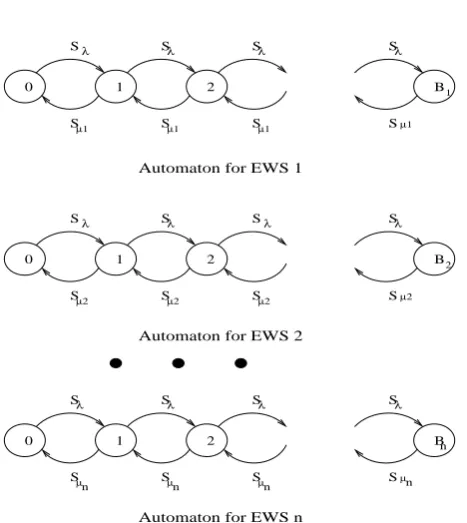
Figure 2. stochastic Automata for elementary service execution
We present in this section how we specify our model using SAN for the both considered models.
4.4. Case
n
is constant
Before giving the automata, we give the description of the different synchronization in the following.
• Sλis a synchronization which corresponds to the
fork which means that we decompose the request (CWS) into nelementary Web services. Thus, its rate is equal toλ.
λ
0 1 B
S S S S
S S S S
2
0 1 B
S S S S
S S S S
2
µ2 µ2
µ2 µ2
2
Automaton for EWS 1
Automaton for EWS 2
Automaton for EWS n
n
µn µ
µ
µn n n
0 1 B
S S S S
Sµ1 Sµ1 Sµ1 Sµ1
1 2
λ λ
λ λ
λ λ
λ λ
λ λ
λ
Figure 3. stochastic Automata for elementary service execution
• Sµ1 is a synchronization which corresponds to the
service of elementary Web service from server 1. Its rate is equal toµ1.
• Thus, we can note thatSµi is the synchronization which corresponds to the service of elementary Web service from serverifor 1≤i≤n. Hence, its rate is equal toµi.
• Sν is a synchronization which corresponds to the
batch service of elementary Web service from all servers. Thus, its rate is equal toν.
For the considered model, we need several automata as described in the following:
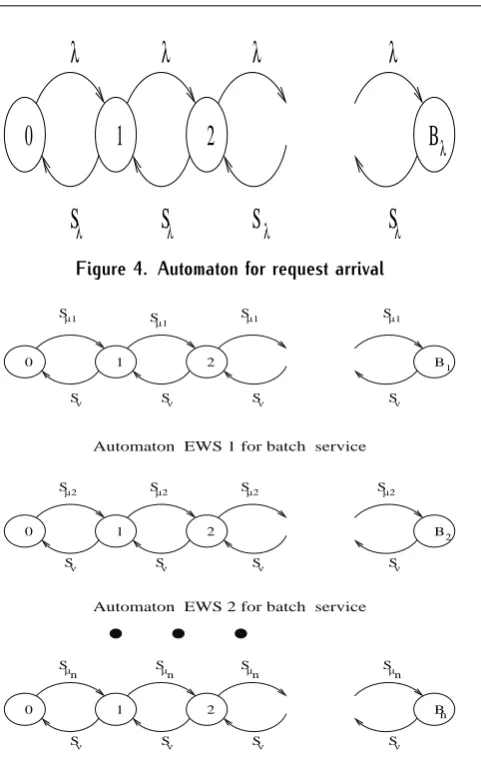
• We need one automaton for request arrival which decompose the CWS into n EWS. The action is done by the synchronizationSλ. The considered
automaton is given in figure4.
• We describe one automaton for each servers where are executed the elementary Web services. As we consider that a CWS can be decomposed in n
EWS, we need n automata. These automata are described in figure3.
• We also need one automaton for each EWS waiting for the batch service. The batch service is provided by synchronizationSνas shown in figure5.
B
0
1
S
S
S
2
S
λ
λ
λ
λ
λ λ λ λ
λ
Figure 4. Automaton for request arrival
Automaton EWS n for batch service
S
µ1
S Sµ1 Sµ1
Sµ2 Sµ2 Sµ2 Sµ2
Sµ
n Sµn Sµn Sµn
Sν
Sν Sν Sν Sν
Sν Sν Sν Sν
0 1 2 B
0 1 2 B
2
n
0 1 B
S S S
1 2
ν ν ν
Automaton EWS 1 for batch service
Automaton EWS 2 for batch service
µ1
Figure 5. Automata for batch service
4.5. Case
n
is variable
For a sake of readability, we represent only the case where a CWS can be decomposed into 1, 2 or 3 EWS (n= 3) and where several automata are needed. Before we describe this modeling, we give the used synchronization:
• The synchronization S1, S2, . . . , S123 are used for
the decompositions of CWS into 1, 2 or 3 EWS (n= 3).
• The synchronizationSµ1, Sµ2, Sµ3are used for the
service of EWS
• The synchronization Sν1, Sν2, . . . , Sν123 are used
for the merge of 1, 2 or 3 EWS.
We present, now, the associated stochastic automata network.
• We need one automaton for request arrival, which decomposes the CWS into n EWS. The action is
2
λ
λ
λ
λ
0
1
3
B
S
S
S
S
S
S
S
S
S
1S
1S
1S
12 2 2
123 123
123 123
Figure 6. Automaton for request arrival
done by the synchronizationSλ. The considered
automaton is given in figure6.
• We need one automaton for each server where are executed the elementary Web services. As we consider that a CWS can be decomposed innEWS, where n is variable, we use the corresponding synchronization. These automata are described in figure7.
• We also need one Automaton for each EWS waiting for the batch service. The batch service is provided by synchronizationSν1, Sν2, . . . , Sν123as
shown in figures8,9. and10.
Once the automata are built, we develop, first, for each automata the local and synchronization matrices. Then we apply the compact formula.
Q=
n
⊕
i=1
Fi+
c
∑
j=1
n
⊗
i=1
Si,j+
c
∑
j=1
n
⊗
i=1
Ri,j
The latter makes it possible to compute the rewards as it is discussed in the next section.
5. Numerical results
Automaton for EWS 3
0 1 B
S1 S1 S1 S1
Sµ1 Sµ1 Sµ1 Sµ1
1
2
Automaton for EWS 1
0 1 B
S S S S
S S S S
2
0 1 B
S S S S
S S S S
2
2 2 2 2
µ2 µ2
µ2 µ2
2
3
µ3 µ3
µ3 µ3
3 3 3 3
Automaton for EWS 2
Figure 7. Automata for elementary Web services
1 ν1 Sν1 Sν1 Sν1
Sν2 Sν2 Sν2 Sν2
Sν3 Sν3 Sν3 Sν3
Sν123 Sν123 Sν123 Sν123
0 1 B
S S S S
2
µ1 µ1 µ1 µ1
S
Figure 8. Automate A1
2
ν1 Sν1 Sν1 Sν1
Sν2 Sν2 Sν2 Sν2
Sν3 Sν3 Sν3 Sν3
Sν123 Sν123 Sν123 Sν123
0 1 B
S S S S
2
µ2 µ2 µ2 µ2
S
Figure 9. Automate A2
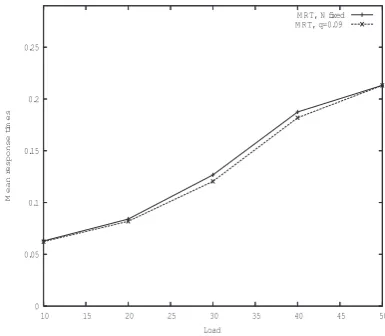
constant) and the general model (nvariable); response
3
ν1 Sν1 Sν1 Sν1
Sν2 Sν2 Sν2 Sν2
Sν3 Sν3 Sν3 Sν3
Sν123 Sν123 Sν123 Sν123
0 1 B
S S S S
2
µ3 µ3 µ3 µ3
S
Figure 10. Automate A3
0 0.05 0.1 0.15 0.2 0.25
10 20 30 40 50 60 70 80 90
M
e
a
n
r
e
s
p
o
n
s
e
t
im
e
s
Load
M R T, N fixed
Figure 11. Mean Response times for the casenis constant.
0 0.05 0.1 0.15 0.2 0.25
10 15 20 25 30 35 40 45 50
M
e
a
n
r
e
s
p
o
n
s
e
t
im
e
s
Load
M R T, N fixed M R T, q=0.09
Figure 12. Mean Response times for both cases.
0 0.5 1 1.5 2 2.5 3 3.5
10 20 30 40 50 60 70 80 90
M
e
a
n
r
e
q
u
e
s
ts
Load
N fixed N not fixed, q=0.25
Figure 13. Mean Requests ratio of both cases.
6. Conclusion
The objective of this paper was to present the SAN tool and to show how it can be used to evaluate Web service architectures. Indeed, the proliferation of Web services on the Internet and their interoperable nature have shown very quickly the importance of having the QoS in their operating model. This enables the distinction between them and provides the users with tools to select those which are the most suitable for their needs. The performance evaluation of such systems is therefore crucial to guarantee their reliability and their QoS requirements. Because of the complexity in the modeling of such requirements, new tools and methods are therefore needed to handle complex synchronization as well as variable number of elementary services.
In this paper we have investigated the use of stochastic automata networks and we have shown how we can use this formalism to model and evaluate these systems. The main objective was to compute composite Web services response times when the number of invoked elementary Web services can be variable. Future work will lead us to generalize the study by taking into account more complex patterns (e.g. hierarchical composite Web services). Secondly, we plan to consider time requirements in the modeling as well as in the performance evaluation of Web service architectures.
References
[1] D. Tidwell, "Web services - The Web’s next revolution", IBM developerWorks, 2000
[2] David Booth, Hugo Haas, Francis McCabe,
Eric Newcomer, Michael Champion, and Chris Ferris David Orchard. Web Service Architecture. Published on the internet, February 2004.
URLhttp://www.w3.org/TR/ws-arch/. W3C
Recommendation.
[3] M. Hu, "Web Services Composition, Partition, and Quality of Service in Distributed System Integration and Re-engineering", In IEEE, Internet Computing, 2005. [4] M. Gudgin, and M. Hadley, and N. Mendelsohn, and J.
Moreau and H. Nielsen, "Simple Object Access Protocol (SOAP) 1.1", World Wide Web Consortium,
[5] T. Bellwood, and L. Clément, and C. von Riegen, "Universal Description, Discovery and Integration", OASIS UDDI Specification Technical Committee, [6] E. Christensen, and F. Curbera, and G. Meredith and
S. Weerawarana, "Web Services Description Language (WSDL) 1.1", World Wide Web Consortium,
[7] Francisco Curbera and Rania Khalaf and Nirmal Mukhi and Stefan Tai and Sanjiva Weerawarana, The next step in Web services, Commun. ACM journal, volume 46, number 10, pages 29-34, year 2003.
[8] Daniela Claro, Patrick Albers and Jin-Kao Hao, Web services composition, In J. Cardoso, Sheth, Amit (Eds.), Semantic Web Services, Processes and Applications » Chapter 8, 2006.
[9] S. Dustdar, W. Schreiner, A survey on web services composition, International Journal Web and Grid Services 1, pages 1-30, 2005
[10] D.A. Menascé. QoS Issues in Web Services", IEEE Internet Computing, vol. 6, no. 6, pp. 72-74, 2002. [11] D.A. Menascé et al., Response Time Analysis of
Composite Web Services," IEEE Internet Computing, vol. 8, no. 1, pp.90-92, January/February 2004.
[12] B. Plateau and J.M. Fourneau "A Methodology for Solving Complex Markov Models of Parallel Systems", Journal of Parallel and Distributed Computing, Vol. 12, pp. 370-387, 1991.
[13] D. Davis and M. P. Parashar, "Latency performance of soap implementations", In CCGRID ’02: Proceedings of the 2nd IEEE/ACM International Symposium on Cluster Computing and the Grid, page 407, Washington, USA, IEEE Computer Society, pp. 407-415, 2002.
[14] C. Kohlhoff and R. Steele, "Evaluating soap for high performance business applications: Real-time trading systems", In Proceedings of WWW, pp. 1-8, 2003. [15] P. Sandoz, S. Pericas-Geertsen, K. Kawaguchi, M. Hadley,
and E. Pelegri-Llopart, "Fast web services", 2009. [16] J. Klingemann, J. Wäsch, and K. Aberer, "Deriving
Service Models in Cross-Organizational Workflows", In proceedings of RIDE -Information Technology for Virtual Enterprises, Sydney, Australia, pp. 100-107, 1999.
[17] D.A. Menascé et al., "Static and Dynamic Processor Scheduling Disciplines in Heterogeneous Parallel Archi-tectures," J. Parallel and Distributed Computing, vol. 28, no. 1, pp. 1-18, 1995.
[18] S. Hahn and L. Fatto, "Two parallel queues created by arrivals with two demands", Applied Mathematics, Vo. 44, pp. 1041-1053, October, 1984.
[19] L. Fatto, "Two parallel queues created by arrivals with two demands II", Applied Mathematics, Vo. 45, pp. 861-878, October, 1985.
[21] A. Makawski and S. Verma, "Interpolation approxima-tions for symmetric Fork-Join Queues", Perform. Evalua-tion journal. 20(1-3), pp. 245-265, 1994.
[22] F. Bacelli and A.M. Makowski, "Simple computable bounds for the fork-join queue", Proceeding Information Science, pp. 436-441, March, 1985.
[23] P. Heidlberg and K.S. Trivedi, "Analytic queuing models for programs with internal concurrency", IEEE Trans. Computer, vol. C-32, pp. 73-82, Nov, 1993.
[24] S. Haddad, L. Mokdad and S. Youcef, Response time analysis of composite Web services", Communication Systems, Networks and Digital Signal Processing (CSNDSP), IEEE Computer Society, Graz University of Technology, pp. 42-49, July 2008.
[25] C.W. Piotr, F.Pawel and W. Grzegorz, "Time Distribution in Structural Workflow Nets", Fundam. Inf., vol. 85, n. 1-4, IOS Press, Amsterdam, Netherlands, pp. 67-87, 2008. [26] M. Sharf, "On the response time of the large-scale composite Web services", Proceedings of the 19th International Teletraffic Congress (ITC 19), Beijing, pp. 1807-1816, 2005.
[27] S. Haddad, L. Mokdad, S. Youcef: Bounding models families for performance evaluation in composite Web services. J. Comput. Science 4(4): 232-241 (2013) [28] S. Weerawarana and F. Curbera, "Business Process