Abuabker Ibrahim E, et al. J Sci Res Pharm, 2018;7(9):109-113
World Inventia Publishers
J
ournal of
S
cientific
R
esearch in
P
harmacy
http://www.jsrponline.com/
Vol. 7, Issue 9, 2018 ISSN: 2277-9469
USA CODEN: JSRPCJResearch Article
KNOWLEDGE AND ATTITUDES ON PARACETAMOL AND NON-STEROIDAL ANTI-INFLAMMATORY DRUGS:
ELECTRONIC SURVEY IN TAIF KINGDOM SAUDI ARABIA
Dr. Abuabker Ibrahim Elbur 1*, Shaker Saad 2
* 1 Associate Professor, Department of Clinical and Pharmacy Practice, College of Clinical Pharmacy,
Imam Abdulrahman Bin Faisal University, Khobar Coastal Road, Khobar, Saudi Arabia.
2 Pharm D Student, College of Pharmacy, Taif University, Saudi Arabia.
Received on: 01-09-2018; Revised and Accepted on: 29-09-2018
ABSTRACT
Objective: To measure the public knowledge and identify their attitudes on paracetamol and non-steroidal anti-inflammatory drugs. Participants and methods: A cross- sectional study was conducted in Taif region, Saudi Arabia during May 2017. Adult Saudi (>18 years) were included. A structured- questionnaire was used to collect the data and it was distributed electronically through Linkonline. Descriptive statistics were used to describe all variables. Logistic regression analysis was performed. Data was processed using the Statistical Package for Social Sciences (SPSS). P value < 0.05 was
considered statistically significant. Results: A total of 410 people participated, of them 205 (50%) were males. Nearly two thirds of the participants
admitted that they always self-medicated with paracetamol and non-steroidal anti-inflammatory drugs. Level of education was found to be the most significant predictor of using analgesics without prescription, (P = 0.001). Respondents considered with satisfactory knowledge on paracetamol were 96
(23.4%). Interviewees suffered from chronic diseases had more satisfactory knowledge compared to healthy ones, (P = 0.04). Conclusion: Gaps in
knowledge and misconceptions in attitudes on important aspects related to the use and safety of paracetamol and non-steroidal anti-inflammatory drugs were identified. Educational interventions to upgrade public knowledge on these agents are badly needed.
KEYWORDS: Paracetamol, NSAID,: Electronic Survey, Taif Kingdom Saudi Arabia.
INTRODUCTION
Analgesics are among the most commonly used drugs to treat diverse types of pain worldwide. A recent report showed that the non-opioid analgesics continue to be the highest revenue-generating group of drugs and they will continue to be so in the future [1]. The
consumption in both North America and Europe alone accounted for over half of the overall market share in the global analgesics market in 2015. By the year 2022 the global analgesics market is expected to reach $26.4 billion [1]. In Saudi Arabia both analgesics and antibiotics are
ranked as the top consumed groups of drugs as reported in a recent study [2].
The use of analgesics is linked to multiple risks of serious side effects. In Australia analgesics cause nephropathy in approximately 10% of all cases of renal replacement therapy and the elderly was mostly affected subset of patients [3]. In a survey conducted in 15 countries of
low-, middle-, and high-income, diclofenac and etoricoxib together account for approximately one-third of all sales of NSAIDs in the included countries. This despite the fact that, diclofenac, the most popular NSAID, is identical to rofecoxib, which was withdrawn from world market due it cardiotoxicity [4]. NSAID is associated with 5- fold increase in the risk of upper GI bleeding, which may not be preceded by dyspeptic warning symptoms [5].
In Saudi Arabia a high prevalence of self-medication coupled with poor knowledge about the consumed drugs was documented and
*Corresponding author:
Dr. Abuabker Ibrahim Elbur
Associate Professor,
Department of Clinical and Pharmacy Practice,
College of Clinical Pharmacy, Imam Abdulrahman Bin Faisal University, Khobar Coastal Road, Khobar, Saudi Arabia.
* E-Mail: [email protected]
DOI:https://doi.org/10.5281/zenodo.1442510
analgesics are used heavily to treat various complains [6]. Poor
knowledge and misconceptions related to the use of analgesics were documented in the literature in several studies around the world. The public lack the knowledge on proper dosing [7] and adverse side effects
associated with the use or overuse of analgesics [8]. Unawareness with
the maximum daily dose was also identified [9]. Similarly, the public
ignores the major precautions of use and contraindications to analgesics
[10].
Assessment of the public general knowledge on paracetamol and non-steroidal anti-inflammatory drugs are important. This assessment can help in the development of educational interventions to decrease misuse and side effects associated with these agents. Therefore, this study was conducted with the main aim to measure the public knowledge and identify their attitudes on paracetamol and NSAIDs. In addition, the study attempted to identify factors associated with poor knowledge about these medicines.
METHODS
Study design:
A cross-sectional study was conducted among the Saudi population living in Taif Area, Kingdom Saudi Arabia during one-month period (May 2017).
Inclusion and exclusion criteria:
All Saudi adult residents aged > 18 years and above were invited to participate in the study. People from other areas in the country and non-Saudi were excluded from participation.
Sample size:
The sample size was calculated based on the information obtained from the last census conducted in the country in the year 2010
[11]. The total number of inhabitants in the study area was estimated to
384. Sample calculation was conducted at a 95% confidence level with a margin of error 5%.
Data collection:
Data was collected by mean of a questionnaire, which was developed after thoroughly searching the literature for relevant studies. The questions used previously by Saengcharoen et al [12] was modified. The adopted questions was translated to Arabic language using forward-backward translation method. The questionnaire was divided into the following sections. Section (1) was designed to collect participants sociodemograhic data (gender, age, residence, educational level, marital status, employment status, family monthly income and presence of chronic illness/s). Section (2): included questions related to the identification of the sources of obtaining analgesics and sources of information about these drugs. Section (3): explored the participants' attitudes toward the use of analgesics through four questions designed in likert scale type with responses ranging from strongly agree, agree, neutral, disagree and strongly disagree. Section (4) measured participants' knowledge on paracetamol using seven questions related the indication of the drug, content of active ingredient in the tablet, frequency of administration, side effects, allergy and hepatotoxicity in high doses. Participants who scored four out of the seven questions were classified as having satisfactory knowledge on paracetamol use. The last section was designed to explore participants’ knowledge on NSAIDs through nine questions dealing with indication, frequency of administration, allergy, toxicity and drug interactions with other medicines. The questionnaire was distributed electronically through Linkonline, with full instructions for participation and a clear statement of the research objective. The questionnaire was tested manually with a group of ten people before distribution. Minor changes were suggested and adopted in the final version.
Data analysis:
Descriptive statistics were used to describe all variables. Logistic regression analysis was performed to determine the most significant demographic variables (independent) associated with satisfactory knowledge on paracetamol (dependent). Crude logistic regression analyses were performed as initial steps of qualifying covariates to be included in multivariate logistic regression analyses. P
value < 0.05 was considered statistically significant. Data was processed using the software SPPS (21.0 SPSS Inc., Chicago III, USA).
Ethical approval: The study was approved by Pharmacy Practice
Research Unit, Faculty of Pharmacy; Taif University; KSA.
RESULTS
Demographics:
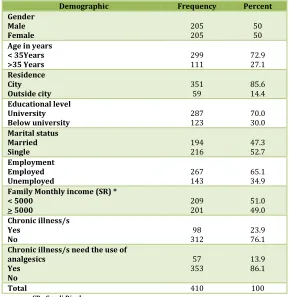
A total of 410 people participated, of them 205 (50%) were males. The majority (85.6%) were town dwellers and attained university level education (70%). Respondents had chronic illness/s 98 (23.9%), of them 57 (58.2%) used analgesics to manage these diseases. Table (1) showed participants' demographics.
Self-medication with analgesics:
More than two thirds (69%) of the participants admitted that they always self-medicate with these agents. Level of education was found to be the most significant predictor of using analgesics without prescription (26.1% university graduates vs. 42.3% educated below university), [2.1 (1.3-3.2), (P = 0.001)].
Sources for obtaining analgesics and sources of information about analgesics:
Nearly half of the interviewees obtained analgesics from community pharmacy outlets. The pharmacists were ranked as top sources of information about these drugs by nearly one third of the interviewees. Table (2) showed sources for obtaining analgesics and sources of information about analgesics.
Attitudes towards the use of analgesics:
Table (3) revealed participants' attitudes towards the use of analgesics. Thirty percent of the participants strongly agree/ agree with the statement "when having pain taking many types of analgesics
Participants' knowledge on paracetamol:
Nearly half of the respondents did not exactly know the frequency of administration of paracetamol to alleviate pain and only < 15% of them knew the maximum dose of paracetamol. Of the participants, 97 (23%) knew that paracetamol in high doses can cause hepatotoxicity. The correct responses to knowledge items on paracetamol as disclosed by the participants were shown in table (4).
Satisfactory knowledge on paracetamol:
The mean knowledge score of the participants on paracetamol was 2.1 + 1.7. Respondents considered with satisfactory knowledge on paracetamol were 96 (23.4%).
Determinants of satisfactory knowledge on paracetamol:
Logistic regression analysis showed that, the only predictor of satisfactory knowledge on paracetamol was the presence of chronic illness. Interviewees suffered from these diseases had more satisfactory knowledge compared to healthy ones (32.7% vs. 20.5%), [1.7 (1.0-2.9), (P = 0.04)]. The result of logistic regression analysis was presented in Table (5).
Knowledge of non-steroidal anti-inflammatory drugs:
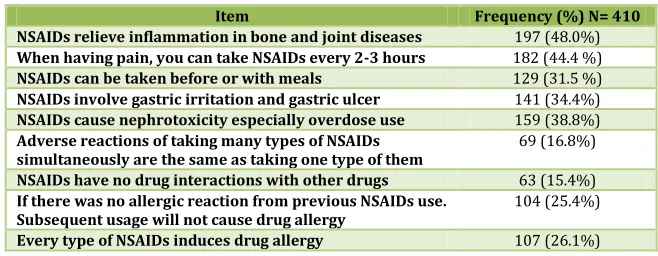
Of all participants 129 (31.5%) use NSAIDs before or with meals and slightly above one third of them agreed with the fact that the use of these agents is associated with gastric irritation or ulceration. Respondents who knew that NSAIDs associated with nephrotoxicity especially in high doses were 159 (38.8). Nearly thirty percent of the participants agreed with the statement " taking many types of analgesics relieves pain symptoms faster". Participants correct responses on NSAIDs use were presented in Table (6).
DISCUSSION
A
nalgesics are among the most commonly used drugs in the world. Public knowledge about the use of analgesic was documented to be suboptimal in multiple studies around the world. The use of analgesics, even at the recommended doses, is associated with risk of serious adverse effects. The current study attempted to measure the knowledge and identify attitudes towards paracetamol and NSAIDs among the public. Although the majority of the participants were highly educated, the study identified several misconceptions in public attitudes and gaps in knowledge regarding both paracetamol and NSAIDs use. The obtained findings are serious given the fact that analgesics are one of the most commonly used medicines in the country[2].
More than two thirds of the interviewees admitted that they always self-medicate with analgesics. Many authors reported high alarming rate of self-medication with analgesics [13-16]. The results
showed that people educated below the university level were twice more to self-medicate with analgesics. This finding is important and it should be considered in the design of future educational interventions aimed to upgrade the less educated knowledge. The content of such interventions should be simple and understandable to this subset of the public.
The results showed that above 50% depend on health professionals (pharmacist and physician) and nearly one quarter of them used the internet as a source of information about analgesics. The internet as a source of health information has become more popular, but the inaccuracy of health information is a big concern [17]. The use of the
internet as a source of information about analgesics among the public was reported in another gulf country with a lower percentage (15%) than what was quoted in the current study [18].
A considerable number of respondents (50%) obtained analgesics from community pharmacy outlets. If community pharmacists are well- trained on patient counseling and community pharmacies have suitable spaces, it can be suitable venues for public health education about these drugs. Such activity was reported by Jang et al [19] who conducted a community pharmacy-based patient education
misconceptions. These misconceptions are serious in term of patient safety, as the use of multiple analgesics bears serious risks. Each individual agent has the potential to interact with other medications, resulting in an increased probability of unwanted adverse reactions in patients using multiple medications [20]. A real-world study showed a
high risk of serious gastrointestinal toxicities such as; perforations, ulcers and bleeding with the use of some over-the -counter NSAIDs and the risk is more with concomitant aspirin use [21]. Wilcox et al [22]
assessed the frequency of using NSAIDs as OTC and the degree of awareness of side effects among the public. They identified that above 40% of the participants consumed a quantity of analgesics more than the recommended dosage.
Overall, the assessment of the participants' knowledge on paracetamol revealed poor knowledge on important aspects related to its use and safety. Poor knowledge on paracetamol was quoted in the literature by Boudjemai et al [23], whereby 25% of the included subjects
thought that a delay between two doses ≤ 3 hours was recommended and 15% thought the maximum daily dose was > 4 g.
The satisfactory knowledge on paracetamol was found to be significantly higher among individuals who suffered from chronic illness/s compared to other participants. Unfortunately, no obvious explanation to justify this difference. However, patients with chronic diseases have good chances to come across health information during their repeated visits to healthcare facilities. In additions, living with chronic disease/s may also make them more vigilant when using medications other than those used for the chronic conditions.
Aspects of poor knowledge on paracetamol in this survey include, unawareness with the content of active ingredient in one tablet and the frequency of administration of the drug. Deficiency in knowledge about toxic doses of analgesics, tendency to cause bleeding and liver damage was reported in the above-mentioned study [8].
Moreover, the participants had a deficiency in two most important safety aspects which are linked together, the maximum daily dose and the association of the drug with hepatotoxicity. Ignoring the maximum number of grams to be taken per day may lead to drug overdose and consequently to liver injury. The development and severity of hepatotoxicity among paracetamol were mainly found to be associated with the amount of the ingested dose [24].
Comparatively, the participants’ knowledge on NSAIDs was low. In the aforementioned study, inappropriate use of these drugs was found to be significantly associated with poor knowledge [12].
Analysis of the items used to assess participants’ knowledge on NSAIDs showed that nearly one third knew the use of these agents is associated with gastric irritation and gastric ulcers. Upper GI complications as a common side effect of NSAIDs can occur with short-term use and the rate of occurrence can increase with chronic use [25]. Likewise, in a similar study Roshi et al [26] identified limited knowledge among users of NSAIDs regarding the upper and lower gastrointestinal toxicity of these drugs. The use of NSAIDs can cause wide varieties of renal complications mainly due to their inhibition of prostaglandins, which regulated vasodilation at the glomerular level [27].
Study limitations:
This study was not without limitation. The study was a cross- sectional, conducted in one area in the country, and recruited the internet users and the majority of them were university graduates. In addition, the survey did not succeed to recruit a considerable number of elderly persons who are considered as high consumers of analgesics compared to younger ones. These facts limit the generalizability of the obtained results. Future studies should consider these limitations to in-depth investigate this topic by recruiting diverse population from different parts of the country.
Table No. 1: Participants Sociodemographic data
Demographic Frequency Percent
Gender Male
Female 205 205 50 50
Age in years < 35Years
>35 Years 299 111 72.9 27.1
Residence City
Outside city 351 59 85.6 14.4
Educational level University
Below university 287 123 70.0 30.0
Marital status Married
Single 194 216 47.3 52.7
Employment Employed
Unemployed 267 143 65.1 34.9
Family Monthly income (SR) * < 5000
> 5000 209 201 51.0 49.0
Chronic illness/s Yes
No 312 98 23.9 76.1
Chronic illness/s need the use of analgesics
Yes No
57
353 13.9 86.1
Total 410 100
Table No. 2: Sources of analgesics and source of Information about analgesics (n= 410)
Sources of Information about analgesics Sources of analgesics
Source Frequency % Source Frequency %
The internet 106 25.9 Community pharmacy 220 53.7
The media 016 3.9 Hospital and primary healthcare settings 90 22
Pharmacist 143 34.9 Left-over 88 21.5
Physician 87 21.2 Others 12 2.9
Others 58 14.1
Table No. 3: Participants attitude towards the use of analgesics
Item Strongly agree/ Agree Neutral Disagree/ Strongly disagree
When having pain, taking many types of
analgesics relieves the symptoms faster 123 (30.0%) 73(17.8%) 214 (52.2%)
When having pain, taking high dose of
analgesics relieves the symptoms sooner 93 (22.7%) 54 (13.2%) 263 (64.1%)
Analgesics prescribed by physicians certainly
cause no allergy 181 (44.1%) 141 (34.4%) 88 (21.5%)
Analgesics given by physicians or pharmacists
with no warning/ precautions are certainly safe 196 (47.8%) 116 (28.3%) 98 (23.9%)
Table No. 4: Correct responses of knowledge items about paracetamol
Item Frequency (%)
Paracetamol relieves fever 255 (62.2%)
One tablet of paracetamol contains 500mg 128 (31.2%)
Paracetmol can be taken every 2-3 h when having pain 194 (47.3%)
The maximum dose of paracetamol is eight tablets a day 56 (13.7%)
Paracetamol does not cause GIT irritation, thus can be taken before meals 74 (18.0%)
High dose of paracetamol usage causes hepatotoxicity 97 (23.7%)
Paracetmol is safe without drug allergy 70 (17.1%)
Table No. 5: Determinants of satisfactory knowledge on paracetamol (N=410)
Covariates % Satisfactory
knowledge n Univariate analysis crude OR (95% CL) ValueP Multivariable analysis adjusted OR (95% CL) ValueP Age group/ year
< 35
> 35 20.7 30.6 299 111 1.7(1.0-2.8) 0.037
Marital status Married
Single 28.4 19.0 194 216 0.6 (0.4-1.0) 0.026
Chronic illness/s Yes
No 32.7 20.5 312 98 1.9 (1.1-3.1) 0.014 1.7 (1.0-2.9) 0.040
Table No. 6: Correct responses of knowledge items about NSAIDs
Item Frequency (%) N= 410
NSAIDs relieve inflammation in bone and joint diseases 197 (48.0%)
When having pain, you can take NSAIDs every 2-3 hours 182 (44.4 %)
NSAIDs can be taken before or with meals 129 (31.5 %)
NSAIDs involve gastric irritation and gastric ulcer 141 (34.4%)
NSAIDs cause nephrotoxicity especially overdose use 159 (38.8%)
Adverse reactions of taking many types of NSAIDs
simultaneously are the same as taking one type of them 69 (16.8%)
NSAIDs have no drug interactions with other drugs 63 (15.4%)
If there was no allergic reaction from previous NSAIDs use.
Subsequent usage will not cause drug allergy 104 (25.4%)
Every type of NSAIDs induces drug allergy 107 (26.1%)
CONCLUSION
T
he study revealed potential gaps in knowledge and misconceptions in attitudes on paracetamol and non-steroidal anti-inflammatory drugs and its use among the recruited people. SubstantialREFERENCES:
1. Allied Market Research. Analgesics market by type (Non-opioids, opioids) and route of administration (oral, intravenous, rectal, transdermal, topical) global analysis and industry forecast, 2015-2022. [cited 2018 Feb 22]. Available from: https://www.alliedmarketresearch.com/analgesics-market. 2. AlKhamees OA, AlNemer KA , Bin Maneea MW, AlSugair FA ,
AlEnizi BH, Alharf AA. Top 10 most used drugs in the Kingdom of Saudi Arabia 2010–2015. Saudi Pharm J 2018; 26:211-216. 3. Chang SH, Mathew TH, McDonald SP. Analgesic nephropathy and
renal replacement therapy in Australia: trends, comorbidities and outcomes. Clin J Am Soc Nephrol 2008;3(3):768-76. 4. McGettigan P, Henry D. Use of non-steroidal anti-inflammatory
drugs that elevate cardiovascular risk: an examination of sales and essential medicines lists in low-, middle-, and high-income countries. PLoS Med 2013 [cited 2018 Feb 22];10;2: [ about 6
p]. Available from:
https://www.ncbi.nlm.nih.gov/pmc/articles/PMC3570554/pdf /pmed.1001388.pdf.
5. Sostres C, Carrera-Lasfuentes P, Lanas A. Non-steroidal anti-inflammatory drug related upper gastrointestinal bleeding: types of drug use and patient profiles in real clinical practice.
Curr Med Res Opin2017;33(10):1815-1820.
6. Aljadhey H, Assiri GA, Mahmoud MA, Al-Aqeel S, Murray M. Self-medication in Central Saudi Arabia. Community pharmacy consumers' perspectives. Saudi Med J 2015;36:328-34. 7. Severin AE, Petitpain N, Scala-Bertola J, Latarche C,
Yelehe-Okouma M, Di Patrizio P, et al. Good use and knowledge of paracetamol (acetaminophen) among self-medicated patients: Prospective study in community pharmacies. Therapie. 2016; 71:287-96.
8. Zamir Q, Nadeem A. Non-steroidal anti-inflammatory drugs vs. Paracetamol: drug availability, patients' preference and knowledge of toxicity. J Ayub Med Coll Abbottabad 2016;28: 746-749.
9. French DP, James DH. Reasons for the use of mild analgesics among English students. Pharm World Sci 2008;30:79-85 .
10. Grézy-Chabardès C, Fournier JP, Dupouy J, Poutrain JC, Oustric S. Patients' Knowledge About Analgesic-Antipyretic Medications Purchased in Community Pharmacies: A Descriptive Study. J Pain Palliat Care Pharmacother 2015;29:334-40.
11. Kingdom of Saudi Arabia. Central Department of Statistics and Information, KSA. Population census 2010. http://www.cdsi.gov.sa/2010-07-3107-0005/cat_view/31-/138—/342—1431-2010/300 (2017). Accessed 2 Apr 2017.12 12. Saengcharoen W, Buasri N, Khantapokha B, Lerkiatbundit S.
Public knowledge and factors associated with inappropriate analgesic use: a survey in Thailand. Int J Pharm Pract 2016;24: 22-9.
13. Ibrahim NK, Alamoudi BM, Baamer WO, Al-Raddadi RM. Self-medication with analgesics among medical students and interns in King Abdulaziz University, Jeddah, Saudi Arabia. Pak J Med Sci
2015;31:14-8
14. Sarahroodi S1, Maleki-Jamshid A, Sawalha AF, Mikaili P, Safaeian L. Pattern of self-medication with analgesics among Iranian
University students in central Iran. J Family Community Med
2012;19:125-9.
15. Kumar N, Kanchan T, Unnikrishnan B, Rekha T, Mithra P, Kulkarni V, et al. Perceptions and practices of self-medication among medical students in coastal South India. PLoS ONE. 2013
[cited 2018 Feb 10];8(8):[about 5 p.]. Available from: http://journals.plos.org/plosone/article?id=10.1371/journal.po ne.0072247
16. Sarganas G1, Buttery AK, Zhuang W, Wolf IK, Grams D, Rosario AS, et al. Prevalence, trends, patterns and associations of analgesic use in Germany. BMC Pharmacol Toxicol 2015[cited 2018 Feb 10];16:28 [about 13 p]. Available from: https://www.ncbi.nlm.nih.gov/pmc/articles/PMC4591581/pdf /40360_2015_Article_28.pdf
17. Cline RJ, Haynes KM. Consumer health information seeking on the Internet: the state of the art. Health Educ Res 2001 ;16:671-92.
18. Al-qallaf MS. Evaluating knowledge of over the counter analgesics among Bahraini people. Asian J Pharm Clin Res 2015; 8:266-270.
19. Jang SM, Cerulli J, Grabe DW, Fox C, Vassalotti JA, Prokopienko AJ, et al. NSAID-avoidance education in community pharmacies for patients at high risk for acute kidney injury, upstate New York, 2011. Prev Chronic Dis. 2014 Dec [2018;18(11): [about 5
p]. Available from:
https://www.ncbi.nlm.nih.gov/pmc/articles/PMC4273546/pdf /PCD-11-E220.pdf
20. Altman RD. A rationale for combining acetaminophen and NSAIDs for mild-to-moderate pain. Clin Exp Rheumatol 2004; 22:110-7.
21. Biskupiak JE1, Brixner DI, Howard K, Oderda GM. Gastrointestinal complications of over-the-counter nonsteroidal antiinflammatory drugs. J Pain Palliat Care Pharmacother 2006; 20:7-14.
22. Wilcox CM, Cryer B, Triadafilopoulos G. Patterns of use and public perception of over-the-counter pain relievers: focus on nonsteroidal anti-inflammatory drugs. J Rheumatol 2005;32: 2218-24.
23. Boudjemai Y, Mbida P, Potinet-Pagliaroli V, Géffard F, Leboucher G, Brazier JL, et al. Patients' knowledge about paracetamol (acetaminophen): a study in a French hospital emergency department. Ann Pharm Fr 2013;71:260-7.
24. Yoon E, Babar A, Choudhary M, Kutner M, Pyrsopoulos N. Acetaminophen-Induced Hepatotoxicity: a Comprehensive Update. J Clin Transl Hepatol 2016;28:131-42.
25. Goldstein JL, Cryer B. Gastrointestinal injury associated with NSAID use: a case study and review of risk factors and preventative strategies. Drug Healthc Patient Saf 2015;22(7): 31-41.
26. Roshi D, Toçi E, Burazeri G1, Schröder-Bäck P, Malaj L, Brand H. Users' Knowledge About Adverse Effects of Non-steroidal Anti-inflammatory Drugs in Tirana, Albania. Mater Sociomed 2017; 29:138-142.
27. Pazhayattil GS, Shirali AC. Drug-induced impairment of renal function. Int J Nephrol Renovasc Dis 2014;12:457-68.
How to cite this article:
Dr. Abuabker Ibrahim Elbur, Shaker Saad. KNOWLEDGE AND ATTITUDES ON PARACETAMOL AND NON-STEROIDAL ANTI-INFLAMMATORY DRUGS: ELECTRONIC SURVEY IN TAIF KINGDOM SAUDI ARABIA. J Sci Res Pharm 2018;7(9):109-113.
DOI: https://doi.org/10.5281/zenodo.1442510
Conflict of interest: The authors have declared that no conflict of interest exists.