International Journal of Advanced Structural Engineering
Experimental Study on Flexural behavior of Metakaolin and Fly ash based
Ferrocement panel
--Manuscript
Draft--Manuscript Number:
Full Title: Experimental Study on Flexural behavior of Metakaolin and Fly ash based Ferrocement panel
Article Type: Original Research
Funding Information:
Abstract: Ferrocement is a form of reinforced concrete differs from conventional reinforced or prestressed concrete primarily by the manner in which the reinforcing elements are dispersed and arranged. It is the composite of ferro(iron) and cement (cement mortar) in which small diameter wire meshes are used uniformly throughout the cross section. This wire meshes are filled in with cement mortar. The mesh made of metallic or other suitable materials. This paper presents an experimental investigation to compare the flexural behavior of partially replaced metakaolin and fly ash based ferrocement panel with control cement mortar panel. The main objective of this study is to investigate different numbers of wire meshes on the flexural strength of the flat ferrocement panels and to compare the effect of varying the number of wire mesh layers in the ferrocement structure under two-point loading. Ferrocement panel of size 940x470mm,40mm thickness has been adopted. panel under two-point loading. In control panel, no meshes have been used. In ferrocement panel, mesh layers of 1,3, and 5 have been tested and their values are compared with control panel. Thus, the flexural strength of varying mesh layers and proportions of material in ferrocement panel has been studied.
Corresponding Author: nivethidhaa s, M.E
Mepco Schlenk Engineering College madurai, india INDIA
Corresponding Author Secondary Information:
Corresponding Author's Institution: Mepco Schlenk Engineering College
Corresponding Author's Secondary Institution:
First Author: nivethidhaa s, M.E
First Author Secondary Information:
Order of Authors: nivethidhaa s, M.E
saranya m, M.E
Order of Authors Secondary Information:
Author Comments: hereby,this is my original research manuscript paper, in which I have did with my own interest and dedication in it. so i kindly request you to accept my research manuscript.
Suggested Reviewers: VENKATESH A, M.E
ASSISTANT PROFESSOR, MEPCO SCHLENK ENGINEERING COLLEGE [email protected]
Performs good in felxural aspects when comparing to normal conventional mortars
HAAMIDH A, M.E
ASSISTANT PROFESSOR, MEPCO SCHLENK ENGINEERING COLLEGE [email protected]
Metakaolin and flyash proportions increases the strength when compared to conventional mixes
preferred material combination is new in construction techniques which gives better strength and flexural results
GSJ: Volume 7, Issue 4, April 2019 ISSN 2320-9186
Experimental Study on Flexural behavior of Metakaolin
and Fly ash based Ferrocement panel
Nivethidhaa S
#1, Saranya M
*2#P. G student & Department of Civil Engineering
*Faculty & Department of Civil Engineering
Mepco Schlenk Engineering College, Sivakasi, Virudhunagar district, Tamilnadu
Abstract
Ferrocement is a form of reinforced concrete differs from conventional reinforced or prestressed concrete primarily by the manner in which the reinforcing elements are dispersed and arranged. It is the composite of ferro(iron) and cement (cement mortar) in which small diameter wire meshes are used uniformly throughout the cross section. This wire meshes are filled in with cement mortar. The mesh made of metallic or other suitable materials. This paper presents an experimental investigation to compare the flexural behavior of partially replaced metakaolin and fly ash based ferrocement panel with control cement mortar panel. The main objective of this study is to investigate different numbers of wire meshes on the flexural strength of the flat ferrocement panels and to compare the effect of varying the number of wire mesh layers in the ferrocement structure under two-point loading. Ferrocement panel of size 940x470mm,40mm thickness has been adopted. panel under two-point loading. In control panel, no meshes have been used. In ferrocement panel, mesh layers of 1,3, and 5 have been tested and their values are compared with control panel. Thus, the flexural strength of varying mesh layers and proportions of material in ferrocement panel has been studied.
Keywords — wire meshes, metakaolin, fly ash, flexural strength, ferrocement, cement mortar.
I. INTRODUCTION
A highly versatile form of reinforced concrete is ferrocement which is made up of wire mesh, sand, water and cement, and possesses unique qualities of strength and serviceability. The difference between ferrocement and reinforced concrete is ferrocement is a thin composite made of cement matrix reinforced with closely spaced small diameter wire meshes instead of larger diameter rods and large size aggregates. The thickness of ferrocement generally ranges from 25-50mm.The least ACI code encourages the use of non-metallic reinforcement and fibres.
The inventors of ferrocement are Frenchmen Joseph Monier who dubbed it “ciment arme” (armored cement) and Joseph Louis Lambot who constructed a batteau with the system in 1848.He constructed a ferrocement rowing boat in 1848, in which reinforcement was in the form of flexible woven wire mat and small size bars. Italian person, Pier Luigi Nervi was noted in the first half of the twentieth century for his use of ferro-cement, in Italian called ferro-cemento.
Ferrocement is defined in different ways by different organisations:
1)According to United Nations High Commissioner for refugees (UNHCR),
Ferrocement is defined as ‘A thin walled construction, consisting of rich cement mortar with uniformly distributed, closely spaced layers of continuous and relatively small diameter mesh (metallic or other suitable material).
2) ACI committee-549 describes it - “Ferrocement is a form of reinforced concrete using closely spaced multiple layers of mesh and/or small diameter rods completely infiltrated with, or encapsulated, in mortar. The most common reinforcement is steel mesh”
With ferrocement it is possible to fabricate a variety of structural elements, may be used in foundations, walls, floors, roofs, shells, etc which are thin walled light weight, durable with have high degree of impermeability. It combines the properties of thin sections and high strength of steel. In addition, it needs no formwork or shuttering for casting. Ferrocement have applications in all fields of civil construction, including water and soil retaining structures, building components, space structures of large size, bridges, domes, dams, oats, conduits, bunkers, silos, treatment plants for water and sewage.
In recent trends, there has been growing interest in a material produced from kaolinite clay called metakaolin. The usage of metakaolin as a cement substitute can reduce up to 127kg of CO2 per tonne of cement produced. Therefore, metakaolin as a cement replacement is an environmentally friendly option. Fly ash is one of the residues from thermal power plant, which when partially replaced with cement can be used as a construction material. Cement being a large-scale producer of CO2 is been partially replaced with fly ash in the proposed system.
Click here to view linked ReferencesISSN 2320-9186
II. LITERATURE REVIEW
Ferrocement panels exhibit a high value of elasticity and excellent crack resistance. Rate of flexural tensile strength development in metakaolin ferrocement is higher than the control ferrocement at all reinforcement levels. The ferrocement jacket was found to be a satisfactory solution for fire protection due to its post-fire flexural strength and toughness compared with plain mortar or concrete cover. Increases in the number of mesh layers enhance the flexural strength of the ferrocement for all metakaolin percentages and for all curing ages. The crack width of the lateral face of the ferrocement panels significantly decreased as the number of wire mesh increased.
III.RESEARCH SIGNIFICANCE
Ferrocement technique makes the structure light weight. The aim of this study is to compare the conventional panel with partially replaced metakaolin and fly ash based ferrocement panel by experimental investigation under two-point loading. The conventional panel refers to the ordinary cement mortar panel. The welded steel wire mesh inside the ferrocement panel provides better flexural strength than the conventional one. The properties of metakaolin and fly ash makes the flexural strength greater. Under two-point loading, the panel has been tested experimentally for flexural strength results.
IV.MATERIALSUSED
A. Cement
The cement used in all mixture was commercially available Ordinary Portland Cement (OPC) of 53 graded confirmed to IS 12269-1987 [2]. The initial and final setting times were found as 32 & 130 minutes respectively. Specific gravity of cement is 3.164.
B. Fine aggregate
Locally available Natural River sand of size below 4.75 mm conforming to Zone II of IS 383-1970 is used as fine aggregate [4]. Specific
gravity of fine aggregate is 2.63.
C. Wire mesh as Reinforcement
Reinforcement for ferrocement is commonly in the form of layers of continuous mesh fabricated from single strand filaments.
D. Metakaolin
Use of ferrocement coupled with metakaolin replacement could be a prudent idea for the benefit of reducing use of cement in ferrocement applications. Inclusion of metakaolin in ferrocement matrix influences properties of the mortar. Since the matrix represents approximately 95% of the
ferrocement volume, its properties have a significant influence on the final properties of the product.
Table 1. Metakaolin property Metakaolin Property Specific gravity 260
Bulk density 0.3 to 0.4 Physical form Powder
Colour white
E. Fly ash
One of the practical solutions to economise cement is to replace cement with supplementary cementitious materials like fly ash (Shetty 2005). Fly ash blended concrete can improve the workability of concrete compared to OPC. Fly ash replacement of cement is effective for improving the resistance of concrete to sulphate attack expansion.
V.MATERIAL PROPERTIES
Table 2. Chemical composition of Metakaolin, Fly ash and Cement
Chemical composition
(%)
Cement Metakaolin Fly ash
Silica (Sio2) 21.8 50.7 65.43
Alumina (Al203)
6.6 45.8 20.67
Ferric oxide (Fe2O3)
4.1 0.35 NIL
Calcium oxide (CaO)
60.1 0.39 1.26
Magnesium oxide (MgO)
2.1 0.08 NIL
Sodium oxide (Na2O)
0.4 0.58 NIL
Potassium oxide (K2O)
0.4 0.05 NIL
Sulphuric anhydride
(SO3)
2.2 NIL NIL
Titanium oxide (TiO2)
NIL 1.25 NIL
Loss on ignition (LOI)
2.4 0.86 NIL
Table 3. Material description
GSJ: Volume 7, Issue 4, April 2019 ISSN 2320-9186
Material Properties Characteristics value
Cement Specific gravity 3.12 Type Ordinary Portland cement (OPC) Fine aggregate Specific gravity 2.56 Fineness modulus 2.51
Size Passing through 4.75mm sieve Mix
proportion for mortar
1:3
Table 4. Mechanical properties of wire mesh Material Properties Characteristics
value
Wire mesh
Size 2mm
diameter,12.5mm x 12.5mm square
opening Yield
strength
390 N/m𝑚2
Youngs modulus
2.1x10⁵ N/𝑚𝑚2
Poisson’s ratio
0.2
Density 7850 kg/𝑚3
VI.EXPERIMENTAL WORK
In order to investigate flexural strength properties of metakaolin and fly ash ferrocements, six mixes were employed to study the effect of metakaolin and fly ash replacement: namely, a reference mix:
(i) with no metakaolin and fly ash mixes (ii) with metakaolin and fly ash as cement
replacement of 5%, 10%,15%, 20% and 25%.
To analyse the strength of each mortar mix, specimens like cubes were casted and tested for compression, and flexure respectively after 28 days of curing. The mix satisfying the strength requirement in all the three aspects was used in casting panels.
Mortar mix design
One of the ultimate aims of studying the various properties of the materials of mortar, is to design a mortar mix for a particular strength and durability. The design of mortar mix is not a simple task on account of the widely varying properties of the constituent materials, the conditions that prevail at the site of work, in particular the exposure condition, and the conditions that are demanded for a particular work for which the mix is designed. Mix
design can be defined as the process of selecting suitable ingredients of concrete and determining their relative proportions with the object of producing concrete of certain minimum strength and durability as economically as possible. The purpose of designing as can be seen is to achieve the stipulated strength and durability.
Mortar mix ratio is 1:3
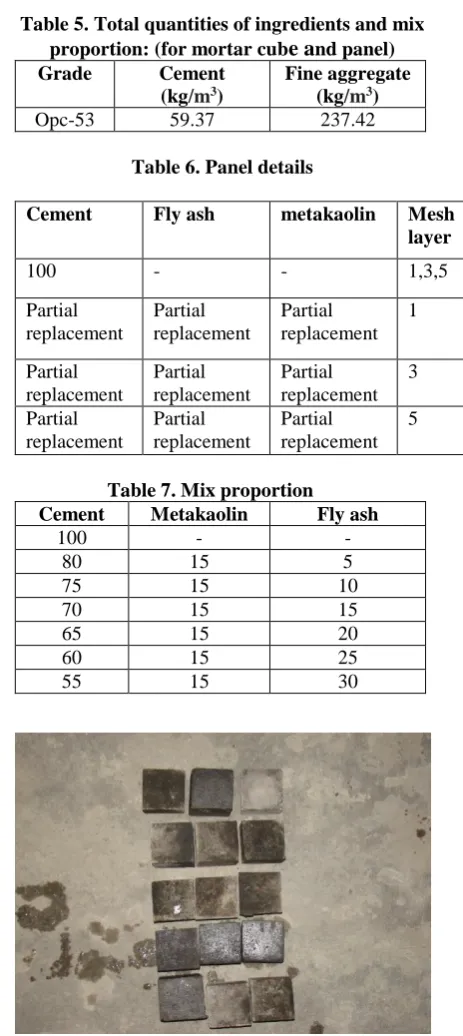
Table 5. Total quantities of ingredients and mix proportion: (for mortar cub
e a
nd panel) Grade Cement(kg/m3)
Fine aggregate (kg/m3)
Opc-53 59.37 237.42
Table 6. Panel details
Cement Fly ash metakaolin Mesh layer
100 - - 1,3,5
Partial replacement Partial replacement Partial replacement 1 Partial replacement Partial replacement Partial replacement 3 Partial replacement Partial replacement Partial replacement 5
Table 7. Mix proportion
Cement Metakaolin Fly ash
100 - -
80 15 5
75 15 10
70 15 15
65 15 20
60 15 25
55 15 30
Fig 1. Cube casting
Fig 2. Square mesh
Casting of panels
Based on the results of compression tests, the best mix proportion is chosen. Then the panels were casted with better proportions for replacement of cement with metakaolin and fly ash using steel square mesh separately. For comparison, a control panel without mesh is casted with which the panel with mesh can be compared.
Fig 3. Casting of Ferrocement panel
The panels have been casted from base 5mm cover with mortar then meshes has been laid and covering them by remaining mortar mix.
Panel specifications
Wooden panel moulds of sizes 940mm×470mm and 40mm thick were used for casting panels. A clear cover of 5mm was maintained at the bottom(tension) and top (compression) sides. This panel size was recommended after a thorough study of ferrocement documents. From the compressive results of cube, the appropriate mix proportions were taken into consideration for casting the panels.
Fig 4. Ferrocement panel
VII. TESTS AND RESULTS
A. Compression test
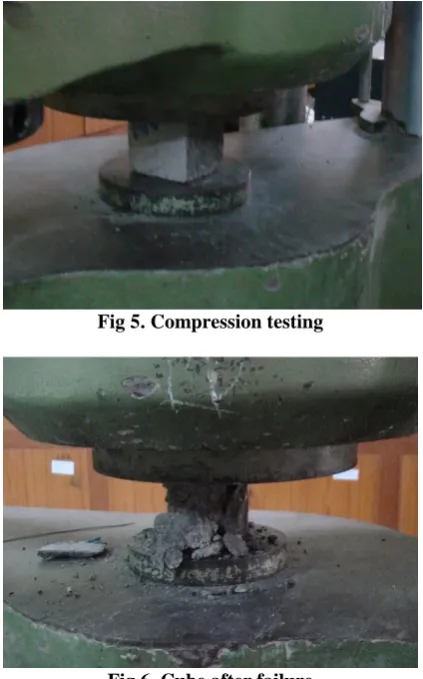
The compression test on cubes was conducted on specimen of each of size 70mm×70mm×70 mm was casted and cured. The test was done on 7th, 14th, 28th day in the compression testing machine. Compressive strength is measured in N/mm2.
Fig 5. Compression testing
Fig 6. Cube after failure
GSJ: Volume 7, Issue 4, April 2019
ISSN 2320-9186
B. Two-point loading test
The panels are tested under two-point loading testing machine with two dial gauges at L/3 distance. The specimens were tested up to failure. Ultimate flexural strength was obtained using the following equation based on theory of simple bending.
𝑓𝑐𝑢=𝐛𝒅𝑤𝑙𝟐
where 𝑓𝑐𝑢 is ultimate flexural moment, w is load at failure in N, l is effective span in mm, b is the width of the specimen in mm, d is effective depth of the specimen in mm.
Fig 7. Demoulded Ferrocement panel
Fig 8. Ferrocement Panel setup
VII. RESULTS AND DISCUSSIONS
The best proportion for mortar mix is taken by testing the cubes under compression testing machine. Compression test machines are specially designed to evaluate static compressive strength characteristics of materials, products and components. The aim of compression test is to determine the behaviour or response of a material by experiencing a compressive load by measuring strain, stress, and deformation.
The compression testing machine weighing upto 1000 KN. For mortar cubes the loads are given at 94.7 KN, 120.3 KN, 125.10KN, 76.26 KN, 65.79KN respectively. The mix proportion which
resists maximum load is taken for casting panel. With replacement of cement with 15% metakaolin and 10% fly ash, various panels have been casted. The ferrocement panels are used as a precast element or cast in site depending on the need. The handling of the ferrocement panels are simple and don’t require heavy machineries for erection
Effect of metakaolin and fly ash percentage
The effect of varying metakaolin and fly ash percentages on flexural strength of ferrocement at ultimate load is studied for different curing periods. It can be observed that, for all curing ages, the strength was either equal to or higher than the control ferrocement up to 15% replacement. The highest strength was observed in 15% replacement of metakaolin and 10% replacement of fly ash which is higher than control ferrocement at 7,14 and 28 days of curing. Metakaolin percentage of 20 and 25 resulted in lower strengths than the control mortar at all curing ages. From this observation, it can be stated that it is possible to obtain higher flexural strength than control mortar for up to 15% replacement of metakaolin, 10% replacement of fly ash and further increase causes decrease in the strength. It can also be observed that for 0.5 water to cementitious ratio, 15% replacement results in the highest strength and can be noted as the optimum metakaolin percentage. The influence of metakaolin and fly ash percentage on flexural strength of ferrocement panel is higher than control mortar up to 15% and 10% replacements.
Fig 9. Compressive strength
Table 8. Flexural strength test data for different metakaolin percentages, different curing ages
and different mesh layers
No. of mesh layers
Curing days
Ultimate flexural strength, MPa
0 28 2.5
1 28 9.1
3 28 17.6
5 28 25.2
18.9
24.2 25.1
21.3
28.1
7
32.0
5
25
35 39
A B C
CO
MPR
ES
SIV
E
ST
R
EG
TH
NO OF DAYS
7 days 14 days 28 days
VIII.CONCLUSION
From the results it is concluded that, the flexural results show better result in 5mesh panel with replacement of 10% fly ash and 15% metakaolin than the conventional one. The flexural strength of the ferrocement panel has been studied by casting mortar cubes followed by panel casting. The casted panels are tested under two-point loading by increasing the mesh layers and varying the percentage of metakaolin and fly ash. The results obtained from the above has been compared with 1,3 and 5 layers of meshes.Ferrocement uses layers of continuous/small diameter steel wire/weld mesh netting (metallic or non-metallic) as reinforcement with high volume fraction of reinforcement (2 to 8%) with specific surface of reinforcement is higher for ferrocement than for RCC.
REFERENCE
1.S. Jeeva Chidambaram, Sanjay Kumar, “Flexural behavior of bamboo based ferrocement slab panels with fly ash”, Construction and Building Materials-Elsevier (2017),
2.Amarnath Yerramala, C. Ramachandurdu, “Flexural strength of metakaolin ferrocement”, Composites – Elsevier, (2017),
3.S. Jaganathan, P. Sudharsanamurthy, “An Experimental Study of Geogrid in Ferrocement Panels”- Construction and Building Materials, Elsevier, (2017),
4.Sayed esmaeil Moussavi, “Flexural response and crack development properties of ferrocement panels reinforced with steel fibers”, Journal of Building Engineering-Elsevier, (2017),
5.N. Ganesan, P.V. Indira, “Effect of ferrocement infill on the strength and behavior of RCC frame under reverse cyclic loading”, Engineering Structures-Elsevier, (2017),
6.Vatwong Greepala, Pichai Nimityongskul, “Structural integrity of ferrocement panels exposed to fire”, Cement & Concrete Composites-Elsevier (2016),
7.Waleed A. Thanoon, Yavuz Yardim, “Structural behaviour of ferrocement–brick composite floor slab panel”, Construction and Building Materials, Elsevier (2016),
8.K. Vetri Aadithiya, Dr. P. Chandrasekaran, “Review paper on usage of ferrocement panels in lightweight sandwich concrete slabs”, Construction and Building Materials, Elsevier (2015),
9.Sakthivel P.B, et.al, “Ferrocement Construction Technology and its Application”, Cement & Concrete Composites-Elsevier (2015),
10.M. A. Saleem, et.al, “Low Cost Earthquake Resistant Ferrocement Small House” Cement & Concrete Composites-Elsevier (2015).
11.Md. Zakaria Hossain, et.al, “Flexural Behaviour of Cement Composites Panels Reinforced with
Different Types of Meshes”, Cement & Concrete Composites-Elsevier (2015),
12.Hassan M.H. Ibrahim, “Shear capacity of ferrocement plates in flexure”, Engineering Structures- Elsevier (2015),
13.R. Alavez-Ramirez, et.al, “Thermal conductivity of coconut fibre filled ferrocement sandwich panels”, Construction and Building Materials-Elsevier (2015),
14.P. Paramasivam, et.al, “Strengthening of RC Beams with Ferrocement Laminates”, Cement and Concrete Composites-Elsevier (2015),
15.A.W. Hago, et.al, “Ultimate and service behavior of ferrocement roof slab panels”, Construction and Building materials, Elsevier (2015),
16.Sridevi Kumarasamy, et.al, “Experimental and numerical analysis of ferrocement RC composite”, composite structures – Elsevier (2015),
17.Hamid Eskandari, Amirhossein Madadi, “Investigation of ferrocement channels using experimental and finite element analysis”, Engineering Science and Technology, an International Journal-Elsevier (2015),
18.V.K. Sahgal, S.K. Madan, “Behaviour of bamboo and eucalyptus basedferrocement slabs.” Proc. of Int. Symposium on Innovative World of Concrete (2012),
19.Kumar Sanjay, M.M. Prasad, “Behaviour of bamboo based ferrocement slabs for low cost housing,” Proc., International Conference on CONCRETE: Construction’s sustainable Option, Concrete Technology Unit, University of Dundee DD14HN, U.K., 2008.
GSJ: Volume 7, Issue 4, April 2019 ISSN 2320-9186