Jyothsna M, et al. J Sci Res Pharm, 2019;8(5):48-53 World Inventia Publishers
J
ournal of
S
cientific
R
esearch in
P
harmacy
http://www.jsrponline.com/Vol. 8, Issue 5, 2019 ISSN: 2277-9469 USA CODEN: JSRPCJ
Research Article
A STABILITY INDICATING METHOD DEVELOPMENT AND VALIDATION OF CLOZAPINE BY UV SPECTROSCOPIC METHOD IN BULK AND TABLET DOSAGE FORM
Jyothsna Modugula 1 *, Dr. Manohar Babu. S 2, Manohar reddy. J 1 and Sushma R 1
1 Department of Pharmaceutical Analysis, SIMS College of Pharmacy, Mangaldas nagar-522001, Guntur, Andhra Pradesh, INDIA. 2 Department of Pharmacology, SIMS College of Pharmacy, Mangaldas nagar-522001, Guntur, Andhra Pradesh, INDIA.
Received on: 13-03-2019; Revised and Accepted on: 04-05-2019
ABSTRACT
Objective: To develop a stability indicating method development and validation of Clozapine by UV spectroscopic method in bulk and
tablet dosage form and validate a simple, precise and cost-effective UV spectrophotometric method for the estimation of Clozapine according to the ICH Q2 (R1) guideline.
Methods: standard Clozapine solution was scanned over UV-Visible range for its wavelength of maximum absorbance. Various
calibration standards of Clozapine were prepared and absorbance was recorded at wavelength of maximum absorbance. Calibration curve of concentration vs. absorbance was plotted and linearity and range was calculated. Various analytical method validation parameters viz. accuracy, precision, LOD, LOQ, robustness and ruggedness were calculated.
Results: The maximum wavelength of Clozapine was found to be 213 nm. The correlation coefficient over the concentration range of
10-50µg/mL was found to be 0.9997. Developed UV method was found to be precise during the intra-day and inter-day study and shows %RSD in the range of 0.94 & 1.10 respectively. The total percentage recovery of Clozapine was found to be 99.57 -100.73%. Developed method was found to be robust and rugged for the intended use. Clozapine content of marketed formulation was successfully calculated using developed UV method.
Conclusion: A simple, precise and cost-effective UV spectrometry method for the estimation of Clozapine was developed and validated.
This UV method can be efficiently used for the estimation of Clozapine in bulk as well as formulation.
KEYWORDS: Clozapine, UV Spectroscopy, ICH guidelines.
INTRODUCTION
C
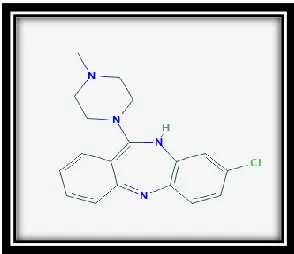
lozapine isa tricyclic dibenzodiazepine, classified asan atypical antipsychotic agent. It binds several types of central nervous system receptors, and displays a unique pharmacological profile. Clozapine is a serotonin antagonist, with strong binding to 5-HT 2A/2C receptor subtype. It also displays strong affinity to several dopaminergic receptors, but shows only weak antagonism at the dopamine D2 receptor, a
receptor commonly thought to modulate neuroleptic activity
[1-3]. Agranulocytosis is a major adverse effect associated with
administration of this agent. Clozapine is a selective
monoaminergic antagonist with high affinity for the serotonin
* Corresponding author: Jyothsna Modugula
Department of Pharmaceutical Analysis,
SIMS College of Pharmacy, Mangaldas nagar-522001, Guntur, Andhra Pradesh, INDIA.
* E-Mail: [email protected]
DOI:https://doi.org/10.5281/zenodo.2677994
Type 2 (5HT2), dopamine Type 2 (D2), 1 and 2 adrenergic, and
H1 histaminergic receptors. Clozapine acts as an antagonist at other receptors, but with lower potency. Antagonism at
receptors other than dopamine and 5HT2 with similar receptor
affinities may explain some of the other therapeutic and side effects of Clozapine. Clozapine's antagonism of muscarinic M1-5 receptors may explain its anticholinergic effects.
The USP official method for the estimation of clozapine from tablets is by HPLC using C8column. Various methods have been reported for estimation of clozapine in biological matrices such as plasma. Clozapine having a strong chromophore shows UV absorption and hence most of these methods include the use
of HPLC with UV detector [4-7]. Spectrophotometric methods
have also been developed for estimation of clozapine in samples
of greater purity [8, 9]. Stability indicating methods have also
been reported for its in vitro determination in gastric and intestinal fluid sand pharmaceutical formulations 9. Most of the reported HPLC methods use the C 8 column. However, in small-scale industries, educational institutions or moderate budget analytical sections, it may be difficult to have dedicated columns for analysis. In such cases a C18 column is mostly preferred since most drugs have a considerable lipophilicity and can be
analyzed using this column [10]. The purpose of this work was to
develop a reproducible, robust and sensitive method for the determination of clozapine from tablets using UV Spectroscopic method.
MATERIALS AND METHODS
Instruments Used:
A double beam UV-visible spectrometer (T60 Spectrophotometry) with UV –Win5 software was used for the analysis. Quartz cells having 3 cm length with 1 cm path length were used for spectral measurement.
Chemicals Used: Clozapine API was obtained from local market, Ethanol (AR grade), 0.1N NaOH (Merck), 0.1N HCL (Merck).
Preparation of solutions: [11-19]
Selection of Solvent: Ethanol
Clozapine is rapidly soluble in ethanol. So ethanol and distilled water (50:50) was selected as a solvent.
Preparation of standard stock solution:
Accurately weighed 20 mg of Clozapine was transferred into the calibrated volumetric flask and dissolved in 20 ml mixture of Ethanol and water (50:50v/v) to achieve a stock solution of 1000 µg/mL (Stock-I). Stock- I solution was further diluted to get a concentration of solution of 50µg/mL (Stock-II).
Determination of wavelength of maximum absorbance (λmax):
Stock-II solution was scanned using full scan mode with medium scanning speed for the entire range of UV and visible i.e. 800 to 200 nm. After obtaining the spectrum, λmax was observed as 213nm.
Preparation of sample solution:
10 tablets were weighed accurately and powdered. The powdered sample equivalent to 50 mg Clozapine was accurately weighed and transferred in to a 50 mL standard flask and make up to volume with diluent and sonicated the sample for 10 min. further dilute 5ml of this solution to 100ml with diluent.
Method Validation: [20-23]
“Validation of an analytical method is the process by which it is established by laboratory studies, that the performance characteristics of the method meet the requirements for the intended analytical application”.
Developed UV method for the estimation of Budesonide was validated as per the ICH guidelines. Different parameters like linearity and range, accuracy, precision, robustness, ruggedness, limit of detection (LOD) and limit of quantitation (LOQ) were calculated using predefined calibration
standards or quality control standards as described below [9, 10].
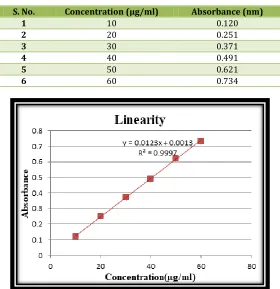
Linearity: Linearity of the proposed UV method was established using six different calibration standards. After analysis of calibration standards, calibration curves in terms of absorbance Vs concentration plots were developed and subjected to linear
least square regression analysis. R2 value was considered to be
important factor for establishing linearity of the proposed UV method.
Preparation of calibration curve: Calibration curve was prepared by diluting the stock-II solution to achieve the six different calibration standards representing 10, 20, 30, 40 and 50µg/mL strength. Absorbance of each calibration standard was measured. The calibration curve representing concentration vs. absorbance was plotted.
Accuracy: “Accuracy is a measure of the closeness of test results obtained by a method to the true value”. Accuracy indicates the deviation between the mean value found and the true value. It is determined by applying the method to samples to which known amounts of analyte have been added. These should be analyzed against standard and blank solutions to ensure that no interference exists. The accuracy is then calculated from the test results as a percentage of the analyte recovered by the assay.
The accuracy of the proposed UV method was evaluated using recovery studies after standard addition of analyte of interest. Three different solutions of Clozapine were prepared with 80%, 100% and 120% and the accuracy was calculated on the basis of percentage recovery.
Precision: The method precision of an analytical method is the degree of agreement among individual test results obtained when the method is applied to multiple sampling of a homogenous sample in different days. The method precision is expressed by,
%RSD = SD x 100 Mean
The precision of the proposed UV method was established by performing intra- and inter-day Clozapine solution (n=5 for each concentration) were analyzed for Intraday and interday precisions. Deviation in the results was calculated in terms of % relative standard deviation (% RSD).
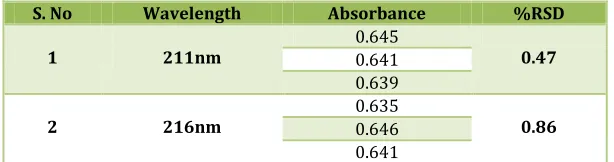
Robustness: Robustness of the developed UV method was established using different wavelengths. Samples (n=5) were analyzed at 211 nm and 215nm. The results were calculated in terms of % RSD.
Ruggedness: Ruggedness study of the method was carried out by analysing triplicate samples of Clozapine solution (60µg/mL) using two different instruments. Results were expressed in terms of % RSD.
Limit of Quantitation (LOQ): The LOQ of the developed UV method was calculated by using following formula LOQ= 10×SD/S Where, SD= Standard deviation of Y-intercepts S= Slope
RESULTS AND DISCUSSION
Selection of wavelength:
The spectra of Clozapine was scanned using full scan mode with medium scanning speed for the entire range of UV and visible i.e. 800 to 200 nm. After obtaining the spectrum,
λmax was observed as 213nm.
Fig. 2: UV Spectrum of Clozapine
Precision:
The precision of proposed method was determined by Intra-day and Inter-day precision, and it was expressed in terms
of percentage relative standarddeviation (%RSD), for Inter-day
and Intra-day were found in the range of 0.94 and 1.10 respectively (Table 1 & 2).
Accuracy:
The accuracy was determined in triplicate by analysing % recovery of Clozapine by standard addition method. The percentage recovery obtained indicates non-interference from the excipients used in this formulation.
From the above solution prepared the three concentrations of samples containing 80, 100, 120 % of Clozapine and absorbance was measured (Table 3).
Linearity:
This is the method's ability to obtain results which are either directly or after mathematical transformation proportional to the concentration of an analyte within a given range.
Preparation of standard solutions:
Standard stock solution-II of Clozapine was diluted to get a solution containing 10, 20, 30, 40 and 50µg/mL and absorbance was recorded. The calibration was done by external standard calibration method. Linearity was observed between the selected concentrations. Calibration graph was obtained by absorbance versus concentration (Table 4 & Fig. 3).
Robustness:
Robustness is the degree of reproducible results obtained by the analysis of the sample under different test conditions by varying wavelengths (Table 5).
Ruggedness:
Ruggedness is a measure of reproducibility of test results under normal, expected operational conditions from laboratory to laboratory and from analyst to analyst (Table 6).
Specificity:
Forced degradation studies were performed to provide an indication of the stability indicating properties and specificity of the method. The degradation samples were prepared by transferring from standard stock solution-II into 10 mL volumetric flasks to get the concentration (50µg/ml). Degradation was attempted using heat (30 min), acid (0.1N HCL) and base (0.1N NaOH). After the degradation treatments were completed, the samples were allowed to equilibrate to room temperature and prepared according to precision preparation. The samples were analysed against a freshly prepared standard sample (with no degradation treatment). Degradation absorbance was observed (Table 7, 8 & 9).
Bench top Stability:
Table No. 1: Result for Intraday Precision
S. No. Absorbance (nm) % RSD
1 0.628
0.94
2 0.613
3 0.615
4 0.613
5 0.618
6 0.621
Table No. 2: Result for Interday Precision
S. No. Absorbance (nm) % RSD
1 0.646
1.10
2 0.652
3 0.640
4 0.649
5 0.637
6 0.634
Table No. 3: Result for Accuracy
S. No. Concentration (%) Original level (µg/ml) Amount added (µg/ml) % Recovery Mean % Recovery %RSD
1 80 40 40.15 100.38
99.57 0.72
2 80 40 39.86 99.65
3 80 40 39.90 99.75
4 100 50 50.88 101.76
100.73 0.88
5 100 50 50.12 100.24
6 100 50 50.01 100.20
7 120 60 60.12 100.20
99.97 0.32
8 120 60 59.76 99.60
9 120 60 60.06 100.10
Table No. 4: Results for Linearity
S. No. Concentration (µg/ml) Absorbance (nm)
1 10 0.120
2 20 0.251
3 30 0.371
4 40 0.491
5 50 0.621
6 60 0.734
Table No. 5: Results for Robustness
S. No Wavelength Absorbance %RSD
1 211nm 0.6450.641 0.47
0.639
2 216nm 0.6350.646 0.86
0.641
Table No. 6: Result for Ruggedness
S. No. Analyst-1 Analyst-2 % RSD System-1 System-2 % RSD
1 0.628 0.621
0.70
0.628 0.622
0.86
2 0.613 0.612 0.613 0.624
3 0.615 0.610 0.615 0.612
4 0.613 0.614 0.613 0.614
5 0.618 0.610 0.618 0.611
6 0.621 0.610 0.621 0.617
Table No. 7: Result for Specificity (Acid Degradation)
S. No. Absorbance (nm)
1 0.667
2 0.646
Table No. 8: Result for Specificity (Alkali Degradation)
S. No. Absorbance (nm)
1 0.635
2 0.655
Table No. 9: Result for Specificity (Thermal Degradation)
S. No. Absorbance (nm)
1 0.671
2 0.646
Table No. 10: Result for Bench Top Stability
S. No Day-1 Day-5 Day-15 Day-20 Day-25 Day-30
1 0.621 0.650 0.642 0.638 0.628 0.623
2 0.632 0.614 0.679 0.667 0.649 0.637
From the above Results it was stated that the Clozapine Standard solution was Stable for 30 days on Bench top.
Table No. 11: Summary of Validation parameters
Parameters Results
λmax (nm) 213nm
Linearity range (μg/ml) 10-50
Regression equation y = 0.0123x+0.0013
Correlation coefficient (r2) 0.9997
Inter-day precision (%RSD) 0.94
Intra-day precision (%RSD) 1.10
LOD (μg/ml) 0.28
LOQ (μg/ml) 0.86
Ruggedness (%RSD) 0.70 &0.86
Robustness (% RSD) 0.47 &0.86
Accuracy (%) 99.57 -100.73
Assay (%) 100.30
SUMMARY AND CONCLUSION
I
n the present investigation, a simple, sensitive,precise and accurate UV method was developed for the quantitative estimation of Clozapine in bulk and Pharmaceutical dosage forms.
The advantage of the developed method lies in the simplicity of the solution preparation, accurate and less number of reagents was used. And all the validation parameters were within the limits.
It can be concluded that the proposed method can be used for the routine analysis for the stability indicating UV method development and validation for the estimation of Clozapine in bulk and Pharmaceutical dosage forms.
REFERENCES:
1. Barnes TR. Schizophrenia Consensus Group of British
Association for Psychopharmacology. Evidence-based guidelines for the pharmacological treatment of schizophrenia: recommendations from the British
Association for Psychopharmacology. J
Psychopharmacol 2011;25:567–620.
2. Gautam S, Meena PS. Drug-emergent metabolic
syndrome in patients with schizophrenia receiving atypical (second-generation) antipsychotics. Ind J
Psychia 2011;53:128-133.
3. Atkinson JM, Douglas-Hall P, Fischetti C, Sparshatt A,
Taylor DM. Outcome following clozapine discontinuation:
a retrospective analysis. J Clin Psychia 2007b;68(7):
1027-1030.
4. Hariharan L, Hariharan M, Naickar JS. and Tandon R.
Determination of cloapine and its two major metabolites in human serum by liquid chromatography using ultraviolet detection. J Liq Chromatogr Rel Technol
1996;19(09):24-17.
5. Akerman KA. Analysis of clozapine and norclozapine by
high performance liquid chromatography. J Chromatogr
B 1997;696:253-259.
6. Ma R, Lau CE. Determination of clozapine and its
metabolite, N-desmethylclozapine in serum
microsamples by high-performance liquid
chromatography and its application to pharmacokinetics
in rats. J Chromatogr B 1998;712: 193-198.
7. Liu YY, Van Troostwijk LJ and Gucheloar HJ.
Simultaneous determination of clozapine, norclozapine and clozapine N Oxide in human plasma by high performance liquid chromatography with ultraviolet
detection, Biomed chromatography. 2001
;15(4):280-286.
8. Raggo MA, Pucci V, Bugamelli F and Volterra V.
Comparison of three analytical methods for quality
control of clozapine tablets. JAOAC Int 2001;84(2):
361-367.
9. Kuchekar BS, Gavhane YN, Gaikwad NB. and Thakkar SV.
Spectrophotometric estimation of clozapine in tablets.
Ind J Pharm Educ Res 2006;40(3):203-204.
10. Hasan Nagiba Y, Elkawy Mohamed A, Elzeany Badr E and
Wagieh Nou E. Stability Indicating method for the determination of clozapine. J Pharm & Biomed Anal.
2002;30:35-47.
11. Kaur H, Bassi P, Monif T, Khuroo A, Kaur G. Development
and validation of high performance liquid
chromatographic method for analysis of clozapine. Pak J
Pharm Sci 2013;26:465-72.
12. Uma A Patil, Bijaya Ghosh. Reverse phase liquid
chromatographic method for the estimation of clozapine
from tablet dosage forms. Int J PharmTech Res 2009;1:
733-6.
13. Chokchai Wongsinsup, Wandee Taesotikul, Sayam
Kaewvichit, Siriluk Sangsrijan, Saowarunee Sangsrijan. Determination of clozapine in human plasma by high– performance liquid chromatography with UV–VIS
detector. CMU J Nat Sci 2010;9:29-37.
14. Emrah Dural, Gorkem Mergen, Tulin Soylemezoglu.
Optimization and validation of an HPLC-UV method for analysis of clozapine and its major metabolites in human
plasma. Turk J Pharm Sci 2015;12:177-86.
15. Trivikram Rawat, IP Pandey. Forced degradation studies
for drug substances and drug products-scientific and
regulatory considerations. Int J Pharm Sci Res 2015;7:
238-41.
16. MS Charde. Jitendra Kumar AS, Welankiwar R, D.
Chakole. Development of forced degradation studies of
drugs. Int J Adv Pharm 2013;2:159-65.
17. VG. Prasanth, Sussana Cicy Eapan, Sheeja Velayudhan
Kutti and Jyothi TS. Development and validation of clozapinein pure and pharmaceutical formulationsby
UV-spectrophotometric method. Der Phamacia Sinica 2011;
2(6):52-58.
18. Reynolds E., Martindale The Extra Pharmacopoeia, The
pharmaceutical press, London, 1999, 657.3.
19. Center for Drug Evaluation and Research (CDER).
Reviewer Guidance. Validation of Chromatographic
Methods. 1994;2-4, 7-16.
20. Chung Chow Chang, Y.C. Lee, Herman Lam and Xue-ming
Zhang. Analytical Method Validation and Instrument
Performance Verification. Wiley Int Sci 2004;75-79.
21. ICH, Q2B, Validation of Analytical Procedures:
Methodology. International Conference on
Harmonization, Geneva, November, 1996;1-10.
How to cite this article:
Jyothsna M, et al. A STABILITY INDICATING METHOD DEVELOPMENT AND VALIDATION OF CLOZAPINE BY UV SPECTROSCOPIC METHOD IN BULK AND TABLET DOSAGE FORM. J Sci Res Pharm 2019;8(5):48-53.
DOI:https://doi.org/10.5281/zenodo.2677994
Conflict of interest: The authors have declared that no conflict of interest exists.