WWJMRD 2016; 2(2): 17-22 www.wwjmrd.com e-ISSN: 2454-6615
Brittany A. Craig Department of Special Education Gonzaga University Spokane, WA, USA
T. F. McLaughlin Department of Special Education Gonzaga University Spokane, WA, USA
K. M. Derby Department of Special Education Gonzaga University Spokane, WA, USA
A. Clark
Department of Special Education Gonzaga University Spokane, WA, USA
Correspondence: Brittany A. Craig Department of Special Education Gonzaga University Spokane, WA, USA
The effects of using a modified direct instruction
flashcard system and errorless learning to teach
sorting by shape and shape identification:
A case study
Brittany A. Craig, T. F. McLaughlin, K. M. Derby, A. Clark
Abstract
The purpose of this study was to evaluate the effects of using the Direct Instruction flashcards method to teach the name of the shapes and the model-lead-test teaching procedure to teach sorting by shape to a preschool student. The student was a 3-year-old student who does not have a diagnosis but qualified for cognitive, fine motor, communication, and social/emotional services in his IEP. The student showed a range of abilities during baseline and his performance morphed the study into its final project. The student achieved mastery throughout each portion of the intervention and showed maintenance even weeks after the study concluded. The materials used to complete this case report were provided by the cooperating teacher. The implementation of the our procedures was easy and already part of the ongoing instruction in the classroom. Finally, more rigorous experimental design could have been utilized.
Keywords: Errorless Learning, Model-Lead-Test, Direct Instruction Flashcards, Sorting, Shapes And Sizes
Introduction
Learning the names of shapes is crucial to function in modern society. Shapes are integrated into all parts of our everyday lives. Different shapes are used for traffic safety and driving and are used in high levels of mathematics. Learning to identify and recognize shapes is also a step towards learning letters. “Drawing the curved lines of a circle or oval shape” help children to write the letters u, m, n, j, and f (1]. Also, learning to draw simple objects can be broken down into the basic shapes. Students need to learn the names of shapes in order to advance to more difficult skills required in mathematics, art, and writing.
Direct Instruction (DI) is a teaching approach which emphasizes small group settings, and aims to teach specifically designed lessons where skills are broken down into manageable tasks [2, 3]. Direct Instruction teaching uses specific teaching functions such as, “teaching in small steps with student practice after each step, guiding students during initial practice, and ensuring that all students experienced a high level of successful practice” [2]. The key to using DI is to create a specially designed curriculum for each student’s learning style and set of skills. The effectiveness of DI teaching can be found throughout hundreds of studies conducted across the country [4]. DI flashcards have been suggested as one of the data-based teaching instructions outlined above [5]. DI flashcards were first suggested to improve student performance in math.
Using DI flashcards begins with a presentation of the flashcard with the designated skill to the student with immediate feedback. If the student correctly completes the skill on the card then the first author presents praise and puts the card at the back of the pack. If the student answers incorrectly the first author provides an error correction and then places the card 3 cards back from the front of the deck. After incorrectly answering a card the student must answer it correctly for three presentations for it to move to the back of the deck. In a study similar to this study the first authors used DI flashcards to teach shape recognition and found it to be effective for the students [6]. DI flashcards have been employed at the in special education preschool classrooms [6, 7, 8], elementary school level [9, 10, 11], middle school [12], and at the high school level [13, 14]. In addition DI flashcards have been effective in
teaching such skills as sight words [9, 10], math facts [15, 16], numeracy, [17], and colors and shapes [6, 18].
The model-lead-test procedure [19, 20, 21] was the second teaching method used in this study that the first authors utilized to teach sorting by shape. According to the National Center of Academic Outcomes, the definition of model-lead-test teaching strategy is, “a 3 step process for teaching students to independently use learning strategies: 1) teacher models correct use of the strategy, 2) teacher leads students to practice correct use, 3) teacher tests students’ independent use of it. Once students attain a score of 80% correct on two consecutive tests, instruction on the strategy stops” [5]. Like the abundant research for DI flashcards, the research for the model-lead-test procedure is also supported by a large amount of research [19, 21, 22]. The model-lead-test procedure has been shown to be effective when teaching many skills ranging from scientific concepts [23] to spelling [24, 25].
The purpose of the present case report was to provide a replication for both DI flashcards and the model, lead, and test procedure to teach a young preschool student colors, shapes, and sorting. An additional purpose was to replicate the outcomes of Herberg McLaughlin, Derby, & Weber, [6] and Mangundayo et al. [8] with a different student and preschool classroom setting.
Method
Participant and Setting
One preschool student served as the participant in this study. The student was a 3-year-old boy (46 months old) who was undiagnosed, but qualified for cognitive, communication, social/emotional, and fine motor services in his IEP and IFSP. The participant lives with his mother, aunt, and baby cousin.
The participant was enrolled in an integrated, ECEAP, preschool classroom. There were 15 students in this classroom, five having IEP’s and receiving various services. The classroom had one lead teacher and two classroom aides who helped implement behavior plans and assisted with the classroom schedule. The participant was pulled out for this study during his time for cognitive work sessions as defined by his IEP and IFSP. The participant had an extremely hard time focusing if there were other children or activities happening around him so an isolated, quiet space was the most ideal workspace for his learning style. The participant and first author worked at an established workstation in a vacant classroom facing each other for the fifteen-minute work sessions. This corner of the room was closed off from many distractions and there were no other beings present to distract the participant. This classroom has been the setting for several recent student research projects [26, 27, 28, 29].
Materials
The first author used a set of shape tiles. The four shapes of the tiles were triangles, squares, rectangles, and circles. The shape tiles came in both large and small sizes. They also came in three colors: red, yellow, blue. These shape tiles were used both to teach the names of the shapes and how to sort by shape (see attached photo). The first author also used a basic, daily recording sheet to track correct and incorrect responses (see attached data sheets).
Dependent Variable and Measurement
The dependent variable was the number of correct colors and shapes the participant could sort by shape. The participant had to match the color or shape when provided with a teacher prompt. Any other response was scored as an error.
Experimental Design and Conditions
The effects of the modified DI flashcard teaching method to teach the names of shapes were evaluated in an AB single-subject design [30, 31] for the participant. The effects of the model-lead-test error correction procedure to teach sorting by shape was also evaluated in an AB design. Then the first author implemented both methods of teaching for both skills at the same time.
Baseline
Baseline was first conducted by asking the student to sort by color using dissimilar objects. The first author placed one item of each color in a sectioned tray and then handed one object at a time to the participant and said, “Put with same color.” Corrects and errors were recorded on the daily record sheets and no feedback was given to the participant. The participant was expected to put the object with the corresponding color within three seconds or it was counted incorrect. The participant did not successfully sort any of the objects for two days. The first author decided to back up and ask the student to “put with same color” using similar objects. The participant did not sort any of the objects correctly. When the first author ran baseline after the weekend the student correctly sorted all of the objects into the correct color groups. The first author decided to run baseline again using the dissimilar objects. The participant correctly sorted all these objects into the correct color groups as well. The first author then decided to take baseline on sorting by shape because this is the next sorting skill the child was to learn according to his IFSP and IEP. For two days, the first author ran baseline for sorting by shape and the student was not able sort any of the tiles by shape. These baseline data were taken twice across a week of work sessions.
DI flashcards, color, shape and sorting
The first author employed the model-lead-test teaching procedure to teach the participant how to sort by shape. The first author taught the participant how to sort by shape using a system of five lessons that started at a beginner level and then increasingly became more difficult. The first lesson was teaching to sort by shape using circles and squares. The second lesson was to teach sorting by shape using rectangles and triangles. In the third lesson the first author taught the participant to sort by shape using all four large, target shapes. The first author wanted to teach discrimination so in the fourth lesson she taught the participant to sort by shape using all four small, target shapes. In the fifth lesson to further reach generalization [32, 33, 34], the first author taught the participant to sort by shape using both the large and small shape tiles that represented all four target shapes. The first author taught these lessons using the follow teaching procedure.
piles. Once she had shown the participant the beginning of each pile being formed she would narrate her actions aloud as she sorted each shape tile into the appropriate pile. When she finished sorting the first author would hold up each pile
and say, “Look these are all (shape)s. I sorted by shape.”
The first author would then ask the student to help her sort the tiles by shape. The first author would guide the student to following the same sorting process by first creating the different piles and then sorting one shape tile at a time to the corresponding pile. After the participant successfully helped to sort the shape tiles the first author would say “Your turn. You sort by shape.” During this test portion of the teaching method the first author would provide praise and encourage the participant to continue. Also, the first author was using an errorless learning teaching method, Heasty, which meant that if the participant began to sort a shape into the wrong pile she would slyly cover the incorrect pile with her hand and guide the student to the correct pile. Errorless learning was an attempt to help the participant avoid making mistakes and learning the incorrect response. If the participant seemed to struggle with the test portion of the procedure, then the first author would return to the model portion or the lead portions based on the participant’s performance and repeat her instruction.
Shape identification using the modified direct instruction flashcard method and model, lead, and test procedure. The first author used the shape tiles as though they were DI flashcards [5] to teach the names of the shapes to the participant. The first author had four target shapes she wanted to teach the participant: squares, circles, rectangles, and triangles. The first author would hold up a shape tile and ask, “What shape?” If the participant did not
name the shape within three seconds or responded incorrectly the first author would provide an error correct. “This is a _________. What shape?” The first author would then move to asking about another shape and would return to the mislabeled shape until the participant answered correctly three times. The first author would use this method until all four target shapes had been correctly identified.
Reliability of Measurement
Each lesson was video recorded. The first author recorded data as the work sessions proceeded and then ran interobserver reliability later when she reviewed the tapes and took data again. Interobserver agreement was determined by dividing the number of agreements by the sum of the agreements and disagreements and then multiplied by 100. The interobserver agreement was 100%.
Results Sorting Shapes
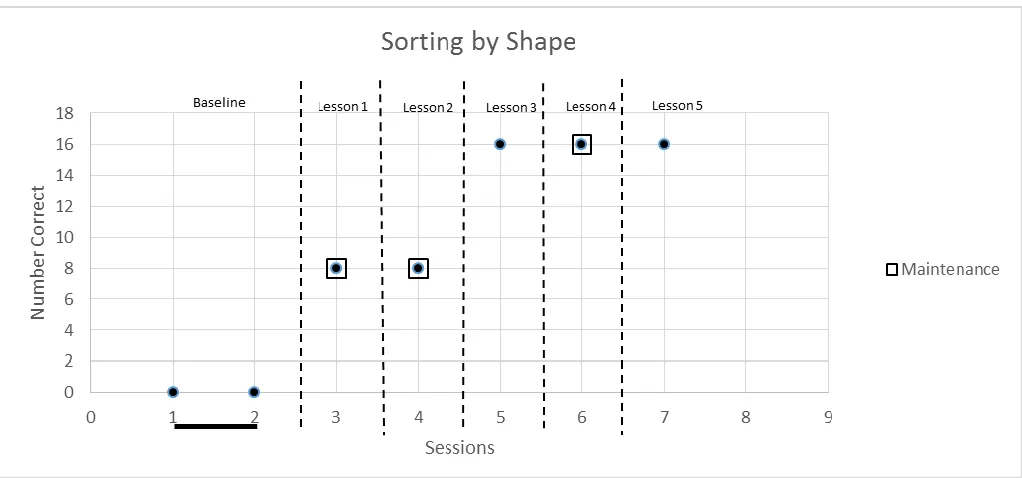
The number of correctly sorted shape tiles is shown in Figure 1. In baseline, the participant sorted 0 of 8 possible shape tiles correctly. At the end of the first lesson the participant was able to correctly sort 8 of 8 possible shape tiles correctly. The participant also correctly sorted 8 of 8 shape tiles after the second lesson using DI flashcards and MLT. At the end of the third, fourth, and fifth lessons the participant correctly sorted 16 of 16 possible shape tiles. Also, when maintenance probes were conducted on lesson 1, lesson 2, and lesson 4 the participant correctly sorted 100% of the shape tiles. Our participant showed a consistent mastery of the material by the end of each lesson.
Fig 1: Number of shapes sorted by lesson during baseline and Modified DI flashcard + MLT (closed circles) and Maintenance (open squares)
Identifying Shapes
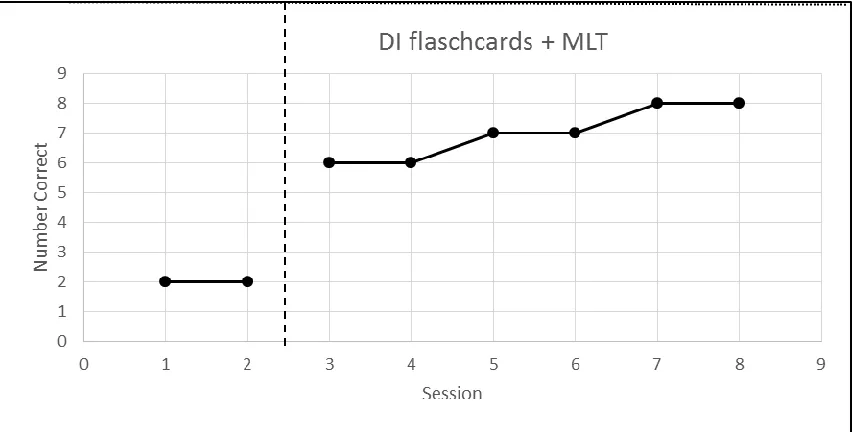
In baseline, the participant correctly identified shapes 2 of 8 trials for both baseline sessions [See Figure 2]. During sessions 3 and 4 the participant correctly identified shapes 6 of 8 trials. In sessions 5 and 6 the participant correctly
Fig 2: number of correct shapes identified by our participant during baseline and Modified DI flashcard + MLT.
Discussion
The purpose of this study was to teach the participant to identify four target shapes, rectangles, circles, triangles, and squares by using a modified DI flashcard procedure to teach sorting by shape using a model-lead-test error correction procedures. The participant showed great improvement with both skills and the data showed correlation with the teaching methods used.
There were several limitations in the present case resort. First, before the study could begin the participant’s parents needed to return the permission slip. This whole process took two weeks of the time for the study. After wasting time waiting for the permission slip baseline created more lost time. As described in the baseline section the participant showed a different range of abilities during baseline that used more of the available sessions to establish a baseline data. Also, the participant is in an integrated preschool classroom for only 2.5 hours a day, 4 days a week. The student was also pulled out of class daily for speech therapy, occupational therapy, and cognitive therapy sessions. This left only 15 minutes a day, 4 days a week, to work with the participant for this study. Despite the limited work sessions available for the study, our participant showed improvement after being taught with the DI flashcard method and model-lead-test method. The use of the AB single case design is a severe limitation in the present case report. However, due to time considerations and the requirement of the edTPA, we could not return to baseline. However, one could view the maintenance data point is some ways as a return to baseline [30, 31], but the participant’s performance failed to decline. One could also view this as maintenance of treatment effects [30, 33, 34]. Employing a multiple baseline across our two skills would also have eliminated the need to return to baseline and would have provided a functional relationship between our procedures and changes in student performance.
There were strengths of this study. The first strength was the low cost of the completing the research. The first author used the cooperating teacher’s shape tiles and these were the only materials used to teach the participant. The teaching methods were easy to implement and adjust if necessary for the student to learn. Also, the teaching methods proved to be effective for teaching the skills of
sorting by shape and shape identification.
The present outcomes for the intervention provide a partial replication of our prior work using error correction [13, 14, 19, 20, 21, 24]. The present results document the possible efficacy of the error correction of model, lead, and test. This error correction procedure has been documented as effective often with a wide range of students and classroom configurations.
Acknowledgements
This research was completed in partial fulfillment for an Endorsement in Special Education from Gonzaga University and the State of Washington. We want to thank our participant and his family for their assistance. Ms. Craig is now a special education teacher in the Bellevue Public Schools in Bellevue, WA.
References
1. Allan EC. The importance of learning about shapes for
preschool students. 2010.
2. Carnine DW, Silbert J, Kame’enui EJ, Tarver SG.
Direct reading instruction (4th ed.). Upper Saddle
River, NJ: Merrill/Prentice-Hall 2005.
3. Carnine DW, Silbert J, Kame’enui EJ, Tarver SG.
Direct reading instruction (5th ed.). Upper Saddle
River, NJ: Merrill/Prentice-Hall/Pearson Education 2010.
4. Marchand-Martella NE, Slocum TA, Martella RC.
(Eds.). An introduction to direct instruction. Boston,
MA: Pearson Education, Inc. 2004.
5. Silbert J, Carnine DW, Stein M. Direct instruction
mathematics. Columbus, OH: Charles E.
Merrill/Pearson Education 1981.
6. Herberg J, McLaughlin TF, Derby KP, Weber KP.
The effects of repeated readings and flashcard error drill the reading accuracy and fluency with rural middle school student with learning disabilities. Academic Research International 2012; 2(3):388-393.
7. Fitting E, McLaughlin TF, Derby KM, Blecher J. The
delays. International Journal of English and Education 2013; 2(2):495-517.
8. Mangundayao J, McLaughlin TF, Williams RL, Toone
E. An evaluation of a direct instructions flashcard system on the acquisition and generalization of numerals, shapes, and colors for preschool-aged students with developmental delays. Journal of Developmental and Physical Disabilities 2013; 26:461-473.
9. Crowley K, McLaughlin TF, Kahn R. The effects of
direct instruction flashcards, reading racetracks on sight word skills for two students with autism. Journal of Developmental and Physical Disabilities 2013; 26:297-311.
10. Green C, McLaughlin TF, Derby KM, Lee K. Using
reading racetracks and flashcards to teach sight words to students with disabilities: Effects for acquisition and response maintenance. Journal of Educational Research: JER 2010; 13(2):84-98.
11. Pierce K, McLaughlin TF, Neyman J, King K. The
gradual and differential effects of direct instruction flashcards with and without a DRH contingency on basic multiplication facts for two students with severe behaviors disorders. i-manager’s Journal on Educational Psychology 2012; 6(2):35-44.
12. Ruwe K, McLaughlin TF, Derby KM, Johnson K. The
multiple effects of direct instruction flashcards on sight word acquisition, passage reading, and errors for three middle school students with intellectual disabilities. Journal of Developmental and Physical Disabilities 2011; 23:241-255.
13. Brasch TL, Williams RL, McLaughlin TF. The effects
of a direct instruction flashcard system on
multiplication fact mastery by two high school students with ADHD and ODD. Child & Family Behavior Therapy 2008; 30(1):51-59.
14. Hayter S, Scott E, McLaughlin TF, Weber KP. The use
of a modified direct instruction flashcard system with two high school students with developmental disabilities. Journal of Physical and Developmental Disabilities 2007; 19:409-415.
15. Lund K, McLaughlin TF, Neyman J, Everson M. The
effects of DI flashcards and math racetrack on multiplication facts for two elementary students with learning disabilities. Journal of Special Education Apprenticeship 2012; 1(1):1-15.
16. Mann Z, McLaughlin TF, Williams RL, Derby KM,
Everson M. The effects of direct instruction flashcards and rewards with math facts at school and in the home: acquisition and maintenance. Journal of Special Education Apprenticeship 2012; 1(2).
17. Mortensen A, McLaughlin TF, Neyman J, Girshick B.
The effects of model, lead, and test with reward to teach a preschool student with a developmental and language delays to demonstrate an understanding of
number quantity. Asia Pacific Journal of
Multidisciplinary Research 2013; 1(1):12-18.
18. Delong L, McLaughlin TF, Neyman J, Wolf M. The
effects of direct instruction flashcard system and model, lead, and test on numeral identification for a nonverbal preschool girl with developmental delays. Asia Pacific Journal of Multidisciplinary Research 2013; 1(1):1-11.
19. Albade K, Altharwa H, McLaughlin TF, Neyman J,
Rinaldi L. The differential and delayed effects of model-lead-test and tracing procedure with fading procedure to teach drawing of shapes for two preschool students with developmental delays. Asia Pacific Journal of Multidisciplinary Research 2013; 1(1):27-36.
20. Aldahri M, Weber KP, McLaughlin TF. Differential
effects of direct instruction model, lead, test procedure with and without a reward on rote counting, number recognition, and rational counting with a young child. International Journal of English and Education 2013; 2(3):451-461.
21. Shouse H, Weber KP, McLaughlin TF, Riley S. The
effects of model, lead, and test and a reward to teach a preschool student with a disability to identify colors. Academic Research International 2012; 2(1):477-483.
22. Skarr A, Zielinski K, Ruwe K, Sharp H, Williams RL,
McLaughlin TF. The effects of direct instruction flashcard and math racetrack procedures on mastery of basic multiplication facts by three elementary school students. Education and Treatment of Children 2014; 37:77-93.
23. Knight VF, Smith BR, Spooner F, Browder D. Using
explicit instruction to teach science descriptors to students with autism spectrum disorder. Journal of Autism and Developmental Disorders 2012; 42:378-389.
24. Bechtoldt S, McLaughlin TF, Derby KM, Blecher J.
The effects of direct instruction flashcards and a model, lead, and test procedure on letter recognition for three preschool students with developmental disabilities. Journal on Developmental Disabilities 2014; 20:5-15.
25. Cole M, McLaughlin TF, Johnson R. The effects of
direct instruction flashcards with oral sentence creation on the spelling accuracy of three middle school students with disabilities. International Journal of Basic and Applied Science 2012; 1(2):308-319.
26. Dundon M, McLaughlin TF, Neyman J, Clark A. The
effects of a model, lead, and test procedure to teach correct requesting using two apps on an ipad with a 5-year-old student with autism spectrum disorder. Educational Research International 2013; 1(3):1-10.
27. Talkington N, McLaughlin TF, Derby KM, Clark A.
The effects of using augmentative and alternative communication to teach a preschool student with developmental delays to request assistance and attention. i-manager’s Journal on School Educational Technology 2013; 8(4):16-21.
28. Ward M, McLaughlin TF, Neyman J, Clark A. Use of
an ipad application as functional communication for a five-year-old preschool student with autism spectrum disorder. International Journal of English and Education 2013; 2:231-238.
29. Wasson K, McLaughlin TF, Derby KM, Clark A. The
effects of using functional communication training and verbal imitation to teach two preschool students with developmental delays the word “help.” International Journal of English and Education 2013; 2:570-578.
30. Kazdin AE. Single case research designs: Methods
for clinical and applied settings. (2nd. ed.). New York,
31. McLaughlin TF. An examination and evaluation of single subject designs used in behavior analysis research in school settings. Educational Research Quarterly 1983; 7:35-42.
32. Alberto P, Troutman A. Applied behavior analysis for
teachers (9th ed.). Upper Saddle River, NJ: Pearson
Education 2012.
33. Stokes T, Baer DM. Mediated generalization: An
unfinished portrait. In K. S. Budd & T. Stokes (Eds.). A small matter of proof: The legacy of Donald M. Baer (pp. 125-138). Reno, NV: Context Press 2003.
34. Stokes TF, Osnes, PG. The developing applied
technology of generalization and maintenance. In Horner, R. H. Dunlap, G., & Koegel, R. L. (Eds.)
Generalization and maintenance. (pp. 5-19).