THE CAMPAIGN OF 1934
PLATE IIIThe fourth season of excavation in the American Zone of the Athenian Agora was be(run on Januiary 22, 1934 and was continued until May 12. In the autumn of 1933 forty-five modern houses, that were located in the blocks designated for excavation, had been demolishe(I and removed, and during the season of excavation 18,000 tons of earth were taken from the area. By the end of the fourth campaign six of the sixteen acres of the American Zone had been cleared after the demolition of 127 mo(lern houses and the removal of 60,000 tons of earth and stones. The result is an impressive picture of the ancient city with the remains of its temples and porticoes emerging in the midst of a busy modern metropolis.
The business administration of the excavations has progressed smootlily under the able direction of Mr. A. Adossides. This branch of the organization is chiefly occupied with the purchase and expropriation of private land and houses. Condemnation proceedings are always vexatious, and constant tact and patience are necessary if serious difficulties are to be avoided. But the expropriation of many houses durino the past four years has established a method of procedure and a scale of prices that greatly facilitate the normal functioning of the leogal machinery. The Governmnental authorities have been cor(lially cooperative througfhout the year. Especially grateful acknowledgment for their interest and support is due to His Excellency Prime Minister Tsaldaris, to His Excellency the Minister of Education, Mr. Makropoulos, and to Professor G. P. Oikonomnos, Director of the Department of Antiquities in the Ministry of Education.
Few chang,es have been imade in the scientific staff since it is a wise policy to maintain continuity of method and procedure. As a result of this policy the elder members of the staff have become experts in variotis branches of the work and have already attained a recoffnized stattus in the archaeological field. Professor Richard Stillwell, supervisingy architect, has been so fully occupied with his duties as Director of the American School and as Supervisor of the excavations of the School at Corinth that he has had little time to give to the Agora and most of the architectural work of the season has been performed by the assistant architect, Charles Spector. All the Fellows who had charge of areas of excavation in 1933 have conitinued in the same branlch of the work. They are: Homer A. Thompson, Miss Dorothy BuLrr (now Mrs. H. A. Thompson), Etugene Vanderpool, James H. Oliver, and Arthur W. Parsons. One new Fellow was added iii this department,
American School of Classical Studies at Athens is collaborating with JSTOR to digitize, preserve, and extend access to
Hesperia
Rodney Young, who has thus been trained in the science of excavation under the eyes of v=eterans. Professor Benjamin D. Meritt has continued in general charge of epigraphical monuments with James H. Oliver of the staff and Sterling Dow, Fellow in the American School, as his competent assistants. Mrs. Shear was assisted in the coin department by Miss Gladys Baker and Miss Catharine Bunnell. Miss Alison Frantz was a newcomer to help Miss Ltucy Talcott in handling the records, and Miss Dorothy Traquair of the American School and Mrs. Sterling Dow served as assistants in the same department. Under Miss Talcott's efficient direction the catalogue department is a model of its kind. Not only is the system of enumerations and storage admirable, by which any one of the thirteen thousand objects catalogued can be immediately produced, but the cards also contain data, such as identification, description. and chronology, that will greatly facilitate the ultimate study and publication of the material. Piet de Jong has continued his valuable services as artist making each of his paintings of ancient vases a veritable work of art. The professional photographic work has been as satisfactorily performed as in past years by Hermann Wagner, photographer of the German Archaeological Institute, and Mrs. Joan Bush, serving for a second year on a voluntary basis, has acquired special skill in using Leica cameras for making the vast nuLmber of small photogrraphs required for the records.
A natural result of the specialized study of the scholars of the staff is the preparation for publication of the new discoveries. These are published in special " Agora Numbers of Hesesria, of which six have already appeared. The prompt publication of this important and often unique new material is rendering a valuable service to the science of archaeology.
The corps of laborers, numbering some 200, was directed by the same group of foremen as in the precedingf year. Sophokles Lekkas, veteran of many campaigns of excavation was head foreman and his four assistants were Deleas of Delphi, Gambouranes of Corinth, Alexopoulos of Mycenae and Pagones of Athens. Bakoules, thie expert technician, was in charge of the mending and sorting of marbles and pottery.
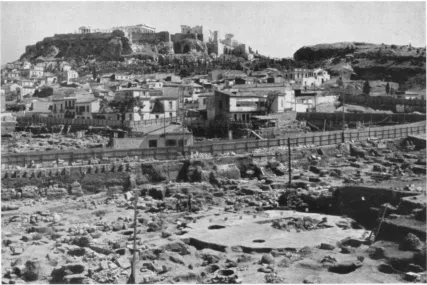
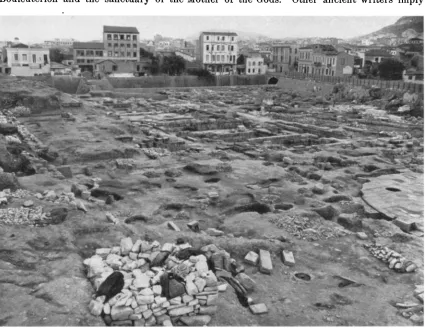
The excavations of the present season were conducted in five blocks on the west side of the American Zone. A view, from the northeast, of the excavated area on the west as it appeared at the close of the season is given in Figure 1. The blocks, which adjoin areas cleared in previous campaigns, are indicated by the Greek letters Beta (B), Gamma (r), Kappa (K), Lambda (A), and Mu (M) on the city plan of the American Zone published above on p. 312, fig. 1.
l I~~~~~~~~~~~~~~~~~~~~~~~~~~~~~~~
of descriptions and references contained in ancient writings and have drawn up various hypothetical plans of the topography of the area. Such was the status of the problem when the American excavations began in 1931. Nothing was definitely known; all theories were conjectural.
The itinerary of Pausanias and casual references by other Greek authors to buildings in the Agora and to events associated with them, have provided the only available clies to the identity of the buildings which have been uncovered during the excavations of the past three years. On the basis of such uncertain evidence tentative identifications of the buildings excavated have been announced in the earlier reports of the excavations. But it must always be borne in mind that reports of current excavations are of a provisional nature and are subject to modification in the light of new discoveries. And it must be clearly emphasized that up to the beginning of the present season no building in the Agora, with the exception of the late stoa of Attalos on the east side, had been identified with certainty. This situation has now been entirely altered as the result of this year's discoveries, and the definite identification of two famous buildings has clarified the topography of the whole western area. From the point of view of Athenian history this is the most important result that has so far been achieved by the current excavations. The buildings that have long been sought have now in part been fouLnd. Many other important monuments still remain buried but more and more clearly as the excavated
area is einlarg,ed will the plan of the city be revealed with its streets and houses, its
temiples and porticoes. The account of the excavations that follows will deal in a preliminarv way with the buildings which have now been identified and with the discoveries associated with them. A detailed study of the topography of the west side of the area is being prepared for prompt publication by Dr. Thompson.
THE THOLOS
Fig. 2. Houlses in Sectioni Beta before Demolitioin
the building, since on the earlier hypothetical plans it had been placed much farther to the southeast. Figure 4 gives a view of the building from the northwest showing its relation to the Areopagus and to the Acropolis.
The Tholos, as we know from descriptions in ancient literature, was a round building with a stone roof. It is also called Skias by the lexicographers and in inscriptions of
the second century B.C. This word, meaning anything that gives shade such as a sunshade
Fig. -4. Tholos from the Northwest
346 T. LESLIE SHEAR
Roman building, or perhaps to the period in which the portico was erected, the Hellenistic
age and probably about the middle of the second century B.c. The circuit wall of curved
poros blocks dates from the fifth century B.c. and is the remaining part of the building
in which Socrates appeared before the Thirty Tyrants (Plato, Apology, 32 C-D).
aa
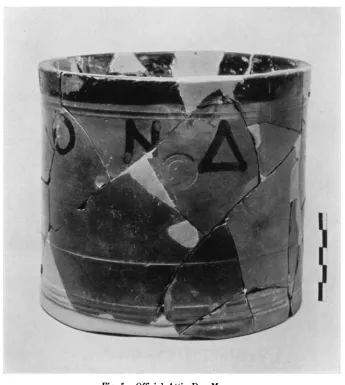
Fig. 5. Official Attic Dry Measure
The Tholos was the civic centre of the city and in it were deposited the standard
weights and measures under the guard of a public slave (I.G., II2, 101339). It was,
therefore, particularly interesting to find some official weights and measures near the building. One of the dry measures, which has been put together from a number of pieces, is now in a practically complete state, Figure 5. It is a round terracotta vessel covered with a fine reddish slip and with the lip painted with a good black glaze. Since the vessel has no handle the bottom is cut in a low arch for a little space on either side so as to provide room for the fingers to facilitate the raising of the measure when it was filled. The official character of the measure is indicated by the word
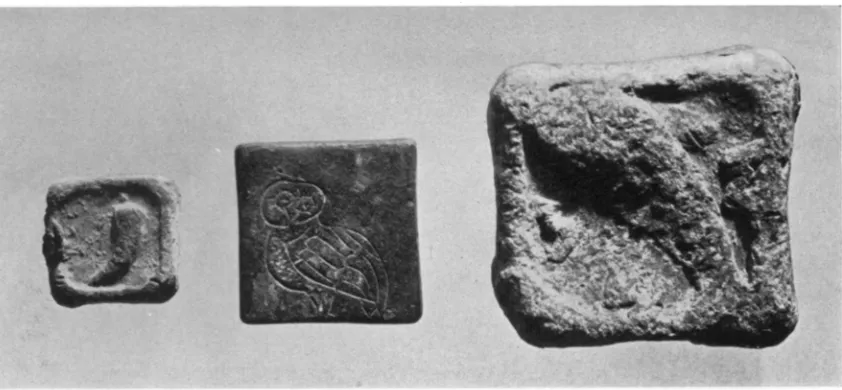
Fig. 6. Standard Weights
AHMOIION painted in large black letters about the bowl and by the seal of the city of Athens that is stamped upon it. This seal is identical with the emblems that appear as Athenian coin types. On one side of the bowl is the helmeted head of Athena and on the other side is the double-bodied owl with a sprig, of olive and the letters AeBE.
This type of coin is dated in the first quarter of the fourth century 1B.c., and the context
in which the measure was found and the shapes of the letters on it confirm this date for it. The inside dimensions of the bowl are 12.75 cm., depth, and 13.9 cm., diameter, giving a capacity of 1933.80 cucm., which is equivalent to nearly two dry quarts. It is probable that this vessel is the Attic choinix but certainty of identification is not possible since the capacity of the choinix is variously stated in ancient records.
348 T. LESLIE SHEAR
twice that amount. The two smaller weights approximately conform to the Solonian standard, the bronze piece with the incised owl weighingf 69.9 grammes and the small lead with a crescent or cornucopiae? weighing 74 grammes, which would be about one- sixth of a mina. The problems connected with the Athenian weights and measures are far from being satisfactorily solved and it is hoped that additional light on the subject may be furnished by the evidence that is being accumulated from the discoveries made in the current excavations.
Behind the Tholos, on the west, a retaining wall had been built against the living rock of tlhe sloping cliff. The wall is, for the most part, constructed of re-used blocks
Fig. 7. Inscribed Stele in Wall
of stone set in lhard cement. The type of construction and the sherds found in it indicate a date for the wall in the early Roman period. Nothing came from it that need necessarily
be later than the first century B.C. It seems, therefore, probable that this wall was built
in connection with reparation and reconstruction after the sack of the city by Sulla in 86 B.C. Besides blocks of stone, pieces of sculpture and of inscriptions were also used
in the construction, two of which are especially important. A statue of Aphrodite, which will be discussed in a later article, was carefully cemented in place in line with the face of the wall. The date of its fabrication into the wall proves it to be an original work of the Greek period. An inscribed stele of Hymettian marble, which is shown in Figure 7 in the position in which it was found, is dated at about the middle of the fourth
century B.C. by the names of archons it contains. This document, which will be subsequently
THE BOULEUTERION
The definite identification of the Tholos must serve as the starting point for the study of the neighboring buildings. Pausanias (I, 5, 1) mentions the Tholos next after the Bouleuterion and the sanctuary of the Mother of the Gods. Other ancient writers imply
Fig. 8. Bouleuiterion from Southwest
that the Bouleuterion and Metroin. were in one and the same precinct. This is directly stated in the late account of the legend of the foundation of the Metrotin. By way of penance for the maltreatment of a priest of the goddess the Athenians built a Bouleuterion and dedicated it to the Mother of the Gods.
350 T. LESLIE SHEAR
The excavations have uncovered two buildings the location of which satisfies the requirements here specified. Just north of the Tholos and separated from it only by a passageway are the foundations of two buildings, one directly in front of the other, which may easily be interpreted as lying in one precinct. Figure 8 gives a view from the southwest which shows the relationship of these buildings to one another and to the Tholos on the south.
The building on the west is a large rectangular hall, for the construction of which space was made by cutting away the cliff. A stone bench extends along the sides of the hall and in front of its central point are the remains of a bema. It is estimated by the architects of the staff that the hall could provide seating space for seven hundred persons. This hall may be quite safely identified as the Council House of the Five Hundred mentioned by Pausanias, because of its proximity to the Tholos, because of its close association with another building in front of it, and because of its size and shape with the bema for the speaker referred to by Antiphon (VI, 40) and with the benches for the prytanes mentioned by Lysias (XIII, 37). There would also have been ample space for the increased membership of the council when that body was enlarged by the addition of new tribes.
THE METROON
Just east of the Bouleuterion and at a slightly lower level is a large building which may now be identified as the Metroon, the temple of the Mother of the Gods. It is constructed with a colonnade that faces the ancient street towards the east, and it is divided into four rooms of which the largest is at the north end. The foundations as seen from the west appear in Figure 9.
The site of the Metroon was used as a sanctuary from very early times as is proved by the remains which graphically illustrate the various vicissitudes of its history. A brief account will be given of the successive chronological periods based on Dr. Thompson's investigation of the building, the results of which he will himself subsequently publish in a study of the topography of the area.
Although the earliest remains on the site overlying bedrock belong to the geometric age the first building period is represented by polygonal walls dated on the evidence of sherds in the early part of the sixth century B.C. Later in that century dates a curved
provided by pottery, and by methods and materials of construction which are similar to those used on the Stoa of Attalos and point to a corresponding date, about the middle
of the second century B.c. A complete re-arrangement of the large north room occurred
in the Roman age, perhaps the time of Hadrian, and the building was entirely destroyed at the end of the fourth century. Such is the main outline of the structural history of
Fig. 9. Metroon from West
the building, and the long tradition of the occupancy of the site is an indication of its sacred character.
352 T. LESLIE SHEAR
inscriptions were lying about the site in one of which the Metroon is mentioned. The shape of the building with its division into four rooms is explained by the fact that the Metroon was used as a filing office for the archives of the state. It seems quite evident that the large room at the north end was the temple proper and that the other rooms served as halls of records containing the marble slabs on which were recorded laws, treaties and decrees (Demosthenes, XIX, 129; Athenaeus V, 214 e; IX, 407 c).
Fig. 10. Temple of Apollo Patro6s from East
THE TEMPLE OF APOLLO PATROOS
Just north of the Metro6in is a passageway leading west to the cliff whence there may have been an ascent to the temple of Hephaestus, the so-called Theseum, that stands on the summit of the hill. A small temple immediately adjoins the passage on the north. Figure 10 shows, on the extreine left, the north end of the Metrodn and in the Centre the foundations of the temple with the passagre between the buildings. The location of the temple exactly corresponds with the designation by Pausanias of the site of the
This building was uncovered by the German excavations of 1896 and has been called by Professor Dorpfeld the Stoa Basileios and has been dated in the sixth century. But the shape of the building is obviously that of a small temple, and the sherds from
Fig. 11. Room' withi Basin north of Apollo Temple
beneath its foundations belong- to the fourth century. No evidence has been secured for the existence of an earlier building on the site and because of this fact and also because its portico is built over a statue base, it is probable that this was an open precinct in early times. When it was planned to erect a temple in the fourth century its size was restricted by the adjoining building on the north and by the passage on the south.
354 T. LESLIE SHEAR
Evidtence in support of the idtentification of this temple as that of Apollo is furnished by a colossal statue of Apollo that was found by the Greeks in 1907 and is now in the National Museum. According, to Professor Oikonomios this statue was found in front of the building, and because of its great size and weight it seems unlikely that it could have wandered far from its original location. The sty]e of the figure and the care and beauty of its workmanship have led to its interpretation as the cult statue that was made by Euphranor (Keramopoullos, Arch. Delt., 1929, p. 95, n. 1; Kouirouniotes, ibid., 1916, Parart., p. 80).
A small room containing a curiously shape(d water basin abuts on the north wall of the temple and the method by which its wall is linked with the temple proves that it antedates that bluilding. The basin (Fio,. 11), which went out of use wlhen the room was constructed, contained objects of the early fourtlh century. Thi.s fact confirms the clating of the temple in thle later part of that cenitury.
THE STOA OF ZEUS ELEUTHERIOS
The iiext buildino, on the north extends from a point a little north of the Apollo temple to the line of the Athens-Peiraeus railway which is the northern border of the American Zone. The foundations were cut whien the railway was constructed but the north encd of the building lhas not yet been found althougIh a trial pit was sunk in search of it in Poseidon Street on the farther side of the railway. This building, of wlhichl a view from the northwest is given in Figure 12, was excavated in 1931 ancl a description of it with a ground plan was published by Richard Stillwell in the First Agora Report in H:eslperia, II, pp. 110 ff., pl. V. This building was called by me at that time the Stoa Basileios as its location seemned to accord with that assigned to that stoa by Pausanias, btit the topographical evidence produced by the work of the current season seems definitely to identify this building as the stoa of Zeus Eleutherios. FLurther investigation has confirmecl the conclusions previously reache(d tha,t it should be dated near the end of the fifth century B.C.
The buildings on the west side of the Agora are now satisfactorily identified in accord with the account of the itinerary of Pausanias, but the first buiilding in the Agora mentioned by him, the Stoa Basileios, is missing from the picture and a puzzling question arises as to its location. It does not seem probable that the names Zeus Stoa and Royal Stoa refer to one and the same building since we have nearly contemporaneous references in literatture to the two as quite distinct. The Stoa Basileios is mentioned as lying beside another stoa by Aristophanes in the Ekllesiaz2ousai (686), a play produced either in 392 or in 389 B.C. The stoa of Zeus Eleutherios is mentioned by Xenophon in
an east to west orientation. In fact, another discovery of the season proves that other important monuments were located in this more northern area. But the land there, besides being outside the American Zone, is near one of the inore important modern streets so that expropriation and excavation would be an expensive undertaking. However, it is essential that in due time the Agora area should be connected by excavation with the site of the German excavations in the Kerameikos, and thus would be disclosed the main entrance of the city through the Dipylon gate to the Market Place.
Fig. 12. Stoa of Zeus from Northwest
THE ALTAR OF THE TWELVE GODS
Another important topographical discovery of the year was the Altar of the Twelve Gods. Thucydides (VI, 54, 6) states that this altar was dedicated in the Agora by Peisistratos, son of Hippas and that subsequently the Athenians enlarged it i'n such a way as to render invisible its inscribed dedication. In clearing the north end of Section Eta, which had in large part been excavated in 1933, the corner of a building-
356 T. LESLIE SHEAR
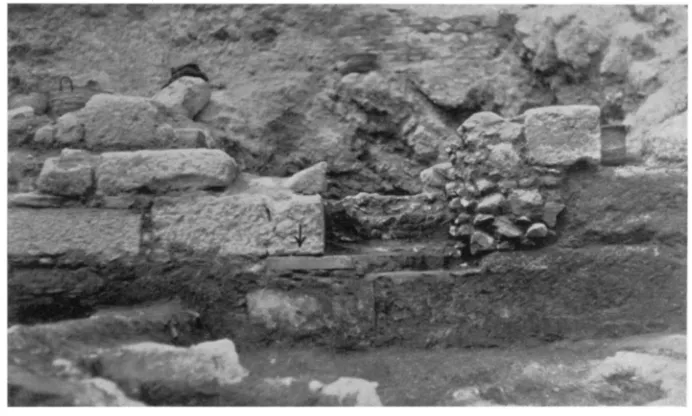
that was evidently of early date appeared in the midst of a complex of Byzantine and Roman walls. The identification of the building was established by an inscription on a statue base standing in its original position in front of the west wall. Figure 13 shows the southwest corner of the building with the statue-base in front. The corner lies close
Fig. 13. Southwest Corner of the Peribolos of the Twelve Gods
to the modern wall bounding the Athens-Peiraeus railway, which appears on the left edge of the picture.
The base is a block of Pentelic marble, 0.785 m. lonog, in the top surface of which are cuttings for the feet of a bronze statue which stood with the rigfht foot slightly advanced (Fig. 14). Along, a smooth band across the top of the front is carved the dedicatory inscription: Leagros, son of Glaukon, dedicated it to the Twelve Gods. The letters are handsomely cut in the style of the early fifth century and the dedicator is unquestionably the Leagros who in his youth was a favorite at the symposia and who
Although the greater part of the building was covered by the railway it was essential in view of its importance to seek to secure any structural details that may have been spared in the construction of the roadbed. The officials of the railway company courteously permitted excavation between the tracks to be carried on for a period of two weeks (Fig. 15) with the result that valuable information was obtained. The southeast corner of the building was found in the first pit that was dug, and the other corners were fixed by additional pits sunk in the roadbed. The remaining, foundations give evidence for
Fig. 14. Base with Dedication by Leagros
358 T. LESLIE SHEAR
The altar of the Twelve Gods was a place of asylum where stranger suppliants took their post while awaiting a welcome by the city (Herodotus, VI, 108). Therefore the natural location for such an altar would be close to a gate of the city and undoubtedly in early times such was its position. Judeich, in fact, hypothetically places a gate at just this spot in his plan of the early wall of the city. With the growth of the city to the north the site of the altar being a very sacred one could not be changed and consequently it lies well within the circuit of the Themistoklean wall. The altar stood at the junction of main intersecting roads and was used as a starting point for measuring
Fig. 15. Digging in the Roadbed of the Athenis-Peiraeus Railroad
distances from the city (Herodotus, II, 7). And it can lhardly be a coincidence that the Stoa of Zeus, which is located directly opposite it across the ancient street, was decorated with a painting of the Twelve Gods by Euphranor (Pausanias, I, 3, 3).
SECTION GAMMA
the Acropolis. As was the case with its northern stretch the street overlies a large water-channel built of polygonal masonry, but beside the main channel there are also supplementary channels constructed of large terracotta pipes that date from the Hellenistic period. Figure 16 illustrates the triple system of conduits, the relation of which to the street may be judged from the square mass of earth in the centre of the picture which
Fig. 16. Water-chnnnels benieath the Street in Section Gamma
has been left at the height of the level of the street, and the top of which is, in fact, the hard packed surface-of the street.
360 T. LESLIE SHEAR
task, which in the case of the wells was for the most part unprofitable. But one large cistern yielded a large quantity of Hellenistic pottery of the second century B.C., which
was published by Thompson in Hesperia, III, 1934, pp. 392ff., pl. III.
SECTION KAPPA
Section Kappa is a block that was clearly designated for excavation since it was bounded on three sides by the excavated areas Theta, Delta and Stigmina. Besides the houses in the block there was also a small. chapel that was dedicated to the Prophet Elias and Saint Charalanlbos. The chapel was evidently miodern and its interior walls were covered with undecorated stucco. It was necessary to remove the building in order that excavation mnight be conducted beneath it, but a careful investigation of its walls before the demolition reveale(i painted frescoes beneath the outer coat of stucco in places on the south wall. This chapel and its paintings are discussed by Miss Frantz in a later article in this Number.
The clearance of this area led to two important topog,raphical discoveries. One is the west end of the great stoa, part of which had been uncovered in 1933 in Section Theta, and the other is a large fountain house situated in the southwest corner of the block. The excavation of the latter buildingr cannot be completed before the removal of 'the mlodern street on the west, but as far as it has been cleared it is shown on the plan in Plate III. The building is square with a portico on the north and west sides facing the ancient street. It has two inner corridors with drainiage basins at the base of the partition walls in which the waterspouts must have been built. A steady flow of water comes from a source on the south side. In type of construction the foundations seemn to belong to the fiftlh century B.C.
The discovery of a largre fotuntain-house with flowing water at this spot raises the question of the possibility of its interpretation as the famous fountain Enneacrunus. Further investigation of the remains must be made before a discussion of this problem will be profitable but it may be pointed out that the location admirably suits the description of Pausanias. He places the fountain near the Odeion, a building that he mentions immediatelv after his reference to the statues of the Tyrannicides which, as we are definitely informed, stood opposite the Metrotin. Here, at least, is an important fountain witlh flowing water situated in the Agora on a site that better accords with ancient references to the Enneacrunus than does that uncovered by Dorpfeld on the slope of the Pnyx.
SECTION LAMBDA
it was not considered advisable to dig much below the Roman level because of the risk of overlooking in the mud necessary evidence for stratifications. With the eventual clearance of the area to the south it will be possible to divert the water through an adequate drain.
The presence of the stream of water here undoubtedly accounts for the construction of a large bath in the late Roman period. This appears in the centre of the picture
Fig. 17. The Roman Bath in Section Lambda
shown in Figure 17, which also includes part of Section Theta on the west and Section Mut on the north. The foundations of the bath are well preserved, with the exedras, basins, and extensive hypocaust. Adjoining, the bath on the east is a large square room of the same period as the bath which was probably the palaestra. The evidence so far
available indicates a date for the bath in the late fourth century A. D.
362 T. LESLIE SHEAR
in Kappa. It then extends in an easterly direction through the entire width of Theta and up to the eastern limit of Lambda, giving a length of 105 m. as far as it has been carried to date. In next season the excavation of the block on the east should reveal its complete length. The evidence provided by objects found in the trenches for the
foundations indicates that the building was constructed in the second century B.C. It is
thus contemporaneous with the Stoa of Attalos and formed the southern boundary of the Agora of the Pergamene period of which the eastern border was the Stoa of Attalos. The relative positions of the two buildings are clearly marked on the plan in Plate III.
Fig. 18. Corner of Roman Building in Section Mu
SECTION MU
ATH&11S
I -
r
-
I: 0
I o- \-S
Ir- -- -
~Z7
-,"ss
X , X
111 VV
~AV
AT
ION
SSICAL
5TUDIL5
, - _ _ i~~~~~~~~~~~~~~~~~~~~~~
, ' <~~~~~~~~~~~~~~~~~~~~~~~~
a, <~~~~~~~~~~~~~~~~
z > L _ _ _ =~~~~~~~~~~~~~~~~~~~~~
< < >
~~~~~~~~~~~~~~~~
\, n,
~~~~~~~~~~~~~~~~~~~~~~~
._' IXSW
0_
0~~~
0
I
~
~
~~~~~
00
x - fsS --kj
0 o0
0~ ~~~)
S~~~~~~~~~~
ALW-0
0aLa
I1
E
' - IlT g-a-S- --2-- - -
H
_--=---=__
I
=
=-__
=t.-
Vs
4o\
\-s
%
\~~~~~~~~ ---f
4 THLl51ON
>
2
R.C.TANCULAR
ROCK-GUT
SHAFT
'\' -3 STOA OF ZLUS ELLUTHERIOS
4 TLJAPLL
OF APOLLO PATROO$
'05
\
'
5 METROON
,
.
6 PROPXLON
OF BOULWUTERION'
7 THOLOS
8 BOULLUT-RION
\
x
9 PERIBOLOS
OF THE TWELVL
CODS
10 LATE ROMAN
BUiLDINGC
11 ALTAR
12 FNGEOD PLRIBOLOS
I13 A\ONUMENT
BASL5
14 GEOMETRIC
HOUSE
RTERRA-COTA
DEPOSIT
15 FOUNTAIN
H1OLSLE
IG SOUTH STOA
17 LATE
ROMAN
BATHS A GYANASIUM
GOMPLEX
18 STOA OF THEL
G IANTS
19 AVALLR1AN//
WALL
20 STOA OF ATTALOS
',
ool
-
,' H/
~~~~~~~~~~~~~~~
11~~~~~~~~~~~~~~~~~~~~~~~~~~~~~~~~~~0,100
.00.
/0
.100~~~~~~~
EX~~~~~~~~~~~~~~~~~~~~~~~~~~~~~~~~~~~~~~~~~~~~~~~~~~~~~-
Fl
1001,
~ ~ ~ ~ ~ ~ ~ ~ ~ ~ ~ ~ ~
-9 9~.e
~ ~ ~ ~ ~ ~ ~ ~ ~
.t~~~~~~~~~~~\ _ 0
IN~~~~~~~~~~~~~~~~~~~~o
\ O \ Z~~/\ ' ///t /// \
\~~~~~~~~~~,/ \\ I I-//
S
\
'' / I C
' '~ x x
~ ~ ~ ~ ~
~
__ 1- /f
~~~\ ' cQ)?p
100,
~ ~ ~ ~ ~ ~
1_ /
a \o /0 30 Fo So 4;o ZO
- _ _ I_ "*- 79 = m
-ay Appeared in April 1935
7'
-. -.~~~~~~~~~~~~~~~~~00.1-a~~~~~~~~01
-a,--
000
.0-
-a a'l
a-, a-a1
a-
'-a0,.0 .1
- 00 -a
-a -a
ax0-
a-~~~~~~~~~~V
Sk
of the early Geometric period were cleared that yielded much characteristic pottery. The wells were quite uniform in type being cut in the hard-pan to a depth of about four metres; the filling was a deposit of heavy clay.
THE AREOPAGUS
In the season of 1932 a deposit of votive objects of early date was found in Sector Stigma at the base of the north slope of the Areopagus, and was subsequently published by Miss Burr (now Mrs. Thompson)
in Hesp)eria, II, 1933, pp. 542-640. The place of this discovery inspired the conjecture that possibly some of the objects may have been originally dedicated in the shrine of the Eumenides on the Areopagus. The shrine is traditionally located in a cave in the rock of the northeastern part of the hill at about the point shown in Figure 19. The huge mass of rock on the left has been broken away from the cliff in comparatively recent times.
An investigation in search of the shrine was conducted for a short time near the end of the season, but nothing of significance was secured from the cave and no trace of the hypothetical shrine was anywhere
found. However, an important
inscription that was discovered in a trench on the north slope of the hill may refer to the Furies. The in- scription is a decree of the orgeones recording the sacrifice of a pig to the "Heroines" on certain days of the month Hekatombaion, the month in which the festival of the Erinyes
was celebrated on the Areopagus. If the " Heroines " be interpreted as the Erinyes, then the " Hero " of the inscription would be Hesychos, the Quiet One, the ancestral hero of the family of the Hesychids who conducted the worship of the Furies.
364 T. LESLIE SHEAR
A little west of the cleft in the rock lie the ruins of the early church of Dionysios the Areopagite, named in honor of the man who was numbered among the earliest Athenian converts of Saint Paul. Many Byzantine and Roman burials were uncovered in the area but nothing was found that gave a clue to the location of the shrine that was sought. It is planned to continue the investigation in this vicinity during the next
campaign.
POTTERY
The harvest in the field of pottery was as abundant as usual, and again this year the major part of the more important discoveries was secured from wells and cisterns.
Fig. 20. Grave of the Geometric Period
The terrain of the Agora is honeycombed with wells which were necessary because of the long dry summers and the small supply of water. On the frequent occasions when the city was captured and destroyed by its foes existing wells, in many instances, were filled with debris and abandoned, and new wells were subsequently dug. It thus often happens that the contents of a well are rich and varied and can be dated within a limited period of time.
Fig. 21. Vases from the Geometiric Grave
Atypical grave of the middle g-eometr'ic period, ninth to eigyhth century B.C., was-
uncovered on the west side of Section Gamm'a and its contents proved to be intact. The grave was cut out of bedrock and was lined
with small stones; the body lay extended approxi- ipately from north to south with the head at the south end of the grave, Figure 20. The arms are lying, along the sides of the body and the leg,s are stretched out. At the bottom of the grave a large one-handled pitcher was placed sidewise across the feet. Juist in front of the pitcher is its cover, and beyond are a one-handled cup and a two-handled bowl, and farther on one side a small aryballos. These vases, which are shown in Figure 21, have uncommon shapes and interestingf decorative motives. The Agora collection of pottery is growing rich in geometric ware because of the repeated discovery of these early deposits. A fundamental change in the attitude of the Greeks towards decorative desig,n began in the seventh century under oriental inspiration acquired as the result of the expansion of trade relations
366 T. LESLIE SHEAR
... .. . . .... . ... . ....-..Y. .wr...-K ... .... . .... .
R
chanoe is characterized by the elaboration of ornaments, by the free use of human and animal figures, and by the introduction of animals of fantastic type. A good example of Attic orientalizing style of the early sixth century is the one-handled jug illustrated in Figure 22. The decoration of the vase consists of two large cocks which are facing each other over a conventionalized palmette-lotus design; rosettes are scattered over the field. The color effect is especially pleasingf as the decorations are painted in reddish-orange on a buff background.
A vase of unique type, Figure 23, was found in Section Gamma lying on hard-pan
in association with potsherds of the sixth century B.c. The shape is a hollow cylinder
curved up like a crescent, and the surface is covered with good black glaze. It has
Fig. 24. Arretine Bowl
four squat lets on which it stands and it terminates at one end in the head of a woman with bulging eyes of archaic style. The woman has her arms bent and is holding hier hands up to her chin. A small hole is perforated through her mouth. At the other end the cylinder was left open so that liquid could be poured in.
368 T. LESLIE SHEAR
Later ceramic periods are well represented among the discoveries of the year. and tlle usual amount of pottery of the Roman period was secured. In the latter group mention should be made of several Arretine bowls that were found in a well-shaft on the slope of the Theseum hill. Some of the complete bowls are genuinely Arretine while others associated with them are locally made imitations of the Arretine. The bowl shown in Figure 24 is an Arretine piece that bears the name CAMURI stamped within a footprint on the inside of the base. It should be dated at about the end of the Augflustan period. The discovery of Arretine ware was particularly welcome since it fills a gap in the series of vases in the Agora collection which now extends with few interruiptions from prehistoric times to the Byzantine age.
MISCELLANEOUS OBJECTS
Many objects found in the course of the season belong to groups which have been discussed in previous reports and need little further comment at present. Thus the collection of Greek and Roman lamps has been enriched by the addition of 377 examples to make a grand total of 1552. The more complete suclh a collection the greater is its value, but among the new discoveries no piece has special interest or outstanding importance. Coins keep pouring in with customary regularity and with 7600 additions for the year tlhe total has now reached 31,600. Athens was notedl for her system of coinage and at certain times hler coins were current throughout the world. She was also for many centuries an important commercial centre to which came foreign traders from all parts of the Mediterranean basin. But even in her market place it is surprising to find such a vast number of pieces scattered over an area of six acres. The coins date from all periods beginning in the sixth century B.c. and extending down to modern times.
They are historical documents in a small way and illustrate the changing fate of the city. Through them can be traced the passing of the independence of ancient Greece, the domination of the Romans, the arrival of the Vandals, the growth of the Byzantine empire, the presence of the Turks, and the rise of modern Greece. These coins can often be closely dated, and when this is the case they furnish valtiable chronological evidence for the stratum in which they are found. They are, therefore, always gathered with the greatest care, cleaned patiently by the electrolytic method, exactly identified, and minutely recorded and catalogued.
Themistokles, Phrearios, and in one case his father's name, Neokles. Some curious variations of spelling occur. The interior theta appears in the name of Themistokles in all cases except one, but the voter who scratched that one was evidently far from sure of the name since he has spelled it with two sigmas, and has confused the termination, writing it thus: THEMISSTOKELS with the K and E in ligature. On the other votes the final syllable of the name is spelled indiscriminately either with one epsilon or with two, and one writer has introduced an aspirate after the second rho of the demotic:
Fig. 25. Ostraka of Themistokles
PHREARHIOS. The conclusion that may be drawn is that the literacy of the Athenian voter of this period was not high, or else that the orthography of proper names was not well established.
Many terracotta figurines were found during the year which added to those secured in the previous campaigns make a total of 627 now in the Agora collection. The most important piece is a fragment, measuring, 0.044 by 0.04 m., with the archaic head of a youth in relief (Fig. 26). Although there is a slight curvature to the piece it seems to have been part of a plaque rather than of a vase. The head of the youth is represented in relief in full profile to the right. The archaic traits are typically characteristic, such as the hair arranged in wavy lines that terminate in knobs, the bulging eye shown as
370 T. LESLIE SHEAR
if in front view, the moulded line of the eyebrow, and the suggestion of a smile about the lips. The head closely resembles that of one of the youths on the sculptured ba,se in the National Museum that had been built into the Themistoklean wall,
and it may be dated about 510 B.C., or a little earlier. The youth, whose head alone
is preserved, formed part of a combat group for above his head appear the remains of the forepaws and claws of a lion by which he is being firmly held. From a similar plaque in the Acropolis Museum we know that the scene represented was the combat between Herakles and the Nemean lion (S. Casson and D. Brooke, Cat. Acropolis Musetum, II, p. 423, No. 1323; E. Reisch in Ath. Mitt., XlI,. 1887, p. 129, pl. III). The full scene on the new plaque must have been an archaic masterpiece, but it is, at least, a fortunate coincidence that the head was preserved in its entirety when the plaque was smashed, for in this archaic head one can appreciate the virility and the originality of the formative stage of Greek sculpture.
This concludes the general report of the more significant results achieved during the present season. Detailed studies of the various categories of objects will be subsequently presented in special articles. Great progress has been made with the work and the results have been most gratifying, but much still remains to be done. The modern houses in four more blocks have been demolished in preparation of the terrain for the resumption of excavation in January 1935, when the fifth campaign should result in the clearance of the entire central part of the American Zone.
T. LESLIE SHEAR