© Global Society of Scientific Research and Researchers
http://ijcjournal.org/
Comparative Analysis of Two Prominent Routing
Protocols in IPv6 Network: OSPFv3 & EIGRPv6
Md. Asif Hossain
a*, Md.Mahful Islam
b, Md. Nesar Uddin Majumder
ca,b,c
Department of Electronics & Communications Engineering, East West University, Dhaka, Bangladesh
a
Email: [email protected]
b
Email: [email protected]
cEmail: [email protected]
Abstract
Due to the huge demand of Internet, computer network has been transited from IPv4 to IPv6 environment. New
routing protocols are also needed in IPv6 network. Among them two are very prominent: IETF’s OSPF and
Cisco’s EIGRP. In IPv6 network, they are known as OSPFv3 and EIGRPv6 respectively. Though several
researchers have worked in these area, but this paper have analyzed the comparisons between these two routing
protocols more intensively. In this paper, packet loss, routing convergence speed and end to end delay have been
considered as the parameters of the comparisons. The comparisons have been evaluated in Cisco’s simulation
environment; Packet Tracer.
Keywords: IPv4; IPv6; OSPF; OSPFv3; EIGRP; EIGRPv6.
1. Introduction
IPv6, the latest version of Internet Protocol was first introduced in 1998. 128 bits are being used in IPv6, on the
other hand, our running IPv4 is using 32 bits. Internet user is increasing day by day. Till the year 2000, 50% of
total IPv4 space were used. To support upcoming generations, Internet protocol addressing system is needed to
implant some up gradation [1]. By measuring these matters, IETF (Internet Engineering Task Force) started to
develop another version of Internet Protocol to support IPv4 at 1994, which is known as IPv6 now. In the year
1998, the basic protocol (RFC 2460) was published [2].
---
There are many features in IPv6 as like [3, 4]:
• In IPv6, IP header is better optimized by removing facultative fields by replacing them after IPv6
header. Here the IPv6 header is easily passable between the routers.
• IPv6 has a very large addressing space with 128 bits. This is for giving the addressing and sub-netting
an up gradation.
• There might be no need of NAT (Network Address Translation) when IPv6 is fully applied.
• For ISP (Internet Service Provider), more effective addressing and routing Infrastructure is provided. • With IPv6, a host can be configured automatically with the Link-local address.
• IPSec is mandatory in IPv6. So there will be built in Internet security.
• IPv6 is totally compatible for implementing new features by adding extension headers.
Routing IPv6 traffic is not supported by existing IPv4 routing protocols [5]. Development of IPv6 dynamic
routing protocols are essential due to the importance upon reliability and scalability in many networks. Dynamic
routing protocols are much better than the static routing protocol due to the ability to automatically adjust to
network topological changes. These changes are included like failed components and rerouting traffic through
alternative paths. There are several interior routing protocols are available for IPv6 network. Among them 2 are
very prominent. One of them is OSPFv3 (Open Shortest Path First version 3) and another one is EIGRPv6
(Enhanced Interior Gateway Routing Protocol version 6).
There are several works have been done with these routing protocols. In [6], the authors have analyzed RIP and
OSPF in IPv6 network. The authors in [7] have compared and discussed OSPF and EIGRP routing protocols
with the IPv6 network and IPv4 network. IKram Ud Din and Saeed Mahfooz [8], shown the performance
analysis of various routing protocols like RIP, OSPF, IGRP and EIGRP with the parameters such as packets
dropping, traffic received, end to end delay and jitter in voice. Some other related works have been done in
[9-13].
The entire paper has been organized as: section 1 introduces the paper, section 2 will show the theoretical
comparison between the routing protocols, section 3 will show the simulation network topology. Results will be
analyzed in section 4 and the paper will conclude in section 5.
2. Comparison of Routing Protocols
This section will discuss the two interior routing protocols for IPv6 network and also their theoretical
comparisons.
2.1.OSPFv3
OSPF (Open Shortest Path First) is also an IGP (Interior Gateway Protocol), which may be the most widely used
in large networks. It has mainly replaced the older RIP (Routing Information Protocol) [14]. There are three
versions of OSPF. This protocol keeps a routing table which contains the shortest path for going to a remote
the network environment and if the shortest path is changed, then the router multicast the latest information to
all other router situated in the Open Shortest Path Fast (OSPF). All routers in the OSPF network gets the same
routing table containing the shortest path to other routers by this way. RIP or BGP (Border Gateway Protocol) to
be connected with other routers, which run on other protocols than OSPF. OSPF protocol number is 89.OSPF
multicast address is 244.0.0.5 for all routers and 244.0.0.6 for the designated router. In IPv6, ff02::5 is being
used for all SPF routers and ff02::6 is for designated routers [15].
2.2. EIGRPv6
Enhanced Interior Gateway Routing Protocol, in short EIGRP is the upgraded version of IGRP. EIGRP just has
an improved architecture than IGRP but most of the features remain same [16]. As like, fundamental or basic
distance information remains unchanged. The operating efficiency or the convergence properties is improved in
EIGRP. EIGRP first introduced in 1993 by CISCO. EIGRP is a distance vector routing protocol. So the routers
in EIGRP automatically shares information between the routers about the routing path. For finding the best
routing path to a remote network, DUAL (Diffusing Update Algorithm) is used which prevents calculating
errors. For finding best path, Bandwidth, Load, Delay, Reliability and MTU (Maximum Transmission Unit) is
noticed. Reliable Transport Protocol (RTP) of Cisco is used in EIGRP instead of User Datagram Protocol or
Transmission Control Protocol [17]. So in EIGRP, no port number is used to identify traffic but it supports
maximizing efficiency and also multicasting. EIGRP protocol number is 88 and multicasting address in IPv4 is
244.0.0.10 and in IPv6 is ff02::a, which.
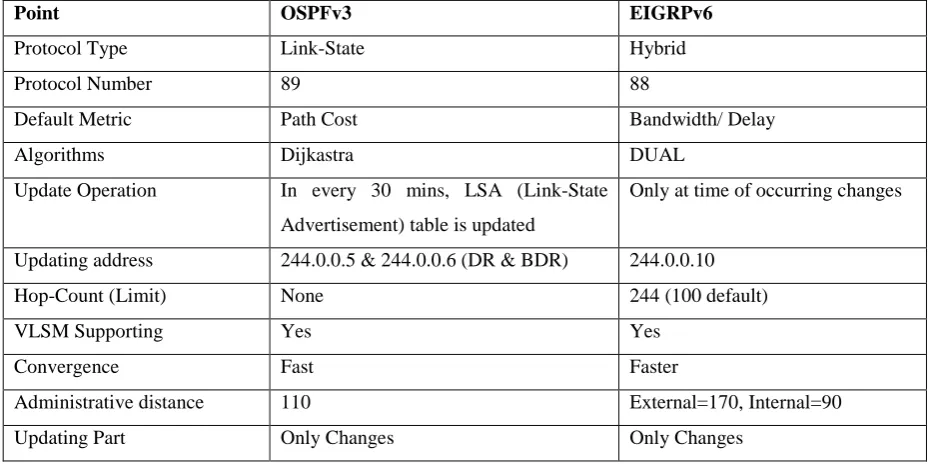
We can see the comparison table for better understanding:
Table 1: Comparison between OSPFv3 and EIGRPv6
Point OSPFv3 EIGRPv6
Protocol Type Link-State Hybrid
Protocol Number 89 88
Default Metric Path Cost Bandwidth/ Delay
Algorithms Dijkastra DUAL
Update Operation In every 30 mins, LSA (Link-State
Advertisement) table is updated
Only at time of occurring changes
Updating address 244.0.0.5 & 244.0.0.6 (DR & BDR) 244.0.0.10
Hop-Count (Limit) None 244 (100 default)
VLSM Supporting Yes Yes
Convergence Fast Faster
Administrative distance 110 External=170, Internal=90
3. Simulation Network Topology
For the analysis of the performance between the routing protocols, Packet Tracer 6.2.2 has been used. For the
simulation purposes, Cisco’s router, switch and general computers have been used. Standard IPv6 addresses
have been used in these topologies.
3.1 Implementation of OSPFv3
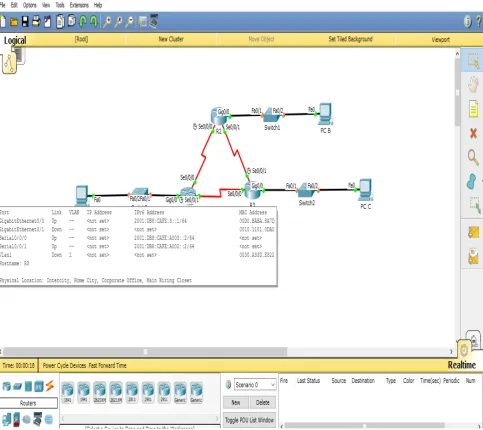
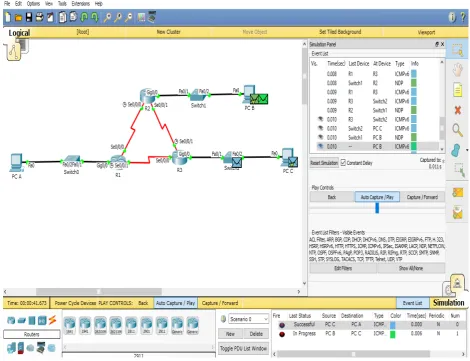
For the simulation purpose of OSPFv3, the following topology has been used:
Figure 1: Topology for the OSPFv3
Figure 2: Simulation of the OSPFv3 routing protocols
The following codes have been used in Packet Tracer 6.2.2 for the above topology.
Only the routing protocol related codes have been shown here:
Table 2: Packet Tracer Code for the OSPFv3 Simulation (summarized)
For Router 1 For Router 2 For Router 3
ipv6 unicast-routing
ipv6 router ospf 10
router-id 1.1.1.1
exit
int g0/0
ipv6 ospf 10 area 0
int s0/0/0
ipv6 ospf 10 area 0
int s0/0/1
ipv6 ospf 10 area 0
ipv6 unicast-routing
ipv6 router ospf 10
router-id 2.2.2.2
exit
int g0/0
ipv6 ospf 10 area 0
int s0/0/0
ipv6 ospf 10 area 0
int s0/0/1
ipv6 ospf 10 area 0
ipv6 unicast-routing
ipv6 router ospf 10
router-id 3.3.3.3
exit
int g0/0
ipv6 ospf 10 area 0
int s0/0/0
ipv6 ospf 10 area 0
int s0/0/1
3.2 Implementation of EIGRPv6
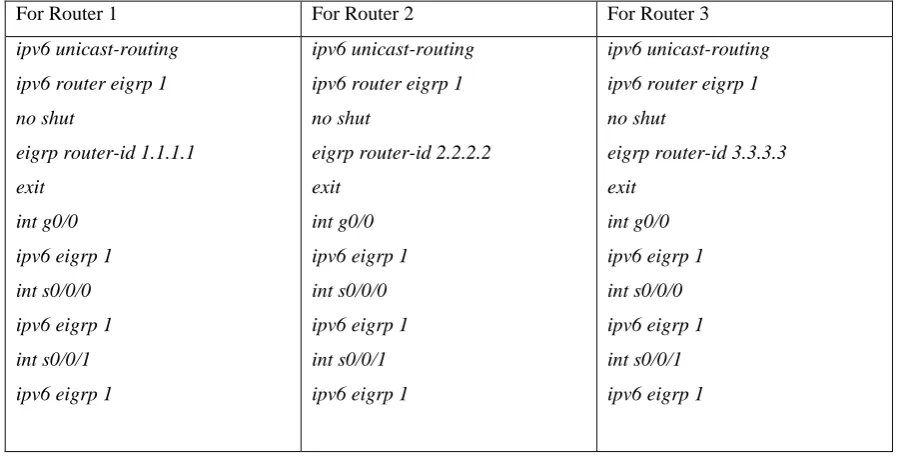
For configuring EIGRP using IPv6, there must be a router ID preconfigured before it is available to run.
The network statement is unavailable in EIGRP while using IPv6. Network interfaces could be directly
configured without using any global IPv6 address.
IPv6 EIGRP has ‘shutdown’ feature like network interfaces.
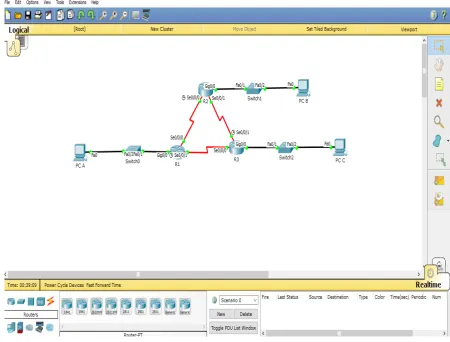
So for starting the routing process “no shut” command has to be made. Following topology has been considered
for the performance analysis.
Figure 3: Topology for the EIGRPv6
Figure 4: Simulation of the EIGRPv6 routing protocols
The following codes have been used in Packet Tracer 6.2.2 for the above topology. Only the routing protocol
related codes have been shown here:
Table 3: Packet Tracer Code for the EIGRPv6 Simulation (summarized)
For Router 1 For Router 2 For Router 3
ipv6 unicast-routing
ipv6 router eigrp 1
no shut
eigrp router-id 1.1.1.1
exit
int g0/0
ipv6 eigrp 1
int s0/0/0
ipv6 eigrp 1
int s0/0/1
ipv6 eigrp 1
ipv6 unicast-routing
ipv6 router eigrp 1
no shut
eigrp router-id 2.2.2.2
exit
int g0/0
ipv6 eigrp 1
int s0/0/0
ipv6 eigrp 1
int s0/0/1
ipv6 eigrp 1
ipv6 unicast-routing
ipv6 router eigrp 1
no shut
eigrp router-id 3.3.3.3
exit
int g0/0
ipv6 eigrp 1
int s0/0/0
ipv6 eigrp 1
int s0/0/1
4. Results & Analysis
In this section, the results got from the above simulations have been analyzed. In our simulation we have used
complex ‘ping’ packet.
4.1 Analysis of packet loss comparison
In the first analysis, we have increased the transmitted packet size for both the topologies. Packet loss occurs
when one or more packets of data travelling across a computer network fail to reach their destination. Packet
loss is typically caused by network congestion failed to choose the alternative paths immediately. It has been
found that, increasing the packet size will result the increasing the number of packet loss. In Figure 1, it is
shown that the packet loss is more for the OSPFv3 network than the EIGRPv6 network. So, for the packet loss
perspective, EIGRPv6 performs much better than OSPFv3.
Figure 5: Packet loss comparison between OSPFv3 and EIGRPv6
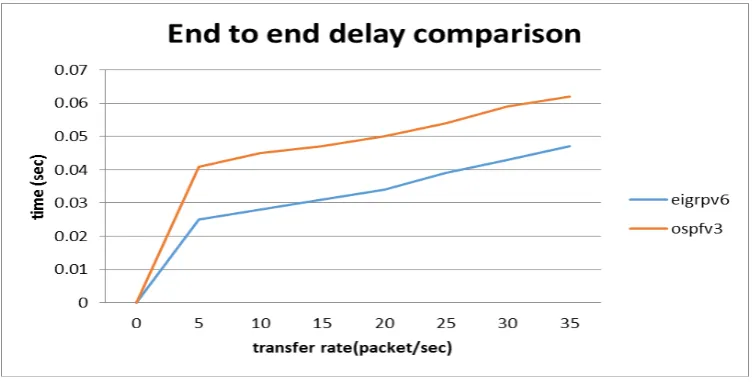
4.2 Analysis of end to end delay comparison
End-to-end delay is referred as the time taken for a packet to be transmitted across a network from source to
destination. It is a common term used in IP network monitoring. In Figure 2, it is shown that increasing the
packet size will increase the end to end delay, because the increasing of congestion and the routing delay. In this
Figure 2. OSPFv3 has more end to end delay than EIGRPv6. So here also EIGRPv6 performs the better.
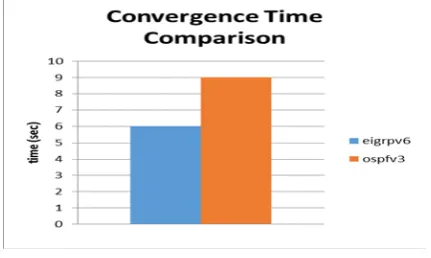
4.3 Analysis of convergence time comparison
Convergence is the state of a set of routers that have the same topological information about the internetwork in
which they operate via the implemented routing protocol. In Figure 3, we have found that OSPFv3 takes around
9 seconds while EIGRPv6 takes 6 seconds. So, in the case of convergence time, EIGRPv6 is also the faster than
the OSPFv3.
Figure 7: Convergence time comparison between OSPFv3 and EIGRPv6
This is due to EIGRP uses DUAL to provide fast convergence whilst OSPF detects topology changes using
hello timers and interface changes. This triggers LSA to update neighbors, optimizations to convergence in
OSPF are done by changing timer values.
5. Conclusion
The paper has been discussed two eminent interior routing protocols. Their performances have been analyzed
considering the parameters of packet loss, end to end delay and convergence timing. In our analysis, we have
found that EIGRPv6 performs much better that OSPFv3 in all these three cases. So our recommendation is to
use EIGRPv6 as an interior routing protocols in IPv6 network. But the main disadvantage of EIGRPv6 is that,
this routing protocols can only be used in the Cisco’s routers only. In this case, OSPFv3 is the best alternative.
In future, we will compare these routing protocols with considering the security issues of IPv6. The work will be
also extended to the real life devices.
References
[1] Geoff Huston, Telstra, "IPv4: How long do we have?⋯", Internet Protocol Journal, Vol. 6, No. 4,
[2] RFC 2460: https://www.ietf.org/rfc/rfc2460.txt
[3] "European IPv6 Task Force", IPv6 TF-SC Consortium, Workshop Industry Focus, Paris, June,
pp.27-28, 2006.
[4] Gregory R. Schloz, Clint Evans, Jaime Flores, Mustafa Rahman, "Internet protocol version 6", Internet
Protocol Journal, Vol. 16, Issue 3, pp. 197 - 204, March 2001.
[5] D. Genkov, "An approach for finding proper packet size in IPv6 networks," in Proc. of 12th
International Conference on Computer Systems and Technologies, Vienna, Austria, pp. 442-447, 2011.
[6] Narula, Rajneesh, and Pallavi Aggarwal. "Performance Evaluation of RIP And OSPF In IPv6 Using
Opnet 14.5 Simulator.", International Journal of Technical Research and Applications, Vol. 2,
Issue 6, PP. 37-41, 2014.
[7] Alex Hinds, Anthony Atojoko, and Shao Ying Zhu, "Evaluation of OSPF and EIGRP Routing
Protocols for IPv6,"International Journal of Future Computer and Communication vol. 2, no. 4 pp.
287-291, 2013.
[8] IKram Ud Din, Saeed Mahfooz and Muhammad Adnan, “Analysis of the routing protocols in the
Real Time Transmission: A Comparative study”, Global Journal of Computer Science and Technology,
Vol. 10, Issue 5, Ver. 1.0, pages 18-22, July 2010.
[9] V.Vetriselvan, Pravin R. Patil, M.Mahendran,"Survey on the RIP, OSPF, EIGRP Routing Protocol",
(IJCSIT) International Journal of Computer Science and Information Technologies, Vol. 5(2),
pp.1058-1065, 2014.
[10] Saubhagya Das, Santosh Subedi and N. Shekar V. Shet, “Network Performance Analysis of Dynamic
Routing protocols real time applications”, International Journal of Modern Engineering Research,
Vol.4, Issue 5, pp. 49-57, May 2014.
[11] N, Ayub, F. Jan, T. Mustafa, W. J. Rana, M. Y. Saeed, and S. Ullah, "Performance analysis of OSPF
and EIGRP routing protocols with respect to the convergence," European Journal of Scientific
Research, vol. 61, no. 3, pp. 434-447, 2011.
[12] Krishnan,Y.N., G, Shobha, “Performance Analysis of OSPF and EIGRP Routing Protocols For
Greener Internetworking”, Green High Performance Computing (ICGHPC), 2013 IEEE International
Conference, pp. 1-4, 2013.
[13] Dey, Golap Kanti, Md Mobasher Ahmed, and Kazi Tanvir Ahmmed. "Performance Analysis and
Redistribution Among ripv2, EIGRP & OSPF Routing Protocol." 2015 International Conference on
[14] Whitfield, Richard John, and Shao Ying Zhu. "A Comparison of OSPFv3 and EIGRPv6 in a Small
IPv6 Enterprise Network." Editorial Preface 6.1, 2015.
[15] Singh, Kuwar Pratap, P. K. Gupta, and G. Singh. "Performance Evaluation of Enhanced Interior
Gateway Routing Protocol in IPv6 Network." arXiv preprint arXiv:1305.4311, 2013.
[16] A. Riesco and A. Verdejo, "Implementing and analyzing in Maude the Enhanced Interior Gateway
Routing Protocol," Electronic Notes in Theoretical Computer Science, pp. 249–266, 2009.
[17] B. Albrightson, J. J. G. L. Aceves, and J. Boyle. "EIGRP – A Fast Routing Protocol Based on