A SIMPLE BIT LOADING ALGORITHM FOR LONG TERM EVOLUTION-ADVANCED
VEHICULAR CHANNEL
1Aniji John, 2Anitha P Mathew and 3Vinoth Babu K
Department of Communication Engineering, VIT University, Vellore, India [email protected], [email protected], [email protected]
Abstract
Increasing demand for energy efficient cellular networks has prompted considerable research on the topic green communication. Bit loading is a technique used in multicarrier communication systems like orthogonal frequency division multiplexing (OFDM) to assign bits efficiently based on the subchannel quality. In adaptive bit loading (ABL), the number of bits that can be transmitted in each subcarrier is determined by the signal to noise ratio (SNR) of the subcarrier. Margin adaptive (MA) algorithm is utilized to minimize the total transmitted energy. In this work, a simple bit loading algorithm (SBL) is proposed for a long-term evolution- advanced (LTE-A) vehicular channel to minimize the total energy required to transmit the target bits. Compared to other algorithms, SBL algorithm is less complex and convergent to the optimal solution in one iteration. The simulation results also prove that the algorithm minimizes computational complexity.
Index Terms— Long Term Evolution-Advanced (LTE-A), Margin Adaptive (MA), Orthogonal Frequency Division Multiplexing (OFDM), Simple Bit Loading (SBL), Vehicular channel
I. Introduction
In recent years, researchers focused their study in improving the energy efficiency in the domain of cellular networks to reduce the operational expendi-tures (OPEX) and to maintain the profitability of cellular networks [1]. The Base Station (BS) consumes most of the energy in the cellular network. Efforts were taken to improve energy efficiency in this sector. The increase in the number of mobile subscribers, multi-media applications, and data rate requirements paves the way for rapid growth in the field of cellular network. The growth in the number of mobile users has led to an increase in data traffic, followed by increase in the number of BSs, to meet the requirements of customers.
Previous works focused on improving the system capacity as well as the data rates, while giving less attention towards the increasing demand of cellular networks for energy. This increasing demand of energy paved the way towards researches about green commu-nications [1-3]. The two most important reasons to pursue the development of green communication
net-works are increase in carbon dioxide (CO2) emissions
and OPEX. CO2 emissions are mainly associated with
off- grid sites that provide coverage for remote areas. Most such sites are powered by diesel-power generators. The goals associated with green cellular networks are to improve the energy efficiency and to
reduce CO2 [4,5].
In OFDM systems, ABL is one of the powerful technique, which increases the spectral and energy efficiency. Bit loading algorithms are classified into two namely MA and rate adaptive (RA) [6, 7]. In RA algorithms, the data rate is maximized by keeping the total transmitted energy constant, whereas in MA algorithms the total transmitted energy is minimized while keeping the total data rate constant.
From literature, it is found that most of the optimal MA bit loading algorithms are complex. The less complex algorithms are less optimal. Thus, these algo-rithms are not suited for time varying real time channel conditions. A MA algorithm with less computational
complexity and near optimal is required for time varying vehicular channels. In [8], a low complex, near optimal SBL algorithm is proposed for OFDM based applications. It is proved that the proposed algorithm just needs one iteration to converge. This is more suitable for time varying vehicular channels. It finds wide applications in the areas like vehicular adhoc network (VANET). But in [8], the authors have not tested the proposed algorithm for LTE-A vehicular channels. Our contribution is testing the performance of SBL algorithm for LTE-A vehicular channel [9].
The organization of the paper is as follows: The pro-posed algorithm is explained in section II. Simulation results and corresponding explanations are included in section III and the paper is concluded in section IV.
II. Highlights of SBL Algorithm
The applications such as voice and video are usually served with fixed rate. MA algorithms minimize the energy required to transmit the target bits [6]. This can be mathematically represented as
1
0
j L T
j
E
E
(1)subject to 1
0
j L
original j
B
R
(2)0
B
j
P
j
1,...
L
where j is the subcarrier index, L is the number of
subcarriers,
E
T is the total energy required to transmitthe target bits,
j
E
is the energy required by thej
thsubcarrier,
B
j is the bit loaded onj
th subcarrier, Pdenotes the maximum number of bits that can be loaded
on a subcarrier at any instant of time and
R
originalis theThe number of subcarriers in the OFDM symbol is divided into g groups using
2 max
2 2
min
log
C
1
g
C
(3)where
C
max 2andC
min 2 are the maximum andminimum subchannel gains respectively. After execu-ting (3), the first group contains subcarriers with the lowest channel gain and the last group contains sub-carriers with highest channel gain. The lower and upper index of each group is obtained using
2 max
1
2
i g i
C
L
2 max
;i
1, 2,...g
2
i g i
C
U
(4)Case 1: When the number of available subcarriers are sufficient to accommodate the target bits, execute (5) to get the number of bits per group.
1
1
(
) * q
;i 1,....g 1
;
i g i orginal m mround
i
Z
R
Z
i
g
(5)where
is a constant and can be computed using1
i*q
g orginal i iR
L
(6)where
q
i is the number of subcarriers fall in thei
thgroup.
Case 2: When the number of subcarriers are large
enough compared to the target bits i.e
1
* q
g
orginal m
m
R
m
L
, execute (7) to find thenumber of bits per group.
1
1
0
;
1
(
) *q ;
2,...
1
;
i i g orginal m mi
Z
round
i
i
g
R
Z
i
g
(7)
for case 2 is modified as2 1
m* q
g orginal m mR
L
q
(8)Inorder to achieve better quality of service (QoS) and energy efficiency for case 2, the subcarriers falling in the lower groups are not loaded with any bits. The
target bits are distributed among the other groups with high channel quality.
Case 3: When the number of subcarriers are not
sufficient when compared to target bits i.e,
1
* q
* (
)
g
orginal m
m
R
m
L
P
g
, execute (9) tofind the number of bits per group.
2
1
( i) * q ;i 1,...g 2
* q ;i g 1
* q ;
i
g
i orginal g m
m
g
round
Z R P Z
P i g
(9)
for case 3 is modified as1
1
*
m*q
g
orginal g m
m g
R
P q
L q
(10)Once the number of bits per group are identified, distribute them among the subcarriers available in each group using
1
i iu iZ
x
q
,x
il
x
iu
1
*
i
iu i i
i
Z
q
Z
q
q
,q
il
q
iq
iu (11)In
i
thgroup,x
ilbits are allocated toq
iu subcarriersand
x
iubits allocated toq
iu subcarriers such that* x
* x
il il iu iu i
q
q
Z
(12)III. Simulation Results
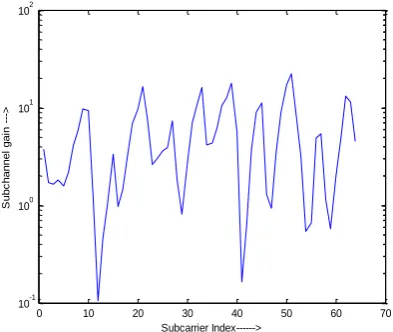
To test the performance of SBL for LTE-A vehicular channels, we have considered the following simulation parameters. The number of subcarriers is taken to be 64. M-ary quadrature amplitude modulation (M-QAM) modulation scheme is utilized to modulate each subcarrier. Based on the channel state information (CSI), M chooses value varying from 0 to 1024. Maximum number of 10 bits can be loaded on a subcarrier. The LTE-A vehicular channel considered for the simulation study is displayed in Table 1. The considered instantaneous subchannel gain of each sub-carrier is displayed in Fig. 1.
Table 1. LTE-A vehicular channel power delay profile [9,10]
Delay(ns) Power (dB)
0 0
30 -1.5
150 -1.4
310 -3.6
370 -0.6
710 -9.1
1090 -7
0 10 20 30 40 50 60 70 10-1
100 101 102
Subcarrier Index--->
S
u
b
c
h
a
n
n
e
l
g
a
in
-
-->
Fig. 1. Subchannel gain vs. subcarrier index
We have considered target bits of 200 to test case 1. The algorithm takes only a single iteration to allocate the target 200 bits to 64 subcarriers. The subcarrier gains are classified to about 10 groups using (3). The lower and upper index of each group, the number of bits allocated to individual subcarriers are listed in Table 2 for case 1. The bit allocation for case 1 is displayed in Fig. 2. It is observed that the subcarriers with good channel gain are loaded with more number of bits and deeply faded subcarriers are not loaded with any bits. All 200 bits are efficiently allocated to subcarriers. The energy allocated per subcarrier for case 1 is displayed in Fig. 3. It is noted that no energy is allocated to deeply faded subcarriers.
Table 2.
R
orginal of 200 bits (case 1)Groups i
L
U
ix
ilx
iuq
ilq
iu1 .009 .02 0 1 0 0 2 .02 .03 0 0 0 0 3 .03 .07 0 0 0 0 4 .07 .14 0 3 0 0 5 .14 .37 0 1 1 1 6 .37 .54 1 3 2 2 7 .54 1.1 2 7 3 3 8 1.1 2.1 0 16 8 8 9 2.1 8.8 4 8 3 1 10 8.8 17.6 5 7 2 2
0 10 20 30 40 50 60 70
0 1 2 3 4 5 6
subcarrier index
N
o
o
f
b
it
s
a
ll
o
c
a
te
d
t
o
e
a
c
h
s
u
b
c
a
rr
ie
r
Fig. 2. Number of bits allocated to each subcarrier for
R
orginal of 200 bits0 10 20 30 40 50 60 70
0 0.5 1 1.5 2 2.5 3
subcarrier index (k)
E
n
e
rg
y
a
ll
o
c
a
te
d
p
e
r
s
u
b
c
a
rr
ie
r
Fig. 3. Energy allocated to each subcarrier for
orginal
R
of 200 bitsWe have considered target bits of 64 to test case 2. The algorithm takes only a single iteration to allocate all the target 64 bits to 64 subcarriers. The lower and upper index of each group, the number of bits allocated to individual subcarriers are listed in Table 3 for case 2. The bit allocation for case 2 is displayed in Fig. 4. All 64 bits are efficiently allocated to subcarriers. The energy allocated per subcarrier for case 2 is displayed in Fig. 5. It is noted that no energy is allotted to deeply faded subcarriers and the subcarriers in lower groups.
Table.3.
R
orginal of 64 bits (case 2)0 10 20 30 40 50 60 70
0 0.5 1 1.5 2 2.5 3 3.5 4
subcarrier index
N
o
o
f
b
it
s
a
ll
o
c
a
te
d
t
o
e
a
c
h
s
u
b
c
a
rr
ie
r
Fig. 4. Number of bits allocated to each subcarrier
for
R
orginal of 64 bitsGroups i
L
U
ix
ilx
iuq
ilq
iu0 10 20 30 40 50 60 70 -0.02
0 0.02 0.04 0.06 0.08 0.1 0.12
subcarrier index (k)
E
n
e
rg
y
a
ll
o
c
a
te
d
p
e
r
s
u
b
c
a
rr
ie
r
Fig.5 Energy allocated to each subcarrier for
R
orginal of64 bits
We have considered target bits of 500 to test case 3. The algorithm takes only a single iteration to allocate the target 500 bits to 64 subcarriers. The lower and upper index of each group, the number of bits allocated to individual subcarriers are listed in Table 4 for case 3. The bit allocation for case 3 is displayed in Fig. 6. It is observed that the subcarriers with good channel gain are loaded with more number of bits and deeply faded subcarriers are loaded with the excess bits. All 500 bits are efficiently allocated to each sub-carriers. The energy allocated per subcarrier for case 3 is displayed in Fig. 7.
Table 4.
R
orginal of 500 bits (case 3)Groups i
L
U
ix
ilx
iuq
ilq
iu1 .009 .02 1 0 0 1 2 .02 .034 0 2 1 0 3 .034 .07 0 0 0 0 4 .07 .14 4 0 0 2 5 .14 .27 5 5 2 2 6 .27 .54 6 6 2 5 7 .54 1.1 7 7 1 5 8 1.1 2.2 8 8 6 24 9 2.2 4.3 2 9 12 4 10 4.3 8.9 8 1 10 9
0 10 20 30 40 50 60 70
0 1 2 3 4 5 6 7 8 9 10
subcarrier index
N
o
o
f
b
it
s
a
ll
o
c
a
te
d
t
o
e
a
c
h
s
u
b
c
a
rr
ie
r
Fig. 6. Number of bits allocated to each subcarrier for
R
orginal of 500 bitsII. Conclusion
In this work, we have tested the performance of SBL algorithm for LTE-A vehicular channels. Based on the results, it is absolute that this algorithm is low complex, and near optimal. It takes just an iteration to converge for cases 1 and 2. For case 3 also it needs very few iterations to converge. Thus, this algorithm is more suited for fixed rate energy efficient applications.
0 10 20 30 40 50 60 70
0 2 4 6 8 10 12
subcarrier index
E
n
e
rg
y
a
llo
c
a
te
d
t
o
e
a
c
h
s
u
b
c
a
rr
ie
r
Fig. 7. Energy allocated to each subcarrier for
R
orginalof500 bits
REFERENCES
[1] M. H. Alsharif, Rosdiadee Nordin, and Mahamod Ismail. "Survey of green radio communications networks: techniques and recent advances," Journal of computer networks and communications 2013, December 2013.
[2] M. Arthi, P. Arulmozhivarman and K. Vinoth Babu. “A Quality-Aware Relay Station Deployment scheme for Green Radio Communication,” Journal of Green Engineering, Accepted and article in press, 2016. [3] M. Arthi, P. Arulmozhivarman and K. Vinoth Babu
“Quality of Service Aware Multi-Hop Relay Networks for Green Radio Communication,” Journal of Green Engineering, Vol. 5, pp. 1–22, 2015.
[4] Wu J, Rangan S, Zhang H, editors. Green communications: theoretical fundamentals, algorithms and applications. CRC Press: September 2012. [5] Zhang, H., Gladisch, A., Pickavet, M., Tao, Z. and
Mohr, W., “Energy efficiency in communications,” IEEE Communications Magazine, 48(11), pp.48-49, November 2010.
[6] K. Vinoth Babu, Ramachandra R. G, B. K. Nallagatla, ”Spectral efficiency maximization in MISO-OFDM systems using rate adaptive bit loading and transmit antenna selection techniques,” Journal of Engineering Science and Technology (JESTEC), 2014
[7] K. Vinoth Babu, Ramachandra R. G, M. Arthi, “Modified Dynamic Subcarrier Bandwidth (MDSB) OFDM Systems for Energy Efficient Transmissions in High Mobility Applications,” Journal of theoretical and applied information technology, Vol. 42, pp. 221-226,2012
[8] S. Nader-Esfahani and M Afrasiabi, Simple Bit loading algorithm for OFDM-based system, IET Communica-tions, pp. 312–316, 2007.
[9] M. Baker, LTE The UMTS Long Term Evolution. Theory to Practice, 2nd
![Table 1. LTE-A vehicular channel power delay profile [9,10] Delay(ns) Power (dB)](https://thumb-us.123doks.com/thumbv2/123dok_us/8405517.1688856/2.595.65.286.494.726/table-vehicular-channel-power-delay-profile-delay-power.webp)