Language
E.Q: Explain language and how
language classification links to
culture?
Language
Language – a set of sounds, combinations of sounds, and symbols that are used for communication.
*can be forced upon cultures, countries like France limit speaking of other languages *6,500 roughly exist yet 2,000 of them have less than 1,000speakers… LESS each year
Major World Languages
World Language Families
pg 183or Map you
Language Terms
• Language FAMILY-(15-20different) a group of languages
descended from a single, earlier tongue.(Indo-European Largest Family)
• Language BRANCH-a further division of language groups. E.g.
Germanic language is a subfamily or BRANCH of Indo-European and languages are German,English,Dutch,Flemish, Norwegian.
• Indo-Iranian largest Branch of Indo-European family(hindi) • Standard language(not required)-a language sustained by the
technologically advanced states/countries in the form of state examination for teachers, civil servants and others.
•
OFFICIAL LANGUAGE
- government law
requiring citizens to learn specific language.
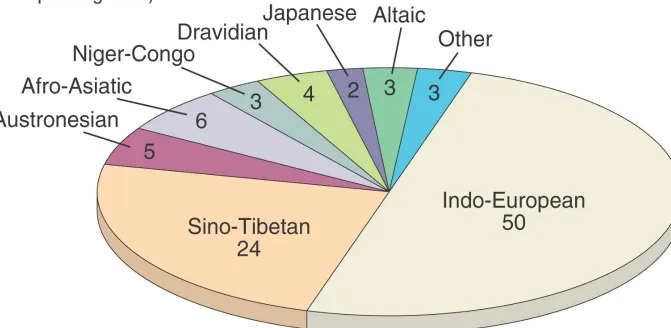
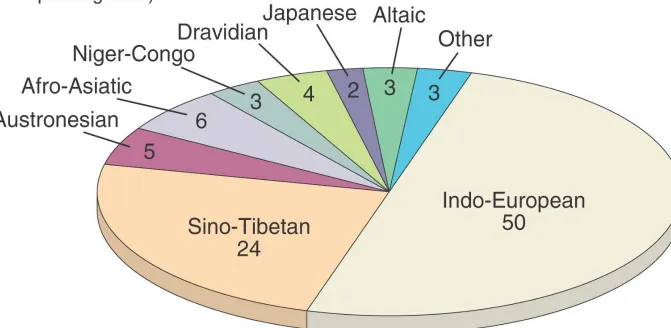
Major Language Families
Percentage of World Population-186
⅔ of world speak language from Indo-European or Sino-Tibetan language family
Language
and
National Identity
Standard Language
a language that is published, widely distributed, and
purposefully taught.
Government usually plays a big role in standardizing a language. NOT-legal or Required yet highly used.
Africa- Swahili is standard language of the continent
Monolingual State a country in which only one language is spoken Ex. Japan, Portugal, Iceland, Denmark
Multilingual State
a country in which more than one language is in use
Official Language +/-?
Nigeria
More than 400 different
languages.
English official language –
avoids
• The French
government has
fought very hard to
prevent the infusion
of English or other
foreign words into
the French language
• France has passed
Do you have an accent?
•
https://www.youtube.com/watch?v=3UgpfS
p2t6k
-distinct emphasis given to a syllable or
especially a vowel “Minnesooota”
American Accents Explained
DIALECTS
• Regional differences in a standard language;
– Syntax-the way words are put together
– Vocabulary DIFFERENCE
– Ex= y’all, you all, you guys, all of you, etc…
DIALECT DIFFERENT FROM ACCENT
– Accents can reveal the regional home of a person.
Isogloss -A geographic boundary within which a particular linguistic feature occurs
How many can you understand?
Let it go!
• In summary take
FRQ: Describe how languages
form and then theories how they
Language divergence –
when a lack of spatial interaction among speakers of a language breaks the language into dialects too much to comprehend and then new languages form. EX- Catalan/Spanish/Portuguese or Quebecois/French
Language convergence
– caused by diffusion and tradewhen peoples with different languages have consistent spatial interaction and their languages collapse into one. EX-Creole
Mutual Intelligibility- means two people can understand each other when speaking. (or writing?)
Problems: (Mandarin/Cantonese Chinese)(Norwegian vs Danish)
• Cannot measure mutual intelligibility
• Many “languages” fail the test of mutual intelligibility • Standard languages and governments impact what is a
“language” and what is a “dialect”
• An example of sound shift:
– Latin for milk is lacte
– Italian is latta
– Spanish is leche
– French is lait
• Another example of
sound shift is:
– German vater
– Dutch vader
– English father
• Still another example is
– Latin for eight is octo
– Spanish is ocho
– French is huit
Spatial Interaction (time-space compression) now
creates RAPID Language Convergence:
•
Lingua franca
– EX Arabic, Swahili,
English
A language used among speakers of different languages for the purposes of international trade and commerce.
•
Pidgin language
– EX=Lingua Franca, creole
a language created when people combine parts of two or more languages into a simplified structure and vocabulary.
•
Creole language
– EX Caribbean
Origin & Diffusion of Languages
• Mother Tongue-the first language spoken by Homo sapiens about 200,000 years ago.
– Nostratic- mother tongue of English
• Deep reconstruction-by studying sound shifts, linguists try to re-create an extinct language.
• Language replacement-traditional languages of small groups of less advanced people were replaced or greatly
modified by an invading tongue. Assimilation dominates…
– Why has English become dominant language in world?
• Linguists can find linkages among languages by examining
sound shifts – a slight change in a word across languages over time. These sound shifts represent Language Divergence.
Hawaii NO xmas…? Are you Mento?
How do Languages Diffuse?
• human interaction-2,000 years ago-Han China, Roman Empire-spread languages over vast empires likely due to
conquest and agriculture Theories (contagious hand-to-hand)
• print distribution-Gutenberg’s movable type printing press (1452-first Gutenberg Bible) helped to diffuse, standardize & stabilize European languages (Hierarchical- educated)
• Migration-ancient & more recent migration from 16th century to now, (Relocation) diffused languages e.g. Spanish, Portuguese,
English & French –dispersal hypothesis
• Trade-(Contagious) encouraged the spread of goods & languages
• Rise of nation-states-stabilized & standardized languages-endangering other languages
Proto-Indo-European
• Russian scholars have led the way on research of ancient languages
• Nostratic-the ancient
ancestor of Indo-European languages-were
hunter-gatherers of 14,000 yrs. ago
• Indo-European is the largest and most widespread
Toponym
Toponym
– a place name
A
toponym
:
• Imparts a certain character on a place
• Reflects the social processes in a place
• Can give us a glimpse of the history of a place
Changing Toponyms
• When people change the toponym of a place, they have the
Changing Toponyms
• Major reasons people
change toponyms:
– After decolonization – After a political
revolution
– To memorialize people or events
– To commodify or brand a place
Martin Luther King, Jr. Streets
Geographer Derek Alderman asks: * Where are MLK streets?
* Why are they where they are?
Wrap Up ?
• Choose
two
concepts from today’s notes
Language Tree Activity
EQ: Explain how language patterns and distributions can be represented on language trees or maps and what knowledge
we gain from understanding these relationships.
Steps: p186 can guide you or
https://lautgesetz.com/latreex/1st- # off 1-22, then you are in charge of finding one
locations language, branch, family.
2nd- Find 12 others from different regions not
bordering your country.
3rd- For 13 languages you found,
draw a language tree!
Major Language Families
Percentage of World Population-186
⅔ of world speak language from Indo-European or Sino-Tibetan language family
• The vocabulary of a ancient language can reveal its cultural
hearth.
• The Indo-European branches of the
language tree at right illustrates the concept of language divergence.
• August Schleicher was the first to compare the world’s language
Languages of Africa
• There are 1,000 spoken languages in Africa and many are unwritten.
• There are 4 major indigenous language families;
• Afro-Asiatic of N. Africa • Nilo-Saharan
• Niger-Congo • Khosian
• Largest ethnic groups are associated with a
Languages of
Subsaharan Africa
-
extreme language diversity- effects of colonialism
-follows tribalism
Indo-European Language Family
Languages
of
Europe
• Dominated by Indo-European.
• Subfamilies include: • Germanic
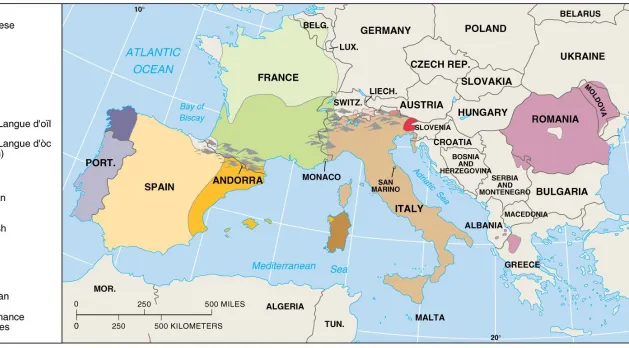
• Romance
• Slavic
• Celtic
• There is a high correlation between languages and
Romance Branch of Indo-European
Germanic Branch
of Indo-European
Languages of China
• Chinese has the most speakers of any language.
• It is one of the world’s oldest languages spoken by the greatest contiguous population on Earth.
• Southern China-the most variety and dialects-most are mutually unintelligible.
• Some scholars argue that for this reason-it is not one language, but several.
• Mandarin-the dominate language of the North spoken by 700 million including Beijing.
• Wu is next with 100 million speakers in Shanghai area.
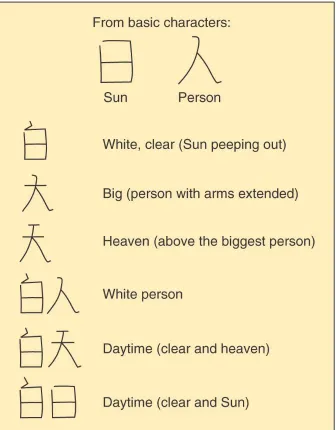
Chinese Ideograms
Languages of India
• India had 4 language
families with the largest being Indo-European and Dravidian.
• There are 15 major
languages-all but 4 are Indo-European.
• Over 1,600 lesser languages.
• The largest Indo-European language is Hindi
South Asian Languages & Language Families
Language and Culture
“No one was allowed to speak the language – the
Dena’ina language. They [the American government]
didn’t allow it in the schools, and a lot of the women had married non-native men, and the men said, ‘You’re
American now so you can’t speak the language.’ So, we became invisible in the community. Invisible to each
other. And, then, because we couldn’t speak the language – what happens when you can’t speak your own language is you have to think with someone else’s words, and that’s a dreadful kind of isolation [emphasis added].”
Language Divisions in Belgium
Fig. 5-16: There has been much tension in Belgium between Flemings, who live in the north and speak Flemish, a Dutch dialect, and Walloons, who live in the south and speak French.
Belgium:
Flanders (Flemish language)