COMPARITIVE STUDY OF STRENGTH
AND DURABILITY PROPERTIES OF
POLYMERIC MATERIALS AS SELF
CURING AGENTS
M.Geetha
Principal i/c, CSI Polytechnic College Salem -636007, India
Dr.R.Malathy
Principal, Excel Engineering College, Komarapalyam, Namakkal 637 303, India
ABSTRACT
This paper compares the strength and durability properties of different grades of concrete when added with polymeric materials with out any external curing for the concrete. The results tabulated and compared with the use of bar diagram and line diagram so as to have a schematic representation of the results. The grades of concrete used were M20, M30 and M40.
Keywords: Split tensile strength, Cylinder compressive strength, Acid resistance, Sea water resistance, Accelerated corrosion test.
1. Introduction
Conventional curing procedures of water ponding, as used for drying shrinkage are not effective in the case of autogenous shrinkage. They may eliminate the autogenous shrinkage in small cross sections only because the penetration of water from the external surface is limited. Moreover, external curing might be difficult to apply to some surfaces.. In view of this limitation, different strategies have been developed in recent years, based on the use of internal water reservoirs; one strategy which has been investigated more extensively is based on the use of light weight aggregates, while the other is based on the use of water absorbing polymers. Both water saturated porous aggregates and water saturated polymers are able to act as internal reservoirs, providing a source of curing of curing water to the paste volume in their vicinity.
2. 1. Objectives
Curing means maintaining a satisfactory moisture content and temperature in concrete in
Order to achieve the desired strength and hardness. Drying removes the water needed for hydration. Without adequate water and due to insufficient hydration, concrete tends to be weak. In out door concreting, temperature, humidity, wind, velocity etc., contribute to the evaporation loss of water. Properly cured concrete has better durability and better surface hardness and is less permeable.
The prevention of loss of moisture from concrete is important not only from the strength development point of view but also from that of prevention of plastic shrinkage, decrease in permeability and improvement of resistance to abrasion. Loss in 28 day strength seems to be directly related to loss of moisture during the first three days. It is evident that 5 % loss in moisture leads to nearly 75 % loss in strength. Hence continuous curing is to be done for the first three days. Intermittent curing seems to be even worse than no curing at all. By proper curing the durability & impermeability of concrete are increased and shrinkage reduced. The resistance of concrete to abrasion is considerably increased by proper curing.
Now a day the level of water table is going down day by day. If water is to be purchased for construction works, the cost of construction goes much higher. Also, the concreting works done at heights and in sloped roofs, (slope of roof is too steep) curing is very difficult. Where thickness of concreting is larger, the percolation of water in the concrete, especially in case of high strength concrete is difficult.
Internal curing is used as a substitute to overcome such problems. One of the methods to overcome such problems faced by external curing is the use of light weight aggregate. The other methods are the use of water absorbent polymers (polyethylene glycol and paraffin wax) and wood derived materials. The disadvantageous being, Light weight aggregate can negatively impact strength and can lead to variability in performance. Polyethylene glycol is more controllable but is relatively expensive compared to light weight aggregate. Wood derived materials may be an alternative to other internal curing materials, while providing consistency at a lower cost but only 50% strength is reached and micro cracks are introduced by wood derived materials.
2.2 Materials
Cement
Portland Pozzolana cement available in local market was used in the investigation.
Coarse Aggregate
Crushed angular granite metal of 20mm size from a local source was used as Coarse aggregate. Its specific gravity and fineness modulus were 2.73 and 6.97 respectively.
Fine Aggregate
River sand was used as fine aggregate. Its specific gravity and fineness modulus were 2.57 and 2.93 respectively.
Admixture
The extract from Spinacia oleracea L(Palak greens) @ 0.6%- 0.8 % weight of cement is added as admixture (green) to the concrete while preparing the concrete. Erukkampal at – 0.2 % to 0.4 % and Polyethylelne at 0.2- 0.4 % of cement.
3.0 Tests Conducted
3. 1 Splitting tensile strength
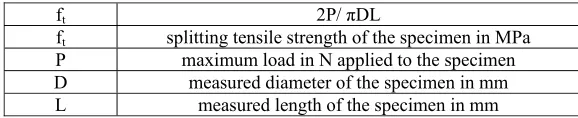
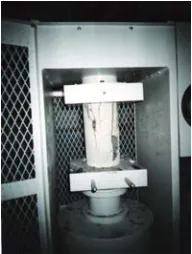
This is an indirect test to determine the tensile strength of cylindrical specimens. Splitting tensile strength tests were carried out on cylinder specimens of size 150 mm diameter and 300 mm length at the age of 28 days curing, using AIMIL compression testing machine of 3000 KN capacity as per BIS : 5816 - 1970 . To avoid the direct load on the specimen, the cylindrical specimens were kept below the wooden strips. The load was applied gradually till the specimens split and readings were noted. The test set up for the splitting tensile strength on the cylinder specimen, with the wooden strips to avoid the direct load on the specimen is shown in Figure 1. Patterns of typical splitting tensile failure mode shapes of cylinder specimens are shown in Figure 2. The splitting tensile strength has been calculated using the following formula:
ft 2P/ πDL
ft splitting tensile strength of the specimen in MPa
Figure 1 Test set up for splitting tensile strength on cylinder specimen
Figure 2 Patterns of typical splitting tensile failure mode shapes of cylinder specimens
3.2 Cylinder compressive strength
Cylinder compressive strength tests were carried out on cylinder specimens of size 150 mm diameter and 300 mm height at the age of 28 days curing, using AIMIL compression testing machine of 3000 KN capacity as per BIS :516-1959.The test set up for compression strength on cylinder specimen is shown in Figure 3.
Figure 3 Compression test on cylinder specimen in – Progress
3.3 Acid resistance
The acid resistance tests were carried out on 150 mm size cube specimens at the age of 28 days curing. The cube specimens were weighed and immersed in water diluted with one percent by weight of sulphuric acid for 45 days continuously. Then the specimens were taken out from the acid water and the surfaces of the cubes were cleaned. Then, the weight and the compressive strengths of the specimens were found out and the average percentage of loss of weight and compressive strengths were calculated.
3.4 Sea water resistance
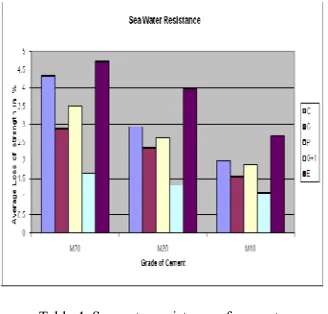
The sea water resistance tests were carried out on 150 mm size cube specimens at the age of 28 days curing. The cube specimens were weighed and immersed in water diluted with three percent sodium hydroxide by weight of water for 45 days continuously. Then the specimens were taken out from the salt water and the surfaces of the cubes were cleaned. Then, the weight and compressive strengths of the specimens were found out and the average percentage of loss of weight and compressive strengths were calculated.
3.5 Accelerated electrolytic corrosion
This is a non-standard test which helps to assess the material quality against rust expansion pressure by chloride accumulation at the anode (rebar). The specimens comprising of cylinder with 100 mm diameter and 200 mm height. A 10 mm diameter for steel rod is centrally placed with 45 mm cover on all sides. The embedded steel rod in the concrete specimen will act as anode and get corroded with passage of time, producing iron oxides around the steel rod which will in turn produce large pressure on surrounding concrete. When this pressure exceeds the tensile strength of concrete, the concrete gets cracked.
At the age of 28 days, the specimens were immersed in three percent sodium chloride solution and the embedded rebars were treated as anode, an external stainless steel electrode serving as cathode by applying a constant positive potential of 30 Volts to this system from a DC source. The variation of current was recorded with time. A sharp rise in current indicates the corrosion and cracking of the concrete is usually visible thereafter. The time taken for initiation of first crack can be considered as a measure of their resistance against chloride permeability and reinforcement corrosion. After cracking, the specimens were taken out, visually inspected, and carefully split open to assess the corroded steel rod. The reinforcement bars were then cleaned as per ASTM G1 by dipping it in Clark’s solution (HCl of specific gravity 1.19 litre + antimony trioxide 20 gm + stannous chloride 50 gm) for 25 minutes. Each bar was then weighed again to the accuracy of 0.1 mg to find out the change in weight. The specimens for accelerated electrolytic corrosion test are shown in Figure 4.
Figure 4 Test specimens for accelerated electrolytic corrosion
4. RESULTS AND DISCUSSION
4.1 Split Tensile Strength
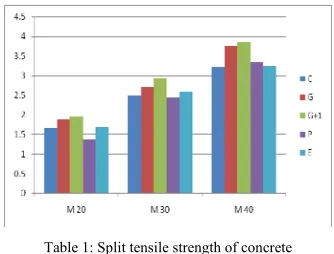
Table 1: Split tensile strength of concrete
The split tensile strength is found higher in the cubes added with plalak greens extract and externally cured for one day. The strength is higher than the normal relation ft 28 =0.08 fck1.04
4.2 Cylinder compressive strength
Table 2: Cylinder Compressive strength of concrete
The minimum loss of strength is found in the cubes added with palak greens extract and externally cured for one day. The cylinder compressive strength is higher than the normal value of 0.8fck .Next higher
strength is in cubes with palak greens.
4.3 Acid resistance
Table 3: Acid resistance of concrete
The acid resistance capacity of the concrete increases with grade of concrete. The minimum loss of strength is found in the concrete added with extract of palak greens and externally cured for 1 day and the next minimum loss of strength is found for the concrete added with extract of palak greens.
4.4 Sea water resistance
Table 4: Sea water resistance of concrete
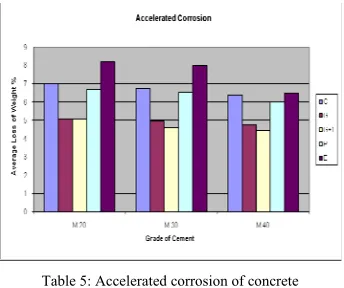
4.5 Accelerated corrosion of concrete
Table 5: Accelerated corrosion of concrete
The percentage loss of weight of the bar after the test is the minimum in cubes with palak greens with one day curing.
5. Conclusion
Of the above tests conducted , the strength as well as the durability property holds good for the cubes with palak green with one day curing and with out external curing. Hence the strength and durability properties of internally cured concrete with palak greens prove to be best among the three alternatives and prove to be the best when compared to external curing. While considering the internal curing with that of external curing, the cost of internal curing proves to be cheaper when compared with that of external curing.
6. References
[1] Bentz, D.P, Snyder, K. A., Protected paste volume in concrete – Extension to internal curing using saturated lightweight fine aggregate, Cement and Concrete Research, Vol. 29, pp. 1863-1867 (1999).
[2] Experimental observation of internal water curing of concrete Pietro Lura- Ole Mejlhede Jensen Shin-Ichi Igarashi [3] Self curing concrete : Water retention , hydration and moisture transport A.S.El-Dieb.
[4] Influence of Micro structure on the Physical Properties of Self Curing of Concrete : ACI Materials Journal –Sep Oct 1996 Ravindra K Dhir, Peter C Hawlett and Thomas D Dyer.
[5] Internal water curing with Liapor aggregates Heron Vol 50 No 1 (2005) Pietro Lura BYG DTU – Department of Civil Engineering Technical University of Denmark & Faculty of Civil Engineering and Geo Sciences.
[6] The use of Light weight fines for the Internal curing of concrete : North East Solite corporation Aug 2002.