VEHICLE NUMBER PLATE
RECOGNITION: A REVIEW
JAYA GUPTA Mtech (CE) Student Computer Engineering Department
SVKM’s NMIMS University Mumbai, Maharashtra, India [email protected]
PROF. SUPRIYA AGRAWAL Asst. Professor
Computer Engineering Department SVKM’s NMIMS University
Mumbai, Maharashtra, India [email protected]
Abstract:
Vehicle Number Plate detection is an image processing technique to detect the vehicle number from the real time images. The objective is to design a system which is capable of extracting the number plate region from the vehicle’s image. The system consists of four modules: Image acquisition, Extraction of plate region, segmentation of characters and recognition of plate characters. The system is designed for gray scale images so it detects the number plate regardless of its color.
Keywords: Vehicle Number Recognition, Automatic Toll Tax Vehicle Number Plate, Number Plate Localization, Smearing, Morphological Operation.
1. Introduction
Vehicle number plate detection is an image processing technology which is used to detect the license plate of a vehicle from the real time image. There are four main modules in this system as shown in figure 1:
Image Acquisition Plate Region Extraction
1st Approach
Image Acquisition Vertical Edging
Histogram Analysis of bit density Row Deviation
Dilation
Removing small Objects and Median Filtering Number Plate Extraction
2nd Approach
Gray Scale Conversion and cropping of image Binary Conversion
Removal of less connected components Subtract from original binary image Noise Removal
Row Profile of the image Column Profile of the image Plate Region Extraction 3rd Approach
Binary conversion Smearing Algorithm Dilation
Plate Region Extraction 4th Approach
Gray Scale Conversion Noise Reduction
Character Segmentation Character Recognition
This system consists of a digital camera which takes the image of the vehicle, find the location of the number plate, segment the characters of the number plate and finally template matching is used for character recognition. Various approaches are used for plate region extraction and character segmentation which are discussed in the next section. Vehicle number plate recognition can be used in many areas from speed enforcement and motorways to automation of parking lots, etc [1]. It plays a major role in automatic monitoring of traffic rules and maintaining law enforcement on public roads [2].
Figure 1: Modules in Vehicle Number Plate Detection System
2. Image Acquisition
In this module this system gets the image from the digital camera. The captured image is then passed from the camera to the software module.
3. Plate Region Extraction
Various approaches are used for the extraction of plate region from the real time vehicle image.
3.1. 1st Approach
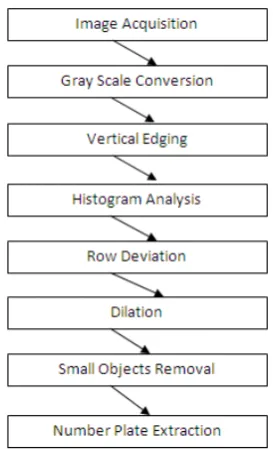
Steps used in 1st approach are as follows as shown in figure 2:
3.1.1 Image Acquisition
An image is captured using digital camera and captured image is acquired in Matlab & then converted in gray scale image.
3.1.2 Vertical Edging
Vertical mask of sable is used for extracting & locating number plate within image. If the image is not very much skewed, vertical edge detection provides good results [3].
3.1.3 Histogram Analysis of bit density
To examine bit density of rows number of ones is calculated for each row & presented through vertical projection. Vertical projection is a graph with two axes. Vertical axis shows the rows of the image, and horizontal axis depicts the number of white pixels in each row.
3.1.4 Row Deviation
Headlights & background of the vehicle (such as trees) can have vertical edges as well; therefore they can also be selected as candidate regions in the previous step. Row deviation is found to prevent this. Number plates are usually located in middle or offset on the vehicle’s bumper so find the number of deviations between “ones” and “zeros” for each row within it 80% middle columns.
3.1.5 Dilation
The image is dilated to connect characters of plate & making skeleton of the number plate. For this morphological operator is used. The resulting image of vertical edges is dilated horizontally in first attempt and dilated vertically in second attempt.
3.1.6 Removing small Objects and Median Filtering
All those regions which have pixels less then P-pixels are removed. In this way there will be only single object in the image which is the location of number plate. Next, 1x15 median filter is applied on the image to make smooth skeleton of the number plate.
3.1.7 Number Plate Extraction
Image after median filtering is multiplied by grey scale image & then by applying horizontal and vertical scanning number plate is cropped and extracted.
3.2 2nd Approach
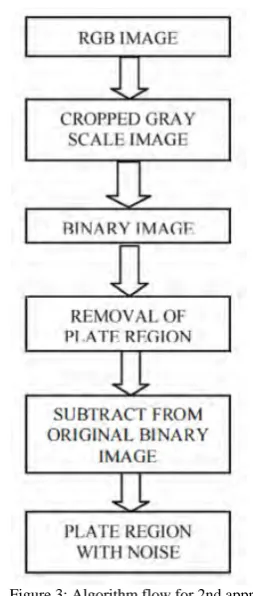
Steps used in 2nd approach are as follows as shown in figure 3: 3.2.1 Gray Scale Conversion and cropping of image
Image is converted into gray scale image and then cropped by removing 60 rows and 180 columns from each size so that we removed the boundary regions from captured image ,based on the assumption that the license plate region is located towards the centre of the image.
3.2.2 Binary Conversion
Figure 3: Algorithm flow for 2nd approach
3.2.3 Removal of less connected components
Now the connected components of size less than or equal to the alpha-numeric character size used in the license plate are removed from the binary plate.
3.2.4 Subtract from original binary image
The next step is to subtract the binary image matrices of step 3.2.3 from the binary image matrices of step 3.2.2. This yields only those components which are less than or equal to the characters used in the license plate. 3.2.5 Noise Removal
Now noise is reduced by removing very small connected white pixels from the image. 3.2.6 Row Profile of the image
Next, the row profile of the image is found by taking the sum of elements in each row of the matrix of the binary image. The region corresponding to the rows of the license plate have characteristic high amplitude. The threshold was set to 65% of the maximum, found by trial and error method.
3.2.7 Column Profile of the image
By above step, we have the rows of the most probable license plate region. The next step is to analyze the columns corresponding to these rows. For that we plot the column profile by taking the sum of elements in each column. The column profile is also passed through a threshold value 50% of maximum.
3.2.8 Plate Region Extraction
Now we have both the row range and the column range of the most probable number plate region and we extract it from the image.
3.3 3rd Approach
Figure 4: Algorithm flow for 3rd approach
3.3.1 Binary conversion
First Image captured from the camera is converted to the binary image consisting of only 1’s and 0’s. 3.3.2 Smearing Algorithm
Smearing algorithm is used to find the plate region. Smearing is a method for the extraction of text areas on a mixed image. With the smearing algorithm, the image is processed along vertical and horizontal runs (scan-lines). If the number of white pixels is less than a desired threshold or greater than any other desired threshold, white pixels are converted to black. In this system, threshold values are selected as 10 and 100 for both horizontal and vertical smearing.
3.3.3 Dilation
After smearing, a morphological operation, dilation, is applied to the image for specifying the plate location. 3.3.4 Plate Region Extraction
To find the exact region and eliminate the other regions, some criteria tests are applied to the image by smearing and filtering operation. After obtaining plate location, region involving only plate is cut.
3.4 4th Approach
Steps used in the 4th approach are as follows as shown in figure 5:
3.4.1 Gray Scale Conversion
Input RGB image is converted to gray scale and the 8 bit gray value is calculated. 3.4.2 Noise Reduction
Median filtering technique is used to reduce the salt and pepper noise. A 3 x 3 mask is used to get the neighbors of a pixel and their corresponding gray value.
3.4.3 Contrast Enhancement using Histogram Equalization
By using histogram enhancement technique contrast of an image is enhanced. 3.4.4 Plate Localization
The basic step in recognition of vehicle number plate is to detect the plate size. In general number plates are rectangular in shape. Hence detection of the edges of the rectangular plate is necessary. Mathematical morphology is used to detect that region. After morphological filtering the four vertexes coordinates of the last selected region are determined and extract the number plate.
4. Character Segmentation
In the 1st approach characters & digits of the plate are segmented and each is saved as different image while in 2nd approach following steps are used for character segmentation:
1) Firstly, image is filtered for enhancing the image and removing the noises and unwanted spots.
2) Then dilation operation is applied to the image for separating the characters from each other if the characters are close to each other.
3) Then horizontal and vertical smearing are applied for finding the character regions.
4) The next step is to cut the plate characters. It is done by finding starting and end points of characters in horizontal direction.
5 . Character Recognition
For recognition of characters template matching is used. In the 1st approach, for matching the characters with stored characters, input images must be equal sized with the stored characters. In the template matching each input character of the plate is correlated with all templates, then from the templates that character is selected which has highest value of correlation coefficient with input character.
2nd approach for character recognition uses the following steps:
1) The characters are normalized to refine the characters into a block containing no extra white spaces in all the four sides of a character
2) For matching the characters with the database, input images must be equal-sized with the database characters.
3) Next step is Template matching .It is an effective algorithm for recognition of characters. The character image is compared with the ones in the database and the best similarity is measured.
4) To measure the similarity and find the best match, a statistical method correlation is used. Correlation is an effective technique for image recognition which was developed by Horowitz [9].
6. Conclusion
Real time and efficient method for Vehicle Number recognition is proposed. Firstly extraction of plate location, then separation of the plate characters individually by segmentation and finally template matching is applied with the use of correlation for recognition of plate characters.
7. References
[1] "Automatic car registration plate recognition using fast hough transform", Security Technolog. 1997. Proceedings. The Instituteof Electrical and Electronics Engineers 31 ,( Annual 1997 International Carnahan Conference on, pp. 209-218, 1997.
[2] D.G. Bailey, D. Irecki, B.K. Lim and L. Yang “Test bed for number plate recognition applications”, Proceedings of First IEEE International Workshop on Electronic Design, Test and Applications ( DELTA’02 ), IEEE Computer Society, 2002.
[3] A. Tahir, H. Adnan Habib, M. Fahad Khan “License Plate Recognition Algorithm for Pakistani License Plates,” Canadian Journal on Image Processing and Computer Vision Vol. 1, No. 2, pp 30-36, April 2010.
[4] M.Horowitz, “Efficient use of a picture correlator” J. Opt. Soc. Am, vol.47, pp.327, 1957.
[5] Shoaib Rehman Soomro, Mohammad Arslan Javed, Fahad Ahmed Memon, “Vehicle number recognition system for automatic toll tax collection”, Robotics and Artificial Intelligence (ICRAI), 2012 International Conference.
[6] Rajesh Kannan Megalingam, Prasanth Krishna, Pratheesh somarajan, Vishnu A Pillai, Reswan VI Hakkim, “Extraction of License Plate Region in Automatic License Plate Recognition”, 201O International Conference on Mechanical and Electrical Technology (ICMET 2010)
[7] D.G. Bailey, D. Irecki, B.K. Lim and L. Yang ,“Test bed for number plate recognition applications”, Proceedings of First IEEE International Workshop on Electronic Design, Test and Applications ( DELTA’02 ), IEEE Computer Society, 2002.
[8] Sourav Roy, Amitava Choudhury, Joydeep Mukherjee, “ An Approach towards Detection of Indian Number Plate from Vehicle”, International Journal of Innovative Technology and Exploring Engineering (IJITEE), Volume-2, Issue-4, March 2013