Free vibration analysis of functionally
graded skew plates with circular cutouts
Jyoti Vimal1
1
Research Scholar, Department of Mechanical Engineering, Motilal National Institute of Technology, Allahabad, India
R K Srivastava2, A D Bhatt3
2,3
Professor, Department of Mechanical Engineering, Motilal National Institute of Technology, Allahabad, India [email protected]
Abstract:
In this paper, free vibration analysis of functionally graded skew plates with circular cutouts is studied. The free vibration analysis is based on the finite element approach using Ansys. The functionally graded materials (FGMs) are assumed to be graded aross their thicknesses according to a power law distribution of the volume fractions and the Poisson’s ratio is taken as constant. Convergence study with respect to the number of nodes has been carried out and the results are compared with those from past investigations available in the literature. The effects of cutout, cutout size, volume fraction index, boundary conditions and thickness ratio on the natural frequencies is studied.
Key words: functionally graded materials, skew plates, multiple circular cutouts
1. Introduction:
Functionally graded materials (FGM) are a class of composite materials that were first proposed by Bever and Duwez [1] in 1972. In a typical FGM plate the material properties continuously vary over the thickness direction by mixing two different materials [2], usually ceramic and metal. Ferreira and Batra [3] provided a global collocation method for natural frequencies of FG plates by a meshless method with first order shear deformation theory. Reddy [4] presented a theoretical formulation and finite element models for FGPs based on the third-order shear deformation theory. Free vibration analysis of laminated composite plates with elastically restrained edges using FEM is studied by Sharma et al. [6]. The governing equations employed are based on the first order shear deformation theory including the effects of rotary inertia. Hiroyuki Matsunaga [7] studied the natural frequencies and buckling of FGM’s plates by taking into account the effects of transverse shear and normal deformations and rotary inertia. For plates with cutouts, Chai [8] presented finite element and some experimental results on the free vibration of symmetric composite plates with central hole. As a result, we present the finite element solution for the functionally graded skew plate with circular cutouts. NG, et al [9], dealt with the parametric resonance of FG rectangular plates under harmonic in plane loading. Huang and Sakiyama [10] proposed an approximate method for analyzing the free vibration of rectangular plates with different cutouts. Vibrations problems of FGM plates can be found in Batra and Jin [11], Vel and Batra [12], Zenkour [13], Roque et al. [14] and Cheng and Batra [15].
Hence, this paper aims at utilizing the finite element method in order to
i) Find the natural frequency of FG skew plates with circular cutouts for various boundary conditions and comparing the results with those in the literature.
ii) Study the effect of skew angle, volume fraction exponent, cutout size, and length-to- thickness ratios on the natural frequency are also examined in detail.
2. Functionally Graded Material Properties
A functionally graded plate made from a mixture of two material phases i.e. a metal and a ceramic as shown in fig. 1. The material property is to be graded through the thickness according to a Power-Law distribution that is
f m c
m
P
P
V
P
z
P
(
)
(
)
(1a)0
,
n
h
z
V
n
f (1b)
Fig. 1. Geometry of a functionally graded skew plate with circular cutouts.
3. Mathematical Formulation
Figure 1 shows the geometry of a functionally graded skew plate. Considering the first order shear deformation theory, the displacement fields are expressed as follows [4].
)
,
,
(
)
,
,
,
(
)
,
,
(
)
,
,
(
)
,
,
,
(
)
,
,
(
)
,
,
(
)
,
,
,
(
0 0 0t
y
x
w
t
z
y
x
w
t
y
x
z
t
y
x
v
t
z
y
x
v
t
y
x
z
t
y
x
u
t
z
y
x
u
y x
(2)where
u
0,v
0 andw
0 denote the displacements of the mid-plane in x, y and z direction, and
x and
y represent the rotations of the transverse normal about the y- and x- axis respectively. Note thatz
u
=
x,z
v
=
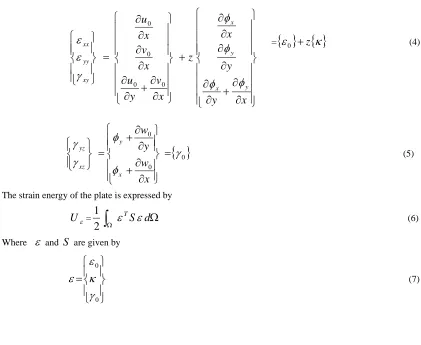
y (3)The strain components at any point can thus be expressed as,
=
0
z
(4)
0 0 0
x
w
y
w
x y xz yz (5)The strain energy of the plate is expressed by
U
=
S
d
T
2
1
(6)
Where
andS
are given by
0 0
(7)S
=
55 45 45 44 66 26 16 66 26 16 26 22 12 26 22 12 16 12 11 16 12 11 66 26 16 66 26 16 26 22 12 26 22 12 16 12 11 16 12 110
0
0
0
0
0
0
0
0
0
0
0
0
0
0
0
0
0
0
0
0
0
0
0
S S S SA
A
A
A
D
D
D
B
B
B
D
D
D
B
B
B
D
D
D
B
B
B
B
B
B
A
A
A
B
B
B
A
A
A
B
B
B
A
A
A
=
SA
D
B
B
A
0
0
0
0
(8)In which the extensional Aij, Coupling Bij, bending Dij, and transverse shear S ij
A
stiffness are defined as(9)
Where
Aij, Bij, and Dij, are defined for i,j = 1,2,6 and S ij
A
is defined for i,j = 4,5. K denotes the transverse shearcorrection coefficient and is taken as K =5/6 for the isotropic material. The elastic coefficient
Q
ij is given by,
1
212
E
Q
Q
12
Q
11,
Q
22
Q
11,)
1
(
2
66 5544
E
Q
Q
Q
. (10)As Young’s modulus E and Poisson ratio
vary through the thickness according to Eq. (1), the elastic coefficient is a function of position z.4. Results and Discussion
The convergence study of the first eight non dimensional fundamental frequencies is tested in Tables 1 for the functionally graded skew plates with clamped edges. In order to show the accuracy of methodology used for free vibration analysis of FG skew plates, the fundamental natural frequencies of skew plates are compared with the solutions presented by Zhao et al [5].
Table 1: Convergence study with respect to the results given by [5] for a isotropic skew plate with the volume fraction index n =1, skew angle α=30 and a/h=10 (fully clamped for external boundaries)
M=N c c
E
h
a
2
=1 2 3 4 5 6 7 84 11.6315 20.2138 25.5442 28.8821 32.6308 38.3235 38.7105 40.1690 6 10.9646 18.5179 23.3028 26.0632 32.505 34.6819 34.7961 38.0622
8 10.7919 18.1017 22.7263 25.3220 32.460 33.4943 33.5394 37.2882
10 10.7131 17.9502 22.4748 25.0519 32.4413 33.0639 33.0842 36.6647 12 10.6803 17.8705 22.3765 24.9217 32.4324 32.8389 32.8558 36.4371 14 10.6564 17.8209 22.3251 24.8473 32.4262 32.7211 32.7477 36.3335 16 10.6237 17.7678 22.2604 24.7605 32.4200 32.5865 32.6007 36.2051 18 10.4828 17.4507 21.8336 24.2539 31.8382 31.8639 32.4130 35.3284 20 10.4749 17.4375 21.8097 24.2327 31.8037 31.8311 32.4094 35.2823
[5] 10.511 17.542 21.954 24.354
The comparison of the results for the non dimensional fundamental frequency for clamped Al/ZrO2 FG skew plates with length-to-thickness ratio, a/h =10 and skew angle, α =30 and the volume fraction exponent, n=1 are shown in table 2 and results are compared with the Zhao et al. [5]. Table 3 shows the results of non dimensional frequencies of FG skew plates for the different values of radius to length ratio, r /a =0.05, 0.1, 0.2, 0.25. From the table it is clear that the non dimensional fundamental frequency of the skew plate decreases by increasing the radius ratio of the hole.
/22 / 2 / 2 /
2
,
dz
,
,
1
,
,
h h ij S ij h h ij ij ijij
B
D
Q
z
z
dz
A
K
Q
Table 2: Comparison of the non dimensional fundamental frequency
for clamped skew Al/ZrO2 FG plates (a/b =1, a/h =10, α =15, n=1)Table 3: Effect of radius to length ratio on the natural frequencies of FG skew plate with circular cutouts (fully clamped for external boundaries, h/a =0.1, a/b = 1, n = 1, α=15)
Mode r /a
0.05 0.1 0.2 0.25
1 8.8994 9.1146 11.4659 14.0394
2 15.9718 15.3882 14.5566 15.5901
3 17.7997 16.9982 16.2818 18.1238
4 22.8680 22.6900 21.8389 21.7928
5 27.8194 27.3500 25.4681 25.5442
6 29.2089 30.1334 30.6090 31.1873
7 31.1200 30.3424 33.7360 32.4652
8 31.5282 32.9186 34.7377 36.679
9 34.1620 35.2540 37.8665 41.338
10 35.5657 35.8730 39.5465 41.6949
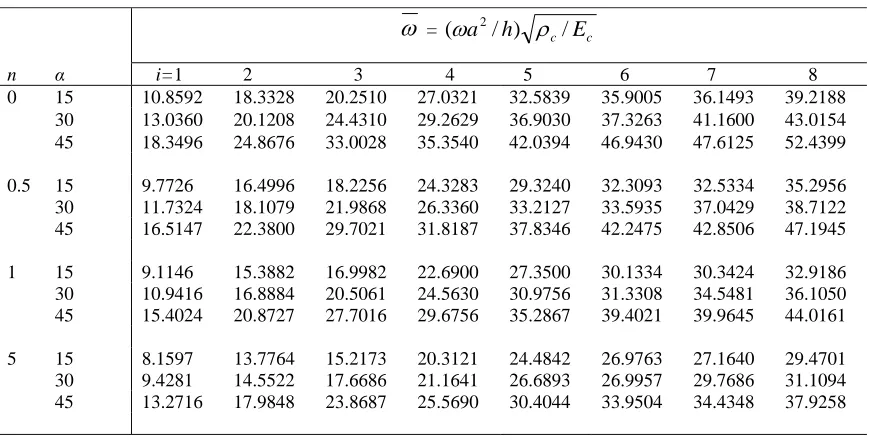
Table 4 show the frequencies of the first eight modes for clamped functionally graded Al/ZrO2 skew plates (a/h =10, a/b = 1 r/a=0.1). The volume fraction exponent n varies between 0 and 5, and the skew angle ranges from 150 to 450. It is observed that, for plates with a fixed volume fraction exponent, the non dimensional frequencies in all eight modes increase with increasing the skew angle, where as for plates with a fixed skew angle, the non dimensional frequencies gradually decreases as the volume fraction exponent increases.
Table 4: Non-dimensionalized frequencies with the skew angle α for a fully clamped Al/ZrO2 plate (a/b=1, a/h=10, r/a=0.1)
=(
a
2/
h
)
c/
E
cn α i=1 2 3 4 5 6 7 8 0 15 10.8592 18.3328 20.2510 27.0321 32.5839 35.9005 36.1493 39.2188
30 13.0360 20.1208 24.4310 29.2629 36.9030 37.3263 41.1600 43.0154 45 18.3496 24.8676 33.0028 35.3540 42.0394 46.9430 47.6125 52.4399
0.5 15 9.7726 16.4996 18.2256 24.3283 29.3240 32.3093 32.5334 35.2956 30 11.7324 18.1079 21.9868 26.3360 33.2127 33.5935 37.0429 38.7122 45 16.5147 22.3800 29.7021 31.8187 37.8346 42.2475 42.8506 47.1945
1 15 9.1146 15.3882 16.9982 22.6900 27.3500 30.1334 30.3424 32.9186 30 10.9416 16.8884 20.5061 24.5630 30.9756 31.3308 34.5481 36.1050 45 15.4024 20.8727 27.7016 29.6756 35.2867 39.4021 39.9645 44.0161
5 15 8.1597 13.7764 15.2173 20.3121 24.4842 26.9763 27.1640 29.4701 30 9.4281 14.5522 17.6686 21.1641 26.6893 26.9957 29.7686 31.1094 45 13.2716 17.9848 23.8687 25.5690 30.4044 33.9504 34.4348 37.9258
Mode Present Zhao et al. [5]
1 8.8361 8.8675
2 15.8770 15.973 3 17.7651 17.883
4 22.6749 22.765
Table 5: The effect of the relative center to center distance on the natural frequencies of fully clamped FG skew plate with two holes ( a/b
=1, h/a=0.1, r/a=0.1 n=0.5, and α =15)
Mode e / b
0.3 0.4 0.5
1 1118.6 1094.3 1070.4
2 1879.9 1915.6 1932.6
3 2138.6 2201.5 2190.8
4 2608.3 2621.3 2652.6
5 3147.4 3290.1 3437.7
6 3544.8 3592.2 3531.4
7 3819.7 3682.8 3695.7
8 3893.6 3801.2 3708.4
9 4186.4 4123.6 3997.6
10 4310.9 4309.9 4472.2
Table 5 shows the effect of relative centre to centre distance on the natural frequencies of functionally graded skew plates with different cutout locations is investigated. It is shown that with increasing the relative distance, for the first mode, the frequencies will decrease.
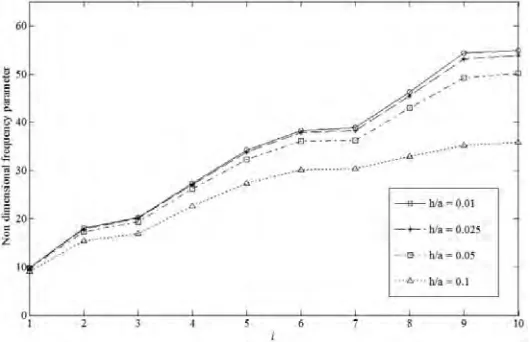
The variation of first ten natural frequencies with the thickness ratio is depicted in Fig. 2.
As the thickness ratios increases the non dimensional frequency decreases. Fig. 3 shows that the variation in the non dimensional frequencies is less when the skew angle varies from 00 to 300, but the variation in the non dimensional frequencies is more when the skew angle rises from 300 to 450. The variation in frequencies in the FG skew plates with different volume fraction exponents also increase as the skew angle increases.
Fig.2 Effect of variation of thickness ratio and number of layers on the first eight natural frequencies.
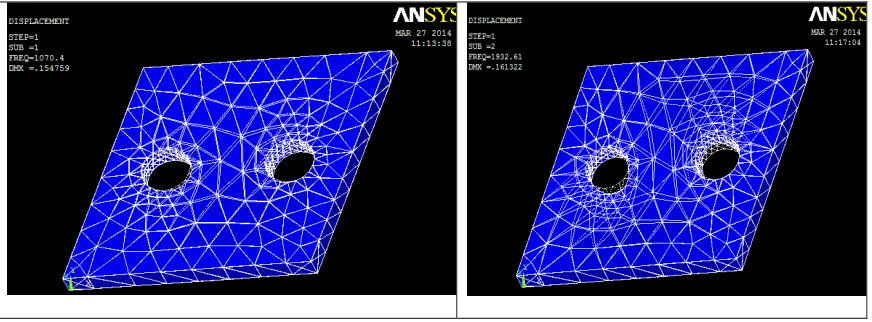
Fig. 4 First four mode shapes of functionally graded skew plates with two circular cutouts (n=0.5, h/a=0.1, a/b=1, r/a=0.1, e/b=0.5)
The first four mode of FG skew plate with two circular hole for n=0.5, h/a=0.1, a/b=1, r/a=0.1, e/b=0.5 is shown in Fig. 4 and Fig. 5 shows the response of FGM skew plates with three circular cutouts.
Fig. 5 First four mode shapes of functionally graded skew plates with three circular cutouts
5. Conclusion
References:
[1] Bever M.B. and Duwez P.E. Gradients in composite materials. Materials Science and Engineering, 10(0):1 – 8, 1972.
[2] Miyamoto Y., Kaysser W.A., Rabin B.H., Kawasaki A., and Ford R.G.. Functionally Graded Materials: Design, Processing and Applications. Kluwer Academic Publishers, 1999.
[3] Ferreira A. J. M., Batra R. C., Roque C. M. C., Qian L. F., and Jorge R. M. N.. Natural frequencies of functionally graded plates by a meshless method, Composite Structure, 75:593–600, 2006.
[4] Reddy J.N., Analysis of functionally graded plates, International Journal for Numerical Methods in Engineering 47 (2000)663–684. [5] Zhao X., Lee Y.Y, Liew K.M, Free vibration analysis of functionally graded plates using the element-free kp-Ritz method, Journal of
Sound and Vibration 319 (2009) 918–939.
[6] Sharma A.K., Mittal N.D., Free vibration analysis of laminated composite plates with elastically restrained edges using FEM, Central European Journal of Engineering, 3(2) (2013) 306-315.
[7] Hiroyuki Matsunaga, Free Vibration and Stability of Functionally Graded Plates According to a 2-D Higher-Order Deformation Theory, Int. J. of Composite Structures 82 (2008), pp. 499-512.
[8] Chai B. G., Free Vibration of Laminated Plates with a Central Circular Hole, Journal of Composite Structures 35 (1996), pp. 357-368. [9] NG T Y, Lam K M. Effect of FGM materials on the parametric resonance of plate Structure, Comput. Meth Appl. Mech. Eng, 2000,
190: 953-962.
[10] Huang M, Sakiyama, Free vibration analysis of rectangular plates with variously shape hole, Journal of Sound and Vibration, 1999, 226: 769-786.
[11] Batra R.C. and Jin J, Natural frequencies of a functionally graded anisotropic rectangular plate. Journal of Sound and Vibration, 282(1-2):509 – 516, 2005.
[12] Vel S. S. and. Batra R. C, Three-dimensional exact solution for the vibration of functionally graded rectangular plates. Journal of Sound and Vibration, 272:703–730, 2004.
[13] Zenkour A.M, A comprehensive analysis of functionally graded sandwich plates: Part 2–buckling and free vibration. International Journal of Solids and Structures, 42(18-19):5243 – 5258, 2005.
[14] Roque C.M.C., Ferreira A.J.M., and Jorge R.M.N, A radial basis function approach for the free vibration analysis of functionally graded plates using a refined theory. Journal of Sound and Vibration, 300(3-5):1048 – 1070, 2007.
![Table 1: Convergence study with respect to the results given by [5] for a isotropic skew plate with the volume fraction index n =1, skew angle α=30 and a/h=10 (fully clamped for external boundaries)](https://thumb-us.123doks.com/thumbv2/123dok_us/9666914.1494574/3.612.95.503.468.644/convergence-respect-results-isotropic-fraction-clamped-external-boundaries.webp)