*Corresponding author, E-mail: [email protected]
EFFECT OF PLANT GROWTH REGULATORS AND PINCHING ON BIOCHEMICAL
CHANGES AND PRODUCTIVITY OF SAFED MUSLI
JAGMEET KAUR*1, JASDEEP KAUR2 AND SUNITA SHARMA1
1Department of Plant Breeding Genetics, 2Department of Botany, Punjab Agricultural University, Ludhiana
Received on 18 May, 2009, Revised on 25 Sept., 2009
SUMMARY
The biochemical changes and productivity of Chlorophytum (safed musli) were studied by the use of PGRs and pinching of inflorescence. The experiment was planned in split plot design. Treatments in main plot consist of sowing of one, two and three roots per hill. The treatments in sub plots were control, manual pinching of inflorescence (soon after its emergence), exogenous application of NAA @ 50 and
100 µµµµµg ml-1 and ethrel @ 250 and 500 µµµµµg ml-1 at 30 and 40 days after sowing (DAS). During growth
period (40 and 70 DAS) photosynthetic efficiency in terms of total chlorophyll content and Hill reaction activity was found to be maximum in sowing of three roots per hill and pinched plants followed by the foliar application of NAA 100 µµµµµg ml-1. Total soluble sugars, total soluble proteins and saponin content were maximum with three roots per hill and NAA 100 µµµµµg ml-1. Sowing of one root per hill and ethrel treated plants showed minimum change in photosynthetic efficiency and biochemical parameters.
Key words: Biochemical constituents, growth regulators, pinching of inflorescence, safed musli.
therapeutic importance, musli tubers are the major constituents of more than 100 Ayurvedic formulations prescribed against general debility (Singh and Chauhan 2003). The economic part of the herb is root. Peeled and dried musli tubers are considered as the wonder drug in Ayurvedic systems of medicine due to its aphrodisiac properties. The saponin is considered to be potent medicinal compound and is found in the tubers (Kothari and Singh 2001). The Chlorophytum roots having higher saponin content have high demand in international drug market (Manjunatha et al. 2004).
Plant growth regulators are well known for their role in plant growth and development. The use of plant growth regulators for improving vegetative growth, yield and quality in various crop plants has been extensively studied (Malik 1995). Auxins and ethylene are well known for their role in plant physiology. Auxins promote cell division and enlargement and in turn promote root growth. They INTRODUCTION
Medicinal plants as a group encompass a huge number of plant species that are used in Homeopathy and various other Indian systems of medicine such as Ayurveda, Siddha and Unani. These days even the international trade is looking to procure medicinal plant materials from India for the production of pharmaceutical, neutraceutical and cosmeticeutical preparations. So, in view of the innate Indian strengths which include diverse ecosystems, technical and farming capacity and strong manufacturing sector, the medicinal plant area can become a huge export opportunity after fulfilling the domestic needs.
Chlorophytum (safed musli), a miracle herb, is one
also play central regulatory role in apical dominance and lateral root initiation. Commercial applications of auxins include rooting compounds and herbicides. Ethylene is a volatile hormone. It enhances lateral expansion of cells leading to transverse or isodiametric growth. It also promotes adventitious root formation at low concentration. It was used in the present study to inhibit seed set that affect the root formation in safed musli. Pinching of inflorescence has been found to improve the growth and tuber production (Singh and Chauhan 2003). The treatment basically comprises the removal of the inflorescence.
Information regarding foliar application of plant growth regulators and pinching of inflorescence in relation to biochemical changes and yield improvement in safed musli is rather meagre. The effect of plant growth regulators on the changes in chemical constituents has been worked out in other crops (Tsegaw 2006, Abd El Wahed et al. 2006, Abd El-Wahed et al. 2004. The present study is therefore, attempted to analyze this aspect.
MATERIALS AND METHODS
The investigations were carried out in Chlorophytum
borivilianum during the Kharif season in split plot
design with three replications and eighteen combinations of number of roots planted per hill (one, two and three roots with crown) in main plots and six treatments, viz. control (no pinching and spray), manual pinching of inflorescence and foliar application of ethrel @ 250 and 500 µg ml-1 and NAA @ 50 and 100 µg ml-1 in subplots. The foliar application was conducted twice using a knap sack sprayer. The first application was given at 30 DAS followed by the second at 40 DAS. The observations were recorded during growth period (in leaves) and at harvest (in roots).The photosynthetic activity in terms of chlorophyll content and Hill reaction activity was estimated in the developing leaves at 40 and 70 days after sowing by the methods given by Anderson and Boardman (1964) and Cherry (1973) respectively. The soluble sugar, total soluble proteins and total saponin content were estimated in dry roots at harvest. Total soluble sugars were extracted in 80% ethanol and estimated according to Dubios et al. (1956). Total soluble proteins were estimated by the method of Lowry et al.
(1951),while saponin content was estimated introducing a slight modification in the method given by Obandoni and Ochuko (2001) by extracting dried roots in 20% ethanol. Fresh yield (g) was recorded by taking weights of the freshly harvested roots while processed yield (g) was recorded after peeling and drying the roots.
RESULTS
Total chlorophyll content: The total chlorophyll content
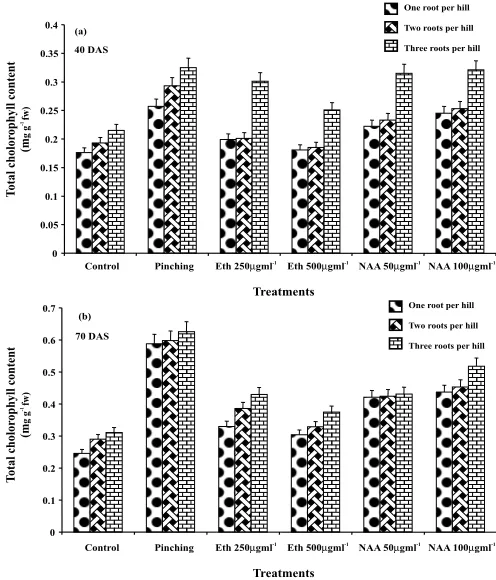
increased from 40 to 70 DAS. The planting of one, two and three roots per hill had a significant effect on the chlorophyll content of leaves. The sowing of three roots per hill recorded maximum chlorophyll content, which was significantly higher than one and two roots per hill and is presented in Fig. 1. This reveals that physiological management of safed musli through the use of PGRs and manual pinching of inflorescence had a significant effect on total chlorophyll content in leaves. It is also apparent from the results that pinching of inflorescence recorded highest chlorophyll content at 40 and 70 DAS
aa aa aa aa aa aa aa aa aa bb bb bb bb bb bb bb bb bb aa aa aa aa aa aa aa aa aa aa aa aa aa bb bb bb bb bb bb bb bb bb bb bb bb bb aa aa aa aa aa aa aa aa aa bb bb bb bb bb bb bb bb bb aa aa aa aa aa aa aa aa aa bb bb bb bb bb bb bb bb bb aa aa aa aa aa aa aa aa aa aa aa bb bb bb bb bb bb bb bb bb bb bb aa aa aa aa aa aa aa aa aa aa aa bb bb bb bb bb bb bb bb bb bb bb aa aa aa aa aa aa aa aa aa aa aa aa aa aa aa aa aa aa aa aa aa aa aa aa aa aa aa aa aa aa aa aa aa aa aa aa aa aa aa aa aa aa aa aa aa aa aa aa aa aa aa aa aa aa aa aa aa aa aa aa aa aa aa aa aa aa aa aa aa aa aa aa aa aa aa aa aa aa aa aa aa aa aa aa aa aa aa aa aa aa aa aa aa aa aa aa aa aa aa aa aa aa aa aa aa aa aa aa aa aa aa aa aa aa aa aa aa aa aa aa aa aa aa aa aa aa aa aa 0 0.05 0.1 0.15 0.2 0.25 0.3 0.35 40 DAS
70 DAS 0.4
Control Pinching Eth 250 gmlµ -1 Eth 500µgml-1 NAA 50µgml-1 NAA 100µgml-1
Treatments Total cholor ophyll content (m g g fw) -1 (a) aa aa aa aa aa aa aa aa bb bb bb bb bb bb bb bb aa aa aa aa aa aa aa aa aa aa aa aa aa aa aa bb bb bb bb bb bb bb bb bb bb bb bb bb bb bb aa aa aa aa aa aa aa aa aa aa bb bb bb bb bb bb bb bb bb bb aa aa aa aa aa aa aa aa bb bb bb bb bb bb bb bb aa aa aa aa aa aa aa aa aa aa aa bb bb bb bb bb bb bb bb bb bb bb aa aa aa aa aa aa aa aa aa aa aa bb bb bb bb bb bb bb bb bb bb bb aa aa aa aa aa aa aa aa aa aa aa aa aa aa aa aa aa aa aa aa aa aa aa aa aa aa aa aa aa aa aa aa aa aa aa aa aa aa aa aa aa aa aa aa aa aa aa aa aa aa aa aa aa aa aa aa aa aa aa aa aa aa aa aa aa aa aa aa aa aa aa aa aa aa aa aa aa aa aa aa aa aa aa aa aa aa aa aa aa aa aa aa aa aa aa aa aa aa aa aa aa aa aa aa aa aa aa aa aa aa aa aa 0 0.1 0.2 0.3 0.4 0.5 0.6 0.7 a b
One root per hill
Two roots per hill
aa aa
Three roots per hill a
b
One root per hill Two roots per hill
aa aa
Three roots per hill
(b) Total cholor ophyll content (m g g fw) -1
Control Pinching Eth 250 gmlµ -1
Eth 500µgml-1
NAA 50µgml-1
NAA 100µgml-1
Treatments
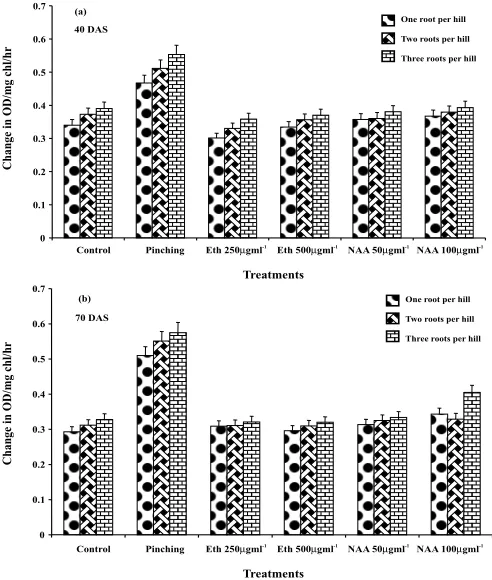
ml-1 showed differential behavior at both the growth stages. At 40 DAS, Hill reaction activity of NAA (100
µg ml-1) in interaction with three roots per hill was statistically on par with the control of the same (Fig. 2). On the contrary, NAA (100 µg ml-1) in interaction with one and two roots per hill depicted an increased Hill reaction activity over control. At 70 DAS, NAA (100 µg ml-1) in interaction with one, two and three roots exhibited an increased Hill reaction activity over the control of one, two and three roots per hill. Ethrel at both the concentrations had a non-significant effect over control.
Total soluble sugars: The treatments attempted in the
investigation had a significant effect on accumulation of total soluble sugar in safed musli. The maximum sugar accumulated with NAA (100 µg ml-1) in sowing of one, two and three roots per hill (3.215, 4.078 and 4.920 mg g-1 dw) over control of one, two and three roots per hill,
viz. 1.360, 2.152 and 2.771 mg g-1 dw respectively (Fig.
3). However, manual pinching of inflorescence and NAA (50 µg ml-1) in sowing of one, two and three roots per hill respectively recorded higher sugar content than control (Fig. 3). Ethrel (250 µg ml-1) treatment showed lowest accumulation of sugar content.
in one, two and three roots per hill, viz. 0.257, 0.293 and 0.325 mg g-1 fw and 0.588, 0.598 and 0.626 mg g-1 fw respectively followed by NAA 100 µg ml-1 (0.245, 0.253 and 0.321 mg g-1 fw and 0.437, 0.488 and 0.518 mg g-1 fw) at 40 and 70 DAS respectively. Ethrel treated plants exhibited low chlorophyll content. However, the lowest total chlorophyll content was observed in control plants at both the growth stages.
Hill reaction activity: Hill reaction activity was
estimated at 40 and 70 DAS and expressed as ∆OD mg-1 chl / hr. In general Hill reaction activity followed a similar trend as that of chlorophyll content. Hill activity increased from 40 to 70 DAS (Fig. 2). It is conspicuous from the figures that pinching of inflorescence recorded maximum Hill reaction activity in sowing of one, two and three roots per hill at 40 (0.467, 0.511 and 0.545 ∆O.D. mg-1 chl hr-1) and 70 DAS (0.510, 0.551 and 0.575 ∆O.D. mg-1 chl hr-1) which was significantly better than all the other treatments attempted. However, NAA 100 µg
aa aa aa aa aa aa aa aa aa aa bb bb bb bb bb bb bb bb bb bb aa aa aa aa aa aa aa aa aa aa aa aa aa aa bb bb bb bb bb bb bb bb bb bb bb bb bb bb aa aa aa aa aa aa aa aa aa bb bb bb bb bb bb bb bb bb aa aa aa aa aa aa aa aa aa aa bb bb bb bb bb bb bb bb bb bb aa aa aa aa aa aa aa aa aa aa bb bb bb bb bb bb bb bb bb bb aa aa aa aa aa aa aa aa aa aa bb bb bb bb bb bb bb bb bb bb aa aa aa aa aa aa aa aa aa aa aa aa aa aa aa aa aa aa aa aa aa aa aa aa aa aa aa aa aa aa aa aa aa aa aa aa aa aa aa aa aa aa aa aa aa aa aa aa aa aa aa aa aa aa aa aa aa aa aa aa aa aa aa aa aa aa aa aa aa aa aa aa aa aa aa aa aa aa aa aa aa aa aa aa aa aa aa aa aa aa aa aa aa aa aa aa aa aa aa aa aa aa aa aa aa aa aa aa aa 0 0.1 0.2 0.3 0.4 0.5 0.6 0.7 aa aa aa aa aa aa aa aa aa bb bb bb bb bb bb bb bb bb aa aa aa aa aa aa aa aa aa aa aa aa aa aa aa aa bb bb bb bb bb bb bb bb bb bb bb bb bb bb bb bb aa aa aa aa aa aa aa aa aa bb bb bb bb bb bb bb bb bb aa aa aa aa aa aa aa aa aa bb bb bb bb bb bb bb bb bb aa aa aa aa aa aa aa aa aa bb bb bb bb bb bb bb bb bb aa aa aa aa aa aa aa aa aa aa bb bb bb bb bb bb bb bb bb bb aa aa aa aa aa aa aa aa aa aa aa aa aa aa aa aa aaa aaa aaa aaa aaa aaa aaa aaa aaa aaa aaa aaa aaa aaa aaa aaa aaa aaa aaa aaa aaa aaa aaa aaa aaa aaa aaa aa aa aa aa aa aa aa aa aa aa aa aa aa aa aa aa aa aa aa aa aa aa aa aa aa aa aa aa aa aa aa aa aa aa aa aa aa aa aa aa aa aa aa aa aa aa aa aa aa aa aa aa aa aa aa aa aa aa aa aa aa aa aa aa aa 0 0.1 0.2 0.3 0.4 0.5 0.6 0.7
Control Pinching Eth 250 gmlµ -1 Eth 500µgml-1 NAA 50µgml-1 NAA 100µgml-1 Treatments
Control Pinching Eth 250 gmlµ -1 Eth 500µgml-1 NAA 50µgml-1 NAA 100µgml-1 Treatments Change in OD/mg chl/hr Change in OD/mg chl/hr 40 DAS (a) a b
One root per hill
Two roots per hill
aa aa
Three roots per hill
70 DAS ab
One root per hill
Two roots per hill
aa aa
Three roots per hill
(b)
Fig. 2. Hill reaction activity in leaves of safed musli at 40 and 70 DAS as influenced by number of roots and foliar application of PGRs. Vertical line on top of each bar indicate standard error aa aa aa aa aa aa aa bb bb bb bb bb bb bb aa aa aa aa aa aa aa aa aa aa aa bb bb bb bb bb bb bb bb bb bb bb aa aa aa aa aa bb bb bb bb bb aa aa aa aa aa aa aa bb bb bb bb bb bb bb aa aa aa aa aa aa aa aa aa aa aa aa bb bb bb bb bb bb bb bb bb bb bb bb aa aa aa aa aa aa aa aa aa aa aa aa aa bb bb bb bb bb bb bb bb bb bb bb bb bb aaa aaa aaa aaa aaa aaa aaa aaa aaa aaa aaa aaa aaa aaa aaa aaa aaa aaa aaa aaa aaa aaa aaa aaa aaa aaa aaa aaa aaa aaa aaa aaa aaa aaa aaa aaa aaa aaa aaa aaa aaa aaa aaa aaa aaa aaa aaa aaa aaa aaa aaa aaa aaa aaa aaa aaa aaa aaa aaa aaa aaa aaa aaa aaa aaa aaa aaa aaa aaa aaa aaa aaa aaa aaa aaa aaa aaa aaa aaa aaa aaa aaa aaa aaa aaa aaa aaa aaa aaa aaa aaa aaa aaa aaa aaa aaa aaa aaa aaa aaa aaa aaa aaa aaa aaa aaa aaa aaa aaa aaa aaa aaa aaa 0 1 2 3 4 5 6
Control Pinching Eth 250 gmlµ -1 Eth 500µgml-1 NAA 50µgml-1 NAA 100µgml-1 Treatments Total soluble sugars (m g g dw) -1 a b
One root per hill
Two roots per hill
aa aa
Three roots per hill
Fig. 3. Total soluble sugars in safed musli as influenced by number of roots and foliar application of PGRs. Vertical line on top of each bar indicate standard error
Total soluble proteins: Total soluble proteins in the
roots per hill produce more saponins (5%) than all the treatments in one and two roots per hill. Among the PGRs, ethrel 500 µg ml-1 recorded lowest saponin content, viz. 3.3, 3.5 and 3.7% in sowing of one, two and three roots per hill respectively.
Fresh and processed yield (g/plant): Fresh and
processed yields were found to be significantly higher with the sowing of three roots per hill than sowing of one and two roots per hill (Table 1 and 2). Physiological manipulation of safed musli with foliar application of PGRs significantly influenced the yield. Highest yield was observed with NAA 100 µg ml-1 while the control plants recorded lowest yield. Also the synergism of NAA 100
µg ml-1 with three roots per hill gave best results due to better photosynthetic efficiency and accumulation of photosynthates.
respectively. However NAA 50 µgml-1 recorded higher protein content in one root per hill (1.651 mg g-1 dw) over its control (0.5775 mg g-1 dw).The marked increase was noticed with manual pinching of inflorescence in three roots per hill (2.009 mg g-1 dw) over all the treatments in one root per hill. Ethrel treated plants recorded low protein content over the control. However, the minimum protein content was observed with the control treatment of one root per hill.
Total saponins: Saponin content was estimated from
harvested tubers and expressed in percentage (Fig 5). NAA 100 µg ml-1 increased saponin content of one, two and three roots per hill over control of one, two and three roots per hill. Manual pinching of inflorescence in three roots per hill recorded higher saponins content, viz. 3.9% over all the treatments in one root per hill. Also it can be elucidated that NAA 50 µg ml-1 when applied to three
aa aa aa aa aa aa aa aa aa aa bb bb bb bb bb bb bb bb bb bb aa aa aa aa aa aa aa bb bb bb bb bb bb bb aa aa aa aa bb bb bb bb aa aa aa aa aa aa bb bb bb bb bb bb aa aa aa aa aa aa aa bb bb bb bb bb bb bb aa aa aa aa aa aa aa aa aa aa aa aa aa bb bb bb bb bb bb bb bb bb bb bb bb bb aaa aaa aaa aaa aaa aaa aaa aaa aaa aaa aaa aaa aaa aaa aaa aaa aaa aaa aaa aaa aaa aaa aaa aaa aaa aaa aaa aaa aaa aaa aaa aaa aaa aaa aaa aaa aaa aaa aaa aaa aaa aaa aaa aaa aaa aaa aaa aaa aaa aaa aaa aaa aaa aaa aaa aaa aaa aaa aaa aaa aaa aaa aaa aaa aaa aaa aaa aaa aaa aaa aaa aaa aaa aaa aaa aaa aaa aaa aaa aaa aaa aaa aaa aaa aaa aaa aaa aaa aaa aaa aaa aaa aaa aaa aaa aaa 0 0.5 1 1.5 2 2.5 3 3.5 4 4.5
Control Pinching Eth 250 gmlµ -1 Eth 500µgml-1 NAA 50µgml-1 NAA 100µgml-1 Treatments Total soluble pr oteins (m g g dw) -1 a b
One root per hill
Two roots per hill
aa aa
Three roots per hill
Fig. 4. Total soluble proteins in safed musli as influenced by number of roots and foliar application of PGRs. Vertical line on top of each bar indicate standard error
aa aa aa aa aa aa aa aa bb bb bb bb bb bb bb bb aa aa aa aa aa aa aa aa aa aa bb bb bb bb bb bb bb bb bb bb aa aa aa aa aa aa aa aa aa aa bb bb bb bb bb bb bb bb bb bb aa aa aa aa aa aa aa aa aa aa bb bb bb bb bb bb bb bb bb bb aa aa aa aa aa aa aa aa aa aa aa bb bb bb bb bb bb bb bb bb bb bb aa aa aa aa aa aa aa aa aa aa aa aa aa bb bb bb bb bb bb bb bb bb bb bb bb bb aaa aaa aaa aaa aaa aaa aaa aaa aaa aaa aaa aaa aaa aaa aaa aaa aaa aaa aaa aaa aaa aaa aaa aaa aaa aaa aaa aaa aaa aaa aaa aaa aaa aaa aaa aaa aaa aaa aaa aaa aaa aaa aaa aaa aaa aaa aaa aaa aaa aaa aaa aaa aaa aaa aaa aaa aaa aaa aaa aaa aaa aaa aaa aaa aaa aaa aaa aaa aaa aaa aaa aaa aaa aaa aaa aaa aaa aaa aaa aaa aaa aaa aaa aaa aaa aaa aaa aaa aaa aaa aaa aaa aaa aaa aaa aaa aaa aaa aaa aaa aaa aaa aaa aaa aaa aaa aaa aaa aaa aaa aaa aaa aaa aaa aaa aaa 0 1 2 3 4 5 6 7
Control Pinching Eth 250 gmlµ -1 Eth 500µgml-1 NAA 50µgml-1 NAA 100µgml-1
Treatments
Saponin
(%)
a b
One root per hill
Two roots per hill
aa aa
Three roots per hill
Fig. 5. Total Saponin content in safed musli as influenced by number of roots and foliar application of PGRs. Vertical line on top of each bar indicate standard error
Table 1. Fresh yield (g plant-1) as influenced by interaction of number of roots, pinching of inflorescence and foliar application of PGRs.
Treatments
Number of roots Control Manual Ethrel Ethrel NAA NAA
pinching 250µg ml-1 500µg ml-1 50µg ml-1 100µg ml-1
One root per hill 23.3 26.8 25.6 25.7 31 34.8*
Two roots per hill 29.4 30.2 27.9 29.6 32.4 42.4*
Three roots per hill 32.5 40.5* 33.8 36.3 37.7* 50.4*
DISCUSSION
Exogenous application of growth regulators is known to cause changes in hormone directed transport which leads to shifts in level of biochemical constituents and ultimately resulted in changed final yield (Wareing and Phillips 1987). Various research workers have attempted the use of plant growth regulators to improve the biochemical constituents of various crop plants as well.
Sivakumar et al. (2002) studied the effect of foliar application of NAA on yield and biochemical parameters of pearl millet. An increase in chlorophyll content, soluble protein and total sugar content was observed with NAA application. These findings endorse the results of present investigation. Sharma et al. (1982) reported an increase in soluble proteins by IAA in developing pods of groundnut. Similarly, Tagade et al. (1998) reported increase in leaf chlorophyll, seed protein and oil content with IAA concentration up to 100ppm. Kaur and Kaur (2005) while working on soybean studied the effect of seed priming with IAA and TIBA on chlorophyll content, Hill activity and yield components. According to their investigation, seed priming with IAA increased chlorophyll content and Hill reaction activity in seeds and podwall at different stages of development. Rehman (1984) studied the effect of pre sowing treatment with NAA 100 ppm on seed and pod development in Cajanus
cajan. The treatment showed a promotory effect on
total soluble sugars, soluble proteins and free amino acids in the seeds, thus, supporting the results of present study. In another study application of NAA at 100 ppm and
BA at 10 ppm significantly improved total chlorophyll content, total soluble sugars, protein content and volatile oil content of fennel seeds (Menaria1 and Maliwal 2007).
Amin et al. (2007) studied the physiological effect of indole - 3 – butyric acid (25, 50 and 100 mg/l ) and salicylic acid ( 50, 100 and 200 mg/l)as well as their combinations on vegetative growth, photosynthetic pigments content of leaves, yield, quality and some biochemical constituents of onion plants. Increasing concentration of indole - 3 – butyric acid from 25 to 100 mg/l and salicylic acid caused increase in photosynthetic pigments content / leaves, yield and its quality as well as biochemical constituents viz. total soluble sugars, total free amino acids, total phenols and total indoles of onion bulb.
Other plant growth regulators have also been used to alter biochemical constituents in various crops. Bhatia and Kaur (1997) reported that foliar application of humicil and homobrassinolide caused an overall increase in Chl a, b and total chlorophyll content and hill activity in leaves of mungbean. Also humicil and homo brassinosteroid in
Cicer arietinum increased Chl a, b, total chlorophyll, Hill
activity, total soluble proteins and total free amino acid content (Kaur 1996). However, in the present investigation the marked increase in yield by manual pinching of inflorescence over control seems favorable. Kothari and Singh (2003) suggested that periodic removal inflorescence improved fresh and processed yield possibly due to a greater allocation of photosynthates to the sink.
Table 2. Processed yield (g plant-1) as influenced by interaction of number of roots, pinching of inflorescence and foliar application of PGRs.
Treatments
Number of roots Control Manual Ethrel Ethrel NAA NAA
pinching 250µg ml-1 500µg ml-1 50µg ml-1 100µg ml-1
One root per hill 5.8 6.6 6.1 6.4 7.8 9.0*
Two roots per hill 7.5 7.6 7.0 7.4 8.1 10.6*
Three roots per hill 7.8 10.1* 8.2 8.9 9.4* 12.6*
Growth regulators and pinching of inflorescence play an important role in changing the levels of different biochemical constituents leading towards yield improvement was largely due to greater allocation of photosynthates. The results of this study it showed improved efficiency of leaves. This is further attributed that NAA lead to higher accumulation of total soluble sugars, total soluble proteins and saponin content at harvest, causing considerable improvement in quality and yield of safed musli. Therefore, further investigation in this direction needs to be encouraged.
REFERENCES
Abd El- Wahed, M.S.A. and Gamal, El Din M.K. (2004). Stimulation effect of spermidine and stigmasterol on growth, flowering, biochemical constituents and essential oil of chamomile plant (Chamomila recutita L., Rausch). Bulg J Plant Physiol 30: 48-60.
Abd El-Wahed, M.S.A., Amin, A.A. and Rashed, El-Sh.M. (2006). Physiological effect of some bioregulators on vegetative growth, yield and chemical constituents of yellow maize plants. World J Agrial Sci 2: 149-55.
Amin, A.A., Rashad EL-Sh, M. and EL-Abagy, H.M.H. (2007). Physiological effect of indole - 3 - butyric acid and salicylic acid on growth, yield and chemical constituents of onion plants. J. Appl. Sci. Res. 3: 1554-1563.
Anderson, J.M. and Boardman, N.K. (1964). Studies on greening of dark brown bean plants VI. Development of phytochemical activity. Aust. J. Bot. 17: 93-101.
Bhatia, D.S. and Kaur, J. (1997). Effect of homobrassinolide and humicil on chlorophyll content, Hill activity and yield components in mashbean (Vigna radiate L. Wilczek). Phytomorphology 47: 421-26.
Cherry, J.H. (1973). Molecular Biology of Plants – A Text Manual. Columbia University Press: New York, USA.
Dubois, M., Gilles, K.A., Hamilton, J.K., Rober, P.A. and Smith, F. (1956). Calorimetric estimation of carbohydrates by phenol sulphuric acid method. Anal. Chem. 28: 350-56.
Kaur, B. (1996). Effect of IAA and cycocel on growth, development and yield of chickpea (Cicer arietinum L.). MSc thesis, Punjab Agricultural University, Ludhiana, India.
Kaur, J. and Kaur, A. (2005). Efficacy of seed priming with IAA and TIBA on chlorophyll content, Hill activity and yield components in soybean (Glycine max L. Merill). Asian J. Microbiol. Biotech. Env. Sci. 7: 161-64.
Kirtikar, K.R. and Basu, B.D. (1975). Indian Medicinal Plants. (Vol IV), Periodical Experts, New Delhi, India.
Kothari, S.K. and Singh, K. (2001). Evaluation of Safed Musli (Chlorophytum borivilianum Santapau & Fernandes) germplasm. J. Spices Arom. Crops. 40: 147-49.
Kothari, S.K. and Singh, K. (2003). Production techniques for cultivation of Safed Musli (Chlorophytum borivilianum). J. Hortial. Sci. Biotechnol. 78: 261-64.
Lowry, O.H., Rosenburg, R.J., Ferr A.L. and Randall, R.J. (1951). Protein measurements with folin phenol reagent. J. Biol. Chem. 193: 263-66.
Malik, C.P. (1995). Plant Growth Regulators: Software for Plant Development and Crop Productivity. Sectional Presidential Address, 82nd Indian Sci. Cong. Assoc.,
Calcutta, India.
Manjunatha, G., Tyagi, S.K. and Shrinivasan, K. (2004). Safed Musli: A White Gold, Agrobios, Jodhpur, India.
Menaria, B.L. and Maliwal, P.L. (2007). Quality of fennel as influenced by plant density, fertilization and plant growth regulators. Indian J. Plant Physiol. 12: 57-62.
Obandoni, B.O. and Ochuko, P.O. (2001). Phytochemical studies and comparative efficacy of the crude extracts of some homeostatic plants in Edo and Delta states of Nigeria. Global J. Pure Appl. Sci. 8: 203-8.
Rehman, S.I.K. (1984). Effects of certain growth regulators on physiology of pod formation in arhar (Cajanus cajan L. Millsp). M.Sc thesis, Punjab Agricultural University, Ludhiana, India.
Sharma, R., Sharma, B. and Singh, G. (1982). Effects of growth regulators on some biochemical changes during pod development in groundnut. Indian J. Bot. 5: 102-06.
Singh, A. and Chauhan, H.S. (2003). Safed musli (Chlorophytum borivilianum): Distribution, biodiversity and cultivation. J. Med. Arom. Pl. Sci. 26: 712-19.
application of growth regulators biochemical attributes and grain yield pearl millet. Indian J. Plant Physiol. 7: 79-82.
Tagade, R., Deotale, R.D., Sable, S. and Chore, C.N. (1998). Effects of IAA and kinetin on biochemical aspects and yield of soybean. J. Soil Crops 9: 72-75.
Tsegaw, T. (2006). Response of potato to paclobutrazol manipulation of reproductive growth under tropical land. PhD thesis, University of Pretoria, Africa.