Earth Syst. Dynam., 9, 285–297, 2018 https://doi.org/10.5194/esd-9-285-2018
© Author(s) 2018. This work is distributed under the Creative Commons Attribution 4.0 License.
Sensitivity of the tropical climate to an interhemispheric
thermal gradient: the role of tropical ocean dynamics
Stefanie Talento1,2and Marcelo Barreiro1
1Department of Atmospheric Sciences, Institute of Physics, Universidad de la República,
Montevideo, 11400, Uruguay
2Department of Geography, Climatology, Climate Dynamics and Climate Change, Justus Liebig University
of Giessen, 35390 Giessen, Germany
Correspondence:Stefanie Talento ([email protected])
Received: 15 November 2017 – Discussion started: 20 November 2017 Revised: 2 February 2018 – Accepted: 6 February 2018 – Published: 20 March 2018
Abstract. This study aims to determine the role of the tropical ocean dynamics in the response of the climate to extratropical thermal forcing. We analyse and compare the outcomes of coupling an atmospheric general circulation model (AGCM) with two ocean models of different complexity. In the first configuration the AGCM is coupled with a slab ocean model while in the second a reduced gravity ocean (RGO) model is additionally coupled in the tropical region. We find that the imposition of extratropical thermal forcing (warming in the Northern Hemisphere and cooling in the Southern Hemisphere with zero global mean) produces, in terms of annual means, a weaker response when the RGO is coupled, thus indicating that the tropical ocean dynamics oppose the incoming remote signal. On the other hand, while the slab ocean coupling does not produce significant changes to the equatorial Pacific sea surface temperature (SST) seasonal cycle, the RGO configuration generates strong warming in the central-eastern basin from April to August balanced by cooling during the rest of the year, strengthening the seasonal cycle in the eastern portion of the basin. We hypothesize that such changes are possible via the dynamical effect that zonal wind stress has on the thermocline depth. We also find that the imposed extratropical pattern affects El Niño–Southern Oscillation, weakening its amplitude and low-frequency behaviour.
1 Introduction
Paleoclimatic data (Wang et al., 2004), 20th century observa-tions (Folland et al., 1986) and numerical simulaobserva-tions (Chi-ang and Bitz, 2005; Broccoli et al., 2006; K(Chi-ang et al., 2008, 2009; Cvijanovic and Chiang, 2013; Talento and Barreiro, 2016, 2017) have all suggested the capability of extraical thermal forcing to affect different features of the trop-ical climate. While Chiang and Bitz (2005) and Broccoli et al. (2006) were among the first to propose an atmo-spheric bridge mechanism connecting extratropical forcing with a tropical response, by performing experiments with atmospheric general circulation models (AGCMs) thermo-dynamically coupled to a motionless ocean, the other stud-ies deepened the analysis and examined the physical mecha-nisms involved in the remote linkage.
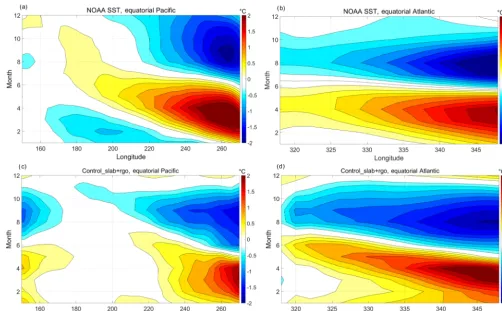
Figure 1.(a, b)De-meaned SST seasonal cycle from NOAA SST data (Smith et al., 2008) in the equatorial Pacific (2◦S–2◦N, 150–270◦E) and Atlantic (2◦S–2◦N, 320–345◦E) respectively.(c, d)De-meaned SST seasonal cycle forControl_slab+rgoin the equatorial Pacific and Atlantic respectively. Contour interval: 0.2◦C.
Talento and Barreiro (2016) use an AGCM coupled to a slab ocean model to quantify the relative roles of the at-mosphere, tropical sea surface temperatures (SSTs) and con-tinental surface temperatures in the ITCZ response to extra-tropical thermal forcing. They find that if the extra-tropical SSTs are not allowed to change, then the ITCZ response strongly weakens (although not negligible), particularly over the At-lantic Ocean and Africa. If, in addition, the land surface temperature over Africa is maintained the ITCZ response completely vanishes, indicating that the ITCZ response to the extratropical forcing is not possible just through purely atmospheric processes, but rather it needs the involvement of either the tropical SST or the continental surface tem-peratures. With the same model configuration, Talento and Barreiro (2017) focus on the South Atlantic convergence zone (SACZ) and show that, during its peak in austral sum-mer, its response to warming in the NH extratropics and cool-ing in the SH extratropics consists of weakencool-ing, mostly due to the NH component of the forcing. Both studies showed strong changes in the tropical band where SST, surface winds and precipitation are strongly coupled. Nevertheless, in these studies important ocean dynamics are missing as the slab
ocean can only simulate the thermodynamic exchange be-tween the atmosphere and the ocean.
Chiang et al. (2008) explore the impact of an ITG on the tropical Pacific climate through simulations performed with an AGCM coupled to a medium-complexity ocean model: a reduced gravity ocean (RGO) model. They find that when the NH is warmer than the SH, the annual mean equatorial zonal SST gradient strengthens, associated with an earlier onset and a later retreat of the seasonal cold tongue together with an intensification during the peak cold season. They also find that El Niño–Southern Oscillation (ENSO) activity is sensitive to the ITG, with small ITG optimal for the devel-opment of ENSO activity.
S. Talento and M. Barreiro: Sensitivity of the tropical climate to an interhemispheric thermal gradient 287
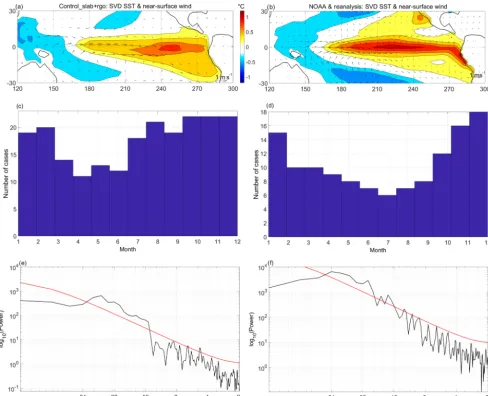
Figure 2. First SVD pattern of SST and near-surface winds in the tropical Pacific Ocean (30◦S–30◦N, 120–300◦E) for the Con-trol_slab+rgoexperiment(a, c, e)and NOAA SST and reanalysis data (b,d,g; Smith et al., 2008; Kalnay et al., 2006).(a, b)Spatial pattern; contour interval 0.2◦C.(c, d)Histogram showing phase-locking to the seasonal cycle.(e, f)Spectral analysis; the red line indicates the red-noise spectrum.
Figure 3.Forcing pattern. The sign convention is positive out of sea. Contour interval 20 W m−2.
of the ITCZ and a weakening of the equatorial zonal SST gradient, caused by cooling (warming) in the western (east-ern) equatorial Pacific, together with the thermocline deep-ening to the east. They note that the energy flux approach proposed in Kang et al. (2008, 2009) and Cvijanovic and Chiang (2013) does not appear to explain the ITCZ shifts in these experiments because even though the northern cross-equatorial energy transport increases with the ice thickness, the mid-latitude transport decreases.
Although most of the simulation studies on extratropical to tropical teleconnections focus on just one ocean model at a time, there is recent literature analysing the subject in a hi-erarchy of ocean model configurations.
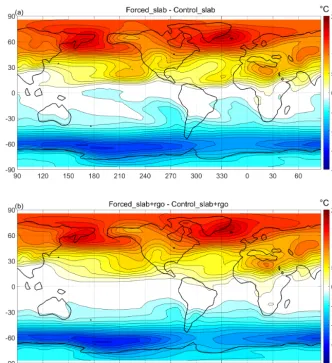
Figure 4.Annual mean anomalies with respect to the control of NSAT for(a)Forced_slaband(b)Forced_slab+rgo. Contour interval 1◦C.
to a slab or to a full oceanic model. They find that with dy-namic ocean heat transport the tropical precipitation response is weaker with, in this case, most of the cross-equatorial heat transport carried out by the ocean and not by the atmosphere. Similar conclusions are obtained by Hawcroft et al. (2017) and Tomas et al. (2016) with different fully coupled mod-els, suggesting that the results are not model specific. In the same direction, Green and Marshall (2017) perform a series of idealized simulations in aqua-planet mode with an AGCM coupled either to a dynamic or to a slab ocean model while an ITG is applied. They find that the oceanic circulation damp-ens the ITCZ shift in response to the ITG by a factor of 4 compared to the case when the ocean circulation is not al-lowed to respond to the forcing. They find that with a dy-namic ocean the mechanical coupling of the tropical atmo-spheric and oceanic energy transport (through Ekman bal-ance) ensures that the ocean circulation always transports energy across the Equator in the same direction as the at-mosphere does, therefore helping offset the imposed thermal contrast and not requiring for the atmosphere to transport as much energy as when the ocean circulation is fixed.
From a theoretical perspective, Schneider (2017) confirms the simulation results and derives a quantitative framework that shows that the Ekman coupling of atmospheric and oceanic energy fluxes dampens the response of the ITCZ and calculates that, in the current climate in the zonal and annual mean, the factor of damping by Ekman coupling is of the order of 3.
To complement the results of the previously mentioned studies here we propose to analyse the tropical response to extratropical thermal forcing in a hierarchy of ocean model configurations, but by using an intermediate-complexity ocean model coupled only in the tropical oceans: an RGO model. These simulations, therefore, represent an additional and intermediate step into understanding the tropical ocean dynamics’ role in the extratropical to tropical communica-tion process.
S. Talento and M. Barreiro: Sensitivity of the tropical climate to an interhemispheric thermal gradient 289
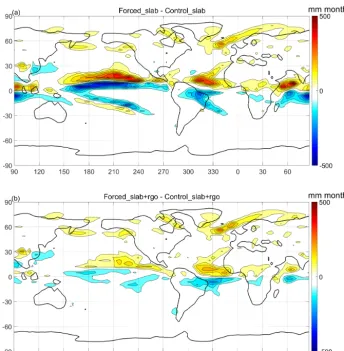
Figure 5.Annual mean anomalies with respect to the control of precipitation for(a)Forced_slaband(b)Forced_slab+rgo. Contour interval 50 mm month−1.
in annual mean, seasonal cycle or ENSO. The summary and conclusions are presented in Sect. 5.
2 Model description
The atmospheric model used in this study is the Abdus Salam International Centre for Theoretical Physics (ICTP) AGCM (Molteni, 2003; Kucharski et al., 2006), which is a full atmospheric model with simplified physics. We use the model version 40 in its eight-layer configuration and T30 (3.75◦×3.75◦) horizontal resolution. The model in-cludes parameterizations of: large-scale condensation, shal-low and deep convection, shortwave radiation (using two spectral bands), longwave radiation (using four spectral bands), surface fluxes of momentum, heat and moisture and vertical diffusion. Present-day boundary surface conditions, orbital parameters and greenhouse forcing are used.
We analyse the outcomes of coupling the AGCM with two ocean models of different complexity. In the first con-figuration the AGCM is coupled with a slab ocean model; a monthly varying ocean heat flux correction (derived from
a previous 30-year model integration with identical settings but with prescribed observed SSTs) is imposed in order to keep the simulated SST close to present-day conditions. In the second configuration, and in order to better reproduce the tropical ocean dynamics, an RGO model is coupled in the tropical region (30◦S–30◦N), while a slab ocean model is applied elsewhere. In this setup an annual-mean ocean heat flux correction is imposed in order to keep the simulated SST close to present-day conditions.
We proceed to describe the RGO model and to validate its results by comparison with observational analogous.
2.1 RGO model formulation and validation
We use an extension of the classical 1.5-layer RGO model, introduced by Cane (1979) to study the ENSO phenomenon. The extension of the model, as in Chang (1994), includes thermodynamics of the upper ocean and allows for the pre-diction of the SST.
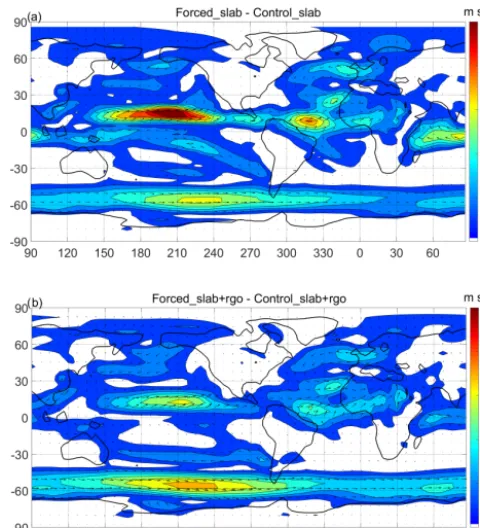
Figure 6. Annual mean anomalies with respect to the con-trol of near-surface (950 hPa) wind for (a) Forced_slab and (b) Forced_slab+rgo. Contour interval 1 m s−1.
Figure 7. Northward atmospheric energy transport for the ex-periments: Control_slab, Control_slab+rgo, Forced_slab and Forced_slab+rgo.
a lower layer of infinite depth in which the velocity must be null so that the kinetic energy is finite. The approximation is reasonable for the tropical ocean because of the existence of a sharp thermocline which inhibits the downward propaga-tion of waves generated in the upper ocean (Zebiak, 1985). To better predict changes of the SST, a linear and homoge-neous frictional layer (assumed to concentrate most of the induced Ekman transport) is added to the model. The sub-surface temperature is parameterized in terms of the thermo-cline depth, the observed annual mean temperature at 50 m
depth (from Levitus, 1982) and the annual mean thermocline depth when the model is forced by observed wind stress.
The resolution of the RGO model is 1◦in latitude and 2◦ in longitude, applied in the 30◦S–30◦N tropical band. The model is run using an anomaly coupling strategy. In this strat-egy, the oceanic and atmospheric components of the model exchange momentum and heat flux anomalies computed rel-ative to their own model annual mean. The modelled anoma-lies are then superimposed on the observed annual mean. Sponge layers of 5◦ width are introduced at the northern and southern boundaries to eliminate artificial coastal Kelvin waves.
A 70-year control simulation in which the AGCM is cou-pled to the RGO in the tropics and to the slab ocean model elsewhere is produced. The last 50 years of the control run are used for averaging and comparison with observational analogues. We use the NOAA Extended Reconstructed SST V3b (Smith et al., 2008) and the near-surface winds from the NCEP/NCAR Reanalysis (Kalnay et al., 2006), for the period 1979–2013.
With the imposed heat flux correction, the annual mean SST in the control simulation strongly resembles the ob-served pattern (not shown). In addition, the model reasonably captures the main characteristics of the seasonal cycle in the equatorial (2◦S–2◦N) Pacific and Atlantic oceans (Fig. 1), although in the equatorial Pacific the de-meaned (annual mean removed) simulated SST seasonal cycle is weaker than in the observations. Also, the Pacific cold tongue is not well developed during SH summer.
The control simulation also reproduces the main mode of variability in the tropical Pacific Ocean quite realistically both in the spatial and temporal domains (Fig. 2; please note that in all the latitude–longitude maps in the manuscript the land and sea mask used by the model is the one depicted). The first coupled pattern arising from a singular value de-composition (SVD) of the monthly SST and surface wind characterizes ENSO and explains 81 % (62 %) of the vari-ability in the observations (simulation). The simulated pat-tern is weaker than the observed, with the SST anomaly max-imum located too far eastward. The phase-locking to the sea-sonal cycle of the simulated pattern peaks during the end of the calendar year as it does in the observations, but its distri-bution is more uniform throughout the year. Both simulated and observed spectra show statistically significant peaks rel-ative to a red-noise null hypothesis from 16 to 60 months.
2.2 Experimental design
S. Talento and M. Barreiro: Sensitivity of the tropical climate to an interhemispheric thermal gradient 291
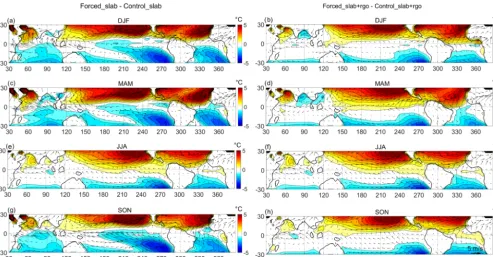
Figure 8.Seasonal SST and near-surface wind anomalies with respect to the control forForced_slab(a, c, e, g)andForced_slab+rgo(b, d, f, h).(a, b)December–February;(c, d)March–May;(e, f)June–August;(g, h)September–November. Contour interval 0.5◦C.
et al. (2008) and in Talento and Barreiro (2016), and it is intended to represent the asymmetric temperature changes associated with glacial–interglacial and millennial-scale cli-mate variability as well as the asymmetric SST pattern char-acteristic of the global warming trend. The forcing pattern is superimposed on a background state and is obtained as ex-plained in Talento and Barreiro (2016).
The forcing pattern is shown in Fig. 3, in which sign con-vention is positive out of sea and, therefore, positive val-ues of the forcing could be considered to represent a situa-tion where the atmosphere is dry and colder than the ocean below it so that there is a strong ocean-to-atmosphere net heat flux. This forcing generates a near-surface tempera-ture (NSAT) anomaly response of up to 16◦C (−20◦C) over the north Atlantic Ocean at 70◦N (over the Ross Sea), as shown in Fig. 4. For comparison, in a climate simulation of the last 21 000 years (TRACE2k experiment, He, 2011) anomalies of about −10◦C (6◦C) are obtained over the North Atlantic (Antarctica) during Heinrich stadial 1, 18 000 to 15 000 years ago.
As mentioned before we use two ocean models. When the AGCM is coupled to a slab ocean model, the experiments are namedControl_slabandForced_slab. If an RGO is used in the tropical band while the slab ocean model is applied elsewhere, the corresponding experiments are named Con-trol_slab+rgoandForced_slab+rgo. In all the simulations the model was run for 70 years and the last 50 are used for averaging. Running the simulations for 70 years proved to be more than enough to reach the equilibrium; a timescale of
10 years was estimated to be the time span necessary for ad-justment. In Table 1 we summarize the experiments. All the data are publicly available in Talento and Barreiro (2018).
3 Results
First we analyse and compare the annual mean anomalies generated by the extratropical forcing with the two configu-rations implemented. Second, we will focus on the tropical Pacific climate and study the changes produced in the sea-sonal cycle for both setups. Finally, we will briefly investi-gate possible changes in ENSO activity when the RGO is coupled in the tropical oceans.
3.1 Annual means
In this subsection we compare the results obtained with the two implemented configurations in terms of annual means of different fields. The results are presented in the form of anomalies with respect to the corresponding control case.
equato-Table 1.Experiment summary.
Experiment name Ocean model Forcing pattern H
Control_slab slab ocean model globally no forcing
Forced_slab slab ocean model globally extratropical forcing, as in Fig. 3
Control_slab+rgo RGO model in 30◦S–30◦N, no forcing slab ocean model elsewhere
Forced_slab+rgo RGO model in 30◦S–30◦N, extratropical forcing slab ocean model elsewhere as in Fig. 3
Figure 9. Equatorial Pacific Ocean (2◦S–2◦N, 150–270◦E) de-meaned near-surface (950 hPa) zonal wind anomalies seasonal cy-cle for (a) Forced_slab and (b) Forced_slab+rgo experiments. Contour interval: 0.5 m s−1.
rial Pacific cooling seen in the slab configuration is no longer present in the rgo+slab configuration, and the southeastern ocean basins do not cool as much. This suggests that, overall, tropical ocean dynamics tend to oppose changes in the an-nual mean conditions. In the extratropics the differences be-tween the two configurations are barely noticeable, although regions of up to 2◦C are noted in the vicinity of the Antarctic Peninsula and Greenland.
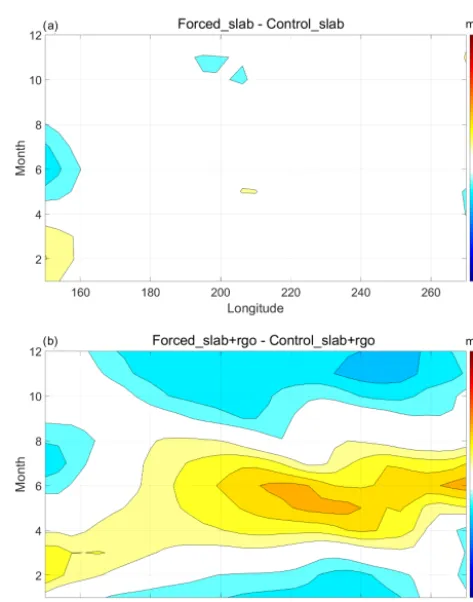
Figure 10.Equatorial Pacific Ocean (2◦S–2◦N, 150–270◦E) de-meaned SST anomalies seasonal cycle for(a)Forced_slaband(b) Forced_slab+rgoexperiments. Contour interval: 0.2◦C.
con-S. Talento and M. Barreiro: Sensitivity of the tropical climate to an interhemispheric thermal gradient 293
Figure 11. Equatorial Pacific Ocean (2◦S–2◦N, 150–270◦E) de-meaned thermocline depth anomalies seasonal cycle for the Forced_slab+rgoexperiment. Contour interval: 2 cm.
trolling the position of the ITCZ (as in Talento and Barreiro, 2016). Changes in the subtropical convergence zones are also weaker in the slab+rgo configuration, differently from the southward shift seen in the slab configuration. In particular for the case of the South Atlantic convergence zone, this re-sult is consistent with Talento and Barreiro (2016), which showed that during southern summer the weakening of the SACZ is related to the development of a region of strong rainfall in the tropical north Atlantic.
As expected from the above results, both experiments present similar patterns of near-surface (950 hPa) wind anomalies (Fig. 6): anomalous northward winds associ-ated with the ITCZ northward displacement in the tropics, and anomalous westerly winds over the Southern Ocean.
The Forced_slab+rgo response is weaker in the tropics
but stronger over the Southern Ocean, compared to the Forced_slabresponse. Similar pictures of a weaker response in the case of slab+rgo configuration can be seen in upper-level winds, mean sea upper-level pressure and mass stream-function (not shown).
To summarize, in Fig. 7 we present the northward atmo-spheric energy transport for the control and forced runs in the two configurations implemented. As can be seen, while the control runs display almost identical transport, the forced runs significantly disagree in magnitude in the tropical re-gion, with the slab+rgo configuration producing the weak-est changes with a decrease of the transport toward the south-ern high latitudes, representing damping by a factor of 1.9. In the perturbed runs, the energy flux equator is located around 12◦N (8◦N) for the slab (slab+RGO) configuration, equiv-alent to a damping in the shift by a factor of 1.5.
3.2 Seasonal cycle
As the previous subsection showed, the most pronounced differences between the two implemented configurations are found in the tropical band. Therefore, for the analysis of
vari-ations in the seasonal cycle we will focus on the 30◦S–30◦N region.
Three-month means of SST and near-surface wind changes for the tropics are shown in Fig. 8. In the Pacific Ocean, for theForced_slabexperiment negative SST anoma-lies are seen reaching the Equator (or even more to the north) in all four seasons, September–November (SON) being the period of strongest cooling and June–August (JJA) being the period in which the negative anomalies have the weakest pen-etration into the NH. Meanwhile, for theForced_slab+rgo experiment the negative SST anomalies barely reach the Equator and, in fact, positive anomalies are the ones pene-trating into the SH for the seasons March–May (MAM) and JJA. Consistent with these changes in response, the equato-rial anomalous winds in the slab configuration are mainly easterlies throughout the year, while in the slab+rgo con-figuration they have a marked northward component and are eastward during MAM season. Also, the equatorial Atlantic tends to warm up during most of the year when using the RGO model.
Equatorial (2◦S–2◦N) de-meaned seasonal cycles for near-surface zonal wind and SST anomalies in the Pacific basin for the two experimental configurations are shown in Figs. 9 and 10 respectively. InForced_slab there are east-ward (westeast-ward) near-surface wind anomalies from Decem-ber to May (June to NovemDecem-ber) distributed along the basin. The positive wind anomalies in the Forced_slab are quite uniform along the basin, although there are maximums in the western and eastern ends during December–February (DJF). The negative anomalies during the second half of the year are maximal in the central-eastern basin. In the slab configu-ration, the equatorial SST response to these wind anomalies is, however, very weak (Fig. 10a). On the other hand, when the RGO is coupled (and although the annual mean anoma-lies were even weaker than for the slab configuration; Fig. 4) there are substantial changes occurring to the seasonal cy-cle of SST in the central-eastern basin: from April to Au-gust (October to December) the forced run produces warm-ing (coolwarm-ing) of up to 1◦C (−0.8◦C). The location and tim-ing of these anomalies lead to a substantial strengthentim-ing of the SST seasonal cycle in the eastern Pacific Ocean (over-lap Fig. 10b on theControl_slab+rgoSST seasonal cycle shown in Fig. 1c).
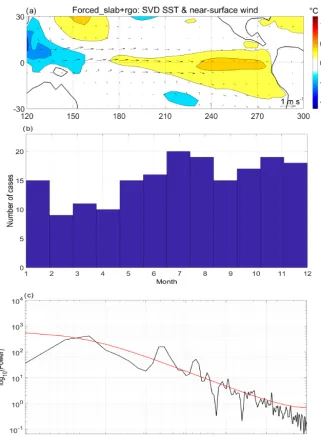
Pa-Figure 12. First SVD pattern of SST and near-surface winds in the tropical Pacific Ocean (30◦S–30◦N, 120–300◦E) for the Forced_slab+rgoexperiments.(a)Spatial pattern; contour interval 0.2◦C.(b) Histogram showing phase-locking to the seasonal cycle. (c)Spectral analysis; the red line indicates the red-noise spectrum.
cific particularly from May to July, and vice versa (but less obvious) in other seasons of the year. In the second half of the year the strengthening of the trades locally shallows the thermocline in the eastern Pacific and the western Pacific re-covers its mean depth.
In summary, the equatorial near-surface zonal wind changes caused by the extratropical forcing seen in the slab configuration induce dynamical ocean–atmosphere coupling that generates seasonal changes in the SST field when the RGO is used. This results in late austral autumn warming and cooling in spring and summer in the equatorial eastern Pacific, leading to a strengthening of the SST seasonal cycle with consistent changes in the thermocline depth.
3.3 ENSO
In this subsection we investigate how the interannual vari-ability in the tropical Pacific is affected by the interhemi-spheric SST gradient induced by the imposed forcing.
S. Talento and M. Barreiro: Sensitivity of the tropical climate to an interhemispheric thermal gradient 295
year. The frequency spectrum of the ENSO pattern under the effect of the extratropical forcing is characterized by shorter periods than in the absence of the forcing and has a peak at 24 months (Figs. 12c and 2e).
The weakening of the ENSO activity can be understood in relation to the changes produced by the extratropical forcing on the SST seasonal cycle in the eastern Pacific Ocean. According to the nonlinear frequency entrainment mechanism (Chang et al., 1994) ENSO amplitude is anti-correlated with the strength of the SST seasonal cycle. The frequency entrainment implies that a self-exciting oscilla-tor (like ENSO) will give up its intrinsic mode of oscillation in the presence of strong external forcing (like a strong sea-sonal SST cycle) and acquire the frequency of the applied os-cillating forcing. Therefore, in our case, as the extratropical forcing generates significant strengthening of the eastern Pa-cific SST seasonal cycle, a weakening of ENSO is expected according to this mechanism.
Assuming linear behaviour holds, our result of ENSO weakening is also in agreement with Timmermann et al. (2007). These authors analyse fully coupled GCMs in the context of an Atlantic meridional overturning circula-tion (AMOC) slowdown, producing generalized cooling of the NH and warming in the SH, and find that most of the models predict a ENSO intensification attributed to a sea-sonal cycle weakening. The weakening of ENSO activity in the presence of a northward ITG is also consistent with the work of Chiang et al. (2008), who use an AGCM coupled to an RGO model, a model configuration similar to ours. Although they do not attempt to explain the causes, they find that ENSO is sensitive to ITG with maximal activity when the ITG is close to zero and a weakened performance as the gradient increases in any direction.
4 Summary and conclusions
We investigated and compared the response of the tropical climate to extratropical thermal forcing in a hierarchy of models in which an AGCM was coupled either to a simple slab ocean model (just thermodynamic coupling) globally or with a combination of an RGO model in the tropical oceans and a slab ocean model elsewhere.
First, we found that the two model configurations lead to considerably different climate responses. In particular, in tropical regions the signal produced in the RGO cou-pling case is weaker in terms of annual means, indicating that regional dynamical air–sea interaction opposes the re-mote signal. This result is in agreement with the quantita-tive framework proposed by Schneider (2017), who calcu-lates an expression for the damping of the ITCZ shift in the case of atmosphere–ocean mechanical coupling. In addition, our result also agrees with the simulation experiments per-formed by Kay et al. (2016) and Green and Marshall (2017), who also obtained a weaker tropical response when using
a fully coupled model than when the AGCM is only cou-pled to a slab model, therefore indicating that the ITCZ shift damping is also seen when an intermediate-complexity ocean model is coupled only in the tropics. In our experiments the energy flux equator (which can be regarded as an approxi-mation for the ITCZ latitude) shift dampens by a factor of 1.5 in the case when tropical ocean dynamics are included, while the southward atmospheric energy transport experi-ences a damping by a factor of 1.9. In the simulations by Green and Marshall (2017) and in the quantitative work of Schneider (2017) the damping factors for the ITCZ shift were 4 and 3 respectively.
However, although the annual mean anomalies produced by the RGO setup are weaker, we find that the changes in the SST seasonal cycle are larger. In particular, over the equato-rial Pacific Ocean, while the slab configuration produces no changes to the SST seasonal cycle, the RGO addition gen-erates profound warming in the central-eastern basin from April to August balanced by cooling in the rest of the year, yielding almost null integration in the annual mean but also implying a significant strengthening of the seasonal cycle in the eastern Pacific. The response of the seasonal cycle to the imposed extratropical forcing is qualitatively similar to the one obtained by Chiang et al. (2008) in similar experiments, although in our case positive SST anomalies reach the eastern boundary of the basin preventing earlier onset of the seasonal cold tongue as found by these authors in their simulations. We hypothesize that the changes in the SST seasonal cycle are possible via the effect that the zonal wind stress has on the thermocline depth: the remote forcing produces positive anomalies of zonal wind stress to be exerted in the first half of the calendar year; in particular, the significant weakening of the trades over the western portion of the basin around Febru-ary and March induces a thermocline-deepening pulse that propagates eastward in the form of a Kelvin wave, reaching the eastern boundary 2 months later, and generating warming of the SST over that region as a result. In the second half of the year stronger trades in the central-eastern basin shallow the thermocline producing local cooling of the SST. Since these mechanisms are not available under the slab configura-tion, the wind stress seasonal cycle changes are not able to produce any SST changes.
current state-of-the-art fully coupled climate models do not seem to agree on the projected future changes in ENSO char-acteristics, and no clear evidence for a correlation with ITG has been detected in future climate projections (Stevenson, 2012; Taschetto et al., 2014).
Data availability. Data sets, codes and analysis scripts used in this study can be obtained from https://doi.org/10.17605/OSF.IO/ABRY8 (Talento and Barreiro, 2018).
Competing interests. The authors declare that they have no con-flict of interest.
Acknowledgements. Part of this work was performed while the first author was supported by Universidad de la República, Agencia Nacional de Investigación e Innovación (ANII, Uruguay) and the Belmont Forum and JPI-Climate Collaborative Research Action “INTEGRATE, An integrated data-model study of interactions between tropical monsoons and extratropical climate variability and extremes”. Comments by two anonymous reviewers are gratefully acknowledged.
Edited by: Ben Kravitz
Reviewed by: two anonymous referees
References
Broccoli, A. J., Dahl, K. A., and Stouffer, R. J.: Response of the ITCZ to Northern Hemisphere cooling, Geophys. Res. Lett., 33, L01702, https://doi.org/10.1029/2005GL024546, 2006. Cane, M. A.: The response of an equatorial ocean to simple wind
stress patterns. I-Model formulation and analytic results. II – Nu-merical results, J. Mar. Res., 37, 233–299, 1979.
Chang, P.: A study of the seasonal cycle of sea surface temperature in the tropical Pacific Ocean using reduced gravity models, J. Geophys. Res.-Oceans, 99, 7725–7741, 1994.
Chang, P., Wang, B., Li, T., and Ji, L.: Interactions between the sea-sonal cycle and the Southern Oscillation-Frequency entrainment and chaos in a coupled ocean–atmosphere model, Geophys. Res. Lett., 21, 2817–2820, 1994.
Chiang, J. C. and Bitz, C. M.: Influence of high latitude ice cover on the marine Intertropical Convergence Zone, Clim. Dynam., 25, 477–496, https://doi.org/10.1007/s00382-005-0040-5, 2005. Chiang, J. C., Fang, Y., and Chang, P.: Interhemispheric thermal gradient and tropical Pacific climate, Geophys. Res. Lett., 35, L14704, https://doi.org/10.1029/2008GL034166, 2008. Cvijanovic, I. and Chiang, J. C.: Global energy budget changes to
high latitude North Atlantic cooling and the tropical ITCZ re-sponse, Clim. Dynam., 40, 1435–1452, 2013.
Folland, C. K., Palmer, T. N., and Parker, D. E.: Sahel rainfall and worldwide sea temperatures, 1901–85, Nature, 320, 602–607, https://doi.org/10.1038/320602a0, 1986.
Friedman, A. R., Hwang, Y. T., Chiang, J. C., and Frierson, D. M.: Interhemispheric temperature asymmetry over the
twenti-eth century and in future projections, J. Climate, 26, 5419–5433, https://doi.org/10.1175/JCLI-D-12-00525.1, 2013.
Green, B. and Marshall, J.: Coupling of trade winds with ocean circulation damps ITCZ shifts, J. Climate, 30, 4395–4411, https://doi.org/10.1175/JCLI-D-16-0818.1, 2017.
Hawcroft, M., Haywood, J. M., Collins, M., Jones, A., Jones, A. C., and Stephens, G.: Southern Ocean albedo, inter-hemispheric en-ergy transports and the double ITCZ: global impacts of biases in a coupled model, Clim. Dynam., 48, 2279–2295, 2017. He, F.: Simulating Transient Climate Evolution of the Last
Deglaciation with CCSM3, PhD Thesis, University of Wisconsin-Madison, http://www.cgd.ucar.edu/ccr/paleo/Notes/ TRACE/he_phd_092010-1.pdf (last access: 16 March 2018), 2011.
Kalnay, E., Kanamitsu, M., Kistler, R., Collins, W., Deaven, D., Gandin, L., Iredell, M., Saha, S., White, G., Woollen, J., Zhu, Y., Chelliah, M., Ebisuzaki, W., Higgins, W., Janowiak, J., Mo, K. C., Ropelewski, C., Wang, J., Leet-maa, A., Reynolds, R., Jenne, R., and Joseph, D.: The NCEP/NCAR 40-Year Reanalysis Project. B. Am. Me-teorol. Soc., 77, 437–472, https://doi.org/10.1175/1520-0477(1996)077<0437:TNYRP>2.0.CO;2, 1996.
Kang, S. M., Held, I. M., Frierson, D. M., and Zhao, M.: The re-sponse of the ITCZ to extratropical thermal forcing: idealized slab-ocean experiments with a GCM, J. Climate, 21, 3521–3532, https://doi.org/10.1175/2007JCLI2146.1, 2008.
Kang, S. M., Frierson, D. M., and Held, I. M.: The trop-ical response to extratroptrop-ical thermal forcing in an ideal-ized GCM: the importance of radiative feedbacks and con-vective parameterization. J. Atmos. Sci., 66, 2812–2827, https://doi.org/10.1175/2009JAS2924.1, 2009.
Kay, J. E., Wall, C., Yettella, V., Medeiros, B., Hannay, C., Cald-well, P., and Bitz, C.: Global climate impacts of fixing the South-ern Ocean shortwave radiation bias in the Community Earth Sys-tem Model (CESM), J. Climate, 29, 4617–4636, 2016.
Kucharski, F., Molteni, F., and Bracco, A.: Decadal interactions be-tween the western tropical Pacific and the North Atlantic Oscilla-tion, Clim. Dynam., 26, 79–91, https://doi.org/10.1007/s00382-005-0085-5, 2006.
Lee, S. Y., Chiang, J. C., and Chang, P.: Tropical Pacific response to continental ice sheet topography, Clim. Dynam., 44, 2429–2446, 2015.
Levitus, S.: Climatological atlas of the world ocean, NOAA Prof. Pap. 13, US Government Printing Office, Washington DC, 1982. Molteni, F.: Atmospheric simulations using a GCM with simplified physical parametrizations. I: Model climatology and variability in multi-decadal experiments, Clim. Dynam., 20, 175–191, 2003. Schneider, T.: Feedback of atmospheric ocean coupling on shifts of the intertropical convergence zone, Geophys. Res. Lett., 44, 11644–11653, https://doi.org/10.1002/2017GL075817, 2017. Schneider, T., Bischoff, T., and Haug, G. H.: Migrations and
dy-namics of the intertropical convergence zone, Nature, 513, 45– 53, 2014.
S. Talento and M. Barreiro: Sensitivity of the tropical climate to an interhemispheric thermal gradient 297
Stevenson, S. L.: Significant changes to ENSO strength and impacts in the twenty-first century: results from CMIP5, Geophys. Res. Lett., 39, L17703, https://doi.org/10.1029/2012GL052759, 2012. Talento, S. and Barreiro, M.: Simulated sensitivity of the trop-ical climate to extratroptrop-ical thermal forcing: troptrop-ical SSTs and African land surface, Clim. Dynam., 47, 1091–1110, https://doi.org/10.1007/s00382-015-2890-9, 2016.
Talento, S. and Barreiro, M.: Control of the South Atlantic Conver-gence Zone by extratropical thermal forcing, Clim. Dynam., 50, 885–900, https://doi.org/10.1007/s00382-017-3647-4, 2017. Talento, S. and Barreiro, M.: Data: Sensitivity of the tropical climate
to an interhemispheric thermal gradient: the role of tropical ocean dynamics, https://doi.org/10.17605/OSF.IO/ABRY8, 2018. Taschetto, A. S., Gupta, A. S., Jourdain, N. C., Santoso, A.,
Um-menhofer, C. C., and England, M. H.: Cold tongue and warm pool ENSO events in CMIP5: mean state and future projections, J. Climate, 27, 2861–2885, https://doi.org/10.1175/JCLI-D-13-00437.1, 2014.
Timmermann, A., Okumura, Y., An, S.-I., Clement, A., Dong, B., Guilyardi, E., Hu, A., Jungclaus, J. H., Renold, M., Stocker, T. F., Stouffer, R. J., Sutton, R., Xie, S.-P., and Yin, J.: The influence of a weakening of the Atlantic meridional overturning circulation on ENSO, J. Climate, 20, 4899–4919, 2007.
Tomas, R. A., Deser, C., and Sun, L.: The role of ocean heat trans-port in the global climate response to projected Arctic sea ice loss, J. Climate, 29, 6841–6859, https://doi.org/10.1175/JCLI-D-15-0651.1, 2016.
Wang, X., Auler, A. S., Edwards, R. L., Cheng, H., Cristalli, P. S., Smart, P. L., Richards, D. A., and Shen, C. C.: Wet pe-riods in northeastern Brazil over the past 210 kyr linked to distant climate anomalies, Nature, 432, 740–743, https://doi.org/10.1038/nature03067, 2004.