https://doi.org/10.5194/amt-11-5351-2018 © Author(s) 2018. This work is distributed under the Creative Commons Attribution 4.0 License.
Cloud classification of ground-based infrared images combining
manifold and texture features
Qixiang Luo, Yong Meng, Lei Liu, Xiaofeng Zhao, and Zeming Zhou
College of Meteorology and Oceanology, National University of Defense Technology, Nanjing, 211101, China Correspondence:Zeming Zhou ([email protected])
Received: 5 November 2017 – Discussion started: 22 December 2017
Revised: 10 August 2018 – Accepted: 7 September 2018 – Published: 25 September 2018
Abstract.Automatic cloud type recognition of ground-based infrared images is still a challenging task. A novel cloud classification method is proposed to group images into five cloud types based on manifold and texture features. Com-pared with statistical features in Euclidean space, manifold features extracted on symmetric positive definite (SPD) ma-trix space can describe the non-Euclidean geometric charac-teristics of the infrared image more effectively. The proposed method comprises three stages: pre-processing, feature ex-traction and classification. Cloud classification is performed by a support vector machine (SVM). The datasets are com-prised of the zenithal and whole-sky images taken by the Whole-Sky Infrared Cloud-Measuring System (WSIRCMS). Benefiting from the joint features, compared to the recent two models of cloud type recognition, the experimental results il-lustrate that the proposed method acquires a higher recogni-tion rate with an increase of 2 %–10 % on the ground-based infrared datasets.
1 Introduction
Cloud has an essential impact on the absorption, scatter-ing, emission of atmosphere, the vertical transport of heat, moisture and momentum (Hartmann et al., 1992; Chen et al., 2000). Cloud cover and cloud type can affect the daily weather and climate change through its radiation and hydro-logical effects (Isaac and Stuart, 1996; Liu et al., 2008; Naud et al., 2016). Therefore, accurate cloud detection and classi-fication is necessary for meteorological observation. Nowa-days, cloud cover changes and cloud type determination have been available through ground-based sky imaging systems (Souzaecher et al., 2006; Shields et al., 2003; Illingworth
et al., 2007). Different from traditional manual observation, ground-based sky-imaging devices can obtain continuous in-formation of sky conditions at a local scale with a high spatial resolution.
automatic cloud classification, based on the KNN classifier. Besides the statistical feature like the mean grey value of the infrared image, Liu et al. (2011) explored another six struc-ture feastruc-tures to characterize the cloud strucstruc-ture for classi-fication. Zhuo et al. (2014) validated that cloud classifica-tion may not perform well if the texture or structure fea-tures were employed alone. As a result, texture and struc-ture feastruc-tures were capstruc-tured from the colour image and then fed into a trained support vector machine (SVM) (Cristian-ini and Shawe-Taylor, 2000) to obtain the cloud type. Dif-ferent from traditional feature extraction, Shi et al. (2017) proposed adopting the deep convolutional activations-based features and provided a promising cloud type recognition re-sult with a multi-label linear SVM model.
Automatic cloud classification has made certain achieve-ments; however, the cloud classification of ground-based in-frared images poses a great challenge to us. So far, little research on cloud classification have been dedicated to the ground-based infrared images (Sun et al., 2009; Liu et al., 2011). Most recent methods conducted on the RGB visi-ble images (Heinle et al., 2010; Zhuo et al., 2014; Li et al., 2016; Gan et al., 2017) cannot directly be exploited on the cloud type classification of infrared images due to the lack of colour information. Compared to colour images, infrared images can be obtained day and night continuously, which is important for practical application and analysis.
Nowadays, the symmetric positive definite (SPD) matrix manifold has achieved success in many aspects, such as ac-tion recogniac-tion, material classificaac-tion and image segmenta-tion (Faraki et al., 2015; Jayasumana et al., 2015). As a repre-sentative of SPD matrix, the Covariance Descriptor (CovD) is a powerful tool to extract the feature of the image. It has several advantages. Firstly, it calculates the first-order and second-order statistics of the local patch. Secondly, it straightforwardly fuses various features. Thirdly, it is inde-pendent of the region size and has low dimensions. Fourthly, by subtracting the mean feature vector, the effect of the noisy samples is reduced to some degree. Finally, it is able to speed up the computation in images and videos using effi-cient methods (Tuzel et al., 2008; Sanin et al., 2013). Covari-ance matrices naturally form a connected Riemannian mani-fold. Although it proves effective, few investigations are pur-sued for the task of cloud classification with manifold fea-tures. The manifold feature vector can maintain these advan-tages of non-Euclidean geometric space and describe the im-age features comprehensively, so it is chosen for an attempt on the cloud classification. In this paper, a novel cloud clas-sification method is proposed for ground-based infrared im-ages. Manifold features, representing the non-Euclidean ge-ometric structure of the image features, and texture features, expressing the image texture, are integrated for the feature extraction.
To exhibit the classification performance, we have com-pared the results with the other two models (Liu et al., 2015; Cheng and Yu, 2015), which are adapted for the
classifica-tion task of infrared images. To make up for the weakness of the local binary patterns (LBP) that cannot describe the lo-cal contrast well, Liu et al. (2015) proposed a new descriptor called weighted local binary patterns (WLBP) for the fea-ture extraction. And then the KNN classifier based on the chi-square distance was employed for cloud type recognition. Cheng and Yu (2015) incorporated statistical features and lo-cal texture features for block-based cloud classification. As Cheng and Yu (2015) reported, the method combining the statistical and uniform LBP features with the Bayesian clas-sifier (Bensmail and Celeux, 1996) displayed the best perfor-mance in the 10-fold cross validation (Ripley, 2005) overall. In this paper, the data and methodology of the method are described in Sect. 2. Section 3 focuses on the experimental results. Conclusions are summarized in Sect. 4.
2 Data and methodology
In this section, the datasets and the methodology for cloud classification are introduced. The proposed method contains three main steps: pre-processing, feature extraction and clas-sification. The framework is illustrated in Fig. 1.
2.1 Dataset and pre-processing
The datasets include the zenithal images and whole-sky im-ages, which are gathered by the Whole-Sky Infrared Cloud Measuring System (WSIRCMS) (Liu et al., 2013). The WSIRCMS is a ground-based passive system that uses an uncooled microbolometer detector array of 320×240 pixels to measure downwelling atmospheric radiance in 8–14 µm (Liu et al., 2011). A whole-sky image is obtained after com-bining the zenithal image and other images at eight differ-ent oridiffer-entations. As a result, the zenithal image has a size of 320×240 pixels while the whole-sky image is of 650×650 pixels. The datasets are provided by National University of Defense Technology in Nanjing, China.
It is true that the clear sky background radiance in 8– 14 µm varies with time and zenith angle. The images of the datasets have been pre-processed in the consideration of this important factor. The clear sky radiance threshold in each image is calculated using the radiation transfer model (Liu et al., 2013). The real radianceR at each pixel in each im-age is converted to the grey value Gpixel between [0,255]
withGpixel=R/(Rtemp−Rclear)×255, where Rclear is the
corresponding clear sky radiance threshold andRtempis the
radiance corresponding to the real-time environment temper-ature. As a result, the effects of the clear sky background brightness temperature can be ignored, which means that this factor has little influence on the feature extraction of the im-ages.
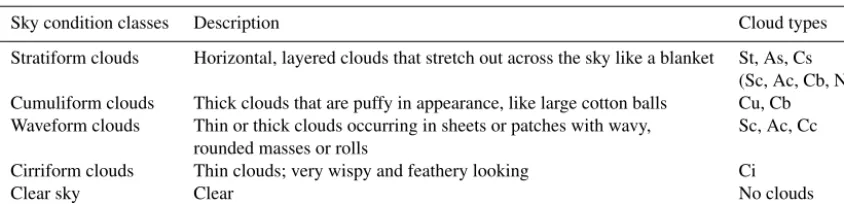
Table 1.The sky condition classes and corresponding description.
Sky condition classes Description Cloud types
Stratiform clouds Horizontal, layered clouds that stretch out across the sky like a blanket St, As, Cs (Sc, Ac, Cb, Ns) Cumuliform clouds Thick clouds that are puffy in appearance, like large cotton balls Cu, Cb
Waveform clouds Thin or thick clouds occurring in sheets or patches with wavy, Sc, Ac, Cc rounded masses or rolls
Cirriform clouds Thin clouds; very wispy and feathery looking Ci
Clear sky Clear No clouds
Figure 1.System framework.
premise is that the chosen images should hold high visual quality and can be recognized by visual inspection. If an im-age is vague, it is hard for experts to justify its type. For the algorithm, it is difficult to extract effective features of a vague image, not to mention recognizing its cloud type. All infrared cloud images are labelled to construct the training set and testing set. To guarantee confidence in the golden-standard method, only images labelled as the same by two meteoro-logical observers are finally chosen as the dataset used in this study. Different from traditional cloud classification by ob-servers, automatic cloud classification by the devices needs a new criterion for recognition. According to the morphology and generating mechanism of the cloud, the sky condition is classified into five categories in this study (Sun et al., 2009): stratiform clouds, cumuliform clouds, waveform clouds, cir-riform clouds and clear sky. The sky conditions and their cor-responding descriptions are as shown in Table 1.
The zenithal dataset used in this study is selected from the historical dataset to assess the performance of the al-gorithm. To guarantee the reliability of true label of each image, the images without mixed cloud types are selected. The typical samples from each category are demonstrated in Fig. 2. As listed in Table 2, the zenithal dataset is comprised of 100 cloud images in each category.
The whole-sky dataset is obtained during July to October in 2014 at Changsha, China. As the whole-sky image is ob-tained by combining the nine sub-images at different orien-tations, the division rules of the whole-sky dataset remain the same as that of the zenithal dataset. The whole-sky sam-ples from each category are exhibited in Fig. 3. As listed in
Table 2.The numbers of each class on two datasets.
Sky condition classes Zenithal Whole-sky
Stratiform clouds 100 246
Cumuliform clouds 100 240
Waveform clouds 100 239
Cirriform clouds 100 46
Clear sky 100 88
Total 500 859
Table 2, the number of cases with stratiform clouds, cumuli-form clouds, wavecumuli-form clouds, cirricumuli-form clouds and clear sky is 246, 240, 239, 46 and 88, respectively.
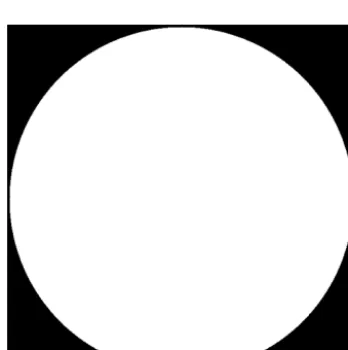
As Fig. 4 shows, a pre-processing mask is provided on the whole-sky images, which is used to extract the region of interest (ROI) from the images, which are the areas of the clouds within the circle rather than those parts outside of the circle. Different from the whole-sky images, all parts of the zenithal images are ROI. Thus, we implement the feature ex-traction directly on the original zenithal images.
2.2 Feature extraction
In addition to the manifold features proposed in this work, the texture features are also combined. The manifold features of the ground-based infrared image are extracted on the SPD matrix manifolds, and after that, they are mapped into the tangent space to form a feature vector in Euclidean space. The texture features represent the statistical information in Euclidean space; on the contrary, the manifold features de-scribe the non-Euclidean geometric characteristics of the in-frared image.
2.2.1 Texture features
Figure 2.Cloud samples from the zenithal dataset:(a)stratiform clouds,(b)cumuliform clouds,(c)waveform clouds,(d)cirriform clouds and(e)clear sky.
Figure 3.Cloud samples from the whole-sky dataset:(a)stratiform clouds,(b)cumuliform clouds,(c)waveform clouds,(d)cirriform clouds and(e)clear sky.
Figure 4.The mask of the whole-sky images. The area within the circle is the ROI, and the area outside the circle is not the ROI.
image.
GLCM= (1)
p(0,0) p(0,1) p(0,2) . . . p(0, k−1) p(1,0) p(1,1) p(1,2) . . . p(1, k−1)
. . .
. . .
. .
. . . .
. . . p(k−1,0) p(k−1,1) p(k−1,2) . . . p(k−1, k−1)
k×k The energy measures the uniformity and texture roughness of the grey level distribution:
energy= k−1
X
i=0 k−1
X
j=0
p(i, j )2. (2)
The entropy is a measure of randomness of grey level distri-bution:
entropy= − k−1
X
i=0 k−1
X
j=0
p(i, j )log2p(i, j ). (3) The contrast is a measure of local variation of grey level dis-tribution:
contrast= k−1
X
i=0 k−1
X
j=0
(i−j )2p(i, j )2. (4) The homogeneity measures the closeness of the distribution of elements in the GLCM to the GLCM diagonal:
homogeneity= k−1
X
i=0 k−1
X
j=0
p(i, j )
1+ |i−j|. (5)
As the number of intensity levelsk increases, the computa-tion of the GLCM increases strongly. In this work,kis set as 16 and then the texture features are obtained by calcu-lating four GLCMs withd=1 andθ=0, 45, 90 and 135◦, respectively. To alleviate the complexity, reduce the dimen-sion and keep rotation invariance, four mean features of four GLCMs withθ=0, 45, 90 and 135◦are obtained as the final texture features. In the experiments, we find that these tex-ture featex-tures are significant for the cloud classification of the ground-based infrared image.
2.2.2 Manifold features
Step 1: Computing the regional CovD
Suppose the imageIis of the sizeW×H, itsd-dimensional features containing greyscale and gradient at each pixel are computed, which compose the feature imageF, whose size isW×H×d:
F (x, y)=f (I, x, y), (6)
where the feature mappingf is defined as follows:
f =
I(x, y)|Ix|
Iy
q
|Ix|2+
Iy
2 |Ixx|
Iyy T . (7)
In which (x, y) denotes the location, I(x, y) denotes the greyscale.|Ix|,
Iy
,|Ixx|and
Iyy
represent the first and
sec-ond order derivative in the direction ofxandyat each pixel, respectively.
q
|Ix|2+
Iy
2
denotes the modulus of gradient. For the feature imageF, supposing it containsn=W× H points ofd-dimensional features {fk, k=1,2, . . ., n}. Its CovD is ad×dcovariance matrix, computed by Eq. (8):
C= 1
n−1
Xn
k=1(fk−µ)(fk−µ)
T, (8)
where µ=1 n
Pn
k=1fk, which represents the feature mean vector.
The CovD can fuse multiple dimensional features of the image and express the correlations between different fea-tures. Besides, as the CovD is symmetric, it is onlyd(d+1)/2 dimensional. If we convert the CovD into a feature vector to describe the image, its dimension isn×d, which needs a high computation cost for cloud classification.
Step 2: Obtaining the feature vector by mapping the CovD into its tangent space
Generally speaking, the manifold is a topological space that is locally equivalent to a Euclidean space. The differential manifold has a globally defined differential structure. Its tan-gent space TXM is a space formed by all possible tangent vectors at a given pointX on the differential manifold. For the Riemannian manifoldM, an inner product is defined in its tangent space. The shortest curve between two points on the manifold is called the geodesic and the length of the geodesic is the distance between two points.
All SPD matrices form a Riemannian manifold. Sup-pose Sdis a set of all n×nreal symmetric matrices: Sd=
A∈M (d):AT =A , whereM (d)represents the set of all d×dmatrices, so thatS++d =
A∈Sd:A>0 is the set of alld×dSPD matrices, which construct ad(d+1)/2 dimen-sional SPD manifold. According to the operation rules of the matrix, the set of the real symmetric matrix is a vector space while the real SPD matrix space is a non-Euclidean space. A Riemannian metric should be given to describe the geomet-ric structure of the SPD matrix and to measure the distance of two points onS++d .
Geodesics on the manifold are related to the tangent vectors in the tangent space. Two operators, exponential map expX(·):TXM→Mand the logarithm map logX(·)= exp−1X (·):M→TXM, are defined over differentiable man-ifolds to switch between the manifold and its tangent space atX.As illustrated in Fig. 5, the tangent vectorvis mapped to the pointY on the manifold through the exponential map. The length ofv is equivalent to the geodesic distance be-tweenXandY, due to the property of the exponential map. Conversely, a point on the manifold is mapped to the tangent spaceTXM through the logarithm map. As pointX moves along the manifold, the exponential and logarithm maps change. The details can be referred in Harandi et al. (2012).
ForS++d , the logarithm and exponential maps are given by:
logX(Y )=X12log
X−12Y X− 1 2
X12, (9)
expX(y)=X12exp
X−12yX− 1 2
X12, (10)
where log(·)and exp(·)are the matrix logarithm and expo-nential operators, respectively. For SPD matrices, they can be computed through singular-value decomposition (SVD). If we let diag(λ1, λ2, . . ., λd) be a diagonal matrix formed from real values λ1, λ2, . . ., λd on diagonal elements and A=Udiag(λi)UT be the SVD of the symmetric matrix A, then
log(A)= ∞
X
r=1
(−1)r−1 r (A−I)
r=Udiag(ln(λ
i))UT, (11)
exp(A)= ∞
X
r=0
1 r!A
r =Udiag(exp(λ
i))UT, (12)
whereIis an identity matrix on manifolds.
The manifold can be embedded into its tangent space at identity matrix I. Thus, based on the bi-invariant Rieman-nian metric (Arsigny et al., 2008), the distance between two SPD matricesA,Bisd (A,B)= klog(A)−log(B)k2, where log(·)denotes the matrix logarithm operator. As symmetric matrices (equivalently tangent spaces) form a vector space, the classification tools in Euclidean space (SVM, KNN, etc.) can be seamlessly employed to deal with the recognition problem.
The logarithmic operator is valid only if the eigenvalues of the symmetric matrix are positive. When no cloud is ob-served in the clear sky, the CovD of the image features could be non-negative definite, and in this case it needs to be con-verted to a SPD matrix. We can formulate it as an optimiza-tion problem (Harandi et al., 2015):
A∗=arg minAkC−AkF,s.t.A+AT >0, (13) whereCis a CovD andA∗is the closest SPD matrix toC.
repre-Figure 5.Illustration of the tangent spaceTXM at pointX on a Riemannian manifold. A SPD matrix can be interpreted as pointX in the space of SPD matrices. The tangent vectorvcan be obtained through the logarithm map, i.e.v=logX(Y ). Every tangent vector in TXM can be mapped to the manifold through the exponential map, i.e. expX(v)=Y. The dotted line shows the geodesic starting atXand ending atY.
sented asa=Vec(log(A)). LetB=log(A),B∈Sdand
B=
b1,1 b1,2 b1,3 . . . b1,d b2,1 b2,2 b2,3 . . . b2,d
..
. ... ... . . . ... bd,1 bd,2 bd,3 . . . bd,d
d×d
, (14)
which lies in Euclidean space. As B is symmetric, we can rearrange it into a vector by vectorizing its upper triangular matrix:
a=Vec(B) (15)
=hb1,1, √
2b1,2,· · ·, √
2b1,d, b2,2, √
2b2,3,· · ·, bd,d
iT
.
Vectorais defined as the manifold features. Asf is the 6-dimensional feature mapping in the experiment, the mani-fold feature vector a to represent the cloud image is 6× (6+1)/2=21 dimensions. The mapped feature vector can reflect the characteristics of its corresponding SPD matrix on matrix manifolds. Thus, manifold features can describe the non-Euclidean property of the infrared image features to some degree.
2.2.3 Combining manifold and texture features
As described in Sect. 2.2.1 and 2.2.2, manifold and tex-ture featex-tures can be extracted and integrated to represent the ground-based infrared images. For an image, its four features including energy, entropy, contrast and homogeneity from GLCM, express its texture, while 21-dimensional manifold features describe the non-Euclidean geometric characteris-tics. The manifold and texture features are combined to form a feature vector to represent the image. Thus, the joint fea-tures of the infrared image have a total of 25 dimensions.
2.3 Classification
2.3.1 Support vector machine
The classifier used in this paper is the SVM (Cristianini and Shawe-Taylor, 2000), which exhibits prominent classifica-tion performance in the cloud type recogniclassifica-tion experiments (Zhuo et al., 2014; Li et al., 2016; Shi et al., 2017). In ma-chine learning, SVMs are supervised learning models. An SVM model is a representation of the examples as points in the reproducing kernel Hilbert space, mapped so that the ex-amples of the separate categories are divided by a clear gap that is as wide as possible. New examples are then mapped into that same space and predicted to belong to a category based on which side of the gap they fall. As Fig. 6 shows, given a set of two-class training examples (denoted by×and o), the key problem is to find the optimal hyperplane to do the separation:wTx+b=0, wherewis a weight vector and bis a bias, and an SVM training model with the largest mar-gin 2/
√
wTwis built. The support vectors are the samples on the dotted lines. The optimization classification hyperplane is determined by the solid line. The test examples are assigned to one category or the other based on this model, making it a non-probabilistic binary linear classifier. In this work, we apply a simple linear function as the mapping kernel, which is validated by the cloud classification experiments.
2.3.2 Multi-class support vector machine method For a multi-class task, one binary SVM classifier is con-structed for every pair of distinct classes, and so, all together c(c−1)/2 binary SVM classifiers are constructed. For an unknown-type sample, it will be input into these binary clas-sifiers and each classifier makes its vote, thusc(c−1)/2 inde-pendent output labels are obtained. The most frequent label is the sample’s type. The variablecis 5 in this paper and the final result is determined by the voting policy.
3 Experiments and discussions
Figure 6.The decision boundary of support vector machine with the largest margin. ×and o denote two-class training examples. wTx+b=0 is the optimal hyperplane to do the separation, where wis a weight vector andbis a bias, and an SVM training model with the largest margin 2/
√
wTwis built. The support vectors are the samples on the dotted lines. The optimization classification hy-perplane is determined by the solid line.
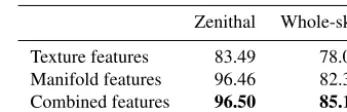
78.01 %, 82.38 % and 85.12 % on the whole-sky dataset, re-spectively. It can be seen that the texture or manifold fea-tures alone do not achieve a better performance than the joint features, which not only inherit the advantage of the texture features, but also own the characteristic of manifold features. On the whole, the method using the joint features performs best in the cross validation.
Naturally, combined features are used for the cloud type recognition. In the experiment, each dataset is grouped into the training set and testing set. The training set is selected randomly from each category in accordance with a certain proportion, 1/10, 1/2 or 9/10, and the remaining part forms the testing set. Each experiment is repeated 50 times to re-duce the accidental bias and the average accuracy is regarded as the final results of classification to evaluate the perfor-mance of the method.
To exhibit the recognition performance of the proposed method, we also compare with the other two models (Liu et al., 2015; Cheng and Yu, 2015) to assess its performance in this experiment. Liu’s model employs the WLBP feature with the KNN classifier based on the chi-square distance while Cheng’s method adopts the statistical and uniform LBP features with the Bayesian classifier. Note that we extract the statistical features from the greyscale images rather than from the RGB images so that the statistical features only have 8 dimensions, as a result, without extra colour information provided, both of the two methods are adaptable to the in-frared images.
Table 3.The 10-fold cross validated classification accuracy (%) on two datasets. The best results are labelled in bold font.
Zenithal Whole-sky
Texture features 83.49 78.01 Manifold features 96.46 82.38 Combined features 96.50 85.12
3.1 Results of the zenithal dataset
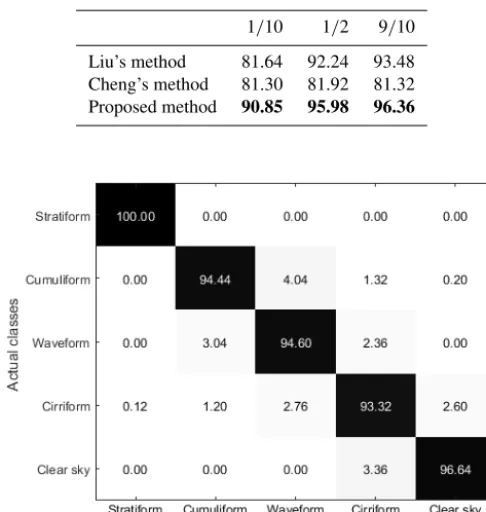
The first experiment is performed on the zenithal dataset. Ta-ble 4 reports the overall recognition rates of the proposed method and the other methods. The proposed method at-tains the best results, with at least 2.5 % improvement over Liu’s method and over 9.5 % higher than Cheng’s method. Meanwhile, the proposed method demonstrates a more sta-ble and more superior performance than the other two meth-ods, even when 1/10 of the dataset is treated as the train-ing set. In this case, the proposed method is up to 90.85 % on the overall accuracy while the other two methods achieve 81.30 % and 81.64 %, respectively. That means discrimina-tive features used for classification can be gained even with what would normally be regarded as limited training data. Although only three cases are given when the fractions of training set are 1/10, 1/2 and 9/10, they can represent most cases. In general, with the increase in the number of traing samples, the overall accuracy of testtraing samples will in-crease until it holds stable, which is in line with the results in Table 4. As a result, as more representative images are used for training, there is no doubt that the recognition rate will be improved.
Table 4. The overall classification accuracy (%) on the zenithal dataset. 1/10, 1/2 and 9/10 are the certain proportions of the train-ing set selected randomly from each category, and the rest corre-spondingly forms the testing set. The best results are labelled in bold font.
1/10 1/2 9/10
Liu’s method 81.64 92.24 93.48 Cheng’s method 81.30 81.92 81.32 Proposed method 90.85 95.98 96.36
Figure 7.Confusion matrix (%) on the zenithal dataset. (1/2 for training and the overall accuracy is 95.98 %.)
3.2 Results of the whole-sky dataset
The second experiment is performed on the whole-sky dataset, which is more challenging because a larger inner-class difference exists than that of the zenithal dataset. The experimental configuration retains the same in Sect. 3.1. Table 5 lists the results of different methods. It is illus-trated that the proposed method gains the overall accu-racy of 78.27 %, 83.54 % and 85.01 % as the proportion of the training set varies. In comparison, Liu’s method achieves 73.58 %, 80.55 % and 81.31 % while Cheng’s method achieves 66.99 %, 67.36 % and 68.18 %, correspond-ingly. Comparing to the other two methods, the experimental results indicate the effectiveness of the proposed method with an obvious improvement in the accuracy. Similarly, the cases where the fractions of data reserved for training constitute 1/10, 1/2 and 9/10 of the total, can represent most cases of classification and are chosen to represent a wide range of pos-sible training scenarios. Generally, the rise in the number of training samples makes the overall accuracy improve, which is in line with the results in Table 5. In a nutshell, a training set with more representative images can further promote the classification accuracy.
Table 5.The overall classification accuracy (%) on the whole-sky dataset. 1/10, 1/2 and 9/10 are the certain proportions of the train-ing set selected randomly from each category, and the rest corre-spondingly forms the testing set. The best results are labelled in bold font.
1/10 1/2 9/10
Liu’s method 73.58 80.55 81.31 Cheng’s method 66.99 67.36 68.18 Proposed method 78.27 83.54 85.01
Figure 8.Confusion matrix (%) on the whole-sky dataset. (1/2 for training and the overall accuracy is 83.54 %.)
Figure 8 displays the confusion matrix of the whole-sky dataset when 1/2 for training is used. The number of each category in the training set is 123, 120, 120, 23 and 44, re-spectively and the remaining part is treated as the testing set. It is demonstrated that stratiform clouds and clear sky pos-sess obvious characteristics for classification while cumuli-form, waveform and cirriform clouds pose a great challenge for a high accuracy of classification. Cirriform clouds are likely to be confused with the clear sky and about 15.22 % of cirriform cloud images are misclassified as the clear sky in the experiment. In the whole-sky image, when it is on the condition of cirriform clouds, the area of cirriform clouds may be just a fraction of the whole sky, making it hard to be distinguished correctly. Furthermore, multiple cloud types could exist in the whole-sky condition, which may result in a relatively low accuracy of the single-type classification, like cumuliform, waveform and cirriform clouds.
Figure 9.Selected misclassified whole-sky images:(a)stratiform clouds to waveform clouds,(b)cumuliform clouds to waveform clouds,
(c)cumuliform clouds to cirriform clouds,(d)waveform clouds to cumuliform clouds and(e)cirriform clouds to cumuliform clouds.
clouds makes it hard to differ from waveform clouds. Fig-ure 9c shows that cumuliform clouds are recognized as cirri-form clouds. In this image, besides cumulicirri-form clouds,few cirriform clouds can also be found. Figure 9d shows that waveform clouds are recognized as cumuliform clouds. It can be seen that both waveform and cumuliform clouds coexist in the sky. Figure 9e shows that cirriform clouds are recog-nized as cumuliform clouds. It is concluded that the whole-sky dataset is more complicated than the zenithal dataset as the weather conditions change.
4 Conclusions
In this paper, a novel cloud classification method of the ground-based infrared images, including the zenithal and whole-sky datasets, is proposed. Besides the texture features computed from the GLCM, manifold features obtained from the SPD matrix manifold are combined together. With the joint features, the proposed method can improve the recog-nition rate of the cloud types. On one hand, the joint fea-tures can inherit the advantages of the statistical feafea-tures, which represent texture information in Euclidean space; on the other hand, the manifold features on the matrix mani-fold can describe the non-Euclidean geometric structure of the image features and thus the proposed method can ben-efit from it for a high classification precision. The CovD is calculated by extracting 6-dimensional features including greyscale, first-order and second-order gradient information, and the mean values are subtracted from the feature vectors, which may improve the recognition performance to some ex-tent, as it can remove the noises of the infrared images. The manifold feature vector is produced by mapping the SPD ma-trix into its tangent space and afterwards the combined fea-ture vector is adopted for cloud type recognition with SVM. With different fractions that the training set occupies, it is validated that in most cases the proposed method outper-forms the other two methods (Liu et al., 2015; Cheng and Yu, 2015). As a whole, the improvement of the proposed method is between 2 % and 10 %. To some degree, it may not be a great improvement, but we have validated that the introduc-tion of manifold features is effective and can achieve some
success, it is worthy doing more work in this field to promote its development.
In future work, more suitable image features like Gabor or wavelet coefficients (Liu and Wechsler, 2002) can be incor-porated into the SPD matrix and the classification would be performed directly on the manifolds to improve the recog-nition rate further. Besides, feature extraction using a deep learning method such as convolutional neural networks can be taken into account to increase the classification accu-racy. Furthermore, the addition of the brightness temperature, or the height information obtained from the laser ceilome-ter, might be helpful for the improvement of the cloud type recognition accuracy. It is found that the proposed method is effective to satisfy the requirement of the cloud classification task on both zenithal and whole-sky datasets. The complex sky condition with multiple cloud types should be our main concern in the next work.
Code and data availability. The code of the proposed method can be made available via email to [email protected].
The two ground-based infrared cloud datasets used in this paper can be made available via email to [email protected].
Author contributions. ZZ conceived and designed the experiments, reviewed the paper and gave constructive suggestions. QL per-formed the experiments and wrote the paper. YM and XZ analyzed the data and reviewed the paper. LL provided and analyzed the data.
Competing interests. The authors declare that they have no conflict of interest.
Acknowledgements. This work is supported financially, in part by the National Natural Science Foundation of China under grant nos. 61473310, 41174164, 41775027 and 41575024.
Edited by: Alyn Lambert
References
Arsigny, V., Fillard, P., Pennec, X., and Ayache, N.: Geomet-ric means in a novel vector space structure on symmetGeomet-ric positive-definite matrices, Siam J. Matrix Anal. A., 29, 328–347, https://doi.org/10.1137/050637996, 2008.
Bensmail, H. and Celeux, G.: Regularized Gaus-sian discriminant analysis through eigenvalue de-composition, J. Am. Stat. Assoc., 91, 1743–1748, https://doi.org/10.1080/01621459.1996.10476746, 1996. Buch, K. A., Sun Chen-Hui, and Thorne L. R.: Cloud
classifica-tion using whole-sky imager data, in: Proceedings of the 5th At-mospheric Radiation Measurement Science Team Meeting, San Diego, CA, USA, 27–31 March, 1995.
Calbó, J. and Sabburg, J.: Feature extraction from whole-sky ground-based images for cloud-type recognition, J. Atmos. Ocean. Tech., 25, 3–14, https://doi.org/10.1175/2007JTECHA959.1, 2008.
Cazorla, A., Olmo, F. J., and Aladosarboledas, L.: Development of a sky imager for cloud cover assessment, J. Opt. Soc. Am. A., 25, 29–39, https://doi.org/10.1364/JOSAA.25.000029, 2008. Chen, T., Rossow, W. B., and Zhang, Y.:
Ra-diative effects of cloud-type variations, J. Cli-mate, 13, 264–286, https://doi.org/10.1175/1520-0442(2000)013<0264:reoctv>2.0.co;2 , 2000.
Cheng, H.-Y. and Yu, C.-C.: Block-based cloud classification with statistical features and distribution of local texture features, At-mos. Meas. Tech., 8, 1173–1182, https://doi.org/10.5194/amt-8-1173-2015, 2015.
Cristianini, N. and Shawe-Taylor, J.: An introduction to support vector machines and other kernel-based learning methods, Cam-bridge university press, CamCam-bridge, 2000.
Faraki, M., Palhang, M., and Sanderson, C.: Log-Euclidean bag of words for human action recognition, IET Comput. Vis., 9, 331– 339, https://doi.org/10.1049/iet-cvi.2014.0018, 2015.
Gan, J., Lu, W., Li, Q., Zhang, Z., Yang, J., Ma, Y. and Yao, W.: Cloud type classification of total-sky images using duplex norm-bounded sparse coding, IEEE J. Sel. Top. Appl., 10, 3360–3372, https://doi.org/10.1109/JSTARS.2017.2669206, 2017.
Ghonima, M. S., Urquhart, B., Chow, C. W., Shields, J. E., Cazorla, A., and Kleissl, J.: A method for cloud detection and opacity classification based on ground based sky imagery, Atmos. Meas. Tech., 5, 2881–2892, https://doi.org/10.5194/amt-5-2881-2012, 2012.
Haralick, R. M., Shanmugam, K., and Dinstein, I. H.: Textural fea-tures for image classification, IEEE T. Syst. Man Cyb., 3, 610– 621, https://doi.org/10.1109/TSMC.1973.4309314, 1973. Harandi, M. T., Sanderson, C., Wiliem, A., and Lovell, B. C.:
Ker-nel analysis over Riemannian manifolds for visual recognition of actions, pedestrians and textures, IEEE Workshop on the Ap-plications of Computer Vision, Breckenridge, CO, USA, 9–11 January, 2012.
Harandi, M. T., Hartley, R., Lovell, B. C., and Sanderson, C.: Sparse coding on symmetric positive definite manifolds using Bregman divergences, IEEE T. Neur. Net. Lear., 27, 1294–1306, https://doi.org/10.1109/TNNLS.2014.2387383, 2015.
Hartmann, D. L., Ockert-bell, M. E., and Michelsen, M. L.: The effect of cloud type on earth’s energy balance: global anal-ysis, J. Climate, 5, 1281–1304, https://doi.org/10.1175/1520-0442(1992)005<1281:TEOCTO>2.0.CO;2, 1992.
Heinle, A., Macke, A., and Srivastav, A.: Automatic cloud classi-fication of whole sky images, Atmos. Meas. Tech., 3, 557–567, https://doi.org/10.5194/amt-3-557-2010, 2010.
Illingworth, A. J., Hogan, R. J., O’Connor, E. J., Bouniol, D., Brooks, M. E., Delano, J., Donovan, D. P., Eastment, J. D., Gaus-siat, N., Goddard, J. W. F., Haeffelin, M., Klein Baltink, H., Kras-nov, O. A., Pelon, J., Piriou, J. M., Protat, A., Russchenberg, H. W. J., Seifert, A., Tompkins, A. M., Van Zadelhoff, G. J., Vinit, F., Willen, U., Wilson, D. R., and Wrench, C. L.: Cloudnet: Con-tinuous evaluation of cloud profiles in seven operational mod-els using ground-based observations, B. Am. Meteorol. Soc., 88, 883–898, 2007.
Isaac, G. A. and Stuart, R. A.: Relationships between cloud type and amount, precipitation, and surface tempera-ture in the mackenzie river valley-beaufort sea area, J. Climate, 9, 1921–1941, https://doi.org/10.1175/1520-0442(1996)009<1921:RBCTAA>2.0.CO;2, 1996.
Jayasumana, S., Hartley, R., Salzmann, M., Li, H., and Ha-randi, M. T.: Kernel methods on Riemannian manifolds with Gaussian RBF kernels, IEEE T. Pattern Anal., 37, 2464–2477, https://doi.org/10.1109/TPAMI.2015.2414422, 2015.
Li, J., Menzel, W. P., Yang, Z., Frey, R. A., and Ackerman, S. A.: High-spatial-resolution surface and cloud-type classi-fication from MODIS multispectral band measurements, J. Appl. Meteorol., 42, 204–226, https://doi.org/10.1175/1520-0450(2003)042<0204:HSRSAC>2.0.CO;2, 2003.
Li, Q., Zhang, Z., Lu, W., Yang, J., Ma, Y., and Yao, W.: From pixels to patches: a cloud classification method based on a bag of micro-structures, Atmos. Meas. Tech., 9, 753–764, https://doi.org/10.5194/amt-9-753-2016, 2016.
Liu, C. and Wechsler, H.: Gabor feature based classifica-tion using the enhanced fisher linear discriminant model for face recognition, IEEE T. Image Process., 11, 467–476, https://doi.org/10.1109/tip.2002.999679, 2002.
Liu, L., Sun, X., Chen, F., Zhao, S., and Gao, T.: Cloud classification based on structure features of in-frared images, J. Atmos. Ocean. Tech., 28, 410–417, https://doi.org/10.1175/2010JTECHA1385.1, 2011.
Liu, L., Sun, X., Gao, T., and Zhao, S.: Comparison of cloud properties from ground-based infrared cloud measurement and visual observations, J. Atmos. Ocean. Tech., 30, 1171–1179, https://doi.org/10.1175/JTECH-D-12-00157.1, 2013.
Liu, S., Zhang, Z., and Mei, X.: Ground-based cloud classification using weighted local binary patterns, J. Appl. Remote Sens., 9, 095062, https://doi.org/10.1117/1.JRS.9.095062, 2015. Liu, Y., Key, J. R., and Wang, X.: The Influence of changes in
cloud cover on recent surface temperature trends in the Arctic, J. Climate, 21, 705–715, https://doi.org/10.1175/2007JCLI1681.1, 2008.
Naud, C. M., Booth, J. F., and Del Genio, A.D.: The rela-tionships between boundary layer stability and cloud cover in the post-cloud-frontal region, J. Climate, 29, 8129–8149, https://doi.org/10.1175/JCLI-D-15-0700.1, 2016.
Ripley, B. D.: Pattern recognition and neural networks, 8 edn., Cam-bridge University Press, CamCam-bridge, 2005.
of Computer Vision (WACV), Tampa, FL, USA, 15–17 March, 103–110, https://doi.org/10.1109/WACV.2013.6475006, 2013. Shi, C., Wang, C., Wang, Y., and Xiao, B.: Deep
convolu-tional activations-based features for ground-based cloud classification, IEEE Geosci. Remote S., 14, 816–820, https://doi.org/10.1109/LGRS.2017.2681658, 2017.
Shields, J. E., Johnson, R. W., Karr, M. E., Burden, A. R., and Baker, J. G.: Daylight visible/NIR whole-sky imagers for cloud and radiance monitoring in support of UV research programs, SPIE International Symposium on Optical Science & Technology, San Diego, California, 3–8 August, 155–166, https://doi.org/10.1117/12.509062, 2003.
Singh, M. and Glennen, M.: Automated ground-based cloud recognition, Pattern Anal. Appl., 8, 258–271, https://doi.org/10.1007/s10044-005-0007-5, 2005.
Souzaecher, M. P., Pereira, E. B., Bins, L. S., and Andrade, M. A. R.: A simple method for the assessment of the cloud cover State in high-latitude regions by a ground-based digital camera, J. Atmos. Ocean. Tech., 23, 437–447, https://doi.org/10.1175/JTECH1833.1, 2006.
Sun, X. J., Liu, L., Gao, T. C., and Zhao, S. J.: Classifica-tion of whole sky infrared cloud image based on the LBP operator, Transactions of Atmospheric Sciences, 32, 490–497, https://doi.org/10.3969/j.issn.1674-7097.2009.04.004, 2009 (in Chinese).
Taravat, A., Frate, F. D., Cornaro, C., and Vergari, S.: Neural networks and support vector machine algorithms for automatic cloud classification of whole-sky ground-based images, IEEE Geosci. Remote S., 12, 666–670, https://doi.org/10.1109/LGRS.2014.2356616, 2014.
Tuzel, O., Porikli, F., and Meer, P.: Pedestrian detection via clas-sification on Riemannian manifolds, IEEE T. Pattern Anal., 30, 1713–1727, 2008.
Tzoumanikas, P., Kazantzidis, A., Bais, A. F., Fotopoulos, S., and Economou, G.: Cloud detection and classification with the use of whole-sky ground-based images, Atmos. Res., 113, 80–88, https://doi.org/10.1016/j.atmosres.2012.05.005, 2012.
Wang, Z. and Sassen, K.: Cloud type and macrophysi-cal property retrieval using multiple remote sensors, J. Appl. Meteorol., 40, 1665–1683, https://doi.org/10.1175/1520-0450(2001)040<1665:CTAMPR>2.0.CO;2, 2001.