University of New Hampshire
University of New Hampshire Scholars' Repository
Psychology Scholarship
College of Liberal Arts (COLA)
2-20-2015
Generative Roles: Assessing Sustained Involvement
in Generativity
Sherry L. Hamby
The University of the South - Sewanee
Lindsey A. Thomas
University of the South, Sewanee
Victoria L. Banyard
University of New Hampshire, [email protected]
Ed de St. Aubin
Marquette University
John Grych
Marquette University
Follow this and additional works at:
https://scholars.unh.edu/psych_facpub
This Article is brought to you for free and open access by the College of Liberal Arts (COLA) at University of New Hampshire Scholars' Repository. It has been accepted for inclusion in Psychology Scholarship by an authorized administrator of University of New Hampshire Scholars' Repository. For more information, please [email protected].
Recommended Citation
Generative roles: Assessing sustained involvement
in generativity
Sherry Hamby
1, Lindsey A. Thomas
1, Victoria L. Banyard
2, Ed de St. Aubin
3, John Grych
3 1Department of Psychology, University of the South, Sewanee, TN, USA 2
Department of Psychology, University of New Hampshire, Durham, NH, USA 3
Department of Psychology, Marquette University, Milwaukee, WI, USA
Email address
[email protected] (S. Hamby), [email protected] (S. Hamby)
To cite this article
Sherry Hamby, Lindsey A. Thomas, Victoria L. Banyard, Ed de St. Aubin, John Grych. Generative Roles: Assessing Sustained Involvement in Generativity. American Journal of Psychology and Behavioral Sciences. Vol. 2, No. 2, 2015, pp. 24-32.
Abstract
Generative roles refer to observable, behavioral community positions that embody aspects of teaching and nurturing that are central to the concept of generativity. Two studies are presented that describe generative roles in a community sample and provide psychometric data for a short index of generative roles. The first study also provides reliability and validity data from a second informant. The second study examines generative roles at different stages of adolescence and adulthood. Participants were asked 8 yes/no questions about a variety of community roles. The validity of the GRI was supported by significant correlations with the Loyola Generativity Scale, a widely used measure of generative concern (r=.33), and measures of related constructs. The correlations were similar across age categories. The Generative Roles Index has good psychometric qualities and complements existing measures of generativity by providing behavioral, observable data on roles.
Keywords
Generativity, Measurement, Meaning, Resilience
1. Introduction
The concept of generativity was introduced by Erik Erikson (1950/1993) in his stage model of personality development. Erikson contends that adults, as part of the process of ego development, wrestle with the conflict of “generativity vs. stagnation.” In order to progress to the next stage of ego development, adults must learn to nurture and guide future generations. He places this psychosocial conflict as the seventh of eight major developmental stages, and loosely associates it with middle-age and parenthood. However, generativity need not be limited to parenthood, as Erikson himself notes. Generativity is now more widely construed to refer to all sorts of sustained efforts to nurture and guide, such as teaching. Generativity has been measured a variety of ways; however, existing measures of generativity are limited by primarily focusing on perceptions and self-reported concern for future generations (Gruenewald, Liao,
& Seeman, 2012). This study presents psychometric data for a new measure, the Generative Roles Index, which is a behaviorally-focused measure of the generative roles that people play in their community.
2. The Construct of Generativity
Generativity is closely related to generosity and altruism, which also involve shifting one’s concerns from the self to a broader social orientation (Ryff & Migdal, 1984; Vaillant, 1995). According to Erikson (1950/1993), generativity is also meant to encompass synonyms such as productivity and
25 Sherry Hamby et al.: Generative Roles Index
concern for children, younger people or the betterment of others in the future.
McAdams and de St. Aubin (1992) expanded on Erikson's concept of generativity by identifying seven facets of generativity: cultural demand; inner desire; conscious concern for the next generation; belief in the goodness of the species; generative commitment; generative action; and finally, a person’s narrative of generativity. They contend that cultural demand (societal opportunities, developmental expectations) and inner desire to be needed combine to produce concern for future generations. This concern is supported by a belief in the overall goodness of the human species, and as a result, people take on generative commitments (goals, decisions), which then develops into generative action (offering, creating, maintaining).
Generativity, with its emphasis on intergenerational concern, is inherently an interpersonal construct (de St. Aubin, 2013). As seen in Erikson's original examples of parenting and teaching, it shares elements with healthy parent-child relationships and compassionate love. McAdams and de St. Aubin (1992) suggest that it also shares elements with other constructs at the family and community level of the social ecology. As the classic exemplar of teaching suggests, generativity is not just about family relationships but also about relationships with people across one's social network (Bradley, 1997; Bradley & Marcia, 1998). Generativity is also inherently a form of generosity. It involves giving for the sake of giving without expectation of concrete reciprocation.
Generativity also is related to meaning making (de St. Aubin, 2013; Schnell, 2009, 2011). Continuing development of psychosocial virtues is important for developing a coherent sense of meaning in life and is important in the struggle between generativity and stagnation. According to Erikson, individuals resolve this particular developmental crisis by choosing to turn outward and help future generations rather than regressing towards selfishness. Furthermore, Kotre (1984) suggests that people use generativity (and its products) as a means to creating a lasting legacy, a symbolic immortality of sorts. Their generativity is partly driven by a desire to leave something of lasting value that will outlast and give meaning to their lives. Another facet of generativity that is shared with meaning making is the desire to maintain traditions (Vaillant, 1995). It follows that those who endorse more generative roles are also likely to score higher on measures of meaning making. These connections to meaning making also suggest connections to well-being. As suggested by Erikson's original phrasing of this stage, those who fail to achieve generativity will experience stagnation. Those who succeed with this developmental challenge should have better psychological well-being (de St. Aubin, 2013).
3. Generativity Across the Lifespan
In Erikson's original formulation (1950/1993), generativity was limited to adulthood and even more specifically to middle adulthood. Contemporary generativity scholarship has
preserved and even heightened this emphasis (Azarow, 2003; Ryff & Migdal, 1984; Vaillant, 1995). For one to be generative, one must not only do generous, creative, and productive activities, but these actions must further be motivated by a generative concern. In this model, although adolescents may exhibit some signs of generativity, they are unable to fully develop the drive to care for the next generation that is essential to being truly generative until later in life. However, the emphasis on invariant, fixed stages has been questioned by others, especially in light of changing social norms such as later marriage (Meeus, Iedema, Helsen, & Vollebergh, 1999; Shulman & Connolly, 2013) and more generally fixed-stage models have not held up well to empirical scrutiny (Hamby, 2014; Vaillant, 1995). Recently, scholars have started to examine generativity as a phenomenon that begins to develop even in adolescence (Guastello, Guastello, & Briggs, 2014; Lawford, Pratt, Hunsberger, & Mark Pancer, 2005).
4. Existing Measures of Generativity
Reflecting the era in which the concept was proposed, many early measures of generativity relied on projective tests such as the Thematic Apperception Test (TAT) (Peterson, 1998; Peterson & Stewart, 1996). Although the labor-intensive nature of projective assessment and questions about the reliability and validity of projective tests have led to a decrease in this method, it is still occasionally used (Hofer, Busch, Chasiotis, Kärtner, & Campos, 2008). Q-sort techniques, usually involving arranging 100 cards with generative statements in order from most to least characteristic of the participant, have also been used to assess generativity (Block, 1961). Q-sort typically requires rank ordering which can help minimize social desirability (because not all socially desirable items can be equally strongly endorsed). However, these are also labor-intensive and, although the psychometrics may be superior to those of the TAT, it is not clear if they provide substantially better data than other self-report approaches.
To complement the LGS, McAdams and de St. Aubin (1992) also created the Generative Behavior Checklist (GBC) a list of various giving acts, such as “taught somebody a skill” and “taught somebody about right and wrong, good and bad". The GBC provides behavioral data, and offers a simple, objective scoring method. However, many of GBC items are single giving acts and may not represent nurturing concern. The GBC includes many items that are similar to measures of helping behaviors, such as Amato's (1990) widely used scale. Although some of this conceptual overlap reflects true overlap in the constructs, the use of similar items for generativity and for other measures of helping also limits the ability to distinguish any differences between generativity and other forms of generosity.
5. The Current Study
In sum, most existing measures of generativity have been aimed at measuring underlying motives and generative concerns. We propose, however, that generative action, to use McAdam's and de St. Aubin's term, is equally important in assessing generativity. Concern without action is not enough to determine one’s generativity. Further, although we recognize that at some level generativity is comprised of individual acts, we share Vaillant’s (1995) belief that a sustained responsibility for caring for others is a hallmark of generativity, and exemplars such as teacher represent a more sustained commitment to care for younger generations than do single donations or other one-time acts of giving. To address this shortcoming, we developed a measure to investigate observable, behavioral roles that signal generative action and commitment.
Generative action and commitment can of course be expressed in a wide variety of roles, even those which do not have teaching or nurturing as a central element or that also come with substantial other rewards, such as high pay. However, there are some roles for which teaching and development are central aspects, including not only the classic exemplar of teacher but also roles such as coach and tutor. These are also common and relatively easily accessible roles in many communities and so relevant to much of the population. The Generative Roles Index retains the strengths (behavioral data, simplicity of scoring) of other measures, particularly of the Generative Behaviors Checklist (McAdams & de St Aubin, 1992), while focusing on roles, simplifying language, and keeping length short.
The purpose of this paper is to present preliminary data for generative roles in two studies. In both studies, frequency of several generative roles is presented along with convergent validity as indicated by associations with several measures of constructs that have, as noted above, been theoretically linked to generativity in the existing literature: interpersonal strengths, generosity, meaning making and well-being. In the first study, we also assess correlation with reports by a second informant. In the second study, we explore engagement in generative roles across different age groups from adolescence through middle adulthood.
6. Study 1 Method
6.1. Participants
The participants were 104 pairs from rural areas of two southern states, the main participant and a close friend or partner “who knew them well.” These “close informants” were most often family members (58%) but also a significant portion were friends (42%). Participants ranged in age between 11 to 64 years old (M=28.8, SD=11.8). 36% of participants were male, and 64% were female. Consistent with census data for the area, 90% of participants were European American/White; 4% were African American/Black, 1% were Asian, and 5% reported more than one race.
At the time of the study, 20% of participants were currently in middle or high school, and 35% of participants held either a high school diploma or a GED. 36% of participants earned between $20,000-$50,000; 24% earned more than $50,000 per year. 24% of participants reported living in a “rural area” with a population of less than 2,500 people; 35% reported living in a “small town” with a population 2,500-20,000 people; 19% reported living in a “town” with 20,000-100,000 people, and 23% reported living somewhere with more than 100,000 people.
6.2. Procedure
Participants were recruited through word of mouth and a local email list for classifieds advertisements. All participants and close informants were given a $40 Wal-Mart gift card for their participation. Participants and close informants each completed a computer-assisted self-interview (CASI) using The Survey System software as part of a larger study on character development and personal strengths. Participants answered questions about themselves; close informants answered an abbreviated questionnaire about their “study partner.”
6.3. Measures
27 Sherry Hamby et al.: Generative Roles Index
“at some time in their life, my study partner has been a tutor.” We counted the number of yes answers, which could range from 0 to 8 (or 0 and 5 for minors), with higher scores indicating more behavioral measures of generative roles. Internal consistency (coefficient alpha) is .73, and correlations with a close informant are moderate (r=.39,
p=.000).
Loyola Generativity Scale. The Loyola Generativity Scale Short Form (McAdams & de St Aubin, 1992) is a widely-used measure of generative concern. Five items were rephrased to the first person from the second person to be consistent with other items on the survey (Hamby, Grych, & Banyard, 2013). A sample item is “I like to teach things to people.” One item was omitted due to language concerns for our sample. Participants responded using a 4-point Likert scale, indicating whether each statement is mostly true, somewhat true, a little true, or not true. The close informants are asked the same items pertaining to the main participant. Coefficient alpha (internal consistency) is .90, and correlations with a close informant are moderate (r=.37,
p=.000).
Generous Behaviors Index. Generosity is an important facet of generativity. The Generous Behaviors Index asks participants to select which activities they have participated in during the last year (15 total items; answers are yes/no), and it includes items such as “spent time volunteering at a charity” and “helped out at church, school, or a community organization.” The original scale (Amato, 1990) included 46 items, of which we selected and modified the wording of 7 items; in addition, Hamby, Grych and Banyard (2013) wrote 8 items to better assess ways in which one may be generous without emphasizing a monetary component. Second informants were given an identical checklist and asked to indicate which activities their study partner has participated in during the last year. Internal consistency (coefficient alpha) is .80, and correlations with a close informant are moderate (r=.33, p=.001).
Grateful Behaviors Scale. The Grateful Behaviors scale (Hamby, et al., 2013) is another measure of interpersonal behaviors that is included here as a means of establishing convergent validity. This scale assesses common grateful behaviors and is applicable to participants with and without children. Items reads, “I think children should write personal thank you notes for birthday and holiday presents” and “I have told a teacher, coach, religious leader, boss, or other important person in my life how much he or she has meant to me.” Participants assess the extent to which each item applies to them using a 4-point Likert scale (mostly true about me, somewhat true about me, a little true about me or not true about me). Scales were a simple sum, with higher scores indicating more gratitude. Second informants answered all items in reference to the main participant. Coefficient alpha (internal consistency) is .55; correlations with a close informant were modest (r=.24, p=.018).
Parent Generative Roles Index (Hamby, et al., 2013) Three items that measure esteemed communal roles that one’s parents might hold (potentially providing social support,
networking, etc.). Items asking about parent generative roles are all yes/no items. Items are: “has one of your parents ever been a teacher or coach?” “has one of your parents ever been a Sunday school teacher, Bible study group leader, or church leader?” and “ has one of your parents ever been a volunteer in the community for a charity, scouts, or other community group?” Scores are a simple sum, with higher scores indicating higher levels of parent generative roles. Second informants also answered all items in reference to the main participant’s parents. Coefficient alpha (internal consistency) is .72, and correlations with a close informant were moderate (r=.42, p=.000).
Meaning Making Practices. The Meaning Making
Practices scale (Banyard, Hamby, & Grych, 2013) taps into various ways in which people create meaning in their lives, many of which share similarities with certain facets of generativity. Sample items include: “I have a set of skills that are valuable to my community,” “I work hard to be an active member of my community;” and “I take care of older or younger family members each week.” This scale contains 31 items; all items were also asked of second informants. Internal consistency (coefficient alpha) is .89, and correlations with a close informant are moderate (r=.41,
p=.000).
Purpose. Two items from the Meaning in Life
Questionnaire (Steger, Frazier, Oishi, & Kaler, 2006) assess one’s sense of their purpose in life. The first item reads “My life has a clear sense of purpose,” and the second reads “I have a good sense of what makes my life meaningful.” Participants answered on a 4-point Likert scale (mostly true about me, somewhat true about me, a little true about me, not true about me); second informants responded to each statement as it applied to the main participant. Internal consistency (coefficient alpha) is .85, and correlations with a close informant are moderate (r=.40, p=.000).
Subjective Well-Being. Five items from the Satisfaction with Life Scale (Diener, Emmons, Larsen, & Griffin, 1985) measure a person’s satisfaction in life and subjective well-being. As well-being can be an outcome of generativity, this measure is included as a means of convergent validity. Participants answered on a 4-point Likert scale with options “mostly true about me,” “somewhat true about me,” “a little true about me,” or “not true about me.” Second informants answered the same items about their study partner. Internal consistency (coefficient alpha) is .90, and correlations with a close informant were moderate (r=.30, p=.003).
whom I have a close relationship”). Second informants were also asked all items about the main participant. Internal consistency (coefficient alpha) is .72, and correlations with a close informant are moderate (r=.41, p=.000).
Workplace Integration (Hamby, et al., 2013). Four items adapted from a scale about military work environments (U.S. Air Force, 2011), this version assesses involvement and integration in the civilian workplace, and is included as a measure of investment in relationships beyond the family and another indicator of convergent validity. For example, an item originally worded as “I enjoy discussing my unit organization with people outside of it” was instead presented as “I enjoy discussing my job with people outside of it.” Participants indicated whether each statement was mostly true, somewhat true, a little true or not true, and scores were a simple sum, with higher scores indicating higher levels of workplace integration. These items were only asked of participants who reported that they were currently employed outside of the home. Likewise, second informants also answered all items in regards to the main participant if the main participant reported current employment. Internal consistency (coefficient alpha) is .82, and correlations with a close informant were moderate (r=.39, p=.007).
7. Results
7.1. Frequency of Generative Roles
The roles we chose to include were relatively common in this sample, ranging from 16% (teacher, an item asked only of adults) to 50% (tutor) of the sample. These relatively high rates are good for statistical purposes and also consistent with Erikson's idea that generativity is a central developmental task.
7.2. Correlations with Other
Theoretically-Related Constructs
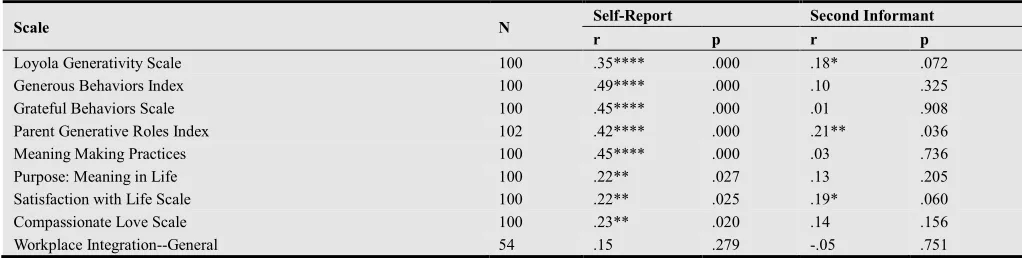
The GRI correlated moderately and significantly with the LGS, a measure of generative concern, as expected. See Table 1. The GRI was also correlated with other behavioral measures of helping and empathic concern. The correlation with the Generous Behaviors Index was the highest we examined at .52. The GRI also correlated positively with the Grateful Behaviors scale. Likewise, the GRI positively correlated with the Parent Generative Roles Index, which measures similar items of generative involvement in the community, and so also indicates intergenerational transmission of generative roles. The GRI also was moderately correlated with the Meaning Making Practices Scale, which also has a behavioral focus and also assesses different expressions of the desire to be involved in something greater than oneself and to leave something positive behind. The GRI had more modest, but still significant, positive correlations with two indicators of well-being, the Purpose/Meaning in Life scale and Subjective Well-being. Other measures indicating nurturing concern or involvement in one's social network, represented here by scale for Compassionate Love and Workplace Integration, had fairly low positive correlations. The correlation with Workplace Integration was not significant.
Correlations with second-informant ratings
Self-report ratings of the Generative Roles Index correlated moderately with close-informant ratings (r=.44,
p=.000). See Table 1. Correlations tended to be positive and in the expected direction, ranging from .01 to .21, with the only exception being the correlation with the Workplace Integration items (r=-.05).
Table 1. Correlation of Self-Reported Generative Role Index Scores with both Self Report and Second Informant Ratings of Other Theoretically-Related Constructs
Scale N Self-Report Second Informant
r p r p
Loyola Generativity Scale 100 .35**** .000 .18* .072 Generous Behaviors Index 100 .49**** .000 .10 .325 Grateful Behaviors Scale 100 .45**** .000 .01 .908 Parent Generative Roles Index 102 .42**** .000 .21** .036 Meaning Making Practices 100 .45**** .000 .03 .736 Purpose: Meaning in Life 100 .22** .027 .13 .205 Satisfaction with Life Scale 100 .22** .025 .19* .060 Compassionate Love Scale 100 .23** .020 .14 .156 Workplace Integration--General 54 .15 .279 -.05 .751
Notes: Workplace Integration items were only asked if participants were currently employed outside the home. *p<.1; **p<.05; ***p<.01; ****p<.001
8. Study 2 Methods
8.1. Participants
The participants were 1706 individuals from Southern states who completed a broader survey on character development and coping with adversity. Participants
29 Sherry Hamby et al.: Generative Roles Index
(75 %), 12% reported Black/African American, 7% considered themselves Hispanic or Latino/a, 4% reported multiple races, 1% reported American Indian or Alaska Native, 0.4% reported Asian, and .5% reported Native Hawaiian or Pacific Islander.
8.2. Procedure
The procedures were similar to Study 1, but in Study 2 a wider variety of advertising strategies was used to recruit participants. Most participants (83%) were recruited from community events, such as local festivals and county fairs. Others were recruited through word of mouth (13%) and newspaper, mail, or other advertising (4%). Our broader range of recruitment strategies allowed us to reach segments of the population who are seldom included in psychology research. Although we made every effort to simplify language, offer an easy-to-use interface, and make available
the option to participate via oral interview, it was our observation that limited reading and computer skills kept some interested individuals from participating. Thus, this sample is most representative of community members with at least a 6th grade reading ability and some experience using a computer. Technical problems and time limitations at events also kept some individuals from completing the survey. The overall completion rate was 86%. The incentive for Study 2 was a $30 Walmart gift card (less than Study 1 because people were not asked to bring a study partner). The survey was again administered as a CASI with an audio option, this time on the Snap10 software platform.
8.3. Measures
Measures were the same as in Study 1. Reliability and validity statistics for these measures are presented in Table 2.
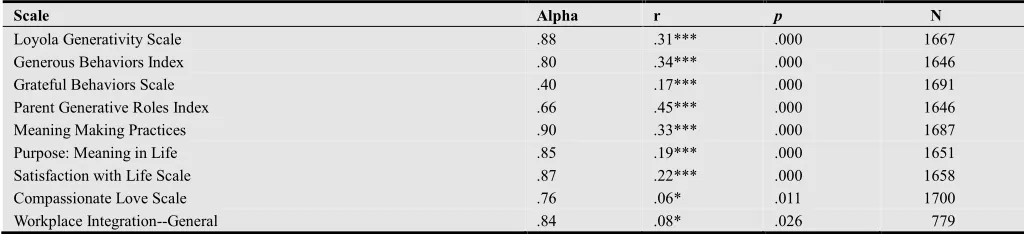
Table 2. Reliability (Internal Consistency) and Correlations with the Generative Roles Index (Convergent Validity) for Measures in Study 2
Scale Alpha r p N
Loyola Generativity Scale .88 .31*** .000 1667 Generous Behaviors Index .80 .34*** .000 1646 Grateful Behaviors Scale .40 .17*** .000 1691 Parent Generative Roles Index .66 .45*** .000 1646 Meaning Making Practices .90 .33*** .000 1687 Purpose: Meaning in Life .85 .19*** .000 1651 Satisfaction with Life Scale .87 .22*** .000 1658 Compassionate Love Scale .76 .06* .011 1700 Workplace Integration--General .84 .08* .026 779 Notes: Workplace Integration items were only asked of participants/second informants who reported either part-time or full-time employment. *p<.05; **p<.01; ***p<.001
9. Results
9.1. Rates, Reliability and Validity
Consistent with Study 1, participation in each item ranged from 11% for teacher to 38% for tutor. Table 2 presents internal consistency (coefficient alpha) data from Study 2 for each of the measures used. Alphas ranged from .40 to .94.
Also consistent with the findings from Study 1, the Generative Roles Index moderately, positively correlates with other measures of interpersonal behaviors and well-being, including the Loyola Generativity Scale, the Generous Behaviors Index, the Grateful Behaviors Scale, and the Parent Generative Roles Index. It also positively correlated with Meaning Making Practices and the two measures of well-being, Purpose: Meaning in Life and Subjective Well-Being: Satisfaction with Life. Again consistent with earlier findings, it only modestly, positively correlates with interpersonal measures of nurture (Compassionate Love Scale and Workplace Integration—General). Significant correlations ranged from .06 to .46. See Table 2. These
generally provide evidence of convergent validity for the GRI, especially for other measures of generativity, generosity and well-being. Although significant in this large sample, our other measures of interpersonal concern and investment showed only weak relationships with the GRI.
9.2. Developmental Patterns in Generative Roles
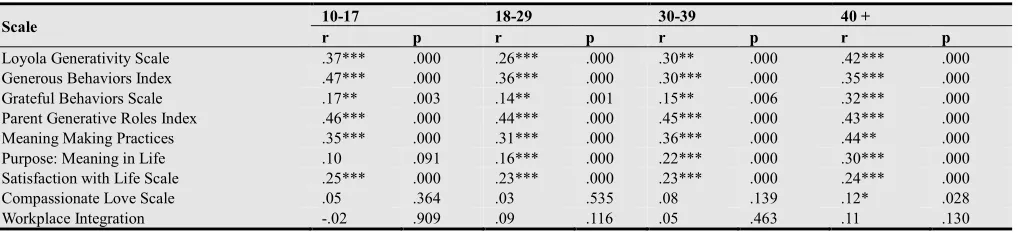
Table 3. Correlations of the Generative Roles Index with Other Measures by Age Groups
Scale 10-17 18-29 30-39 40 +
r p r p r p r p
Loyola Generativity Scale .37*** .000 .26*** .000 .30** .000 .42*** .000 Generous Behaviors Index .47*** .000 .36*** .000 .30*** .000 .35*** .000 Grateful Behaviors Scale .17** .003 .14** .001 .15** .006 .32*** .000 Parent Generative Roles Index .46*** .000 .44*** .000 .45*** .000 .43*** .000 Meaning Making Practices .35*** .000 .31*** .000 .36*** .000 .44** .000 Purpose: Meaning in Life .10 .091 .16*** .000 .22*** .000 .30*** .000 Satisfaction with Life Scale .25*** .000 .23*** .000 .23*** .000 .24*** .000 Compassionate Love Scale .05 .364 .03 .535 .08 .139 .12* .028 Workplace Integration -.02 .909 .09 .116 .05 .463 .11 .130 Notes: N ranges by group, excluding Workplace Integration Items: 10-17 (255 to 301), 18-29 (477 to 565), 30-39 (291 to 346), 40 and older (314-364). Workplace Integration Items were only asked of participants who reported current employment. 10-17 (N=25), 18-29 (N=281), 30-39 (N=227), 40 and older (N=206).
*p<.05; **p<.01; ***p<.001
10. Discussion
Generative behavior has been recognized as an important component of generativity for decades (Gruenewald, et al., 2012; McAdams & de St Aubin, 1992). However, until now no measure of roles indicating a sustained commitment to generative action has been available. The Generative Roles Index addresses this gap in the literature as it assesses a range of common, specific generative roles relevant across the lifespan. The relatively high rates of participation in these roles in both samples support the centrality of generativity as an important developmental task. The GRI showed good reliability and validity in two community samples, including moderate correlations of generative roles with a close informant, and moderate correlations with one of the most widely used measures of generative concern, the Loyola Generativity Scale (McAdams & de St. Aubin, 1992).
Convergent validity was also demonstrated with moderate positive correlations with other related constructs, including the Generous Behaviors Index and Grateful Behaviors Scale, both measures of interpersonal helping behaviors. It also moderately correlated with measures of Parent Generative Roles, one of the only intergenerational measures used in this study. Meaning Making Practices also moderately, positively correlated with the GRI, supporting theoretical work linking these two constructs (de St. Aubin, 2013).
A particular strength of this data set is the inclusion of second informant data. The correlations with second informants were particularly strong and significant for the Generative Roles Index, perhaps because it asks about observable, behavioral measures. Self-report has well-known limitations, including social desirability biases, exaggeration, and misinterpretation. These data should help to counteract some of the inherent limitations of self-report. The significant correlation between participants’ own reports of their generative roles and their study partner’s reports suggest that, for this scale, social desirability does not strongly influence self-report ratings. As all of the roles we ask about are observable (and largely verifiable through other outside sources), participants might be more inclined to answer honestly, especially given that roles such as teacher and Bible
study group leader are likely well-known communal roles. The inclusion of second informant data lends an aspect of validity to this measure that is uncommon amongst other self-report studies.
Perhaps the greatest strength of this study is the sample. It is varied by gender, age, income, and many other variables. It is not limited to the stereotypical set of college sophomores. The items in this measure were tailored to be appropriate to this sample. For example, items are straightforward with no negative wording or reverse scoring. These features are particularly important for community-based research, especially for populations, such as the one we drew our sample from, where educational attainment is relatively low. By wording items simply, we allowed a greater, more representative portion of the population to partake in the study. Five of the eight items included also are written specifically to be suitable to participants of all ages. Including items that are applicable to children is another way in which we allow for a more representative community sample.
31 Sherry Hamby et al.: Generative Roles Index
and changes in generativity across the lifespan.
These correlational findings offer some support for the model of generativity proposed by McAdams and de St. Aubin’s (1992), where generativity is primarily an interpersonal, intergenerational construct. It follows logically that somebody who allocates their time and resources towards the future generation might also exhibit higher levels of generosity, which is also supported by the data. Likewise, the significant positive correlations with the Meaning Making Practices scale (Banyard, et al., 2013) support Kotre’s (1984) and Vaillant’s (1995) contention that generativity stems from the desire to create a lasting legacy, to leave something behind that will endure longer than one’s own life. The Generative Roles Index aligns with the existing literature on generativity while adding a behavioral measure of a more sustained commitment to the future generation.
10.1. Limitations
The limitations of these data should be acknowledged when considering the results. Although both samples were drawn from the community, the sample is drawn from one particular region of the country. Some of the items, such as Bible study leader, were designed with our rural Southern community in mind. We had relatively high levels of endorsement for all of our roles, suggesting we were successful in identifying common ones in this community. However, some roles may be less applicable elsewhere. Our approach of identifying salient generative roles might be adapted for communities where the roles might be different, both within and outside the United States. For example, the role of community elder embodies generativity and might be appropriate in some communities.
10.2. Implications
Future research could further explore other aspects of generativity, including community-specific aspects of generative action. Our findings showing relative consistency in the associations of generative roles with other attributes across developmental stages suggest more research should assess manifestations of generativity across the life cycle. We also recommend more work on behavioral indicators of personality to complement assessments of motives and attitudes. As has been noted by others, we believe investigation of generative roles holds promise for better understanding resilience following adversity (de St. Aubin, 2013). Recent work has indicated that generativity is tied to regulatory strengths as well as the interpersonal an meaning making strengths shown here (Busch & Hofer, 2012). These three life domains—regulatory, interpersonal and meaning making—have been identified as central in the Resilience Portfolio Model and suggest the importance of generativity for promoting resilience and well-being (Grych, Hamby, & Banyard, 2014). Finally, this study also provides a model for using a close informant to supplement self-report data on personal strengths. The Generative Roles Index provides one means of furthering research in these areas.
Appendix 1 The Generative Roles
Index
All items are yes/no.
Items 1-3 are only asked of participants over 18 years old. Items 4-8 are asked of all participants.
1. At some time in my life, I have been a school teacher. 2. At some time in my life, I have been a Sunday school teacher.
3. At some time in my life, I have been a leader or co-leader of a community support group.
4. At some time in my life, I have been a Bible study group leader.
5. At some time in my life, I have been a coach (volunteer or paid).
6. At some time in my life, I have been a scout leader/youth group leader (for example, for Boy Scouts, Girl Scouts, 4H).
7. At some time in my life, I have been a captain of a team. 8. At some time in my life, I have been a tutor.
Acknowledgement
This study was made possible through the support of a grant from the John Templeton Foundation. The opinions expressed in this publication are those of the authors and do not necessarily reflect the views of the John Templeton Foundation.
References
[1] Amato, P. R. (1990). Personality and Social Network Involvement as Predictors of Helping Behavior in Everyday Life. Social Psychology Quarterly, 53(1), 31-43. doi: 10.2307/2786867
[2] Azarow, J. A. (2003). Generativity and well-being: An investigation of the Eriksonian hypothesis. Northwestern University.
[3] Banyard, V. L., Hamby, S., & Grych, J. (2013). Meaning Making Practices Scale. Sewanee, TN: Life Paths Research Program.
[4] Block, J. (1961). The Q-sort method in personality assessment and psychiatric research: Thomas Springfield, IL.
[5] Bradley, C. L. (1997). Generativity–Stagnation: Development of a Status Model. Developmental Review, 17(3), 262-290. doi: http://dx.doi.org/10.1006/drev.1997.0432
[6] Bradley, C. L., & Marcia, J. E. (1998). Generativity-Stagnation: A Five-Category Model. [Article]. Journal of Personality, 66(1), 39-39.
[7] Busch, H., & Hofer, J. (2012). Self-regulation and milestones of adult development: Intimacy and generativity.
Developmental Psychology, 48(1), 282-293. doi:
10.1037/a0025521
[9] de St. Aubin, E. (2013). Generativity and the meaning of life. In J. Hicks & C. Routledge (Eds.), The experience of meaning in life: Classical perspectives, emerging themes, and controversies (pp. 241-255). Dordrecht, The Netherlands: Springer.
[10] Diener, E., Emmons, R. A., Larsen, R. J., & Griffin, S. (1985). The satisfaction with life scale. Journal of Personality Assessment, 49(1), 71-75.
[11] Erikson, E. H. (1950/1993). Childhood and society. New York: WW Norton & Company.
[12] Gruenewald, T. L., Liao, D. H., & Seeman, T. E. (2012). Contributing to others, contributing to oneself: Perceptions of generativity and health in later life. The Journals of Gerontology. doi: 10.1093/geronb/gbs034
[13] Grych, J., Hamby, S., & Banyard, V. L. (2014). The Portfolio Model of Resilience: How “positive” psychology can inform the study of “negative” life events. Sewanee, TN: Life Paths Research Program.
[14] Guastello, D. D., Guastello, S. J., & Briggs, J. M. (2014). Parenting style and generativity measured in college students and their parents. SAGE Open, 4(1).
[15] Hamby, S. (2014). Battered women's protective strategies: Stronger than you know. London: Oxford University Press.
[16] Hamby, S., Grych, J., & Banyard, V. L. (2013). Life paths measurement packet. Sewanee, TN: Life Paths Research Program.
[17] Hawley, G. A. (1985). Construction and validation of an Eriksonian measure of psychosocial development. ProQuest Information & Learning.
[18] Hofer, J., Busch, H., Chasiotis, A., Kärtner, J., & Campos, D. (2008). Concern for Generativity and Its Relation to Implicit Pro-Social Power Motivation, Generative Goals, and Satisfaction With Life: A Cross-Cultural Investigation. [Article]. Journal of Personality, 76(1), 1-30. doi: 10.1111/j.1467-6494.2007.00478.x
[19] Kotre, J. N. (1984). Outliving the self: Generativity and the interpretation of lives: Johns Hopkins University Press Baltimore.
[20] Lawford, H., Pratt, M. W., Hunsberger, B., & Mark Pancer, S. (2005). Adolescent Generativity: A Longitudinal Study of Two Possible Contexts for Learning Concern for Future Generations. Journal of Research on Adolescence, 15(3), 261-273. doi: 10.1111/j.1532-7795.2005.00096.x
[21] McAdams, D. P., & de St Aubin, E. (1992). A theory of generativity and its assessment through self-report, behavioral acts, and narrative themes in autobiography. Journal of Personality and Social Psychology, 62(6), 1003-1015.
[22] Meeus, W., Iedema, J., Helsen, M., & Vollebergh, W. (1999). Patterns of adolescent identity development: Review of literature and longitudinal analysis. Developmental review, 19(4), 419-461.
[23] Ochse, R., & Plug, C. (1986). Cross-cultural investigation of the validity of Erikson's theory of personality development.
Journal of Personality and Social Psychology, 50(6), 1240-1252. doi: 10.1037/0022-3514.50.6.1240
[24] Peterson, B. E. (1998). Case studies of midlife generativity: Analyzing motivation and realization. In D. P. M. E. d. S. Aubin (Ed.), Generativity and adult development: How and why we care for the next generation (pp. 101-131). Washington, DC, US: American Psychological Association.
[25] Peterson, B. E., & Stewart, A. J. (1996). Antecedents and contexts of generativity motivation at midlife. Psychology and Aging, 11(1), 21-33. doi: 10.1037/0882-7974.11.1.21
[26] Pratt, M. W., Norris, J. E., Arnold, M. L., & Filyer, R. (1999). Generativity and moral development as predictors of value-socialization narratives for young persons across the adult life span: From lessons learned to stories shared. Psychology and Aging, 14(3), 414-426. doi: 10.1037/0882-7974.14.3.414
[27] Ryff, C. D., & Migdal, S. (1984). Intimacy and generativity: Self-perceived transitions. Signs, 9(3), 470-481.
[28] Schnell, T. (2009). The Sources of Meaning and Meaning in Life Questionnaire (SoMe): Relations to demographics and well-being. The Journal of Positive Psychology, 4(6), 483-499.
[29] Schnell, T. (2011). Individual differences in meaning-making: Considering the variety of sources of meaning, their density and diversity. Personality and Individual Differences, 51(5), 667-673.
[30] Shulman, S., & Connolly, J. (2013). The Challenge of Romantic Relationships in Emerging Adulthood Reconceptualization of the Field. Emerging Adulthood, 1(1), 27-39.
[31] Sprecher, S., & Fehr, B. (2005). Compassionate love for close others and humanity. Journal of Social and Personal Relationships, 22(5), 629-651.
[32] Steger, M. F., Frazier, P., Oishi, S., & Kaler, M. (2006). The Meaning in Life Questionnaire: Assessing the presence of and search for meaning in life. Journal of Counseling Psychology, 53(1), 80.
[33] U.S. Air Force. (2011). 2011 Air Force Community Assessment Survey: Survey data codebook. Lackland Air Force Base, TX.