R E S E A R C H A R T I C L E
Open Access
The role of concern about falling on
stepping performance during complex
activities
Shaira Viaje
1, Geert Crombez
2, Stephen R. Lord
1,3, Jacqueline C. T. Close
1,4, Perminder Sachdev
5,6,7,
Henry Brodaty
6,7and Kim Delbaere
1,3*Abstract
Background:There is limited understanding of the underlying mechanisms explaining the role of concern about
falling on fall risk in older people. Anxiety is known to interact with cognitive resources and, as people get older, they require more cognitive resources to maintain balance. This might affect an individual’s ability to perform cognitive-motor tasks concurrently. The aim of this study was to investigate the effect of a visuospatial dual-task on stepping performance in older people with and without concern about falling and the impact of repeating this task in those with high concern about falling.
Methods:Three-hundred-eight community-dwelling older people, aged 70 to 90 years old, participated in the
study. Participants were asked to perform a Choice Stepping Reaction Time (CSRT) task in two conditions; once without any other tasks (single task condition), and once while simultaneously performing a visuospatial task (dual-task condition). Participants were asked to rate their levels of concern and confidence specifically related to each of the 25 stepping trials (before/after). We also measured general concern about falling, affect, and sensorimotor and cognitive functioning.
Results:Total stepping reaction times increased when participants also performed the visuospatial task. The relation between general concern about falling and stepping reaction time, was affected by sensorimotor and executive functioning. Generalised linear mixed models showed that the group with moderate to high levels of general concern about falling had slower total stepping reaction times than those with lower levels of concern about falling, especially during the dual-task condition. Individuals with greater general concern about falling showed reduced confidence levels about whether they could do the stepping tasks under both conditions. Repeatedly performing the stepping task reduced the immediate task-specific concern about falling levels and increased confidence in all participants.
Conclusions:These findings reveal that people with higher general concern about falling experienced more
difficulties during a dual-task condition than people with lower levels of concern. Of further interest, better sensorimotor and cognitive functioning reduced this effect. Graded exposure has potential to reduce concern about falling during fear-evoking activities, especially in conjunction with therapies that improve balance, mood and cognitive function.
© The Author(s). 2019Open AccessThis article is distributed under the terms of the Creative Commons Attribution 4.0 International License (http://creativecommons.org/licenses/by/4.0/), which permits unrestricted use, distribution, and reproduction in any medium, provided you give appropriate credit to the original author(s) and the source, provide a link to the Creative Commons license, and indicate if changes were made. The Creative Commons Public Domain Dedication waiver (http://creativecommons.org/publicdomain/zero/1.0/) applies to the data made available in this article, unless otherwise stated. * Correspondence:[email protected]
1Falls, Balance and Injury Research Centre, Neuroscience Research Australia,
University of New South Wales, PO Box 1165, Sydney, Randwick, NSW 2031, Australia
3School of Public Health and Community Medicine, University of New South
Wales, Sydney, Australia
Background
Concern about falling is common in older people, with prevalence rates up to 43% [1]. Falls can result in injuries which impose limitations upon daily activities, jeopardize autonomy and decrease quality of life [2,3]. These devas-tating consequences of falls are possible reasons for the high prevalence of concern about falling in older people who have suffered a fall in the past. However, concern about falling is also reported in individuals without a fall history [4,5]. A wide range of factors has been associated with concern about falling, many of which are also known risk factors for falls, such as being female, being older and having poor balance and gait [5,6]. Additionally, impaired cognitive ability [7], depression and anxiety [8] have been associated with concern about falling. History of falls has been found to be a predictor for developing concern about falling [4]. For individuals who have never experienced a fall, concern about falling could develop through forecast-ing the possible consequences of falls [9].
Concern about falling may have paradoxical effects. High levels of concern about falling are associated with avoidance of daily activities [10]. Such avoidance behav-iours can result in physical inactivity, decreased muscle strength and balance, which increase fall risk through deconditioning [11]. Concern about falling can increase fall risk, even in older people who do not have impaired balance or other obvious risk factors [12]. Previous stud-ies have found that individuals with concern about fall-ing often adopt a slow gait speed as a strategy to protect themselves from falling and maintain balance during high-risk activities [13,14]. People who display such gait behaviour may, however, fall more because a slower gait reduces the individual’s stability and therefore increases the likelihood of falling [14]. Furthermore, concern about falling may also affect a person’s fall risk due to the interplay between anxiety and attention [15]. Anxiety may interfere with tasks that require attention and com-plex coordination. Therefore, concern about falling may further increase the challenge of tasks such as walking, especially under dual-tasking conditions [16]. As age in-creases, walking and maintaining posture becomes more cognitively demanding and less automatic [17]. Anxiety might then interfere with this process and increase the challenge to remain upright while walking [18–21]. There is limited understanding about how to reduce concern about falling. Cognitive behavioural therapy is a psychotherapeutic approach known to be efficacious in the treatment of depression and low mood, with lasting effects that protect against relapse following the end of the treatment [22] and may also be relevant to reduce concern about falling [10]. The aim of cognitive behav-ioural therapy is to target (erroneous) thoughts and be-liefs. Exposure to fear-evoking stimuli has been used as a strategy in cognitive behavioural therapy and may be of
particular use in our context. Wetherell et al. (2016) sug-gested graded exposure to fear-evoking tasks as a treat-ment for concern about falling. However, this research topic is still in its infancy and not well-understood.
The aims of this study were twofold. First, we explored the effect of cognitive task on the performance of a step-ping task in individuals with and without concern about falling. Second, we examined how repeating this stepping task affected taskspecific concern about falling -especially in those with higher general levels of concern about falling. We also attempted to investigate whether this relationship was affected by mood or executive function. Our experiment was informed by two theories. Attentional control theory posits that task performance will be worse when individuals cannot efficiently control their internal thoughts and feelings of anxiety [18]. Ac-cording to the selective exposure theory, individuals tend to favour information that reinforces their anxiety, or in-formation in their environment that is congruent with and confirms their current attitudes [23]. To the best of our knowledge, the current study is the first to apply these theories on dual-task performance in relation to concern about falling. More specifically, this study inves-tigated the performance of older people in a stepping re-action time task, once in a single task condition and once in a dual task condition. We hypothesised that stepping performance during the dual-task condition will be worse in individuals with concern about falling com-pared to those with lower concern. Additionally, we hypothesised that task-specific concern about falling will be higher during the dual-task condition and will reduce after repeating the stepping task. Finally, due to the interaction between anxiety, depressive symptoms and executive resources, we hypothesised that the relation-ship between concern about falling and stepping per-formance will be affected by current mood or executive function.
Methods Participants
University of New South Wales and informed written con-sent was obtained from all participants.
Experimental procedure
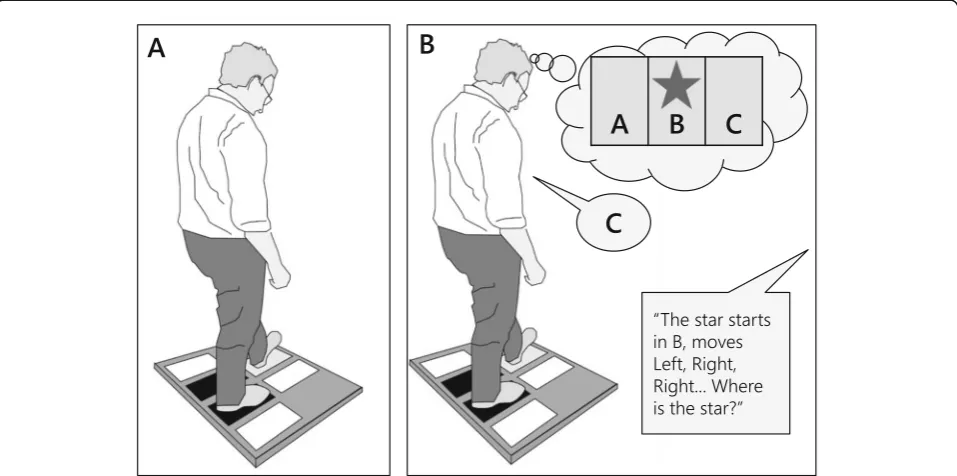
We used the same methodology as previously described by St George et al. [25]. Participants completed a Choice Stepping Reaction Time (CSRT) task under two condi-tions (with and without a visuospatial task). The CSRT device consisted of a low platform (84 cm × 76 cm) and six rectangular panels (32 cm × 12 cm): two base plates and four stepping plates. The participant stood on the base plates and stepped onto an illuminated stepping
plate presented in a random order (Fig. 1). A
supra-threshold was applied so that no participants had diffi-culty detecting the Target stimuli. Participants were instructed to step onto a plate as quickly as possible when it was illuminated, using the left foot only for the plates on their left (front and side) and the right foot only for the two right plates. Participants stood with their feet 12 cm apart and parallel with the two side plates. The light of the illuminated plate turned off when participants had stepped with their full foot. They then moved their foot back to the starting base plate at their own pace. Pressure switches under each plate recorded the time of stepping events to within 1-millisecond ac-curacy throughout a trial. There was usually between 5 and 10 s delay before the start of a new trial to allow participants to regain their balance. Response time was recorded as the time from the plate illumination to the foot lift-off of the appropriate leg. Transfer time was
recorded as the time from the appropriate foot lift-off to foot contact on the correct plate. From the lift-off events recorded by the stepping plates, incorrect start data were obtained. Thus, this method recorded“correct”response and transfer times with any errors made in selecting the appropriate stepping foot included in the response time and any errors made in stepping to the target included in the transfer time. For example, if participants initially raised the incorrect stepping foot and then replaced it before initiating movement with the correct leg, these events increased the response time measure. If partici-pants stepped with the correct leg but did not land on the correct plate and required an additional step to reach the target, this increased the transfer time meas-ure. The total CSRT reaction time in milliseconds was used for all analyses: this comprised the sum of response and transfer times. All trials were included in the ana-lyses, regardless of whether the participant made errors.
The CSRT task was performed either alone (single task condition) and while simultaneously performing a visuospatial task (dual-task condition). The visuo-spatial task was used because it allowed participants to look directly at the stepping plates of the platform while performing the primary stepping task and
pro-vide a record of cognitive task responses– allowing
ascertainment of whether or not participants were at-tending to the secondary task. The visuospatial “star
movement” task, adapted from Brooks [26], required
participants to envision three boxes side by side
la-belled A, B, and C (Fig. 1). Participants were then
asked to visualise a star in one of boxes and making three movements. They were told the starting box of the star and the direction of the three movements, i.e., left or right. Participants were shown a visual dis-play during the explanation of the protocol. They were allowed sufficient practice without the visual dis-play until they demonstrated that they understood the test requirements and could score 5 consecutive cor-rect responses. For each trial in the dual-task, the ex-perimenter verbally delivered the initial position and three movements of the star and immediately follow-ing this, a steppfollow-ing plate was randomly illuminated. Participants completed the step and then reported the finishing box of the star, i.e., box A, B, or C. Pformance was recorded in terms of the number of er-rors made in identifying the finishing position. We used the same methodology as previously described by St George et al. [25].
The two conditions were administered in a random order with each comprising 25 trials with five illumina-tions per plate. Each of the 25 CSRT trials for each con-dition, took 3 to 5 min to complete. To measure the effect of repeating this stepping task 25 times, partici-pants were asked to indicate their levels of confidence to perform the stepping task and task-specific concern about falling 4 times, before and immediately after each condition on a 10-point Likert scale. Participants gave a rating between 1 and 10 (‘1’ represented lowest confi-dence, or greatest concern:‘10’represented highest con-fidence and least concern). Concon-fidence questions were
‘how confident are/were you that you can/cou the
step-ping task without making errors?’ The question about
task-specific concern about falling read, ‘to what extent are/were you concerned that you will/might lose your balance during the stepping task?’
Other measures of interest
The Physiological Profile Assessment (PPA) [27] was
assessed as a measure of sensorimotor function. The PPA is a validated composite measure of fall risk, con-taining five assessments: visual contrast sensitivity (Mel-bourne Edge Test), proprioception (measured with a lower limb-matching task), reaction time (measured using a light as stimulus and a finger-press as response), postural sway (path length measured with a sway meter recording displacements of the body at the level of the pelvis while standing on a foam mat with eyes open), and muscle strength (measured isometrically in the dominant leg with participants seated with the hip and knee flexed 90°) [27].
Falls Efficacy Scale International (FES-I) [28] was used to assess general concern about falling. Participants rated their concern about falling during 16 daily activities on a 4-point scale (‘1’= not at all concerned; ‘4’= high
concern). The sum score may range between 16 and 64. A higher score reflects greater concern about falling. For this study, individuals were categorized using a validated cut-point, based on their levels of general concern about fall-ing: group of low concern (FES-I scores≤19) and group of moderate to high concern (FES-I scores > 19) [12].
Depressed mood and anxiety were assessed with two questionnaires. The Geriatric Depression Scale (GDS) is a 15 item instrument to screen for depression in older
people [29]. Scores ranged from 0 to 15 with higher
scores representing more depressive symptoms. Anxiety was assessed using the Goldberg Anxiety Scale (GAS) [30]. A high score on this 9-item questionnaire reflected greater anxiety.
Cognitive processing performance was tested with a trail making test (TMT) [31], more specifically as a measure of visual search and executive function including psychomotor speed, set-shifting and working memory. In part A, partici-pants connected letters in ascending order. In part B, they were required to connect alternating letters and numbers in ascending order as quickly as possible. Set-shifting was measured as the difference in completing parts A and B. Maximum completion for part A was set at 180 s and 320 s for part B [32]. The TMT ‘executive function’ score was computed by subtracting Part A from Part B.
Statistical analyses
The statistical software, SPSS Version 24 was used for all analyses and a value of p< 0.05 was considered sig-nificant. Linear regression was used to explore the strength of the association between CSRT performance and FES-I (univariable) and after controlling for PPA, GDS, GAS and TMT (multivariable). TMT measures of cognitive function were controlled for years of education in all analyses. Generalised linear mixed models were used to analyse differences in CSRT performances [1] between single and dual-task conditions, and [2] be-tween people with low and high general concern about falling (FES-I scores≤19 vs > 19). In addition, interaction effects between condition and groups were also exam-ined. Similar models were used to analyse differences in task-specific confidence and concern about falling over time. Measures of PPA, previous falls, GDS, GAS and TMT were added separately as covariates to the analysis.
Results
The mean age of our participants was 78.0 years (SD = 4.5) and 53% (N= 162) were female. Out of a possible seven common medical conditions, the sample had a
mean of 3.1 (SD = 1.5) and 85% (N= 262) rated their
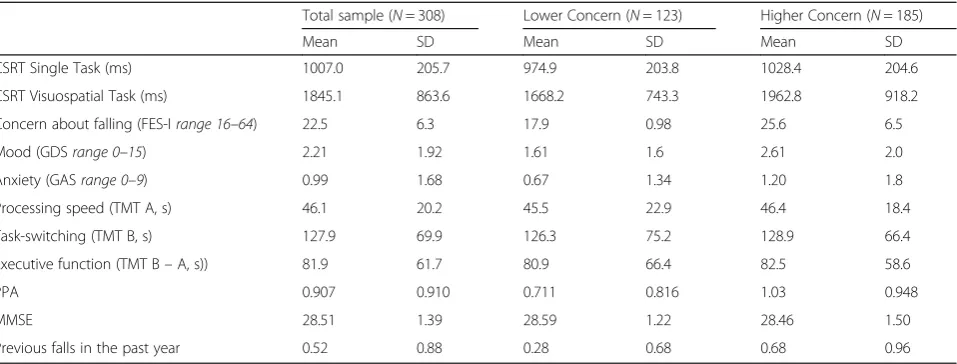
and 60% (N= 185) reported moderate to high levels of general concern about falling (Table1).
Table 2 shows that FES-I, was significantly associated with average reaction times of the stepping task during both the single task condition and the dual-task condi-tion. In the single task condition, the strength of the as-sociation was reduced by 37%, after controlling for PPA; yet both variables stayed significant, suggesting that both have a unique contribution in predicting the perform-ance during the single task condition. In the dual-task condition, the strength of the association was also re-duced by 38%, after controlling for PPA. However, only PPA remained significant. When TMT was entered in the model (instead of the PPA), the strength of the asso-ciation of the FES-I was reduced by 19%; with both vari-ables staying significant, suggesting that both varivari-ables have an independent contribution in predicting the per-formance during the dual-task condition. When GDS and GAS were entered in the model, the strength of the association between FES-I and CSRT was not signifi-cantly affected.
Generalised linear mixed models confirmed that the total stepping reaction times were significantly longer during the dual-task condition compared to the single-task condition (β=−934.4, 95% CI [−1058.7 to−810.1],
p< 0.001)–see Fig.2. The group with moderate to high levels of general concern about falling had slower total stepping reaction times than those with lower levels of concern about falling (β=−294.6, 95% CI [−480.8 to− 108.4],p= 0.002). The group × condition interaction was significant and indicated that the dual task affected the CSRT task performance more in the group with higher levels of general concern about falling (β= 241.2, 95% CI [70.8 to 411.6],p= 0.006).
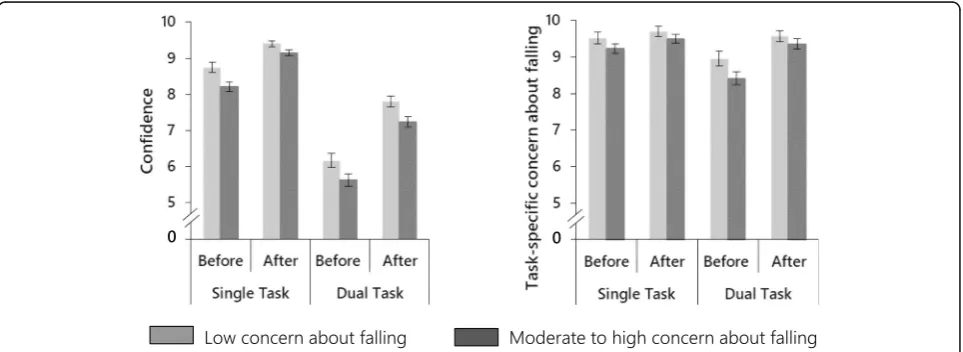
The effect of repeating the task on task-specific confidence and concern about falling is illustrated in Fig.3.Analysis of ratings before and after each condition revealed a significant difference in ratings between time (before vs after task) and condition. Participants became more confident (β=−1.618, 95% CI [−1.918 to −1.317], p< 0.001) and less concerned (β=−0.951, 95% CI [−1.250 to−0.652],p< 0.001) after the performance of the stepping task in comparison with before.
Table 1Summary of descriptive data for total sample, participants with lower (FES-I≤19) and higher (FES-I > 19) levels of concern
Total sample (N= 308) Lower Concern (N= 123) Higher Concern (N= 185)
Mean SD Mean SD Mean SD
CSRT Single Task (ms) 1007.0 205.7 974.9 203.8 1028.4 204.6
CSRT Visuospatial Task (ms) 1845.1 863.6 1668.2 743.3 1962.8 918.2
Concern about falling (FES-Irange 16–64) 22.5 6.3 17.9 0.98 25.6 6.5
Mood (GDSrange 0–15) 2.21 1.92 1.61 1.6 2.61 2.0
Anxiety (GASrange 0–9) 0.99 1.68 0.67 1.34 1.20 1.8
Processing speed (TMT A, s) 46.1 20.2 45.5 22.9 46.4 18.4
Task-switching (TMT B, s) 127.9 69.9 126.3 75.2 128.9 66.4
Executive function (TMT B–A, s)) 81.9 61.7 80.9 66.4 82.5 58.6
PPA 0.907 0.910 0.711 0.816 1.03 0.948
MMSE 28.51 1.39 28.59 1.22 28.46 1.50
Previous falls in the past year 0.52 0.88 0.28 0.68 0.68 0.96
Legend: CSRT = Choice Stepping Reaction Time, FES-I = Falls Efficacy Scale International, GDS = Geriatric Depression Scale, GAS = Geriatric Anxiety Scale, TMT = Trail Making Test; lower scores represent better performance in all tests
Table 2Results of regression analysis, identifying the strength of associations between FES-I and stepping performance while controlling for PPA, GDS, GAS and TMT
Single task CSRT Dual-task CSRT
FES-I# Covariate† FES-I# Covariate†
Concern about falling (FES-I) 6.59 (1.82),p< 0.001 – 18.04 (7.73),p= 0.020 –
Fall risk (PPA) 4.18 (1.74),p= 0.017 79.61 (12.13),p< 0.001 11.48 (7.72),p= 0.138 215.96 (53.68),p< 0.001
Mood (GDS) 5.78 (1.90),p= 0.003 10.54 (6.30),p= 0.095 15.89 (7.74),p= 0.041 43.46 (25.63),p= 0.091
Anxiety (GAS) 6.11 (1.89),p= 0.001) 5.06 (7.07),p= 0.475 18.06 (7.95),p= 0.024 11.56, (29.66),p= 0.697
Executive function (TMT) 6.05 (1.80),p= 0.001 0.72 (0.18),p= 0.313 14.69 (7.44),p= 0.049 3.52 (0.76),p< 0.001
Overall, participants were also more confident (β= 1.902, 95% CI [1.621 to 2.184], p< 0.001) and expressed lower levels of task-specific concern (β= 0.141, 95% CI [−0.015 to 0.296], p= 0.076, borderline significance) in the single task condition than in the dual-task condition. Group differences were only found for confidence: the group with higher levels of general concern about falling were less confident regard-ing both conditions compared to the group with lower levels of concern (β= 0.554, 95% CI [0.135 to 0.972], p= 0.010). The significant time × condition interaction effects for rat-ings of confidence (β= 0.682, 95% CI [0.338 to 1.025], p< 0.001) and task-specific concern about falling (β= 0.676, 95% CI [0.318 to 1.033],p< 0.001) indicated adjustments to-wards higher confidence and lower concern about falling were more pronounced after repeated in the dual-task
condition in comparison with the single task condition. The group × time interactions were not significant for either confidence (β=−0.031, 95% CI [−0.535 to 0.474], p= 0.905) or concern ratings (β= 0.325, 95% CI [−0.077 to 0.728],p= 0.113). In a further series of exploratory analyses, we explored the role of generic measures of sensorimotor functioning, falls in the past year, cognitive functioning and depressed mood and anxiety on the group × time inter-action. Controlling for PPA or previous falls had no impact on this interaction. However, the interaction became signifi-cant for task-specific concern about falling (β= 0.392, 95%CI [0.002 to 0.781], p= 0.049) when controlling for GDS; and borderline significant (β= 0.387, 95% CI [−0.005, 0.778], p= 0.053; β= 0.386, 95% CI [−0.002, 0.774], p= 0.051) when controlling for GAS and TMT. Further, post-Fig. 2Boxplot of average total stepping reaction times for simple and visuospatial CSRT in participants with lower concern about falling and moderate to high concern about falling
hoc probing analyses [33] suggested that people with high general concern and low mood (GDS > 5) were less likely to adjust their task-specific concern ratings over time. How-ever, caution is required when interpreting these results due to reduced sample sizes.
Discussion
This study investigated the experience and performance during a stepping task under single task and dual-task conditions in older people with low and higher levels of general concerns about falling. The study also explored whether repeating the stepping task improved ratings of task-specific concern and confidence. The results con-firmed that participants, overall, were slower during the dual-task condition, but, and of particular interest, the group with higher levels of general concern about falling were more affected in the dual-task condition than the group with low levels of concern. Results indicated that participants overall benefitted from exposure to the step-ping task: the task-specific concern about falling dimin-ished over trials. Further exploratory analyses revealed that poorer sensorimotor function and executive function affected the relationship between general concern about falling and the performance of stepping task in the dual task condition. These findings highlight the negative rela-tionship between general concern about falling and step-ping ability, especially during complex activities. Improved sensorimotor function and better cognitive function may reduce this impact.
Processes explaining the relation between general concern about falling and performing complex activities Previous studies have shown that performing dual-task activities becomes more challenging as people get older and a reduced ability to simultaneously perform multiple tasks might subsequently impact risk of falling [14, 34]. Our results showed that participants with higher levels of general concern about falling tended to have slower reaction times when cognitive task requirements in-creased. This relation was reduced after controlling for sensorimotor function. While this suggests that good physical abilities might be paramount in the relationship, other factors might still be at play. Shackman, Sarino-poulos [21] suggested that anxiety may interfere with visuospatial working memory, which could explain why individuals with higher levels of general concern about falling were slower during the dual-task condition. This further aligns with the attentional control theory, which proposes that anxiety interferes with attention and cog-nitive resources when task demands increase, possibly negatively impacting task performance [18]. In our ex-ploratory analysis, it was also found that executive
func-tion, specifically working memory and cognitive
flexibility [35, 36], had an effect on the association
between general concern about falling and stepping re-action times in the dual-task condition. The relationship between cognitive function, concern about falling and stepping is consistent with previous studies that showed that poor cognitive ability was associated with both fall risk [37] and the development of concern about falling
[7]. This may explain how concern about falling
in-creases fall risk during complex activities. According to the attentional control theory it may be expected that concerns about falling will require some attentional pro-cessing during multi-tasking, which may then have detri-mental effects on the efficiency of the reactive stepping performance.
Repeated exposure to reduce task-specific concern about falling
Our results indicate that repeated exposure is beneficial to reduce task-specific concern about falling and in-crease confidence regarding a cognitive-motor task in participants with higher levels of concern about falling. Individuals with greater general concern about falling were less confident about whether they could do the stepping tasks. Initial lack of confidence and task-specific concern were corrected when the same stepping movement was repeated. Exposing older people to activ-ities that they (erroneously) perceive as unsafe may in-crease their confidence about their ability to conduct the activity without falling, as individual’s predictions be-come corrected through repeated exposure. These find-ings are consistent with an earlier study by Rachman et al., which revealed that highly fearful individuals have an increased tendency to over-predict the value of threat [38]. As such, over-prediction of threat has been associ-ated with avoidance of those activities which might evoke a negative outcome [39]. Such avoidance behav-iour limits opportunities for individuals to experience situations which counter these irrational fears [38]. As a consequence, people might enter a negative spiral of fear-avoidance and physical deconditioning, further in-creasing a person’s risk of falling [11]. While our results are the first of their kind, they indicate that exposure might be successful in people with high levels of general concern about falling, but an overall good well-being, re-gardless of whether they had previous falls or have an in-creased fall risk due to reduced sensorimotor function.
Clinical and research implications towards reducing the impact of concern about falling on fall risk
an effective approach to reduce concern about falling long-term. Randomised controlled trials will be re-quired to confirm this hypothesis.
Exercise
The implication of the sensorimotor function affecting the relation between general concern about falling and stepping performance, is that improving physical func-tion should be considered as a strategy. If well-designed, balance exercise programs can reduce falls by 39% as
demonstrated by a comprehensive meta-analysis [41].
Exercise and physical activity are also known to improve depressed mood [42] and could improve cognitive per-formance in older people [43]. A Cochrane systematic review and meta-analysis showed that exercise can re-duce concern about falling immediately following an intervention [44]. Exercise interventions have been pro-posed as a promising means for the prevention of falls and are recommended in evidence-based guidelines for fall prevention worldwide. However, the long-term effect of exercise on concern about falling is unclear [44], and might require additional strategies.
Graded exposure therapy
Exposure therapy may be effective in reducing short-term, task-specific concern about falling regarding perceived fall-threatening activities. To date, only one study has investi-gated this approach towards reducing concern about falling. Wetherell, Johnson [45] reported pilot findings showing a combined approach of exercise with exposure therapy was successful in reducing excessive levels of concern about fall-ing. Exposure therapy has been applied successfully to re-duce fear of pain and movement [46]. Similar to concern about falling, fear of pain and movement contributes to the maintenance of pain disability, which can lead to avoidance behaviour [46]. Vlaeyen, de Jong [47] implemented graded exposure, during which participants were required to per-form fear-evoking activities and was successful at reducing an overall and long-term fear of pain and avoidance behav-iour. Therefore, repeated exposures to pain threatening ac-tivities without suffering a negative outcome, not only decreased their fear regarding that activity but also trans-lated to other daily activities [48]. This study showed reduc-tions in short-term, task-specific concern about falling immediately after the performing the exposure. Future re-search should investigate the long-term effectiveness of graded exposure to reduce concern about falling in older people, possibly in combination with other approaches such as exercise and/or cognitive behavioural therapy.
Cognitive Behavioural therapy
When cognitive behavioural therapy is aimed at modifying patterns of thoughts (cognitions) and actions (behaviours) detrimental to fall risk, including avoidance
behaviour [10,49], it can also reduce concern about fall-ing as well as the incidence of fall events [49, 50]. Such approaches might minimize the interference of concern about falling on the capacity to perform tasks requiring attentional resources, through addressing low mood as well as through addressing concern about falling directly. Furthermore, this strategy might be considered in con-junction with exposure therapy, especially in people with concomitant low mood.
Combined cognitive-motor training
The integration of cognitive training into established fall interventions may improve the effectiveness of current programs (e.g., exercise) to reduce fall risk in people with concern about falling. Our finding that executive function affected the relation between concern about falling and cognitive-motor performance, implies that improving working memory and cognitive flexibility [35,
36] could be effective in weakening the association be-tween concern about falling and fall risk in more chal-lenging cognitive-motor situations. Previous studies have observed the association between falls and executive function [15, 51], which suggests cognitive training may also contribute to the reduction of falls directly. Studies which tested the effects of cognitive training found posi-tive results on gait, balance and fall risk [52,53]. There-fore, cognitive training might reduce falls, in addition to reducing the negative effect of concern about falling on performance during more challenging dual-task condi-tions. Previous research has also shown a combination of physical and cognitive training can improve executive function [54] and reduce fall risk and concern about fall-ing [55, 56]. A combined training approach might have stronger long-term effects compared to physical or cog-nitive training alone.
Limitations
Conclusion
The study aimed to gain a better understanding of the association between concern about falling and stepping performance during complex activities. General concern about falling was associated with poorer stepping reac-tion times, especially when combined with a visuospatial task. Individuals with greater concern about falling tended to have longer reaction times. This association between concern about falling and stepping perform-ance, was strongly influenced by sensorimotor function and executive function. Reduced task-specific confidence observed immediately after the task, was more pro-nounced in people with higher levels of general concern about falling. Multiple exposures by repetition of the stepping task improved short-term task-specific concern and confidence equally in all participants. These findings suggest that sensorimotor function, mood and executive function may be important for older people with higher levels of general concern about falling to successfully perform more complex cognitive-motor tasks.
Abbreviations
CSRT:Choice Stepping Reaction Time; FES-I: Falls Efficacy Scale International; GAS: Goldberg Anxiety Scale; GDS: Geriatric Depression Scale;
PPA: Physiological Profile Assessment; TMT: Trail Making Test
Acknowledgements
We would like to thank participants from the Sydney Memory and Ageing Study for volunteering their time to take part in this study.
Authors’contributions
KD, GC and SRL had the study idea and conducted the methods. KD collected the data and helped with the data analysis. SV did the data analyses and wrote the manuscript with KD. JCT, PS and HB assisted with the interpretation of the results. All authors edited and approved the manuscript.
Funding
This work was funded by a National Health and Medical Research Council, grant 350833, and by the Australian National Health and Medical Research Council, grant 400941. Prof. Lord and A/Prof Delbaere are currently supported by the Australian National Health and Medical Research Council. The funding bodies played no role in the design of the study and collection, analysis, and interpretation of data and in writing the manuscript.
Availability of data and materials
The datasets used and/or analysed during the current study are available from the corresponding author on reasonable request.
Ethics approval and consent to participate
The protocol was approved by the Human Studies Ethics Committee HREC 05224 at the University of New South Wales and informed written consent was obtained from all participants.
Consent for publication
Not applicable
Competing interests
KD is a member of the editorial board for BMC Geriatrics. The authors declare that they have no other competing interests.
Author details 1
Falls, Balance and Injury Research Centre, Neuroscience Research Australia, University of New South Wales, PO Box 1165, Sydney, Randwick, NSW 2031, Australia.2Department of Experimental-Clinical and Health Psychology,
Ghent University, Gent, Belgium.3School of Public Health and Community
Medicine, University of New South Wales, Sydney, Australia.4Prince of Wales
Clinical School, Medicine, University of New South Wales, Sydney, Australia.
5Neuropsychiatric Institute, Prince of Wales Hospital, Randwick, New South
Wales, Sydney, Australia.6Centre for Healthy Brain Ageing (CHeBA), School of Psychiatry, University of New South, Sydney, Wales, Australia.7Dementia
Centre for Research CollaborationUniversity of New South Wales, Sydney, Australia.
Received: 21 January 2019 Accepted: 12 November 2019
References
1. Lach HW. Incidence and risk factors for developing fear of falling in older adults. Public health nursing (Boston, Mass). 2005;22(1):45–52.
2. Hartholt KA, van Beeck EF, Polinder S, van der Velde N, van Lieshout EMM, Panneman MJM, et al. Societal consequences of falls in the older population: injuries, healthcare costs, and long-term reduced quality of life. J Trauma Acute Care Surg. 2011;71(3):748–53.
3. Vellas B, Cayla F, Bocquet H, de Pemille F, Albarede JL. Prospective study of restriction of activity in old people after falls. Age Ageing. 1987;16(3):189–93. 4. Friedman SM, Munoz B, West SK, Rubin GS, Fried LP. Falls and fear of falling: which comes first? A longitudinal prediction model suggests strategies for primary and secondary prevention. J Am Geriatr Soc. 2002;50(8):1329–35. 5. Liu JY. Fear of falling in robust community-dwelling older people: results of
a cross-sectional study. J Clin Nurs. 2015;24(3–4):393–405.
6. Scheffer AC, Schuurmans MJ, van Dijk N, van der Hooft T, de Rooij SE. Fear of falling: measurement strategy, prevalence, risk factors and consequences among older persons. Age Ageing. 2008;37(1):19–24.
7. Uemura K, Shimada H, Makizako H, Doi T, Tsutsumimoto K, Lee S, et al. Effects of Mild Cognitive Impairment on the Development of Fear of Falling in Older Adults: A Prospective Cohort Study. J Am Med Dir Assoc. 2015; 16(12):1104.e9–13.
8. Gagnon N, Flint AJ, Naglie G, Devins GM. Affective correlates of fear of falling in elderly persons. Am J Geriatr Psychiatry. 2005;13(1):7–14. 9. Yardley L, Smith H. A prospective study of the relationship between feared
consequences of falling and avoidance of activity in community-living older people. Gerontologist. 2002;42(1):17–23.
10. Zijlstra GA, Van Haastregt JCM, Van Rossum E, Van Eijk JTM, Yardley L, Kempen GIJM. Interventions to reduce fear of falling in community-living older people: a systematic review. J Am Geriatr Soc. 2007;55(4):603–15. 11. Delbaere K, Crombez G, Vanderstraeten G, Willems T, Cambier D. Fear-related
avoidance of activities, falls and physical frailty. A prospective community-based cohort study. Age Ageing. 2004;33(4):368–73.
12. Delbaere K, Close JC, Mikolaizak AS, Sachdev PS, Brodaty H, Lord SR. The falls efficacy scale international (FES-I). A comprehensive longitudinal validation study. Age Ageing. 2010;39(2):210–6.
13. Reelick MF, van Iersel MB, Kessels RP, Rikkert MG. The influence of fear of falling on gait and balance in older people. Age Ageing. 2009;38(4):435–40. 14. Donoghue OA, Cronin H, Savva GM, O'Regan C, Kenny RA. Effects of fear of
falling and activity restriction on normal and dual task walking in community dwelling older adults. Gait & Posture. 2013;38(1):120–4. 15. Anstey KJ, von Sanden C, Luszcz MA. An 8-year prospective study of the
relationship between cognitive performance and falling in very old adults. J Am Geriatr Soc. 2006;54(8):1169–76.
16. Wollesen B, Mattes K, Schulz S, Bischoff LL, Seydell L, Bell JW, et al. Effects of Dual-Task Management and Resistance Training on Gait Performance in Older Individuals: A Randomized Controlled Trial. Front Aging Neurosci. 2017;9:415.
17. Woollacott M, Shumway-Cook A. Attention and the control of posture and gait: a review of an emerging area of research. Gait & Posture. 2002;16(1):1–14. 18. Eysenck MW, Derakshan N, Santos R, Calvo MG. Anxiety and cognitive
performance: attentional control theory. Emotion. 2007;7(2):336–53. 19. Vytal K, Cornwell B, Arkin N, Grillon C. Describing the interplay between anxiety
and cognition: from impaired performance under low cognitive load to reduced anxiety under high load. Psychophysiology. 2012;49(6):842–52. 20. Gage WH, Sleik RJ, Polych MA, McKenzie NC, Brown LA. The allocation of
attention during locomotion is altered by anxiety. Exp Brain Res. 2003; 150(3):385–94.
22. Jayasekara R, Procter N, Harrison J, Skelton K, Hampel S, Draper R, et al. Cognitive behavioural therapy for older adults with depression: a review. J Ment Health. 2015;24(3):168–71.
23. Festinger L. A theory of cognitive dissonance, vol. 2. Stanford, CA: Stanford University Press; 1962.
24. Sachdev PS, Brodaty H, Reppermund S, Kochan NA, Trollor JN, Draper B, et al. The Sydney memory and ageing study (MAS): methodology and baseline medical and neuropsychiatric characteristics of an elderly epidemiological non-demented cohort of Australians aged 70-90 years. Int Psychogeriatr. 2010;22(8):1248–64.
25. St George RJ, Fitzpatrick RC, Rogers MW, Lord SR. Choice stepping response and transfer times: effects of age, fall risk, and secondary tasks. J Gerontol Series A. 2007;62(5):537–42.
26. Brooks LR. The suppression of visualization by Reading. Q J Exp Psychol. 1967;19(4):289–99.
27. Lord SR, Menz HB, Tiedemann A. A physiological profile approach to falls risk assessment and prevention. Phys Ther. 2003;83(3):237–52. 28. Yardley L, Beyer N, Hauer K, Kempen G, Piot-Ziegler C, Todd C.
Development and initial validation of the falls efficacy scale-international (FES-I). Age Ageing. 2005;34(6):614–9.
29. Yesavage JA, Sheikh JI. 9/geriatric depression scale (GDS). Clin Gerontol. 1986;5(1–2):165–73.
30. Goldberg D, Bridges K, Duncan-Jones P, Grayson D. Detecting anxiety and depression in general medical settings. BMJ. 1988;297(6653):897–9. 31. Reitan RM, Wolfson D. The Halstead-Reitan neuropsychological test battery.
In: Wedding D, Horton Jr AM, Webster JS, editors. The neuropsychology handbook: behavioral and clinical perspectives. New York, NY, US: Springer Publishing Co; 1986. p. 134–60.
32. Tombaugh TN. Trail making test a and B: normative data stratified by age and education. Arch Clin Neuropsychol. 2004;19(2):203–14.
33. Holmbeck GN. Post-hoc probing of significant Moderational and Mediational effects in studies of pediatric populations. J Pediatr Psychol. 2002;27(1):87–96. 34. Beauchet O, Annweiler C, Dubost V, Allali G, Kressig RW, Bridenbaugh S,
et al. Stops walking when talking: a predictor of falls in older adults? Eur J Neurol. 2009;16(7):786–95.
35. Kortte KB, Horner MD, Windham WK. The trail making test, part B: cognitive flexibility or ability to maintain set? Appl Neuropsychol. 2002;9(2):106–9. 36. Sanchez-Cubillo I, Perianez JA, Adrover-Roig D, Rodriguez-Sanchez JM,
Rios-Lago M, Tirapu J, et al. Construct validity of the trail making test: role of task-switching, working memory, inhibition/interference control, and visuomotor abilities. J Int Neuropsychol Soc. 2009;15(3):438–50.
37. Mirelman A, Herman T, Brozgol M, Dorfman M, Sprecher E, Schweiger A, et al. Executive function and falls in older adults: new findings from a five-year prospective study link fall risk to cognition. PLoS One. 2012;7(6):e40297. 38. Rachman S. The overprediction of fear: a review. Behav Res Ther. 1994;32(7):683–90. 39. Cox BJ, Swinson RP. Overprediction of fear in panic disorder with
agoraphobia. Behav Res Ther. 1994;32(7):735–9.
40. Suzuki M, Ohyama N, Yamada K, Kanamori M. The relationship between fear of falling, activities of daily living and quality of life among elderly individuals. Nurs Health Sci. 2002;4(4):155–61.
41. Sherrington C, Fairhall NJ, Wallbank GK, Tiedemann A, Michaleff ZA, Howard K, Clemson L, Hopewell S, Lamb SE. Exercise for preventing falls in older people living in the community. Cochrane Database of Systematic Reviews. 2019;(1).https://doi.org/10.1002/14651858.CD012424.pub2.
42. Singh NA, Stavrinos TM, Scarbek Y, Galambos G, Liber C, Fiatarone Singh MA. A randomized controlled trial of high versus low intensity weight training versus general practitioner care for clinical depression in older adults. J Gerontol A Biol Sci Med Sci. 2005;60(6):768–76.
43. Brown AK, Liu-Ambrose T, Tate R, Lord SR. The effect of group-based exercise on cognitive performance and mood in seniors residing in intermediate care and self-care retirement facilities: a randomised controlled trial. Br J Sports Med. 2009;43(8):608–14.
44. Kendrick D, Kumar A, Carpenter H, Zijlstra G, Skelton DA, Cook JR, Stevens Z, Belcher CM, Haworth D, Gawler SJ, Gage H, Masud T, Bowling A, Pearl M, Morris RW, Iliffe S, Delbaere K. Exercise for reducing fear of falling in older people living in the community. Cochrane Database of Systematic Reviews. 2014;(11).https://doi.org/10.1002/14651858.CD009848.pub2.
45. Wetherell JL, Johnson K, Chang D, Ward SR, Bower ES, Merz C, et al. Activity, balance, learning, and exposure (ABLE): a new intervention for fear of falling. Int J Geriatr Psychiatry. 2016;31(7):791–8.
46. Vlaeyen JW, de Jong J, Geilen M, Heuts PH, van Breukelen G. The treatment of fear of movement/(re) injury in chronic low back pain: further evidence on the effectiveness of exposure in vivo. Clin J Pain. 2002;18(4):251–61. 47. Vlaeyen JWS, de Jong J, Geilen M, Heuts PHTG, van Breukelen G.
Graded exposure in vivo in the treatment of pain-related fear: a replicated single-case experimental design in four patients with chronic low back pain. Behav Res Ther. 2001;39(2):151–66.
48. Leeuw M, Goossens ME, van Breukelen GJ, de Jong JR, Heuts PH, Smeets RJ, et al. Exposure in vivo versus operant graded activity in chronic low back pain patients: results of a randomized controlled trial. Pain. 2008;138(1):192–207. 49. Zijlstra GA, Van Haastregt JCM, Ambergen T, Van Rossum E, Van Eijk JTM,
Tennstedt SL, et al. Effects of a multicomponent cognitive behavioral group intervention on fear of falling and activity avoidance in community-dwelling older adults: results of a randomized controlled trial. J Am Geriatr Soc. 2009;57(11):2020–8.
50. Huang T-T, Yang L-H, Liu C-Y. Reducing the fear of falling among community-dwelling elderly adults through cognitive-behavioural strategies and intense tai chi exercise: a randomized controlled trial. J Adv Nurs. 2011; 67(5):961–71.
51. Herman T, Mirelman A, Giladi N, Schweiger A, Hausdorff JM. Executive control deficits as a prodrome to falls in healthy older adults: a prospective study linking thinking, walking, and falling. J Gerontol A Biol Sci Med Sci. 2010;65(10):1086–92.
52. Segev-Jacubovski O, Herman T, Yogev-Seligmann G, Mirelman A, Giladi N, Hausdorff JM. The interplay between gait, falls and cognition: can cognitive therapy reduce fall risk? Expert Rev Neurother. 2011;11(7):1057–75. 53. Smith-Ray RL, Hughes SL, Prohaska TR, Little DM, Jurivich DA, Hedeker D.
Impact of cognitive training on balance and gait in older adults. J Gerontol Ser B Psychol Sci Soc Sci. 2015;70(3):357–66.
54. Kayama H, Okamoto K, Nishiguchi S, Yamada M, Kuroda T, Aoyama T. Effect of a Kinect-based exercise game on improving executive cognitive performance in community-dwelling elderly: case control study. J Med Internet Res. 2014;16(2):e61.
55. Barban F, Annicchiarico R, Melideo M, Federici A, Lombardi MG, Giuli S, et al. Reducing Fall Risk with Combined Motor and Cognitive Training in Elderly Fallers. Brain Sciences. 2017;7:19.
56. Schoene D, Valenzuela T, Toson B, Delbaere K, Severino C, Garcia J, et al. Interactive cognitive-motor step training improves cognitive risk factors of falling in older adults - a randomized controlled trial. PLoS One. 2015;10(12): e0145161.
57. Crombez G, Eccleston C, Vlaeyen JWS, Vansteenwegen D, Lysens R, Eelen P. Exposure to physical movement in low back pain patients: restricted effects of generalization. Health Psychol. 2002;21(6):573–8.
Publisher’s Note