RESEARCH
Iterative ensemble feature selection
for multiclass classification of imbalanced
microarray data
Junshan Yang
1*, Jiarui Zhou
2, Zexuan Zhu
3, Xiaoliang Ma
1and Zhen Ji
1Abstract
Background: Microarray technology allows biologists to monitor expression levels of thousands of genes among various tumor tissues. Identifying relevant genes for sample classification of various tumor types is beneficial to clini-cal studies. One of the most widely used classification strategies for multiclass classification data is the One-Versus-All (OVA) schema that divides the original problem into multiple binary classification of one class against the rest. Never-theless, multiclass microarray data tend to suffer from imbalanced class distribution between majority and minority classes, which inevitably deteriorates the performance of the OVA classification.
Results: In this study, we propose a novel iterative ensemble feature selection (IEFS) framework for multiclass clas-sification of imbalanced microarray data. In particular, filter feature selection and balanced sampling are performed iteratively and alternatively to boost the performance of each binary classification in the OVA schema. The proposed framework is tested and compared with other representative state-of-the-art filter feature selection methods using six benchmark multiclass microarray data sets. The experimental results show that IEFS framework provides superior or comparable performance to the other methods in terms of both classification accuracy and area under receiver operating characteristic curve. The more number of classes the data have, the better performance of IEFS framework achieves.
Conclusions: Balanced sampling and feature selection together work well in improving the performance of mul-ticlass classification of imbalanced microarray data. The IEFS framework is readily applicable to other biological data analysis tasks facing the same problem.
© 2016 Yang et al. This article is distributed under the terms of the Creative Commons Attribution 4.0 International License (http://creativecommons.org/licenses/by/4.0/), which permits unrestricted use, distribution, and reproduction in any medium, provided you give appropriate credit to the original author(s) and the source, provide a link to the Creative Commons license, and indicate if changes were made. The Creative Commons Public Domain Dedication waiver (http://creativecommons.org/ publicdomain/zero/1.0/) applies to the data made available in this article, unless otherwise stated.
Background
Microarray gene expression data are widely used for can-cer clinical studies [1, 2].The identification of relevant genes to cancers is a common biological challenge [3]. It is crucial to explore a list of high-potential biomark-ers and signature candidates that are strongly associated with the disease among a large number of simultaneously observed genes [4]. From a machine learning perspective,
gene selection is regarded as feature selection to the can-didate genes that can be used to distinguish the classes of sample tissues.
Multiclass cancer prediction based on gene selec-tion has attracted increasing research interest [5–8]. For instance, Li et al. [9] compared different feature selection and multiclass classification methods for gene expres-sion data. The paper indicated that multiclass classifica-tion problem is much more difficult than the binary one for gene expression data. By comparing several filter feature selection methods and representative classifiers including naive Bayes, k-nearest neighbor (KNN), and support vector machine (SVM), they also suggested that
Open Access
*Correspondence: [email protected]
1 College of Engineering and Information, Shenzhen University, Shenzhen, People’s Republic of China
Full list of author information is available at the end of the article
the classification accuracy degrades rapidly as the num-ber of classes increase. Kim-Anh et al. [10] developed a One-Verse-One schema based optimal feature weight-ing approach usweight-ing classification-and-regression tree and SVM classifiers. Zhou et al. [7] extended the support vector machine—recursive feature elimination (SVM-RFE) [11] to solve the multiclass gene selection problem based on different frameworks of multiclass SVMs, and improved the classification accuracy. Yeung et al. [12] utilized the Bayesian model averaging method for gene selection, which was reported to be applicable to micro-array data sets with any number of classes. It is capable of obtaining high accuracy with only a small number of selected genes, and meanwhile providing posterior prob-abilities for the predictions. To alleviate the siren-pitfall problem, Rajapakse et al. [8] proposed a novel algorithm to decompose multiclass ranking statistics into class-specific statistics, and use Pareto-front analysis for the selection of genes. Experiments showed that a signifi-cant improvement in classification performance and redundancy reduction among the top-ranked genes was achieved.
The aforementioned methods have achieved success in multiclass microarray data, however, the inherent imbal-anced nature of multiclass microarray data, i.e., some minority classes may have relatively small number of samples compared to other classes (denoted as major-ity classes), still pose major challenges to gene selection methods. In this study, we propose an iterative ensemble feature selection (IEFS) framework based on the One-Versus-All (OVA) classification schema [13] to improve the classification performance in terms of both classifi-cation accuracy and area under receiver operating char-acteristic curve (AUC). OVA schema is a widely used ensemble solution for solving multiclass problems. In each binary sub-classification of OVA schema, samples of the majority class outnumber those from the minority class [14–17]. Therefore, a binary classifier would obtain good overall accuracy on majority class but not the minority class. The informative genes beneficial to sepa-rate the minority class are overwhelmed by those that are discriminating in the majority class, due to the lack of samples in minority class. Known as siren-pitfall, this
problem has not yet been well addressed in multiclass classification of microarray data [18]. In this paper, we use a sampling method prior to gene selection in binary classification to solve this problem caused by imbalanced data distribution.
Data sampling is one of the most widely used approaches to address imbalanced classification problem [19]. It turns an imbalanced distribution data into a bal-anced/optimal distribution one, wherein undersampling and oversampling as the two representative approaches have been thoroughly studied [19]. Undersampling removes samples from the majority class to match the minority class. In contrast, oversampling duplicates sam-ples from the minority class to match the size of majority class [20].
The IEFS framework is tested on six benchmark mul-ticlass microarray data sets and the experimental results show that the framework significantly improves the pre-diction accuracy of both minority and majority classes.
Results and discussion
Microarray data sets
To validate the effectiveness of IEFS framework, six mul-ticlass benchmark microarray data sets shown in Table 1
are used in the experiments. The GCM data consists of 190 tumor samples of 14 commonly seen tumor types. Lung data contains 186 lung tumor samples and 17 nor-mal tissues. The 186 lung tumor samples include 139 ade-nocarcinomas resected from lung and 47 tumor samples from the other 3 tumor types. In the acute lymphoblastic leukemia (ALL) data set, target and classes cover 7 sub-groups from the treatment of pediatric ALL. The ALL-AML-4 data set comes with 4 types of tumors including AML-Bone Marrow, ALL-Peripheral Blood, ALL B cell, and T-Cell. The ALL-AML-3 data set has 3 types of tumors including AML, ALL B-Cell, and ALL T-Cell with 7129 samples. Finally, the Thyroid data set profiles from the human thyroid origin with four thyroid tissue types, i.e., papillary carcinoma, follicular carcinoma, follicu-lar adenoma, and normal thyroid. All these data sets are characterized with only a small number of samples but thousands of features. The number of classes in all data sets range from 3 to 14.
Table 1 Summary of microarray data sets
Name #Features #Samples #Samples in each class #Classes Source
GCM 14,122 190 11 10 11 11 22 11 10 10 30 11 11 11 11 20 14 [14]
Lung 12,600 203 139 17 6 21 20 5 [15]
ALL 12,558 327 15 27 64 20 43 79 79 7 [16]
ALL-AML-4 7129 72 38 9 21 4 4 [17]
ALL-AML-3 7129 72 38 9 25 3 [17]
Experimental design
In the experiment, we investigate the combinations of two sampling methods, i.e., oversampling and undersam-pling, and three filter feature selection methods in IEFS framework. The filter feature selection methods include one ranking method and two space search methods [22]. The ranking method measures the relevance between features and the class label vector based on mutual infor-mation [23]. The two space search methods include fast correlation-based filter selection (FCBF) [24] and mini-mum redundancy maximini-mum relevance feature selection (mRMR) [25]. FCBF identifies relevant features as well as redundancy among them based on symmetric uncer-tainty. The mRMR penalises a feature’s relevancy by its redundance in the presence of the other selected features. The relevance and redundancy are measured using corre-lation between features based on mutual information.
In the IEFS framework, undersampling or oversam-pling technology is applied to correct the sample distri-bution skewness before feature selection. Particularly, the random undersampling [26] and the synthetic minor-ity oversampling technique (SMOTE) [27] are used. The sampling and feature selection are performed iteratively and alternatively until a satisfactory performance is obtained.
The classification performance of the selected feature subset obtained by IEFS framework is evaluated using both KNN and SVM. KNN and SVM classifiers are sen-sitive to the imbalanced class distribution [28, 29]. Their performance on the imbalanced data sets can easily be affected without sample distribution skewness correc-tion. IEFS framework is expected to improve the perfor-mance of KNN and SVM.
Most classifiers obtain good overall classification accu-racy on the whole data but a poor accuaccu-racy on the minor-ity classes [30]. When applied on imbalanced data, a good classifier should perform well on minority classes even at the expense of performance on the majority classes. AUC measures the sensitivity and specificity that are defined as the proportions of samples that are correctly classi-fied in the positive and the negative classes, respectively. Therefore, the metric of AUC is better than classification accuracy to evaluate classifier performance on minority class [31]. In addition to classification accuracy, the clas-sification performance on AUC is also reported.
In our empirical studies, the number of selected features in filter ranking method is increased from 5 to 100 with internal 5. The performance of using all features is intro-duced as the baseline performance. The number of the nearest neighbors used in oversampling method is set to 5. For the controlled size of selected feature with filter rank-ing method, the step T of sample balance and feature selec-tion is set to 1 and 4, respectively. Because FCBF is capable
of deciding the number of selected features itself, the step
T of sample balance and feature selection in IEFS with FCBF is set to 1. Consistently, the step T of selected feature subset with mRMR is set to 1. The classification accuracies on data sets Lung, ALL-AML-3 and ALL-AML-4 are eval-uated with threefold stratified cross-validation [31] as the sizes of some classes are smaller than 10. The classification accuracies on the other three data sets, i.e., GCM, ALL and Thyroid are evaluated using tenfold stratified cross-vali-dation [32]. All experiments are conducted in the WEKA environment [33]. The other parameters for FCBF, mRMR and the classifiers [KNN (K = 3) and SVM] are used with default settings in WEKA.
Experimental results
Figure 1 reports the classification accuracies of IEFS framework and other compared feature selection meth-ods (Filter Ranking, FCBF and mRMR) using both KNN and SVM. The results on GCM data show that the clas-sification accuracy of IEFS framework with oversampling (SMOTE) significantly outperforms other counterpart methods at various signature sizes. However, IEFS frame-work with undersampling is worse than the compared methods due to the extreme lack of training data. On data sets Lung, ALL, ALL-AML-3 and ALL-AML-4, the performance obtained by IEFS framework with oversam-pling (T = 1 and T = 4) is slightly better than the other methods. It is observed that the more classes a data set has, the better performance the proposed framework can obtain. This is because IEFS with oversampling (SMOTE) can correct the imbalanced sample distribution, and overcome the caused problem in single binary classifica-tion of the OVA schema. Meanwhile, oversampling can increase the number of training data that are beneficial to train a stronger binary classifier. IEFS framework out-performs other counterpart feature selection methods on most of the data sets by a decent margin of at least 10 selected features. This is very useful for biological data analysis, because biologists prefer fewer target genes so that they can focus more on those potential biomarkers. However, on Thyroid data, from Fig. 1 shows that the accuracy of IEFS framework with oversampling degrades sharply as the number of selected features increases. On the contrary, the accuracy of IEFS framework with undersampling increases obviously, especially with the ranking feature selection and KNN classifier.
Thyroid data. Generally, the performance of IEFS frame-work using different filter feature selection methods does not show significant difference.
The computational cost of IEFS framework depends on the sampling preprocessing, the step T, and the number of classes. IEFS framework might consume more compu-tational resources than the other filter feature selection methods, yet the extra effort for accuracy improvement is acceptable considering that the classification task is nor-mally conducted offline.
Conclusions
This paper proposes an iterative ensemble feature selec-tion for imbalanced multiclass microarray data. The per-formance of conventional filter feature selection methods including Filter ranking, FCBF, and mRMR is compared to the IEFS framework on six gene microarray data sets. The results show that our proposed framework and OVA ensemble schema can obtain promising performance on multiclass gene selection problems. Within this framework different concrete oversampling methods can be applied for various multiclass gene selection problems. Undersampling does not work so well as oversampling in this framework due to the lack of training samples. In the future work, more effective oversampling methods beneficial to specific filter feature selection techniques will be developed and investigated with OVA classification schema. Moreover, the optimal combination of sampling method and feature selection will be explored. IEFS framework is also applica-ble to other domains suffering from the same proapplica-blem.
Methods
The iterative ensemble feature selection
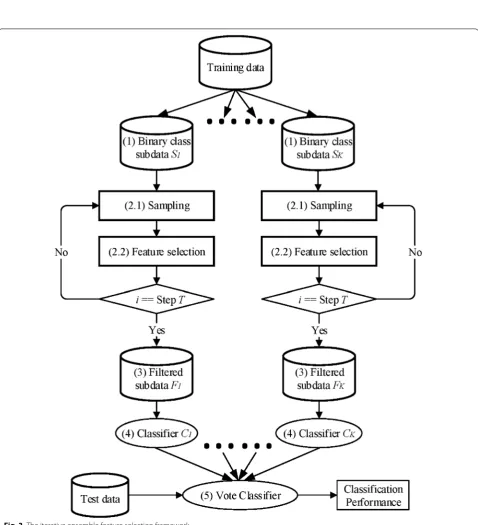
In this section, we outline the IEFS framework for OVA classification in five stages as shown in Fig. 3. At the first step, a class binarization [13] transforms a K-class train-ing data set into K binary class subdata sets (S1,…, SK) on
the first stage [Fig. 3(1)]. At the second step, undersam-pling with sample decrease or oversamundersam-pling with sample increase followed by feature selection is proceeded itera-tively for T steps [Fig. 3(2.1, 2.2)]. The number of selected features decreases as the oversampling/undersampling carries on. The interval number Mi of decreasing or
increasing samples in ith step is computed as:
(1)
Mi=
SM−Sm T
where SM denotes the number of samples in the
major-ity class and Sm denotes the number of samples in the
minority class in a binary classification. The interval size
Ni of decreasing features in ith step is computed as:
where NM denotes the number of all features and Nn
denotes the target selected number. After data sampling and feature selection, the training data that is then fil-tered by getting rid of the unselected features [Fig. 3(3)]. The filtered training data Fk is used to train the binary
classifier Ck at the fourth step [Fig. 3(4)]. Once each of
the individual classifiers (C1,…, CK) is trained, the final
prediction is made by taking the majority vote of the individual classifiers at the fifth step [Fig. 3(5)].
Sampling methods
The random undersampling [26] and SMOTE oversam-pling [27] are used in the IEFS framework. The random undersampling method creates sample balance between the two classes by reducing the size of the majority one. This is accomplished by randomly removing samples from the majority class until the sizes of majority and minority classes are equal. The SMOTE algorithm gen-erates new samples for the minority class. These samples are created artificially based on the feature space similari-ties between existing minority examples. By interpolating between the existing minority samples, a denser minority class containing more samples is achieved.
Filter ranking feature selection
Filter ranking feature selection method first evaluates the univariate correlation between each feature and the class label vector based on mutual information and then ranks them in descending order. Afterward, a predefined num-ber of top ranked features are selected. Filter ranking is widely used thanks to its easy implementation and high efficiency, but it cannot handle the redundancy between features.
Fast correlation‑based filter feature selection
FCBF [24] is a fast correlation-based filter feature selection method used in IEFS framework. It begins by ranking the features based on the correlation between features and the class label vector in a descending order and then removes those with correlation values smaller than a threshold δ.
(2)
Ni=
NM−Nn T (See figure on previous page.)
Fig. 1 Comparison of classification accuracy using KNN and SVM. The y-axis indicates the classification accuracy (in percentage, %). The x-axis
(See figure on previous page.)
Fig. 2 Comparison of AUC using KNN and SVM. The y-axis indicates AUC (in percentage, %). The x-axis indicates the number of selected gene
signatures. In the legend, “Undersampling” is abbreviated to “US” and “Oversampling” is abbreviated to “OS”. The first and the third column are the experiments using KNN. The second and the fourth column are the experiments using SVM
FCBF goes through the ranked feature list in decreasing order and a feature fi is removed if there exist another
fea-ture fj such that SU(c; fj) ≥ SU(c; fi) and SU(fi; fj) ≥ SU(fi; c)
where SU(a; b) denotes the symmetrical uncertainty [34] between feature a and feature b. These two inequalities mean that fj is better as a predicator of class label vector c
and fi is more similar to fj than to c. The threshold δ can be
adjusted to get the expected number of features.
Minimum redundancy maximum relevance feature selection
The mRMR feature selection criterion was proposed by Peng et al. [25] to evaluate the candidate feature subset considering both feature redundancy and relevance at the meantime. Particularly, max-relevance, denoted as max D(S, c), refers to maximizing the relevance of a feature subset S to the class label c. In [25], the relevance of a fea-ture subset is defined as:
where Φ(fi, c) denotes the relevance of a feature fi to c
based on mutual information.
If two relevant features highly depend on each other, the class-discriminative power would not change too much if one of them is removed. Feature redundancy is defined based on pair-wise feature dependence. Min-redundancy min R(S) is used to select a feature subset of mutually exclusively features. The redundancy of feature subset R(S) is defined as follows:
mRMR is defined as the simple operator max Φ(D,
R) = D − R which optimizes D and R simultaneously. In the experiment, linear forward search method [35] with window size 50 is used to find the near-optimal features. Given a feature subset Sm−1 of m − 1 selected features,
the task is to select the m-th feature that optimizes the following criterion:
Authors’ contributions
JY and ZJ conceived the study, performed the experiments, and wrote the paper. JZ, ZZ, and XM reviewed and revised the manuscript. All authors read and approved the manuscript.
Author details
1 College of Engineering and Information, Shenzhen University, Shenzhen, People’s Republic of China. 2 School of Computer Science and Technology, Harbin Institute of Technology Shenzhen Graduate School, Shenzhen, People’s
(3)
D(S, c)= 1 |S|
fi∈S �fi,c
(4)
D(S, c)= 1 |S|2
fi,fj∈S
�fi,fj
max
fj∈/Sm−1
�
�
fj,c�−
1
m−1
�
fj∈Sm−1
��
fi,fj�
Republic of China. 3 College of Computer Science and Software Engineering, Shenzhen University, Shenzhen, People’s Republic of China.
Acknowledgements
This work was supported in part by National Natural Science Foundation of China Joint Fund with Guangdong (U1201256), the National Natural Science Foundation of China (61471246, 61171125, and 61501138), the Guangdong Foundation of Outstanding Young Teachers in Higher Educa-tion InstituEduca-tions (Yq2013141), Guangdong Special Support Program of Top-notch Young Professionals (2014TQ01X273), Guangdong Natural Science Foundation (S2012010009545), Shenzhen Scientific Research and Develop-ment Funding Program(JCYJ20130329115450637, KQC201108300045A, and ZYC201105170243A), Innovation R&D Project of Nanshan District of Shenzhen (KC2014JSQN0008A), and Nanshan Innovation Institution Construction Program(KC2014ZDZJ0026A and KC2013ZDZJ0011A).
Competing interests
The authors declare that they have no competing interests.
Declarations
Publication of this article was funded by the National Natural Science Founda-tion of China (61171125). This article has been published as part of Journal of Biological Research—Thessaloniki, Volume 23, Supplement 1, 2016: Proceed-ings of the 2014 International Conference on Intelligent Computing. The full contents of the supplement are available online at http://jbiolres.biomedcen-tral.com/articles/supplements/volume-23-supplement-1.
Published: 4 July 2016
References
1. Fehrmann RS, Karjalainen JM, Krajewska M, Westra HJ, Maloney D, Simeonov A, et al. Gene expression analysis identifies global gene dosage sensitivity in cancer. Nat Genet. 2015;47:115–25.
2. Gerstung M, Pellagatti A, Malcovati L, Giagounidis A, Della Porta MG, Jädersten M, et al. Combining gene mutation with gene expression data improves outcome prediction in myelodysplastic syndromes. Nat Com-mun. 2015;6:5901.
3. Chambers AH, Pillet J, Plotto A, Bai J, Whitaker VM, Folta KM. Identification of a strawberry flavour gene candidate using an integrated genetic-genomic-analytical chemistry approach. BMC Genomics. 2014;15:217. 4. Hausser J, Zavolan M. Identification and consequences of miRNA-target
interactions—beyond repression of gene expression. Nat Rev Genet. 2014;15:599–612.
5. Madahian B, Deng LY, Homayouni R. Development of sparse Bayesian multinomial generalized linear model for multi-class prediction. BMC Bioinformatics. 2014;15:S10.
6. Engchuan W, Chan JH. Pathway activity transformation for multi-class classification of lung cancer datasets. Neurocomputing. 2015;165:81–9. 7. Zhou X, Tuck DP. MSVM-RFE: extensions of SVM-RFE for multiclass gene
selection on DNA microarray data. Bioinformatics. 2007;23:1106–14. 8. Rajapakse JC, Mundra PA. Multiclass gene selection using Pareto-fronts.
IEEE/ACM Trans Comput Biol Bioinform. 2013;10:87–97.
9. Li T, Zhang C, Ogihara M. A comparative study of feature selection and multiclass classification methods for tissue classification based on gene expression. Bioinformatics. 2004;20:2429–37.
10. Cao KAL, Bonnet A, Gadat S. Multiclass classification and gene selection with a stochastic algorithm. Comput Stat Data Anal. 2009;53:3601–15. 11. Guyon I, Weston J, Barnhill S, Vapnik V. Gene selection for cancer
classifica-tion using support vector machines. Mach Learn. 2002;46:389–422. 12. Yeung K, Bumgarner RA, Raftery AE. Bayesian model averaging:
develop-ment of an improved multi-class, gene selection and classification tool for microarray data. Bioinformatics. 2005;21:2394–402.
13. Fürnkranz J. Round robin classification. J Mach Learn Res. 2002;2:721–47.
• We accept pre-submission inquiries
• Our selector tool helps you to find the most relevant journal • We provide round the clock customer support
• Convenient online submission • Thorough peer review
• Inclusion in PubMed and all major indexing services • Maximum visibility for your research
Submit your manuscript at www.biomedcentral.com/submit
Submit your next manuscript to BioMed Central
and we will help you at every step:
15. Bhattacharjee A, Richards WG, Staunton J, Li C, Monti S, Vasa P, et al. Classification of human lung carcinomas by mRNA expression profiling reveals distinct adenocarcinoma subclasses. Proc Natl Acad Sci USA. 2001;98:13790–5.
16. Yeoh EJ, Ross ME, Shurtleff SA, Williams WK, Patel D, Mahfouz R, et al. Classification, subtype discovery, and prediction of outcome in pediatric acute lymphoblastic leukemia by gene expression profiling. Cancer Cell. 2002;1:133–43.
17. Golub TR, Slonim DK, Tamayo P, Huard C, Gaasenbeek M, Mesirov JP, et al. Molecular classification of cancer: class discovery and class prediction by gene expression monitoring. Science. 1999;286:531–7.
18. Forman G. A pitfall and solution in multi-class feature selection for text classification. Proc Twenty-first Int Conf Mach Learn. 2004;6441:38. 19. He H, Garcia EA. Learning from imbalanced data. IEEE Trans Knowl Data
Eng. 2009;21:1263–84.
20. Liu X-Y, Wu J, Zhou Z-H. Exploratory undersampling for class-imbalance learning. In: IEEE Transactions on Systems, Man, and Cybernetics, Part B (Cybernetics), vol 39. IEEE; 2009. p. 539–50.
21. Yukinawa N, Oba S, Kato K, Taniguchi K, Iwao-Koizumi K, Tamaki Y, et al. A multi-class predictor based on a probabilistic model: application to gene expression profiling-based diagnosis of thyroid tumors. BMC Genomics. 2006;7:190.
22. Lazar C, Taminau J, Meganck S, Steenhoff D, Coletta A, Molter C, et al. A survey on filter techniques for feature selection in gene expression micro-array analysis. IEEE/ACM Trans Comput Biol Bioinform. 2012;9:1106–19. 23. Guyon I, Elisseeff A. An introduction to variable and feature selection. J
Mach Learn Res. 2002;3:1157–82.
24. Yu L, Liu H. Feature selection for high-dimensional data: a fast correlation-based filter solution. Proc Eight Int Conf Mach Learn. 2003;2:856–63.
25. Peng H, Long F, Ding C. Feature selection based on mutual information: criteria of max-dependency, max-relevance, and min-redundancy. In: IEEE Transactions on Pattern Analysis and Machine Intelligence, vol 27. IEEE; 2005. p. 1226–38.
26. Japkowicz N. The class imbalance problem: significance and strategies. In Proceedings of the international conference on artificial intelligence. 2002;111–117.
27. Chawla NV, Bowyer KW, Hall LO, Kegelmeyer WP. Smote: synthetic minor-ity over-sampling technique. J Artif Intell Res. 2002;16:321–57. 28. Akbani R, Kwek S, Japkowicz N. Applying support vector machines to
imbalanced datasets. Mach Learn. 2004;3201:39–50.
29. Liu W, Chawla S. Class confidence weighted kNN algorithms for imbal-anced data sets. Adv Knowl Discov Data Min. 2011;6635:345–56. 30. Chawla NV, Japkowicz N, Kotcz A. Editorial: special issue on learning from
imbalanced data sets. ACM Sigkdd Explor Newsl. 2004;6:1–6. 31. Japkowicz N. Learning from imbalanced data sets: a comparison of
vari-ous strategies. In: AAAI workshop on learning from imbalanced data sets, vol. 68; 2000. p. 10–15.
32. Do KA, Ambroise C. Analyzing microarray gene expression data, vol. 14. New York: Wiley; 2004. p. 1080–7.
33. Hall M, Frank E, Holmes G, Pfahringer B, Reutemann P, Witten IH. The weka data mining software: an update. ACM Sigkdd Explor Newsl. 2009;11:10–8.
34. Press WH, Teukolsky SA, Vetterling WT, Flannery BP. Numerical Recipes in C. Cambridge University Press, vol. 10; 1992. p. 195–196.