F UNG A L G EN O M ES
Open Access
IMA Genome-F 11
Draft genome sequences of
Fusarium xylarioides,
Teratosphaeria gauchensis
and
T. zuluensis
and genome
annotation for
Ceratocystis fimbriata
Brenda D. Wingfield
1*, Arista Fourie
1†, Melissa C. Simpson
1†, Vuyiswa S. Bushula-Njah
1, Janneke Aylward
1,
Irene Barnes
1, Martin P. A. Coetzee
1, Léanne L. Dreyer
2, Tuan A. Duong
1, David M. Geiser
3, Francois Roets
4,
E. T. Steenkamp
1, Magriet A. van der Nest
1,6, Carel J. van Heerden
5and Michael J. Wingfield
1Abstract
Draft genomes of the fungal speciesFusarium xylarioides, Teratosphaeria gauchensisandT. zuluensisare presented. In addition an annotation of the genome ofCeratocystis fimbriatais presented. Overall these genomes provide a valuable resource for understanding the molecular processes underlying pathogenicity and potential management strategies of these economically important fungi.
Keywords:Genome announcement, Genome annotation, Fungal pathogen, Coffee pathogen, Eucalyptus canker pathogen,Fusarium xylarioides,Teratosphaeria gauchensis,T. zuluensis
IMA GENOME-F 11A
Genome annotation forCeratocystis fimbriata: an aggressive fungal pathogen of root crops
Introduction
The genusCeratocystisincludes 41 species of mainly plant pathogenic fungi (Marin-Felix et al. 2017; Holland et al. 2019Barnes et al.2018; Liu et al.2018). The type species, Ceratocystis fimbriata, was first described in the USA in 1890 as the causal agent of black rot of Ipomoea batatas (Halsted 1890). It shows strong host specificity and does not infect tree hosts, in contrast to many other species in this genus (Baker et al.2003; Fourie et al.2018). The patho-gen is known in various parts of the USA as well as in Asian countries including Papua New Guinea, China, Japan, Hawaii and New Zealand (Halsted and Fairchild 1891; Lewthwaite et al.2011; Li et al.2016). Population genetic analyses of isolates collected in these countries have re-vealed a very low genetic diversity in all the populations
and C. fimbriatathus appears to be a near clonal species
(Li et al.2016; Scruggs et al.2017).
The sexual fruiting structures inCeratocystisspp., includ-ingC. fimbriata, are flask-shaped ascomata with long necks exuding sticky ascospore masses at their apices (Wingfield et al. 2017b). Ceratocystis fimbriata, along with all other species ofCeratocystis, is self-fertile (Halsted1890; De Beer et al.2014). The fungus includes isolates that are self-sterile, arising from a phenomenon known as unidirectional mating-type switching, where an isolate of the opposite mating-type is required for sexual reproduction to occur (Harrington and McNew 1997; Witthuhn et al. 2000; Wilken et al.2014).
Genome sequences represent valuable scientific re-sources that provide an important source of information needed to understand the biology of organisms. A draft genome sequence of C. fimbriata (isolate CBS114723) was published in 2013 (Wilken et al. 2013) and these data were specifically used to characterise the mating-type locus of the isolate (Wilken et al. 2014). Genomes of other species ofCeratocystis, including C. albifundus (Van der Nest et al.2014a), C. eucalypticola (Wingfield et al. 2015b) and C. manginecans (Van der Nest et al. 2014b), have also been published, and form part of a
© The Author(s). 2019Open AccessThis article is distributed under the terms of the Creative Commons Attribution 4.0 International License (http://creativecommons.org/licenses/by/4.0/), which permits unrestricted use, distribution, and reproduction in any medium, provided you give appropriate credit to the original author(s) and the source, provide a link to the Creative Commons license, and indicate if changes were made. The Creative Commons Public Domain Dedication waiver (http://creativecommons.org/publicdomain/zero/1.0/) applies to the data made available in this article, unless otherwise stated.
* Correspondence:[email protected]
†Arista Fourie and Melissa C. Simpson contributed equally to this work.
1Department of Biochemistry, Genetics and Microbiology (BGM), Forestry and
Agricultural Biotechnology Institute (FABI), University of Pretoria, Private Bag X20, Hatfield 0028, South Africa
larger genome sequencing project. The aim of this study was firstly to improve the genome assembly of C. fim-briata, the type species of this genus, and secondly to provide a curated annotation of this genome that can serve as a resource for other species in the genus. Here, we present an improved assembly of C. fimbriata with significantly fewer contigs than the previous assembly, and the first annotation of this genomehttp://www.ncbi. nlm.nih.gov/Taxonomy/Browser/wwwtax.cgi?lvl=0&id= 5158, with RNA data incorporated to improve gene prediction. Genomes of Ceratocystidaceae provide an opportunity to investigate various taxonomic and evo-lutionary questions of an important group of plant pathogens.
Sequenced strains
USA: North Carolina, isolated fromIpomoea batatas,Dec, 1998, D. McNew (CMW14799, C1421, CBS114723).
Nucleotide sequence accession number
The genomic sequence of Ceratocystis fimbriata (CMW14799, CBS114723) has been deposited at DDBJ/ EMBL/GenBank under accession no. APWK00000000. The version described in this paper is version APWK03000000. RNA sequencing data has been deposited in the NBCI
Short Read Archive under accession number
PRJNA67151.
Materials and methods
Ceratocystis fimbriata was grown on 2% (w/v) MEA
(Biolab, Merck, South Africa), supplemented with 150 mg/L streptomycin and 100μg/L thymine (MEA-ST medium), at room temperature (22–24 °C) for two weeks. DNA extraction was performed using the proto-col described by Goodwin et al. (1992) with minor modi-fications. An RNase treatment step was included after the first phenol/chloroform step and incubated for 1 h at 37 °C. The RNase was then removed with a subsequent phenol/chloroform step. DNA purity was determined using a ND_1000 Spectrophotometer (Nanodrop, Wilmington, DE). The integrity of the genomic DNA was determined with agarose gel electrophoresis on a 1% gel. DNA quantity was determined with a Qubit® 2.0 Fluorometer (ThermoFisher Scientific, Waltham, USA) following the manufacturer’s protocol.
To verify the identity of the isolate and the absence of bacterial contamination, the fungal ITS regions 1 and 2, including the 5.8S rRNA gene (refered collectively as the ITS region) of the ribosomal operon and a portion of the bacterial 16S rRNA were amplified. Amplification and amplicon purification of the ITS region were per-formed, as described by Fourie et al. (2015), using primers ITS1 and ITS4 (White et al. 1990). The se-quence of the PCR product was determined with Sanger
sequencing using an ABI Big DYE Terminator Cycle Se-quencing Ready Reaction Kit (Applied BioSystems, Thermo Fisher, California, USA). The ITS sequence was then aligned against that ofC. fimbriata. The 16S rRNA region was amplified using primers 27F and 1492R (DeLong 1992) and PCR cycler conditions from Beukes et al. (2013), including a positive control bacterial DNA sample. The absence of a PCR band confirmed the ab-sence of bacterial DNA in the sample.
The taxonomic placement of C. fimbriata among the Microascales was investigated by means of a phylogen-etic analysis of three combined gene regions, the 28S and 60S ribosomal RNA and the Mcm7 (DNA replica-tion licensing factor) gene regions. The sequences of representative isolates of the different genera in this order were obtained from GenBank, as reported by De Beer et al. (2014), and aligned using Muscle alignment in MEGA v.7 (Kumar et al. 2016). A maximum likeli-hood analysis was performed with the sequence data, using RaxML v.8.2.11 (Stamatakis2014), model parame-ters were estimated by the software and 1000 bootstrap replicates were performed to obtain branch support values. TheGraphiumgenus was selected as outgroup.
Genome sequencing was performed by FASTERIS SA, Switzerland. All libraries were combined in one lane of an Illumina HiSeq 2500 instrument that produces reads of 125 bp in length. Three libraries were constructed; consisting of a 3000 bp insert mate-pair library and both a 300 bp and 500 bp paired-end library. Illumina adapter sequences were removed from the reads by FASTERIS. Initial quality control (QC) of the sequence reads of each library was performed using FastQC (Andrews 2010). Low quality reads (leading and trailing Phred score < 20) and reads shorter than 20 bp (mate-pair) and 100 bp (paired-end), respectively, were removed from the data using Trimmomatic (Bolger et al. 2014). Analysis with FastQC was repeated, after read trimming, to ensure all reads had a Phred quality score above 20 and that all adapters were removed.
back to the scaffolds and read trimming was switched off. The pipeline BUSCO (Benchmarking Universal Single-Copy Orthologs; Simão et al.2015) was used to determine the percentage of conserved Ascomycete (1315 genes) and Sordariomycete (3375 genes) single-copy orthologs present in the genome.
RNA extraction was performed on mycelial and ascomatal tissue harvested from three agar plates after ten days of growth. Liquid nitrogen was used to flash freeze the harvested tissue after which a mortar and pestle was used to grind it to a fine powder. RNA extractions were then performed using the RNeasy® Plant Mini Kit (Qiagen, Limburg, The Netherlands) following the manufacturer’s instructions but the RLC buffer was replaced with RLT buffer, and the optional DNase-1 digestion step was included. Quality of the extracted total RNA was evaluated using agarose gel electrophoresis with 2% (w/v) agarose (Seakem). The concentration was then measured using a ND_1000 Spectrophotometer (Nanodrop, Wilmington, DE). Fur-ther quality assessment was performed using the Experion™ automated electrophoresis system (Bio-Rad Laboratories, California, USA). The extracted RNA was enriched for mRNA using Dynabead® mRNA purification kit (Thermo-Fisher Scientific, Waltham, USA) and then subjected to cDNA synthesis, library preparation and sequencing at the Central Analytical Facilities, Stellenbosch University, South Africa, using the Ion Proton Platform and PI™Chip system (Life Technologies, Carlsbad, CA). Quality of the raw reads was checked using FastQC as described above. Sequences were trimmed using Trimmomatic by removing low quality reads (leading and trailing Phred score < 20), reads below 20 bp in length, the first 20 bp of each read (due to low quality), and any bases over 300 bp in length.
The MAKER genome annotation pipeline v2.31.8 (Cantarel et al. 2008; Holt and Yandell 2011) was used for structural annotation of the genome. RNA-Seq data was incorporated into training of gene predictors and used as gene evidence during all MAKER iterations. The RNA-Seq reads were aligned to the genome with STAR (Dobin et al. 2013) and transcripts were assembled with Cufflinks (Trapnell et al. 2012). The aligned RNA-Seq reads in BAM format were incorporated into the Braker1 pipeline (Hoff et al. 2016) for training of AUGUSTUS v.3.2.1 (Stanke et al.2004) and GeneMark-ET (Lomsadze et al. 2014). SNAP (Korf 2004) was trained with transcripts assembled from Cufflinks using the est2genome function in MAKER. A species specific repeat library was created using RepeatScout (Price et al. 2005) and RepeatMasker (Smit et al. 1996–2010). This repeat library was used to mask the genome against re-petitive elements before performing gene prediction in MAKER. A final MAKER run was conducted using trained parameters from SNAP, AUGUSTUS and GeneMark.
FgeneSH (Solovyev et al.2006) was run based on parame-ters pre-optimised for Neurospora crassa and the gene models obtained were passed over to MAKER in the final run. Gene models obtained from MAKER were visualised using WebApollo (Lee et al. 2013), along with RNA-seq evidence aligned to the genome, and all gene models were examined and curated, where necessary, based on the RNA-Seq evidence.
Functional annotation of the genes was based on com-parison to various databases. A BLASTp analysis was performed for all proteins against the Swissprot data-base. Proteins were also compared to the Protein family (Pfam) database using InterProScan v.5.24 (Jones et al. 2014). SignalP v.4.0 (Petersen et al. 2011) was used to predict secretion signals and Phobius v.1 (Käll et al. 2004) was used to predict the presence of transmem-brane domains. To predict the number of genes present in internal clusters, the genes involved in secondary me-tabolite production were determined using the anti-SMASH v.3 software available online (Weber et al. 2015). The functional annotations predicted for each protein were added to the gff file using the software ANNIE (Ooi et al.2009) and GAG (Hall et al.2014).
Results and discussion
The paired-end and mate-pair sequencing generated ap-proximately 42,5 million raw reads with an average length of 166 bp. Trimmed reads were assembled into 399 scaffolds, ranging in size from 500 bp to 516 595 bp, with an average read coverage of 630 and N50 value of 173 733 bp. The C. fimbriatagenome was 30 159 98 bp in size with a GC content of 45.6%. There were 7728 predicted genes, of which 7266 (94%) were protein-cod-ing genes, 105 (1.36%) were rRNA genes and 348 (4.5%) were tRNA genes. In total, 62% of the genes could be annotated with a known function. TheC. fimbriata gen-ome contained 98% Ascomycete and 90% Sordariomy-cete completed BUSCO gene models. The taxonomic placement of C. fimbriataamong the Microascales is il-lustrated in Fig. 1. The sequence alignments were sub-mitted to Treebase (24031).
This study showed thatC. fimbriatahas far fewer genes than other fungal plant pathogens with similar genome sizes. For example, the head blight pathogen Fusarium
graminearum (genome size: 36.5 Mb) has approximately
publicly available for species ofCeratocystisand 18 in the Ceratocystidaceae (Wilken et al.2013; Van der Nest et al. 2014a; Van der Nest et al.2014b; Van der Nest et al.2015; Wingfield et al.2015a; Wingfield et al.2015b; Wingfield et al.2016a; Wingfield et al.2017; Molano et al.2018; Van-derpool et al. 2018; Wingfield et al. 2018a). The annota-tion of the C. fimbriata genome sequence presented in this study is the first manually curated genome including additional RNA evidence, for any species in the Ceratocys-tidaceae. This annotation will provide the means to im-prove annotations for other species of Ceratocystis and provides an improved assembly that can be used for future comparative studies.
Authors: A. Fourie*, M.C. Simpson*, T.A. Duong, I.
Barnes, M.P.A. Coetzee, M.A. van der Nest, M.J. Wingfield and B.D. Wingfield.
*Contact: [email protected] or arista.four
[email protected](authors contributed equally)
IMA GENOME-F 11B
Draft genome sequence ofFusarium xylarioides Introduction
Fusarium xylarioidesSteyaert (1948) is a soilborne fungal
pathogen that causes coffee wilt disease (CWD) in many coffee growing regions in Africa (Rutherford 2006). The
sexual stage, previously referred to as Gibberella
xylar-ioides(Heim1950), is readily observed in CWD infested
trees (Ploetz 2006). This heterothallic fungus is a mem-ber of the F. fujikuroi species complex (FFSC), a group of phylogenetic species that infect a number of import-ant crops (O’Donnell et al. 1998; O’Donnell et al.2000). Previous studies have reported the presence of two gen-etically and biologically distinct forms of this pathogen (Geiser et al. 2005; Lepoint et al. 2005), but their tax-onomy has not yet been conclusively resolved. The avail-ability of a complete genome sequence will, therefore, serve as the starting point for addressing the taxonomic confusion about this species in the literature. Also, more genetic data on this species will enable studies on its biology and evolution.
Sequenced strain
Uganda: Iganga District: Isolated fromCoffea canephora, Dec. 2000, D.M. Geiser (KSU 18978 = FRC L-0394 = CMW 53787–living culture).
Nucleotide sequence accession number
The whole genome shotgun sequencing project of
Fusar-ium xylarioides KSU 18978 (FRC-L0394 = CMW 53787)
has been deposited at DDBJ/ENA/GenBank under the
accession no. SRZU00000000. The version described in this paper is version SRZU01000000.
Materials and methods
Fusarium xylarioidesKSU 18978 (CMW 53787) was
ob-tained from the culture collection (CMW) of the For-estry and Agricultural Biotechnology Institute (FABI), University of Pretoria. The isolate was grown in 40 ml potato dextrose broth (20% potato dextrose broth w/v) and incubated on an orbital shaker (135 rpm)for 2 d at room temperature (22–25 °C). Genomic DNA was ex-tracted following the method of Duong et al. (2013). One pair-end library of 250 bp read length and 550 bp insert size was prepared and sequenced using the Illu-mina HiSeq 2500 platform. Quality control of pair-end reads received and adapter trimming was performed in the program Trimmomatic v. 0.36 (Bolger et al. 2014). Genome assembly was performed from trimmed reads using SPAdes v. 3.10 (Bankevich et al.2012) and further scaffolding was performed using SSPACE Standard v. 3.0 (Boetzer et al.2011). The genome quality and complete-ness were evaluated with BUSCO v. 2.0 (Simão et al. 2015) using the dataset forSordariomycetes. The number of protein-coding genes encoded by the genome was evaluated with the program AUGUSTUS v. 3.2.2 (Stanke et al. 2006) using Fusarium graminearum as a species model. The taxonomic identity of the sequenced genome was confirmed by Maximum likelihood (ML) analysis of authenticated sequences using MEGA version X (Kumar et al.2018).
Results and discussion
The assembled draft genome of Fusarium xylarioides was estimated to be 55.24 Mb with a coverage of 61x, corresponding to 424 scaffolds larger than 500 bp with an N50 value of 250 204 bp, and an average GC content of 43.4%. Among the FFSC species for which genomes sequences are available, F. xylarioides thus has the lar-gest predicted genome size, i.e., the genomes of F.
circi-natum is 43.43 Mb, F. temperatum 45.46 Mb, F.
fracticaudum 46.29 Mb, F. pininemorale 47.83 Mb, and
F. nygamai is 51.61 Mb (Wingfield et al. 2015a, 2015b,
2017, 2018a). The predicted size of our sequenced gen-ome was similar to that of another F. xylarioides strain K1 (55.11 Mb), whose genome sequence has recently been made available on NCBI under nucleotide acces-sion number GCA_004329255.
Based on BUSCO analysis, genome completeness was 99.0% (C:3687 [S:3680, D:7], F:26, M:12, n:3725), suggest-ing that the assembly covers the majority of the organism’s gene content. AUGUSTUS predicted that the assembly encodes 14 588 open reading frames (ORFs) and this was in agreement with data from other members of the FFSC (Wingfield et al.2015a,2015b,2017,2018a).
Phylogenetic analysis based on partial gene sequences of β-tubulin and TEF-1α confirmed the sequenced gen-ome to be ofF. xylarioides(Fig. 2).F. xylarioidesand F. udumare the only two members of the FFSC that cause true vascular wilt diseases (Geiser et al.2005). Therefore, the increase in available whole genome data will not only allow for taxonomic re-evaluation of F. xylarioides, but will also enable comparative genomics studies to better understand the biology and evolution of members of the FFSC.
Authors:V.S. Bushula-Njah*, T.A. Duong, D.M. Geiser,
E.T. Steenkamp, and B.D. Wingfield.
*Contact:[email protected]
IMA GENOME-F 11C
Draft genome sequences ofTeratosphaeria gauchensis
andT. zuluensis, causal agents of Teratosphaeria stem canker
Introduction
Teratosphaeria stem canker (previously known as Con-iothyrium canker) is a fungal disease ofEucalyptustrees planted outside of their native range for the production of wood and non-wood products. Since its discovery in a South African plantation in the late 1980’s (Wingfield et al.1996), this disease has emerged inEucalyptus planta-tions in 14 additional countries where tropical or sub-tropical climates predominate (Aylward et al. 2019). Infection is characterized by necrotic lesions that grow and eventually merge to form large gum-filled, bleeding cankers (Wingfield et al. 1996). Gum-stained wood is unsuitable for timber production and lesions hinder de-barking so that pulping is affected (Old et al.2003).
Teratosphaeria gauchensis andT. zuluensis,
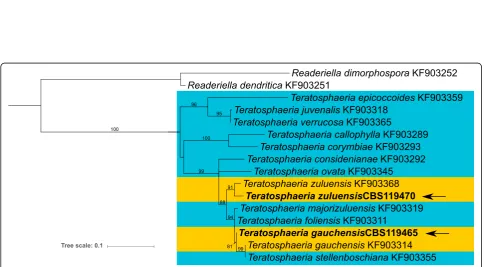
Dothideo-mycete fungi (Capnodiales, Teratosphaeriaceae), cause Teratosphaeria stem canker independently (Cortinas et al.2006). These two species are unique in that they are the only known stem canker pathogens in a genus pre-dominantly associated with the leaves ofEucalyptus spe-cies (Fig. 3; Quaedvlieg et al.2014). Until recently, they were thought to have distinct geographic distributions, but in 2014 both were identified in a Ugandan plantation (Jimu et al. 2014). Together with the 2015 discovery of
T. gauchensis in southern Africa (Jimu et al.2015), this
suggests that concurrent infections are bound to occur in plantations of central and southern Africa (Aylward et al.2019).
We present the genome sequences of the ex-holotype
of T. gauchensis (CBS 119465) and the ex-type of T.
zuluensis (CBS 119470). These genomes will enable
Fig. 2Maximum likelihood (ML) tree based on partial gene sequences ofβ-tubulin and translation elongation factor 1-α. Sequence alignments were assembled with MAFFT version 7 (Katoh and Standley2013). The program MEGA X version 7 (Kumar et al.2018) was used to estimate the best-fit substitution model (TN93) with a discrete gamma distribution (+G). The same program was used for ML phylogenetic analysis and percentage bootstrap support (1000 replications) values are indicated at branch nodes
Sequenced strain
Teratosphaeria gauchensis: Uruguay: La Juanita: isol.
Stem cankers on Eucalyptus grandis, Feb. 2005, M.J.
Wingfield (CBS 119465 = CMW 50181- culture, PREM
62331–dried culture).
Teratosphaeria zuluensis: South Africa:KwaZulu-Natal
Province (Kwambonambi plantation): isol. Stem cankers
on Eucalyptus grandis, Feb. 2005, M.J. Wingfield (CBS
119470 = CMW 50183 – culture, PREM 62332 – dried culture).
Nucleotide accession number
The genomic sequence data of T. gauchensis and T.
zuluensis have been deposited at DDJ/EMBL/GenBank
under the accessions VCMR00000000 (T. gauchensis) and VCMQ00000000 (T. zuluensis). This paper describes the first versions of these genomes.
Material and methods
Fungi were cultured on 2% Malt Extract Agar (Merck, Wadeville, South Africa) at 25 °C for approximately 2 weeks. DNA was extracted as described for T. destruc-tans(Wingfield et al.2018b). The quality of the extracted DNA was estimated from the absorbance curve and the 260/280 and 260/230 absorbance ratios determined by a NanoDrop ND-1000 spectrophotometer (ThermoFisher Scientific, Wilmington, USA). DNA concentrations were determined with a Qubit® 2.0 Fluorometer (Invitrogen, Carlsbad, California).
Teratosphaeria gauchensis(CBS 119465) was sequenced
at Macrogen (Seoul, Korea) using a single PacBio Sequel SMRT Cell as well as a portion of an Illumina HiSeq 2500 lane at Inqaba Biotec (Pretoria, South Africa). The single paired-end Illumina library had an insert size of 550 bp and a target read length of 250 bp. A hybrid assembly was computed by trimming the raw Illumina sequence reads with Trimmomatic 0.38 (Bolger et al. 2014) and using these in LoRDEC 0.6 (Salmela and Rivals2014) to correct the PacBio reads. The corrected PacBio reads were assem-bled with Canu 1.7.1 (Koren et al.2017). An Illumina as-sembly was subsequently constructed in SPAdes 3.10.1 (Bankevich et al. 2012), using k-mer values of 21, 33, 55, and 77 and applying the Canu assembly as“trusted reads”. A final error correction of the hybrid assembly was per-formed with Pilon 1.22 (Walker et al.2014).
Teratosphaeria zuluensis(CBS 119470) was sequenced
with the Ion 520™& Ion 530™ ExT Kit and an Ion 530™ Chip (ThermoFisher Scientific, MA) at the Central Ana-lytical Facility (CAF, Stellenbosch University, South Af-rica). Assembly of reads was done with SPAdes 3.10.1 (Bankevich et al.2012) using k-mer values 21, 33, 55, 77, 99, and 127. For both T. gauchensis and T. zuluensis, genome completeness was estimated with Benchmarking
Universal Single-Copy Orthologs (BUSCO) 2.0.1 (Simão et al.2015) using the“Ascomycotaodb9”dataset.
Repeats within each genome were identified with RepeatScout and masked with RepeatMasker Open-4.0.7 (http://www.repeatmasker.org). Annotation was performed with the MAKER 2.31.10 pipeline (Campbell et al. 2014) using pre-trained de novo gene predictors AUGUSTUS 3.3 (Stanke et al.2006), GeneMark-ES Suite 4.35 (http://exon. gatech.edu/GeneMark/) and SNAP 2006-07-28 (Korf2004). External EST and protein evidence from 15 other Capno-diales species were included in the annotation pipeline.
The Elongation Factor genes (EF1-α) of the two stem canker pathogens were extracted from their genomes and used along with the EF1-αgenes of related species (Quaedvlieg et al.2014) for phylogenetic analysis. The Maximum Likelihood tree was computed with the PhyML+SMS “one-click” method on NGPhylogeny.fr (Lemoine et al. 2019). This protocol employs MAFFT (Katoh et al. 2017) for multiple alignment, BMGE (Criscuolo and Gribaldo 2010) for alignment curation and the aLRT SH-like method (Anisimova and Gascuel 2006) for calculating bootstrap support.
Results and discussion
Teratosphaeria gauchensiswas assembled into 53 contigs
larger than 1 kb, with an N50 = 1.44 Mb and L50 = 8. This equated to a total assembly size of 30.27 Mb with a GC content of 45.6%. The PacBio reads provided an esti-mated genome coverage of 124x with an additional 160x coverage obtained from the Illumina data. The T.
zuluensisassembly yielded 86 contigs above 1 kb (N50 =
1.00 Mb, L50 = 12), an estimated genome size of 28.71 Mb, 44.5% GC and estimated 155x genome coverage. The search for 1315 Ascomycota ortholog proteins iden-tified 97.6% (1285) single-copy orthologs in T. gauchen-sisand 96.9% (1274) inT. zuluensis, indicating that these genomes are ca. 97% complete. This presents a higher level of completeness than the 84.5% of T. destructans, the only other publishedTeratosphaeriagenome (Wing-field et al.2018b).
A similar number of genes were predicted inT.
gau-chensis and T. zuluensis at 11699 and 11520,
respect-ively. Of these, 9304 predictions in T. gauchensis and 9457 in T. zuluensis were supported by external evi-dence. Both genomes had a low repeat content of 2.2%, much lower than the ca.17% estimated forT. destruc-tans (GenBank RIBY01000000). Since the genomes of these stem canker pathogen species, as well as T. destructans, were sequenced with long-read technolo-gies, we are confident that this is not an underestimate, but reflects the true repeat content in these genomes.
The EF1-αgene tree (Fig.3) illustrates the relationship
ofT. zuluensisandT. gauchensisto leaf-associated
(Aylward et al. 2019; Quaedvlieg et al. 2014), suggests that the association with Eucalyptus stem cankers evolved more than once. TheT. zuluensisgenome isolate CBS119470 groups with the ex-epitype strain CBS120301 (KF903368), however, theT. gauchensis strain sequenced in this study (CBS119465) groups sister to a clade that contains an ex-type strain (CBS120304; KF903314) of T.
gauchensisandT. stellenboschiana. A similar phylogenetic
relationship is apparent with both the ITS and β-tubulin gene regions as well as with concatenated gene trees (data not shown).Teratosphaeria gauchensisis known to repre-sent a species complex displaying statistical support for subgroups within the species (Aylward et al.2019; Silva et al. 2015). Future studies should take the taxonomic pos-ition of this genome isolate into consideration when inter-preting genomic data.
Several other fungal groups affect Eucalyptus stems, in-cluding species in the generaChrysoporthe (Gryzenhout et al.2004),Cytospora(Adams et al.2006),Holocryphia(Van der Westhuizen et al.1993) andNeofusicoccum(Slippers et al.2009). Of these, genomes of Eucalyptus-specific isolates are available only forChrysoporthe austroafricana,C. cuben-sisandC. deuterocubensis, the causal agents of Cryphonec-tria canker (Wingfield et al. 2015a, 2015b).Teratosphaeria gauchensisandT. zuluensis, therefore, represent the second group of Eucalyptus stem canker pathogens to be se-quenced. In future, comparative genomics projects that in-clude various Eucalyptusstem pathogens as well as closely related species associated with other plant organs (e.g. T. destructans), may reveal fungal characteristics that enable stem pathogenicity.
Authors: J. Aylward, B.D. Wingfield, L.L. Dreyer, F.
Roets, C.J. van Heerden, M.J. Wingfield.
Contact:[email protected]
Abbreviations
aLRT SH:Aproximate Likelihood Ratio Test for branches; ANNIE: ANNotation Information Extractor; AUGUSTUS: Software for gene prediction; BLAST: Basic Local Alignment Search Tool; BLASTp: Basic Local Alignment Search Tool for protein sequences; BMGE: Block Mapping and Gathering with Entropy; BUSCO: Benchmarking Universal Single-Copy Orthologs; Canu: A hierarchical assemblypipeline; cDNA: Complementary Deoxyribose Nucleic Acid; CWD: Coffee wilt disease; DDBJ: DNA Data Bank of Japan; DNA: Deoxyribose Nucleic Acid; DST: Department of Science and Technology of South Africa; EF1-α: Elongation Factor 1 alpha gene; EMBL: Nucleotide Sequence Data Library; ENA: European Nucleotide Archive; FABI: Forestry and Agricultural Biotechnology Institute; FFSC:F. fujikuroispecies complex; GenBank: NIH genetic sequence database; GeneMark: Gene prediction software; ITS Internal: Transcribed Spacer; LoRDEC: Hybrid error correction program; MAFFT: Multiple Alignment using Fast Fourier Transform; MEGA: Molecular Evolutionary Genetics Analysis; NCBI: National Center for Biotechnology Information; NRF: National Research Foundation (NRF); ORF(s): Open reading frame(s); PhyML: Phylogeny software based on maximum-likelihood principle; PREM: South African National Collection of Fungi; RNA: Ribose Nucleic Acid; rRNA: Ribosomal Ribo Nucleic Acid; SARChI: South African Research Chairs Initiative; SMS: Smart Model Selection in PhyML; SNAP: Web-based tool for identification and annotation of proxy Single Nucleotide Polymorphisms; SPAdes: St. Petersburg genome assembler; SSPACE: SSAKE-based Scaffolding of Pre-Assembled Contigs after Extension program; tRNA: Ribo Nucleic Acid; USA: United States of America
Acknowledgements
For theCeratocystisannotation project Alisa Postma-Smidt is acknowledged for providing assistance with the genome assembly and read mapping. Dr. Fourie Joubert and Alisa Postma-Smidt also provided assistance with gen-ome annotation and curation. We acknowledge a team of students and staff members in FABI that assisted in the genome jamboree for manual curation of the gene models: Tayo Adenigba, Dr. Dave Berger, Wilma Janine, Claire Jordaan, Kayleigh Maier, Mandy Messal, Ramesh Moolam, Lizel Potgieter, Catherine Tatham, Conrad Trollip, Salome van Hoepen, Bradley Vincent, Dr. Markus Wilken and Andi Wilson.
Adherence to national and international regulations
Not applicable to the specific isolates used in this manuscript. All isolates are maintained in culture collections as per government regulations and quarentine specifications.
Authors’contributions
The manuscript is comprised of three sections, 11A, 11B, 11C. Each are authored separately and there is a specific contact person. In each case the contact person has taken the lead in writing and compiling the manuscuript. The other authors have been involved in the idea behind the manuscript, editing and analysis of the data. All authors read and approved the final manuscript.
11A Genome annotation forCeratocystis fimbriata: an aggressive fungal pathogen of root crops
Authors: A. Fourie*, M.C. Simpson*, T.A. Duong, I. Barnes, M.P..A. Coetzee, M.A. van der Nest, M.J. Wingfield and B.D. Wingfield
Contact:[email protected]@fabi.up.ac.za
(*authors contributed equally)
11B Draft genome sequence ofFusarium xylarioides
Authors: V.S. Bushula-Njah, T.A. Duong, D.M. Geiser, E.T. Steenkamp, and B.D. Wingfield
Contact:[email protected]
11C Draft genome sequences ofTeratosphaeria gauchensisandT. zuluensis, causal agents of Teratosphaeria stem canker
Authors: J. Aylward, B.D. Wingfield, L.L. Dreyer, F. Roets, C.J. van Heerden, M.J. Wingfield
Contact:[email protected]
Authors’information
No additional information provided.
Funding
We acknowledge the National Research Foundation (NRF) and Department of Science and Technology (DST) of South Africa for providing scholarship funding for students as well as members of the Tree Protection Cooperative Programme at the Forestry and Agricultural Biotechnology Institute for providing financial support for this project. These projects from part of the DST/NRF Centre of Excellence in Tree Health Biotechnology and the SARChI in Fungal Genomics.
Availability of data and materials
All data and material is available the relevant details (data banks, culture collections and herbaria) are given in the manuscript.
Ethics approval and consent to participate
Not applicable, no humans, human subjects nor data were used in this manuscript.
Consent for publication
Not applicable.
Competing interests
The authors declare that they have no competing interests.
Author details
1Department of Biochemistry, Genetics and Microbiology (BGM), Forestry and
Agricultural Biotechnology Institute (FABI), University of Pretoria, Private Bag X20, Hatfield 0028, South Africa.2Department of Botany and Zoology,
Stellenbosch University, Private Bag X1, Matieland 7602, South Africa.
Environmental Microbiology, 121 Buckhout Lab, University Park, State College, PA 16802, USA.4Department of Conservation Ecology and
Entomology, Stellenbosch University, Private Bag X1, Matieland 7602, South Africa.5Central Analytical Facilities, Stellenbosch University, Private Bag X1, Matieland 7602, South Africa.6Biotechnology Platform, Agricultural Research
Council, Private Bag X05, Onderstepoort 0002, South Africa.
Received: 8 June 2019 Accepted: 1 July 2019
References
Adams G, Roux J, Wingfield M (2006) Cytospora species (Ascomycota, Diaporthales, Valsaceae): introduced and native pathogens of trees in South Africa. Australas Plant Pathol 35:521–548
Andrews S (2010) FastQC: a quality control tool for high throughput sequence data.http://www.bioinformatics.babraham.ac.uk/projects/fastqc
Anisimova M, Gascuel O (2006) Approximate likelihood-ratio test for branches: a fast, accurate, and powerful alternative. Syst Biol 55:539–552
Aylward J, Roets F, Dreyer LL, Wingfield MJ (2019) Teratosphaeria stem canker of Eucalyptus: two pathogens, one devastating disease. Mol Plant Pathol 20:8–19
Baker CJ, Harrington TC, Krauss U, Alfenas AC (2003) Genetic variability and host specialization in the Latin American clade ofCeratocystis fimbriata. Phytopathology 93:1274–1284
Bankevich A, Nurk S, Antipov D, Gurevich AA, Dvorkin M, Kulikov AS et al (2012) SPAdes: a new genome assembly algorithm and its applications to single-cell sequencing. J Comput Biol 19:455–477
Barnes I, Fourie A, Wingfield M, Harrington T, McNew D et al (2018) New Ceratocystis species associated with rapid death of Metrosideros polymorpha in Hawai’i. Persoonia Mol Phylogeny Evol Fungi 40:154–181
Beukes CW, Venter SN, Law IJ, Phalane FL, Steenkamp ET (2013) South African papilionoid legumes are nodulated by diverseBurkholderiawith unique nodulation and nitrogen-fixation loci. PLoS One 8:e68406
Boetzer M, Henkel CV, Jansen HJ, Butler D, Pirovano W (2011) Scaffolding pre-assembled contigs using SSPACE. Bioinformatics 27:578–579
Boetzer M, Pirovano W (2012) Toward almost closed genomes with GapFiller. Genome Biol 13:R56
Bolger AM, Lohse M, Usadel B (2014) Trimmomatic: a flexible trimmer for Illumina sequence data. Bioinformatics 30:2114–2120
Campbell MS, Holt C, Moore B, Yandell M (2014) Genome annotation and curation using MAKER and MAKER-P. Curr Protoc Bioinformatics 48:4.11. 11–14.11. 39
Cantarel BL, Korf I, Robb SMC, Parra G, Ross E et al (2008) MAKER: an easy-to-use annotation pipeline designed for emerging model organism genomes. Genome Res 18:188–196
Cortinas MN, Crous PW, Wingfield BD, Wingfield MJ (2006) Multi-gene phylogenies and phenotypic characters distinguish two species within the
Colletogloeopsis zuluensiscomplex associated with Eucalyptus stem cankers. Stud Mycol 55:133–146
Criscuolo A, Gribaldo S (2010) BMGE (block mapping and gathering with entropy): a new software for selection of phylogenetic informative regions from multiple sequence alignments. BMC Evol Biol 10:210
De Beer ZW, Duong TA, Barnes I, Wingfield BD, Wingfield MJ (2014) Redefining
Ceratocystisand allied genera. Stud Mycol 79:187–219
De Wit PJGM, Van Der Burgt A, Ökmen B, Stergiopoulos I, Abd-Elsalam KA et al (2012) The genomes of the fungal plant pathogensCladosporium fulvumand
Dothistroma septosporumreveal adaptation to different hosts and lifestyles but also signatures of common ancestry. PLoS Genet 8:e1003088 DeLong EF (1992) Archaea in coastal marine environments. Proc Natl Acad Sci
89:5685–5689
Dobin A, Davis CA, Schlesinger F, Drenkow J, Zaleski C et al (2013) STAR: ultrafast universal RNA-seq aligner. Bioinformatics 29:15–21
Duong TA, De Beer ZW, Wingfield BD, Wingfield MJ (2013) Characterization of the mating-type genes inLeptographium procerumandLeptographium profanum. Fungal Biology 117:411–421
Fourie A, Wingfield MJ, Wingfield BD, Barnes I (2015) Molecular markers delimit cryptic species inCeratocystis sensu stricto. Mycol Prog 14:1020
Fourie A, Wingfield MJ, Wingfield BD, van der Nest MA, Loots MT et al (2018) Inheritance of phenotypic traits in the progeny of aCeratocystisinterspecific cross. Fungal Biology 122:717–729
Geiser DM, Lewis-Ivey ML, Hakiza G, Juba JH, Miller SA (2005)Gibberella xylarioides
(anamorph:Fusarium xylarioides), a causative agent of coffee wilt disease in Africa, is a previously unrecognized member of theG. fujikuroispecies complex. Mycologia 97:191–201
Goodwin SB, Drenth A, Fry WE (1992) Cloning and genetic analyses of two highly polymorphic, moderately repetitive nuclear DNAs fromPhytophthora infestans. Curr Genet 22:107–115
Gryzenhout M, Myburg H, Van der Merwe NA, Wingfield BD, Wingfield MJ (2004) Chrysoporthe, a new genus to accommodateCryphonectria cubensis. Stud Mycol 50:119–142
Hall B, DeRego T, Geib S (2014) GAG: the genome annotation generator. (Version 1.0) [Software]. Available fromhttp://genomeannotation.github.io/GAG
Halsted BD (1890) Some fungous disease of the sweet potato. Agric College Exp Station Bull 76:1–32
Halsted BD, Fairchild DG (1891) Sweet-potato black rot. J Mycol 7:1–11 Harrington TC, McNew DL (1997) Self-fertility and uni-directional
mating-type switching inCeratocystis coerulescens, a filamentous ascomycete. Curr Genet 32:52–59
Heim R (1950) La carbunculariose du Caféier. Suppl Colon a la Revue de Mycol 15:89–98
Hoff KJ, Lange S, Lomsadze A, Borodovsky M, Stanke M (2016) BRAKER1: unsupervised RNA-Seq-based genome annotation with GeneMark-ET and AUGUSTUS. Bioinformatics 32:767–769
Holland, LA, DP Lawrence, MT Nouri, R Travadon, TC Harrington, FP Trouillas, (2019) Taxonomic Revision and Multi-locus Phylogeny of theNorth American Clade of Ceratocystis. Fungal Systematics and Evolution 3 (1):135–156. Holt C, Yandell M (2011) MAKER2: an annotation pipeline and genome-database
management tool for second-generation genome projects. BMC Bioinformatics 12:491
Jimu L, Wingfield MJ, Mwenje E, Roux J (2014) First report of Teratosphaeria zuluensis causing stem canker ofEucalyptus grandisin Uganda. For Pathol 44:242–245
Jimu L, Wingfield MJ, Mwenje E, Roux J (2015) Diseases onEucalyptusspecies in Zimbabwean plantations and woodlots. South Forests 77:221–230 Jones P, Binns D, Chang H-Y, Fraser M, Li W et al (2014) InterProScan 5:
genome-scale protein function classification. Bioinformatics 30:1236–1240 Käll L, Krogh A, Sonnhammer ELL (2004) A combined transmembrane topology
and signal peptide prediction method. J Mol Biol 338:1027–1036 Katoh K, Rozewicki J, Yamada KD (2017) MAFFT online service: multiple sequence
alignment, interactive sequence choice and visualization. Brief Bioinform.https:// doi.org/10.1093/bib/bbx108.
Katoh K, Standley DM (2013) MAFFT multiple sequence alignment software version 7: improvements in performance and usability. Mol Biol Evol 30:772–780 King R, Urban M, Hammond-Kosack MCU, Hassani-Pak K, Hammond-Kosack KE
(2015) The completed genome sequence of the pathogenic ascomycete fungusFusarium graminearum. BMC Genomics 16:544
Klosterman SJ, Subbarao KV, Kang S, Veronese P, Gold SE et al (2011)
Comparative genomics yields insights into niche adaptation of plant vascular wilt pathogens. PLoS Pathog 7:e1002137
Koren S, Walenz BP, Berlin K, Miller JR, Bergman NH, Phillippy AM (2017) Canu: scalable and accurate long-read assembly via adaptive k-mer weighting and repeat separation. Genome Res 27:722–736
Korf I (2004) Gene finding in novel genomes. BMC Bioinformatics 5:59 Kumar S, Stecher G, Li M, Knyaz C, Tamura K (2018) MEGA X: molecular
evolutionary genetics analysis across computing platforms. Mol Biol Evol 35:1547–1549
Kumar S, Stecher G, Tamura K (2016) MEGA7: molecular evolutionary genetics analysis version 7.0 for bigger datasets. Mol Biol Evol 33:1870–1874 Lee E, Helt GA, Reese JT, Munoz-Torres MC, Childers CP et al (2013) Web Apollo:
a web-based genomic annotation editing platform. Genome Biol 14:R93 Lemoine F, Correia D, Lefort V, Doppelt-Azeroual O, Mareuil F, Cohen-Boulakia S
et al (2019) NGPhylogeny. Fr: new generation phylogenetic services for non-specialists. Nucleic Acids Res 47(W1):W260-W265
Lepoint PCE, Munaut FTJ, Maraite HMM (2005)Gibberella xylarioidesSensu Lato fromCoffea canephora: a new mating population in theGibberella fujikuroi
species complex. Appl Environ Microbiol 71:8466–8471
Lewthwaite SL, Wright PJ, Triggs CM (2011) Sweetpotato cultivar susceptibility to infection byCeratocystis fimbriata. New Zealand Plant Prot 64:1–6 Li Q, Harrington TC, McNew D, Li J, Huang Q et al (2016) Genetic bottlenecks for
Liu F, Barnes I, Roux J, Wingfield MJ, Chen S (2018) Molecular phylogenetics and microsatellite analysis reveal a new pathogenicCeratocystisspecies in the Asian-Australian clade. Plant Pathol 67:1097–1113
Lomsadze A, Burns PD, Borodovsky M (2014) Integration of mapped RNA-Seq reads into automatic training of eukaryotic gene finding algorithm. Nucleic Acids Res 42:e119 Marin-Felix Y, Groenewald JZ, Cai L, Chen Q, Marincowitz S et al (2017) Genera of
phytopathogenic fungi: GOPHY 1. Stud Mycol 86:99–216
Molano EPL, Cabrera OG, Jose J, do Nascimento LC, Carazzolle MF et al (2018)
Ceratocystis cacaofunestagenome analysis reveals a large expansion of extracellular phosphatidylinositol-specific phospholipase-C genes (PI-PLC). BMC Genomics 19:58–58
O’Donnell K, Cigelnik E, Nirenberg HI (1998) Molecular systematics and phylogeography of theGibberella fujikuroispecies complex. Mycologia 90:465–493
O’Donnell K, Nirenberg HI, Aoki T, Cigelnik E (2000) A multigene phylogeny of theGibberella fujikuroispecies complex: detection of additional phylogenetically distinct species. Mycoscience 41:61–78
Old KM, Wingfield MJ, Yuan ZQ (2003) A manual of diseases of eucalypts in South-East Asia. CIFOR, Jakarta
Ooi HS, Kwo CY, Wildpaner M, Sirota FL, Eisenhaber B et al (2009) ANNIE: integrated de novo protein sequence annotation. Nucleic Acids Res 37:W435–W440 Petersen TN, Brunak S, von Heijne G, Nielsen H (2011) SignalP 4.0: discriminating
signal peptides from transmembrane regions. Nat Methods 8:785 Ploetz RC (2006)Fusarium-induced diseases of tropical, perennial crops.
Phytopathology 96:648–652
Price AL, Jones NC, Pevzner PA (2005) De novo identification of repeat families in large genomes. Bioinformatics 21:i351–i358
Quaedvlieg W, Binder M, Groenewald JZ, Summerell BA, Carnegie AJ, Burgess TI et al (2014) Introducing the consolidated species concept to resolve species in the Teratosphaeriaceae. Persoonia 33:1–40
Rutherford MA (2006) Current knowledge of coffee wilt disease, a major constraint to coffee production in Africa. Phytopathology 96:663–666 Salmela L, Rivals E (2014) LoRDEC: accurate and efficient long read error
correction. Bioinformatics 30:3506–3514
Scruggs AC, Basaiah T, Adams ML, Quesada-Ocampo LM (2017) Genetic diversity, fungicide sensitivity, and host resistance toCeratocystis fimbriatainfecting Sweetpotato in North Carolina. Plant Dis 101:994–1001
Silva MRC, Diogo E, Bragança H, Machado H, Phillips AJL (2015) Teratosphaeria gauchensis associated with trunk, stem and foliar lesions of Eucalyptus globulus in Portugal. For Pathol 45:224–234
Simão FA, Waterhouse RM, Ioannidis P, Kriventseva EV, Zdobnov EM (2015) BUSCO: assessing genome assembly and annotation completeness with single-copy orthologs. Bioinformatics 31:3210–3212
Slippers B, Burgess T, Pavlic D, Ahumada R, Maleme H, Mohali S et al (2009) A diverse assemblage of Botryosphaeriaceae infect Eucalyptus in native and non-native environments. South Forests 71:101–110
Smit AFA, Hubley R, Green P (1996–2010) RepeatMasker Open-3.0.http:// www.repeatmasker.org
Solovyev V, Kosarev P, Seledsov I, Vorobyev D (2006) Automatic annotation of eukaryotic genes, pseudogenes and promoters. Genome Biol 7:1–12 Stamatakis A (2014) RAxML version 8: a tool for phylogenetic analysis and
post-analysis of large phylogenies. Bioinformatics 30:1312–1313
Stanke M, Keller O, Gunduz I, Hayes A, Waack S, Morgenstern B (2006) AUGUSTUS: ab initio prediction of alternative transcripts. Nucleic Acids Res 34:W435–W439 Stanke M, Steinkamp R, Waack S, Morgenstern B (2004) AUGUSTUS: a web server
for gene finding in eukaryotes. Nucleic Acids Res 32:W309–W312 Steyaert RL (1948) Contribution al’étude des parasites des végétaux du Congo
Belge. R Bot Soc Belgium Ser 2 30:11–58
Trapnell C, Roberts A, Goff L, Pertea G, Kim D et al (2012) Differential gene and transcript expression analysis of RNA-seq experiments with TopHat and cufflinks. Nat Protoc 7:562–578
Van der Nest MA, Beirn LA, Crouch JA, Demers JE, de Beer ZW et al (2014a) Draft genomes ofAmanita jacksonii,Ceratocystis albifundus, Fusarium circinatum, Huntiella omanensis, Leptographium procerum, Rutstroemia sydowiana, andSclerotinia echinophila. IMA Fungus 5:472–485
Van der Nest MA, Bihon W, de Vos L, Naidoo K, Roodt D et al (2014b) Draft genome sequences ofDiplodia sapinea, Ceratocystis manginecans,
andCeratocystis moniliformis. IMA Fungus 5:135–140
Van der Nest MA, Steenkamp ET, McTaggart AR, Trollip C, Godlonton T et al (2015) Saprophytic and pathogenic fungi in the Ceratocystidaceae differ in their ability to metabolize plant-derived sucrose. BMC Evol Biol 15:273
Van der Westhuizen I, Wingfield M, Kemp G, Swart W (1993) First report of the canker pathogenEndothia gyrosaon Eucalyptus in South Africa. Plant Pathol 42:661–663 Vanderpool D, Bracewell RR, McCutcheon JP (2018) Know your farmer: ancient
origins and multiple independent domestications of ambrosia beetle fungal cultivars. Mol Ecol 27:2077–2094
Walker BJ, Abeel T, Shea T, Priest M, Abouelliel A, Sakthikumar S et al (2014) Pilon: an integrated tool for comprehensive microbial variant detection and genome assembly improvement. PLoS One 9:e112963
Weber T, Blin K, Duddela S, Krug D, Kim HUK et al (2015) antiSMASH 3.0—a comprehensive resource for the genome mining of biosynthetic gene clusters. Nucleic Acids Res 43:W237–W243
White TJ, Bruns T, Lee S, Taylor J (1990) Amplification and direct sequencing of fungal ribosomal RNA genes for phylogenetics. In: Innis MA, Gelfand DH, Sninsky JJ, White TJ (eds) PCR protocols: a sequencing guide to methods and applications. Academic Press Inc., San Diego, pp 315–322
Wilken PM, Steenkamp ET, Wingfield MJ, De Beer ZW, Wingfield BD (2013) Draft nuclear genome sequence for the plant pathogen,Ceratocystis fimbriata. IMA Fungus 4:357–358
Wilken PM, Steenkamp ET, Wingfield MJ, De Beer ZW, Wingfield BD (2014) DNA loss at theCeratocystis fimbriatamating locus results in self-sterility. PLoS One 9:e92180 Wingfield BD, Ades PK, Al-Naemi FA, Beirn LA, Bihon W et al (2015a) Draft genome
sequences ofChrysoporthe austroafricana, Diplodia scrobiculata, Fusarium nygamai, Leptographium lundbergii, Limonomyces culmigenus, Stagonosporopsis tanaceti, and
Thielaviopsis punctulata. IMA Fungus 6:233–248
Wingfield BD, Ambler JM, Coetzee M, De Beer ZW, Duong TA et al (2016a) Draft genome sequences ofArmillaria fuscipes, Ceratocystiopsis minuta, Ceratocystis adiposa, Endoconidiophora laricicola, E. polonicaandPenicillium freiiDAOMC 242723. IMA Fungus 7:217–227
Wingfield BD, Barnes I, de Beer ZW, De Vos L, Duong TA et al (2015b) Draft genome sequences ofCeratocystis eucalypticola, Chrysoporthe cubensis, C. deuterocubensis, Davidsoniella virescens, Fusarium temperatum, Graphilbum fragrans, Penicillium nordicum, andThielaviopsis musarum. IMA Fungus 6:493–506
Wingfield BD, Berger DK, Steenkamp ET, Lim H-J, Duong TA et al (2017) Draft genome ofCercospora zeina,Fusarium pininemorale,Hawksworthiomyces lignivorus,Huntiella decipiensandOphiostoma ips. IMA Fungus 8:385–396 Wingfield BD, Bills GF, Dong Y, Huang W, Nel WJ et al (2018a) Draft genome
sequence ofAnnulohypoxylon stygium,Aspergillus mulundensis,Berkeleyomyces basicola(syn.Thielaviopsis basicola),Ceratocystis smalleyi,twoCercospora beticolastrains,Coleophoma cylindrospora,Fusarium fracticaudum,
Phialophora cf. hyalina, andMorchella septimelata. IMA Fungus 9:199–223 Wingfield BD, Duong TA, Hammerbacher A, Van der Nest MA, Wilson A et al
(2016b) Draft genome sequences forCeratocystis fagacearum, C. harringtonii, Grosmannia penicillata, andHuntiella bhutanensis. IMA Fungus 7:317–323 Wingfield BD, Liu M, Nguyen HDT, Lane FA, Morgan SW et al (2018b) Nine draft
genome sequences ofClaviceps purpurea s.lat., includingC. arundinis,C.
humidiphila, andC. cf.spartinae, pseudomolecules for the pitch canker pathogen
Fusarium circinatum, draft genome ofDavidsoniella eucalypti,Grosmannia galeiformis,Quambalaria eucalypti, andTeratosphaeria destructans. IMA Fungus 9:401–418
Wingfield MJ, Barnes I, De Beer ZW, Roux J, Wingfield BD et al (2017b) Novel associations between ophiostomatoid fungi, insects and tree hosts: current status - future prospects. Biol Invasions 19:3201–3214
Wingfield MJ, Crous PW, Coutinho TA (1996) A serious canker disease of Eucalyptus in South Africa caused by a new species ofConiothyrium. Mycopathologia 136:139–145
Witthuhn RC, Harrington TC, Wingfield BD, Steimel JP, Wingfield MJ (2000) Deletion of theMAT-2mating-type gene during uni-directional mating-type switching inCeratocystis. Curr Genet 38:48–52
Zerbino DR, Birney E (2008) Velvet: algorithms for de novo short read assembly using de Bruijn graphs. Genome Res 18:821–829
Publisher’s Note