R E S E A R C H
Open Access
Effect of elevated atmospheric carbon
dioxide on the allelopathic potential of
common ragweed
Jichul Bae
1,5†, Chaeho Byun
2†, Yun Gyong Ahn
3, Jung Hyun Choi
4, Dowon Lee
1and Hojeong Kang
2,6*Abstract
Background:Allelopathy has been suggested as one potential mechanism facilitating the successful colonisation and expansion of invasive plants. The impacts of the ongoing elevation in atmospheric carbon dioxide (CO2) on the production of allelochemicals by invasive species are of great importance because they play a potential role in promoting biological invasion at the global scale. Common ragweed (Ambrosia artemisiifoliavar.elatior), one of the most notorious invasive exotic plant species, was used to assess changes in foliar mono- and sesquiterpene production in response to CO2elevation (389.12 ± 2.55 vs. 802.08 ± 2.69 ppm).
Results:The plant growth of common ragweed significantly increased in elevated CO2. The major monoterpenes in the essential oil extracted from common ragweed leaves wereβ-myrcene,DL-limonene and 1,3,6-octatriene, and the major sesquiterpenes wereβ-caryophyllene and germacrene-D. The concentrations of 1,3,6-octatriene (258%) andβ-caryophyllene (421%) significantly increased with CO2elevation.
Conclusions:These findings improve our understanding of how allelochemicals in common ragweed respond to CO2elevation.
Keywords:Allelopathy,Ambrosia artemisiifoliavar.elatior, Monoterpene, Sesquiterpene, CO2elevation
Background
Invasive exotic plants are recognised as one of the big-gest threats to native ecosystems because they outcom-pete native species and alter environmental conditions
and resource availability (D’Antonio and Vitousek1992).
Native to North America, common ragweed (Ambrosia
artemisiifolia var. elatior L.) is rapidly spreading across
many parts of East Asia (Chen et al. 2007; Fang and
Wan 2009; Kil et al. 2004; Miyawaki and Washitani 2004; Xu et al.2006), Europe (Bullock et al.2010; Essl et al. 2015; Smith et al. 2013) and Australia (Bass et al. 2000), where it becomes invasive and poses a threat to agroecosystems, native ecosystems and public health. In South Korea, common ragweed is designated as one of
the 14 most problematic invasive alien plants by the Act on the Conservation and Use of Biodiversity, the Minis-try of Environment.
The allelopathic effect of plant terpenoids is of great ecological interest as many plant species enhance their competitiveness and fitness through allelopathy. The Novel Weapon hypothesis proposed by Callaway and Ridenour (2004) attributes the successful establishment and proliferation of some invasive exotic plants in intro-duced ranges to their allelochemicals (Callaway and
Ridenour2004). Although these chemicals are relatively
ineffective against neighbours in the native range of the invasive species due to co-evolved tolerance, these
substances can act as‘novel weapons’when encountered
by adjacent plant species in invaded ranges (Callaway
and Aschehoug 2000; Callaway and Ridenour 2004).
Allelopathic effects of invasive plant terpenoids on the germination and growth of native and crop species in in-vaded ranges have been observed in numerous cases, demonstrating that allelopathy plays a potential role in the success of some invasive exotic plants (Barney et al.2005;
© The Author(s). 2019Open AccessThis article is distributed under the terms of the Creative Commons Attribution 4.0 International License (http://creativecommons.org/licenses/by/4.0/), which permits unrestricted use, distribution, and reproduction in any medium, provided you give appropriate credit to the original author(s) and the source, provide a link to the Creative Commons license, and indicate if changes were made. The Creative Commons Public Domain Dedication waiver (http://creativecommons.org/publicdomain/zero/1.0/) applies to the data made available in this article, unless otherwise stated.
* Correspondence:[email protected]
†Jichul Bae and Chaeho Byun contributed equally to this work.
2
School of Civil and Environmental Engineering, Yonsei University, Seoul 03722, Republic of Korea
6School of Civil and Environmental Engineering, Yonsei University, N303
Cipollini and Dorning 2008; Ens et al. 2009a; Ens et al. 2009b; Kong et al.2007; Maharjan et al.2010; Orr et al. 2005; Prati and Bossdorf 2004; Sun et al. 2006; Tefera 2002; Wang et al. 2010; Yamamoto 1995; Zhao et al. 2009). Most volatile and reactive terpenes such as mono-and sesquiterpenes are usually stored in leaves, mono-and these compounds induce allelopathic effects on neighbouring plants through leaf volatilisation or leachates.
Allelopathy has been suggested as a possible mechan-ism underlying the successful introduction and establish-ment of invasive exotic plant species in new habitats because allelochemicals released from an invader are often evolutionarily novel to a recipient native
commu-nity (Callaway and Ridenour 2004; Hierro and Callaway
2003). Volatile oils of common ragweed are allelochem-icals released into the environment through leaf volatil-isation or leachates that can affect the growth and other
functions of nearby flora (Beres et al. 2002; Chalchat et
al.2004; Fischer and Quijano 1985; Pajevićet al.2010). Vidotto et al. (2013) demonstrated that leaf residues of common ragweed inhibit early growth of crop species including tomato and lettuce, as well as germination of
weed species such as large crabgrass (Digitaria
sangui-nalis). Choi et al. (2010) reported that an extract from common ragweed leaves inhibits germination and seed-ling growth of various weed species including barnyard grass (Echinochloa crus-galli), large crabgrass (D. sangui-nalis) and Asian flatsedge (Cyperus microiria). A bio-assay study showed that the allelopathic effect of common ragweed leaf extract was stronger than that of flower and achene extracts (Kazinczi et al.2008a,2008b). By contrast,
Kazinczi et al. 2008a, 2008b demonstrated that leaf
ex-tracts of sunflower (Helianthus annuus), field bindweed
(Convolvulus arvensis) and velvetleaf (Abutilon theo-phrasti) promoted rather than inhibited germination and growth of common ragweed, and found that common rag-weed could utilise these extracts as a source of nutrients. Additionally, no autotoxicity of common ragweed ex-tracts was observed in their studies (Kazinczi et al. 2008a, 2008b). Therefore, allelopathic effects may pro-vide common ragweed with a competitive advantage over the neighbouring plant community and may play a role in facilitating its successful invasion and prolifera-tion in newly invaded habitats.
Global mean atmospheric carbon dioxide (CO2) has
increased by 29% since preindustrial times and is antici-pated to reach 600 to 1000 ppm by the year 2100
(Pachauri et al. 2014). Rising CO2 mixing ratio in the
atmosphere is responsible for climate change and has widespread impacts on terrestrial biology. Due to its threats to native ecosystems and public health, specific attention has been given to determine the role of rising
at-mospheric CO2 mixing ratio with respect to the
distribu-tion, growth and pollen production of common ragweed
(Bullock et al.2010; Essl et al.2015; Hamaoui-Laguel et al. 2015; Rogers et al. 2006; Smith et al. 2013; Ziska and Caulfield2000). However, no information is currently
avail-able concerning the impact of rising CO2mixing ratio on
the allelopathic potential of this species. Elevated
atmos-pheric CO2mixing ratio increases carbon (C) supply and
thus leads to high C/N ratios in plant tissues, eventu-ally making conditions favourable for the production
of C-based secondary compounds (Bazin et al. 2002;
Berenbaum 1995; Bryant et al.1983; Coley et al.1985;
Coviella et al.2002; Peñuelas and Estiarte1998;
Raisa-nen et al. 2008; Stamp 2003). However, the effects of
elevated atmospheric CO2mixing ratio on the
produc-tion of allelochemicals affecting the invasiveness of plants have not been widely studied (Applebee et al. 1999; Lindroth1996).
Understanding the physiology and ecology of common ragweed in response to environmental change is of great importance because this species poses a major threat to public health, native ecosystems and agroeconomy in many parts of the world. Previous studies showed that
glo-bal environmental changes such as elevated CO2mixing
ratio and global warming can promote the growth and allergenic pollen production of common ragweed (Hirose et al.1996; Ziska et al.2007; Ziska and Caulfield2000).
Carbon-based substances such as mono- and sesquiter-penes are the prominent components of volatile allelo-chemicals derived from common ragweed leaves (Chalchat
et al.2004). Therefore, we hypothesised that elevated CO2
mixing ratio concentrations would increase foliar mono-and sesquiterpene production in this species.
Materials and methods
Growth chamber
Growth chambers (140 × 74 × 1200 cm3, DS-51GLP, Dasol
Science, Republic of Korea) with different target CO2
mix-ing ratio concentrations (400 and 800 ppm) were used
for CO2mixing ratio manipulation experiments.
Cham-bers were programmed with an alternating day/night temperature regime of 28/22 °C, a 14/10 h day/night photoperiod and relative humidity of 60%. The light
in-tensity was 148.5 PPFD (μmol/m2/s), and the dawn and
dusk transitions lasted 1 h. The CO2mixing ratio
concen-tration in the chamber was lowered by incoming air from
the laboratory in which the CO2mixing ratio concentration
was higher than 430 ppm; therefore, CO2 mixing ratio
absorbent (SODASORB, Grace Darex Packaging Technolo-gies, USA) was applied to achieve the target ambient
CO2 mixing ratio concentration. To minimise any
absorbent-specific effects, the same amount of CO2 absorbent was also applied for the target elevated CO2
mixing ratio condition. The CO2 mixing ratio
experimental period (60 days) were maintained by ap-plying 500 g of absorbent and replacing it every 5 days.
Seed collection and plant propagation
Common ragweed involucral achenes (hereafter referred to as seeds) were extracted from soil samples collected along agriculture field edges infested with the species in Heungeop-ri, Heungeop-myeon, Wonju-si, Gangwon-do, South Korea (latitude 37.18° N, longitude 127.54° E) in April 2009. We had to moisten the seeds of common ragweed before sowing seeds because their seeds are
highly dormant (Baskin and Baskin1980). Common
rag-weed seeds need cold-wet stratification period lasting for
2–4 weeks. A total of 100 randomly chosen seeds were
placed on two layers of Whatman No. 2 filter paper (Whatman International Ltd.) moistened with 5 mL of distilled water in four Petri dishes (25 seeds per dish). Dishes were placed in the growth chamber under
ambi-ent CO2 mixing ratio conditions. Following the 7-day
germination period, 48 seedlings of similar height (3–5 cm) were planted into twelve 3-L pots (four seedlings per pot) filled with a standard potting mixture containing peat moss, decomposed organic soil, sand, vermiculate and perlite at a ratio of 2:2:2:1:1 (v/v). Pots were randomly assigned to the two growth chambers (six pots per cham-ber). Four plants in each pot were thinned to one plant per pot at the six to eight leaf stage in order to ensure uniform-ity among the plants. In this way, shading effect on neigh-bouring plant was prevented. The selected plants were grown for 60 days, and pots were randomly rearranged within the chamber weekly to minimise location-specific effects. Shading by neighbouring plants was not ob-served during the experiments. The entire experiment was repeated 12 times.
Growth analysis
After 60 days of growth, growth analysis was performed.
Allelochemical extraction and analysis
After 60 days of growth, all leaves were separated from the stem and ~ 3 g of fresh leaves from each plant was manually ground at room temperature with sea sand
(15–20 mesh) and 40 mL of n-pentane. Each sample was
then spiked with 1 mL of 0.1% tetradecane as an internal standard. The resulting extract was filtered through a Whatman No. 40 filter paper cone (Whatman Inter-national Ltd.) with sodium sulphate and concentrated by evaporation with a gentle stream of nitrogen gas.
Ex-tracts were stored in sealed vials at −20 °C until
chem-ical analysis.
Gas chromatography/mass spectrometry (GC/MS) analysis was performed using an Agilent 6890 Plus gas chromatograph equipped with a 5973-N quadrupole mass selective detector (Palo Alto, CA, USA). Using a
DB-5 MS capillary column (30 m × 0.25 mm i.d., 0.25μm
film thickness, 5% diphenyl:95% dimethylsiloxane phase, J&W Scientific, Folsom, CA, USA), the GC oven was maintained at 60 °C for 2 min then elevated to 310 °C in in-crements of 5 °C/min and maintained at that temperature for 2 min. The sample was injected at a split ratio of 1:10. The temperature of the GC injection port and the MS interface was 250 °C and 280 °C, respectively. The mass selective detector was run in electron impact (EI) mode with an electron energy of 70 eV. The mass spectrom-eter was operated in full scan mode between 50 and 700 amu. The Wiley7n spectra database was used for compound identification.
The internal standard yielded a peak with a retention time ranging from 19.26 to 19.46 min. The identity of each compound was confirmed by determining the re-tention time and comparing with mass spectral data in
publicly available databases (≥90% representing a
posi-tive identification). To investigate the effects of CO2 mixing ratio on the number of mono- and sesquiter-penes produced, the detection frequency with which each individual compound was observed in each treat-ment was measured. The area of the internal standard peak and those of mono- and sesquiterpenes in the GC chromatograms were calculated, and their ratios were then used to measure the concentrations of the analytes.
Statistical analysis
Data collected from chemical analyses were averaged for each treatment. One-way analysis of variance (ANOVA)
was used to investigate the effects of CO2 mixing ratio
on allelochemical content. All analyses in the present study were conducted with JMP version 8 (SAS Institute Inc., Cary, NC, USA 2008).
Results
Growth of common ragweed (number of leaves, above-ground height, fresh weight) significantly increased in
elevated CO2 compared to ambient CO2 condition
(Table 1). The retention time and detection frequency
of individual mono- and sesquiterpenes are shown in
Table 2. The major mono- and sesquiterpenes (those
most abundant and present in all extract samples)
in-cluded three monoterpenes (β-myrcene, DL-limonene
Table 1Growth of common ragweed (number of leaves, aboveground height, fresh weight) in ambient CO2treatment
and elevated CO2treatment
CO2treatment Pvalue
Ambient Elevated
and 1,3,6-octatriene) and two sesquiterpenes (β
-caryo-phyllene and germacrene-D; Table2).
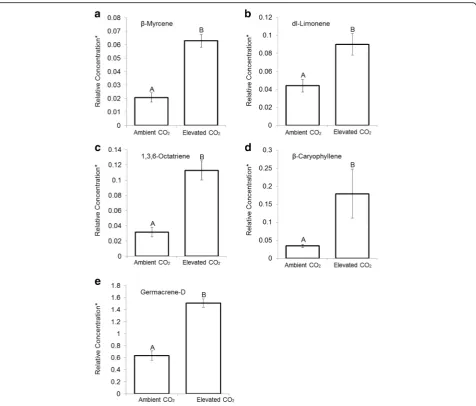
The results demonstrated that elevation in CO2 mixing ratio concentration significantly influenced the relative concentrations of the major mono- and
ses-quiterpenes (Fig.1). The relative concentrations of the
major mono- and sesquiterpenes increased in
con-junction with CO2 elevation as follows: β-myrcene
(203%), DL-limonene (105%), 1,3,6-octatriene (258%),
β-caryophyllene (421%) and germacrene-D (138%).
Discussion
The main foliar mono- and sesquiterpenes identified in the
present study included three monoterpenes (β-myrcene,
DL-limonene and 1,3,6-octatriene) and two sesquiterpenes (β-caryophyllene and germacrene-D), consistent with previ-ous investigations. Chalchat et al. (2004) reported that the main components of essential oils obtained from common
ragweed shoots by steam distillation were germacrene-D
(24.1%), DL-limonene (16.8%), α-pinene (8.0%), β-myrcene
(7.4%) and borneol (2.9%) (Chalchat et al.2004). Similarly, Kim and Kim (1999) found octene (15.67%),
1,3,6-octa-triene (15.00%),β-myrcene (12.98%), borneol (10.30%) and
α-pinene (3.21%) to be the most abundant monoterpenes
in essential oils from common ragweed leaves (Peñuelas
and Llusià1997). However, the proportion of major
essen-tial oil components in the present study was considerably less than in previous studies. This apparent discrepancy may result from the fact that Chalchat et al. (2004) analysed essential oil from steam distillation of 100 g of dried flower-ing shoots rather than 4 g of fresh young leaves in the current study. Moreover, Chalchat et al. (2004) analysed flowering shoots of common ragweed in September, and Kim and Kim (1999) averaged the amount of foliar
mono-terpenes from late March to September, whereas
60-day-old leaves were used in the present study, resulting in smaller amounts of allelochemicals. Peñuelas and Llusià (1997) suggested that the concentration of volatile terpenes in plants is influenced by environmental factors such as seasonality (larger content in autumn) and age (larger con-tent in older plants). Indeed, Kim and Kim (1999) observed a seasonal variation: the total monoterpene concentration in ragweed leaves increased continuously from a plasto-chron index of 2.0 (early spring) to 11.89 (immediately prior to flowering).
The ecological effectiveness of allelopathy is
concen-tration-dependent (Lotina-Hennsen and King-Diaz2005);
therefore, changes in the concentration of allelochemicals in response to environmental or habitat conditions deter-mine the degree to which these compounds are exposed to neighbouring plants, and hence their allelopathic po-tential. Environmental stresses such as elevated
atmos-pheric CO2 mixing ratio may enhance the allelopathic
potential of plants (Anaya 1999). The current study
showed that increased C supply (i.e., elevated CO2mixing
ratio) increased the relative concentrations of major mono- and sesquiterpenes. The degree to which changes
in CO2 mixing ratio influenced each major mono- or
sesquiterpene was variable and dependent on the type of compound. These compounds may have differing biosyn-thetic origins and thus respond differently to environmen-tal variables. It would be worthwhile examining the
magnitude of the responses to elevated CO2mixing ratio
in terms of differences in their structures and synthetic mechanisms (i.e., expression of genes encoding synthase enzymes for each compound) in future studies.
Although a single population approach and experi-ments in controlled environexperi-ments such as growth chambers can have some limitations when attempting to draw general conclusions, the findings of the present study improve our understanding of how the invasiveness of common ragweed is induced by
Table 2Retention time, relative frequency and relative abundance of identified mono- and sesquiterpenes in essential oil fromA. artemisiifoliavar.elatiorleaves
Monoterpenes Sesquiterpenes
Compounds R.T. D.F. (%) Compounds R.T. D.F. (%) 2-Hexenal 4.56 88 Bicycloelemene 17.51 21 Santolina triene 5.57 63 δ-Elemene 17.59 46
α-Pinene 6.40 96 α-Copaene 18.69 38 Camphene 6.82 4 β-Bourbonene 18.92 13 Sabinene 7.39 29 β-Elemene 19.04 38
β-Pinene 7.54 83 β-Caryophyllene 19.88 100
β-Myrcene 7.78 100 γ-Elemene 20.06 33
DL-Limonene 8.93 100 β-Cubebene 20.11 4 1,3,6-Octatriene 9.37 100 Bergamotene 20.14 83 Chrysanthenone 11.58 33 γ-Cadinene 20.47 8 Borneol 13.06 25 β-Farnesene 20.60 33
β-Selinene 20.76 8
α-Caryophyllene 20.79 92
α-Selinene 21.19 25
γ-Curcumene 21.27 17 Germacrene-D 21.43 100 Aromadendrene 21.61 17 Bicyclogermacrene 21.76 88
δ-Cadinene 22.28 29
β-Sesquiphellandrene 22.40 4
α-Gurjunene 22.63 4 Elemol 23.00 4 Germacrene B 23.31 46 endo-1-Bourbonanol 23.71 42
allelochemicals and how elevated CO2 mixing ratio can affect this process. We want to emphasise that
el-evated CO2 increases alleochemicals of common
rag-weed and it may be one of many possible reasons that common ragweed is highly invasive these days.
Conclusion
We have experimentally proven that elevated CO2can
increase the growth and the concentrations of alleo-chemicals in common ragweed which is one of most well-known invasive plants. The relative concentrations
of the major monoterpenes (β-myrcene 203%,
DL-limo-nene 105%, and 1,3,6-Octatriene 258%) and
sesquiter-penes (β-caryophyllene 421% and germacrene-D 138%)
increased in conjunction with CO2 elevation. Our
finding indicated that one of the key mechanisms
connecting elevated CO2 and plant invasiveness is
alleochemicals. We suggest the following studies on the
effect of increased CO2 on alleochemicals using other
invasive plants in different environment to generalise our finding.
Nomenclature
Common ragweed,Ambrosia artemisiifoliavar.elatior
Acknowledgements
discussion and Dr. Changsuk Kim (National Institute of Agricultural Science and Technology) for the seed collection. This work has been supported by the National Research Foundation of Korea (NRF) grant funded by the Korea government (MSIT)(2018R1C1B6005351). We are grateful to NRF
(2016R1D1A1A02937049, 2017096A001719BB01) for the financial support.
Availability of data and materials
All relevant data are available from the Figshare database (https://figshare.com/ articles/Common_ragweed_allelopathy_allelochemical_data/6337004/1).
Authors’contributions
JB carried out the experiment and data analysis and wrote the draft of the manuscript. CB wrote the draft of the manuscript and revised the manuscript. YA assisted in the data analysis. JC assisted in the data analysis. DL conceived the concept of this paper and revised the manuscript. HK revised the manuscript. All authors read and approved the final manuscript.
Ethics approval and consent to participate
Not applicable
Consent for publication
Not applicable
Competing interests
The authors declare that they have no competing interests.
Publisher’s Note
Springer Nature remains neutral with regard to jurisdictional claims in published maps and institutional affiliations.
Author details
1Department of Environmental Planning, Graduate School of Environmental
Studies, Seoul National University, Seoul 151-742, Republic of Korea.2School of Civil and Environmental Engineering, Yonsei University, Seoul 03722, Republic of Korea.3Korea Basic Science Institute, Seoul Center, Seoul, Republic of Korea.4Department of Environmental Science and Engineering,
Ewha Womans University, Seoul 120-750, Republic of Korea.5Current Address: Agassiz Research and Development Centre, Agriculture and Agri-Food Canada, Agassiz, BC V0M 1A0, Canada.6School of Civil and Environmental Engineering, Yonsei University, N303 Yonsei-ro 50, Seodaemun-gu, Seoul 03722, Republic of Korea.
Received: 6 December 2018 Accepted: 16 April 2019
References
Anaya AL. Allelopathy as a tool in the management of biotic resources in agroecosystems. Cr Rev Plant Sci. 1999;18(6):697–739.
Applebee TA, Gibson DJ, Newman JA. Elevated atmospheric carbon dioxide alters the effects of allelochemicals produced by tall fescue on alfalfa seedlings. Trans Ill State Acad Sci. 1999;92:23–31.
Barney JN, Hay AG, Weston LA. Isolation and characterization of allelopathic volatiles from mugwort (Artemisia vulgaris). J Chem Ecol. 2005;31(2):247–65. Baskin JM, Baskin CC. Ecophysiology of secondary dormancy in seeds of
Ambrosia artemisiifolia. Ecology. 1980;61(3):475–80.
Bass DJ, Delpech V, Beard J, Bass P, Walls RS. Ragweed in Australia. Aerobiologia. 2000;16(1):107–11.
Bazin A, Goverde M, Erhardt A, Shykoff JA. Influence of atmospheric carbon dioxide enrichment on induced response and growth compensation after herbivore damage inLotus corniculatus. Ecol Entomol. 2002;27(3):271–8. Berenbaum MR. The chemistry of defense: theory and practice. Proc Natl Acad
Sci U S A. 1995;92(1):2–8.
Beres I, Kazinczi G, Narwal S. Allelopathic plants. 4. Common ragweed (Ambrosia elatior L. Syn A. artemisiifolia). Allelopathy J. 2002;9(1):27–34.
Bryant JP, Chapin FS III, Klein DR. Carbon/nutrient balance of boreal plants in relation to vertebrate herbivory. Oikos. 1983;40(3):357–68.
Bullock J, Chapman D, Schafer S, Roy D, Haynes T, Beal S, Wheeler B, Dickie I, Phang Z, Tinch R, et al. Assessing and controlling the spread and the effects of common ragweed in Europe. In: European Commision. Final report: ENV. B2/ETU/2010/0037; 2010. p. 456.
Callaway RM, Aschehoug ET. Invasive plants versus their new and old neighbors: a mechanism for exotic invasion. Science. 2000;290(5491):521–3.
Callaway RM, Ridenour WM. Novel weapons: invasive success and the evolution of increased competitive ability. Front Ecol Environ. 2004;2(8):436–43. Chalchat J-C, Maksimovic Z, Petrovic S, Gorunovic M, Dordevic S, Mraovic M.
Chemical composition and antimicrobial activity ofAmbrosia artemisiifoliaL. essential oil. J Essent Oil Res. 2004;16:270–3.
Chen H, Chen L, Albright T Developing habitat-suitability maps of invasive ragweed (Ambrosia artemisiifolia. L) in China using GIS and statistical methods. In GIS for health and the environment: development in the Asia-Pacific region with 110 figures. Edited by Lai P, Mak A. Heidelberg: Springer Berlin Heidelberg; 2007: 105–121.
Choi B, Song D, Kim C, Song B, Woo S, Lee C. Allelpathic effects of common ragweed (Ambrosia artemisiifoliavar.elatior) on the germination and seedling growth of crops and weeds. Korean J Weed Sci. 2010;30(1):34–42.
Cipollini D, Dorning M. Direct and indirect effects of conditioned soils and tissue extracts of the invasive shrub, Lonicera maackii, on target plant performance. Castanea. 2008;73(3):166–76.
Coley P, Bryant J, Chapin F III. Resource availability and plant antiherbivore defense. Science. 1985;230(4728):895–9.
Coviella CE, Stipanovic RD, Trumble JT. Plant allocation to defensive compounds: interactions between elevated CO2and nitrogen in transgenic cotton plants.
J Exp Bot. 2002;53(367):323–31.
D'Antonio C, Vitousek P. Biological invasions by exotic grasses, the grass/fire cycle, and global change. Annu Rev Ecol Syst. 1992;23(1):63–87. Ens EJ, Bremner JB, French K, Korth J. Identification of volatile compounds
released by roots of an invasive plant, bitou bush (Chrysanthemoides moniliferaspp.rotundata), and their inhibition of native seedling growth. Biol Invasions. 2009a;11(2):275–87.
Ens EJ, French K, Bremner JB. Evidence for allelopathy as a mechanism of community composition change by an invasive exotic shrub,
Chrysanthemoides moniliferaspp.rotundata. Plant Soil. 2009b;316(1): 125–37.
Essl F, Biró K, Brandes D, Broennimann O, Bullock J, Chapman D, Chauvel B, Dullinger S, Fumanal B, Guisan A, et al. Biological flora of the British Isles:
Ambrosia artemisiifolia. J Ecol. 2015;103(4):1069–98.
Fang J, Wan F. Invasive species and their impacts on endemic ecosystems in China. In: Kohli R, Jose S, Singh H, Batish D, Boca Raton FL, editors. Invasive plants and forest ecosystem. USA: CRC Press; 2009. p. 157–76.
Fischer N, Quijano L. Allelopathic agents from common weeds:Amaranthus palmeri, Ambrosia artemisiifolia, and related weeds, pp. 133–147, in A.C. Thompson (ed.). The Chemistry of Allelopathy: Biochemical Interactions Among Plants. ACS Symposium Series No. 268. Washington, D.C: American Chemical Society; 1985.
Hamaoui-Laguel L, Vautard R, Liu L, Solmon F, Viovy N, Khvorostyanov D, Essl F, Chuine I, Colette A, Semenov M, et al. Effects of climate change and seed dispersal on airborne ragweed pollen loads in Europe. Nature Clim Change. 2015;5(8):766–71. Hierro JL, Callaway RM. Allelopathy and exotic plant invasion. Plant Soil. 2003;
256(1):29–39.
Hirose T, Ackerly DD, Traw MB, Bazzaz FA. Effects of CO2elevation on canopy
development in the stands of two co-occurring annuals. Oecologia. 1996; 108(2):215–23.
Kazinczi G, Béres I, Novák R, Bíró K, Pathy Z. Common ragweed (Ambrosia artemisiifolia): a review with special regards to the results in Hungary. I. Taxonomy, origin and distribution, morphology, life cycle and reproduction strategy. Herbologia. 2008a;9(1):55–91.
Kazinczi G, Béres I, Onofri A, Nádasy E, Takács A, Horváth J, Torma M. Allelopathic effects of plant extracts on common ragweed (Ambrosia artemisiifoliaL.). J Plant Dis Prot. 2008b;21:335–40.
Kil J, Shim K, Park S, Koh K, Suh M, Ku Y, Suh S, Oh H, Kong H. Distributions of naturalized alien plants in South Korea. Weed Technol. 2004;18:1493–5. Kim J-H, Kim H-S. Variation Monoterpenes during Leaf Development in Ambrosia
artemisiifolia var. elatior. J Ecol Environ 1999;22(3):155–61.
Kong CH, Wang P, Xu XH. Allelopathic interference of Ambrosia trifida with wheat (Triticum aestivum). Agri Ecosyst Environ. 2007;119(3–4):416–20. Lindroth RL. Consequences of elevated atmospheric CO2. Carbon dioxide,
populations, and communities; 1996. p. 347.
Maharjan S, Shrestha BB, Jha PK. Allelopathic effects of aqueous extract of leaves ofParthenium HysterophorusL. on seed germination and seedling growth of some cultivated and wild herbaceous species. Sci World. 2010;5(5):33–9. Miyawaki S, Washitani I. Invasive alien plant species in riparian areas of Japan: the
contribution of agricultural weeds, revegetation species and aquacultural species. Global Environmental Research. 2004;8(1):89–101.
Orr SP, Rudgers JA, Clay K. Invasive plants can inhibit native tree seedlings: testing potential allelopathic mechanisms. Plant Ecol. 2005;181(2):153–65. Pachauri RK, Allen MR, Barros VR, Broome J, Cramer W, Christ R, Church JA, Clarke
L, Dahe Q, Dasgupta P. Climate change 2014: synthesis report. Contribution of Working Groups I, II and III to the fifth assessment report of the Intergovernmental Panel on Climate Change: IPCC; 2014.
PajevićS, Borišev M, OrčićD, Boža P, NikolićN. Photosynthetic and biochemical characteristics of invasive species (Ambrosia artemisiifoliaL.,Ambrosia trifidaL. andIva xanthifoliaNutt.) depending on soil humidity and phenological phase. Russian J Ecol. 2010;41(6):498–505.
Peñuelas J, Estiarte M. Can elevated CO2affect secondary metabolism and
ecosystem function? Trends Ecol Evol. 1998;13(1):20–4.
Peñuelas J, Llusià J. Effects of carbon dioxide, water supply, and seasonality on terpene content and emission by Rosmarinus officinalis. J Chem Ecol. 1997; 23(4):979–93.
Prati D, Bossdorf O. Allelopathic inhibition of germination byAlliaria petiolata
(Brassicaceae). Am J Bot. 2004;91(2):285–8.
Raisanen T, Ryyppo A, Julkunen-Tiitto R, Kellomaki S. Effects of elevated CO2and
temperature on secondary compounds in the needles of Scots pine (Pinus sylvestrisL.). Trees-Struct Funct. 2008;22(1):121–35.
Rogers C, Wayne P, Macklin E, Muilenberg M, Wagner C, Epstein P, Bazzaz F. Interaction of the onset of spring and elevated atmospheric CO2on
ragweed (Ambrosia artemisiifoliaL.) pollen production. Environ Health Perspect. 2006;114(6):865–9.
Smith M, Cecchi L, Skjøth C, Karrer G,Šikoparija B. Common ragweed: a threat to environmental health in Europe. Environ Int. 2013;61:115–26.
Stamp N. Out of the quagmire of plant defense hypotheses. Q Rev Biol. 2003; 78(1):23–55.
Sun B, Tan J, Wan Z, Gu F, Zhu M. Allelopathic effects of extracts from Solidago canadensis L. against seed germination and seedling growth of some plants. J Environ Sci. 2006;18(2):304–9.
Tefera T. Allelopathic effects ofParthenium hysterophorusextracts on seed germination and seedling growth ofEragrostis tef. J Agron Crop Sci. 2002; 188(5):306–10.
Vidotto F, Tesio F, Ferrero A. Allelopathic effects of Ambrosia artemisiifolia L. in the invasive process. Crop Prot. 2013;54:161–7.
Wang RL, Staehelin C, Peng SL, Wang WT, Xie XM, Lu HN. Responses of Mikania micrantha, an invasive weed to elevated CO 2: induction ofβ-caryophyllene synthase, changes in emission capability and allelopathic potential ofβ -Caryophyllene. J Chem Ecol. 2010;36(10):1076–82.
Xu H, Qiang S, Han Z, Guo J, Huang Z, Sun H, He S, Ding H, Wu H, Wan F. The status and causes of alien species invasion in China. Biodivers Conserv. 2006; 15(9):2893–904.
Yamamoto Y. Allelopathic potential ofAnthoxanthum odoratumfor invading
Zoysia-grassland in Japan. J Chem Ecol. 1995;21(9):1365–73.
Zhao X, Zheng GW, Niu XM, Li WQ, Wang FS, Li SH. Terpenes fromEupatorium adenophorumand their allelopathic effects onArabidopsisseeds germination. J Agric Food Chem. 2009;57(2):478–82.
Ziska L, George K, Frenz D. Establishment and persistence of common ragweed (Ambrosia artemisiifolia L.) in disturbed soil as a function of an urban-rural macro environment. Glob Chang Biol. 2007;13(1):266–74.
Ziska LH, Caulfield FA. Rising CO2and pollen production of common ragweed