
R E S E A R C H
Open Access
Functional analysis of archaeal MBF1 by
complementation studies in yeast
Jeannette Marrero Coto
1,3, Ann E Ehrenhofer-Murray
2, Tirso Pons
3, Bettina Siebers
1*Abstract
Background:Multiprotein-bridging factor 1 (MBF1) is a transcriptional co-activator that bridges a sequence-specific
activator (basic-leucine zipper (bZIP) like proteins (e.g. Gcn4 in yeast) or steroid/nuclear-hormone receptor family (e. g. FTZ-F1 in insect)) and the TATA-box binding protein (TBP) in Eukaryotes. MBF1 is absent in Bacteria, but is well-conserved in Eukaryotes and Archaea and harbors a C-terminal Cro-like Helix Turn Helix (HTH) domain, which is the only highly conserved, classical HTH domain that is vertically inherited in all Eukaryotes and Archaea. The main structural difference between archaeal MBF1 (aMBF1) and eukaryotic MBF1 is the presence of a Zn ribbon motif in aMBF1. In addition MBF1 interacting activators are absent in the archaeal domain. To study the function and therefore the evolutionary conservation of MBF1 and its single domains complementation studies in yeast (mbf1Δ) as well as domain swap experiments between aMBF1 and yMbf1 were performed.
Results:In contrast to previous reports for eukaryotic MBF1 (i.e.Arabidopsis thaliana, insect and human) the two
archaeal MBF1 orthologs, TMBF1 from the hyperthermophileThermoproteus tenaxand MMBF1 from the mesophile Methanosarcina mazeiwere not functional for complementation of anSaccharomyces cerevisiaemutant lacking Mbf1 (mbf1Δ). Of twelve chimeric proteins representing different combinations of the N-terminal, core domain, and the C-terminal extension from yeast and aMBF1, only the chimeric MBF1 comprising the yeast N-terminal and core domain fused to the archaeal C-terminal part was able to restore full wild-type activity of MBF1.
However, as reported previously forBombyx mori, the C-terminal part of yeast Mbf1 was shown to be not essential for function. In addition phylogenetic analyses revealed a common distribution of MBF1 in all Archaea with available genome sequence, except of two of the three Thaumarchaeota;Cenarchaeum symbiosumA and Nitrosopumilus maritimusSCM1.
Conclusions:The absence of MBF1-interacting activators in the archaeal domain, the presence of a Zn ribbon
motif in the divergent N-terminal domain of aMBF1 and the complementation experiments using archaeal- yeast chimeric proteins presented here suggests that archaeal MBF1 is not able to functionally interact with the
transcription machinery and/or Gcn4 ofS. cerevisiae. Based on modeling and structural prediction it is tempting to speculate that aMBF1 might act as a single regulator or non-essential transcription factor, which directly interacts with DNA via the positive charged linker or the basal transcription machinery via its Zn ribbon motif and the HTH domain. However, also alternative functions in ribosome biosynthesis and/or functionality have been discussed and therefore further experiments are required to unravel the function of MBF1 in Archaea.
Reviewers:This article was reviewed by William Martin, Patrick Forterre, John van der Oost and Fabian Blombach
(nominated by Eugene V Koonin (United States)). For the full reviews, please go to the Reviewer’s Reports section.
* Correspondence: [email protected]
1Faculty of Chemistry, Biofilm Centre, Molecular Enzyme Technology and
Biochemistry, Biofilm Centre, Faculty of Chemistry, University of Duisburg-Essen, Universitätsstr. 5, (S05 V03 F41), 45141 Duisburg-Essen, Germany
Full list of author information is available at the end of the article
Background
Although the Archaea, the third domain of life, are pro-karyotes, the processes involved in genetic information processing, including transcription, are more similar to their eukaryotic counterparts. The minimal archaeal transcription machinery consists of a multi-subunit RNA-polymerase (RNAP) resembling the eukaryotic RNA polymerase II, a TATA-box binding protein (TBP) that is also similar to its eukaryotic counterpart, and transcription factor B (TFB), which is homologous to eukaryotic (RNAP) TFIIB [1]. Multiple forms of the gen-eral transcription factors (GTFs), TBPs and TFBs, are commonly found in Archaea, and it has been proposed that they might function similar to bacterial sigma-factors, which regulate transcription in response to environmental changes [2]. However, relatively little is known about transcriptional regulation in Archaea and how it helps to confer fitness across a broad range of environments, including hostile ones.
Given the eukaryotic like- nature of the basal tran-scription machinery in Archaea, it is striking that most transcriptional regulators are bacterial-type regulators, modulating a eukaryotic-type core transcription appara-tus. Only few eukaryotic-type transcriptional regulators were reported so far [3,4]. Multiprotein-bridging factor 1 (MBF1), known as transcriptional co-activator in Eukaryotes, has been identified in Archaea and therefore seems to be present in all organisms, which harbor TBP as GTF, Archaea and Eukaryotes [3], raising questions about its possible function in Archaea.
MBF1 was first purified from posterior silk gland
extracts of the silkworm,Bombyx mori and was
subse-quently found in organisms as distant as mammals,
Arabidopsis and yeast [5-24]. In insectsin vitro tran-scription studies revealed that MBF1 activates
transcrip-tion of the fushi tarazu (ftz) gene by bridging the
activator FTZ-F1 (nuclear hormone receptor) and TBP in B. moriand Drosophila melanogaster [5-7]. The ftz
gene ofD. melanogasteris expressed during
embryogen-esis and metamorphosis and is connected with body segmentation [18]. In general, MBF1 mediates transcrip-tional activation by bridging between TBP and either steroid/nuclear hormone receptors (e.g. FTZ-F1 in insects [5-7], Ad4BP/SF-1 in human [8]) or leucine zip-per (bZIP)-type transcriptional activators such as Gcn4 in yeast [9] and ATF1, c-Jun, and c-Fos in human [8,17]). Therefore MBF1-dependent activators are responsible for the regulation of numerous different processes in these organisms [5 - 24, for recent review see [25]]. A unique structural feature of MBF1 interact-ing activators is that they contain a conserved basic region in their DNA-binding domains. It has been pre-viously suggested that the co-activator MBF1 mediates transcriptional activation by interaction with the
conserved basic region, which stimulates the binding of the co-activator-activator complex to the target DNA sequences, in a similar manner as the human T-cell leu-kaemia virus transactivator Tax does [25-27].
In yeast, Mbf1 interacts with Gcn4 and Tbp directly and is involved in histidine synthesis, by mediating the
Gcn4-dependent transcriptional activation of the HIS3
gene, which encodes imidazole-3-phosphate dehydratase
[7]. Yeast mutants lacking either MBF1or GCN4are
viable, but are defective in HIS3activation, and they
therefore exhibit sensitivity to 3-aminotriazole (3-AT),
an inhibitor of theHIS3gene product [7,28].
Apart from the well-documented role of eukaryotic MBF1 in transcription, it has been speculated that yMbf1 might be involved in translation fidelity [ [29], see refer-ence 25 for review]. It was found that yeast strains with a
deletion ofMBF1(mbf1Δ) exhibit an increased rate of
ribosomal +1 frameshifting for several different reporter gene constructs harboring frameshift mutations [29]. It has been suggested that the interaction between the trun-cated product of Mbf1 and Tbp is impaired, thus affect-ing the RNAP III dependent transcription of tRNA genes. The resulting reduced levels of tRNAs are sup-posed to induce increased rates of frameshift misreading, leading to suppression [29]. Alternatively, Koning and co-workers (2009) suggested that MBF1 might also be involved in the biogenesis of ribosomes or tRNA, possibly indirectly by transcription regulation of factors contribut-ing to these pathways [25]. However, up to now, no experimental data support the connection of MBF1 with RNAP III transcription initiation or translation.
Previous studies revealed that expression of each of
the three paralogues of MBF1 from the plant
Arabidop-sis thaliana was able to restore Mbf1 function in the
yeast deletion strain (mbf1Δ) [21]. Moreover, the defect
ofmbf1Δwas also rescued by expression of silkworm or
human MBF1 (Takemaru and Hirose, unpublished observation [7]) suggesting a common phylogenetic con-served function of MBF1 within Eukaryotes. On the basis of a combined bioinformatic and experimental approach, a co-evolution of MBF1 and TBP has been suggested and relevant residues for TBP and MBF1 interaction were predicted for Archaea, protists, plants, fungi and animals [30]. However, so far no experimental data are available for the biological function of MBF1 in Archaea.
In the present study, it was tested whether aMBF1
from Thermoproteus tenax (TMBF1) and Methanosar-cina mazei (MMBF1) as well as constructed archaeal-yeast chimeric proteins were able to complement the
function of yeastMBF1 as an attempt to elucidate the
Results and Discussion
Eukaryotic and archaeal MBF1: a comparison
Database searches (BLASTX) revealed sequences with apparent MBF1 similarity in almost all available 64 archaeal genomes (Status: 15.12.2010). Only in two of the three members of the recently proposed phylum
Thaumarchaeota, Cenarchaeum symbiosum A and
Nitrosopumilus maritimusSCM1, MBF1 is absent [25],
whereasCandidatus Nitrososphaera gargensis possesses
a single MBF1 homolog. All genomes harboring MBF1 contain a single MBF1 homolog with the only exception of Halobacteriales, which harbor two paralogues [25].
In general MBF1 comprises an N-terminal domain that is connected by a flexible linker to the C-terminal part, which is composed of a HTH domain and a short C-terminal stretch (Additional File 1). Whereas the HTH domain of MBF1 is well-conserved in Archaea and
Eukaryotes and comprises foura-helices, the N-terminal
domain as well as the C-terminus is more divergent [3,25]. The N-terminal domains of aMBF1 and eukaryotic MBF1 reveal no obvious similarity and thus are non-orthologous. In the N-terminal part all aMBF1 s possess a well-conserved Zn ribbon motif, predicted on the basis of two pairs of cysteine residues, which is absent in eukaryotic counterparts (Additional File 1). Due to the presence of the Zn ribbon motif a possible direct binding of aMBF1 to DNA has been suggested previously [3,25]. The predicted Zn ribbon motif in archaeal MBF1 is simi-lar to the reported non-classical zinc finger-like domain, which is also present in other transcription-related
pro-teins from Archaea and Eukaryotes, includingPyrococcus
furiosus transcription factor B (PfuTFB), human and
yeast transcription factor IIS (TFIIS),Thermococcus celer
RNAP II subunit M (TcRPOM) and human TFIIB
[31-35]. The presence of the non-classical zinc finger-like domain in aMBF1 therefore suggests a possible direct interaction with the RNAP rather than DNA binding. The HTH domain in the C-terminal part of MBF1 is highly conserved in Archaea (Additional File 1) and it has been predicted as the only highly conserved cro-HTH domain vertically inherited from Archaea to
Eukar-yotes [3]. The linker (residues 35-62 in BmMBF1 and
residues 41-68 in yMbf1) exhibits less prominent
conser-vation and inB. moria functional role rather than an
architectural was predicted due to its flexible structure [7]. In Archaea this essential region encompasses a high level of basic residues (arginine or lysine) (Additional File 1). For the C-terminal stretch, as shown in Addi-tional File 1, all aMBF1, except Thermoplasmatales,
the Thaumarchaeon C. N. gargensisand halobacterial
MBF1b paralogues (NP2072A, VNG1483C, rrnAC0872, HQ2874A), comprise a C-terminal extension with a
well-conserved four amino acid motif “
[TS]-[LIVMF]-G-[DENI]”.
The regions of MBF1 required for protein-protein interaction with TBP and the sequence specific activator have been identified in insects and in yeast [7,9].
Dele-tion analyses ofB. moriMBF1 and yMbf1 demonstrated
that the core domain of MBF1 comprising the flexible linker and HTH domain (residues 35-113 and residues 41-119, respectively) is essential for the binding of TBP
and the transcriptional activators, FTZ-F1 in B. mori
[7] and Gcn4 in yeast [9]. Further analysis revealed that
mainly the conserved HTH domain inBmMBF1
(resi-dues 65-132) and yMbf1 (resi(resi-dues 71-138) contribute to these interactions. A deletion of the N-terminal part (residues 1-66) as well as of the C-terminal part (residue
114-146) in BmMBF1 still retains significant activity.
NMR studies (hMBF1, BmMBF1 [36,37]) revealed the
presence of four amphipathic helices in the highly
con-served HTH region (residues 63-132) in BmMBF1, that
are bundled into a compact form [36] and a function in maintaining domain stability has been proposed. Binding of TBP in hMBF1 occurs via the amphipathic helices in the HTH domain [37] and in yeast an aspartate residue at position 112 (Asp 112), located in helix three, was identified as important binding site for Tbp [9]. The
N-terminal domain of MBF1 fromBmMBF1, yMbf1 and
hMBF1 is not required for binding TBP. In insects and yeast, binding of TBP to a truncated version of MBF1 lacking its N-terminal amino acids (residues 1-34 in
BmMBF1 [7] and residues 1-40 in yMbf1 [9]) remained
unaffected but the binding of the activator, Gcn4 or FTZ-F1, was slightly reduced. Therefore both, the N-terminal region and the core domain are indispensa-ble for binding the activator, whereas the HTH domain is essential for binding TBP. The observation that the N-terminal domain of MBF1 is not required for binding TBP in human, yeast and insects [6,7,9] suggests that at least aMBF1 and yTbp interaction is possible, despite the divergent N-terminal region with a conserved Zn ribbon motif.
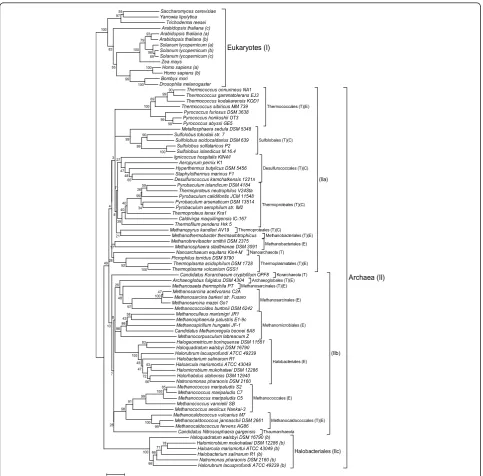
A phylogenetic tree (distance-based neighbour-joining) was constructed based on the multiple alignment of the MBF1 sequences lacking the non-orthologous N-terminal domain of Eukaryotes and Archaea (residues
1-37 of T. tenaxMBF1) (Additional File 1). Bootstrap
data supported two distinct branches: (I) MBF1 homolo-gues of Eukaryotes and (II) MBF1 homolohomolo-gues of all Archaea (Figure 1). The archaeal branch II is subdivided into three clusters, the first one (IIa) includes MBF1 homologues from Crenarchaeota, Nanoarchaeota and part of the Euryarchaeota (i.e. Thermococcales, Thermo-plasmatales and Methanobacteriales). The second archaeal branch (IIb) comprises MBF1 homologues of
the KorarchaeonC. K. crytophilum, the Thaumarchaeon
MBF1b paralogues. Within the Halobacteriales there are two distinct lineages of MBF1, indicating that gene duplication occurred at an early stage of halobacterial evolution and that the MBF1 paralog (branch IIc) might have acquired new functions.
Noteworthy most of the archaeal (hyper)thermophiles, are grouped in branch IIa and only few (hyper)
thermophiles (Methanosaeta thermophila,
Archaeaglo-bus fulgidus,C. K. crytophilum and the three Methano-caldococcales) are found in branch IIb (Figure 1). Therefore, it is tempting to speculate that adaptation of MBF1 to high temperature might have been an impor-tant selection factor in branch IIa. Although no general rule could be proposed for protein stabilization at high
Saccharomyces cerevisiae Yarrowia lipolytica
Trichoderma reesei Arabidopsis thaliana (c) Arabidopsis thaliana (a) Arabidopsis thaliana (b) Solanum lycopernicum (a) Solanum lycopernicum (b) Solanum lycopernicum (c)
Zea mays Homo sapiens (a)
Homo sapiens (b) Bombyx mori Drosophila melanogaster
Eukaryotes (I)
Thermococcus onnurineus NA1 Thermococcus gammatolerans EJ3 Thermococcus kodakarensis KOD1 Thermococcus sibiricus MM 739
Pyrococcus furiosus DSM 3638 Pyrococcus horikoshii OT3 Pyrococcus abyssi GE5
Thermococcales (T)(E)
Metallosphaera sedula DSM 5348 Sulfolobus tokodaii str. 7
Sulfolobus acidocaldarius DSM 639 Sulfolobus solfataricus P2 Sulfolobus islandicus M.16.4
Sulfolobales (T)(C)
Ignicoccus hospitalis KIN4/I Aeropyrum pernix K1 Hyperthermus butylicus DSM 5456 Staphylothermus marinus F1 Desulfurococcus kamchatkensis 1221n
Desulfurococcales (T)(C)
Pyrobaculum islandicum DSM 4184 Thermoproteus neutrophilus V24Sta Pyrobaculum calidifontis JCM 11548 Pyrobaculum arsenaticum DSM 13514 Pyrobaculum aerophilum str. IM2 Thermoproteus tenax Kra1
Caldivirga maquilingensis IC-167 Thermofilum pendens Hrk 5
Thermoproteales (T)(C)
Thermoproteales (T)(C)
Methanopyrus kandleri AV19
Methanobacteriales (T)(E)
Methanothermobacter thermautotrophicus Methanobrevibacter smithii DSM 2375
Methanosphaera stadtmanae DSM 3091 Methanobacteriales (E)
Nanoarchaeota (T)
Nanoarchaeum equitans Kin4-M Picrophilus torridus DSM 9790
Thermoplasma acidophilum DSM 1728 Thermoplasma volcanium GSS1
Thermoplasmatales (T)(E)
(IIa)
Korarchaeota (T)
Candidatus Korarchaeum cryptofilum OPF8
Archaeoglobales (T)(E)
Archaeoglobus fulgidus DSM 4304
Methanosarcinales (T)(E)
Methanosaeta thermophila PT Methanosarcina acetivorans C2A
Methanosarcina barkeri str. Fusaro Methanosarcina mazei Go1
Methanococcoides burtonii DSM 6242
Methanosarcinales (E)
Methanoculleus marisnigri JR1 Methanosphaerula palustris E1-9c Methanospirillum hungatei JF-1 Candidatus Methanoregula boonei 6A8
Methanocorpusculum labreanum Z
Methanomicrobiales (E)
Halogeometricum borinquense DSM 11551 Haloquadratum walsbyi DSM 16790 Halorubrum lacusprofundi ATCC 49239
Halobacterium salinarum R1 Haloarcula marismortui ATCC 43049 Halomicrobium mukohataei DSM 12286 Halorhabdus utahensis DSM 12940 Natronomonas pharaonis DSM 2160
Halobacteriales (E)
Methanococcus maripaludis S2 Methanococcus maripaludis C7 Methanococcus maripaludis C5 Methanococcus vannielii SB Methanococcus aeolicus Nankai-3
Methanococcales (E)
Methanocaldococcus vulcanius M7 Methanocaldococcus jannaschii DSM 2661 Methanocaldococcus fervens AG86
Methanocaldococcales (T)(E)
Thaumarchaeota
Candidatus Nitrososphaera gargensis
(IIb)
Haloquadratum walsbyi DSM 16790 (b) Halomicrobium mukohataei DSM 12286 (b)
Haloarcula marismortui ATCC 43049 (b) Halobacterium salinarum R1 (b)
Natromonas pharaonis DSM 2160 (b) Halorubrum lacusprofundi ATCC 49239 (b)
Halobacteriales (IIc) Archaea (II) 69 98 93 79 100 100 100 99 55 97 55 83 100 85 100 100 100 83 63 56 72 47 45 100 99 100 99 99 90 99 69 100 47 100 59 34 26 99 99 90 99 99 58 43 66 98 91 98 97 92 65 48 48 47 40 40 39 28 27 26 26 21 17 8 7 10 7 8 3 4 49 78 100 66 66 71 0.1
temperature, several recurrent themes and general ten-dencies were observed in a large-scale comparative ana-lysis of proteins from closely related mesophilic and
thermophilic Methanococcus species [ [38], for review
[39]]. In addition it has recently been suggested that protein misfolding plays a key role in determining evo-lutionary rates [40-44]. Many proteins require the assis-tance of molecular chaperones for correct folding and it has been proposed that -GroEL-dependent folding increases evolutionary rates by buffering the harmful effects of misfolding-related mutations [44]. The protein folding apparatus of Archaea contains both eukaryotic and bacterial components [45], however, so far no infor-mation of the evolutionary effects of chaperones on pro-tein evolution in Archaea is available.
As reported previously the genomic context ofmbf1is
well conserved in Crenarchaeota and comprises genes, which encode proteins with predicted function in infor-mational processing such as transcription or translation.
Thembf1gene is in close neighborhood to the genespan
(proteasome-activating nucleotidase),hflX(G-protein of
the HflX family) [46],tgt (tRNA guanine
transglycosy-lase),tfbandtfe(coding for archaeal homologues of
transcription factor II B and the Nterminal half of alpha -subunit of transcription factor II E, respectively) and
rpoG(hypothetical RNA-polymerase subunit G) [25]. In
Euryarchaeota, the genomic context ofmbf1is less
con-served; however, proximity to panis also observed. In
Thaumarcheaota,N. maritimusSCM1 andC. symbiosum
A,mbf1is replaced by a gene encoding a putative
phos-phate-uptake regulator and the genomic context in the close neighborhood is similar to Crenarchaeota [25]. Unfortunately, so far the complete genome of
C. N. gargensisis not available for comparison.
Complementation of yeast mbf1Δby archaeal MBF1
Transcription regulation in Archaea is not well under-stood. Although the archaeal transcription apparatus is similar to the eukaryotic one; most archaeal transcrip-tion regulators are of the bacterial-type [4,47,48]. MBF1 is highly conserved in Eukaryotes and Archaea and a co-evolution with TBP has been proposed previously [24]. However, the function of co-activators from Archaea has not been studied so far and the biological role of aMBF1 as multiprotein bridging factor has not been documented. Therefore a key question concerning
aMBF1 is its in vivo function. To address this issue,
complementation studies in yeast were performed and it was tested whether aMBF1 s from the hyperthermophile
Thermoproteus tenax and the mesophile Methanosar-cina mazeiare functional for complementation in yeast
lacking Mbf1 (mbf1Δ). The mesophilicM. mazeiMBF1
was included in this study in order to exclude tempera-ture-dependent effects, which might be caused by
expression in a mesophilic host (e.g. incorrect folding, missing activity).
In yeast, Mbf1 is involved in the co-activation of the
transcription of the HIS3 gene, encoding the third
enzyme of histidine biosynthesis, by bridging between Tbp and the bZIP type activator, Gcn4 [9]. Deletions
either ofMBF1 orGCN4 in yeast are viable, but
sensi-tive to 3-AT. Therefore complementation by eukaryotic MBF1 could be easily monitored by growth in the pre-sence of 3-AT, as demonstrated previously for the three
A. thalianaMBF1 s [21].
First experiments were performed with the expression vector, pHR98/3, under the control of a constitutive and high-level expression promoter. The expression plasmids encoding full-length TMBF1 and MMBF1 were
intro-duced into thembf1Δstrain and the AT sensitivity was
compared to that of the wild-type and thembf1Δstrain
expressing either yeast Mbf1 (pHRyMBF1, positive
con-trol) or an empty vector (pHR98/3, negative concon-trol)
(data not shown). As expected, growth of the mbf1Δ
strain was sensitive to 3-AT, and 3-AT resistance was restored by re-introducing yeast Mbf1 on a plasmid
(pHRyMBF1, positive control). However, the growth of
thembf1Δstrain in presence of 3-AT was not restored
by introducing the expression plasmid comprising
full-length aMBF1 fromM. mazei orT. tenax, respectively.
In order to exclude deleterious effects caused by overex-pression of aMBF1 in yeast, the experiments were repeated using the vector pRS316. The three genes,
yMBF1, TMBF1 and MMBF1, were introduced under
the control of the endogenous yeast MBF1 regulatory
region (pyMBF1, pTMBF1 and pMMBF1, respectively).
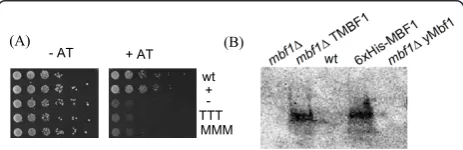
However, as shown in Figure 2A also under control of
the ‘natural’MBF1 promoter no complementation by
aMBF1 as well as by the empty vector (pRS316, negative
- AT + AT wt
+ -TTT
MMM
(A) (B)
control) was observed, whereas yeast Mbf1 restored
3-AT sensitivity of thembf1Δstrain.
Western blot analysis of yeast cell extracts, using poly-clonal antibodies generated against TMBF1, confirmed
that TMBF1 (pHRTMBF1) was successfully expressed in
the mbf1Δstrain (Figure 2B). Thus, the lack of
comple-mentation appears to be not due to the absence of MBF1 expression using the high level expression vector.
For the vector pTMBF1, TMBF1 expression was only
hardly detectable with the antibody (data not shown). The antibody showed no cross-reactivity with recombi-nant MMBF1 or yeast Mbf1. The addition of tags (i.e. positively charged His-tag) for protein detection was consciously avoided, since they might interfere with pro-tein-protein interaction of MBF1 with Tbp and Gcn4, required for functional complementation in yeast.
In general, many different recombinant archaeal pro-teins of (hyper)thermophilic origin have been success-fully and functional expressed in mesophilic hosts, such as, Escherichia coli, Bacillus subtilis and yeast [49]. More recently TFB1, TFB3 and all the subunits of
RNAP from Sulfolobus solfataricusP2 were efficiently
expressed in yeast and used for yeast-two-hybrid experi-ments [50,51]. Furthermore, of great interest for this study, i) the RNAP subunit P from the
hyperthermophi-lic Euryarchaeon Pyrococcus furiosus functionally
replaced the eukaryotic polymerase subunit Rbp12 in the respective yeast mutant [52] and ii) yeast, human,
and archaeal TBP are functionally interchangeable in
vitro in aMethanococcus-derived cell-free transcription system [53].
Therefore, these results indicate that aMBF1, in con-trast to eukaryotic MBF1 from human, insects [7] or plants [21], is not able to complement and to restore eukaryotic MBF1 wild-type function (3-AT resistance) in yeast by substituting for eukaryotic MBF1 during Gcn4-mediated transcription activation.
Based on a bioinformatic and mutational approach in yeast Liu and co-workers [30] suggested the co-evolu-tion of Mbf1 with Tbp in Eukaryotes and Archaea. Aspartic acid (position 112) in yMbf1 and glutamine (position 68) in yTbp were identified as important resi-dues required for Mbf1:Tbp interaction during Gcn4-dependent transcriptional activation [9,30]. In aMBF1, they identified lysine, arginine, serine, or asparagine as interacting residues that correspond to yMbf1 D112 based on the multiple alignment of 21 full-length Mbf1
protein sequences [30]. Anin vivomutational approach
for yMbf1 revealed that combinations that occur natu-rally (e.g. the mutant yMbf1-D112R (WT-Tbp-68Q); Archaea) showed no effect, whereas combinations not normally found, like yMbf1-D112K (WT-Tbp-68Q), were sensitive to 3-AT, indicating that the interactions between yMbf1 and yTbp were disrupted in the latter
mutants [30]. The amino acids corresponding to posi-tion 112 in TMBF1 and MMBF1, are arginine (posiposi-tion 102) and lysine (position 108), respectively (Additional File 1), suggesting that TMBF1 but not MMBF1 might be able to interact with yTbp. However, as shown above
TMBF1 was not able to complement the yeast mbf1Δ
strain in spite of the presence of the appropriate amino acid for the interaction with yTbp.
In order to further analyze MBF1 and TBP interaction sites in Archaea a multiple sequence alignment of 14 eukaryotic and all available 68 archaeal MBF1 and TBP sequences was performed (CLUSTAL_X, [54]) focusing on the determined interaction sites of yeast (Mbf1-D112, Tbp-Q68) [30]. A summary of compensatory amino acid changes in the MBF1:TBP interaction sites is shown in Additional File 2 and 3. Based on more archaeal genomes available the comparative analysis sug-gests that other additional TBP:MBF1 interacting resi-dues than previously reported [30] are present in Archaea and thus the diversity of archaeal residues is much higher than previously predicted. However, the proposed co-evolution of MBF1:TBP, the importance of the well-conserved HTH-domain of MBF1 for TBP interaction and the fact that archaeal TBP and
eukaryo-tic Tbp are functionally interchangeable (in vitro
tran-scription system [53]) suggests that the interaction between MBF1 and TBP might be also conserved in Archaea.
Beside aMBF1-yTbp interaction also the binding of aMBF1 to the activator Gcn4, which depends on both the N-terminal and HTH- domain is important. In yeast the binding of Gcn4 to Mbf1 was not altered by a D112A mutation (Tbp binding), but it was slightly reduced by
the N-terminal deletion of yMbf1 (MBF1ΔNT). Both
mutants (D112A andMBF1ΔNT) are sensitive to 3-AT
as shown by Takemaru and co-workers [9]. It has been reported previously that Archaea lack bZIP-proteins like the transcriptional activator Gcn4 [25]. In accordance with previous analysis PSI-BLAST searches with yGcn4
(281 amino acids) andBmFTZ-F1 (534 amino acids) in
all available archaeal genomes revealed no homologues to the activators which interact with MBF1. Therefore, it is questionable if the respective sites for Gcn4 interactions are present in aMBF1 either in the divergent N-terminal domain or in the conserved HTH domain. In summary, these data suggest that the interaction of aMBF1 with yGcn4 could be impaired rather than with yTbp and in the light of the above, chimeric proteins of Archaea and yeast were constructed and tested for 3-AT sensitivity.
Chimeric yeast - archaeal MBF1 variants
high structural similarity with T. tenaxand M. mazei
MBF1, despite their difference in amino acid sequence; TMBF1 and MMBF1 share 39% and 36% amino acid identity with their yeast counterpart, respectively.
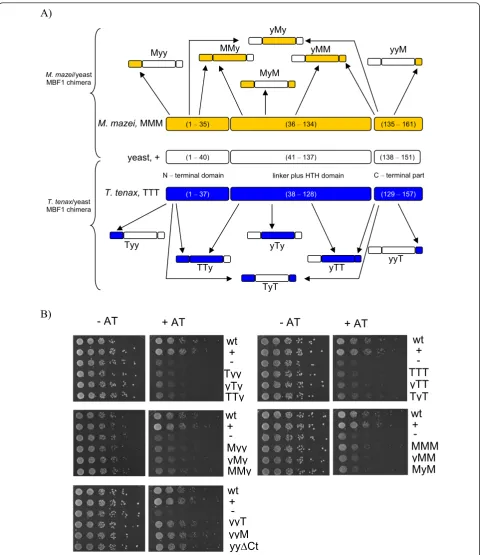
The observed missing complementation of aMBF1 in yeast might be caused by the presence of the Zn ribbon motif in the N-terminus of aMBF1 or as discussed above by changes of important amino acid necessary for Tbp and Gcn4 interaction. To test this possibility and to study the evolutionary conservation of MBF1 domains in Eukaryotes and Archaea, in total 12 chimeric inter-species MBF1 variants were constructed. Each chimeric protein was composed of different combinations of the N-terminal domain, the core domain (including the flex-ible linker and HTH-domain) and the C-terminal
exten-sion from either the hyperthermophile T. tenaxor the
mesophile M. mazei, and yeast (Figure 3A). The hybrid
proteins were constructed using the recombination/gap repair cloning technique in yeast and 3-AT sensitivity in
the mbf1Δbackground was examined (Figure 3B). No
complementation was observed for any of the aforemen-tioned chimeric MBF1 variants targeting the N-terminal domain or the core domain (i.e. Tyy and Myy; yTy and yMy; TTy and MMy, yTT and yMM; TyT and MyM), indicating that neither the archaeal N-terminal nor the core domain, harboring the conserved HTH domain, was sufficient to allow for functional Mbf1 in yeast.
Next it was studied whether the well conserved, archaeal C-terminal extension has an influence on
yMbf1 function. The mbf1Δ expressing the chimeric
proteins, yyT- and yyM-MBF1, showed similar 3-AT resistance as the wild-type and the positive control
(pyMBF1, Figure 3B). However, also the yMBF1mutant
(yyΔCt -MBF1 (residues 1 - 137), control) lacking the
yeast C-terminal part (residues 138 - 151) restored WT activity, i.e. 3-AT resistance (Figure 3B). This observa-tion clearly indicates that the archaeal C-terminal stretch comprising the well conserved archaeal motif does not interfere with domain stability of yMbf1 (Figure 3B) and moreover that the C-terminal part of yeast MBF1 is not required for function as shown
pre-viously for the BmMBF1 mutant Δ114-146 [7]. The
TMBF1 antibody showed no cross-reactivity with the hybrid proteins, however, the functional complementa-tion by yyT and yyM nicely demonstrates funccomplementa-tional expression.
In summary, complementation studies with chimeric archaeal/yeast proteins indicate that neither the N-term-inal, nor the core domain of archaeal MBF1 is able to substitute for the respective eukaryotic domains. Only the archaeal and yeast C-terminal extension, which was shown here to be dispensable for yMbf1 function, can be successfully swapped. Therefore, due to the fact that the N-terminal and core domain of yeast are required
for Gcn4 interaction [9], MBF1 interacting activators are absent in archaeal genomes and conserved MBF1:TBP interaction has been suggested [30], it is tempting to speculate that archaeal MBF1 is not able to bind to the yeast activator Gcn4 rather than yTbp.
Computational analysis Structure prediction of MBF1
Since no 3 D structure of MBF1 is available, the
previously described solution structure of T. reesei
C-terminal HTH domain [55] was used for modeling of
T. tenax MBF1 via METASERVER, a consensus fold-recognition method [56], PHYRE [57], I-TASSER [58]
fold-recognition and ab initio methods. These three
methods suggested different HTH domains as the best
template forT. tenax MBF1 with both, transcriptional
regulator from Vibrio cholerae (PDB ID: 1y9q) and
C.BclI a control element of the BclI
restriction-modifica-tion system inBacillus caldolyticus (PDB ID: 2b5a) as
best hits, which score significantly above the threshold. The human MBF1 (endothelial differentiation-related factor 1 protein, EDF-1; PDB ID: 1x57) and the
regula-tor of cytolysin operon inEnterococcus faecalis(PDB ID:
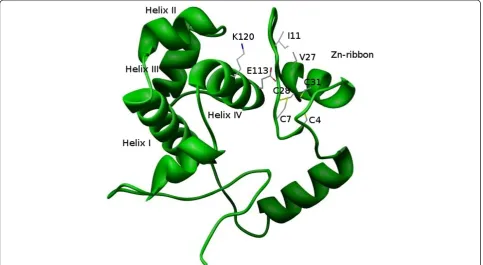
1utx) were identified simultaneously by at least two methods. Only I-TASSER [58] provided a 3 D model for the complete MBF1 sequence. The structural models were analyzed by different structure validation programs including PROCHECK [59] for the evaluation of the Ramachandran plot quality, WHATCHECK [60] for the calculation of packing quality Z-score, and VERIFY-3 D [61] for the evaluation of sequence-structure compatibil-ity (Table 1). In general, qualcompatibil-ity values obtained for the 3 D models are similar to those observed in the tem-plate structures indicating a high quality of the MBF1 low-resolution model presented in this work (Figure 4).
Analysis of the three-dimensional model of TMBF1 suggests two residues in the N-terminal Zn ribbon motif that establish van der Waals interactions with residues in the HTH domain: (i) The isoleucine residue at posi-tion 11 (Zn ribbon) interacts with lysine at posiposi-tion 120 (helix-IV) (Figure 4). TMBF1-I11 is highly conserved in archaeal sequences and TMBF1-K120 is well conserved in both, Archaea and Eukaryotes (see Additional File 1). In yeast Mbf1, lacking the Zn ribbon motif, TMBF1-I11 is substituted by alanine. (ii) The valine at position 27 (Zn ribbon motif) which is well conserved in Archaea interacts with the not so well conserved E113 (helix-IV) of TMBF1 (Figure 4). These predicted interactions between the Zn ribbon motif and the HTH domain
would be favorable for the folding stability of T. tenax
MBF1.
Prediction of functional residues of archaeal MBF1
Comparison of the HTH domain from the 3 D model of
A)
(1 –40) (41 –137) (138 – 151)
(1 –37) (38 –128) (129 – 157)
yeast, +
T. tenax, TTT
N – terminal domain linker plus HTH domain C – terminal part
(1 –35) (36 –134) (135 – 161)
M. mazei, MMM
Tyy
TTy
yTy
TyT
yTT yyT
Myy MMy
yMy
MyM
yMM yyM
M.mazei/yeast MBF1 chimera
T.tenax/yeast MBF1 chimera
B)
- AT
+ AT
wt
+
-Tyy
yTy
TTy
wt
+
-TTT
yTT
TyT
wt
+
-yyT
yyM
yy
¨
Ct
wt
+
-MMM
yMM
MyM
wt
+
-Myy
yMy
MMy
- AT
+ AT
reeseiMBF1 (PDB ID: 2jvl, [55]) revealed that helix-II is the most highly conserved region (Figure 5). The
C-terminal domain of T. reesei MBF1 [55] has been
reported previously to be structurally similar to the DNA-binding domain (residues 1 to 69) of the phage
434 repressor (F434rep) (PDB ID: 1pra). For F434rep
the residues involved in DNA binding were identified;
F434rep-Q17 in helix-II participates in the anchoring to
the DNA and F434rep-R43 in helix-IV inserts in the
DNA minor groove [62]. In TMBF1, TMBF1-R86 at the
first position of helix-II corresponds toF434rep-Q17
and TMBF1-E113 in helix-IV to F434rep-R43. These
characteristics would be unfavorable for DNA binding,
and concurs with previous studies that BmMBF1 does
not bind directly to DNA, but instead stabilizes
FTZ-F1-DNA interactions [6]. InBmMBF1 Q90 and I117 are at
the respective positions (Additional File 1). DNA phos-phate interaction with positive charged residues has
been previously described for F434rep [62]; arginine
and lysine residues positioned in the loop II connecting
helices III and IV of F434rep establish important
con-tacts with DNA phosphates [62]. However, the respec-tive posirespec-tive charged residues are absent in the HTH
domain ofB. mori,T. reeseiandT. tenaxMBF1
suggest-ing no bindsuggest-ing to DNA via the core domain. Therefore, the HTH domain in archaeal MBF1 might be important for protein-protein interaction, possibly with TBP which is well conserved also in Archaea.
It has been suggested previously [7] that the flexible linker in eukaryotic MBF1 could have a functional role
Table 1 Evaluation of the constructed three-dimensional model of archaeal MBF1 fromThermoproteus tenax(TMBF1)
Criteria Characteristic MBF1
(M1-E157)
MBF1 (R64-N141)
2b5a (A)
1y9q (A)
1x57 (A)
1utx (A)
PROCHECK Most favored regions 60.0% 94.1% 97.1% 93.1% 84.7% 93.3%
Additional allowed 24.4% 5.9% 2.9% 6.3% 11.1% 6.7%
Generally Allowed 8.9% 0% 0.0% 0.6% 2.8% 0.0%
Disallowed regions 6.7% 0% 0.0% 0.0% 1.4% 0.0%
WHATCHECK (Z-scores) 2nd generation packing quality -4.061 -0.752 -0.1 -0.9 -1.758 -0.7
VERIFY-3D 3D-1 D score (≥0.2) 72.15% 64.56% 84.62% 98.28% 96.74% 100%
PDB ID: 2b5a, C.BCLI, control element of the BCLI restriction modification system (Bacillus caldolyticus); PDB ID: 1y9q, HTH_3 family transcriptional regulator (Vibrio cholerae); PBD ID: 1x57, EDF-1, human multiprotein bridging factor 1a; PDB ID: 1utx, CYLR2, Transcriptional repressor of cytolysin operon (Enterococcus faecalis).
rather than an architectural. In all aMBF1 a well- con-served lysine-arginine-rich region is present between the Zn ribbon motif and the HTH domain, which would be favorable for the interaction with the DNA phosphate backbone (Additional File 1). In eukaryotic MBF1 lacking the Zn ribbon motif, this lysine-arginine-rich region is absent (Additional File 1). Taken together, based on pre-dictions derived from modeling as well as structural ana-lyses, and the performed complementation studies, it is tempting to speculate that aMBF1 might act as a single regulator or non-essential transcription factor, which directly interacts with DNA via the positive charged lin-ker or to the basal transcription machinery via its Zn rib-bon motif (i.e. RNAP) and the HTH domain (i.e. TBP).
Origin of archaeal and eukaryotic MBF1: trends in evolution
As previously indicated [3], there is an extensively diver-sity of HTH domains in Archaea as well as in Bacteria. Most of the predicted archaeal HTH-containing proteins show significantly higher similarity to bacterial than to eukaryotic HTH-containing transcription factors, with the only exception of the core transcription machinery comprising eukaryotic-like transcription factors such as,
TFIIE-a, TFIIB/TFB and MBF1 [3]. It has been
pro-posed that beyond the core machinery, the bacterial-like HTH- containing archaeal proteins might have been established and maintained through multiple horizontal gene transfer events from Bacteria to Archaea in the course of evolution. Moreover, most of the archaeal HTH domains appear to have undergone at least some evolution within the archaeal superkingdom [3]. MBF1 is the only highly conserved HTH-domain in Archaea and Eukaryotes. Eukaryotic MBF1 is not a general tran-scription factor since the disruptants are viable and able to grow under different growth conditions [9]. The situation in Archaea appears to be similar, because MBF1 is well distributed but lost in two of the three
members of the Thaumarchaeota, C. symbiosumA and
N. maritimusSCM1. The absence of MBF1 homologs in Bacteria suggests that MBF1 was originally present in the last common ancestor of Archaea and Eukaryotes.
Eukaryotic MBF1 lacks the Zn ribbon motif and MBF1-dependent gene regulation requires the function of specific activators belonging to bZIP-like protein or steroid/nuclear-hormone receptor family, which bind directly DNA. In contrast, archaeal MBF1 exhibits a Zn ribbon motif and homologs of eukaryotic MBF1-specific activators are absent in Archaea, suggesting a different mode of action of MBF1. Further on, the conserved
genomic context of mbf1in the archaeal domain with
proximity to genes involved in information processing proposes a basal function of aMBF1 in transcription or translation [25].
Two evolutionary scenarios can be discussed which might have evoked the present-day image. One possibi-lity is that the common ancestor possessed an ancient Zn ribbon containing MBF1 version which interacts directly with DNA and/or RNAP and no specific inter-acting activators were required. This MBF1 version was maintained in Archaea but further evolved in Eukar-yotes. Probably the Zn ribbon motif was lost due to the emergence of specific MBF1-interacting activators (bZIP like proteins or FTZ-F1 related proteins), which allowed for improved fine tuning of gene regulation in a more
complex cellular network; for instance, genHIS3, which
possesses a constitutive“TATA-less control element” as
well as a regulatory region ("TATA-containing control
element”) and the latter is regulated by the Gcn4-Mbf1
complex in yeast under starvation conditions [63]. An alternative possibility is that the last common ancestor harbored both an eukaryotic-like MBF1 and homologs of MBF1-interacting regulators. The specific interacting activators were lost in the archaeal lineage and provoked the evolution of the Zn ribbon containing archaeal spe-cific MBF1, which acquired new functions.
The fact that MBF1 is involved in many different fun-damental processes in Eukaryotes (e.g. histidine synth-esis, development, immune and antioxidant defense, steroid/hormone synthesis, lipid metabolism) and inter-acts with different activators in a very sophisticated and complex manner seems to favor the first scenario.
helix-I helix-II helix-III helix-IV RMSd %ID TMBF1 70EYAEVIKRARESL--GLSREALASYIGVKESVLKRIESGQLMPDIELARKLEKALGVKLL127
2jvl 82EVGKAIEQGRQKFEPTMTQAELGKEIGETAATVASYERGTATPDQNILSKMER--VLNVK139 4.2A 16.9% 1x57 13EVGKVIQQGRQSK--GLTQKDLATKINEKPQVIADYESGRAIPNNQVLGKIERAIGLKLR70 3.8A 30.3% 1pra 1SISSRVKSKRIQL--GLNQAELAQKVGTTQQSIEQLENGKTKRP-RFLPELASALGVSVD57 2.7A 22.1% 1y9q 11QIANQLKNLRKSR--GLSLDATAQLTGVSKAMLGQIERGESSPTIATLWKIASGLEASFS68 2.7A 22.1% 1utx 1MIINNLKLIREKK--KISQSELAALLEVSRQTINGIEKNKYNPSLQLALKIAYYLNTPLE58 2.5A 24.6% 2b5a 10KFGRTLKKIRTQK--GVSQEELADLAGLHRTYISEVERGDRNISLINIHKICAALDIPAS67 1.6A 19.7%
However, since the function of archaeal MBF1 is still unclear future studies have to be awaited, which will provide key insights into the evolution and mechanism of basic processes in both domains, Archaea and Eukaryotes.
Conclusions
Previous studies with eukaryotic MBF1 revealed that the
defect of a yeast MBF1deletion was rescued by the
expression of silkworm and human MBF1 [Takemaru and Hirose, unpublished observation, 7] or plant MBF1
(threeA. thalianaparalogues [21]) indicating that MBF1
s from divergent eukaryotic sources are able to substitute yMbf1 in Gcn4-dependent transcriptional activation. In contrast the present study revealed that archaeal MBF1, neither from hyperthermophilic (Crenarchaeota) nor from mesophilic (Euryarchaeota) origin, was capable of
functionally complementing thembf1Δin yeast.
Further-more, domain swap experiments suggest that the diver-gent archaeal N-terminal domain and the core domain of MBF1, harboring the conserved HTH domain, are not functional in yeast. This was surprising since the HTH domain of MBF1 is a cro-HTH type domain and has been identified previously as the only highly conserved, classical HTH domain that is vertically inherited in all Archaea and Eukaryotes. Further results obtained in this study indicated that the archaeal C-terminal extension
containing the well conserved archaeal motif “
[TS]-[LIVMF]-G-[DEN]”did not interfere with yMbf1
func-tion and revealed that the C-terminal extension of yeast
Mbf1 is not required for Mbf1 function (yyΔCt-MBF1).
The conservation of MBF1 among all organisms in which TBP is used as a general transcription factor sug-gests that MBF1 has a fundamentally important function also in Archaea. However, the absence of bZIP-like proteins in the archaeal domain, the presence of a non-classical type Zn ribbon motif, the positive- charged lin-ker in aMBF1 and the complementation experiments using archaeal- yeast chimeric protein presented here suggest a different mode of action of MBF1 -may be as non-essential transcription factor or transcriptional regulator, which contacts DNA and/or the basal tran-scription apparatus probably via RNAP and/or TBP. Alternatively a role of MBF1 in translation either directly in ribosome biogenesis [25] or indirectly in translation fidelity [29] has been proposed. Thus, further studies (e.g. protein-protein interaction studies, muta-tional approaches) are required in order to elucidate the specific function of MBF1 in Archaea.
Methods
Yeast strains
Growth and manipulation of yeast was performed
according to standard procedures. AEY3087 (MATa
his3Δ1 leu2Δ0, met15Δ0, ura3Δ0) and an mbf1Δ:: kanMX derivative thereof (Yeast Deletion Collection, ResGen/Invitrogen) were used to determine AT
sensitiv-ity. For this purpose, the strains were rendered His3+ by
transformation to histidine prototrophy with a HIS3
fragment.
Cloning of MBF1 gene from yeast,T. tenaxandM. mazei
To construct the overexpression vectors, pHRyMBF1
(YOR298C-A), pHRTMBF1(TTX_1938, FR823290) and
pHRMMBF1 (MM_1005) encompassing the coding
region of yMbf1 and aMBF1 genes, the three DNA
frag-ments corresponding to yMBF1, TMBF1 and MMBF1
open reading frame were amplified by PCR and then,
the resulting DNA fragments were cloned intoBamHI
and SalI sites of pHR98/3 (2μm, URA3) vector
contain-ing a constitutive and high-level expression promoter. The pairs of primers and the restriction enzymes used for cloning are indicated in Additional File 4.
To construct pyMBF1, the 1,667-KbEcoRI/NotI
geno-mic fragment encompassing the entire MBF1regulatory
and coding region was cloned into pRS316 (2 μm,
URA3) vector using the primer set yMBF1-yprom-r and
yMBF1-yprom-f (Additional File 4). Plasmids
encom-passing the MBF1gene from T. tenax (pTMBF1) and
M. mazei(pMMBF1) were generated by recombination/
gap repair cloning technique in yeast using pyMBF1as
the starting vector (Addtional File 4). In these
con-structs, the yeast MBF1 open reading frame was
replaced by theMBF1gene fromT. tenaxandM. mazei
to construct plasmids pTMBF1 and pMMBF1,
respec-tively. Therefore, pTMBF1and pMMBF1encompass the
yeastS. cerevisiae MBF1promoter and theMBF1coding
region fromT. tenax or M. mazei, respectively. After
gap repair, plasmids were isolated from yeast by
amplifi-cation inE. coliand verified by sequence analysis.
Generation of chimeric MBF1s
Chimeric variants of yeast-archaeal MBF1 were con-structed by gap repair in yeast as described above. They were named using a three letters code with y, T or M,
corresponding to the origin from yeast (y),T. tenax(T)
or M. mazei (M) and the order indicates the position, i.e. N- terminal domain, central region (flexible linker and helix-turn-helix- domain) or C- terminal extension (e.g. yTT). The chimeric variants were generated using PCR sewing (Additional File 5). For this purpose, two primer sets (external and internal) were designed to
amplify the respective fragment ofMBF1 with addition
of sequences for gap repair. The external primers were designed encompassing the 50-bp target fragment in both outer arms. The gene- specific parts of the internal
primers were designed to ensure that their 5’-termini
File 4). Gap repair and construct verification was per-formed as above.
Generation of antibodies
Polyclonal antibodies against T. tenax MBF1
(anti-TMBF1) were generated against the His-tagged version ofT. tenaxMBF1 protein expressed in Escherichia coli
(EUROGENTEC, Seraing, Belgium). SDS-PAGE and immuno blotting procedures were performed according to standard protocols. The TMBF1 antibody was used in a 1:500 dilution.
Complementation test: Sensitivity to Aminotriazole
Yeast colonies of the wild-type (WT) and the mbf1Δ
yeast strain transformed with plasmid expressing aMBF1, chimeric protein variants, yMBF1 or empty vec-tor were grown in the appropriate minimal medium. For the serial dilutions, a suspension with an optical density
(OD600nm) of 0.3 was generated, and 5-fold serial
dilu-tions thereof were made in a microtiter dish. The cells were transferred onto supplemented minimal medium with or without 3 mM aminotriazole using a 6 × 8 pronged replica plater. The plates were incubated for 3 days at 30°C.
Computational analysis
All databases and software used in the present study are publicly available. Sequences of MBF1 and TBP from Archaea and Eukaryotes were retrieved from publicly available databases including Swiss-Prot (sp), GenBank (gb), EMBL (emb), and DDBJ (dbj). A list of Archaea with available complete genome sequence was retrieved from the Genomes On Line Database (GOLD) [64]. Nucleotide sequences were translated into protein sequences using the TRANSLATE web-server [65]. Position-Specific Iter-ated BLAST (PSI-BLAST) searches were performed against the non-redundant (nr) database at the National Center for Biotechnology Information (NCBI) http://www. ncbi.nlm.nih.gov [66] and were used to identify MBF1, TBP and Gcn4 related sequences. Sequence alignments with E-value less than 10-3 and with bit score greater than 100 were considered significant.
The analysis for functional domains was performed using Pfam protein family database http://pfam.sanger. ac.uk/ [67]. Furthermore, CLUSTAL_X [54] with default settings was used to compare MBF1 and TBP sequences. The aligned sequences were inspected and adjusted manually to minimize the number of gaps and inser-tions. These manual adjustments were based on the sequence similarities, secondary structure prediction, and finally, fold recognition results.
The phylogenetic tree was constructed according to the Neighbor-Joining method [68] and visualized by
MEGA program version 4.0 [69]. Distance analyses including 1500 bootstrap replicates were performed.
Structurally related proteins were identified by searches against known structures in the Protein Data Bank (PDB) [70], and for sequence-to-structure align-ment of the deduced aMBF1 METASERVER was used [56]. METASERVER predictions were complemented with those obtained by PHYRE [57] and I-TASSER [58] for a successful fold recognition approach. The pre-dicted 3 D structure of MBF1 was subjected to a series of tests for evaluating its internal consistency and relia-bility. Backbone conformation was evaluated by the inspection of the Psi/Phi Ramachandran plot obtained from PROCHECK analysis [59]. Packing quality of the 3 D model was investigated by the calculation of WHATCHECK Z-score value [60]. Finally, sequence-structure compatibility was evaluated by VERIFY-3 D [61]. All these programs were executed from the
struc-ture analysis and verification servers’web-site at UCLA
http://www.doe-mbi.ucla.edu/.
Reviewers’comments
Reviewers’report 1: Bill Martin, Institut für Botanik III, Düsseldorf University, Germany
This is a very straightforward and worthwhile manuscript investigating the ability of the archaeal bZIP protein MBF1 to complement yeast MBF deletion mutants and in domain swapping regimens. Although the complemen-tation studies showed that only a small portion of the archaeal MBF1 (the C-terminal region) can substitute for the yeast protein in complementation studies. It would have been more exciting perhaps if the functionally more important core and N-terminal regions of the archaeal proteins from crenarchaeotes and euryarchaeotes had been functional, but they did thorough work to show that under these conditions that does not work, so that is important information for the community to know. Overall the paper was very well-prepared and is well worth publishing, basically in present form in my opi-nion. The only point that I stumbled upon was the six
occurrences of“interestingly”, which is a word that can
Authors’ response: We appreciate these constructive comments. We included the possible function of chapero-nins in protein evolution in the manuscript. Although chaperonins are reported in Archaea to our knowledge their role in evolution has not been studied so far. How-ever, it is tempting to speculate that they might be of special significance for proper protein folding at high temperature.
“Interestingly”has been removed from the text.
Reviewers’report 2: Patrick Forterre, Institut Pasteur, France
It is often claimed that Archaea use bacterial-like pro-teins to regulate an eukaryotic-like transcription machinery. At the cross-road between regulators and basal transcription factors, the protein MBF1, present in Archaea and Eukarya, but not in Bacteria, is an interest-ing model for mechanistic and evolutionary studies. In their paper, Bettina Siebers and co-workers have first
used literature data and in silico analyses to compare
the archaeal and eukaryal MBF1. In addition, they have
used a MBF1 mutant from the yeastSaccharomyces
cer-evisiae to check various constructions of chimeric archaeal/eukaryal MBF1 proteins. In Eukarya, MBF1 proteins interact with TBP and regulatory proteins of the FTZ-F1 family. Whereas TBP is conserved between Archaea and Eukarya, FTZ-F1 regulators have no homo-logues in Archaea.
The experimental work by Siebers and co-workers shows that the archaeal MBF1 cannot complement the eukaryotic one. Chimeric proteins only work when the C-terminal domain of the eukaryal one is replaced by the archaeal one, but this domain is precisely the domain of MBF1 which is dispensable for in vivo function.
Since the central domain of MBF1 that probably inter-acts with TBP is conserved between Archaea and Eukarya, the lack of complementation probably came from the differences between the N-terminal domains of the Archaeal and Eukaryal MBF1 and discrete differ-ences in the central domain. The determinants for inter-action between MBF1 and FTZ-F1 are probably missing in the archaeal protein. The archaeal proteins apparently exhibit specific features that allow them to interact directly with DNA and RNA polymerase without the requirement for an additional FTZ-F1-like protein. In particular, a Zn ribbon motif present in the N-terminal part of the archaeal protein and a set of basic residues conserved in the archaeal protein could be essential for the interaction of the archaeal protein with TBP, RNA polymerase and DNA.
I think that publication of such paper in Biology Direct should be the opportunity for the authors to dis-cuss more about the evolutionary and/or physiological
aspects of their work. It seems that MBF1 in Archaea can be considered as a kind of additional basal tran-scription factor (dispensable since lacking in some Thaumarchaeota). What can be its role (using informa-tion from the genomic context)? How the system evolved from Archaea to eukarya or vice versa?
It would be nice if the authors could compare two scenarios, either the loss of FTZ-F1-like proteins in the archaeal lineage or their gain in the eukaryal lineage. They could possibly even suggest experiments to evolve the archaeal MBF1 protein into an archaeal-like one or vice versa.
Authors’response: Considering the valuable remarks a new subsection “Origin of archaeal and eukaryotic MBF1: trends in evolution” has been included in the Results and Discussion section. We agree it would be interesting to design experiments focused on the evolution of the archaeal MBF1 protein into the archaeal like one or vice versa. Actually this was somehow the intention when we tried to work with chimeric proteins; however, it seems to be quite difficult, probably due to the acquired different functions in the course of evolution. May be directed evolution would be an alternative tool for further studies.
A MBF1 protein is present in the recently available
genome of the thaumarchaeon Nitrososphaera gargensis.
Considering the possible position of Thaumarchaeota at the base of the archaeal tree, it should be interesting to add this protein in the phylogenetic analysis.
Authors’ response: MBF1 from C. N. gargensis was included in the analysis as recommended. Unfortunately, the genomic context of mbf1 in C. N. gargensis could not be analyzed, because the whole genome sequence is not available.
Reviewers’report 3: John van der Oost and Fabian Blombach, Wageningen University, The Netherlands
Marrero Coto and colleagues report on an interesting protein that is conserved in most Archaea and in all Eukaryotes, the Multi-protein Bridging Factor (MBF1). In order to gain insight in a function of the archaeal enzyme, complementation studies have been performed of the yeast MBF1, in which the entire yeast protein or fragments (domain swap) were substituted by its archaeal counterpart. In addition, a bioinformatics ana-lysis has been performed. Overall the experiments have been well performed, and are well described. MBF1-TBP interaction - An extensive series of well-designed com-plementation experiments has been performed. Unfortu-nately, the outcome of the described experimental work is rather disappointing. It is concluded that the MBF1
proteins from neitherThermoproteusnor
Methanosar-cinaare capable of functionally complementing
addition, it is concluded that the C-terminal extension of yeast MBF1 appears not to have an important role in the function of MBF1 as transcriptional coactivator. Obviously, more experiments are required to draw firm conclusions on the evolutionary conservation of the MBF1/TBP interaction. Based on the presented data it is impossible to conclude at what stage the complementa-tion fails: is it because an imperfect interaccomplementa-tion between MBF1 and TBP, between MBF1 and the bZIP regulators, or both?
Author’s response: We appreciate these constructive comments and recommendations. We think that the outcome of these experiments is not disappointing, but rather indicates the necessity to complement bioinfor-matic predictions by biological experiments. In 1999 a possible function of MBF1 in Archaea as transcription factor related to the core machinery was predicted due to the presence of the well-conserved HTH domain in Archaea and Eukaryotes and the additional Zn ribbon motif present in Archaea [3,30]. Liu and co-workers proposed a co-evolution of MBF1 and TBP in Eukar-yotes and Archaea using bioinformatic as well as muta-tional analyses, suggesting the possibility of a similar role of eukaryotic and archaeal MBF1 [30]. Impor-tantly it has been previously shown that archaeal TBP can be replaced by human and yeast TBP in a Metha-nococcus-derived cell-free transcription system [53]
highlighting the common origin of the core transcrip-tional machinery. To the best of our knowledge no bio-logical data are available that test and clarify the function of archaeal MBF1 and therefore it was a rea-sonable approach to test for archaeal MBF1 function in a yeast MBF1 deletion strain, especially since func-tional complementation by plant, human and insect MBF1 has been demonstrated [7,21].
The performed experiments revealed that archaeal MBF1 as well as all of the constructed chimeric proteins (except the C-terminal domain swap) are not able to complement for MBF1 function in yeast.
We agree that we can only speculate about the reasons why the complementation fails, but due to the presence of the well-conserved HTH domain, the absence of bZIP regulators in Archaea and the fact that eukaryotic and archaeal TBP are interchangeable in an archaeal in vitro transcription system, an impaired interaction of MBF1 with Gcn4 rather than with TBP is favourable. In the revised version of the manuscript we extended the respective discussion and are more specific about the possible explanations. In addition further experiments to analyze for yGcn4, y/aTBP, y/aMBF1 (WT and chimeric proteins) and aRNAP(subunit) interactions by yeast two hybrid studies are currently on the way in order to address this important point.
Importantly, it is not known if all hybrid constructs are expressed in a soluble form (only shown for
T. tenax MBF1). Although quite labor-intensive, tag-based immuno-detection and co-immuno- precipitation experiments would have been informative. The pre-sented data do not disprove an interaction between TBP and MBF1. The failure of the archaeal HTH domains to replace the HTH of yeast MBF1 can have several reasons.
Author’s response: Beside T. tenax MBF1 the func-tional complementation of yyM and yyT confirms expres-sion in soluble form. We agree that this is an important point and therefore we added more detailed information in the manuscript, why we choose the current approach. The aim of this study was to investigate functional com-plementation in yeast, which is based on the interaction of MBF1 with Tbp and Gcn4 in yeast. Therefore we avoided any tags for protein detection, which might interfere with protein-protein interaction or might influ-ence protein-DNA interaction (e.g. by introducing a posi-tively charged His tags).
After initial negative results for aMBF1 complementa-tion using the yeast overexpression vector (pHR98/3) we decided to express aMBF1, yMBF1 (control) as well as chimeric MBF1 s under the control of the natural yeast MBF1 promoter in order to avoid deleterious effects due to overexpression. Unfortunately the expression under control of the natural promoter and thus the low protein amounts hampered the detection of the chimeric TMBF1 proteins by the polyclonal TMBF1 antibody, although at least for yyT and yyM soluble expression was demon-strated by functional complementation.
Being able to functionally replace yeast MBF1 by plant (Arabidopsis), insect (Bombyx mori) or human MBF1 does not mean that the same should be possible with archaeal MBF1, especially regarding the far greater phy-logenetic distance.
In silico analysis of MBF1 - No conclusions are drawn from the phylogenetic analysis, and (apart from showing the conservation of the C-terminal HTH domain in the eukaryal and archaeal proteins) it does not add much to the manuscript.
Author’s response: We agree, the manuscript has been changed accordingly and the phylogeny is discussed in more detail now (see also reviewer 1 and 2).
As the N-terminal domains of archaeal and eukaryotic MBF1 are non-orthologous, it may be appropriate to omit them from the alignment, or at least make a clear statement on this in text and figure legend.
Authors’response: A clear statement on the non-ortho-logous N-terminal domain was made in the text and in the Figure legend for clarity. Furthermore the phyloge-netic tree was re-constructed based on the multiple alignment of the MBF1 sequences lacking the fragment corresponding to the Zn ribbon since the archaeal and eukaryotic N-terminal domains are non-orthologous.
In addition, in the description of the structural model, the conservation is described of residues of the N-terminal domains of archaeal and eukaryotic MBF1
(positions 11 and 27 in T. tenax MBF1); this does not
make sense as they are non-homologous domains. Some of the descriptions in the description of the structural models (e.g ProCheck) rather belong in the M&M section.
Author’s response: This is a misunderstanding. We modified the text for clarity. It has been mentioned in the paper that the N-terminal domain of MBF1 from Archaea has a Zn ribbon motif that is absent in the eukaryotic counterparts. The analysis of the 3D-model of T. tenax MBF1 was performed to analyze for putative van der Waals interactions between residues of the N-terminal domain and the C-terminal HTH-domain, which might contribute to fold stability of the T. tenax MBF1.
The description of the programs used to analyze MBF1 structural models (PROCHECK, WHATCHECK and VERIFY-3D) are declared in both Sections: in Methods and in Results and Discussion. We considered the follow-ing two sentences appropriate also for the Results and Discussion section. The exact citation, as appeared in the manuscript, is:“The structural models were analyzed by different structure validation programs including PRO-CHECK [59]for the evaluation of the Ramachandran plot quality, WHATCHECK [60]for the calculation of packing quality Z-score, and VERIFY-3 D [61]for the evaluation of sequence-structure compatibility (Table 1). In general, quality values obtained for the 3 D models are similar to those observed in the template structures indicating a high quality of the MBF1 low-resolution model presented in this work (Figure 4)”.
The Endothelial Differentiation related factor 1 used here as template is in fact a human MBF1 ortholog; this should be mentioned in the text.
Author’s response: Modified in the text for clarity. Conclusions - It is proposed that, on the basis of the presented data, MBF1 most likely functions in Archaea as a specific transcriptional regulator. This is a hypoth-esis that could be tested experimentally, by protein-protein interaction studies (TBP, TFB, RNAP), by DNA-binding analysis, or by gene disruption.
Author’s response: We appreciate the recommenda-tions. Moreover, the experimental investigations of the MBF1/TFB/RNAP and Gcn4 interaction (yeast-two-hybrid experiments, see above) are currently underway in the laboratory of BS at the University of Duisburg-Essen.
In their conclusion the authors should also mention alternative functions, including on the recently sug-gested role of the archaeal MBF1 in ribosome biosynth-esis and/or functionality.
Author’s response: The proposed role of MBF1 in ribo-some biogenesis has been discussed in the manuscript for clarity; this suggested alternative function of MBF1 is now also included in the conclusions.
Additional material
Additional file 1: Multiple sequence alignment of archaeal and eukaryotic MBF1s. The N-terminal domains of archaeal and eukaryotic MBF1 s are non-orthologous. The Zn ribbon motif is absent in the eukaryotic N-terminal domain. The two pairs of cysteine residues present in the N-terminal domain of archaeal MBF1 s (aMBF1) are highlighted by grey shading. Dashes indicate gaps in the amino acid sequence introduced to optimize the alignment. D112 of yMbf1, required for TBP binding in yeast, and the respective residues in eukaryotic MBF1 and aMBF1 are indicated by asterisk. The conserved motif, T(S, L(V, M, F, I)-G-D(E, N, I), in the C- terminal extension of aMBF1 is indicated in bold. For the construction of the phylogenetic tree (Figure 1) the non-orthologous N-terminal domain (residues 1-37TtxMBF1) was omitted.
Additional file 2: Multiple sequence alignment of partial sequences of eukaryotic and archaeal MBF1 s and TBPs. Multiple sequence alignment of partial sequences of eukaryotic and archaeal MBF1 and TBP proteins comprising analogous residues to aspartic acid at position 112 (D112, red shadow) of yMbf1 and asparagine at position 68 (Q68, blue shadow) of yTbp. A summary of compensatory amino acid changes of the interaction site of MBF1:TBP in Archaea is given in Additional File 3.
Additional file 3: Summary of compensatory amino acid changes of the interaction site of MBF1:TBP in Archaea. Summary of
compensatory amino acid changes of the interaction site of MBF1:TBP in Archaea based on the multiple sequence alignment shown in Additional File 2.
Additional file 4: List of primer sets used in this work. List of primer sets used in this work for cloning yMBF1, TMBF1, MMBF1and chimeric genes to be expressed in yeast. Underlined sequences indicate the corresponding cut-end sequence of the cloning vector used in the recombination/gap repair cloning technique.
![Figure 5 Structural superimposition of the conserved helix-turn-helix (HTH) domains. The structural superimposition was performed usingthe CE method [72]](https://thumb-us.123doks.com/thumbv2/123dok_us/389166.1531618/10.595.59.539.89.170/figure-structural-superimposition-conserved-structural-superimposition-performed-usingthe.webp)