Comments: An Added Dimension to the Parents’
Evaluation of Developmental Status Questionnaire
abstract
OBJECTIVE:The aim of this study was to better understand the utility of using the Parents’ Evaluation of Developmental Status (PEDS) in well-child visits by analyzing themes and patterns in parents’ written re-sponses on the PEDS form.
METHODS:We reviewed a consecutive sample of medical records with PEDS forms for children aged 6 months to 9 years (site 1) and 3 to 5 years (site 2). We recorded the concerns that parents identified in response to the 10 PEDS questions along with demographic informa-tion. We then categorized parents’ written comments about those con-cerns according to comment content. We used qualitative and quanti-tative methods for analysis.
RESULTS:We collected 752 PEDS forms. Ninety percent of the parents endorsed at least 1 concern (94.6% on the English forms versus 69.7% on the Spanish forms;P⬍.001). Parents qualified 27.5% of their con-cerns with a written comment. In 23.9% of cases in which parents identified a concern and provided a written comment, the content of the comment did not match the question’s intent; rates of mismatch were similar for the English and Spanish forms. Among comments regarding behavioral concerns, 12% reflected a misunderstanding of age-appropriate behavior. Medical concerns accounted for 14.1% of the comments; these concerns were more common on English forms (61.3%) than on Spanish forms (1.7%) (P⬍.08). More than one-fourth of the comments reported behavior or development that was on target or advanced for the child’s age.
CONCLUSIONS:Parents frequently used the PEDS forms to communi-cate additional concerns regarding their child or provide positive feed-back on their child’s progress. The inappropriate developmental ex-pectations, limited health literacy, and culturally distinct comments on the PEDS forms reinforce the importance of using screening tools to enhance the care provided during visits but not to replace patient-provider communication.Pediatrics2010;126:S170–S176
AUTHORS:Joanne E. Cox, MD,aNoelle Huntington, PhD,a,b
Adrianna Saada, BA,aAlexandra Epee-Bounya, MD,aand
Alison D. Schonwald, MDa,b
Divisions ofaGeneral Pediatrics andbDevelopmental Medicine,
Children’s Hospital Boston, Boston Massachusetts
KEY WORDS
developmental screening, well-child visits
ABBREVIATIONS
WCV—well-child visit
PEDS—Parents’ Evaluation of Developmental Status CHPCC—Children’s Hospital Primary Care Center MEHC—Martha Eliot Health Center
This paper was presented in part at the 2009 Pediatric Academic Societies meeting; May 5, 2009, Baltimore, MD.
www.pediatrics.org/cgi/doi/10.1542/peds.2010-1466M doi:10.1542/peds.2010-1466M
Accepted for publication Sep 1, 2010
Address correspondence to Joanne E. Cox, MD, CHPCC, Children’s Hospital Boston, 300 Longwood Ave, Boston, MA 02115. E-mail: [email protected]
PEDIATRICS (ISSN Numbers: Print, 0031-4005; Online, 1098-4275). Copyright © 2010 by the American Academy of Pediatrics
The American Academy of Pediatrics recommends using a validated tool to screen children for risk of develop-mental delays at the 9-, 18-, and 30-month well-child visits (WCVs). In its policy statement on the subject the academy listed a variety of screeners that target language, motor skills, or a broader range of concerns.1 Some of these questionnaires ask parents about the child’s skills, others require direct assessment of the child by the health care professional, and only a few ask parents to identify concerns across developmental realms. Every listed tool is standardized, and their accuracy is considered adequate for a screening measure.
Schonwald et al2 have demonstrated that using the Parents’ Evaluation of Developmental Status (PEDS) to screen children for developmental de-lays during WCVs is effective and oper-ationally feasible in a large, urban, teaching setting. They also showed that implementing the PEDS does not lengthen the WCV and that providers reported that the PEDS helped to struc-ture the visit.3 Other tools, such as the Ages & Stages Questionnaire, were found to be an effective and feasible addition to the WCV.4,5 Despite the known utility and feasibility of routine developmental screening in identifying children at risk of delays, little is known about other effects of this sub-stantial practice change on the WCV. Given provider resistance to adding this procedure to the already over-filled WCV, it is important to document other potential benefits of routine screening within real-life settings.
Our practices chose to screen children for developmental delays during WCVs by using the PEDS because of its brev-ity, literacy level, and ease of adminis-tration.6–10The PEDS is a 10-item ques-tionnaire that parents complete to identify concerns about developmen-tal progress. The questionnaire’s 10
items address discreet developmental realms; the first and last items provide opportunities to identify more general concerns.7,8Rather than asking about the presence of specific skills, the PEDS encourages parents to write down and discuss their concerns with the provider. In scoring the PEDS, some concerns are considered “predictive,” which means that they are more likely to be indicative of a developmental is-sue and, therefore, are more likely to warrant a referral for further evalua-tion. Other concerns are considered “nonpredictive,” which means that the concerns most likely can be addressed by counseling parents during the WCV. Whether a concern is considered pre-dictive depends, in part, on the child’s age. However, it is the provider’s judg-ment, based on further conversation with the parent, that determines whether a referral is made.
In this study, we analyzed parent com-ments on the PEDS. By categorizing the content areas that parents addressed, the developmental knowledge they had or needed, and the patterns unique to Spanish-speaking families, we hoped to identify other ways that the PEDS could be used to better meet the needs of the families we serve.
METHODS
Setting and Participants
We collected completed PEDS forms from the Children’s Hospital Primary Care Center (CHPCC) and Martha Eliot Health Center (MEHC), both of which serve predominantly low-income fami-lies. The CHPCC is the primary care pe-diatric practice of Children’s Hospital Boston and serves⬃13 000 children (⬃40 000 visits per year), mostly from the surrounding Boston neighbor-hoods. Forty percent of CHPCC patients are black or African American, 35% are Latino, and 65% qualify for free care or have Medicaid coverage. The PEDS has been a standard part of WCVs at the
CHPCC for children aged 6 months to 9 years since January 2006. The MEHC is an urban community health center op-erated by Children’s Hospital Boston that serves ⬎8000 families from di-verse ethnic, cultural, and linguistic backgrounds. Of the families that the MEHC serves, 24% are English-speaking, 75% are Spanish-English-speaking, and 1% speak other languages such as Creole and Somali. Many families served by the MEHC are recent immi-grants, primarily from the Dominican Republic and other Latino countries. The PEDS became a standard part of WCVs at the MEHC for children aged 6 months to 5 years in April 2007.
Design
We reviewed all medical records of children aged 6 months to 9 years be-tween January 2007 and February 2008 for the CHPCC and of children aged 3 to 5 years between April 2007 and June 2007 for the MEHC. MEHC data were originally recorded for an-other study that focused on narrower age and date ranges. At both sites, our study included all completed and avail-able PEDS responses for children within the study age ranges who had a WCV within the specified date win-dows. The hospital’s institutional re-view board approved the study.
For each of the 10 PEDS questions, we recorded whether the parent en-dorsed a concern (by responding “yes” or “a little”) and transcribed verbatim all of the parents’ written comments. A bilingual research assistant trans-lated the comments that were written in Spanish to English. We also re-corded the child’s age, gender, ethnic-ity, race, insurance status, primary care provider, and WCV date, as well as the parent’s primary language and the language used to complete the PEDS.
Two investigators (Drs Schonwald and Cox) analyzed the written comments by using standard qualitative
The study team reviewed the codes, created a hierarchy of code classes and subclasses, and refined the codes. Some code categories were based on the 8 areas of development addressed in questions 2 through 9 of the PEDS; another category included more gen-eral concerns (eg, “I am worried that he doesn’t do all the things that other kids his age do.”) We also developed codes to capture medical concerns, emotional/mental health concerns, and concerns about autism. We devel-oped a subclass of codes for specific behavioral (eg, hyperactivity or ag-gression) and activities-of-daily-living (eg, sleeping or toileting) concerns. Fi-nally, we developed codes to capture the positive and neutral information that some parents provided, such as statements that the child’s develop-ment was on target or listing services that the child was receiving.
Two investigators (Drs Schonwald and Cox) then coded all comments from the CHPCC and 2 investigators (Drs Schonwald and Epee-Bounya) did the same for the MEHC comments by using the coding system that the study team had developed. A third author (Dr Hun-tington) then reviewed and resolved all discrepancies, in some cases with additional discussion and clarification of codes by the study team.
We analyzed the data by using SPSS 14.0 (SPSS Inc, Chicago, IL) for frequen-cies, 2 or Fischer’s exact tests de-pending on cell size, and independent
ttests.
RESULTS
We collected 752 PEDS forms (690 from the CHPCC and 62 from the MEHC). Of these forms, 138 (18.4%) were com-pleted in Spanish, although 22.1% of the parents reported that their pri-mary language was Spanish. Mean ages of the children were 3.4 ⫾ 2.5
years (English forms) and 3.5 ⫾ 1.9 (Spanish forms) (P ⫽ .46). Approxi-mately one-third of the children (32.6%) were Latino, 42.0% were black, and 30.2% were biracial or of another race or ethnicity. Forty-nine percent of the children were male, and 70.7% had Medicaid coverage.
Frequencies of Concerns and Comments
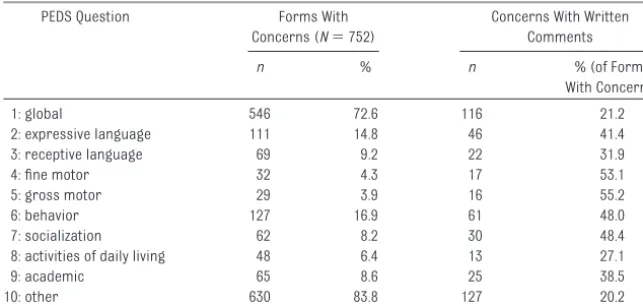
Table 1 summarizes the frequencies of the concerns (circled or written) and presence of written comments for each question. Ninety percent of the parents endorsed a concern (“yes” or “a little”) in response to at least 1 ques-tion, primarily questions 1 (global con-cerns) and 10 (other concern). Par-ents qualified 27.5% of their concerns across all questions with a written comment, most frequently for
con-cerns about motor skills, behaviors, and socialization.
Of parents who completed the forms in English, 94.6% indicated a concern on at least 1 question, compared with 69.6% of parents who completed the
forms in Spanish (2 ⫽ 78.64; P ⬍ .001) (Table 2). English forms also showed significantly more concerns, on average, than Spanish forms (2.4 vs 1.6;t749⫽5.5;P⬍.001). Concern rates were significantly higher on the En-glish forms for questions 1, 4, 8, and 10. Parents who completed the forms in English or Spanish were equally likely to qualify their concerns with
written comments, although those who completed the forms in English were more likely to provide a written comment about a behavioral concern, and parents who filled out the forms in
Concerns (N⫽752) Comments
n % n % (of Forms With Concerns) 1: global 546 72.6 116 21.2 2: expressive language 111 14.8 46 41.4 3: receptive language 69 9.2 22 31.9 4: fine motor 32 4.3 17 53.1 5: gross motor 29 3.9 16 55.2 6: behavior 127 16.9 61 48.0 7: socialization 62 8.2 30 48.4 8: activities of daily living 48 6.4 13 27.1 9: academic 65 8.6 25 38.5 10: other 630 83.8 127 20.2
TABLE 2 Number of PEDS Forms With 1 or More Concerns, According to Language PEDS Question English Forms With
Concerns (N⫽613)
Spanish Forms With Concerns (N⫽138)
Pa
n % n %
1: global 464 75.8 81 59.1 ⬍.001 2: expressive language 93 15.6 18 13.1 .47 3: receptive language 59 9.7 10 7.3 .38 4: fine motor 32 5.2 0 0.0 .006 5: gross motor 26 4.3 3 2.2 .26 6: behavior 108 17.9 19 13.9 .26 7: socialization 53 8.8 9 6.6 .40 8: activities of daily living 46 7.6 2 1.5 .008 9: academic 57 10.0 8 6.0 .14 10: other 559 91.2 70 50.7 ⬍.001
Spanish were more likely to offer writ-ten comments about an “other” con-cern (Table 3).
Types of Comments
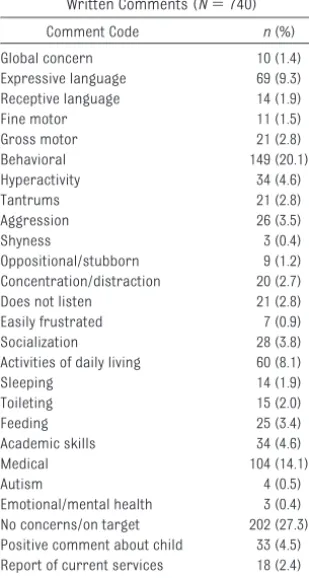
Parents provided a total of 740 com-ments on the PEDS forms. Table 4 sum-marizes the content of parent com-ments. More than half of all comments
addressed concerns about the child’s expressive language, behavior, activi-ties of daily living, or medical issues. More than one-fourth of the comments were in response to PEDS questions to which parents had responded by indi-cating no concern; in these cases, the parents used the comment field to re-inforce that they had “no concerns” or state that their child was “fine.”
Question-Comment Mismatch
We evaluated how often parents con-veyed a concern about 1 area of devel-opment in response to a question in-tended to elicit concerns about another area of development. Of com-ments made in response to questions 2 through 9, 23.9% did not match the
question’s intent (Table 5). For exam-ple, parents provided comments on be-havioral issues in responses to ques-tions about their child’s fine or gross motor skills:
“I have been told that he can’t keep his fingers out of his mouth.” (parent com-ment on question 4 [fine motor skills is-sues] about a 6-month-old)
“She hits a bit and scratches all the time.” (parent comment on question 5 [gross motor skills issues] about a 2-year-old)
The rate of mismatch between com-ments and question intent was equal for the English and Spanish forms. The 55 known mismatches were in only 45 (6%) of all forms. On the English forms, 6.7% contained at least 1 mismatch compared with 2.9% on the Spanish forms, although this difference was not significant (2⫽2.2;P⫽.11).
For 6 of the mismatches, the question represented a nonpredictive concern for that child’s age but the text of the parent’s comment indicated that there was actually a predictive concern. For example, in response to question 6 about behavioral concerns, which are nonpredictive, a parent expressed an academic concern, which is predictive:
“He can’t read just yet when you read to him he seems to not care less about what you’re reading.” (about an 8-year-old)
In 21 of the mismatch cases, the oppo-site occurred: the question was
de-TABLE 3 Number of Concerns With Written Comments, According to Language PEDS Question Concerns With
Written Comments on English forms
Concerns With Written Comments
on Spanish forms
Pa
n %b n %b
1: global 98 21.1 17 21.0 .98 2: expressive language 41 44.1 5 27.8 .20 3: receptive language 21 35.6 1 10.0 .11 4: fine motor 17 53.1 — — — 5: gross motor 13 50.0 3 100 .10 6: behavior 58 53.7 3 15.8 .002 7: socialization 28 52.8 2 22.2 .09 8: activities of daily living 13 28.3 0 0.0 .38 9: academic 24 42.1 1 12.5 .11 10: other 93 16.6 24 34.3 ⬍.001
— indicates not applicable.
aBased on2analysis or Fisher’s exact test.
bPercentage out of forms where there was a concern (see Table 2 for denominators).
TABLE 4 Qualitative Coding of Parents’ Written Comments (N⫽740) Comment Code n(%) Global concern 10 (1.4) Expressive language 69 (9.3) Receptive language 14 (1.9) Fine motor 11 (1.5) Gross motor 21 (2.8) Behavioral 149 (20.1) Hyperactivity 34 (4.6) Tantrums 21 (2.8) Aggression 26 (3.5) Shyness 3 (0.4) Oppositional/stubborn 9 (1.2) Concentration/distraction 20 (2.7) Does not listen 21 (2.8) Easily frustrated 7 (0.9) Socialization 28 (3.8) Activities of daily living 60 (8.1) Sleeping 14 (1.9) Toileting 15 (2.0) Feeding 25 (3.4) Academic skills 34 (4.6) Medical 104 (14.1) Autism 4 (0.5) Emotional/mental health 3 (0.4) No concerns/on target 202 (27.3) Positive comment about child 33 (4.5) Report of current services 18 (2.4) Telling a story about child 25 (3.4)
TABLE 5 Mismatches Between Written Comments and Content of Question, According to Language PEDS Question Total Forms
With Mismatches English Forms With Mismatches Spanish Forms With Mismatches Pa
n %b n %b n %b
2: expressive language 3 6.5 3 8.6 0 0.0 .49 3: receptive language 10 45.5 9 50.0 1 100.0 .33 4: fine motor 11 64.7 11 64.7 — — — 5: gross motor 1 6.3 1 11.1 0 0.0 .49 6: behavior 7 11.5 6 10.3 1 33.3 .22 7: socialization 12 40.0 11 42.3 1 50.0 .83 8: activities of daily living 4 30.8 4 30.8 — — — 9: academic 7 28.0 6 33.3 1 100.0 .18 Total 55 23.9 51 23.7 4 26.7 —
— indicates not applicable.
aBased on2analysis or Fisher’s exact test.
bPercentage out of forms where there was a concern and a written comment (see Tables 1 and 3 for denominators).
nonpredictive concern. For example, in response to question 3 about receptive language concerns, which are
predic-tive, the parent expressed a behavioral concern that is nonpredictive:
“I tell him not to do something and he seems to forget what I say and does it again.” (about a 5-year-old)
Developmentally Inappropriate Concerns
In many cases, parent comments indi-cated a misunderstanding of typical development for age. In particular, 12% of all behavioral concerns seemed
to be developmentally inappropriate, and the parents indicated that they ex-pected their child to display skills be-yond his or her age or developmental level. For example:
“Crying a lot before going to sleep.” (about a 6-month-old)
“She’s bad.” (about a 12-month-old) “She does not know how to play with other children.” (about an 18-month-old)
Medical Concerns
The PEDS was designed to capture de-velopmental and behavioral concerns, but 14.1% of all comments addressed medical concerns, most commonly in response to question 1 (global cerns) or question 10 (other
con-cerns). Medical concerns were more commonly expressed on the English forms (61.3%) than on the Spanish forms (41.7%) (2⫽3.0;P⬍.08). The most common medical concerns were about orthopedic issues (eg, “prob-lems with legs”), rashes, and coughs.
Feedback
Some parents used the PEDS form to share additional information about
their child, such as a positive de-scription of the child, a story about the child’s developmental achieve-ments, or information on the child’s current service use. Overall, 10.3% of
“No concerns, very intelligent child. She amazes us everyday.” (positive state-ment about a 4-year-old child) “She say ‘ta,’ ‘a.’ She wants to walk. She holds her bottle. She sits up by herself. She love to grab things.” (story about developmental achievements of a 6-month-old)
“Early intervention has come to the house twice for an evaluation.” (current service use)
“She has been diagnosed with autism. She is currently in Early Childhood Pro-gram.” (about a 4-year-old)
DISCUSSION
Although the American Academy of Pediatrics recommends routine screening for effective, early, and universal identification of young chil-dren who would benefit most from timely interventions, little is known about the additional impact of rou-tine screening on primary care. Re-sults of our analyses confirmed that a substantial portion of PEDS forms include information that is poten-tially useful to providers, beyond the identification of risks of developmen-tal and behavioral concerns. We found that when practices use the PEDS appropriately, they can collect a wealth of information beyond the development realm, including poten-tial medical concerns and parent misunderstandings of normal child development.
To use the PEDS questionnaire appro-priately, providers must discuss re-ported concerns with parents. Mis-matches between question intent and actual parent concern can occur as well as parent misunderstanding of what is developmentally appropriate for their child. In our study, only a few mismatched written comments would have changed the risk category indi-cated by the PEDS score, but all of the mismatches could provide important opportunities to engage with parents who need education on developmental
mon than our results showed, because the mismatches we identified were based only on what parents had writ-ten; conversations with parents might identify even more concerns that par-ents had incorrectly identified as being relevant to a given PEDS question. Pro-viders may be able to use parents’ comments as a framework for guiding additional dialogue. Developmentally inappropriate concerns may afford an opportunity to learn about parents’ un-derstanding of child development and adjust this understanding. Improving parent knowledge of child develop-ment could not only improve the parent-child relationship but also pre-vent misdiagnoses.13
The 90% of PEDS forms in our study with at least 1 concern endorsed as “a little” or “yes” was higher than the 56.7% rate in the PEDS-standardization study.9A possible explanation could be that providers were more likely to in-clude completed PEDS forms in medi-cal records when parents endorsed concerns and to discard forms with no endorsed concerns. Alternatively, these differences could reflect dif-ferent demographic characteristics: 74.6% of our patients were black or Latino, whereas only 35.5% of pa-tients in the standardization group were black or Hispanic/other.
dif-ferent levels of comfort in communi-cating with medical personnel about what they might perceive as nonmedi-cal information.
The different patterns we found in written comments on the English and Spanish forms were similar to some of those found in the PEDS-standardization study.9As in our study, the standardization study revealed that Hispanic parents were less likely than white and black parents to be concerned about self-help but more likely to be concerned about medical status.9The authors of previous stud-ies have described differences in ma-ternal developmental expectations among different cultural groups and the importance of cultural context when talking with parents,14–16 which reinforces the importance of provider cultural competency in interpreting screening tool results to ensure that dialogue with parents is reciprocal, re-spectful, and responsive and to estab-lish a context for further discussion.
Perhaps most intriguing are the “med-ical” or “feedback” comments, which provide information about parents’ medical concerns, current services that the children are receiving,
diag-noses from other providers, or posi-tive assessments of the children’s functioning. In previous work, our group showed that after our practices implemented developmental screen-ing, parents reported talking to the provider about their concerns more often and being more likely to receive answers to their concerns than before screening became routine.3 The com-ment structure of the PEDS may em-power parents to communicate unso-licited comments to their child’s medical provider,9and the opportunity to convey neutral or positive informa-tion could enhance the parent-provider relationship by contributing to a strength-based, rather than a deficit-based, model of care.
CONCLUSIONS
Our study results show that parents frequently use the PEDS to communi-cate concerns beyond those regarding their child’s development, such as medical concerns, or to provide posi-tive feedback on their child’s progress. The comments revealed that some par-ents have inappropriate developmen-tal expectations or limited health liter-acy that providers should address in their discussions with these parents.
Our results provide confirmation that screening tools can enhance, but should not replace, patient-provider communication. The variety of topics covered in parents’ comments can provide a framework for discussion throughout the WCV, enable health care providers and parents to use WCV time more efficiently, and enhance the partnership between parents and providers.
It is unclear whether other develop-mental and behavioral screeners re-veal similar supplemental information on children and parents. Future stud-ies should examine whether screeners with questions about specific skills, rather than open-ended inquiries about concerns, have the same poten-tial to facilitate conversation between parents and providers. In addition, re-searchers should evaluate the influ-ence of parent health literacy on the written feedback provided in response to developmental and behavioral screener questions.
ACKNOWLEDGMENTS
This work was supported by NIDRR. We thank the staff and patients of CHPCC and MEHC.
REFERENCES
1. American Academy of Pediatrics, Council on Children With Disabilities, Section on Devel-opmental Behavioral Pediatrics; Bright Fu-tures Steering Committee; Medical Home Initiatives for Children With Special Needs Project Advisory Committee. Identifying in-fants and young children with developmen-tal disorders in the medical home: an algo-rithm for developmental surveillance and screening [published correction appears in
Pediatrics. 2006;118(4):1808 –1809]. Pediat-rics. 2006;118(1):405– 420
2. Schonwald A, Hungtington N, Chaln E, Risko W, Bridgemohan C. Routine developmental screening implemented in urban primary care settings: more evidence of feasibility and effectiveness.Pediatrics. 2009;123(2): 660 – 668
3. Schonwald A, Horan K, Huntington N. De-velopmental screening: is there enough
time? Clin Pediatr (Phila). 2009;48(6): 648 – 655
4. Hix-Small H, Marks K, Squires J, Nichel R. Impact of implementing developmental screening at 12 and 24 months in a pediat-ric practice. Pediatrics. 2007;120(2): 381–389
5. Rydz D, Srour M, Oskoui M, et al. Screening for developmental delay in the setting of a community pediatric clinic: a prospective assessment of parent-report question-naires.Pediatrics. 2006;118(4). Available at: www.pediatrics.org/cgi/content/full/118/ 4/e1178
6. Glascoe FP. Screening for developmental and behavioral problems.Ment Retard Dev Disabil Res Rev. 2005;11(3):173–179 7. Glascoe FP.Parents’ Evaluations of
Develop-mental Status: A Method for Detecting and Addressing Developmental and Behavioral
Problems in Children. Nashville, TN: Ells-worth & Vandermeer Press; 2006 8. Glascoe FP. If you don’t ask, parents may not
tell: noticing problems vs. expressing con-cerns. Arch Pediatr Adolesc Med. 2006; 160(2):220 –221
9. Glascoe FP.Collaborating With Parents: Us-ing Parents’ Evaluations of Developmental Status to Detect and Address Developmen-tal and Behavioral Problems in Children. Nashville, TN: Ellsworth & Vandermeer Press; 2006
10. Glascoe FP. Early detection of developmen-tal and behavioral problems.Pediatr Rev. 2000;21(8):272–279
11. Strauss AL, Corbin JM.Basics of Qualitative Research: Grounded Theory Procedures and Techniques. Newbury Park, CA: Sage Publications; 1990
12. Jones J, Hunter D. Qualitative research:
376 –380
13. Williams M, Davis T, Parker R, Weiss B. The role of health literacy in patient-physician communication. Fam Med. 2002;34(5): 383–389
cultural dynamics and family issues.Infants Young Child. 1999;12(1):24 – 42
15. Bornstein MH, Cote LR. Who is sitting across from me? Immigrant mothers’ knowledge of parenting and children’s
de-full/225/5/e557
DOI: 10.1542/peds.2010-1466M
2010;126;S170
Pediatrics
Alison D. Schonwald
Joanne E. Cox, Noelle Huntington, Adrianna Saada, Alexandra Epee-Bounya and
Dimension to the Parents' Evaluation of Developmental Status Questionnaire
Developmental Screening and Parents' Written Comments: An Added
Services
Updated Information &
http://pediatrics.aappublications.org/content/126/Supplement_3/S170
including high resolution figures, can be found at:
References
#BIBL
http://pediatrics.aappublications.org/content/126/Supplement_3/S170
This article cites 11 articles, 5 of which you can access for free at:
Subspecialty Collections
al_issues_sub
http://www.aappublications.org/cgi/collection/development:behavior
Developmental/Behavioral Pediatrics following collection(s):
This article, along with others on similar topics, appears in the
Permissions & Licensing
http://www.aappublications.org/site/misc/Permissions.xhtml
in its entirety can be found online at:
Information about reproducing this article in parts (figures, tables) or
Reprints
http://www.aappublications.org/site/misc/reprints.xhtml
DOI: 10.1542/peds.2010-1466M
2010;126;S170
Pediatrics
Alison D. Schonwald
Joanne E. Cox, Noelle Huntington, Adrianna Saada, Alexandra Epee-Bounya and
http://pediatrics.aappublications.org/content/126/Supplement_3/S170
located on the World Wide Web at:
The online version of this article, along with updated information and services, is
by the American Academy of Pediatrics. All rights reserved. Print ISSN: 1073-0397.