ARTICLE
Bronchopulmonary Dysplasia in Very Low Birth
Weight Subjects and Lung Function in
Late Adolescence
Lex W. Doyle, MD, FRACPa,b,c, Brenda Faber, RNc, Catherine Callanan, RNc, Nicholas Freezer, MD, FRACPd, Geoffrey W. Ford, FRACPc, Noni M. Davis, FRACPc
Departments ofaObstetrics and Gynecology andbPediatrics, University of Melbourne, Melbourne, Australia;cDivision of Newborn Services, Royal Women’s Hospital,
Melbourne, Australia; anddDepartment of Respiratory Medicine, Royal Children’s Hospital, Melbourne, Australia
The authors have indicated they have no financial relationships relevant to this article to disclose.
ABSTRACT
OBJECTIVES.The purpose of this work was to determine the relationship between lung function in late adolescence and bronchopulmonary dysplasia, to establish whether lung function changed more from earlier in childhood in those with bronchopulmonary dysplasia, and to assess the effect of different definitions of bronchopulmonary dysplasia on respiratory outcome.
METHODS.Subjects were composed of 147 survivors of birth weight⬍1500 g from the Royal Women’s Hospital (Melbourne, Australia) born during 1977–1982 and who had lung function tests at a mean age of 18.9 years. Of the 147 subjects, 33 (22%) had bronchopulmonary dysplasia in the newborn period. Lung function was measured according to American Thoracic Society guidelines.
RESULTS.All of the lung function variables reflecting airflow were substantially diminished in the bronchopulmonary dysplasia group, but lung volumes were not significantly different. More subjects in the bronchopulmonary dysplasia group had reductions in airflow in the clinically significant range (eg, forced expired volume in 1 second/forced vital capacity ratio⬍75%; bronchopulmonary dyspla-sia: 42.4% [14 of 33]; and no bronchopulmonary dyspladyspla-sia: 16.4% [18/114]). Results were not substantially affected after adjustment for confounding variables, including intrauterine growth restriction or birth weight. Compared with earlier in childhood, the forced expired volume in 1 second/forced vital capacity ratio deteriorated more in bronchopulmonary dysplasia subjects between 8 and 18 years. Lung function results varied little with different definitions of bronchopul-monary dysplasia.
CONCLUSIONS.Subjects of very low birth weight with bronchopulmonary dysplasia in the newborn period have poorer lung function in late adolescence than those without bronchopulmonary dysplasia, and their lung function may be deteriorat-ing at a more rapid rate.
www.pediatrics.org/cgi/doi/10.1542/ peds.2005-2522
doi:10.1542/peds.2005-2522
Key Words
bronchopulmonary dysplasia, very low birth weight, lung function, adolescence
Abbreviations
VLBW—very low birth weight BPD— bronchopulmonary dysplasia NBW—normal birth weight
FEV1—forced expired volume in 1 second
V⬘EMAX75%—flow rate at 75% of vital
capacity
V⬘EMAX50%—flow rate at 50% of vital
capacity
V⬘EMAX25%—flow rate at 25% of vital
capacity
FEF25–75%—forced midexpiratory flow
FVC—forced expiratory vital capacity TLC—total lung capacity RV—residual volume CI— confidence interval
Accepted for publication Jan 3, 2006
Address correspondence to Lex W. Doyle, Department of Obstetrics and Gynecology, The Royal Women’s Hospital, 132 Grattan St, Carlton 3053, Australia. E-mail: lwd@unimelb. edu.au
V
ERY LOW BIRTH weight ([VLBW] birth weight ⱕ1500 g) infants comprise⬃10 to 15 per 1000 live births, and survival rates now exceed 80%. However, to survive the neonatal period, many require prolonged periods of assisted ventilation or oxygen therapy, both of which can injure the lung, causing bronchopulmonary dysplasia (BPD).1 BPD has been described in ⱕ40% ofVLBW survivors, and the rate rises as the birth weight falls below 1500 g.2 Hence, the prevalence of VLBW
survivors with BPD reaching adulthood is approaching 3 to 4 per 1000, a prevalence greater than that for many childhood diseases known to affect the respiratory sys-tem, such as cystic fibrosis.
Northway et al3reported respiratory function
abnor-malities, including airway obstruction, in early adult-hood in 26 survivors with BPD; however, few in that study were of VLBW. Halvorsen et al4assessed 46
sur-vivors of birth weight⬍1001 g or⬍29 weeks’ gestation at a mean age of 17.7 years; those with BPD also had airway obstruction. There are reports of improving lung function in survivors with BPD as they grow older in early childhood5but not in all studies.6,7
There are different definitions of BPD, ranging from oxygen dependency at 28 days8to oxygen dependency
at 36 weeks’ corrected age9to those with Northway stage
3 or 4 changes.10The effect of differing definitions on the
results of lung function tests is unknown.
The aims of this study were to determine the relation-ship between lung function tests atⱖ18 years of age and BPD to determine whether changes in lung function were more evident with increasing age and to assess the effect of different definitions of BPD on lung function results.
METHODS
Subjects were composed of 147 VLBW survivors from the Royal Women’s Hospital (Melbourne, Australia) who had lung function tests atⱖ18 years of age; 63 had birth weights 500 to 999 g and were derived from 86 consecutive survivors born between 1977 and March 1982; 84 had birth weights between 1000 and 1500 g and were derived from 124 consecutive survivors born between October 1980 and March 1982. Some of these VLBW subjects had been assessed at ages 2, 5, 8, 11, and 14 years as part of a prospective longitudinal research study of the outcomes of VLBW survivors, including lung function at ages 8,11 11,6and 1412 years in some
subjects. Of the 147 subjects, 33 (22%) had BPD in the newborn period. We also assessed lung function in 37 normal birth weight ([NBW] birth weight ⬎2499 g) control subjects, derived from 60 who had been ran-domly selected at birth; the NBW controls previously had lung function tests only at 14 years old.12
Birth weight SD scores were calculated relative to the British Growth reference.13At the time of birth of these
subjects, exogenous surfactant and high frequency
oscil-latory ventilation were unavailable. No infant was treated with postnatal corticosteroids in the newborn period. The Royal Women’s Hospital is the largest of the 3 level-III perinatal centers in the state of Victoria, Aus-tralia, caring for ⬃45% of survivors of birth weight
⬍1000 g in the state. The majority of VLBW infants are inborn, their mothers coming from all over the state.
The criteria we used for BPD have been described11
and included infants who had required assisted ventila-tion, who had respiratory distress and were still in oxy-gen at 28 days of age, and who had an abnormal chest radiograph at or after 28 days consistent with Northway stage 3 or 4 BPD.10We also used the less severe criterion
of requiring oxygen at 28 days and the stricter criterion of requiring oxygen at a postmenstrual age of 36 weeks. Subjects were assessed in late adolescence (ⱖ18 years) by a research nurse who obtained a clinical his-tory, including a history of smoking, and measured their height with a stadiometer. Height and weight SD scores, a reflection of growth relative to expected values of 0 for age and gender, were calculated relative to the British Growth reference.13 Subjects requiring bronchodilators
within the previous year for wheezing were considered to have asthma.
The American Thoracic Society guidelines were used to perform the tests of pulmonary function. Respiratory technicians were blinded to clinical details of the sub-jects. Variables reflecting airflow measured were: forced expired volume in 1 second (FEV1); expiratory flow
at 75% (V⬘EMAX75%), 50% (V⬘EMAX50%), and 25%
(V⬘EMAX25%) of vital capacity; and forced midexpiratory
flow (FEF25–75%). Lung volumes included: forced vital
capacity (FVC), total lung capacity (TLC), and residual volume (RV). Results at body temperature and pressure saturated with water vapor were expressed as a percent-age predicted for percent-age, height, and gender relative to results from Australian subjects aged from 8 to 19 years free of lung disease.14Not all of the subjects could
com-plete all of the lung function tests because of either poor cooperation or unavailability or malfunction of equip-ment on the day of testing. Some of the subjects had lung function tests at 8 years of age, as described previ-ously,11 and the results expressed relative to the same
normative Australian data.14 The change in lung
func-tion between age 8 and ⱖ18 years was calculated for each subject with data at both ages. Because a few sub-jects were ⬎19 years of age, we also calculated lung function values relative to height and gender from an-other source15and recomputed all of the results.
All of the subjects gave written, informed consent to participate in the study, which was approved by the Research and Ethics Committees of the Royal Women’s Hospital. Data were edited and analyzed using SPSS for Windows programs.16Dichotomous variables were
con-trasted by2analysis and continuous variables by
also analyzed by linear regression to adjust for con-founding variables of birth weight, gestational age, birth weight SD score, and active smoking. Mean differences and 95% confidence intervals (CI) were calculated from thettests or regression analyses, where appropriate.
RESULTS
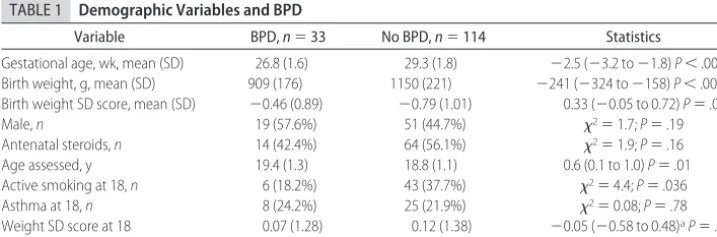
The mean age of the 147 subjects at the time of lung function testing was 18.9 (SD 1.1) years, corrected for prematurity; 26 (18%) were aged⬎19 years. Of the 147 subjects, 129 (88%) also had lung function tests at 8 years of age. The mean gestational age and birth weight and the rate of active smoking at 18 years of age were all significantly lower in BPD subjects, and the age at which they were assessed was significantly higher, but there were no significant differences in birth weight SD scores, gender, rate of asthma at 18 years of age, or weight or height SD scores at 18 years of age (Table 1). The 37 NBW controls had mean a birth weight of 3504 (SD 496) g, and mean gestational age of 40.0 (SD 1.2) weeks; 8% (3 of 37) had asthma, and 22% (8 of 37) were smokers. Most subjects in the non-BPD VLBW group had nor-mal lung function tests, with mean values within the ranges expected (Table 2). However, many lung function variables reflecting airflow were substantially lower in VLBW subjects with BPD compared with those who did not have BPD. Birth weight, gestational age, birth weight SD score and active smoking had little effect on any respiratory function variable; adjustment for these variables had little effect on the mean differences and 95% CIs and did not alter any statistical conclusions (Table 2). In addition to reductions in mean values, more VLBW subjects with BPD had lung function abnormali-ties indicating airway obstruction in clinically important ranges (FEV1⬍75% predicted [BPD, 10 of 33 {30.3%};
no BPD, 9 of 114 {7.9%};2⫽11.4;P ⫽.001]; FEV 1/
FVC⬍75% [BPD, 14 of 33 {42.4%}; no BPD, 18 of 114 {15.8%};2⫽10.7;P⫽0.001]).
Compared with NBW controls, VLBW subjects with-out BPD had substantially reduced variables reflecting flow (eg, FEV1, % predicted; NBW 99.4 [SD 9.5], VLBW
non-BPD 94.4 [12.7], mean difference ⫺5.0 [95% CI:
⫺9.4 to⫺0.5; P⫽.03]; FEV1/FVC, %; NBW 88.7 [SD
6.7], VLBW non-BPD 83.2 [9.4], mean difference⫺5.5 [95% CI:⫺8.8 to⫺2.1;P⫽.001]). If respiratory func-tion variables at ⱖ18 years were computed relative to the alternative reference data,15 results were virtually
identical, and no statistical conclusions were altered (data not shown).
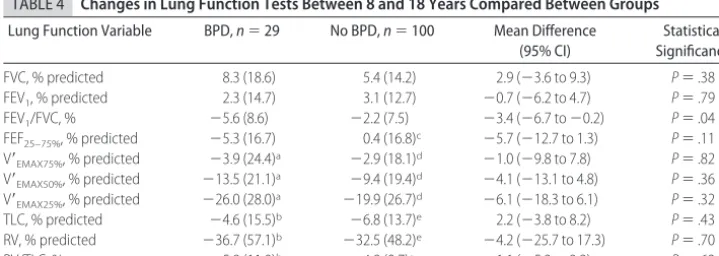
Lung function data at 8 years of age for the 129 VLBW subjects with data at both ages are shown in Table 3. Most variables reflecting flow were significantly lower in those who had BPD. Compared with lung function vari-ables measured at 8 years, the only variable with a statistically significant difference over time in BPD sub-jects was a larger fall in the FEV1/FVC ratio between 8
and 18 years of age (Table 4). Active smoking was asso-ciated with a statistically significant reduction in the FEV1/FVC ratio between 8 and 18 years of age (mean
difference:⫺4.8%; 95% CI:⫺7.5 to⫺2.1). Birth weight SD score was associated with a significant increase in the FEV1/FVC ratio between 8 and 18 years (mean
differ-ence per 1 SD increase in birth weight SD score: 1.8; 95% CI: 0.5 to 3.1). Adjusting for these variables aug-mented the statistical significance of the difference in the reduction in the FEV1/FVC ratio between BPD and
non-BPD subjects (adjusted mean difference:⫺4.8; 95% CI:
⫺7.9 to⫺1.7). Gender, birth weight, and gestational age were not significantly associated with the change in the FEV1/FVC ratio between 8 and 18 years of age.
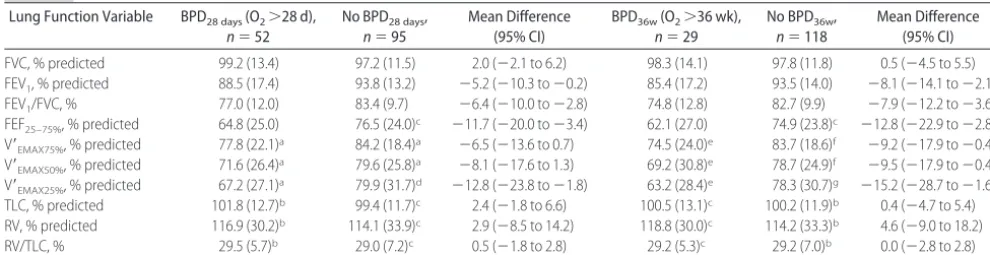
With the less strict criterion to define BPD of only needing oxygen ⬎28 days after birth, there were 55 subjects, and with a more severe definition for BPD of needing oxygen at 36 weeks’ postmenstrual age, there were 29 subjects. Almost no statistical conclusions were altered concerning the differences in lung function vari-ables between BPD and non-BPD subjects with either of these definitions, the only exceptions being V⬘EMAX75%
and V⬘EMAX50%(Table 5).
DISCUSSION
A major finding from our study is that overall lung function of VLBW survivors without BPD is within the reference range at 18 years old, although there are some
TABLE 1 Demographic Variables and BPD
Variable BPD,n⫽33 No BPD,n⫽114 Statistics
Gestational age, wk, mean (SD) 26.8 (1.6) 29.3 (1.8) ⫺2.5 (⫺3.2 to⫺1.8)P⬍.001a
Birth weight, g, mean (SD) 909 (176) 1150 (221) ⫺241 (⫺324 to⫺158)P⬍.001a
Birth weight SD score, mean (SD) ⫺0.46 (0.89) ⫺0.79 (1.01) 0.33 (⫺0.05 to 0.72)P⫽.09a
Male,n 19 (57.6%) 51 (44.7%) 2⫽1.7;P⫽.19
Antenatal steroids,n 14 (42.4%) 64 (56.1%) 2⫽1.9;P⫽.16
Age assessed, y 19.4 (1.3) 18.8 (1.1) 0.6 (0.1 to 1.0)P⫽.01 Active smoking at 18,n 6 (18.2%) 43 (37.7%) 2⫽4.4;P⫽.036
Asthma at 18,n 8 (24.2%) 25 (21.9%) 2⫽0.08;P⫽.78
Weight SD score at 18 0.07 (1.28) 0.12 (1.38) ⫺0.05 (⫺0.58 to 0.48)aP⫽.86
Height SD score at 18 ⫺0.48 (0.97) ⫺0.35 (1.17) ⫺0.13 (⫺0.57 to 0.31)aP⫽.55
reductions in variables reflecting flow compared with NBW controls. However, VLBW survivors with BPD have substantial reductions in variables reflecting
ob-structive airways disease, and there are more with clin-ically important reductions in airflow than in VLBW subjects without BPD. Moreover, there has been a
sig-TABLE 2 Lung Function Tests Compared Between Groups at Age>18 Years
Lung Function Variable BPD,n⫽33 No BPD,n⫽114 Mean Difference (95% CI);P
Adjusted Mean Difference (95% CI)f
FVC, % predicted 98.4 (14.9) 100.1 (11.9) ⫺1.7 (⫺6.6 to 3.2);P⫽.50 ⫺2.0 (⫺7.6 to 3.7);P⫽.49 FEV1, % predicted 81.6 (18.7) 92.9 (12.8) ⫺11.3 (⫺16.9 to⫺5.7);P⬍.001 ⫺10.0 (⫺16.6 to⫺3.3);P⫽.004
FEV1/FVC, % 73.9 (12.9) 83.2 (9.4) ⫺9.3 (⫺13.3 to⫺5.2);P⬍.001 ⫺8.3 (⫺13.0 to⫺3.5);P⫽.001
FEF25–75%, % predicted 57.5 (25.7) 75.8 (22.9)b ⫺18.3 (⫺27.5 to⫺9.1);P⬍.001 ⫺17.8 (⫺28.9 to⫺6.7);P⫽.002
V⬘EMAX75%, % predicted 76.4 (26.0)a 89.2 (19.2)c ⫺12.8 (⫺21.7 to⫺4.0);P⫽.005 ⫺14.2 (⫺24.4 to⫺4.0);P⫽.007
V⬘EMAX50%, % predicted 68.9 (29.5)a 85.7 (26.8)c ⫺16.9 (⫺28.5 to⫺5.2);P⫽.005 ⫺18.3 (⫺32.0 to⫺4.7);P⫽.009
V⬘EMAX25%, % predicted 60.2 (27.8)a 78.0 (30.4)d ⫺17.8 (⫺30.6 to⫺5.1);P⫽.006 ⫺18.9 (⫺33.7 to⫺4.1);P⫽.013
TLC, % predicted 99.4 (14.7)b 96.8 (12.4)e 2.6 (⫺2.5 to 7.7);P⫽.32 2.5 (⫺3.3 to 8.3);P⫽.39
RV, % predicted 108.7 (30.1)b 100.4 (31.2)e 8.3 (⫺4.0 to 20.6);P⫽.18 7.4 (⫺7.1 to 22.1);P⫽.31
RV/TLC, % 30.4 (6.3)b 28.8 (6.8)e 1.6 (⫺1.1 to 4.2);P⫽.24 0.8 (⫺2.4 to 4.0);P⫽.61
Data are mean (SD), unless otherwise specified.
an⫽6 missing data. bn⫽1 missing data. cn⫽8 missing data. dn⫽9 missing data. en⫽2 missing data.
fAdjusted for birth weight, gestational age, birth weight SD score, and active smoking.
TABLE 3 Lung Function Tests Compared Between Groups at Age 8 Years
Lung Function Variable BPD,n⫽29 No BPD,n⫽100 Mean Difference (95% CI)P
FVC, % predicted 88.7 (16.2) 95.2 (14.6) ⫺6.6 (⫺12.8 to⫺0.3);P⫽.039 FEV1, % predicted 80.4 (15.9) 90.0 (14.4) ⫺9.6 (⫺15.7 to⫺3.4);P⫽.002
FEV1/FVC, % 81.8 (10.8) 85.1 (8.3) ⫺3.3 (⫺7.0 to 0.4);P⫽.08
FEF25–75%, % predicted 65.4 (27.2) 75.3 (21.1)a ⫺9.9 (⫺19.4 to⫺0.5);P⫽.04
V⬘EMAX75%, % predicted 81.8 (21.7)a 92.0 (21.7)b ⫺10.1 (⫺19.3 to⫺0.9);P⫽.031
V⬘EMAX50%, % predicted 81.4 (30.4)a 93.9 (25.7)b ⫺12.5 (⫺23.9 to⫺1.1);P⫽.032
V⬘EMAX25%, % predicted 83.8 (40.9)a 96.0 (32.2)b ⫺12.2 (⫺26.8 to 2.3);P⫽.10
TLC, % predicted 101.8 (12.3) 104.2 (12.7)c ⫺2.4 (⫺7.7 to 2.4);P⫽.38
RV, % predicted 145.2 (53.3) 132.4 (39.0)c 12.9 (⫺5.1 to 30.9);P⫽.16
RV/TLC, % 37.3 (11.1) 33.4 (8.6)c 3.9 (0.1 to 7.8);P⫽.046
Data are mean (SD), unless otherwise specified.
an⫽1 missing data. bn⫽2 missing data. cn⫽7 missing data.
TABLE 4 Changes in Lung Function Tests Between 8 and 18 Years Compared Between Groups Lung Function Variable BPD,n⫽29 No BPD,n⫽100 Mean Difference
(95% CI)
Statistical Significance
FVC, % predicted 8.3 (18.6) 5.4 (14.2) 2.9 (⫺3.6 to 9.3) P⫽.38 FEV1, % predicted 2.3 (14.7) 3.1 (12.7) ⫺0.7 (⫺6.2 to 4.7) P⫽.79
FEV1/FVC, % ⫺5.6 (8.6) ⫺2.2 (7.5) ⫺3.4 (⫺6.7 to⫺0.2) P⫽.04
FEF25–75%, % predicted ⫺5.3 (16.7) 0.4 (16.8)c ⫺5.7 (⫺12.7 to 1.3) P⫽.11
V⬘EMAX75%, % predicted ⫺3.9 (24.4)a ⫺2.9 (18.1)d ⫺1.0 (⫺9.8 to 7.8) P⫽.82
V⬘EMAX50%, % predicted ⫺13.5 (21.1)a ⫺9.4 (19.4)d ⫺4.1 (⫺13.1 to 4.8) P⫽.36
V⬘EMAX25%, % predicted ⫺26.0 (28.0)a ⫺19.9 (26.7)d ⫺6.1 (⫺18.3 to 6.1) P⫽.32
TLC, % predicted ⫺4.6 (15.5)b ⫺6.8 (13.7)e 2.2 (⫺3.8 to 8.2) P⫽.43
RV, % predicted ⫺36.7 (57.1)b ⫺32.5 (48.2)e ⫺4.2 (⫺25.7 to 17.3) P⫽.70
RV/TLC, % ⫺5.8 (11.0)b ⫺4.8 (9.7)e ⫺1.1 (⫺5.3 to 3.2) P⫽.62
Data are mean (SD), unless otherwise specified.
nificantly greater reduction in the FEV1/FVC ratio
be-tween early childhood and late adolescence in our BPD subjects.
There are various definitions of BPD. We have fol-lowed the original definition of Northway et al,10partly
so we could compare the lung function in early adult-hood of VLBW BPD survivors with their early report.3In
their study, subjects were assessed at a similar mean age (18.3 [SD 2.7] years) to our study. However, the subjects in their study with BPD were much heavier (mean birth weight: 1894 g) and more mature (mean gestational age: 33.2 weeks) at birth than in our study. Northway et al3
also found reductions in variables reflecting flow, but their results for mean FEV1, mean FEF25%–75%, and
V⬘EMAX50%were all lower than in our study.
In our study, using either the more lenient (⬎28 days) or stricter (⬎36 weeks) definitions did not sub-stantially alter the statistical differences in lung function between BPD and non-BPD subjects. We speculate that others would conclude similarly if they were to replicate our study. A major purpose in reporting results using different definitions of BPD is to facilitate comparisons with those using these different definitions who may subsequently measure lung function in late adolescence in VLBW survivors. In the only other study of which we are aware, apart from our own and that of Northway et al,3where the lung function of BPD survivors has been
determined into late adolescence, Halvorsen et al4
as-sessed 46 survivors of birth weight ⬍1001 g or ⬍29 weeks’ gestation at a mean age of 17.7 years. Of the 46 survivors, 10 had no BPD, 24 had mild BPD (required oxygen at 28 days), and 12 had moderate/severe BPD (required oxygen at 36 weeks’ postmenstrual age). The mean birth weights and gestational ages in their study were similar to those in the BPD and non-BPD groups in our study. Values for mean FEV1, FVC, V⬘EMAX75%,
V⬘EMAX50%, TLC, and RV were similar to those in our
study for the respective groups.
The strengths of our study are that we have been able to track the respiratory function of a consecutive cohort of VLBW subjects through childhood and that the ma-jority of subjects have been tested both early in child-hood as well as in late adolescence. This contrasts with some other studies that are more likely to be composed of convenience samples of BPD survivors or where fol-low-up is for a much shorter period. A weakness of our study is that we do not have lung function beyond lung volumes and flow rates. However, we deliberately did not submit our subjects to more strenuous exercise test-ing or bronchial challenge tests, because we wanted to reassess them many times as they grew older, and we were fearful that stressful testing would make them unlikely to return for additional assessments. That we have been able to retest the majority at ages 8 and 18 years suggests that our strategy has been successful so far. Another relative weakness is that the results precede surfactant therapy and postnatal corticosteroids, and the results may not apply to children born in nurseries to-day. However, our data will remain the best estimate of what might occur for tiny infants in today’s nurseries who reach late adolescence until replaced by more con-temporary data. They are certainly applicable to the VLBW survivors born the late 1970s and early 1980s. Another limitation is that although we augmented the number of BPD survivors by including subjects of birth weight⬍1000 g born over a longer period than those of birth weight 1000 to 1500 g, we still had relatively few subjects with BPD. It would also have been desirable to look for interactions between BPD and tobacco smoke, but the power to detect an augmented effect of tobacco smoke was limited by the observation that our BPD
TABLE 5 Lung Function Test Results at Age>18 Years Compared Between Groups With Differing Definitions of BPD
Lung Function Variable BPD28 days(O2⬎28 d), n⫽52
No BPD28 days, n⫽95
Mean Difference (95% CI)
BPD36w(O2⬎36 wk), n⫽29
No BPD36w, n⫽118
Mean Difference (95% CI)
FVC, % predicted 99.2 (13.4) 97.2 (11.5) 2.0 (⫺2.1 to 6.2) 98.3 (14.1) 97.8 (11.8) 0.5 (⫺4.5 to 5.5) FEV1, % predicted 88.5 (17.4) 93.8 (13.2) ⫺5.2 (⫺10.3 to⫺0.2) 85.4 (17.2) 93.5 (14.0) ⫺8.1 (⫺14.1 to⫺2.1)
FEV1/FVC, % 77.0 (12.0) 83.4 (9.7) ⫺6.4 (⫺10.0 to⫺2.8) 74.8 (12.8) 82.7 (9.9) ⫺7.9 (⫺12.2 to⫺3.6)
FEF25–75%, % predicted 64.8 (25.0) 76.5 (24.0)c ⫺11.7 (⫺20.0 to⫺3.4) 62.1 (27.0) 74.9 (23.8)c ⫺12.8 (⫺22.9 to⫺2.8)
V⬘EMAX75%, % predicted 77.8 (22.1)a 84.2 (18.4)a ⫺6.5 (⫺13.6 to 0.7) 74.5 (24.0)e 83.7 (18.6)f ⫺9.2 (⫺17.9 to⫺0.4)
V⬘EMAX50%, % predicted 71.6 (26.4)a 79.6 (25.8)a ⫺8.1 (⫺17.6 to 1.3) 69.2 (30.8)e 78.7 (24.9)f ⫺9.5 (⫺17.9 to⫺0.4)
V⬘EMAX25%, % predicted 67.2 (27.1)a 79.9 (31.7)d ⫺12.8 (⫺23.8 to⫺1.8) 63.2 (28.4)e 78.3 (30.7)g ⫺15.2 (⫺28.7 to⫺1.6)
TLC, % predicted 101.8 (12.7)b 99.4 (11.7)c 2.4 (⫺1.8 to 6.6) 100.5 (13.1)c 100.2 (11.9)b 0.4 (⫺4.7 to 5.4)
RV, % predicted 116.9 (30.2)b 114.1 (33.9)c 2.9 (⫺8.5 to 14.2) 118.8 (30.0)c 114.2 (33.3)b 4.6 (⫺9.0 to 18.2)
RV/TLC, % 29.5 (5.7)b 29.0 (7.2)c 0.5 (⫺1.8 to 2.8) 29.2 (5.3)c 29.2 (7.0)b 0.0 (⫺2.8 to 2.8)
Data are mean (SD), unless otherwise specified.
subjects were less likely to be active smokers at 18 years of age.
Some of the subjects were ⬎19 years of age when tested and, hence, were older than the children in the normative sample, whose ages ranged from 8 to 19 years. However, if we recalculated theⱖ18-year results relative to other normative data, no statistical conclu-sions were altered.
Others have suggested that lung function in survivors with BPD might improve as they grow older in early childhood,5but this may have just been regression
to-ward the mean in children with initially poor lung func-tion who improved when retested a few years later.6We
have described previously some reductions in variables reflecting airflow at 11 years of age in children with BPD compared with those without BPD within a complete VLBW cohort; however, the reductions were relatively small, and most subjects with BPD had lung function within clinical reference ranges.6Moreover, there were
no statistically significant changes in lung function be-tween 8 and 11 years of age in the BPD subjects, but their number was few and the time interval short. In another study where lung function tests were repeated in 17 subjects with BPD between 8 and 15 years, Koum-bourlis et al7reported that reductions in airflow persisted
over time, although there was improvement in air trap-ping.
Areas for future study include determining the respi-ratory health of our VLBW survivors until later into adulthood. We are fearful that the quicker decline in the FEV1/FVC ratio in our BPD subjects may translate into
earlier deterioration in respiratory health than would be expected in otherwise healthy adults. Importantly, this deterioration was not caused by differences in birth weight or intrauterine growth restriction but was related to BPD per se. The longer-term effects of exposure to noxious insults, such as tobacco smoke, should also be determined. Furthermore, more recent cohorts of VLBW survivors born in the surfactant era should also have lung function determined throughout childhood and into adulthood to determine any systematic differences with changes in perinatal health care practices.
ACKNOWLEDGMENT
This work was supported in part by a grant from the Royal Women’s Hospital Research Foundation.
REFERENCES
1. Jobe AH, Bancalari E. Bronchopulmonary dysplasia.Am J Re-spir Crit Care Med.2001;163:1723–1729
2. Darlow BA, Cust AE, Donoghue DA. Improved outcomes for very low birthweight infants: evidence from New Zealand na-tional population based data.Arch Dis Child Fetal Neonatal Ed.
2003;88:F23–F28
3. Northway WH, Jr, Moss RB, Carlisle KB, et al. Late pulmonary sequelae of bronchopulmonary dysplasia.N Engl J Med.1990; 323:1793–1799
4. Halvorsen T, Skadberg BT, Eide GE, Roksund OD, Carlsen KH, Bakke P. Pulmonary outcome in adolescents of extreme pre-term birth: a regional cohort study. Acta Paediatr. 2004;93: 1294 –1300
5. Blayney M, Kerem E, Whyte H, O’Brodovich H. Bronchopul-monary dysplasia: improvement in lung function between 7 and 10 years of age.J Pediatr.1991;118:201–206
6. Doyle LW, Ford GW, Olinsky A, Knoches AM, Callanan C. Bronchopulmonary dysplasia and very low birthweight: lung function at 11 years of age.J Paediatr Child Health.1996;32: 339 –343
7. Koumbourlis AC, Motoyama EK, Mutich RL, Mallory GB, Wal-czak SA, Fertal K. Longitudinal follow-up of lung function from childhood to adolescence in prematurely born patients with neonatal chronic lung disease.Pediatr Pulmonol.1996;21: 28 –34
8. Bancalari E, Abdenour GE, Feller R, Gannon J. Bronchopul-monary dysplasia: clinical presentation. J Pediatr. 1979;95: 819 – 823
9. Shennan AT, Dunn MS, Ohlsson A, Lennox K, Hoskins EM. Abnormal pulmonary outcomes in premature infants: predic-tion from oxygen requirement in the neonatal period. Pediat-rics.1988;82:527–532
10. Northway WH, Jr, Rosan RC, Porter DY. Pulmonary disease following respirator therapy of hyaline-membrane disease. Bronchopulmonary dysplasia.N Engl J Med.1967;276:357–368 11. Kitchen WH, Olinsky A, Doyle LW, et al. Respiratory health and lung function in 8-year-old children of very low birth weight: a cohort study.Pediatrics.1992;89:1151–1158 12. Doyle LW, Cheung MM, Ford GW, Olinsky A, Davis NM,
Callanan C. Birth weight⬍1501 g and respiratory health at age 14.Arch Dis Child.2001;84:40 – 44
13. Freeman JV, Cole TJ, Chinn S, Jones PR, White EM, Preece MA. Cross sectional stature and weight reference curves for the UK, 1990.Arch Dis Child.1995;73:17–24
14. Hibbert ME, Lannigan A, Landau LI, Phelan PD. Lung function values from a longitudinal study of healthy children and ado-lescents.Pediatr Pulmonol.1989;7:101–109
15. Quanjer PH, Tammeling GJ, Cotes JE, Pedersen OF, Peslin R, Yernault JC. Lung volumes and forced ventilatory flows. Re-port Working Party Standardization of Lung Function Tests, European Community for Steel and Coal. Official Statement of the European Respiratory Society.Eur Respir J.1993;16(suppl): 5– 40
DOI: 10.1542/peds.2005-2522
2006;118;108
Pediatrics
Ford and Noni M. Davis
Lex W. Doyle, Brenda Faber, Catherine Callanan, Nicholas Freezer, Geoffrey W.
Function in Late Adolescence
Bronchopulmonary Dysplasia in Very Low Birth Weight Subjects and Lung
Services
Updated Information &
http://pediatrics.aappublications.org/content/118/1/108 including high resolution figures, can be found at:
References
http://pediatrics.aappublications.org/content/118/1/108#BIBL This article cites 15 articles, 5 of which you can access for free at:
Subspecialty Collections
http://www.aappublications.org/cgi/collection/pulmonology_sub Pulmonology
http://www.aappublications.org/cgi/collection/neonatology_sub Neonatology
sub
http://www.aappublications.org/cgi/collection/fetus:newborn_infant_ Fetus/Newborn Infant
following collection(s):
This article, along with others on similar topics, appears in the
Permissions & Licensing
http://www.aappublications.org/site/misc/Permissions.xhtml in its entirety can be found online at:
Information about reproducing this article in parts (figures, tables) or
Reprints
DOI: 10.1542/peds.2005-2522
2006;118;108
Pediatrics
Ford and Noni M. Davis
Lex W. Doyle, Brenda Faber, Catherine Callanan, Nicholas Freezer, Geoffrey W.
Function in Late Adolescence
Bronchopulmonary Dysplasia in Very Low Birth Weight Subjects and Lung
http://pediatrics.aappublications.org/content/118/1/108
located on the World Wide Web at:
The online version of this article, along with updated information and services, is
by the American Academy of Pediatrics. All rights reserved. Print ISSN: 1073-0397.