TECH Parenting to Promote
Effective Media Management
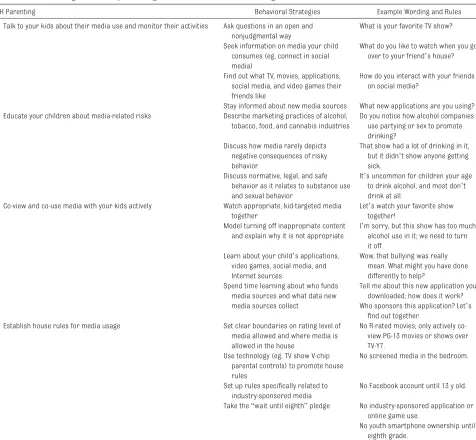
Joy Gabrielli, PhD, a Lisa Marsch, PhD, a Susanne Tanski, MDbAs media and technology proliferate in the lives of US children, parents are confronted with the ever-growing task of home media management. Accumulating evidence reveals that youth media exposure to health risk behaviors (HRBs) (eg, risky sexual behavior, substance use) during the preteen years is associated with increased risk for subsequent engagement in HRBs, 1, 2 and greater intensity of exposure leads to greater youth risk. Whereas parents remain a strong influence on youth behavior and guidelines advocate for parental media restriction and monitoring, the definition of specific media parenting behaviors that impact child outcomes is needed. The American Academy of Pediatrics (AAP) has offered an evidence-informed summary of recommended parenting practices within the media environment.3 However, parents generally express a desire for more information about effective youth media management and are relatively unaware of the AAP’s media recommendations.4 To support AAP guidelines, a review of the literature and evidence from behavioral observation and focus group studies reveal 4 behavioral domains encapsulated by our proposed talk, educate, co-view, and house rules (TECH) parenting.5 We propose TECH parenting as a useful framework to address important behavioral targets for parental media management of preadolescent youth (Table 1 and Supplemental Fig 1).
T: TALK TO KIDS ABOUT MEDIA USE AND MONITOR THEIR MEDIA-RELATED ACTIVITIES
Parental monitoring is associated with reduced youth risk for HRBs, and talking with youth about media use allows parents to learn what their child is viewing or using.5 Some 84% of preteenagers (ages 8–12 years) reported that their parents have talked with them about the content of media they use; however, only 54% reported that their parents knew
“a lot” about their social media use.6 Parents should talk to children about media regularly because kids’ preferences and/or behaviors can change quickly over time. The use of open-ended questions (Table 1) can facilitate engagement in conversation and allow parents to receive more comprehensive information on children’s media exposure. These conversations can be used as periodic check-ins and as a starting point for education about HRBs that may have been depicted in media and/or
To cite: Gabrielli J, Marsch L, Tanski S. TECH Parenting to
Promote Effective Media Management. Pediatrics. 2018; 142(1):e20173718
aCenter for Technology and Behavioral Health, and bDepartment of Pediatrics, Geisel School of Medicine, Dartmouth College, Hanover, New Hampshire
Drs Gabrielli and Tanski conceptualized and designed the protocol described in the manuscript, drafted the initial manuscript, and reviewed and revised the manuscript; Dr Marsch reviewed and revised the manuscript; and all authors approved the final manuscript as submitted and agree to be accountable for all aspects of the work.
DOI: https:// doi. org/ 10. 1542/ peds. 2017- 3718
Accepted for publication Feb 21, 2018
Address correspondence to Joy Gabrielli, PhD, Center for Technology and Behavioral Health, Geisel School of Medicine at Dartmouth, 46 Centerra Parkway, Suite 301, Lebanon, NH 03766. E-mail: [email protected]
PEDIATRICS (ISSN Numbers: Print, 0031-4005; Online, 1098-4275).
Copyright © 2018 by the American Academy of Pediatrics
FINANCIAL DISCLOSURE: The authors have indicated they
have no financial relationships relevant to this article to disclose.
FUNDING: Supported by funding from the National Institutes
of Health and National Institute on Drug Abuse grant P30DA029926 (principal investigator: Dr Marsch) and T32 training support through DA037202 (Dr Gabrielli). Funded by the National Institutes of Health (NIH).
POTENTIAL CONFLICT OF INTEREST: The authors have
indicated they have no potential conflicts of interest to disclose.
product marketing (eg, alcohol brands) that children have viewed. Researchers have demonstrated that effective parental communication with children about HRBs and HRB-related media content can reduce youth risk for HRB engagement.7
E: EDUCATE CHILDREN ABOUT THE RISKS PRESENT ACROSS VARIOUS FORMS OF MEDIA
A review of research on substance use in the media revealed high
rates of substance appearances in television and movies (eg, alcohol was found in 70% of prime time television programs), with few depictions of negative consequences of HRBs.8, 9 Parents need to educate youth on negative consequences of violence, substance use, and risky sexual behavior, especially if youth are exposed to inaccurate media depictions of HRBs. For example, characters may be shown drinking alcohol excessively without getting sick. These depictions suggest risk
behaviors are safe or have only positive outcomes, which can impact youth expectancies related to HRBs and their subsequent willingness to engage in HRBs.
Beyond depictions of behavior, children need to learn how to interpret advertising that promotes certain product-related behaviors, such as drinking or smoking. For example, in the new media environment (eg, Internet, social media, and applications),
GABRIELLI et al 2
TABLE 1 Behavioral Strategies and Example Wording to Promote Effective TECH Parenting
TECH Parenting Behavioral Strategies Example Wording and Rules
T Talk to your kids about their media use and monitor their activities Ask questions in an open and nonjudgmental way
What is your favorite TV show? Seek information on media your child
consumes (eg, connect in social media)
What do you like to watch when you go over to your friend’s house? Find out what TV, movies, applications,
social media, and video games their friends like
How do you interact with your friends on social media?
Stay informed about new media sources What new applications are you using? E Educate your children about media-related risks Describe marketing practices of alcohol,
tobacco, food, and cannabis industries
Do you notice how alcohol companies use partying or sex to promote drinking?
Discuss how media rarely depicts negative consequences of risky behavior
That show had a lot of drinking in it, but it didn’t show anyone getting sick.
Discuss normative, legal, and safe behavior as it relates to substance use and sexual behavior
It’s uncommon for children your age to drink alcohol, and most don’t drink at all.
C Co-view and co-use media with your kids actively Watch appropriate, kid-targeted media together
Let’s watch your favorite show together!
Model turning off inappropriate content and explain why it is not appropriate
I’m sorry, but this show has too much alcohol use in it; we need to turn it off.
Learn about your child’s applications, video games, social media, and Internet sources
Wow, that bullying was really mean. What might you have done differently to help?
Spend time learning about who funds media sources and what data new media sources collect
Tell me about this new application you downloaded; how does it work? Who sponsors this application? Let’s
find out together. H Establish house rules for media usage Set clear boundaries on rating level of
media allowed and where media is allowed in the house
No R-rated movies; only actively co-view PG-13 movies or shows over TV-Y7.
Use technology (eg, TV show V-chip parental controls) to promote house rules
No screened media in the bedroom.
Set up rules specifically related to industry-sponsored media
No Facebook account until 13 y old. Take the “wait until eighth” pledge No industry-sponsored application or
online game use.
No youth smartphone ownership until eighth grade.
Additional resources include AAP Media Guidelines, Circle Disney Parental Control, Common Sense Media, www. mediatechparentin g. net, and www. waituntil8th. org. PG-13, parental guidance suggested for children <13 y old; TV, television; TV-Y7, television for children ≥7 y old.
at Viet Nam:AAP Sponsored on August 28, 2020 www.aappublications.org/news
some alcohol companies employ
“advergames” that could be highly engaging for underage drinkers.8 Parents should alert children to what these games are intended to do (eg, change product interest) and teach them about other marketing strategies employed in the media (eg, product placements). The social media environment provides additional venues for marketing and new ways for youth to share inappropriate social media content. Integrated marketing campaigns promote youth exposure to marketing across media venues, and parents must remain aware of the various sources of potential exposure to ideally mitigate youth risk. Risks for youth within the media environment continue to evolve as technology advances. However, youth can learn how to effectively interpret marketing messaging, and preventive interventions that include a media literacy component have demonstrated efficacy in reducing youth risk for problematic behaviors such as substance use.10
C: CO-VIEW AND CO-USE MEDIA WITH KIDS ACTIVELY
Many parents indicate concern about what their children see across media and report inappropriate media content as a primary concern. Yet, parents also report that they are not fully aware of the content within the programming and games that kids view and use. Whereas 82% of parents reported high awareness of the content their child sees on television, only 56% report high awareness of online video content, and 40% report high awareness of social media exposures.11
Active co-viewing and co-use of media can help parents learn about evolving media, such as video games and social media applications, allowing parents to more effectively and comprehensively monitor children’s media use.
Parents can also use this time to teach their children to develop healthy online behaviors and help children recognize and respond to inappropriate content (eg, alert an adult). Parents should model good media decision-making by only co-viewing content that is age-appropriate for their child. In addition, parents should talk to their children about media containing sex, violence, or substance use immediately and consider turning off the inappropriate content. If parents co-view media with their children without addressing the risk content within it, it could be perceived as passive endorsement of the behaviors depicted, potentially increasing youth risk for engagement in those behaviors.12
H: ESTABLISH CLEAR AND EFFECTIVE HOUSE RULES FOR MEDIA USAGE
Parents vary in their approach to house rules for youth media use; 88% of parents of preteenagers have rules about what content their children can watch, but only 33% report variations in their rules based on the specific device (eg, television versus tablet versus cell phone).11 Although many technological tools exist to support restriction of content, only a minority of parents (less than one-third) report employing them.11 For example, only 1 in 4 parents report using a third-party application to manage child device use or shut off the Internet at a certain time of the night.11 Parents should establish clear house rules for where, when, and what media is allowed. Some evidence-informed rules include the following3:
1. Designate media-free zones in your home (eg, dinner table, children’s bedrooms).
⚬ Children with media-free bedrooms get more sleep at night, perform better in school, and are less likely to be overweight.
2. Only allow media use after homework and physical activity have been completed.
⚬ Kids who use less screen-based media report better social and emotional functioning. 3. Store all digital technology in a
central house location (not in bedrooms) overnight at least 1 hour before bedtime.
⚬ Use of screened media
immediately before bedtime can interfere with sleep patterns and impact educational performance.
⚬ Notifications from digital devices can interrupt sleep.
4. Review applications, Web sites, video games, or social media programs your child uses.
⚬ Some applications contain information gathering and location tracking of which youth may not be aware.
⚬ Review social media activity; youth may not understand the long-term and public nature of posting information on the Internet.
5. Be explicit about allowable movie and television show ratings and content your children can watch.
⚬ Youth whose parents allow them to watch R-rated movies are at higher risk for underage smoking, alcohol use, and cannabis use.1, 2, 12
⚬ Television shows rated above TV-Y7 include significantly greater amounts of sex, smoking, and alcohol use.9 Media ratings provide information about age-appropriateness of content for children, although some behaviors (eg, violence and substance use) are not well captured in ratings.
Parents can influence youth health risk trajectories, 5, 7, 12 and pediatricians can help by offering them specific skills to improve media management in the home. Paired with the AAP Family Media Plan (https:// www. healthychildren. org/ English/ media/ Pages/ default. aspx), the memorable acronym of TECH parenting may be used as a frame to promote positive and specific media parenting behaviors that have the potential to mitigate media-related risks for HRB development in youth.
ACKNOWLEDGMENTS
We acknowledge Zoe L.B. Brennan and Aminata Traore for their support in developing the TECH parenting model and conducting literature reviews to provide research evidence for recommendations of the model.
REFERENCES
1. Koordeman R, Anschutz DJ, Engels RC. Alcohol portrayals in movies, music videos and soap operas and alcohol use of young people: current status and future challenges. Alcohol Alcohol. 2012;47(5):612–623
2. Leonardi-Bee J, Nderi M, Britton J. Smoking in movies and smoking initiation in adolescents: systematic review and meta-analysis. Addiction. 2016;111(10):1750–1763
3. Council on Communications and Media. Media use in school-aged children and adolescents. Pediatrics. 2016;138(5):e20162592
4. Funk JB, Brouwer J, Curtiss K, McBroom E. Parents of preschoolers: expert media recommendations and ratings knowledge, media-effects beliefs, and monitoring practices. Pediatrics. 2009;123(3):981–988 5. Collier KM, Coyne SM, Rasmussen EE,
et al. Does parental mediation of media influence child outcomes? A meta-analysis on media time, aggression, substance use, and sexual behavior. Dev Psychol. 2016;52(5):798–812 6. Rideout V. The Common Sense Census:
Media Use by Tweens and Teens. San Francisco, CA: Common Sense Media; 2015
7. Choi HJ, Miller-Day M, Shin Y, et al. Parent prevention communication profiles and adolescent substance use: a latent profile analysis and growth curve model. J Fam Commun. 2017;17:15–32
8. Strasburger VC; American Academy of Pediatrics; Council on Communications and Media. Policy statement—children, adolescents, substance abuse, and the media. Pediatrics. 2010;126(4):791–799 9. Gabrielli J, Traore A, Stoolmiller M,
Bergamini E, Sargent JD. Industry television ratings for violence, sex, and substance use. Pediatrics. 2016;138(3):e20160487 10. Gordon CS, Jones SC, Kervin L.
Effectiveness of alcohol media literacy programmes: a systematic literature review [published correction appears in Health Educ Res. 2015;30(4):682]. Health Educ Res. 2015;30(3):449–465 11. Lauricella AR, Cingel DP, Beaudoin-Ryan
L, Robb MB, Saphir M, Wartella EA. The Common Sense Census: Plugged-in Parents of Tweens and Teens. San Francisco, CA: Common Sense Media; 2016
12. Cox MJ, Gabrielli J, Janssen T, Jackson KM. Parental restriction of movie viewing prospectively predicts adolescent alcohol and marijuana initiation: implications for media literacy programs. Prev Sci. 2018, In press
GABRIELLI et al 4
ABBREVIATIONS
AAP: American Academy of Pediatrics
HRB: health risk behavior TECH: talk, educate, co-view, and
house rules
at Viet Nam:AAP Sponsored on August 28, 2020 www.aappublications.org/news
DOI: 10.1542/peds.2017-3718 originally published online June 28, 2018;
2018;142;
Pediatrics
Joy Gabrielli, Lisa Marsch and Susanne Tanski
TECH Parenting to Promote Effective Media Management
Services
Updated Information &
http://pediatrics.aappublications.org/content/142/1/e20173718
including high resolution figures, can be found at:
References
http://pediatrics.aappublications.org/content/142/1/e20173718#BIBL
This article cites 9 articles, 4 of which you can access for free at:
Subspecialty Collections
_sub
http://www.aappublications.org/cgi/collection/preventative_medicine Preventive Medicine
http://www.aappublications.org/cgi/collection/media_sub Media
following collection(s):
This article, along with others on similar topics, appears in the
Permissions & Licensing
http://www.aappublications.org/site/misc/Permissions.xhtml
in its entirety can be found online at:
Information about reproducing this article in parts (figures, tables) or
Reprints
http://www.aappublications.org/site/misc/reprints.xhtml
DOI: 10.1542/peds.2017-3718 originally published online June 28, 2018;
2018;142;
Pediatrics
Joy Gabrielli, Lisa Marsch and Susanne Tanski
TECH Parenting to Promote Effective Media Management
http://pediatrics.aappublications.org/content/142/1/e20173718
located on the World Wide Web at:
The online version of this article, along with updated information and services, is
http://pediatrics.aappublications.org/content/suppl/2018/06/20/peds.2017-3718.DCSupplemental
Data Supplement at:
by the American Academy of Pediatrics. All rights reserved. Print ISSN: 1073-0397.
the American Academy of Pediatrics, 345 Park Avenue, Itasca, Illinois, 60143. Copyright © 2018 has been published continuously since 1948. Pediatrics is owned, published, and trademarked by Pediatrics is the official journal of the American Academy of Pediatrics. A monthly publication, it
at Viet Nam:AAP Sponsored on August 28, 2020 www.aappublications.org/news