ARTICLE
Behavioral Therapy for Childhood Constipation:
A Randomized, Controlled Trial
Marieke van Dijk, MSca, Marloes E. J. Bongers, MDb, Giel-Jan de Vries, MScc, Martha A. Grootenhuis, PhDa, Bob F. Last, PhDa,d, Marc A. Benninga, MD, PhDb
aPsychosocial Department andbDepartment of Pediatric Gastroenterology and Nutrition, Emma Children’s Hospital/Academic Medical Center, University of Amsterdam,
Amsterdam, Netherlands;cDepartment of Psychiatry, Academic Medical Center, University of Amsterdam, Amsterdam, Netherlands;dDepartment of Developmental
Psychology, Vrije Universiteit Amsterdam, Amsterdam, Netherlands
The authors have indicated they have no financial relationships relevant to this article to disclose.
What’s Known on This Subject
Stool-withholding behavior is probably the major cause for development and/or per-sistence of childhood constipation. There is some evidence that the adjunct of behav-ioral interventions to laxative therapy, rather than laxative therapy alone, improves con-tinence in children with constipation.
What This Study Adds
This is the first large, randomized, controlled trial evaluating the effectiveness of behav-ioral therapy in constipated children. The study showed that conventional treatment should remain the first choice of treatment. When behavioral problems are present, behavioral therapy should be considered.
ABSTRACT
OBJECTIVE.It has been suggested that the addition of behavioral interventions to laxa-tive therapy improves continence in children with functional fecal incontinence associated with constipation. Our aim was to evaluate the clinical effectiveness of behavioral therapy with laxatives compared with conventional treatment in treating functional constipation in childhood.
PATIENTS AND METHODS.In this randomized, controlled trial conducted in a tertiary hos-pital in the Netherlands, 134 children aged 4 to 18 years with functional constipation were randomly assigned to 22 weeks (12 visits) of either behavioral therapy or conventional treatment. Primary outcomes were defecation frequency, fecal incon-tinence frequency, and success rate. Success was defined as defecation frequency of
ⱖ3 times per week and fecal incontinence frequency of ⱕ1 times per 2 weeks irrespective of laxative use. Secondary outcomes were stool-withholding behavior and behavior problems. Outcomes were evaluated at the end of treatment and at 6-months follow-up. All of the analyses were done by intention to treat.
RESULTS.Defecation frequency was significantly higher for conventional treatment. Fecal incontinence frequency showed no difference between treatments. After 22 weeks, success rates did not differ between conventional treatment and behavioral therapy (respectively, 62.3% and 51.5%), nor did it differ at 6 months of follow-up (respectively, 57.3% and 42.3%). The proportion of children withholding stools was not different between interventions. At follow-up, the proportion of children with behavior problems was significantly smaller for behavioral therapy (11.7% vs 29.2%).
CONCLUSION.Behavioral therapy with laxatives has no advantage over conventional treatment in treating childhood constipation. However, when behavior problems are present, behavioral therapy or referral to mental health services should be considered.
C
ONSTIPATION IN CHILDREN is a worldwide problem with a prevalence ranging from 0.7% to 29.6%.1Up to 84% of functional constipated children suffer from fecal incontinence2and more than one third exhibit behavior problems.3,4It remains unclear whether behavior problems are primary or secondary to functional consti-pation.In the vast majority of patients no somatic cause can be found, and, therefore, these patients are considered to have a functional defecation disorder.5Retentive posturing or stool-withholding behavior is probably the major cause for development and/or persistence of childhood constipation.6–11 Retained stools become
progres-sively more difficult and painful to evacuate, leading to fear and avoidance of defecation.12,13This vicious cycle can be described as learned behavior.
www.pediatrics.org/cgi/doi/10.1542/ peds.2007-2402
doi:10.1542/peds.2007-2402
The funding source had no role in the study design, data collection, data analysis, data interpretation, writing of the report, or in the decision to submit the article for publication.
All of the authors declare that they participated in the concept and design; analysis and interpretation of data; and drafting or revising the article. All the authors affirm that they have had full access to and uphold the integrity of the data presented. Also, all of the authors have seen and approved the final version. The corresponding author had final responsibility for the decision to submit for publication.
This trial has been registered at www.clinicaltrials.gov (identifier ISRCTN25185569).
Key Words
childhood, constipation, fecal incontinence, treatment, behavioral therapy
Abbreviations
BT— behavioral therapy CT— conventional treatment CBCL—Child Behavior Checklist CI— confidence interval
Accepted for publication Nov 12, 2007 Address correspondence to Marieke van Dijk, MSc, Psychosocial Department, Emma Children’s Hospital, Academic Medical Center, Room G8-224, PO Box 22700, 1100 DE Amsterdam, Netherlands. E-mail: m.vandijk@ amc.uva.nl
Based on clinical experience, constipated children are traditionally treated by pediatricians combining laxative treatment with behavioral approaches, like toilet train-ing and education. Long-term follow-up studies showed, however, that despite intensive medical treatment, func-tional constipation persists into young adulthood in one third of patients.14,15
In treating childhood constipation, it seems important to address defecation avoidance and to treat behavior problems. There is some evidence that the adjunct of behavioral interventions to laxative therapy, rather than laxative therapy alone, improves continence in children with functional fecal incontinence associated with con-stipation.16–18 We developed a protocolized behavioral therapy (BT) for constipated children and their parents. The present study results aimed to evaluate this BT with laxatives compared with conventional treatment (CT). It was hypothesized that BT with laxatives would result in more success regarding constipation, stool-withholding behavior, and behavior problems.
METHODS
Patients
The study population consisted of children with func-tional constipation aged 4 to 18 years referred by general practitioners, school doctors, and pediatricians to the gastrointestinal outpatient clinic at the Emma Children’s Hospital. Inclusion took place between November 2002 and August 2004. At entry, patients had to meet at least 2 of 4 criteria: defecation frequency⬍3 times per week, fecal incontinenceⱖ2 times per week, passage of large amounts of stool at least once every 7 to 30 days (large enough to clog the toilet), or a palpable abdominal or rectal fecal mass.19Children were excluded if they had received a comprehensive BT in the previous 12 months. Children using drugs influencing gastrointestinal func-tion other than laxatives and children with organic causes for defecation disorders, such as Hirschsprung dis-ease, spina bifida occulta, hypothyroidism, or other meta-bolic or renal abnormalities, were also excluded. The med-ical ethics committee of the Academic Medmed-ical Center of Amsterdam approved the study protocol. All of the patients and/or parents gave written informed consent.
Baseline Assessment
One week before baseline assessment the pediatric gas-troenterologist asked the parents to consider participa-tion in the study. Parents were assigned to discontinue any laxative treatment and to record in a bowel diary frequency of stools and episodes of fecal incontinence. The criterion of a standard amount of stool was illus-trated to parents with a clay model. Fecal incontinence was defined as any amount of feces in the underwear.
The next week eligibility was verified, and a physical examination, including digital rectal examination, was performed to evaluate presence of an abdominal or rec-tal fecal mass. Baseline data for primary and secondary outcome measures were obtained. The parent who ac-companied the child to the outpatient clinic filled out the questionnaire for the secondary outcomes.
Design
The study had a 2-parallel group, randomized, con-trolled design. After baseline measurement and if writ-ten informed consent was given, a research assistant performed a telephone call to a randomization center and revealed the allocation to parents immediately. A computer-based system was used to generate a sequence of random group assignment for consecutive patients.
Random assignment was stratified by age (4 – 8 years or
ⱖ8 years) and gender. Within 2 weeks after random as-signment, patients received their first treatment session.
Intervention
The intervention period for both CT and BT consisted of 12 visits during 22 weeks with similar intervals between treatment sessions. CT and BT used similar laxative ther-apy. Disimpaction with daily Klyx enemas (PCH Phar-machemie BV-Teva Pharmaceutical Industries, Haarlem, Netherlands, sodium-dioctylsulfosuccinate and sorbitol; 60 mL per day for childrenⱕ6 years of age; 120 mL per day for children⬎6 years of age) for 3 consecutive days was prescribed by pediatric gastroenterologists before starting treatment. Maintenance therapy consisted of polyethylene glycol 3350, 1 sachet (10 g) per day, and if treatment was considered to have insufficient effect, the dose was increased by 1 sachet. If spontaneous defeca-tion was delayed for⬎3 days, parents were advised to give an enema or bisacodyl suppository of 5 mg. In BT, it was preferred to give oral bisacodyl tablets of 5 mg instead of rectal laxatives. During BT, pediatric psychol-ogists adjusted the laxative dose and consulted a pediat-ric gastroenterologist when necessary. In both treatment groups, patients kept a bowel diary.
CT
CT was conducted by pediatric gastroenterologists and consisted of visits lasting ⬃20 to 30 minutes, during which laxative treatment (polyethylene glycol 3350 and, if necessary, Klyx enemas or bisacodyl suppositories) and the bowel diary were discussed. Patients and their parents received education to explain that symptoms are not harmful and are common in children with func-tional constipation and that a positive, nonaccusatory approach is essential.20 Furthermore, children were in-structed not to withhold stool when they feel urge to defecate. Motivation was enhanced by praise and small gifts from the pediatric gastroenterologists.
Protocolized BT
can, will, and do. This approach is derived from a multi-disciplinary BT to treat children with defecation disor-ders.22,23For all involved psychologists, a detailed manual for both age-related modules was available to ensure a standard delivery of therapy. Visits lasted⬃45 minutes.
Clinical Outcomes
Primary outcome measures were defecation frequency per week, fecal incontinence frequency per week, and successful treatment. Treatment was considered success-ful if patients achieved a defecation frequency of ⱖ3 times per week and a fecal incontinence frequency ofⱕ1 times per 2 weeks, irrespective of laxative use.
Secondary outcome measures were stool-withhold-ing behavior and behavior problems. Stool-withholdstool-withhold-ing behavior was scored on a 3-point scale (yes, sometimes, or no) by asking parents if they observed that their child holds his legs stiffly together or crosses them when feel-ing urge to defecate. Behavior problems were assessed by the Child Behavior Checklist (CBCL/4 –18).24 This questionnaire obtains parent’s report of their child’s be-havior problems at the time of administration and for the preceding 6 months. Behavioral ratings were com-pared with a normative sample of Dutch children.25The CBCL yields scores for a total problem scale and for an internalizing (withdrawal, somatic complaints, and anx-iety or depression) and externalizing (delinquency and aggression) behavior problem scale. Derived from stan-dard scores, a normalized T-score⬎63 (90th percentile) is a well-validated cutoff discriminating between nonre-ferred and renonre-ferred children to mental health centers. It indicates whether a child needs professional help for his or her problems.24
Assessments in each intervention arm took place at the last visit (posttreatment time point) and 6 months after the 22-week treatment was ended (follow-up). Time between baseline assessment and follow-up was
⬃1 year. Follow-up assessment was conducted by tele-phone by pediatric gastroenterologists. Assessment of behavior problems at both time points was done by a research assistant who sent parents one CBCL with a stamped addressed envelope to return the question-naire. Parents decided whether the mother or the father filled out the questionnaire at home.
Sample Size
The sample size was calculated to allow detection of a 25% difference in the proportion of success between BT and CT. It was estimated that CT reached success in 35% of the children at follow-up.26 Under the additional as-sumption of a significance level of .05, a power of .80, and 2-sided hypothesis testing, a minimal sample size of 124 with 62 children in each group was determined.
Statistical Analysis
Intent-to-treat analyses were conducted using SAS 9.1.3 (SAS Institute, Inc, Cary, NC) and Stata 9.2 (Stata Corp, College Station, TX). Because of withdrawal before treat-ment start, dropouts during the study, failure to fill out questionnaires, or research procedure violations,
miss-ing data occurred. Imputation of missmiss-ing values was used to make intent-to-treat analyses feasible.27Missing data were imputed using Imputation and Variance Esti-mation Software (IVEware: Imputation and Variance Estimation Software, Survey Methodology Program, Survey Research Center, Institute for Social Research, University of Michigan. T. E. Raghunathan, Peter W. Solenberger, John Van Hoewyk), which uses a general-purpose multivariate imputation procedure (sequential re-gression imputation method28) that can handle relatively complex data structures when data are missing. It produces imputed values for each individual in the data set condi-tional on all of the values observed for that individual. In this manner, 10 different data sets were created. All of the analyses were performed using these 10 data sets and then aggregated by averaging the individual results.
Independent sample t tests were used to test differ-ences in continuous variables and 2 tests when the variables were categorical for the sample description at baseline. The proportion of patients who dropped out before the end of treatment was tabulated and compared using2.
To determine the effect of treatment on defecation frequency and fecal incontinence frequency, negative binomial regression models were fitted with treatment (CT or BT), time (posttreatment and follow-up), and treatment by time as factors. To control for possible differences in baseline values, defecation or fecal incon-tinence frequency at baseline were included in the model as covariates. For these regression models, a ro-bust variance estimator was used. For all of the binary outcome measures, a risk ratio model was applied. The effect of treatment condition on the proportion of suc-cessfully treated children, stool-withholding behavior, and CBCL behavior problems (normalized T-score:⬎63) was derived using generalized linear models for the bi-nomial family with treatment, time, and treatment-by-time interaction as factors in the model. Again, baseline measures were included to control for differences in baseline values. For stool-withholding behavior and the 3 CBCL scales, the proportion of children at baseline was included, whereas success rate was adjusted for the base-line value of defecation and fecal incontinence fre-quency. Adjusted means and proportions were derived from the regression models based on their linear predic-tions. Estimated values (adjusted), rather than observed (unadjusted) values, are presented throughout the arti-cle unless otherwise specified. APvalue⬍.05 was con-sidered statistically significant.
RESULTS
Sample
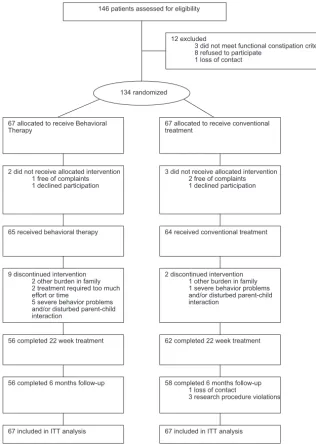
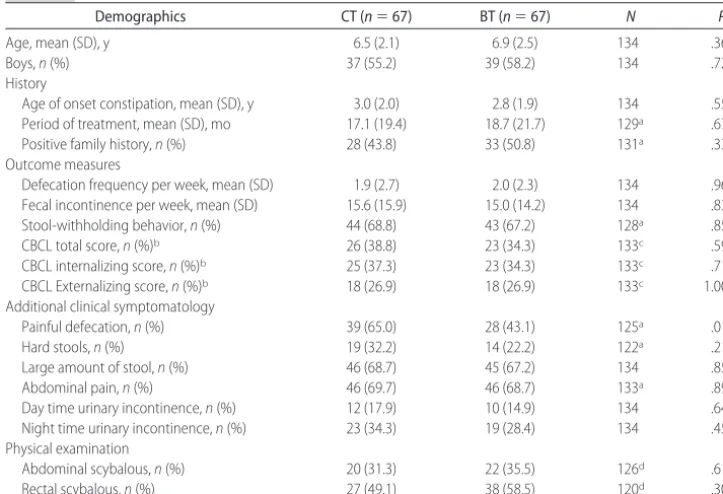
post-treatment and by 9 patients (CT: 6; BT: 3) at follow-up. Baseline characteristics are presented in Table 1. Except for painful defecation (P⫽.014), there were no signif-icant differences found between the 2 groups in socio-demographic factors or for clinical characteristics.
Primary Outcomes
Baseline data are presented in Table 1. Defecation fre-quency increased from an average of 2.0 stools per week to 7.2 in the CT group and 5.4 in the BT group at posttreatment (Table 2). Compared with the BT group, defecation frequency in CT was significantly higher (in-cidence rate ratio: 0.75; 95% confidence interval [CI]: 0.59 – 0.96;P⫽.021). Planned comparisons showed that this effect was mainly caused by a difference between interventions at posttreatment (7.2 vs 5.4;P⫽.021) and not at follow-up (6.6 vs 5.3;P⫽.150).
Fecal incontinence frequency dropped from an aver-age of 15 per week at start of the study to 2.1 and 5.0 per
week at posttreatment for, respectively, CT and BT (Table 2). From posttreatment to follow-up, fecal in-continence frequency increased to an average of 6.4 in CT and 8.6 in BT. There was no statistically significant difference found between treatment conditions (P ⫽
.135).
At posttreatment, success rate was higher in CT (62.3%) than in BT (51.5%; Table 2). However, no statistically significant difference between treatments was found (Pvalue⫽.249). At follow-up, the number of children successfully treated declined to 57.3% in CT and 42.3% in BT. Again, the difference proved statisti-cally nonsignificant (P⫽.095).
Secondary Outcomes
Baseline data are presented in Table 1. Stool-withhold-ing behavior was reduced from baseline to follow-up in both treatments conditions; from more than two thirds of the children withholding their stools to 13.8% in CT
146 patients assessed for eligibility
67 allocated to receive Behavioral Therapy
9 discontinued intervention 2 other burden in family 2 treatment required too much effort or time
5 severe behavior problems and/or disturbed parent-child interaction
2 discontinued intervention 1 other burden in family 1 severe behavior problems and/or disturbed parent-child interaction
56 completed 6 months follow-up 58 completed 6 months follow-up 1 loss of contact
3 research procedure violations 134 randomized
67 allocated to receive conventional treatment
2 did not receive allocated intervention 1 free of complaints 1 declined participation
3 did not receive allocated intervention 2 free of complaints 1 declined participation
56 completed 22 week treatment 62 completed 22 week treatment
67 included in ITT analysis 67 included in ITT analysis 65 received behavioral therapy 64 received conventional treatment
12 excluded
3 did not meet functional constipation criteria 8 refused to participate
1 loss of contact
and 10.6% in BT at posttreatment (Table 3). The pro-portion of children with stool-withholding behavior did not differ between interventions (P⫽.654).
Most CBCL forms were filled out by mothers (72.3%), followed by fathers (15.4%) and others (10.8%; ie, stepmothers and stepfathers). In 59.6% of the full cases, the same responder filled out the CBCL at all of the assessment points, with no difference between the 2 treatment groups (CT: 58.5%; BT: 60.7%; P ⫽
.813). More than one third of the children exhibited behavior problems (CBCL normalized T-score:⬎63) at baseline. At end of treatment, this percentage was decreased to 22.8% in CT and 21.9% in BT (Table 3). At follow-up, BT was found to have influenced behav-ior problems significantly by reducing the proportion of children with these problems to 11.7% compared with 29.2% in CT (relative risk: 0.42; 95% CI: 0.18 – 0.96;P ⫽.039).
TABLE 1 Baseline Characteristics of Children Allocated to CT or BT
Demographics CT (n⫽67) BT (n⫽67) N P
Age, mean (SD), y 6.5 (2.1) 6.9 (2.5) 134 .367
Boys,n(%) 37 (55.2) 39 (58.2) 134 .727
History
Age of onset constipation, mean (SD), y 3.0 (2.0) 2.8 (1.9) 134 .551 Period of treatment, mean (SD), mo 17.1 (19.4) 18.7 (21.7) 129a .673
Positive family history,n(%) 28 (43.8) 33 (50.8) 131a .338
Outcome measures
Defecation frequency per week, mean (SD) 1.9 (2.7) 2.0 (2.3) 134 .961 Fecal incontinence per week, mean (SD) 15.6 (15.9) 15.0 (14.2) 134 .831 Stool-withholding behavior,n(%) 44 (68.8) 43 (67.2) 128a .850
CBCL total score,n(%)b 26 (38.8) 23 (34.3) 133c .591
CBCL internalizing score,n(%)b 25 (37.3) 23 (34.3) 133c .719
CBCL Externalizing score,n(%)b 18 (26.9) 18 (26.9) 133c 1.00
Additional clinical symptomatology
Painful defecation,n(%) 39 (65.0) 28 (43.1) 125a .014
Hard stools,n(%) 19 (32.2) 14 (22.2) 122a .215
Large amount of stool,n(%) 46 (68.7) 45 (67.2) 134 .853
Abdominal pain,n(%) 46 (69.7) 46 (68.7) 133a .897
Day time urinary incontinence,n(%) 12 (17.9) 10 (14.9) 134 .641 Night time urinary incontinence,n(%) 23 (34.3) 19 (28.4) 134 .456 Physical examination
Abdominal scybalous,n(%) 20 (31.3) 22 (35.5) 126d .614
Rectal scybalous,n(%) 27 (49.1) 38 (58.5) 120d .305
aMissing characteristics were unknown to parents.
bData show the proportion children with CBCL normalized T-score⬎63 (90th percentile). cOne CBCL questionnaire was not filled out.
dPhysical examination is missing because the child was too anxious to perform examination.
TABLE 2 The Effect of Treatment on Primary Outcome Measures: Defecation Frequency, Fecal Incontinence Frequency, and the Proportion of Success
Variable CT BT Groupa Group⫻Timeb
IRR/RR (95% CI) P IRR/RR (95% CI) P
Defecation frequency per week, mean (95% CI)
IRR⫽0.75 (0.59–0.96) .021 IRR⫽1.06 (0.75–1.50) .758
Posttreatmentc 7.2 (6.1–8.5) 5.4 (4.3–6.7)
Follow-upd 6.6 (5.0–8.8) 5.3 (4.4–6.3)
Fecal incontinence per week, mean (95% CI)
IRR⫽2.36 (0.77–7.31) .135 IRR⫽0.57 (0.12–2.61) .467
Posttreatment 2.1 (0.8–5.8) 5.0 (2.1–12.0) Follow-up 6.4 (3.5–11.7) 8.6 (4.0–18.3) Success, % (95% CI)
Posttreatment 62.3 (51.1–76.1) 51.5 (39.7–66.9) RR⫽0.83 (0.60–1.14) .249 — —
Follow-up 57.3 (46.6–70.4) 42.3 (31.8–56.4) RR⫽0.74 (0.52–1.05) .095 — —
RR indicates relative risk, derived from generalized linear models for the binomial family with group (CT or BT), defecation frequency, and fecal incontinence frequency at baseline as factors in the model; IRR, incidence rate ratio, derived from negative binomial regression models with group (CT or BT), time (posttreatment or follow-up), the interaction term of group by time as factors, and baseline score as covariate included in the model.
aGroup is the main effect of BT.
bGroup⫻time is the interaction effect of BT with measurement at follow-up. cPosttreatment is the assessment of clinical outcomes at the last treatment visit.
The proportion of children with internalizing prob-lems also declined from an average of 35.8% to 17.3% and 18.9% for, respectively, CT and BT (Table 3). At follow-up, this proportion increased in CT but decreased further in BT (23.4% vs 14.0%). However, no statisti-cally significant effect was found for the effect of treat-ment condition (P⫽.600) or for the influence of BT at follow-up (P⫽.156).
The proportion of children exhibiting externalizing problems changed from an average proportion of 26.9% to 15.9% in CT and 15.6% in BT at posttreatment (Table 3). Both treatments seemed equally effective in reducing externalizing problems (P⫽.990).
DISCUSSION
This study is the first large randomized, controlled trial evaluating the clinical effectiveness of BT with laxatives for functional constipation in childhood. The results in-dicate that this BT with laxatives has no advantage over CT in treating childhood constipation. Both treatments decreased fecal incontinence frequency and increased defecation frequency. However, CT resulted in a higher defecation frequency than BT. Behavior problems were common, with more than one third of the participating children exhibiting these problems. This study shows that BT is superior in addressing behavior problems in constipated children.
Our results can only be compared with 1 other ran-domized, controlled trial18and 1 quasirandomized trial,29 which also evaluated the effect of an extensive behav-ioral intervention with laxatives compared with CT. Borowitz et al18also found no differences in treatment success among 3 different treatment modalities: medical therapy, medical therapy plus enhanced toilet training, and medical therapy plus enhanced toilet training plus biofeedback training. Still, the enhanced toilet training
intervention was considered to be more effective, be-cause more children responded to treatment with de-creases in fecal incontinence. This latter finding is in contrast with our outcome. Taitz et al29 investigated in 47 children the additional effect of play therapy with both a focus on the individual child and on parent-child interaction. In accordance with our results, their find-ings indicated that psychotherapeutic elements do not add to medical treatment, which traditionally already incorporates behavioral management techniques, such as toilet training, positive reinforcement, and education. Our hypothesis that BT would result in more children ceasing their stool withholding behavior than CT was not confirmed. The main assumption underlying our behavior therapy was that fear for defecation perpetu-ates chronic constipation with stool-withholding behav-ior as avoidance response. Prescribed laxative treatment may have caused large improvement of this aberrant behavior in both interventions. Laxatives facilitate trans-port and expulsion by softening of stools and, thus, seem to prevent stool-withholding behavior sufficiently.8,17
CT was associated with more frequent bowel move-ments per week. Before starting treatment, optimal laxa-tive dosages were established for each child by the pediatric gastroenterologists. However, during BT, pediatric psychol-ogists adjusted laxative dosages and only consulted the pediatric gastroenterologist when necessary in their opin-ion. This possibly resulted in prescribing suboptimal dos-ages and less use of rescue medication. This stresses the important role for experienced pediatricians in regulating laxatives, one of the main components in the treatment of childhood constipation.30
As expected BT relieved more children from coexist-ing behavior problems. This is not surpriscoexist-ing, because the behavioral protocol aims at decreasing anxiety and teaches parents behavior modification procedures. Part
TABLE 3 The Effect of Treatment on Secondary Outcome Measures: The Proportion of Children Exhibiting Stool-Withholding Behavior and Behavior Problems (CBCL Total Score>63)
Variable CT BT Groupa Group⫻Timeb
% 95% CI % 95% CI RR (95% CI) P RR (95% CI) P
Stool-withholding behavior 0.77 (0.24–2.46) .654 1.72 (0.43–6.91) .444 Posttreatmentc 13.8 7.3–26.3 10.6 3.7–30.1
Follow-upd 14.2 7.3–27.8 18.7 9.3–37.7
CBCL total scoree 1.04 (0.65–1.68) .863 0.42 (0.18–0.96) .039
Posttreatment 22.8 13.7–37.7 21.9 12.5–38.2 Follow-up 29.2 19.3–44.3 11.7 5.1–26.7
CBCL internalizing scoree 1.16 (0.66–2.03) .600 0.55 (0.24–1.26) .156
Posttreatment 17.3 9.2–32.3 18.9 10.8–33.2 Follow-up 23.4 13.3–41.0 14.0 6.1–31.7
CBCL externalizing scoree 1.00 (0.52–1.90) .990 0.97 (0.40–2.34) .947
Posttreatment 15.9 8.4–30.1 15.6 8.0–30.3 Follow-up 16.4 8.3–32.2 15.6 7.3–33.1
RR indicates relative risk, derived from generalized linear models for the binomial family with group (CT or BT), time (posttreatment or follow-up), the interaction term of group by time, and the proportion of children having stool-withholding behavior or having CBCL total score⬎63 at baseline as factors in the model.
aGroup is the main effect of behavioral treatment.
bGroup⫻time is the interaction effect of behavioral treatment with measurement at follow-up. cPosttreatment is the assessment of clinical outcomes at the last treatment visit.
of the reduction of behavior problems in both treatments may be explained by normalized behavioral functioning after successful treatment, because it is assumed that the social impact of fecal incontinence is mainly responsible for disturbed behavior in children with functional defe-cation disorders.31–33 The exact relationship between functional constipation and behavior problems still re-mains unclear, as well as the influence of behavior prob-lems on treatment outcome. Because in this study no difference in success rate was revealed between the 2 intervention arms, the beneficial effect of BT on behav-ioral functioning seems not to be (directly) related to the resolution of constipation-related symptoms.
Some limitations of this study need to be considered. The visit frequency and duration of treatment of the CT were made equivalent to that of the BT group to strengthen the comparison of treatments, which, how-ever, could also jeopardize generalizing the findings to general practice. Regardless of high visit frequency and duration, this did not lead to a higher success rate com-pared with those studies with 2 to 6 visits in a time period of 6 months.18,19,26,31,34,35 Generalization of the findings may also be hampered, because the pediatric gastroenterologists involved in this study are highly spe-cialized and experienced in treating chronic constipa-tion. However, CT in our study was based on the clinical practice guideline from the North American Society for Pediatric Gastroenterology, Hepatology, and Nutrition,36 which provides recommendations for the management of functional constipation by the primary care provider. These guidelines are generally available and used by many pediatric gastroenterologists and primary care pro-viders. Furthermore, primary outcome measures and stool-withholding behavior were not blindly rated. An-other limitation was that pediatric psychologists were partly responsible for laxative treatment in the BT con-dition, which possibly resulted in differences in laxative treatment. Despite the aforementioned limitations, we feel that our study has several strong points, such as a large sample that approximates the average patient in primary care settings with no restrictions regarding psy-chiatric abnormalities. Furthermore, 2 well-controlled and protocolized specialized treatments were used with similar frequency of visits and a 6-months follow-up period. Also, this study showed a low attrition rate.
This randomized, controlled trial showed that BT with laxatives has no advantage over CT in treating childhood constipation. CT should remain the first choice of treat-ment. BT may be considered when children experience behavior problems concurrently. Quality of care for chron-ically constipated children may be improved by adding a behavioral screening to the clinical evaluation of consti-pated children.13,36Positive screening should lead to con-sidering BT or referral to mental health services.
ACKNOWLEDGMENTS
The study was funded in part by the Dutch Digestive Disease Foundation (SWO 02-16).
We thank Anneke Destre´e-Vonk (†2005) and
Anne-Martine Onland-van Nieuwenhuizen for developing this protocolized behavioral therapy for children with chronic constipation.
REFERENCES
1. van den Berg MM, Benninga MA, Di Lorenzo C. Epidemiology of childhood constipation: a systematic review.Am J Gastroen-terol.2006;101(10):2401–2409
2. Voskuijl WP, Heijmans J, Heijmans HS, Taminiau JA, Benninga MA. Use of Rome II criteria in childhood defecation disorders: applicability in clinical and research practice.J Pediatr.2004; 145(2):213–217
3. Loening-Baucke V, Cruikshank B, Savage C. Defecation dy-namics and behavior profiles in encopretic children.Pediatrics.
1987;80(5):672– 679
4. Benninga MA, Voskuijl WP, Akkerhuis GW, Taminiau JA, Bu¨ller HA. Colonic transit times and behaviour profiles in children with defecation disorders.Arch Dis Child.2004;89(1): 13–16
5. Loening-Baucke V. Chronic constipation in children. Gastroen-terology.1993;105(5):1557–1564
6. Bernard-Bonnin AC, Haley N, Belanger S, Nadeau D. Parental and patient perceptions about encopresis and its treatment.J Dev Behav Pediatr.1993;14(6):397– 400
7. Blum NJ, Taubman B, Nemeth N. During toilet training, con-stipation occurs before stool toileting refusal.Pediatrics.2004; 113(6). Available at: www.pediatrics.org/cgi/content/full/113/ 6/e520
8. Cox DJ, Sutphen J, Borowitz S, Kovatchev B, Ling W. Contri-bution of behavior therapy and biofeedback to laxative therapy in the treatment of pediatric encopresis.Ann Behav Med.1998; 20(2):70 –76
9. Loening-Baucke V. Constipation in early childhood: patient characteristics, treatment, and long-term follow up.Gut.1993; 34(10):1400 –1404
10. Loening-Baucke V. Prevalence, symptoms and outcome of constipation in infants and toddlers. J Pediatr. 2005;146(3): 359 –363
11. Partin JC, Hamill SK, Fischel JE, Partin JS. Painful defecation and fecal soiling in children. Pediatrics. 1992;89(6 pt 1): 1007–1009
12. Di Lorenzo C. Childhood constipation: finally some hard data about hard stools!J Pediatr.2000;136(1):4 –7
13. Rasquin A, Di Lorenzo C, Forbes D, et al. Childhood functional gastrointestinal disorders: child/adolescent. Gastroenterology.
2006;130(5):1527–1537
14. van Ginkel R, Reitsma JB, Bu¨ller HA, van Wijk MP, Taminiau JA, Benninga MA. Childhood constipation: longitudinal fol-low-up beyond puberty.Gastroenterology.2003;125(2):357–363 15. Staiano A, Andreotti MR, Greco L, Basile P, Auricchio S. Long-term follow-up of children with chronic idiopathic constipa-tion.Dig Dis Sci.1994;39(3):561–564
16. Brazzelli M, Griffiths P. Behavioural and cognitive interven-tions with or without other treatments for the management of faecal incontinence in children. Cochrane Database Syst Rev.
2006;(2):CD002240
17. McGrath ML, Mellon MW, Murphy L. Empirically supported treatments in pediatric psychology: constipation and encopre-sis.J Pediatr Psychol.2000;25(4):225–254
18. Borowitz SM, Cox DJ, Sutphen JL, Kovatchev B. Treatment of childhood encopresis: a randomized trial comparing three treatment protocols.J Pediatr Gastroenterol Nutr. 2002;34(4): 378 –384
19. van der Plas RN, Benninga MA, Bu¨ller HA, Bossuyt PM, Ak-kermans LM, Redekop WK, et al. Biofeedback training in
ment of childhood constipation: a randomised controlled study.Lancet.1996;348(9030):776 –780
20. van der Plas RN, Benninga MA, Taminiau JA, Bu¨ller HA. Treatment of defaecation problems in children: the role of education, demystification and toilet training.Eur J Pediatr.
1997;156(9):689 – 692
21. van Dijk M, Benninga MA, Grootenhuis MA, Onland-van Nieuwenhuizen AM, Last BF. Chronic childhood constipation: a review of the literature and the introduction of a protocolized behavioral intervention program. Patient Educ Couns. 2007; 67(1–2):63–77
22. Brugman A, Wissink-Ensink ML, Severijnen, RSVM. De mul-tidisciplinaire gedragsbehandeling van obstipatie en inconti-nentie. In: Looiaard N, Platenkamp J, van Velze-Boender-maker S, van Waarden-Koets A, eds.Waar Is de Uitgang? Een Boekje Open Over Anusatresie. Meppel, Netherlands: Drukkerij Giethoorn ten Brink; 2002:76 – 82
23. van Kuyk EM, Brugman-Boezeman AT, Wissink-Essink M, Severijnen RS, Festen C, Bleijenberg G. Defecation problems in children with Hirschsprung’s disease: a biopsychosocial ap-proach.Pediatr Surg Int.2000;16(5– 6):312–316
24. Achenbach TM.Manual for the Child Behavior Checklist/4 –18 and 1991 Profiles. Burlington, VT: University of Vermont Depart-ment of Psychiatry; 1991
25. Verhulst FC, van der Ende J, Koot HM. Handleiding voor de CBCL/4 –18. Rotterdam, Netherlands: Afdeling Kinder-en Jeug-dpsychiatrie, Sophia Kinderziekenhuis/Academisch Zieken-huis Rotterdam/Erasmus Universiteit Rotterdam; 1996 26. van Ginkel R, Bu¨ller HA, Boeckxstaens GE, van der Plas RN,
Taminiau JA, Benninga MA. The effect of anorectal manome-try on the outcome of treatment in severe childhood constipation: a randomized, controlled trial.Pediatrics. 2001; 108(1). Available at: www.pediatrics.org/cgi/content/full/108/ 1/e9
27. Rubin DB. Multiple imputation after 18⫹years.J Am Stat Assoc.
1996;91(434):473– 489
28. Raghunathan TE, Lepkowski JM, Van Hoewyk J, Solenberger P. A multivariate technique for multiply imputing missing values using a sequence of regression models.Survey Methodol.
2001;27:85–95
29. Taitz LS, Wales JK, Urwin OM, Molnar D. Factors associated with outcome in management of defecation disorders.Arch Dis Child.1986;61(5):472– 477
30. Benninga MA, Voskuijl WP, Taminiau JA. Childhood consti-pation: is there new light in the tunnel?J Pediatr Gastroenterol Nutr.2004;39(5):448 – 464
31. Nolan T, Debelle G, Oberklaid F, Coffey C. Randomised trial of laxatives in treatment of childhood encopresis.Lancet. 1991; 338(8766):523–527
32. van der Plas RN, Benninga MA, Redekop WK, Taminiau JA, Bu¨ller HA. Randomised trial of biofeedback training for enco-presis.Arch Dis Child.1996;75(5):367–374
33. Young MH, Brennen LC, Baker RD, Baker SS. Functional encopresis: symptom reduction and behavioral improvement.
J Dev Behav Pediatr.1995;16(4):226 –232
34. Voskuijl W, de Lorijn F, Verwijs W, et al. PEG 3350 (Transipeg) versus lactulose in the treatment of childhood functional constipation: a double blind, randomised, controlled, multicentre trial.Gut.2004;53(11):1590 –1594
35. Loening-Baucke V. Biofeedback treatment for chronic consti-pation and encopresis in childhood: long-term outcome. Pedi-atrics.1995;96(1 pt 1):105–110
DOI: 10.1542/peds.2007-2402
2008;121;e1334
Pediatrics
Bob F. Last and Marc A. Benninga
Marieke van Dijk, Marloes E. J. Bongers, Giel-Jan de Vries, Martha A. Grootenhuis,
Trial
Behavioral Therapy for Childhood Constipation: A Randomized, Controlled
Services
Updated Information &
http://pediatrics.aappublications.org/content/121/5/e1334
including high resolution figures, can be found at:
References
http://pediatrics.aappublications.org/content/121/5/e1334#BIBL
This article cites 30 articles, 8 of which you can access for free at:
Subspecialty Collections
http://www.aappublications.org/cgi/collection/gastroenterology_sub Gastroenterology
following collection(s):
This article, along with others on similar topics, appears in the
Permissions & Licensing
http://www.aappublications.org/site/misc/Permissions.xhtml
in its entirety can be found online at:
Information about reproducing this article in parts (figures, tables) or
Reprints
http://www.aappublications.org/site/misc/reprints.xhtml
DOI: 10.1542/peds.2007-2402
2008;121;e1334
Pediatrics
Bob F. Last and Marc A. Benninga
Marieke van Dijk, Marloes E. J. Bongers, Giel-Jan de Vries, Martha A. Grootenhuis,
Trial
Behavioral Therapy for Childhood Constipation: A Randomized, Controlled
http://pediatrics.aappublications.org/content/121/5/e1334
located on the World Wide Web at:
The online version of this article, along with updated information and services, is
by the American Academy of Pediatrics. All rights reserved. Print ISSN: 1073-0397.