University of Pennsylvania
ScholarlyCommons
Publicly Accessible Penn Dissertations
1-1-2016
Data-Driven Dynamic Robust Resource
Allocation: Application to Efficient Transportation
Fei Miao
University of Pennsylvania, [email protected]
Follow this and additional works at:
http://repository.upenn.edu/edissertations
Part of the
Civil Engineering Commons,
Computer Engineering Commons, and the
Electrical
and Electronics Commons
This paper is posted at ScholarlyCommons.http://repository.upenn.edu/edissertations/1896
Recommended Citation
Miao, Fei, "Data-Driven Dynamic Robust Resource Allocation: Application to Efficient Transportation" (2016).Publicly Accessible Penn Dissertations. 1896.
Data-Driven Dynamic Robust Resource Allocation: Application to
Efficient Transportation
Abstract
The transformation to smarter cities brings an array of emerging urbanization challenges. With the
development of technologies such as sensor networks, storage devices, and cloud computing, we are able to collect, store, and analyze a large amount of data in real time. Modern cities have brought to life
unprecedented opportunities and challenges for allocating limited resources in a data-driven way. Intelligent transportation system is one emerging research area, in which sensing data provides us opportunities for understanding spatial-temporal patterns of demand human and mobility. However, greedy or matching algorithms that only deal with known requests are far from efficient in the long run without considering demand information predicted based on data.
In this dissertation, we develop a data-driven robust resource allocation framework to consider spatial-temporally correlated demand and demand uncertainties, motivated by the problem of efficient dispatching of taxi or autonomous vehicles. We first present a receding horizon control (RHC) framework to dispatch taxis towards predicted demand; this framework incorporates both information from historical record data and real-time GPS location and occupancy status data. It also allows us to allocate resource from a globally optimal perspective in a longer time period, besides the local level greedy or matching algorithm for assigning a passenger pick-up location of each vacant vehicle. The objectives include reducing both current and
anticipated future total idle driving distance and matching spatial-temporal ratio between demand and supply for service quality. We then present a robust optimization method to consider spatial-temporally correlated demand model uncertainties that can be expressed in closed convex sets. Uncertainty sets of demand vectors are constructed from data based on theories in hypothesis testing, and the sets provide a desired probabilistic guarantee level for the performance of dispatch solutions. To minimize the average resource allocation cost under demand uncertainties, we develop a general data-driven dynamic distributionally robust resource allocation model. An efficient algorithm for building demand uncertainty sets that compatible with various demand prediction methods is developed. We prove equivalent computationally tractable forms of the robust and distributionally robust resource allocation problems using strong duality. The resource allocation problem aims to balance the demand-supply ratio at different nodes of the network with minimum balancing and re-balancing cost, with decision variables on the denominator that has not been covered by previous work.
Trace-driven analysis with real taxi operational record data of San Francisco shows that the RHC framework reduces the average total idle distance of taxis by 52%, and evaluations with over 100GB of New York City taxi trip data show that robust and distributionally robust dispatch methods reduce the average total idle distance by 10% more compared with non-robust solutions. Besides increasing the service efficiency by reducing total idle driving distance, the resource allocation methods in this dissertation also reduce the demand-supply ratio mismatch error across the city.
Degree Type
Dissertation
Degree Name
Graduate Group
Electrical & Systems Engineering
First Advisor
George J. Pappas
Keywords
Data-driven, Receding horizon control, Resource allocation, Robust optimization, Uncertainty sets
Subject Categories
DATA-DRIVEN DYNAMIC ROBUST RESOURCE ALLOCATION: APPLICATION TO
EFFICIENT TRANSPORTATION
Fei Miao
A DISSERTATION
in
Electrical and Systems Engineering
Presented to the Faculties of the University of Pennsylvania
in
Partial Fulfillment of the Requirements for the
Degree of Doctor of Philosophy
2016
Supervisor of Dissertation
George J. Pappas, Joseph Moore Professor and Chair, Electrical & Systems Engineering
Graduate Group Chairperson
Alejandro Ribeiro, Rosenbluth Associate Professor, Electrical & Systems Engineering
Dissertation Committee
Victor M. Preciado, Chair of the Committee, Assistant Professor, Electrical & Systems Engineering
George J. Pappas, Professor, Electrical & Systems Engineering
Insup Lee, Professor, Computer and Information Science
John A. Stankovic, Professor, UVA Computer Science
DATA-DRIVEN DYNAMIC ROBUST RESOURCE ALLOCATION: APPLICATION TO
EFFICIENT TRANSPORTATION
c
COPYRIGHT
2016
Fei Miao
This work is licensed under the
Creative Commons Attribution
NonCommercial-ShareAlike 3.0
License
To view a copy of this license, visit
ACKNOWLEDGEMENT
I have spent almost six wonderful years at the University of Pennsylvania, and during this period I
had the fortune to meet some truly amazing people.
First and foremost, I would like to express my gratitude to my adviser Prof. George J. Pappas for
being the best mentor. He guided me to a completely new research field with the right research
attitudes, and gave me the independence to develop critical thinking and explore various research
topics. George has shown great support when I need his brilliant suggestions and inspired me to be
a better researcher.
Special thanks to my thesis committee members, professors John A. Stankovic, Insup Lee, Hamsa
Balakrishnan and Victor M. Preciado. They took extra effort to provide me with valuable advice
during writing of this thesis. Furthermore, John has been much more than a committee member; I
enjoyed working with him and I deeply appreciate the time and research vision he shared with me.
I also know more about the field of cyber physical system from Insup’s group meeting.
I want to extend heartfelt thanks to Prof. Miroslav Pajic and Quanyan Zhu for being great
col-laborators and providing valuable discussions while working on problems from the CPS security
domain. I would also like to thank Shuo Han in our group for revising every detail of my paper draft
patiently, helping me to improve my writing skill and suggesting interesting related work to read.
Grad school would not be such an invaluable part of my life without all the people from the GRASP
Lab and the Precise Center - thank you for your friendship and all your help, it has been a privilege
to work with you! Finally, for their unconditional love, patience and encouragement, I am grateful
to my family: my parents and my husband.
The work presented in this thesis has been supported in part by the NSF 1239483,
CNS-1239108, CNS-1239226, and CPS-1239152 grants with project title: CPS: Synergy:Collaborative
Research: Multiple-Level Predictive Control of Mobile Cyber Physical Systems with Correlated
ABSTRACT
DATA-DRIVEN DYNAMIC ROBUST RESOURCE ALLOCATION: APPLICATION TO
EFFICIENT TRANSPORTATION
Fei Miao
George J. Pappas
The transformation to smarter cities brings an array of emerging urbanization challenges. With
the development of technologies such as sensor networks, storage devices, and cloud computing,
we are able to collect, store, and analyze a large amount of data in real time. Modern cities have
brought to life unprecedented opportunities and challenges for allocating limited resources in a
data-driven way. Intelligent transportation system is one emerging research area, in which sensing
data provides us opportunities for understanding spatial-temporal patterns of demand human and
mobility. However, greedy or matching algorithms that only deal with known requests are far from
efficient in the long run without considering demand information predicted based on data.
In this dissertation, we develop a data-driven robust resource allocation framework to consider
spatial-temporally correlated demand and demand uncertainties, motivated by the problem of
ef-ficient dispatching of taxi or autonomous vehicles. We first present a receding horizon control
(RHC) framework to dispatch taxis towards predicted demand; this framework incorporates both
information from historical record data and real-time GPS location and occupancy status data. It
also allows us to allocate resource from a globally optimal perspective in a longer time period,
be-sides the local level greedy or matching algorithm for assigning a passenger pick-up location of each
vacant vehicle. The objectives include reducing both current and anticipated future total idle driving
distance and matching spatial-temporal ratio between demand and supply for service quality. We
then present a robust optimization method to consider spatial-temporally correlated demand model
uncertainties that can be expressed in closed convex sets. Uncertainty sets of demand vectors are
proba-bilistic guarantee level for the performance of dispatch solutions. To minimize the average resource
allocation cost under demand uncertainties, we develop a general data-driven dynamic
distribution-ally robust resource allocation model. An efficient algorithm for building demand uncertainty sets
that compatible with various demand prediction methods is developed. We prove equivalent
com-putationally tractable forms of the robust and distributionally robust resource allocation problems
using strong duality. The resource allocation problem aims to balance the demand-supply ratio at
different nodes of the network with minimum balancing and re-balancing cost, with decision
vari-ables on the denominator that has not been covered by previous work.
Trace-driven analysis with real taxi operational record data of San Francisco shows that the RHC
framework reduces the average total idle distance of taxis by 52%, and evaluations with over100GB of New York City taxi trip data show that robust and distributionally robust dispatch methods reduce
the average total idle distance by 10% more compared with non-robust solutions. Besides increasing
the service efficiency by reducing total idle driving distance, the resource allocation methods in this
TABLE OF CONTENTS
ACKNOWLEDGEMENT . . . iv
ABSTRACT . . . v
LIST OF TABLES . . . x
LIST OF ILLUSTRATIONS . . . xv
CHAPTER 1 : Introduction . . . 1
1.1 Opportunities with Smart Cities . . . 1
1.2 Challenges for Data-Driven Dynamic Resource Allocation of Efficient Transporta-tion Systems . . . 3
1.2.1 How to Improve Global Optimality and Efficiency with Predicted Demand 4 1.2.2 How to Consider Demand Uncertainties in Dynamic Decisions . . . 5
1.2.3 How to Efficiently Construct Spatial-Temporal Demand Uncertainty Sets . 6 1.3 Contributions of the Thesis . . . 6
1.3.1 A Receding Horizon Control Framework for Real-Time Taxi Dispatch . . . 7
1.3.2 Data-Driven Robust Taxi Dispatch . . . 8
1.3.3 Data-Driven Dynamic Distributionally Robust Resource Allocation . . . . 10
1.4 Outline of the Dissertation . . . 12
CHAPTER 2 : Background and Notation . . . 13
2.1 Strong Duality of Convex Optimization . . . 13
2.1.1 Slater’s Constraint Qualification . . . 14
2.2 Hypothesis Testing . . . 15
3.1 Introduction . . . 17
3.2 Related Work . . . 18
3.3 Taxi Dispatch Problem: Motivation and System . . . 19
3.4 Taxi Dispatch Problem Formulation . . . 20
3.4.1 Supply and demand in taxi dispatch . . . 21
3.4.2 Optimal dispatch under operational constraints . . . 22
3.4.3 Discussions on the optimal dispatch formulation . . . 28
3.4.4 Robust RHC formulations . . . 32
3.5 RHC Framework Design . . . 35
3.5.1 RHC Algorithm . . . 35
3.5.2 Multi-level Dispatch framework . . . 39
3.6 Case Study: Method Evaluation . . . 41
3.6.1 Predicted demand based on historical data . . . 42
3.6.2 RHC with real-time sensor information . . . 44
3.6.3 Robust taxi dispatch . . . 47
3.6.4 Design parameters for Algorithm 1 . . . 47
CHAPTER 4 : Data-Driven Robust Resource Allocation . . . 53
4.1 Introduction . . . 53
4.2 Problem Formulation . . . 54
4.2.1 Problem description . . . 55
4.2.2 Robust taxi dispatch problem formulation . . . 58
4.3 Constructing Uncertainty Sets . . . 63
4.3.1 Samples of concatenated demand vector . . . 63
4.3.2 An uncertainty set with probabilistic guarantee . . . 64
4.3.3 Uncertainty Modeling . . . 66
4.4 Algorithm For Constructing Uncertain Demand Sets . . . 70
4.4.1 Aggregating demand and partition the sample set . . . 70
4.5 Computationally Tractable Formulations . . . 74
4.6 Data-Driven Evaluations . . . 79
4.6.1 A Motivation Example . . . 79
4.6.2 Evaluations based on a 100GB dataset . . . 81
4.6.3 Box type of uncertainty set . . . 82
4.6.4 SOC type of uncertainty set . . . 84
4.6.5 Compare robust solutions with non-robust solutions . . . 85
CHAPTER 5 : Data-Driven Dynamic Distributionally Robust Resource Allocation . . . . 90
5.1 Introduction . . . 90
5.2 Dynamic Distributionally Robust Resource Allocation . . . 91
5.2.1 Problem Formulation . . . 92
5.2.2 Forms of Objective Function . . . 95
5.3 Efficient Distributional Set Construction Algorithm . . . 97
5.3.1 Reducing Computational Complexity . . . 98
5.3.2 Algorithm . . . 100
5.3.3 Constructing Uncertainty Sets for a General Demand Prediction Model . . 102
5.4 Computationally Tractable Form . . . 104
5.5 Evaluations with Taxi Trip Data . . . 107
CHAPTER 6 : Conclusion and Future Work . . . 111
6.1 Thesis Summary and Contributions . . . 111
6.2 Future Work . . . 113
LIST OF TABLES
TABLE 1 : Parameters and variables of the RHC problem (3.8). . . 22
TABLE 2 : San Francisco Data in the Evaluation Section. Giant baseball game in AT&T park on May 31, 2008 is a disruptive event we use for evaluating the robust optimization formulation. . . 40
TABLE 3 : An estimation of state transition matrix by bootstrap: one row of matrix ˆ C(hk) . . . 44
TABLE 4 : Average cost comparison for different values ofβk. . . . 48
TABLE 5 : Parameters and variables of taxi dispatch problem (4.11). . . 56
TABLE 6 : Parameters of Algorithm 2. . . 57
TABLE 7 : New York city data used in this evaluation section. . . 82
TABLE 8 : Value of indexsfor the box type uncertainty set (4.17). For largeτ n,N need to be large, or s is too close to N that the range covers values of almost all samples. . . 84
TABLE 9 : Comparing thresholds with and without discriminating weekdays and week-ends data. WhenΓB 1 orΓB2 is smaller, the volume of the uncertainty set is smaller. Heren= 1000,τ = 3,N = 1000,= 0.3,αh = 0.2. . . 84
TABLE 10 : Comparing thresholds of SOC uncertainty sets for different dimensions rc, by changing either the region partition numbernor the prediction time horizonτ. . . 85
TABLE 11 : Comparing thresholdsγB
LIST OF ILLUSTRATIONS
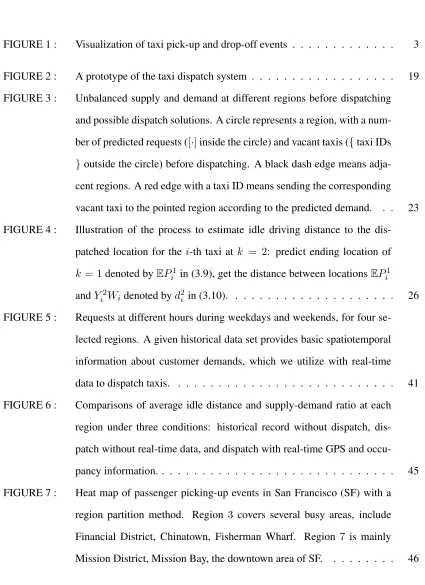
FIGURE 1 : Visualization of taxi pick-up and drop-off events . . . 3
FIGURE 2 : A prototype of the taxi dispatch system . . . 19
FIGURE 3 : Unbalanced supply and demand at different regions before dispatching
and possible dispatch solutions. A circle represents a region, with a
num-ber of predicted requests ([·]inside the circle) and vacant taxis ({taxi IDs
}outside the circle) before dispatching. A black dash edge means
adja-cent regions. A red edge with a taxi ID means sending the corresponding
vacant taxi to the pointed region according to the predicted demand. . . 23
FIGURE 4 : Illustration of the process to estimate idle driving distance to the
dis-patched location for thei-th taxi atk = 2: predict ending location of
k= 1denoted byEPi1in (3.9), get the distance between locationsEPi1
andY2
i Widenoted byd2i in (3.10). . . 26
FIGURE 5 : Requests at different hours during weekdays and weekends, for four
se-lected regions. A given historical data set provides basic spatiotemporal
information about customer demands, which we utilize with real-time
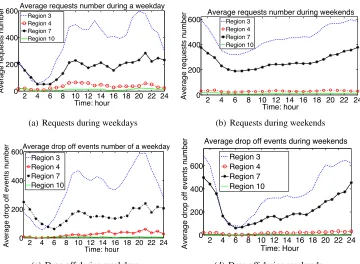
data to dispatch taxis. . . 41
FIGURE 6 : Comparisons of average idle distance and supply-demand ratio at each
region under three conditions: historical record without dispatch,
dis-patch without real-time data, and disdis-patch with real-time GPS and
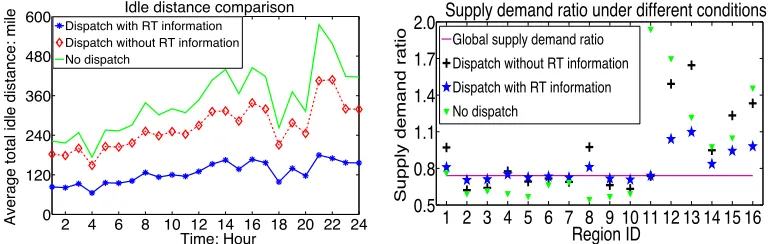
occu-pancy information. . . 45
FIGURE 7 : Heat map of passenger picking-up events in San Francisco (SF) with a
FIGURE 8 : Comparison of supply demand ratio at each region under disruptive events,
for solutions of robust optimization problems (3.12), problem (3.8) in the
RHC framework, and historical data without dispatch. With the roust
dispatch solutions of (3.12), the supply demand ratio mismatch error is
reduced by46%. . . 47 FIGURE 9 : Comparisons of supply-demand ratio at each region and average total
idle distance for differentβkvalues. . . . . 48
FIGURE 10 : Comparison of supply demand ratios at each region during one time slot
for differentαk. When αk is larger, vacant taxis can traverse longer to
dispatched locations and match with customer requests better. . . 49
FIGURE 11 : Average total idle distance of all taxis during one day, for different region
partitions. Idle distance decreases with a larger region-division number,
till the number increases to a certain level. . . 50
FIGURE 12 : Average total idle distance at different time of one day compared for
different prediction horizons.WhenT = 4, idle distance is decreased at most hours compared withT = 2. ForT = 8the costs are worst. . . 51 FIGURE 13 : Comparison of average total idle distance and supply-demand ratio at
each region for differentt2– the length of time slot for updating sensor
information. . . 51
FIGURE 14 : A prototype of the taxi dispatch system . . . 55
FIGURE 15 : A network flow model of the robust taxi dispatch problem. A circle
rep-resents a region with region ID1,2,3,4. We omit the superscript of time
ksince every parameter is for one time slot only. Uncertain demand is
denoted byri,Liis the original number of vacant taxis before dispatch at
regioni, andXij is a dispatch solution that sending the number of vacant
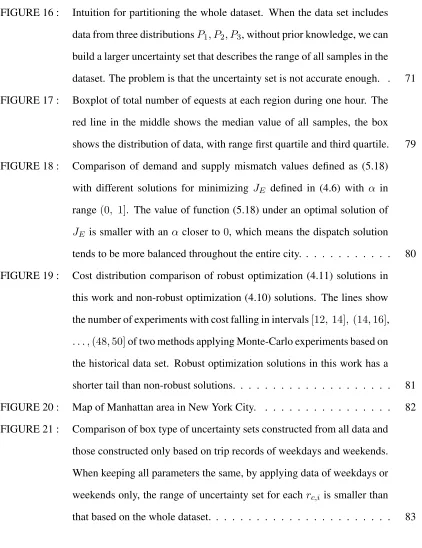
FIGURE 16 : Intuition for partitioning the whole dataset. When the data set includes
data from three distributionsP1, P2, P3, without prior knowledge, we can
build a larger uncertainty set that describes the range of all samples in the
dataset. The problem is that the uncertainty set is not accurate enough. . 71
FIGURE 17 : Boxplot of total number of equests at each region during one hour. The
red line in the middle shows the median value of all samples, the box
shows the distribution of data, with range first quartile and third quartile. 79
FIGURE 18 : Comparison of demand and supply mismatch values defined as (5.18)
with different solutions for minimizing JE defined in (4.6) with α in
range(0, 1]. The value of function (5.18) under an optimal solution of
JE is smaller with anα closer to0, which means the dispatch solution
tends to be more balanced throughout the entire city. . . 80
FIGURE 19 : Cost distribution comparison of robust optimization (4.11) solutions in
this work and non-robust optimization (4.10) solutions. The lines show
the number of experiments with cost falling in intervals[12, 14],(14,16],
. . . ,(48,50]of two methods applying Monte-Carlo experiments based on the historical data set. Robust optimization solutions in this work has a
shorter tail than non-robust solutions. . . 81
FIGURE 20 : Map of Manhattan area in New York City. . . 82
FIGURE 21 : Comparison of box type of uncertainty sets constructed from all data and
those constructed only based on trip records of weekdays and weekends.
When keeping all parameters the same, by applying data of weekdays or
weekends only, the range of uncertainty set for eachrc,iis smaller than
FIGURE 22 : Demand-supply ratio error distribution of the robust optimization
solu-tions with the SOC type of uncertain demand set ( = 0.25, or proba-bilistic guarantee level75%) and non-robust optimization solutions. The demand-supply ratio error of robust solutions is smaller than that of the
non-robust solutions, that the average demand-supply ratio error is
re-duced by31.7%. . . 86 FIGURE 23 : Total idle distance comparison of robust optimization solutions with the
SOC type of uncertain demand set (= 0.25, or probabilistic guarantee level75%) and non-robust optimization solutions. The average total idle distance is reduced by10.13%. For all samples used in testing, the robust dispatch solutions result in no idle distance greater than0.8×105, and non-robust solutions has48%of samples with idle distance greater than 0.8×10⁵. The number of total idle distance shown in this figure is the direct calculation result of the robust dispatch problem, and we convert
the number to an estimated value of corresponding miles in one year, the
result is a total reduction of20million miles in NYC. . . 87 FIGURE 24 : The percentage of tests that have a smaller true dispatch cost than the
optimal cost of the robust dispatch problem with the box and SOC types
of uncertainty sets constructed from data. When1− decreases, the percentage value also decreases, but always greater than1−. . . 87 FIGURE 25 : Comparisons of the optimal cost of the robust dispatch problem with box
and SOC types of uncertainty sets and the average cost when applying
the robust solutions for the test subset of sampledrc. . . 88
FIGURE 27 : The idea of calculatingΣˆ ∈ RKn×Knwhen receding time horizon. For
example, when index moves fromt = 1 tot = 2, only the blocks of components in matrixΣˆ shown in blue are new and necessary for calcu-latingΣˆc(t), t = 2, and we only calculate these blocks of variance and
covariance matrices, store them in the corresponding positions of matrix
ˆ
Σfor the future computing process. . . 99 FIGURE 28 : The average cost of empirical tests for the distributionally robust
dis-patch solutions via solving (5.13), two types of uncertainty sets of the
robust dispatch methods designed in [57] and non-robust dispatch
solu-tions. The line ”DRO” represents the average cost of the distributionally
CHAPTER 1 : Introduction
The number of cities is increasing worldwide and the transformation to smarter cities is taking
place, which bring an array of emerging urbanization challenges [63, 16]. With the development of
technologies such as radio-frequency identification (RFID), sensor networks, storage devices, and
cloud computing, we are able to collect, store, and analyze a large amount of data efficiently [38].
Cities have grown into complex systems saturated by aging infrastructures of increasing running
costs, fading control over private data, and a growing pool of interlinked socio-economic problems
urging for immediate solutions. The United Nations forecasts that by 2050, over six billion people,
or about 66% of the world population, will live in cities or towns [67]. Increased urbanization
worldwide presents a variety of challenges related to the systems integral to any city, such as public
transportation, roads and bridges, water and energy systems, and telecommunications networks.
Future cities will be highly instrumented with sensors and devices that provide almost real-time
updates of various states of cities, including congestions, level of pollutions, or availability of
re-sources. The scaling laws observed in the evolution and growth of the modern cities fundamentally
have brought to life unprecedented opportunities to address these challenges in a data-driven way.
In order to manage the complexity of such urban environments in a smarter way, it is inevitable that
real-time control and decision be implemented based on the state of cities measured by sensors.
1.1. Opportunities with Smart Cities
Intelligent transportation system is one emerging research area, in which sensing data collected
in real time provides us opportunities for understanding spatial-temporal human mobility patterns.
More and more transportation systems are equipped with various sensors and wireless radios to
enable better mobility service, such as intelligent highways, traffic light control, supply chain
man-agement, and autonomous fleets. The embedded sensing and control technologies in these systems
significantly improve their safety and efficiency over traditional systems. Examples include traffic
transporta-tion network efficiency [82].
Based on such rich spatial-temporal information about passenger mobility patterns and demand,
many control solutions have been designed for intelligent transportation systems. Coverage
con-trol and coordination algorithms to allocate groups of autonomous vehicles are presented with
dis-tributed gradient descent algorithms [25]. Dispatch algorithms that aim to minimize customers’
waiting time [85, 47] or to reduce cruising mile [90] have been developed. A smart parking
sys-tem that assigns and reserves an optimal resource (parking space) for a driver based on the driver’s
cost function has been proposed, and the overall efficient utilization of parking capacity is
guaran-teed [35]. Although these works heavily rely on precise passenger-demand models or prior
infor-mation to make dispatch decisions, they show the possibility to improve system’s performance with
information provided by data.
Research and development on autonomous cars is currently very active. Researchers are not only
developing the technology to make autonomous cars a reality, but are also analyzing their potential
impact on urban mobility. By considering average demand predicted based on either historical
or streaming data when making current decisions, vehicle re-balancing and re-allocating costs are
reduced for shared automated vehicles [69, 92]. Similarly, the above mentioned projects of smart
parking systems [35] and coordinating algorithms for groups of vehicles towards demand [25] are
both examples in the autonomous vehicle area. A case study based on Singapore data shows that
autonomous car sharing could reduce the number of passenger vehicles by 60% [81]. These work
provide guidelines and justification for the design of shared-vehicle mobility-on-demand systems.
More work that considers different transportation system design requirements are necessary with
the trend of urbanization and technology development.
Meanwhile, resource allocation schemes with various performance metrics have been designed for
numerous systems in the literature [60], such as wireless networks [31], data-centers [45], power
systems [19], health-care and emergency response systems [30, 32], and transportation systems [35,
81]. Resilience properties of dynamical networks are analyzed for distributed routing policies [23,
(a) New York City (b) San Francisco
Figure 1: Visualization of taxi pick-up and drop-off events
and assumptions about the demand affect the performance of the supply-providing approaches [21,
68]. Based on these exiting methods designed for different service requirements, new frameworks
that deal with resource allocation problems with the paradigm of smart cities can be developed.
1.2. Challenges for Data-Driven Dynamic Resource Allocation of Efficient Transportation
Systems
The ultimate goal of a modern transportation system is to fulfill the mobility requirement of people
and goods while minimizing various operational costs such as greenhouse gas emissions and wears
of the infrastructure. In the context of urban environments, on-demand mobility, including taxicabs
and other ride-sharing services, has gained popularity in recent years due to the rapidly rising
ex-penses of car ownership in cities. Figure 1 shows a visualization of taxi pick-up and drop-off events
in New York City and San Francisco. The operation of on-demand mobility services with limited
service resources, however, is far from optimal — they may result to extra costs and conflicts of
interests to the limited resources in cities.
Though existing works for mobility-on-demand service of autonomous vehicle consider
system-level optimality [92, 69, 81], how to incorporate historical and real-time sensing data to improve
dynamic resource allocation performance or how to deal with demand uncertainties has not been
explicitly studied or empirically tested yet. The challenges considered in this dissertation are as
1.2.1. How to Improve Global Optimality and Efficiency with Predicted Demand
Greedy strategies may increase human satisfaction myopically, while the total utilization is not
optimal under conflict of interests. How to incorporate historical recording data and real-time
sensing information to allocate resources from a system-level optimality perspective is critical
for smart cities, since resource is limited.
Compared with transportation systems such as subway, bus, and trains, ride-sharing or taxi service
is more flexible without a repeated schedule every day, and dispatch decisions should be made in
real time. However, efficient coordination of taxi networks based on the current system state at a
large scale is a challenging task. Traditional taxi networks in metropolitan areas heavily rely on
taxi drivers’ experience to look for passengers on streets to maximize individual profit. However,
such self-interested, uncoordinated behaviors of drivers usually result in spatial-temporal mismatch
between taxi supply and passenger demand. Greedy algorithms are widely employed by large taxi or
ride-sharing service companies, such as finding the nearest vacant taxi to pick up a passenger [51],
or first-come, first-served.
Considering a transportation system such as a taxi dispatch system or an on-demand ride-sharing
system (e.g., uber, lyft and Sidecar), the current applied service usually assigns the driver that
can reach the customer in shortest time once a request appears in the system. Though aiming to
minimize each individual’s waiting time, the total profit is not globally optimal and the service is
not efficient– passengers at over-supplied regions have shorter average waiting time than those at
under-supplied regions, and the service may lose their customer in those under-supplied regions.
Meanwhile, without a system-level regulator, drivers tend to stay within areas that they think there
will be more potential customers, and traverse on streets in hoping to pick up the next passenger
in a short idle distance or idle time based on their own experience. Before a request enters to the
system, drivers do not have ideas where to go, hence, there will be extra idle driving distance,
energy consumption and unnecessary congestion or occupation of the road resources caused by the
behavior of searching passengers. There has not been previous work that considers this type of
based on either existing record data or streaming data. Further more, real-time sensing data provides
update of a vehicle’s status such as location, speed, and vacancy, and shows the mobility pattern of
both vacant and in-service vehicles. How to define the measurement of service quality or efficiency
considering available information provided by data is critical for improving the performance of the
system.
1.2.2. How to Consider Demand Uncertainties in Dynamic Decisions
Given a demand-related dataset, how to formulate a computationally tractable robust
re-source allocation problem under predicted uncertain demand is a rising questions for many
smart city applications.
Previous research has shown that sensing data contains rich information about passenger and taxi
mobility patterns [91, 74, 73]. Moreover, recent studies have shown that the passenger demand
information can be extracted and used to reduce passengers’ waiting time, taxi cruising time, or
fu-ture supply re-balancing cost to serve requests [49, 75, 92]. Meanwhile, considering fufu-ture demand
when making the current dispatch decisions helps to reduce resource re-allocating costs [92, 84].
However, passenger-demand models have their intrinsic model uncertainties that result from many
factors, such as weather, passenger working schedule, and city events etc. Algorithms that do
not consider these uncertainties can lead to inefficient dispatch services, resulting in long waiting
times of under-served passengers, imbalanced workloads, and increased taxi idle mileage. While
robust optimization aims to minimize the worst-case cost under all possible random parameters,
it sacrifices average system performances [2]. It is essential to address the trade-off between the
worst-case system performance guarantee and the average dispatch cost under uncertain demand,
with system performance metric such as service fairness and service allocate/re-allocate cost under
1.2.3. How to Efficiently Construct Spatial-Temporal Demand Uncertainty Sets
How to construct spatial-temporally correlated uncertain demand sets based on a large amount
of data for robust resource allocation problems is beyond the scope of designing an accurate
machine learning algorithm— we need to bridge the gap between machine learning algorithm
and robust optimization methods.
It is difficult to find a very accurate demand model based on data for many applications; even such a
model exists, it may be too complicated to fit the requirement of a computationally tractable robust
optimization problem. Thus, building an uncertain set that includes appropriate information for
robust resource allocation strategies is critical and challenging. The demand uncertainty set should
include information about either the value of the distribution of the random demand to make sure that
the robust solutions based on it provides the desired performance guarantee, and the computational
cost of reaching such robust solutions are not too high for a large-scale system.
Many application areas need a spatial-temporal model of demand uncertainties for regulating the
supply more efficiently. For instance, in the area of clean and renewable energy, an adaptive
ro-bust dispatch method has been designed for wind power systems [52] but no probabilistic guarantee
of the performance is guaranteed. Motivated by portfolio management problems in financial area,
data-driven robust optimization approaches have been developed for independent and identically
distributed (i.i.d.) sampled random vectors in the literature [12, 27, 79, 28]. For transportation
sys-tems such as taxi syssys-tems or autonomous vehicle syssys-tems, no previous work has considered to build
a spatial-temporally correlated demand uncertainty set, or formulate a robust resource allocation
framework given the uncertain predicted demand yet. An efficient modeling algorithm for a large
sensing dataset need to be developed, the performance improvement based on uncertainty demand
sets need to be evaluated based on data.
1.3. Contributions of the Thesis
Our goal is to utilize information provided by a large amount of sensing data to optimize
gap between demand data to dynamic resource allocation decisions, designs both computationally
tractable robust optimal resource allocation models in a real-time framework and uncertain demand
modeling algorithms. With the objective of balancing demand-supply ratio for a fair service, we
prove computationally tractable forms and the corresponding uncertain demand set construction
process. The decision variable of the robust problem is on the denominator, which has not been
covered by previous work in the literature.
Regarding to the specific example of taxi or autonomous ride-sharing car dispatch framework, both
anticipated future idle driving cost and global geographical service fairness are considered, while
fulfilling current, local passenger demand. To accomplish such a goal, we incorporate both system
models learned from historical data and real-time taxi data into a taxi network control framework.
Evaluations based on datasets of metropolitan areas in the US show that the total idle distance of all
taxis is reduced by our framework, and supply is more balanced across different regions of one city.
Contributions of this dissertation are explicitly stated as the following.
1.3.1. A Receding Horizon Control Framework for Real-Time Taxi Dispatch
We design a computationally efficient moving time horizon framework for taxi dispatch with
large-scale real-time information of the taxi network. Our dispatch solutions in this framework consider
future costs of balancing the supply demand ratio under physical constraints. We take a receding
horizon control (RHC) approach to dynamically control taxis in large-scale networks. Future
de-mand is predicted based on either historical taxi data sets [18] or streaming data [91, 62]. The
real-time GPS and occupancy information of taxis is also collected to update supply and demand
information for future estimation. This design iteratively regulates the mobility of idle taxis for high
performance, demonstrating the capacity of large-scale smart transportation management.
The contributions of this domain are as follows.
• To the best of our knowledge, we are the first to design an RHC framework for large-scale
by involving anticipated future idle driving distance for re-balancing supply.
• The framework incorporates large-scale data in real-time control. Sensing data is used to
build predictive passenger demand, taxi mobility models, and serve as real-time feedback for
RHC.
• Extensive trace driven analysis based on a San Francisco taxi data set shows that our
ap-proach reduces average total taxi network idle distance by52%, and the error between local and global supply demand ratio by45%, compared to the actual historical taxi system perfor-mance.
• Spatial-temporal context information such as disruptive passenger demand is formulated as
uncertainty sets of parameters into a robust dispatch problem. This allows the RHC
frame-work to provide more robust control solutions under uncertain contexts. The error between
local and global supply demand ratio is reduced by25%compared with the error of solutions without considering demand uncertainties.
1.3.2. Data-Driven Robust Taxi Dispatch
Though real-time sensing information corrects parts of model prediction error based on the
evalua-tions of the receding horizon control taxi dispatch framework, demand model uncertainty is still one
critical factor that affects the performance of the dispatch algorithm. To consider model uncertainty
with a real-time computable resource allocation approach, we design a promising yet challenging
approach — a robust dispatch framework with an uncertain demand model, called an uncertainty
set, that captures spatial-temporal correlations of demand uncertainties and provides a probabilistic
guarantee (as defined in problem (4.12)). Solving the robust dispatch problem with the constructed
uncertainty set yields a probabilistic guarantee for the optimality of the actual dispatch cost. We
have the freedom to specify a lower bound for the probability that an actual dispatch cost under
the true demand vector being smaller than the optimal cost of the robust dispatch solutions. Hence,
we are able to find a better solution for considering the trade-off between the average dispatch cost
guarantees.
We first develop the objective and constraints of a multi-stage robust dispatch problem considering
spatial-temporally correlated demand uncertainties. The objective of a system-level optimal
dis-patch solution is balancing workload of taxis in each region of the entire city with minimum total
current and expected future idle cruising distance. We then design a data-driven algorithm for
con-structing uncertainty demand sets without assumptions about the true distribution of the demand
vector. The constructing algorithm is based on theories proved for independent and identically
dis-tributed (i.i.d.) sampled random vectors in the robust optimization literature [12, 27, 79]. However,
how to apply these theories for spatial-temporal data and a robust resource allocation form of taxi
dispatch problem based on the constructed spatial-temporally correlated uncertainty sets have not
been explored before. To the best of our knowledge, this is the first work to design a robust taxi
dispatch framework that provides a desired probabilistic guarantee using demand uncertainty sets
built from realistic data.
With two types of uncertainty sets — one box type and one second-order-cone (SOC) type, we
prove equivalent convex optimization forms of the robust dispatch problem via the strong duality
theorem. The robust dispatch problem formulated in this work is convex over the decision
vari-ables and concave over the constructed uncertain sets, with decision varivari-ables on the denominators.
This form is not the standard form (i.e., linear programming (LP) or semi-definite programming
(SDP) problems) that has already been covered by previous work [8, 12, 26]. With proofs shown
in this work, both system performance and computational tractability are guaranteed under
spatial-temporal demand uncertainties. Based on four years of taxi trip data in New York City, we evaluate
factors that affect the accuracy of the uncertainty sets, properties of each type of uncertainty sets,
and trade- off between the probabilistic guarantee levels and the average dispatch costs of robust
dispatch solutions.
The contributions of our work in this domain are:
temporal uncertainties of predicted demand, with the weighted sum of multi- objective of
balancing vacant taxi supply and reducing total idle driving distance.
• We design a data-driven algorithm to construct uncertainty sets that provide a desired level
of probabilistic guarantee for the robust taxi dispatch solutions. We show that the
second-order-cone type of uncertain set provides a smaller average dispatch cost than the box type
via evaluations.
• We prove that there exists an equivalent computationally tractable convex optimization form
for the robust dispatch problem with each type of constructed uncertainty set.
• Evaluations on four years of taxi trip data in New York City show that the average
demand-supply ratio mismatch is reduced by31.7%, and the average total idle distance is reduced by 10.13%or about20million miles annually with robust dispatch solutions.
1.3.3. Data-Driven Dynamic Distributionally Robust Resource Allocation
The knowledge and assumptions about the demand model affect the performance of resource
allo-cation strategies. A robust alloallo-cation scheme shows its advantage in worst-case scenarios compared
with non-robust approaches [2, 54, 52]. Considering the trade-off between system’s average
perfor-mance and worst-case perforperfor-mance, robust taxi dispatch techniques with a probabilistic guarantee
level for an original chance constrained problem are developed and evaluated based on a realistic
dataset [57]. Stochastic programming (SP) is another approach to describe decision-making
prob-lems under uncertain parameters. However, the computational complexity of an SP problem is
not polynomial of the spatial-temporal decision variables, and not scalable for dynamic resource
allocation in general. Moreover, it is difficult to obtain an explicit formulation about the true
dis-tribution function of the random demand purely based on data in practice. Hence, when we are
able to construct a set of distribution functions that includes the true distribution function of the
random demand given a demand dataset, minimizing the expected cost over the worst-case
distri-bution function in the set is a promising approach. Distridistri-butionally robust optimization techniques
To minimize the average resource allocation cost under demand uncertainties, we design a
data-driven distributionally robust dynamic resource allocation model under uncertain spatial-temporally
correlated demand, with an application in taxi dispatch problem given demand data. An efficient
algorithm for constructing an uncertain set of the distribution function based on data without
as-sumptions about prior knowledge is proposed, by utilizing the rolling-horizon property of the
dis-tribution uncertain set. The constructing algorithm is based on theories proved for independent
and identically distributed (i.i.d.) sampled random vectors in hypothesis testing and data-driven
optimization literature [18, 12, 28]. We prove an equivalent computationally tractable form of the
distributionally robust resource allocation problem via strong duality theorem. With proofs shown
in this work, both average performance of the system and computational tractability are guaranteed
under spatial-temporal demand uncertainties.
The contributions of our work in this domain are
• We design an efficient algorithm to construct distributional uncertainty set based on
spatial-temporal demand data for a data-driven dynamic distributionlly robust resource allocation
model.
• We derive an equivalent computationally tractable convex optimization form for a general
form of resource allocation problem with each type of constructed uncertainty set. The
re-source allocation problem aims to balance the demand-supply ratio at different nodes of the
network with minimum balancing and re-balancing cost, with decision variables on the
de-nominator that has not been covered by previous work [8, 12, 28].
• For an example problem of fairly allocating vacant taxis according to uncertain demand at
each region of the city with minimum total idle driving distance, we evaluate the average cost
of the distributionally robust taxi dispatch solutions based on four years taxi trip records of
New York City. Results show that the average demand-supply ratio error is reduced by 28.6%,
1.4. Outline of the Dissertation
The dissertation is organized as follows. Chapter 2 presents a summary of the used notation and
background knowledge from convex optimization, robust optimization and hypothesis testing. We
present the receding horizon control framework that incorporates both historical record and
real-time sensing information in Chapter 3. Chapter 4 addresses the problem of demand uncertainties
with a data-driven robust taxi dispatch framework, and both the process of constructing a demand
uncertainty set from data and computationally tractable robust optimization formulations are
de-signed. Motivated by the efficient transportation problem, Chapter 5 presents a general form of
distributionally robust resource allocation method and an efficient algorithm of constructing
uncer-tainty sets. Finally, in Chapter 6, we give our concluding remarks and highlight some future work
CHAPTER 2 : Background and Notation
In this dissertation, we denote1Nas a lengthNcolumn vector of all1s. Superscripts of variables as
inXk, Xk+1 denote discrete time. We denote thej-th column of matrixXkasXk
·j. For any vector
x, we denote byxT the transpose of x, and x
i as the i-th component of x. For a random vector
y ∈Rn, we denote one sample of theyasy˜. For a differentiable Lagrangian functionL(x, y), we denote∆xL(x, y)as its partial derivative overx.
2.1. Strong Duality of Convex Optimization
We briefly review the strong duality property in convex optimization literature [17], and the proofs
of equivalent computationally tractable forms of the (distributionally) robust resource allocation
problem are based on strong duality. In the following we describe a general standard form
opti-mization problem and its dual, while concrete formulations of both the primal and dual problems
will be defined in the following chapters of this dissertation.
Consider a standard form convex optimization problem [17]
minimize f0(x)
subject to fi(x)60, i= 1, . . . , m
hj(x) = 0, j= 1, . . . , p,
(2.1)
with variablex ∈ Rn, and nonempty domain x ∈ D. The LagrangianL : Rn×Rm ×Rp → R
associated with the primal problem (2.1) is defined as
L(x, λ, v) =f0(x) +
m X
i=1
λifi(x) + p X
j=1
vjhj(x),
with domainL = D ×Rm ×Rp. We refer to the dual variables λ
i andvi as the Lagrange
mul-tiplier associated with theith inequality constraintfi(x) 6 0and equality constraint hj(x) = 0,
Then the (Lagrange) dual functiong:Rm×Rp →Ris defined as the minimum value ofLoverx:
g(λ, v) = inf
x∈DL(x, λ, v) = infx∈D
f0(x) +
m X
i=1
λifi(x) + p X
j=1
vjhj(x)
.
The Lagrange dual problem associated with problem (2.1) is then
maximize g(λ, v)
subject to λ>0.
(2.2)
We denote p∗ as the optimal value of primal problem (2.1), and d∗ as the optimal value of the
dual problem (2.2). The property of weak duality always hold for thed∗ andp∗, that the optimal
value of the Lagrange dual problem is the best lower bound of the optimal value of the primal
problem (2.1),i.e.,
d∗ 6p∗.
The differencep∗−d∗is defined as the optimal duality gap of problem (2.1), and the gap value is
always nonnegative.
2.1.1. Slater’s Constraint Qualification
When the primal convex problem (2.1) satisfies that the equality constraints are affine, orhj(x) = 0
is specified as the formAx =b, the Slater’s condition is defined as: there exists an x ∈ relintD
such that
If the firstlconstraint functionsf1, . . . , flare affine, then the Slater’s condition can be refined as:
there exists anx∈relintDsuch that
fi(x)<0, i= 1, . . . , l, fi(x)<0, i=l+ 1, . . . , m, Ax=b. (2.4)
When a primal convex problem (2.1) satisfies Slater’s condition, strong duality holds [17], and we
have
d∗ =p∗. (2.5)
Proof and examples of convex primal and dual problems when strong duality holds are given in
book [17]; for more details about strong duality please refer to it.
It is worth noting that when the primal problem is a convex maximization problem, then the dual
problem is a minimization form. The process of finding the dual form is similar as defined above.
2.2. Hypothesis Testing
We briefly review the general process of a hypothesis testing that designed for i.i.d. samples. The
algorithms of building demand uncertain sets in this dissertation are based on hypothesis testing.
Hypothesis testing is a widely applied technique to examine the property of a data set [48]. A
hypothesis testing starts from a given null-hypothesisH0 that makes a claim about an unknown
distributionP∗, and we need to decide whether to acceptH0or reject it, based on a data setSdrawn
fromP∗. The fact that a null-hypothesis is false means there is no sufficient evidence to determine
its validity.
A typical test designs a statistic T ≡ T(S, H0), and a threshold Γ ≡ Γ(αh,S, H0), whereαh
CHAPTER 3 : Real-Time Resource Allocation in Smart Cities: A Receding Horizon
Control Approach
3.1. Introduction
Traditional taxi systems in metropolitan areas often suffer from inefficiencies due to uncoordinated
actions as system capacity and customer demand change. With the pervasive deployment of
net-worked sensors in modern vehicles, large amounts of information regarding customer demand and
system status can be collected in real time. This information provides opportunities to perform
various types of control and coordination for large-scale intelligent transportation systems. In this
chapter, we present a receding horizon control (RHC) framework to dispatch taxis, which
incor-porates highly spatiotemporally correlated demand/supply models and real-time GPS location and
occupancy information. The objectives include matching spatiotemporal ratio between demand
and supply for service quality with minimum current and anticipated future taxi idle driving
dis-tance. Extensive trace-driven analysis with a data set containing taxi operational records in San
Francisco shows that our solution reduces the average total idle distance by52%, and reduces the supply demand ratio error across the city during one experimental time slot by45%. Moreover, our RHC framework is compatible with a wide variety of predictive models and optimization problem
formulations. This compatibility property allows us to solve robust optimization problems with
corresponding demand uncertainty models that provide disruptive event information.
The rest of this chapter is organized as follows. The background of taxi monitoring system and
control problems are introduced in Section 3.3. The taxi dispatch problem is formally formulated
in Section 3.4, followed by the RHC framework design in Section 3.5 and a multi-level dispatch
framework in Section 3.5.2. A case study with a real taxi data set from San Francisco to evaluation
3.2. Related Work
There are three categories of research topics related to the work of this chapter: taxi dispatch
sys-tems, transportation system modeling, and multi-agent coordination and control.
A number of recent works study approaches of taxi dispatching services or allocating transportation
resources in modern cities. Zhang and Pavone [92] designed an optimal rebalancing method for
autonomous vehicles, which considers both global service fairness and future costs, but they didn’t
take idle driving distance and real-time GPS information into consideration. Truck schedule
meth-ods to reduce costs of idle cruising and missing tasks are designed in the temporal perspective in
work [87], but the real-time location information is not utilized in the algorithm. Seow et.al focus
on minimizing total customer waiting time by concurrently dispatching multiple taxis and allowing
taxis to exchange their booking assignments [78]. A shortest time path taxi dispatch system based
on real-time traffic conditions is proposed by Lee et.al [47]. In [76, 43, 75], authors aim to maximize
drivers’ profits by providing routing recommendations. These works give valuable results, but they
only consider the current passenger requests and available taxis. Our design uses receding horizon
control to consider both current and predicted future requests.
Various mobility and vehicular network modeling techniques have been proposed for transportation
systems [22, 15]. Researchers have developed methods to predict travel time [34, 41] and traveling
speed [5], and to characterize taxi performance features [49]. A network model is used to describe
the demand and supply equilibrium in a regulated market is investigated [86]. These works provide
insights to transportation system properties and suggest potential enhancement on transportation
system performance. Our design takes a step further to develop dispatch methods based on available
predictive data analysis.
There is a large number of works on mobility coordination and control. Different from taxi
ser-vices, these works usually focus on region partition and coverage control so that coordinated agents
can perform tasks in their specified regions [25, 3, 42]. Aircraft dispatch system and air traffic
and design objectives are different from taxi dispatching problem. Also, receding horizon control
(RHC) has been widely applied for process control, task scheduling, and multi-agent transportation
networks [64, 46, 50]. These works provide solid results for related mobility scheduling and control
problems. However, none of these works incorporates both the real-time sensing data and historical
mobility patterns into a receding horizon control design, leveraging the taxi supply based on the
spatiotemporal dynamics of passenger demand.
Remark 1 The results from this chapter have been captured in [59, 56].
3.3. Taxi Dispatch Problem: Motivation and System
Taxi networks provide a primary transportation service in modern cities. Most street taxis respond
to passengers’ requests on their paths when passengers hail taxis on streets. This service model has
successfully served up to 25% public passengers in metropolitan areas, such as San Francisco and
New York [39, 65]. However, passenger’s waiting time varies at different regions of one city and taxi
service is not satisfying. In the recent years, ”on demand” transportation service providers like Uber
and Lyft aim to connect a passenger directly with a driver to minimize passenger’s waiting time.
This service model is still uncoordinated, since drivers may have to drive idly without receiving
any requests, and randomly traverse to some streets in hoping to receive a request nearby based on
Passenger Distribution
Taxi Mobility
Real-Time Control
Pickup & Delivery Dispatch Center
Cellular Ratio
GPS
Occupancy Sensing
experience.
Our goal in this work is a centralized dispatch framework to coordinate service behavior of
large-scale taxi Cyber-Physical system. The development of sensing, data storage and processing
tech-nologies provide both opportunities and challenges to improve existing taxi service in metropolitan
areas. Figure 14 shows a typical monitoring infrastructure, which consists of a dispatch center
and a large number of geographically distributed sensing and communication components in each
taxi. The sensing components include a GPS unit and a trip recorder, which provides real-time
ge-ographical coordinates and occupancy status of every taxi to the dispatch center via cellular radio.
The dispatch center collects and stores data. Then, the monitoring center runs the dispatch
algo-rithm to calculate a dispatch solution and sends decisions to taxi drivers via cellular radio. Drivers
are notified over the speaker or on a special display.
Given both historical data and real-time taxi monitoring information described above, we are
ca-pable to learn spatiotemporal characteristics of passenger demand and taxi mobility patterns. This
paper focuses on the dispatch approach with the model learned based on either historical data or
streaming data. One design requirement is balancing spatiotemporal taxi supply across the whole
city from the perspective of system performance. It is worth noting that heading to the allocated
position is part of idle driving distance for a vacant taxi. Hence, there exists trade-off between
the objective of matching supply and demand and reducing total idle driving distance. We aim at
a scalable control framework that directs vacant taxis towards demand, while balancing between
minimum current and anticipated future idle driving distances.
3.4. Taxi Dispatch Problem Formulation
Informally, the goal of our taxi dispatch system is to schedule vacant taxis towards predicted
passen-gers both spatially and temporally with minimum total idle mileage. We use supply demand ratio
of different regions within a time period as a measure of service quality, since sending more taxis
for more requests is a natural system-level requirement to make customers at different locations
allocation problems, and autonomous driving car mobility control approach [92].
The dispatch center receives real-time sensing streaming data including each taxi’s GPS location
and occupancy status with a time stamp periodically. The real-time data stream is then processed
at the dispatch center to predict the spatiotemporal patterns of passenger demand. Based on the
prediction, the dispatch center calculates a dispatch solution in real-time, and sends decisions to
vacant taxis with dispatched regions to go in order to match predicted passenger demands.
Besides balancing supply and demand, another consideration in taxi dispatch is minimizing the
total idle cruising distance of all taxis. A dispatch algorithm that introduces large idle distance in
the future after serving current demands can decrease total profits of the taxi network in the long
run. Since it is difficult to perfectly predict the future of a large-scale taxi service system in practice,
we use a heuristic estimation of idle driving distance to describe anticipated future cost associated
with meeting customer requests. Considering control objectives and computational efficiency, we
choose a receding horizon control approach. We assume that the optimization time horizon isT,
indexed byk= 1, . . . , T, given demand prediction during time[1, T].
3.4.1. Supply and demand in taxi dispatch
We assume that the entire area of a city is divided intonregions such as administrative sub-districts.
We also assume that within a time slotk, the total number of passenger requests at thej-th region
is denoted byrk
j. We also userk ,[r1k, . . . , rkn]∈R1×nto denote the vector of all requests. These
are the demands we want to meet during timek = 1, . . . , T with minimal idle driving cost. Then the total number of predicted requests in the entire city is denoted by
Rk =
n X
j=1
rkj.
We assume that there are totalN vacant taxis in the entire city that can be dispatched according to
the real-time occupancy status of all taxis. The initial supply information consists of real-time GPS
position of all available taxis, denoted byP0 ∈
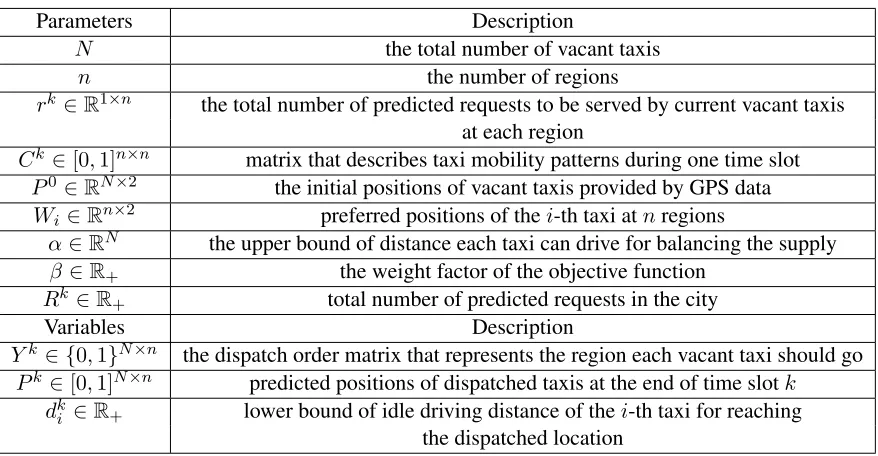
Parameters Description
N the total number of vacant taxis
n the number of regions
rk∈
R1×n the total number of predicted requests to be served by current vacant taxis
at each region
Ck∈[0,1]n×n matrix that describes taxi mobility patterns during one time slot P0∈
RN×2 the initial positions of vacant taxis provided by GPS data Wi∈Rn×2 preferred positions of thei-th taxi atnregions
α∈RN the upper bound of distance each taxi can drive for balancing the supply β∈R+ the weight factor of the objective function
Rk∈
R+ total number of predicted requests in the city
Variables Description
Yk∈ {0,1}N×n the dispatch order matrix that represents the region each vacant taxi should go Pk∈[0,1]N×n predicted positions of dispatched taxis at the end of time slotk
dk
i ∈R+ lower bound of idle driving distance of thei-th taxi for reaching the dispatched location
Table 1: Parameters and variables of the RHC problem (3.8).
the position of thei-th vacant taxi. While the dispatch algorithm does not make decisions for
occu-pied taxis, information of occuoccu-pied taxis affects the predicted total demand to be served by vacant
taxis, and the interaction between the information of occupied taxis and our dispatch framework
will be discussed in section 3.5.
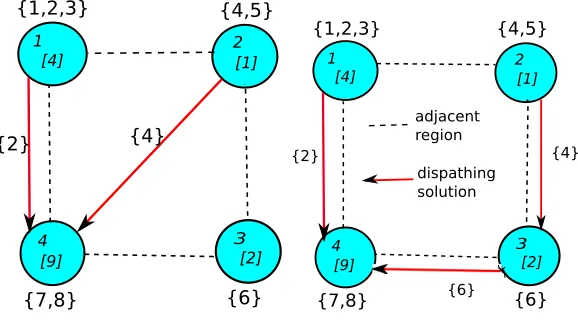
The basic idea of the dispatch problem is illustrated in Figure 3. Specifically, each region has a
predicted number of requests that need to be served by vacant taxis, as well as locations of all vacant
taxis with IDs given by real-time sensing information. We would like to find a dispatch solution that
balances the supply demand ratio, while satisfying practical constraints and not introducing large
current and anticipated future idle driving distance. Once dispatch decisions are sent to vacant taxis,
the dispatch center will wait for future computing a new decision problem until updating sensing
information in the next period.
3.4.2. Optimal dispatch under operational constraints
The decision we want to make is the region each vacant taxi should go. With the above initial
information about supply and predicted demand, we define a binary matrixYk ∈ {0,1}N×nas the
dispatch order matrix, whereYk
1
3 4
[4] 2[1]
[2] [9]
{6}
{2} {4}
{1,2,3} {4,5}
{7,8}
(a) A dispatch solution – taxi2goes to region4, and taxi4goes to region4.
1
3 4
[4] 2[1]
[2] [9]
{2} {4}
{6}
{1,2,3} {4,5}
{6} {7,8}
adjacent region dispathing solution
(b) A dispatch solution – taxi2goes to region4, taxi4goes to region3, and taxi 6goes to region4.
Figure 3: Unbalanced supply and demand at different regions before dispatching and possible dis-patch solutions. A circle represents a region, with a number of predicted requests ([·]inside the circle) and vacant taxis ({ taxi IDs } outside the circle) before dispatching. A black dash edge means adjacent regions. A red edge with a taxi ID means sending the corresponding vacant taxi to the pointed region according to the predicted demand.
k. Then
Yk1n=1N, k= 1, . . . , T
must be satisfied, since every taxi should be dispatched to one region during timek.
Two objectives
One design requirement is to fairly serve the customers at different regions of the city — vacant taxis
should be allocated to each region according to predicted demand across the entire city during each
time slot. To measure how supply matches demand at different regions, we use the metric—supply
demand ratio. For regionj, its supply demand ratio for time slotkis defined as the total number of
vacant taxis decided by the total number of customer requests during time slotk. When the supply
j= 1, . . . , n,k= 1, . . . , T,
1TNYk ·j rk
j
= N
Rk, ⇐⇒
1TNYk ·j
N =
rk j
Rk, (3.1)
For convenience, we rewrite equation (3.1) as the following equation about two row vectors
1
N1 T NYk=
1
Rkr
k, k= 1,· · · , T. (3.2)
However, equation (3.2) can be too strict if used as a constraint, and there may be no feasible
solu-tions satisfying (3.2). This is because decision variablesYk, k= 1, . . . , T are integer matrices, and
taxis’ driving speed is limited that they may not be able to serve the requests from any arbitrary
re-gion during time slotk. Instead, we convert the constraint (3.2) into a soft constraint by introducing
a supply-demand mismatch penalty functionJE for the requirement that the supply demand ratio
should be balanced across the whole city, and one objective of the dispatch problem is to minimize
the following function
JE = T X k=1 1 N1 T NYk−
1
Rkr k 1 . (3.3)
The other objective is to reduce total idle driving distance of all taxis. The process of traversing
from the initial location to the dispatched region will introduce an idle driving distance for a vacant
taxi, and we consider to minimize such idle driving distance associated with meeting the dispatch
solutions.
We begin with estimate the total idle driving distance associated with meeting the dispatch solutions.
For the convenience of routing process, the dispatch center is required to send the GPS location of
the destination to vacant taxis. The decision variableYkonly provides the region each vacant taxi
should go, hence we map the region ID to a specific longitude and latitude position for every taxi.
In practice, there are taxi stations on roads in metropolitan areas, and we assume that each taxi has a