
ANTIOXIDANT POTENTIAL OF VARIOUS EXTRACTS FROM WHOLE PLANTS OF DOLICHOS BIFLORUS (LINN) EVALUATED BY THREE IN VITRO METHODS
5
0
0
Full text
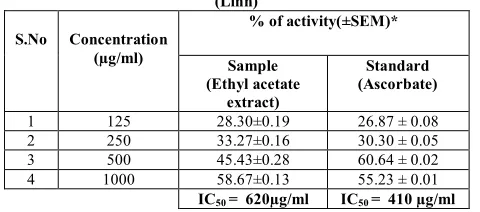
(2) A. Kottai Muthu et al. IRJP 2 (3) 2011 252-256 MATERIAL AND METHODS Collection and Identification of Plant materials The whole plant of Dolichos biflorus (Linn), were collected form Sankaran koil, Tirunelveli District of Tamil Nadu, India. Taxonomic identification was made from Botanical Survey of Medical Plants Unit Siddha, Government of India. Palayamkottai. The whole plant of Dolichos biflorus (Linn), were dried under shade, segregated, pulverized by a mechanical grinder and passed through a 40 mesh sieve. Preparation of Extracts The above powered materials were successively extracted with Petroleum ether (40-600C) by hot continuous percolation method in Soxhlet apparatus13for 24 hrs. Then the marc was subjected to Ethyl acetate (76780C) for 24 hrs and then marc was subjected to Methanol for 24 hrs. The extracts were concentrated by using a rotary evaporator and subjected to freeze drying in a lyophilizer till dry powder was obtained. Evaluation of Antioxidant activity by in vitro Techniques: Total antioxidant activity (Phosphomolybdic acid method) 14 The antioxidant activity of the sample was evaluated by the transformation of Mo (VI) to Mo (V) to form phosphomolybdenum complex (Prieto et al., 1999)14. An aliquot of 0.4 ml of sample solution was combined in a vial with 4 ml of reagent solution (0.6 M sulfuric acid, 28 mM sodium phosphate and 4 mM ammonium molybdate). The vials were capped and incubated in a water bath at 950C for 90 min. After the samples had cooled to room temperature, the absorbance of the mixture was measured at 695 nm against a blank. The antioxidant activity was expresses relative to that of ascorbic acid. FRAP assay A modified method of Benzie and Strain (1996)15 was adopted for the FRAP assay. The stock solutions included 300 mM acetate buffer, pH 3.6, 10 mM TPTZ (2, 4, 6-tripyridyl-S-triazine) solution in 40 mMHCl and 20 mMFecl3. 6H2O. The fresh working solution was prepared by mixing 25 ml acetate buffer, 2.5 ml TPTZ and 2.5 ml Fecl3.6H2O. The temperature of the solution was raised to 370 C before using. Plant extracts (0.15 ml) were allowed to react with 2.85 ml of FRAP solution for 30 min in the dark condition. Readings of the colored product (Ferrous tripyridyltriazine complex) were taken at 593 nm. The standard curve was linear between 200 and 1000 µM Feso4. Results are expressed in µM (Fe (II) /g dry mass and compared with that of ascorbic acid.. IRJP 2 (3) Mar 2011. Iron chelating activity The method of Benzie and strain (1996)15 was adopted for the assay. The principle is based on the formation of O-Phenanthroline-Fe2+ complex and its disruption in the presence of chelating agents. The reaction mixture containing 1 ml of 0.05% O-Phenanthroline in methanol, 2 ml ferric chloride (200µM) and 2 ml of various concentrations ranging from 10 to 1000µg was incubated at room temperature for 10 min and the absorbance of the same was measured at 510 nm. EDTA was used as a classical metal chelator. The experiment was performed in triplicates. RESULTS AND DISCUSSION Total antioxidant activity (Phosphomolybdic acid method) The percentage of total antioxidant activity of petroleum ether extract of Dolichos biflorus depicted in Table 1. The petroleum ether extract of Dolichos biflorus exhibited a maximum total antioxidant activity of 51.58% at 1000 µg/ml whereas for ascorbate (standard) was found to be 55.23 % at 1000 µg/ml. The IC50values of the petroleum ether extract of Dolichos biflorus and ascorbate were found to be 970µg/ml and 410µg/ml respectively. The percentage of total antioxidant activity of ethyl acetate extract of Dolichos biflorus depicted in Table 2. The ethyl acetate extract of Dolichos biflorus exhibited a maximum total antioxidant activity of 58.67% at 1000 µg/ml whereas for ascorbate (standard) was found to be 55.23 % at 1000 µg/ml. The IC50values of the ethyl acetate extract of Dolichos biflorus and ascorbate were found to be 620µg/ml and 410µg/ml respectively. The percentage of total antioxidant activity of methanolic extract of Dolichos biflorus presented in Table 3. The methanolic extract of Dolichos biflorus exhibited a maximum total antioxidant activity of 79.38% at 1000 µg/ml whereas for ascorbate (standard) was found to be 55.23 % at 1000 µg/ml. The IC50 of the methanolic extract of Dolichos biflorus and ascorbate were found to be 260µg/ml and 410µg/ml respectively. Based on the result clearly indicated methanolic extract of Dolichos biflorus was found to be more effective than that other two extracts. But when compare all the extracts with standard the methanolic extract of Dolichos biflorus was found strong antioxidant activity. The IC50 of the methanolic extract of Dolichos biflorus and ascorbate were found to be 260µg/ml and 410µg/ml respectively. FRAP assay The reducing capacity of a compound may serve as a significant indicator of its potential antioxidant activity.. Page 252-256.
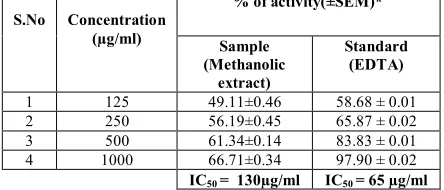
(3) A. Kottai Muthu et al. IRJP 2 (3) 2011 252-256 The FRAP assay showed greater variability between various extracts. Table 4 was illustrated the FRAP values of petroleum ether extract of Dolichos biflorus and ascorbate at various concentrations (125, 250, 500, 1000 µg/ml). The maximum reducing ability at 1000µg/ml for petroleum ether extract and ascorbate were found to be 48.33% and 98.07% respectively. The IC50 values of petroleum ether extract and ascorbate were recorded as 1050µg/ml and 50µg/ml respectively. The reducing ability of the ethyl acetate extract of Dolichos biflorus and ascorbate at various concentrations (125, 250, 500, 1000 µg/ml) were examined and the values were illustrated in Table 5. The maximum reducing ability at 1000µg/ml for ethyl acetate extract and ascorbate were found to be 57.42% and 98.07% respectively. The IC50 values of ethyl acetate extract and ascorbate were recorded as 780µg/ml and 50µg/ml respectively. The reducing ability of the methanolic extract of Dolichos biflorus and ascorbate at various concentrations (125, 250, 500, 1000 µg/ml) were examined and the values were illustrated in Table 6. The maximum reducing ability at 1000µg/ml for methanolic extract and ascorbate were found to be 75.74% and 98.07% respectively. The IC50 values of methanolic extract and ascorbate were recorded as 180µg/ml and 50µg/ml respectively. Based on the above results indicated, the methanolic extract of Dolichos biflorus was found to most effective than that of petroleum ether & ethyl acetate extract. But when compare to the all the three extracts with ascorbate (standard), the methanolic extract of the Dolichos biflorus showed the moderate result. Iron chelating activity Iron is essential for life because it is required for oxygen transport, respiration and activity of many enzymes. However, iron is an extremely reactive metal and catalyzes oxidative changes in lipids, proteins and other cellular components16. Iron binding capacity of the petroleum ether extract of Dolichos biflorus and the metal chelator EDTA at various concentrations (125, 250, 500, 1000 µg/ml) were examined and the values were summarized in Table 7.Maximum chelating of metal ions at 1000µg/ml for plant extract and EDTA were found to be 47.58% and 97.90% respectively. The IC50 value of plant extract and EDTA were recorded as 1050µg/ml and 65µg/ml respectively. Iron binding capacity of the ethyl acetate extract of Dolichos biflorus and the metal chelator EDTA at various concentrations (125, 250, 500, 1000 µg/ml) were examined and the values were presented in table 8.. IRJP 2 (3) Mar 2011. Maximum chelating of metal ions at 1000µg/ml for plant extract and EDTA were found to be 61.37% and 97.90% respectively. The IC50 value of plant extract and EDTA were recorded as 590µg/ml and 65µg/ml respectively. Iron binding capacity of the methanolic extract of Dolichos biflorus and the metal chelator EDTA at various concentrations (125, 250, 500, 1000 µg/ml) were examined and the values were presented in table 9. Maximum chelating of metal ions at 1000µg/ml for plant extract and EDTA was found to be 66.71% and 97.90% respectively. The IC50 value of plant extract and EDTA was recorded as 130µg/ml and 65µg/ml respectively. Based on the findings clearly indicated that, the methanolic extract of Dolichos biflorus had showed more effective metal chelating activity than that of other two extracts. CONCLUSION In the present work, the high antioxidant capacity observed for methanolic extract of whole plant of Dolichos biflorus (Linn) suggest that it may play a role in preventing human diseases in which free radicals are involved, such as cancer, ageing and cardiovascular diseases. However, further studies are needed to isolate active principles responsible for the overall antioxidant activity of the extract. REFERENCES 1. Ames BN, Shigenega MK, Hagen TM. Oxidants and the degenerative diseases of ageing. Proc Nati Acad Sci, 1993; 90: 7915 – 22. 2. Shenoy R, Shirwaikar A. Anti-inflammatory and free radical scavenging studies of Hyptis suaveolens (labiatae). Indian drugs,2002; 39: 574 – 577. 3. Patil S, Jolly CI, Narayanan S. Free radical scavenging activity of acacia catechu and Rotula aquatica: implications in cancer therapy. Indian drugs, 2003; 40: 328 – 332. 4. Orhan I, Kartal M, Sezer M, Şenol FS, Yilmaz G, Şener BS. Free radical scavenging properties and phenolic characterization of some edible plants. Food Chem, 2009; 114: 276-281. 5. Siddhuraju P, Becker K. The antioxidant and free radical scavenging activities of processed cowpea (Vigna unguiculata (L.) Walp.) seed extracts. Food Chem, 2007; 101: 10-19. 6. Sastri BN. The Wealth of India, Raw Materials, Information and Publication Directorate. CSIR, New Delhi, 1969,Vol III, 101. 7. Garimella TS, Jolly CI, Narayanan S. In vitro studies on antilithiatic activity of seeds of Dolichos biflorus Linn. and rhizomes of Bergenia ligulata Wall. Phytother. Res, 2001; 15: 351-355. 8. Laskar S, Bhattarcharyya UK, Sinhababu A, Basak BK. Antihepatotoxic activity of kulthi (Dolichos biflorus) seed in rats. Fitoterapia, 1998; 69: 401-402. 9. Muthu AK, Sethupathy S, Manavalan R, Karar PK. Hypolipidemic effect of methanolic extract of Dolichos biflorus Linn. In high fat diet fed rats. Indian J. Exp. Biol,2005; 43: 522-525.. Page 252-256.
(4) A. Kottai Muthu et al. IRJP 2 (3) 2011 252-256 10. Pant MC, Uddin I, Bhardwaj UR, Tewari RD. Blood sugar and total cholesterol lowering effect of Glucine soja (Sieb. and Zucc.), Mucuna pruriens (D.C.) and Dolichos biflorus (Linn.) seed diets in normal fasting albino rats. Indian J. Med. Res, 1968; 56: 1808-1812. 11. Pattanaik N, Singh AV, Pandey RS, Singh BK, Kumar M, Dixit SK, Tripathi YB. Toxicology and free radicals scavenging property of tamra bhasma. Indian J. Clin. Biochem, 2003; 18: 181-189. 12. Rao M, Rao PNP, Kamath R, Rao MNA. Reduction of cisplastininduced nephrotoxicity by cistone, a polyherbal Ayurvedic reparation, in C57BL/6J mice bearing B16F1 melanoma without reducing its antitumor activity. J. Ethnopharmacol, 1999; 68: 77-81. 13. Harborne JB. Phytochemical methods 11 Edn. In Chapman &, Hall. New York, 1984, 4-5. 14. Prieto P, Pineda M, Aguilar M. Spectrophotometric quantitation of antioxidant capacity through the formation of a Phosphomolybdenum Complex: Specific application to the determination of vitamin E. Anal. Biochem, 1999; 269:337341. 15. Benzie IEF and Strain JJ. The ferric reducing ability of plasma (FRAP) as a measure of “antioxidant power”: the FRAP assay. Anal Biochem,1996; 239: 70-76. 16. Smith C, Halliwell B, Aruoma OI. Protection by albumin against the pro-oxidation actions of phenolic dietary components. Food Chem Toxicol, 1992; 30: 483-489.. Table 3: Total antioxidant activity of Methanolic extract of Dolichos biflorus (Linn) % of activity(±SEM)* S.No Concentration (µg/ml) Sample Standard. Table 1: Total antioxidant activity of Petroleum ether extract of Dolichos biflorus (Linn) % of activity(±SEM)* S.No Concentration (µg/ml) Sample Standard. (Ethyl acetate (Ascorbate) extract) 125 16.35±0.21 72.04 ± 0.01 1 2 250 33.55±0.24 82.05 ± 0.03 3 500 42.66±0.14 86.04 ± 0.02 4 1000 57.42±0.24 98.07 ± 0.04 IC50 = IC50 = 50 780µg/ml µg/ml *All values are expressed as mean ± SEM for three determinations. 1 2 3 4. 125 250 500 1000. (Petroleum ether extract) 19.65±0.11 26.76±0.91 42.71±0.26 51.58±0.14 IC50 = 970µg/ml. (Ascorbate) 26.87 ± 0.08 30.30 ± 0.05 60.64 ± 0.02 55.23 ± 0.01 IC50 = 410 µg/ml. (Methanolic (Ascorbate) extract) 1 125 24.63±0.39 26.87 ± 0.08 2 250 49.76±0.31 30.30 ± 0.05 3 500 72.71±0.26 60.64 ± 0.02 4 1000 79.38±0.14 55.23 ± 0.01 IC50 = 410 IC50 = 260µg/ml µg/ml *All values are expressed as mean ± SEM for three determinations Table 4: FRAP assay of Petroleum ether extract of Dolichos biflorus (Linn) % of activity(±SEM)* S.No Concentration (µg/ml) Sample Standard (Petroleum (Ascorbate) ether extract) 1 125 13.42±0.32 72.04 ± 0.01 2 250 35.33±0.19 82.05 ± 0.03 500 41.71±0.21 86.04 ± 0.02 3 4 1000 48.33±0.03 98.07 ± 0.04 IC50 = IC50 = 50 µg/ml 1050µg/ml *All values are expressed as mean ± SEM for three determinations Table 5: FRAP assay of Ethyl acetate extract of Dolichos biflorus (Linn) % of activity(±SEM)* S.No Concentration (µg/ml) Standard Sample. Table 6: FRAP assay of Methanolic extract of Dolichos biflorus (Linn) % of activity(±SEM)* S.No Concentration (µg/ml) Standard Sample. *All values are expressed as mean ± SEM for three determinations. Table 2: Total antioxidant activity of Ethyl acetate extract of Dolichos biflorus (Linn) % of activity(±SEM)* S.No Concentration (µg/ml) Sample Standard 1 2 3 4. 125 250 500 1000. (Ethyl acetate extract) 28.30±0.19 33.27±0.16 45.43±0.28 58.67±0.13 IC50 = 620µg/ml. (Ascorbate) 26.87 ± 0.08 30.30 ± 0.05 60.64 ± 0.02 55.23 ± 0.01 IC50 = 410 µg/ml. (Ascorbate). 72.04 ± 0.01 2 250 65.02±0.13 82.05 ± 0.03 3 500 71.55±0.60 86.04 ± 0.02 4 1000 75.74±0.34 98.07 ± 0.04 IC50 = 50 IC50 = 180 µg/ml µg/ml *All values are expressed as mean ± SEM for three determinations 1. 125. (Methanolic extract) 40.53±0.21. *All values are expressed as mean ± SEM for three determinations. IRJP 2 (3) Mar 2011. Page 252-256.
(5) A. Kottai Muthu et al. IRJP 2 (3) 2011 252-256 Table 7: Effect of Petroleum ether extract of Dolichos biflorus (Linn) on Ironchelating method % of activity(±SEM)* S. Concentration No (µg/ml) Sample Standard. Table 8: Effect of Ethyl acetate extract of Dolichos biflorus (Linn) on Ironchelating method % of activity(±SEM)* S.No Concentration (µg/ml) Sample Standard. (Petroleum (EDTA) ether extract) 1 125 18.83±0.89 58.68 ± 0.01 2 250 29.45±0.12 65.87 ± 0.02 3 500 33.54±0.74 83.83 ± 0.01 4 1000 47.58±0.16 97.90 ± 0.02 IC50 = 65 µg/ml IC50 = 1050 µg/ml *Data presented as the mean ± SEM of three measurements.. (Ethyl acetate (EDTA) extract) 1 125 32.54±0.68 58.68 ± 0.01 2 250 39.67±0.87 65.87 ± 0.02 3 500 48.68±0.18 83.83 ± 0.01 4 1000 61.37±0.75 97.90 ± 0.02 IC50 = 65 IC50 = 590µg/ml µg/ml *Data presented as the mean ± SEM of three measurements.. Table 9: Effect of Methanolic extract of Dolichos biflorus (Linn) on Iron-chelating method % of activity(±SEM)* S.No Concentration (µg/ml) Standard Sample (Methanolic (EDTA) extract) 125 49.11±0.46 58.68 ± 0.01 1 2 250 56.19±0.45 65.87 ± 0.02 3 500 61.34±0.14 83.83 ± 0.01 4 1000 66.71±0.34 97.90 ± 0.02 IC50 = 130µg/ml IC50 = 65 µg/ml *Data presented as the mean ± SEM of three measurements.. Source of support: Nil, Conflict of interest: None Declared. IRJP 2 (3) Mar 2011. Page 252-256.
(6)
Figure
Related documents
Methods: We searched MedLine using PubMed in order to retrieve and thematically analyze full- length scholarly journal papers or case reports dealing with religious traditions
19% serve a county. Fourteen per cent of the centers provide service for adjoining states in addition to the states in which they are located; usually these adjoining states have
2015, the waters of the Ébrié lagoon were generally of poor quality for the different uses examined 25.. in this study (aquaculture, irrigation, watering and sport and recreation)
Therefore, "The Raft of the Medusa" can be considered a representation of the sublime, by Burke's standards, if the subject matter and elements of the painting pose
I want my art to convey both meanings, I want my art to be heard as a protest against discrimination, in favor of human rights, and I want my art to be a ritual, a prayer for
According to Sadyohutomo (2008); Mutaáli (2012); Umar and Dewata (2017), that high population growth in a region will create conflicts between land use. Changes in the
Hospital admission is considered a risk (especially for older patients), which increases with age [1]. Among 70- year olds who are admitted in the hospital, 35% show functional loss
Methods: An online survey of practicing Australian physiotherapists was conducted to investigate knowledge of the Australian Physical Activity and Sedentary Behaviour (PASB)
