Open Access
Research
Self-administration and interviewer-administration of the German
Chronic Respiratory Questionnaire: instrument development and
assessment of validity and reliability in two randomised studies
Milo A Puhan*
1, Michaela Behnke
2, Martin Frey
3, Thomas Grueter
3,
Otto Brandli
4, Alfred Lichtenschopf
5, Gordon H Guyatt
6and
Holger J Schunemann
6,7Address: 1Horten Centre, University Hospital of Zurich, Postfach Nord CH-8091 Zurich, Switzerland, 2Ordinariat und Institut für Arbeitsmedizin,
University of Hamburg, Germany, 3Klinik Barmelweid, Barmelweid, Switzerland, 4Zuercher Hoehenklinik Wald, Faltigberg-Wald, Switzerland, 5Rehabilitationszentrum, Weyer/Enns, Austria, 6Department of Clinical Epidemiology and Biostatistics, McMaster University, Hamilton, Ontario,
Canada and 7Departments of Medicine and of Social & Preventive Medicine, University at Buffalo, New York, USA
Email: Milo A Puhan* - [email protected]; Michaela Behnke - [email protected];
Martin Frey - [email protected]; Thomas Grueter - [email protected]; Otto Brandli - [email protected]; Alfred Lichtenschopf - [email protected]; Gordon H Guyatt - [email protected]; Holger J Schunemann - [email protected] * Corresponding author
COPDHealth Related Quality of LifeChronic Respiratory QuestionnaireStandardisationSelf-Administration
Abstract
Background: Assessment of health-related quality of life (HRQL) is important in patients with chronic obstructive pulmonary disease (COPD). Despite the high prevalence of COPD in Germany, Switzerland and Austria there is no validated disease-specific instrument available. The objective of this study was to translate the Chronic Respiratory Questionnaire (CRQ), one of the most widely used respiratory HRQL questionnaires, into German, develop an interviewer- and self-administered version including both standardised and individualised dyspnoea questions, and validate these versions in two randomised studies.
Methods: We recruited three groups of patients with COPD in Switzerland, Germany and Austria. The 44 patients of the first group completed the CRQ during pilot testing to adapt the CRQ to German-speaking patients. We then recruited 80 patients participating in pulmonary rehabilitation programs to assess internal consistency reliability and cross-sectional validity of the CRQ. The third group consisted of 38 patients with stable COPD without an intervention to assess test-retest reliability. To compare the interviewer- and self-administered versions, we randomised patients in groups 2 and 3 to the interviewer- or self-administered CRQ. Patients completed both the standardised and individualised dyspnoea questions.
Results: For both administration formats and all domains, we found good internal consistency reliability (Crohnbach's alpha between 0.73 and 0.89). Cross-sectional validity tended to be better for the standardised compared to the individualised dyspnoea questions and cross-sectional validity was slightly better for the self-administered format. Test-retest reliability was good for both the interviewer-administered CRQ (intraclass correlation coefficients for different domains between
Published: 08 January 2004
Health and Quality of Life Outcomes 2004, 2:1
Received: 18 November 2003 Accepted: 08 January 2004
This article is available from: http://www.hqlo.com/content/2/1/1
and 0.86). Lower within-person variability was responsible for the higher test-retest reliability of the interviewer-administered format while between person variability was similar for both formats.
Conclusions: Investigators in German-speaking countries can choose between valid and reliable self-and interviewer-administered CRQ formats.
Background
Clinicians and investigators are showing increasing agree-ment that measureagree-ment of health-related quality of life (HRQL) is important for patient management.[1] For patients with chronic diseases such as COPD, the aim of treatments is to reduce symptoms and to improve quality of life.[2] However, only translated[3,4] but no clinically validated German versions of COPD-specific quality of life instrument exist.[5]
The interviewer-administered "Chronic Respiratory Ques-tionnaire" (CRQ)[6] is a valid, reliable and responsive instrument.[7,8] that has seen extensive use. [9-11] The CRQ is simple to use and there is a significant body of lit-erature guiding their interpretation. [12-15] However, the requirement for an interviewer may be inefficient and some investigators suggested that the individualised dysp-noea questions increases the time needed for administra-tion.[8,16] A self-administered version[17] of the CRQ as well as a standardised dyspnoea domain are both availa-ble[18]. These administration formats need evaluation before investigators can confidently use them in clinical trials.
In addition, there is a need for a validated COPD-specific instrument in German-speaking countries. Ideally there should be one culturally adapted version for all German-speaking countries to ensure comparability of CRQ scores across these countries in future clinical trials. Therefore, the aim of this study was to translate the English versions of the interviewer- and self-administered CRQ as well as the individualised and standardised dyspnoea domains into German and to validate these formats concurrently in Switzerland, Germany and Austria. We focus in this report on the instrument development, cross-sectional validity
and reliability. We report the evaluative properties of the German CRQ including responsiveness and longitudinal validity elsewhere.[19]
Methods
PatientsWe recruited three separate groups of patients with COPD (see table 1) with a FEV1/FVC < 70% predicted and post-bronchodilator FEV1 < 80% predicted according to GOLD criteria COPD[2] and no restriction of disease severity. Inclusion criteria were further: German as the first or "daily" language, age > 40 years, and ability to complete the CRQ within one session. We excluded patients with inability to read or write, with cognitive difficulties, with cancer or lung diseases other than COPD.
The first group of patients consisted of 44 patients from four rehabilitation clinics and a University hospital in Switzerland (Zuercher Hoehenklinik Wald, Klinik Bar-melweid and University Hospital of Zurich), Germany (Pulmoresearch Institute Hamburg) and Austria (Rehabil-itationsklinik Weyer/Enns). In these patients we pilot tested the CRQ formats during the translation and adap-tation process (table 1). These patients did not participate in the subsequent validation study.
We recruited an additional 80 patients (group 2) from the same four rehabilitation centres. These patients followed an intense multidisciplinary pulmonary rehabilitation program that consisted mainly of physical exercise but also offered patient education, relaxation therapies and psychosocial support. In these patients we assessed the internal consistency reliability and the cross-sectional validity of the German CRQ.
Table 1: Groups of COPD patients recruited for the adaptation and validation of the German CRQ
Number of patients Recruitment sites Objective
Group 1 44 4 pulmonary rehabilitation centres and one
University hospital in Switzerland, Germany and Austria
Pilot testing of CRQ formats during translation and adaptation process
Group 2 80 4 pulmonary rehabilitation centres in Switzerland,
Germany and Austria
Internal consistency reliability and cross-sectional validity of CRQ formats
Group 3 38 One outpatient service of a University hospital and
three private practices in Switzerland and Germany
Finally, we recruited a third group of patients (group 3, n = 38) who did not undergo any changes in the therapeutic management for at least six weeks and were in a stable pulmonary condition to assess test-retest reliability of the German CRQ. We recruited these patients from one Uni-versity hospital (Zurich, Switzerland) and private offices of pulmonologists in Switzerland and Germany.
Chronic Respiratory Questionnaire
The CRQ is divided into the four domains of fatigue, emo-tional function, mastery and dyspnoea. Patients answer to each of the 20 questions on a seven points scale expressing the degree of disability from 1 (maximum impairment) to 7 (no impairment). The standardised dyspnoea domain comprises five items concerning activities that cause short-ness of breath in some patients with COPD as previously described.[18,19] When applicable we trained all inter-viewers in the use of this instrument in identical fashion to ensure consistent application following the recommen-dations of the developer of the original CRQ (GHG).
Translation and instrument development
We followed a sequential forward and backward transla-tion approach (applied in patient group 1) (see figure 1).[20] Two translators independently translated the Eng-lish interviewer administered CRQ (CRQ-IA) and self-administered CRQ (CRQ-SA) as well as the individual and standardised dyspnoea items into German. In a Consen-sus Meeting with the translators, two pulmonologists and a methodologist agreed on first German versions for these formats. We then pilot tested these versions in 10 patients of group 1 to identify difficulties in understanding. In addition, we tested various possible wordings of items, answer choices and instructions if the translation team considered more than one possible version. An English translator with experience in biomedical sciences but una-ware of the original English CRQ performed a back trans-lation of the German CRQ formats into the source language (English). A team of McMaster University inves-tigators compared the back translation with the English CRQ to check for conceptual discrepancies.
After administration of the CRQ to an additional 23 patients in group 1, the translation team discussed the comments from these patients and decided in consensus on modifications. Finally, we recruited another 11 patients (belonging to group 1) to investigate whether these changes were appropriate.
Instrument testing
To allow comparisons between the different administra-tion formats of the German CRQ, we validated them con-currently in two randomised studies. In the first study we randomly assigned 80 patients to either the CRQ-IA group (n = 40) or CRQ-SA group (n = 40). All patients
com-pleted the individualised and standardised dyspnoea items. To eliminate order effects we also randomised the order of administration (first individualised, then stand-ardised or vice versa). We assessed all patients within 3 days after enrolment in any of the four rehabilitation programs.
In the second randomised study, we used the same ran-domisation procedure and included 38 stable patients (group 3). These patients completed the CRQ twice, ten days apart. These patients were blinded to their previous scores at the follow-up interview and did not undergo any therapy changes.
We generated two separate randomisation lists by compu-ter (one for group 2 and one for group 3) in blocks of four per centre. Allocation of patients to either the CRQ-IA or CRQ-SA was concealed using a central telephone system. The site investigators, who were unaware of details on block randomisation, contacted the study coordinator (MP) by telephone for each patient who had given informed consent to receive the group assignment. The study coordinator registered the patient's initials, gender and date of birth to verify if all patients were allocated cor-rectly. All local ethics committees approved the study pro-tocol and patients provided informed consent prior to participation in the study.
Validation instruments to assess cross-sectional validity of the CRQ
Flow diagram of the development process of the German CRQ
Figure 1
Flow diagram of the development process of the German CRQ
Consensus Meeting English CRQ-IA and -SA
Translation 2 Translation 1
German CRQ-IA, first version
German CRQ-SA, first version
Pilot test 2 Phase 2 (n=11)
German CRQ-IA, final version
German CRQ-SA, final version Pilot test 2
Phase 1 (n=23)
German CRQ-IA, 4th
version
German CRQ-SA, 4th version Back translation and comparison with English CRQ
German CRQ-IA, 3rd version
German CRQ-SA, 3rd version German CRQ-SA,
2nd version German CRQ-IA,
2nd version
Pilot test 1 (n=10) CRQ = Chronic Respiratory Questionnaire
Statistical analysis
We calculated CRQ domain scores by summing the scores of the single items and then dividing the sum by the number of items in the respective domain. We used para-metric tests because scores on the seven points Likert-type scale did not differ significantly from a normal distribu-tion (Shapiro-Wilk test and analysis of normal quantile-quantile plots).
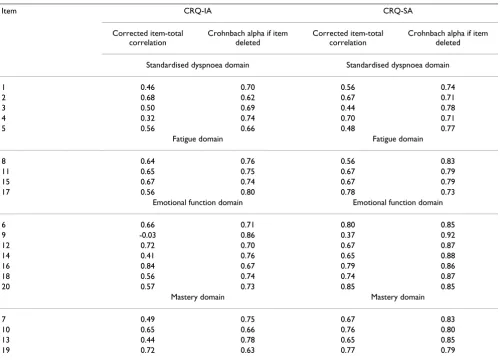
We assessed internal consistency for each domain by cal-culating Crohnbach's alpha for CRQ baseline scores. In addition, we calculated for each standardised item its cor-rected item-total correlation, which should exceed 0.2[27] and calculated Crohnbach's alpha again excluding the item under study. We did not include the individualised dyspnoea domain in this analysis because patients select different items so that the domain cannot be assessed across patients for internal consistency.
To assess cross-sectional validity (in patient group 2) we used Pearson correlation coefficients between the CRQ baseline scores and those of the validation measures. Finally, we assessed test-retest reliability using intraclass correlation coefficients for the baseline and follow-up CRQ domain scores of the stable COPD patients (group 3) by taking the between person variance at baseline and follow-up as the signal and within person variance as well as between person variance at baseline and follow-up as the noise. All statistical analyses were performed with SPSS for Windows version 10.0 (SPSS Inc, Chicago, Ill).
Results
Translation and instrument development (group 1)
The wording of the questions and answer choices corre-spond to the original version. We did not add or remove items nor change the answer scales apart from adaptation to German. Modifications became necessary for the instructions of the individualised dyspnoea items of the CRQ-SA. The original translation of the instructions was too extensive and too complicated and patients were una-ble to complete this domain by themselves without diffi-culties. Therefore, we simplified the instructions omitting some of the instructions that added text without contrib-uting substantially to the understanding. In addition, we listed each item of the individualised and standardised dyspnoea domain separately. This means that there are five separate questions for the dyspnoea domain.
Patients at times were surprised that the list of activities of the individualised dyspnoea domain did not begin with a physical activity ("being angry or upset"). Therefore we placed this item at position 5 of the list of 26 items. Accordingly, the standardised dyspnoea question 1 of the English CRQ ("Shortness of breath when being angry or
upset") was unchanged but placed as question 3 in the German CRQ. We pilot tested the changes and patients were able to complete the German CRQ-SA without major difficulties and understood all items and answer choices.
Internal consistency and cross-sectional validity (group 2)
Nine patients did not complete the study for the following reasons: five withdrew for non-specified reasons (one patient in CRQ-IA group and four in CRQ-SA group) and two patients did not meet the a priori inclusion criteria upon review of their baseline data (one patient in each group with FEV1/FVC > 70%). In addition, two patients of
the CRQ-SA group discontinued the rehabilitation pro-gram shortly after admission (one patient had an acute exacerbation requiring inpatient care and the other went home shortly after beginning of the rehabilitation). We excluded these two patients because we had decided a pri-ori to include only patients with complete validation data in the analysis. The baseline characteristics of these two patients did not differ from the included patients. Thus, we analysed data from 38 patients of the CRQ-IA group and 33 patients of the CRQ-SA group. The patients of the two groups (CRQ-IA and CRQ-SA) were similar at base-line: Mean age was 67.4 years (SD 8.7) in the CRQ-IA and 67.7 (SD 8.3) in CRQ-SA group, FEV1/FVC predicted was 48.5% (SD 13.3) in the CRQ-IA and 49.9% (SD 10.5) in the CRQ-SA group and the average smoking history was 44.9 pack years (26.1) in the CRQ-IA and 46.8 (27.6) in the CRQ-SA group.
Crohnbach's alpha for baseline data were between 0.73 and 0.89 for both administration formats and met our a priori defined requirements for adequate internal consist-ency reliability (table 2). For the CRQ-IA, corrected item-total correlations for baseline data were for all but one item above 0.32 (table 3). Item 9 ("How often during the last two weeks have you felt embarrassed by your cough-ing or heavy breathcough-ing?") had a very low item-total corre-lation of -0.03. If this item was deleted internal consistency reliability would be markedly improved (0.86). Corrected item-total correlations tended to be higher for the CRQ-SA (0.37–0.85). As for the CRQ-IA item 9 showed the lowest corrected item-total correlation but was considerable higher compared with the CRQ-IA (0.37).
For the fatigue domain, the correlations were similar for the CRQ-IA and CRQ-SA except for the correlations with the six-minute walking test, which was significant higher for the CRQ-IA (table 5). We did not observe statistically significant differences between the CRQ-IA and CRQ-SA
for the correlations of the emotional function and mastery domain.
Test-retest reliability (group 3)
In patients randomised to the CRQ-IA (n = 16), mean age was 63.7 (SD 9.1), FEV1/FVC in percent-predicted 44.3
Table 2: Inter-item correlations† (internal consistency reliability) of the interviewer and self-administered format for baseline scores
DOMAIN GERMAN CRQ-IA (n = 33) GERMAN CRQ-SA (n = 38)
Standardised Dyspnoea items 0.73 0.78
Fatigue items 0. 81 0.83
Emotional Function items 0.77 0.89
Mastery items 0.76 0.86
† Crohnbach's alpha. CRQ-IA = Interviewer administered Chronic Respiratory Questionnaire. CRQ-SA = Self-administered Chronic Respiratory Questionnaire
Table 3: Corrected item-total correlations and internal consistency reliability if item was deleted for baseline scores of the interviewer and self-administered CRQ format
Item CRQ-IA CRQ-SA
Corrected item-total correlation
Crohnbach alpha if item deleted
Corrected item-total correlation
Crohnbach alpha if item deleted
Standardised dyspnoea domain Standardised dyspnoea domain
1 0.46 0.70 0.56 0.74
2 0.68 0.62 0.67 0.71
3 0.50 0.69 0.44 0.78
4 0.32 0.74 0.70 0.71
5 0.56 0.66 0.48 0.77
Fatigue domain Fatigue domain
8 0.64 0.76 0.56 0.83
11 0.65 0.75 0.67 0.79
15 0.67 0.74 0.67 0.79
17 0.56 0.80 0.78 0.73
Emotional function domain Emotional function domain
6 0.66 0.71 0.80 0.85
9 -0.03 0.86 0.37 0.92
12 0.72 0.70 0.67 0.87
14 0.41 0.76 0.65 0.88
16 0.84 0.67 0.79 0.86
18 0.56 0.74 0.74 0.87
20 0.57 0.73 0.85 0.85
Mastery domain Mastery domain
7 0.49 0.75 0.67 0.83
10 0.65 0.66 0.76 0.80
13 0.44 0.78 0.65 0.85
19 0.72 0.63 0.77 0.79
(SD 10.4) and patients had a mean smoking history of 52.4 pack years (SD 28.9). Mean age in the CRQ-SA group (n = 19) was 61.1 (SD 8.0), FEV1/FVC in percent-predicted 44.4 (SD 13.6) and a mean smoking history of 54.6 pack years (SD 33.8). Intraclass correlation coefficients were
higher for the IA but also well above 0.7 for all CRQ-SA domains (table 6). Lower within-person variability was responsible for the higher test-retest reliability of the inter-viewer-administered format while between-person varia-bility was similar for both formats.
Table 4: Cross-sectional validity for the individualised and standardised dyspnoea domains: Correlations for baseline scores.
Instrument and domain CRQ-IA Dyspnoea Domains CRQ-SA Dyspnoea Domains
Individualised† Standardised† Individualised† Standardised†
Feeling Thermometer 0.04 (-0.13;0.21) 0.12§ (-0.05;0.29) 0.09* (-0.08;0.26) 0.58* § (0.44;0.72) SF-36-General Health Perception Index 0.03 (-0.14;0.20) 0.18 (0.01;0.35) 0.28 (0.12;0.44) 0.35 (0.19;0.51) SF-36-Physical Functioning Index 0.42 (0.26;0.58) 0.54 (0.40;0.68) 0.34* (0.18;0.50) 0.68* (0.55;0.81) Mental Health Index 0.04 (-0.13;0.21) 0.20§ (0.03;0.37) 0.35 (0.19;0.51) 0.54§ (0.40;0.68) SF-36-Vitality Index 0.17* § (0.00;0.34) 0.59* (0.45;0.73) 0.60§ (0.46;0.74) 0.50 (0.35;0.65) Six minutes walk test 0.25 (0.08;0.42) 0.30 (0.14;0.46) 0.10 (-0.07;0.27) 0.28 (0.12;0.44) Borg Scale -0.17 (-0.35;0.01) -0.03 (-0.20;0.14) -0.28 (-0.44;-0.12) -0.34 (-0.50;-0.18)
CRQ-IA = Interviewer administered German Chronic Respiratory Questionnaire. CRQ-SA = Self-administered German Chronic Respiratory Questionnaire. † Pearson Correlation Coefficient (95% confidence intervals); r > 0.28 significant at p < 0.05. * indicate significant differences between the individualised and standardised dyspnoea domains §indicate significant differences between the domains of the CRQ-IA and CRQ-SA.
Table 5: Cross-sectional validity for the fatigue, emotion and mastery domains. Correlations for baseline scores.†
Instrument and domain
CRQ-IA Domains CRQ-SA Domains
Fatigue† Emotion† Mastery† Fatigue† Emotion† Mastery†
Feeling Thermometer 0.10 (-0.07;0.27) 0.08 (-0.09;0.25) 0.17 (0.01;0.33) 0.16 (0.00;0.32) 0.19 (0.03;0.35) 0.30 (0.14;0.46) SF-36-General Health
Perception Index
0.46 (0.31;0.61) 0.28 (0.12;0.44) 0.36 (0.20;0.52) 0.18 (0.01;0.35) 0.12 (-0.05;0.29) 0.38 (0.22;0.54)
SF-36-Physical Functioning Index
0.45 (0.30;0.60) -0.07 (-0.24;0.10) 0.30 (0.14;0.46) 0.21 (0.04;0.38) -0.15 (-0.32;0.02) 0.39 (0.23;0.55)
SF-36-Mental Health Index
0.53 (0.38;0.68) 0.72 (0.60;0.84) 0.62 (0.49;0.75) 0.63 (0.50;0.76) 0.69 (0.57;0.81) 0.42 (0.26;0.58)
SF-36-Vitality Index 0.72 (0.60;0.84) 0.63 (0.50;0.76) 0.67 (0.54;0.80) 0.66 (0.53;0.79) 0.50 (0.35;0.65) 0.49 (0.34;0.64) Six minutes walk test 0.35§ (0.18;0.52) 0.24 (0.08;0.40) 0.30 (0.14;0.46) 0.00§ (-0.17;0.17) -0.04 (-0.21;0.13) 0.00 (-0.17;0.17) Borg Scale -0.16 (-0.34;0.02) -0.11 (-0.28;0.06) -0.11 (-0.28;0.08) -0.11 (-0.28;0.06) -0.18 (-0.35;-0.01) -0.31 (-0.47;-0.15)
CRQ-IA = Interviewer administered German Chronic Respiratory Questionnaire CRQ-SA = Self-administered German Chronic Respiratory Questionnaire † Pearson Correlation Coefficient (95% confidence intervals); r > 0.28 significant at p < 0.05 § indicate significant differences between the domains of the CRQ-IA and CRQ-SA
Table 6: Test-retest reliability# of the German CRQ
Domain GERMAN CRQ-IA GERMAN CRQ-SA
Individualised dyspnoea 0.81 0.86
Standardised dyspnoea 0.92 0.78
Fatigue 0.95 0.79
Emotional Function 0.92 0.82
Mastery 0.92 0.80
Discussion
We developed different administration formats of the German CRQ and validated them in two randomised studies. We found good internal consistency reliability for the interviewer- and self-administered CRQ. Cross-sec-tional validity was higher for the standardised compared to individual dyspnoea questions. Test-retest reliability exceeded our preset threshold (intraclass correlation coef-ficient > 0.7) for both the CRQ-IA and the CRQ-SA. The strengths of our study included the stepwise develop-ment of the German CRQ formats, which allowed us to reconsider and to test the different versions in three stages of pilot testing. The aim of this approach was to add qual-ity with every step in terms of conceptual equivalence between the source and target version as well as in terms of comprehensibility for the patients. While the CRQ-IA was easy comprehensible for patients, we noticed through pilot testing that patients had difficulties completing the individualised dyspnoea items of the initial German translation of the CRQ-SA independently. However by modifying and pilot testing the instructions of this indi-vidualised dyspnoea domain we were able to develop an improved version.
The standardised dyspnoea domains produced higher cross-sectional correlations than the individualised dysp-noea domains. This finding is important because it indi-cates that the standardised CRQ dyspnoea domain allows for better discrimination between different degrees of COPD severity. These results are consistent with those of a recent study in which discriminative properties of the standardised dyspnoea questions of the English CRQ also proved superior[18]
We found for item 9 ("How often during the last two weeks have you felt embarrassed by your coughing or heavy breathing?") a very low itemtotal correlation of -0.03. Because there is no apparent explanation for this finding, we used the data set of patient group 3 (test-retest) and analysed the item-total correlations of the emotional function domain. We found item-total correla-tions of 0.51 for the CRQ-IA and 0.50 for the CRQ-SA for item 9. For all items of the emotional function domain the item-total correlation was between 0.44 and 0.85. Thus we assume that the low item-total correlation in patient group 2 was due to chance.
Conclusions
The careful development of the German CRQ has led to reliable and valid self- and interviewer administered CRQ formats and individualised and standardised dyspnoea questions. The need of an interviewer and the time-con-suming selection process of the individualised dyspnoea questions are no longer a hindrance for the use of the
CRQ: Investigators can choose between self-and inter-viewer administered formats and individualised and standardised dyspnoea questions based on efficiency con-siderations. The brevity of the standardised CRQ-SA with good validity, reliability and responsiveness makes the CRQ-SA an attractive choice for trials as well as for clinical practice.
Abbreviations
COPD = Chronic Obstructive Pulmonary Disease
CRQ = Chronic Respiratory Questionnaire
CRQ-IA = Chronic Respiratory Questionnaire Interviewer-Administered
CRQ-SA = Chronic Respiratory Questionnaire Self-Administered
FT = Feeling Thermometer
HRQL = Health Related Quality of Life SD = Standard Deviation
Competing interests
None declared.
Funding
GlaxoSmithKline Switzerland and the Swiss Lung League funded this study with grants to the Horten Centre (MP). The sponsors were not involved in the study design, conduction of the trial, analysis of data and manuscript writing.
Authors contributions
MP, MB, MF, OB, HS and GG designed and organised the study; MB, MF, TG, OB and AL collected the data and supervised the study at their study sites, MP and HS analysed the data and wrote the first draft of the manu-script, MB, MF, TG, OB, AL and GG critically reviewed the manuscript and MP and HS prepared the final version of the manuscript.
Acknowledgment
The CRQ-IA and CRQ-SA are copyrighted by McMaster University; Prin-cipal Authors Dr. Gordon Guyatt and Dr. Holger Schünemann. Use of the instrument requires licensing.
We would like to thank Cornelia Flamann (Zuercher Hoehenklinik Wald) and Dr. Marco Laschke (Klinik Barmelweid) for data collection in their centres.
References
Publish with BioMed Central and every scientist can read your work free of charge "BioMed Central will be the most significant development for disseminating the results of biomedical researc h in our lifetime."
Sir Paul Nurse, Cancer Research UK
Your research papers will be:
available free of charge to the entire biomedical community
peer reviewed and published immediately upon acceptance
cited in PubMed and archived on PubMed Central
yours — you keep the copyright
Submit your manuscript here: BioMedcentral 2. Pauwels RA, Buist AS, Calverley PM, Jenkins CR, Hurd SS: Global
strategy for the diagnosis, management, and prevention of chronic obstructive pulmonary disease. NHLBI/WHO Glo-bal Initiative for Chronic Obstructive Lung Disease (GOLD) Workshop summary. Am J Respir Crit Care Med 2001, 163:1256-1276.
3. Calverley P, Pauwels R, Vestbo J, Jones P, Pride N, Gulsvik A, Ander-son J, Maden C: Combined salmeterol and fluticasone in the treatment of chronic obstructive pulmonary disease: a ran-domised controlled trial.Lancet 2003, 361:449-456.
4. Behnke M, Taube C, Kirsten D, Lehnigk B, Jorres RA, Magnussen H: Home-based exercise is capable of preserving hospital-based improvements in severe chronic obstructive pulmonary disease.Respir Med 2000, 94:1184-1191.
5. Puhan MA, Koller M, Brandli O, Steurer J: [Pulmonary rehabilita-tion of COPD in Switzerland--an assessment of current status].Schweiz Rundsch Med Prax 2003, 92:111-116.
6. Guyatt GH, Berman LB, Townsend M, Pugsley SO, Chambers LW: A measure of quality of life for clinical trials in chronic lung disease.Thorax 1987, 42:773-778.
7. Harper R, Brazier JE, Waterhouse JC, Walters SJ, Jones NM, Howard P: Comparison of outcome measures for patients with chronic obstructive pulmonary disease (COPD) in an outpa-tient setting.Thorax 1997, 52:879-887.
8. Wijkstra PJ, TenVergert EM, van Altena R, Otten V, Postma DS, Kraan J, Koeter GH: Reliability and validity of the chronic res-piratory questionnaire (CRQ).Thorax 1994, 49:465-467. 9. Goldstein RS, Todd TR, Guyatt G, Keshavjee S, Dolmage TE, van
Rooy S, Krip B, Maltais F, LeBlanc P, Pakhale S, Waddell TK: Influ-ence of lung volume reduction surgery (LVRS) on health related quality of life in patients with chronic obstructive pul-monary disease.Thorax 2003, 58:405-410.
10. Tsukino M, Nishimura K, McKenna SP, Ikeda A, Hajiro T, Zhang M, Izumi T: Change in generic and disease-specific health-related quality of life during a one-year period in patients with newly detected chronic obstructive pulmonary disease.Respiration 2002, 69:513-520.
11. Lacasse Y, Brosseau L, Milne S, Martin S, Wong E, Guyatt GH, Gold-stein RS: Pulmonary rehabilitation for chronic obstructive pulmonary disease.Cochrane Database Syst Rev 2002:CD003793. 12. Redelmeier DA, Guyatt GH, Goldstein RS: Assessing the minimal
important difference in symptoms: a comparison of two techniques.J Clin Epidemiol 1996, 49:1215-1219.
13. Wyrwich KW, Tierney WM, Wolinsky FD: Further evidence sup-porting an SEM-based criterion for identifying meaningful intra-individual changes in health-related quality of life.J Clin Epidemiol 1999, 52:861-873.
14. Jaeschke R, Singer J, Guyatt GH: Measurement of health status. Ascertaining the minimal clinically important difference. Control Clin Trials 1989, 10:407-415.
15. Wyrwich KW, Fihn SD, Tierney WM, Kroenke K, Babu AN, Wolin-sky FD: Clinically important changes in health-related quality of life for patients with chronic obstructive pulmonary dis-ease: an expert consensus panel report.J Gen Intern Med 2003, 18:196-202.
16. Jones PW: Issues concerning health-related quality of life in COPD.Chest 1995, 107:187S-193S.
17. Williams JE, Singh SJ, Sewell L, Guyatt GH, Morgan MD: Develop-ment of a self-reported Chronic Respiratory Questionnaire (CRQ-SR).Thorax 2001, 56:954-959.
18. Schunemann Holger J., Griffith Lauren, Jaeschke Roman, Goldstein Roger, Stubbing David, Austin Peggy, Guyatt Gordon H.: A Compar-ison of the Original Chronic Respiratory Questionnaire With a Standardized Version.Chest 2003, 124:1421-1429.
19. M.A. Puhan, M. Behnke, M. Laschke, A. Lichtenschopf, O. Brandli, G.H. Guyatt, Schunemann HJ: Self-administration and standard-isation of the chronic respiratory questionnaire: A ran-domised trial in three German-speaking countries.Respiratory Medicine 2004 in press.
20. Bullinger M: Creating and Evaluation Cross-Cultural Instru-ments.Quality of Life and Pharmacoeconomics in Clinical TrialsVolume 69. Secondth edition. Edited by: SpilkerB. Philadelphia, Lippincott; 1996:659-668.
21. Kirsten DK, Taube C, Lehnigk B, Jorres RA, Magnussen H: Exercise training improves recovery in patients with COPD after an acute exacerbation 1.Respir Med 1998, 92:1191-1198.
22. Bullinger M: German translation and psychometric testing of the SF-36 Health Survey: preliminary results from the IQOLA Project. International Quality of Life Assessment. Soc Sci Med 1995, 41:1359-1366.
23. Griffiths TL, Burr ML, Campbell IA, Lewis-Jenkins V, Mullins J, Shiels K, Turner-Lawlor PJ, Payne N, Newcombe RG, Ionescu AA, Thomas J, Tunbridge J, Lonescu AA: Results at 1 year of outpatient multi-disciplinary pulmonary rehabilitation: a randomised control-led trial.Lancet 2000, 355:362-368.
24. Fries JF, Ramey DR: "Arthritis specific" global health analog scales assess "generic" health related quality-of-life in patients with rheumatoid arthritis. J Rheumatol 1997, 24:1697-1702.
25. Mathias SD, Colwell HH, Miller DP, Moreland LW, Buatti M, Wanke L: Health-related quality of life and functional status of patients with rheumatoid arthritis randomly assigned to receive etanercept or placebo.Clin Ther 2000, 22:128-139. 26. Schunemann HJ, Griffith L, Stubbing D, Goldstein R, Guyatt GH: A
clinical trial to evaluate the measurement properties of 2 direct preference instruments administered with and with-out hypothetical marker states. Med Decis Making 2003, 23:140-149.