R E S E A R C H
Open Access
Working in preventive medicine or not?
Flawed perceptions decrease chance of
retaining students for the profession
Van Anh Thi Nguyen
1*, Karen D. Könings
2, E. Pamela Wright
3, Hoat Ngoc Luu
4, Albert J. J. A. Scherpbier
2and
Jeroen J. G. van Merriënboer
2Abstract
Background:Recruiting and retaining students in preventive medical (PM) specialties has never been easy; one main challenge is how to select appropriate students with proper motivation. Understanding how students perceive PM practice differently from practicing doctors is necessary to guide students, especially for those for whom PM is only a substitute for medicine as their first study preference, properly during their study and, later, the practice of PM.
Methods:One thousand three hundred eighty-six PM students in four Vietnamese medical schools and 101 PM
doctors filled out a questionnaire about the relevance of 44 characteristics of working in PM. ANOVAs were conducted to define the relationship between students’interest, year of study, willingness to work in PM, and the degree to which students had realistic perceptions of PM practice, compared to doctors’perceptions.
Results:Overall, compared to doctors’ perceptions, students overestimated the importance of most of the
investigated PM practice’s characteristics. Moreover, students’ perception related to their preference and willing to pursue a career in PM after graduation. In particular, students for whom PM was their first choice had more realistic perceptions of community practice than those who chose PM as their second choice. And, second-choice students had more realistic perceptions than first-choice students in their final years of study, but expected higher work stress in PM practice. Students who were willing to pursue a career in PM rated the importance of community practice higher than those who were not. We also found that students’ perception changed during training as senior students had more realistic perceptions of clinical aspects and working stress than junior students, even though they overemphasized the importance of the community aspects of PM practice.
Conclusions: To increase the number of students actually entering the PM field after graduation, the flawed perceptions of students about the real working environment of PM doctors should be addressed through vocation-oriented activities in the curriculum targeted on groups of students who are most likely to have unrealistic perceptions. Our findings also have implications for other less attractive primary health care specialties that experience problems with recruiting and retaining students.
Keywords:Student perception, Characteristics of specialty, Preventive medicine, First-choice students, Student motivation, Career choice
© The Author(s). 2019Open AccessThis article is distributed under the terms of the Creative Commons Attribution 4.0 International License (http://creativecommons.org/licenses/by/4.0/), which permits unrestricted use, distribution, and reproduction in any medium, provided you give appropriate credit to the original author(s) and the source, provide a link to the Creative Commons license, and indicate if changes were made. The Creative Commons Public Domain Dedication waiver (http://creativecommons.org/publicdomain/zero/1.0/) applies to the data made available in this article, unless otherwise stated.
* Correspondence:[email protected]
1Department of Medical Education and Skills Laboratory, Hanoi Medical
Background
Preventive medicine (PM) should be a priority in develop-ing countries where preventable diseases cause death of millions of people every year, especially of children under 5 years old [1]. However, it is an international problem that primary health care (PHC) specialties, such as PM, are not attractive to medical students [2,3]. Previous stud-ies have shown that students’knowledge and experiences of specialties influence their career decision-making pro-cesses [4]; they increase or decrease students’preferences for PHC careers [5, 6] and working in rural settings [7]. Insufficient understanding or knowledge of the role of PHC specialties is a major factor discouraging students from pursuing a career in those specialties [8,9]. However, little is known about the development of students’ percep-tions of PHC specialties over time. Particularly, it is under-explored how the perceptions of students with different specialization interests develop in different phases of the curriculum, and whether students’perceptions of the spe-cialty relate to their willingness to work as a PHC doctor.
Medical students gradually collect more knowledge and experiences during different phases of their studies, mostly during their training in clinical clerkship [10,11] and community practice [7]. Based on those experiences, senior students make more definite and consistent deci-sions on their career choice in PHC than junior students do [9]. Nonetheless, some studies show that the career preferences of students are not always related to their actual knowledge of the specialty [8,12] but primarily to their values and goals [13]. Some scholars recommend that students should be more guided to gain a more ac-curate view of PHC specialties [12] and that educators should consider the risk of fostering a negative attitude toward PHC specialties among students during their training [13,14].
In medical education, motivation for or interest level in pursuing a career in a particular specialty has been found to influence medical students’ persistence in their study [15] and their specialty choice [16]. Moreover, motivation is a predictor of students’ satisfaction during the study, in-cluding levels of distress or burnout [17,18]. Another study [19] showed that “second-choice students,” who chose to study the specialty because they were not accepted into their preferred program (i.e., general medicine), regretted their choice and wanted to change to another specialty or even another profession, more than“first-choice students,” who were admitted to their preferred program, did. A pri-mary reason for these feelings of regret was that students were not properly informed about the specialty they chose to pursue, meaning they were not fully aware of the mis-sion, working conditions, and job prospects. This observa-tion is consistent with other studies noting that the major impediment to students’career decisions is a poor under-standing of the specialties [9]. However, we have not found
pre-existing studies on how perceptions of a specialty vary among students who have different levels of interest in that specialty. Also, it is as yet unclear how students’ per-ceptions change over the course of their studies, as a result of the accumulation of experience and know-ledge, and whether this impacts first-choice students and second-choice students differently. This kind of information is crucial for teachers and vocational edu-cators who have to aid all students in forming ad-equate understanding about a specialty.
Studies reveal that although medical students choose to study medicine because of their desire to help people and they are well aware of the importance of PHC in the health care system, these motivations do not translate into a willingness to work in the community and in rural areas [8, 9, 12]. However, few studies have focused on the perceptions of students who have already expressed a willingness to work in the PHC field. It would be valu-able to get insight into the perceptions of those studying PHC at the undergraduate level in relation to their levels of interest in PHC and their willingness to work as a PHC doctor in the future.
The fact that PHC specialties are not attractive to med-ical students is an international problem and can also be observed in Vietnam, where medical schools are not highly successful in recruiting appropriate PM students. Students often choose to study PM for various reasons, such as curiosity about the profession, likely high-income jobs, low entry requirements and study burden compared to general medicine, and chance to uphold family tradi-tions [19]. The fact that none of these reasons relates to a personal passion for prevention indicates that the students may not fully understand PM, public health (PH), and the role of PM doctors in community health protection. As a consequence, it is not surprising that only 60% of PM stu-dents anticipate choosing a job within the specialty after graduation, because the rest look for a “higher prestige” job, e.g., a clinical doctor in a hospital in big cities [19]. These views seem very removed from reality where one of the main motivating factors that keep PH workers, includ-ing PM doctors, in their jobs is that they realize that their contribution to health protection is appreciated by col-leagues and the community [20]. Therefore, the differ-ences between students’perceptions and those of doctors regarding the characteristics of PM practice should be ex-amined in more depth.
1. How realistically do students perceive the characteristics of the practice of a PM doctor? 2. How do students’realistic perceptions change over
the course of the curriculum as they acquire more experience in PM? Does degree of interest in PM affect students’realistic perceptions at different levels in the curriculum?
3. How does the willingness to work in PM after graduation affect the realistic perceptions of students? Does willingness to work in PM after graduation affect students’realistic perceptions, and is this impacted by degree of interest in PM?
Methods
Setting and participants
PM training programs in Vietnam are conducted at the undergraduate level. At the moment, this study was con-ducted, 6 out of 13 medical Vietnamese universities of-fered PM training. They recruit students who are either high school graduates for a 6-year track or those already holding a bachelor of science (nurses, public health, medical technique, etc.) for a 4-year track. The regular curriculum lasts for 6 years, with the first 2 years focus-ing on basic sciences and basic medical knowledge and skills, the next 2 years on clinical clerkship, and the last 2 years on knowledge and skills related to the PM spe-cialty, while the 4-year track only contains the last 4 years [21]. Graduates obtain the Degree of Doctor of PM and can officially work as PM doctors in the com-munity or PM centers at different levels of the health care system (national, provincial, district, commune), in hospitals (if they take post-graduate training course in clinical specialties), research institutes, non-government organizations, or in medical universities/schools [22]. In Vietnam, the preventive medical system includes public health, family medicine, and PM. While bachelors of public health work only in prevention, family medical doctors take care of health of people in a family [23]. PM doctors in Vietnam have to cover both preventive and curative duties; they treat common diseases and have to detect and prevent epidemics in the community as well [22]. This requires them to work mainly in the community or in PM centers and to serve a broad range of people.
The current study is focused on the 6-year track PM training and involved 1386 PM students from four med-ical universities in the North of Vietnam and 101 prac-ticing PM doctors working in Hanoi, the capital. All participants were invited to voluntarily participate im-mediately after attending lectures (students) or meetings (doctors). Signed consent was acquired after the re-searchers explained that voluntary and anonymity of the participants was guaranteed. After participants filled out the questionnaire (taking approximately 10 min), they
received a small financial compensation for their de-voted time, which is ordinary in Vietnamese context. Ethical approval for the study was given by the Institu-tional Review Board of the Hanoi Medical University (Decision No 174/HMU-IRB) and of the other three uni-versities’Scientific and Technical Committees.
Materials
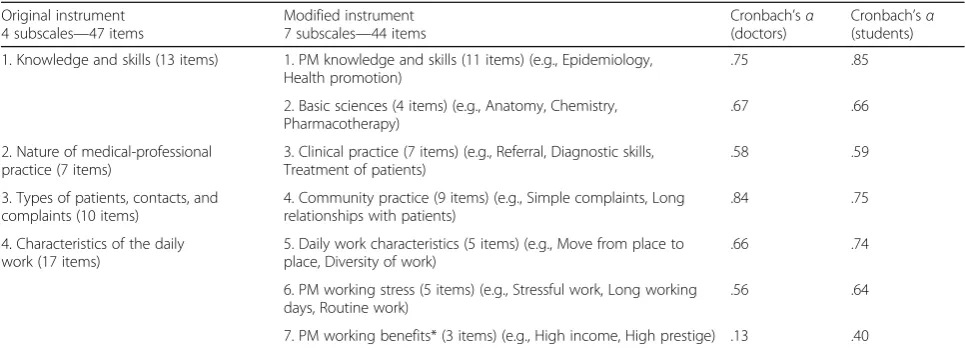
A written questionnaire was developed based on earlier studies on students’ perceptions of the medical profes-sion [12,24]. The original questionnaire, which included 47 characteristics of the medical profession, was used in a study by Soethout [12]. In our study, in light of sugges-tions from practicing PM doctors in the pilot phase, three items were added: “Skill with using computers,” “Capacity to use a foreign language,”and“Work that re-quires a lot of travelling.” Participants were asked to in-dicate to which degree these characteristics applied to a PM doctor’s daily practice with the phrase:“To what ex-tent does this characteristic apply to the profession of PM?” using a 3-point Likert scale (1 = not applicable, 2 = moderately applicable, 3 = highly applicable). Explora-tory factor analysis was used to identify factors within the 50 items. This procedure resulted in seven factors that were interpreted as seven subscales, and Cronbach’s alpha was calculated for each subscale. Cronbach’s alpha of every subscale was improved by deleting items that worsened the internal consistency of that subscale. Table1presents the content and internal consistency re-liability of the seven subscales, with Cronbach’s alphas of each subscale, separately for practicing doctors and of students. The Cronbach’s alpha values for the two sub-scales“Clinical practicing”(.58) and“PM working stress” (.59) were quite low, (< .60); we decided to keep these subscales because they are important characteristics of working in PM and Cronbach’s alpha of 0.6 was consid-ered acceptable for new subscales [25]. We will interpret these results with caution. The subscale of“PM working
benefits” was taken out because of too low alpha, to
avoid negative effect on the study’s accuracy. This pro-cedure produced a final questionnaire containing six subscales with 41 items.
Mean scores of the six subscales were computed. As data were normally distributed, parametric tests were used. The differences between the original and the modified questionnaire are presented in Table1as well.
Data analysis
To answer the first research question, differences be-tween students’perceptions and the corresponding
doc-tors’ answers were tested for each subscale by using
independent sample t-tests. The value of the difference
score between students’ perceptions and doctors’
(i.e., a positive score indicates that students perceive the importance of a characteristic to be greater than doctors do, while a negative score indicates students’ underesti-mation of the importance of a characteristic as com-pared with doctors). Effect sizes in terms of Cohen’s d
were calculated in all analyses, in whichdvalues of .2 to .3 are considered small effects, those around .5 medium effects, and larger than .8 significant effects [26]. Regard-ing the second and third research questions, ANOVAs were conducted to test for the impact of levels in the cur-riculum, willingness to work in PM, and levels of interest in PM on students’realistic perceptions. Students were di-vided into the following categories: first-choice students and second-choice students; junior students from first to fourth year, and senior students in fifth and sixth year; and students willing and unwilling to work in PM. Results were presented in tables for significant effects; graphs were plotted to illustrate the interaction effects. Results for research questions 2 and 3 were considered statistically significant if the one-tailedpwas≤.05. For research ques-tion 1, two-tailed tests were conducted. Data were ana-lyzed using IBM SPSS Statistics (Version 20.0).
Results
General information of participants
Among PM students, there were 937 (67.60%) first-choice students, 432 (31.16%) second-choice students, and 17 students (1.22%) who did not remember their initial prior-ity choice and therefore were excluded from the analysis. There were 513 (37.02%) senior students, and 821 (59.23%) students who stated that they are willing to work in PM after graduation. The mean age of the students was 21.57 years (SD= 2.24), with 61% being women. PM doc-tors had a mean age of 40.38 years (SD= 8.62; 25 to 60 years old), with 52.47% being women, and the mean
length of time working in the PM field was 11.72 years (SD= 8.13; 1 to 32 years).
Students’perceptions of the characteristics of PM practice
Table 2 displays the differences in perceptions of PM
practice’s characteristics between students and practicing doctors. Students significantly overestimated the charac-teristics of PM practice on all scales, except for clinical practice. The effect size was medium (Cohen’sd> .5) in most of the subscales where the differences were found significant (p< .05). This indicates that the differences were large enough to have practical impact, although the mean difference between students and doctors was quite low (ranging from .13 to .29).
Effects of level in the curriculum and degree of interest in PM on students’realistic perceptions
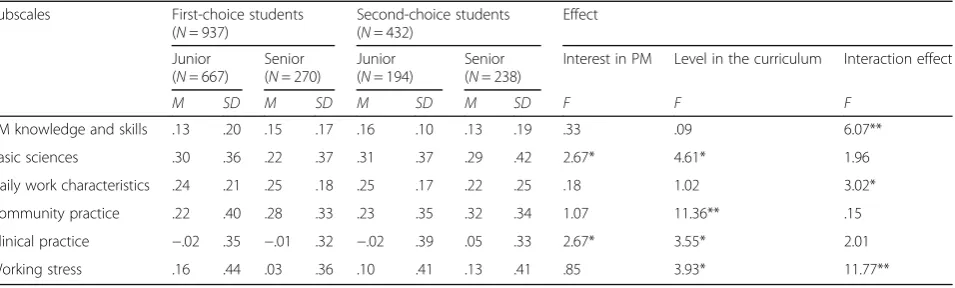
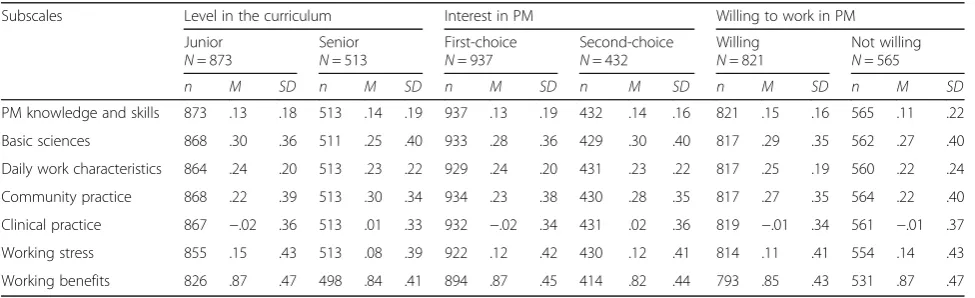
We found a significant effect of levels in the curriculum on students’ realistic perceptions on the subscales of basic sciences (F(1,1360) = 4.61, p< .05), community practice (F(1,1358) = 11.36, p< .01), clinical practice (F(1,1359) = 3.55, p< .05), and PM working stress (F(1,1348) = 3.93, p< .05) (see Table 3). Senior students had more realistic perceptions than junior students did of basic sciences, clinical practice, and PM working stress; however, they seemed to overestimate the import-ance of community practice compared to junior students (for full descriptive statistics, see Appendix).
Regarding the impact of degree of interest in PM on students’realistic perceptions, we found a significant ef-fect in the subscales of basic sciences (F(1,1360) = 2.67,
p= .05) and clinical practice (F(1,1358) = 2.67, p= .05). First-choice students had more realistic perceptions than second-choice students did of basic sciences and of clin-ical practice.
Table 1Modification of the study instrument and internal consistency reliability of the subscales
Original instrument 4 subscales—47 items
Modified instrument 7 subscales—44 items
Cronbach’sα (doctors)
Cronbach’sα (students)
1. Knowledge and skills (13 items) 1. PM knowledge and skills (11 items) (e.g., Epidemiology, Health promotion)
.75 .85
2. Basic sciences (4 items) (e.g., Anatomy, Chemistry, Pharmacotherapy)
.67 .66
2. Nature of medical-professional practice (7 items)
3. Clinical practice (7 items) (e.g., Referral, Diagnostic skills, Treatment of patients)
.58 .59
3. Types of patients, contacts, and complaints (10 items)
4. Community practice (9 items) (e.g., Simple complaints, Long relationships with patients)
.84 .75
4. Characteristics of the daily work (17 items)
5. Daily work characteristics (5 items) (e.g., Move from place to place, Diversity of work)
.66 .74
6. PM working stress (5 items) (e.g., Stressful work, Long working days, Routine work)
.56 .64
7. PM working benefits* (3 items) (e.g., High income, High prestige) .13 .40
Furthermore, an interaction effect was found between the level in the curriculum and degree of interest in PM on students’ realistic perceptions of PM knowledge and skills (F(1,1365) = 6.07,p< .01), daily work characteristics (F(1,1356) = 3.02,p< .05), and working stress (F(1,1348) = 11.77, p< .01) (Fig. 1). As shown in Fig. 1a, b, first-choice students had more realistic perceptions of PM knowledge and skills and daily work characteristics at the beginning; however, they increasingly overesti-mated these characteristics at higher levels of study. Second-choice students gradually had more accurate perceptions of these characteristics over the time. Fig-ure 1c shows that the more first-choice students learnt the more accurate perception of working stress they had, whereas second-choice students increasingly overesti-mated this when they got to their final years.
Effect of willingness to work in PM and degree of interest in PM on students’realistic perceptions
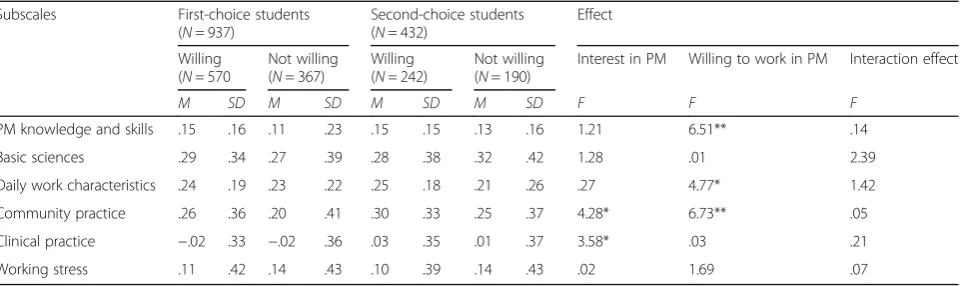
Regarding the effect of students’ willingness to work in PM on their perception, we found a significant effect on the subscales of PM knowledge and skills (F(1,1365) = 6.51,p< .01), daily work characteristics (F(1,1356) = 4.77,
p< .05), and community practice (F(1,1360) = 6.73,
p< .01) (see Table4). Students who were willing to work in PM after graduation overestimated the importance of PM knowledge and skills, daily work characteristics, and
community practice more than their peers who were un-willing to work in PM did (see Appendix).
Concerning the impact of interest in PM on the realis-tic perceptions of students who differed in their willing-ness to work in PM, we found a significant effect on the subscales of community practice (F(1,1360) = 4.28, p
< .05) and clinical practice (F(1,1359) = 3.58, p< .05). First-choice students, whether they were willing to work in PM or not, had more realistic perceptions than their second-choice counterparts regarding community prac-tice and clinical pracprac-tice (see Table4). No interaction ef-fects of willingness to work in PM and degree of interest in PM were found.
Discussion
Our study provides new insight into the impact of levels in the curriculum and career preferences on students’ perceptions of a specific primary health care specialty, PM. The results show that students have different views than practicing doctors. More specifically, students con-sidered most of the PM characteristics to be more im-portant than they are in practice, even for the typical ones such as the community aspect that defines the meaning of PM, or the working stress that describe the daily job features of PM. Clinical aspect was the only one characteristic that students perceived similarly to the reality; this point was a warning signal about PM
Table 2Relevance of characteristics of PM in daily work as perceived by students, compared with perceptions of practicing doctors
Subscales PM students PM doctors Δstudents-doctors t Cohen’s
d
n M SD n M SD M SD
PM knowledge and skills 1 386 2.91 .19 100 2.78 .23 .13 .19 7.05* .62
Basic sciences 1 379 2.41 .38 98 2.13 .38 .26 .38 7.23* .74
Daily work characteristics 1 377 2.92 .21 100 2.68 .33 .22 .23 10.30* .87
Community practice 1 381 2.40 .37 100 2.15 .43 .23 .38 6.35* .62
Clinical practice 1 380 2.37 .35 100 2.38 .41 −.01 .35 −.24 .03
Working stress 1 368 2.22 .42 100 2.10 .39 .11 .42 2.82* .30
*Two-tailedpvalue≤.01
Table 3Effect of level in the curriculum and interest in PM on student’s realistic perception of PM
Subscales First-choice students (N= 937)
Second-choice students (N= 432)
Effect
Junior (N= 667)
Senior (N= 270)
Junior (N= 194)
Senior (N= 238)
Interest in PM Level in the curriculum Interaction effect
M SD M SD M SD M SD F F F
PM knowledge and skills .13 .20 .15 .17 .16 .10 .13 .19 .33 .09 6.07**
Basic sciences .30 .36 .22 .37 .31 .37 .29 .42 2.67* 4.61* 1.96
Daily work characteristics .24 .21 .25 .18 .25 .17 .22 .25 .18 1.02 3.02*
Community practice .22 .40 .28 .33 .23 .35 .32 .34 1.07 11.36** .15
Clinical practice −.02 .35 −.01 .32 −.02 .39 .05 .33 2.67* 3.55* 2.01
Working stress .16 .44 .03 .36 .10 .41 .13 .41 .85 3.93* 11.77**
students’tendency to pursue clinical careers. In particu-lar, by ranking of importance of characteristics of PM based on mean subscale scores of students and doctors, we see a similar picture in the top-3 ranking. Doctors ranked the following as of most importance: (1) PM knowledge and skills, (2) daily work characteristics, and (3) clinical practice. Students chose (1) daily work charac-teristics, (2) PM knowledge and skills, and (3) basic sci-ences as their first three priorities. Although students realized the importance of daily job and the application of PM knowledge and skills in the specialty, they seemed to underestimate the application of clinical practice while they overemphasize the basic sciences in their future work. Our findings confirmed the conclusion of previous studies [8,12,13] that students’career preferences are not always related to their actual knowledge of the specialty, and our results provide specific evidence about percep-tions of PM from the point of view of undergraduate stu-dents. Considering the state of PM training in Vietnam, a heavily theoretical and less practical curriculum, in which the first 4 years focus on basic sciences and basic medical knowledge, could be responsible for students’flawed per-ceptions of the importance of most PM aspects.
Regarding the question on how students’realistic per-ceptions change over the course of the curriculum, our results show that after getting some PM experience in the fifth and sixth years, senior students developed more accurate perceptions of basic sciences, clinical aspects, and working stress, but overemphasized the importance of community in PM practice compared to the reality. Previous studies have shown that the knowledge and ex-perience that medical students gain during practice in the field helps them to develop more realistic percep-tions of a particular specialty [7, 10, 11]. Our findings confirm these observations in the case of PM, and they also indicate a notable point that training in the commu-nity should be more practical to help students to have realistic perceptions of this aspect of PM practice.
Concerning the impact of degree of interest in PM on students’ realistic perceptions, our study reveals that first-choice students always had more realistic perceptions of basic sciences and clinical practice than second-choice students, and they had more realistic perceptions of work-ing stress than second-choice students in later years. How-ever, second-choice students had more realistic perceptions of PM knowledge and skills and daily work characteristics Fig. 1Interaction effects of level in the curriculum and interest in PM on students’realistic perceptions of PM practice (a: Perceptions of PM
knowlegde and skills;b: Perceptions of PM daily work's characteristics;c: Perceptions of PM working stress)
Table 4Effect of willingness to work in PM and interest in PM on student’s perception of PM
Subscales First-choice students (N= 937)
Second-choice students (N= 432)
Effect
Willing (N= 570
Not willing (N= 367)
Willing (N= 242)
Not willing (N= 190)
Interest in PM Willing to work in PM Interaction effect
M SD M SD M SD M SD F F F
PM knowledge and skills .15 .16 .11 .23 .15 .15 .13 .16 1.21 6.51** .14
Basic sciences .29 .34 .27 .39 .28 .38 .32 .42 1.28 .01 2.39
Daily work characteristics .24 .19 .23 .22 .25 .18 .21 .26 .27 4.77* 1.42
Community practice .26 .36 .20 .41 .30 .33 .25 .37 4.28* 6.73** .05
Clinical practice −.02 .33 −.02 .36 .03 .35 .01 .37 3.58* .03 .21
Working stress .11 .42 .14 .43 .10 .39 .14 .43 .02 1.69 .07
than their first-choice counterparts. One explanation for this observation could be that lower interest in PM could increase the stressful feelings that second-choice students reported during their studies. Previous studies have indi-cated that motivation and career choice play a role in the prevalence of burnout [17,18]. Applying this to our case, we may speculate that second-choice students, who showed a lower interest in PM and higher expectation of work stress in PM practice, could be at risk of burnout and there-fore should be given more attention in efforts at prevention. Moreover, in light of previous findings about the impact of early education programs on improving attractiveness of PHC to medical students [5–7], the fact that second-choice students had more accurate perceptions of some PM char-acteristics in their final years is a promising sign for devel-oping an intervention strategy. This program should early introduce the practical information such as important knowledge and skills that are useful for PM doctors, a typ-ical work day of a PM doctor, how working in PM helps to protect the community, and so on to PM students, specific-ally to second-choice students who are willing to work in PM, though it was not their initial preference.
Our results revealed that students who had high will-ingness to work in PM overemphasized the importance of PM knowledge and skills, PM daily work characteris-tics, and the community aspects compared to the reality. A potential reason for this phenomenon could be that students who expressed a willingness to work in PM also had more motivation to learn and to look for informa-tion about the specialty; however, the informainforma-tion they found was theoretical and removed from reality. There-fore, our findings could be a foundation for developing a more appropriate information provision program, which would help students, specifically those who are not will-ing to work in PM, to have accurate perceptions of their future work, focusing on the role of PM knowledge and skills, PM daily work characteristics, and the community aspects of PM practice.
Remarkably, we found that first-choice students, whether they were willing to work in PM after graduation or not, had a more accurate perception of the community and clinical aspects of PM practice than second-choice students. This finding reinforces the idea of introducing community-oriented values and the concept of commu-nity interest to students during the course of training, es-pecially to those for whom PM was not their first choice, to produce a greater number of PM doctors.
Examining the extent to which students’perceptions of PM practice are realistic as compared to doctors’ percep-tions helps us to better understand students’ specialty preferences and willingness to work in PM. Hopefully, these insights can contribute to methods of attracting more appropriate students to work in PM, by providing students with additional information during their medical
studies. Our findings indicate the kinds of misconceptions students have about the real working situation of prac-ticing PM doctors, such as their daily work characteristics or the specific knowledge and skills applied in PM prac-tice, which could be corrected before and during studying as part of the curriculum’s vocational component. Another implication of our study is that second-choice students have a greater tendency toward stress and might be at risk of burnout. Appropriate vocational interventions focusing on community-oriented values and interests should be di-rected to second-choice students, especially those who are not willing to work in PM, in order to increase the num-ber of students entering the PM field after graduation. These findings may also have implications for other less attractive PHC specialties that are struggling to recruit and retain students.
Limitations
There are some limitations of our study. Although the original questionnaire developed by Soethout [12] used a 5-point Likert scale, we decided to use a 3-point Likert scale when asking how much a particular characteristic applied to a PM doctor’s daily practice, which could have reduced the accuracy of the scale. This option was chosen because it is general practice in Vietnam to ex-press opinions by using one of three options: either agree, disagree, or neutral. Additionally, despite relatively low Cronbach’s alphas for the two subscales “Clinical practice” and“PM working stress,”we decided to report on these subscales because of their importance and rep-resentativeness in understanding the characteristics of PM practice. The results on these scales were inter-preted with more caution. Furthermore, we recruited only PM practicing doctors who are working in a big city and may not representable for PM practice across the north of Vietnam, where we recruited part of our par-ticipating students. The different practice settings might have an effect on perception of PM doctors, and this issue deserves to be explored in more detail in further studies. Lastly, this was a cross-sectional study focusing on the perception of PM students at a particular time, and we could not provide information about the rela-tionship between students’ perceptions of PM and their study achievements. A long-term follow-up study would be necessary to answer the question of whether the in-accurate perceptions of students affect their final career decisions and working destinations, i.e., in the commu-nity or in hospitals.
Conclusions
report more stressful feelings about their future work than first-choice students. Although students realize the importance of PM knowledge and skills, daily work char-acteristics, and community practice, their perceptions are theoretical and far from reality. Identifying specific flawed points in students’perceptions, as well as trying to encourage target subjects, such as junior students, second-choice students, and students who are not will-ing to work in PM, to develop a positive attitude, could be helpful for vocational interventions in the curriculum. Consequently, these measures might help to recruit and retain qualified people in the PM field.
Abbreviations
PH:Public health; PHC: Primary health care; PM: Preventive medicine
Acknowledgements
The authors acknowledge the project“Strengthening teaching and research
capacity of preventive medicine in Vietnam”—NUFFIC for funding the study.
We thank the Board of Directors and preventive medical students of four medical universities in Vietnam for their endorsement and willingness to participate in the study.
Funding
This study was funded by the Netherlands Organization for International Cooperation in Higher Education (NUFFIC). The NUFFIC financially supported the process of data collection and English editing of the manuscript, but did not have any role in the design of the study, the way data were collected, analysis, and interpretation of data and in writing the manuscript.
Availability of data and materials
The datasets generated and analyzed during the current study are available in the Maastricht University Dataverses/School of Health Professions
Education (SHE), [http://hdl.handle.net/10411/20754].[27]
Authors’contributions
VATN contributed to the design, data collection, analysis, and writing. KDK, JJGvM, and AJJAS contributed to the design, statistical analysis, data interpretation, and writing. PW and HNL contributed to the design and writing. All authors read and approved the final manuscript.
Ethics approval and consent to participate
The consent forms were given together with the questionnaire to the participants. Signed consent was acquired from all participants after the researchers explained that answering the questionnaire was voluntary and that the anonymity of the participants was guaranteed. Ethical approval for
the study was given by the Institutional Review Board of the Hanoi Medical University (Decision No 174/HMU-IRB). The investigator also had the approval of the Scientific and Technical Committees of the other three universities to conduct the data collection.
Consent for publication Not applicable.
Competing interests
The authors declare that they have no competing interests.
Publisher’s Note
Springer Nature remains neutral with regard to jurisdictional claims in published maps and institutional affiliations.
Author details
1Department of Medical Education and Skills Laboratory, Hanoi Medical
University, 1 Ton That Tung street, Dongda, Hanoi, Vietnam.2Faculty of Health, Medicine and Life Sciences, School of Health Professions Education (SHE), Maastricht University, P.O. Box 616, 6200, MD, Maastricht, the Netherlands.3Guelph International Health Consulting, Frederik Hendrikstraat 18, 1052, HT, Amsterdam, the Netherlands.4Biostatistics and Medical Informatics Department, Institute for Preventive Medicine and Public Health, Hanoi Medical University, 1 Ton That Tung street, Dongda, Hanoi, Vietnam.
Received: 1 August 2018 Accepted: 30 April 2019
References
1. UNICEFhttps://www.unicef.org/immunization/index_why.htmlAccessed 26
July 2018.
2. Fincher RM, Lewis LA, Rogers LQ. Classification model that predicts medical
students’choices of primary care or non primary care specialties. Acad Med.
1992;67(Suppl 5):324–7.
3. Newton DA, Grayson MS, Whitley TW. What predicts medical student career
choice? J Gen Intern Med. 1998;13(Suppl 3):200–3.
4. Mihalynuk T, Leung G, Fraser J, Bates J, Snadden D. Free choice and career
choice: clerkship electives in medical education. Med Educ. 2006;40:1065–71.
5. Hau MM, Tyler IV, Buxton JA, Elliott LJ, Harvey BJ, Hockin JC, Mowat DL.
Assessing Canadian medical students’familiarity with and interest in
pursuing a career in community medicine. Can J Public Health. 2009;100(3):
194–8.
6. Anil S, Zawahir M, Al-Naggar R. Effectiveness of preventive medicine
education and its determinants among medical students in Malaysia. Front
Med. 201;10(1):91–100.
7. Bland CJ, Meurer LN, Maldonado G. Determinants of primary care specialty
choice: a non-statistical meta-analysis of the literature. Acad Med. 1995;
70(Suppl 7):620–41.
Appendix
Table 5Descriptive statistics on realistic perceptions of PM students
Subscales Level in the curriculum Interest in PM Willing to work in PM
Junior N= 873
Senior N= 513
First-choice N= 937
Second-choice N= 432
Willing N= 821
Not willing N= 565
n M SD n M SD n M SD n M SD n M SD n M SD
PM knowledge and skills 873 .13 .18 513 .14 .19 937 .13 .19 432 .14 .16 821 .15 .16 565 .11 .22
Basic sciences 868 .30 .36 511 .25 .40 933 .28 .36 429 .30 .40 817 .29 .35 562 .27 .40
Daily work characteristics 864 .24 .20 513 .23 .22 929 .24 .20 431 .23 .22 817 .25 .19 560 .22 .24
Community practice 868 .22 .39 513 .30 .34 934 .23 .38 430 .28 .35 817 .27 .35 564 .22 .40
Clinical practice 867 −.02 .36 513 .01 .33 932 −.02 .34 431 .02 .36 819 −.01 .34 561 −.01 .37
Working stress 855 .15 .43 513 .08 .39 922 .12 .42 430 .12 .41 814 .11 .41 554 .14 .43
8. Kim BG, Hoang VM, Nguyen VH, Nguyen MN, Nguyen DH. Knowledge of primary health care and career choice at primary health care settings
among final year medical students–challenges to human resources for
health in Vietnam. Glob Public Health. 2015;10 Suppl 1:S120-30.https://doi.
org/10.1080/17441692.2014.986157.
9. Deutsch T, Hönigschmid P, Frese T, Sandholzer H. Early community-based
family practice elective positively influences medical students’career
considerations–a pre-post-comparison. BMC Fam Pract. 2013;14:24.https://
doi.org/10.1186/1471-2296-14-24.
10. Maiorova T, Stevens F, Scherpbier A. Zee J. van der. The impact of clerkships
on students' specialty preferences: what do undergraduates learn for their
profession? Med Educ. 2008;42(6):554–62.
11. Braniff C, Spence R, Stevenson M, Boohan M, Watson P. Assistantship
improves medical students’perception of their preparedness for starting
work. Med Teach. 2016;38:51–8.
12. Soethout MBM, Ten Cate OTJ, van der Wal G. Correlations of knowledge
and preference of medical students for a specialty career: a case-study of
youth health care. BMC Public Health. 2008;8:14.https://doi.org/10.1186/
1471-2458-8-14.
13. Phillips J, Weismantel D, Gold K, Schwenk T. How do medical students view
the work life of primary care and specialty physicians? Fam Med. 2012;44(1):
7–13.
14. Landström B, Mattsson B, Nordin P, Rudebeck CE. The characteristics of
general practice and the attractiveness of working as a GP: medical
students’views. Int J Med Educ. 2014;5:51–5.
15. Ten Cate O, Snell L, Mann K, Vermunt J. Orienting teaching toward the
learning process. Acad Med. 2004;79(3):219–28.
16. Kusurkar R, Ten Cate T, Van Asperen M, Croiset G. Motivation as an
independent and a dependent variable in medical education: a review of
the literature. Med Teach. 2011;33:e242–62.
17. Pagnin D, De Queiroz V, De Oliveira Filho M, Gonzalez N, Salgado A, Oliveira
B, Lodi C, Melo R. Burnout and career choice motivation in medical
students. Med Teach. 2013;35:388–94.
18. Győrffy Z, Birkás E, Sándor I. Career motivation and burnout among medical
students in Hungary–could altruism be a protection factor? BMC Med
Educ. 2016;16:128.
19. Nguyen TVA, Koning K, Scherpbier A, Wright P, Luu NH, van Merriënboer J.
Preventive medicine as a first- or second-choice course: a cross-sectional
survey into students’motivational differences and implications for
information provision. BMC Research Notes. 2017;10:383.https://doi.org/10.
1186/s13104-017-2706-6.
20. Dieleman M, Pham VC, Le VA, Martineau T. Identifying factors for job
motivation of rural health workers in North Viet Nam. Hum Resour Health.
2003;1:10.https://doi.org/10.1186/1478-4491-1-10.
21. Fan AP, Tran DT, Kosik RO, Mandell GA, Hsu HS, Chen YS. Medical education
in Vietnam. Med Teach. 2012;34:103–7.
22. Ministry of Health, Ministry of Home Affairs of Vietnam. Joint circular 10/
2015/TTLT-BYT-BNV- regulation of code, professional title of doctor, preventive medical doctor and doctor assistant. In: Hanoi; 2015.
23. Ministry of Health of Vietnam. Circular 16/2014/TT-BYT–instruction of pilot
family doctor and family doctor clinics. In: Hanoi; 2014.
24. Nieuwhof MG, Rademakers JJ, Kuyvenhoven MM, Soethout MB, Ten Cate TJ.
Students’conceptions of the medical profession: an interview study. Med
Teach. 2005;27(8):709–14.
25. Loewenthal K, Lewis CA. An introduction to psychological tests and scales.
Psychology press; 2015.
26. Cohen, J. Statistical power analysis for the behavioral sciences. 2nd ed.