S T U D Y P R O T O C O L
Open Access
Advancing implementation science through
measure development and evaluation:
a study protocol
Cara C. Lewis
1,2*, Bryan J. Weiner
3, Cameo Stanick
4and Sarah M. Fischer
1Abstract
Background:Significant gaps related to measurement issues are among the most critical barriers to advancing implementation science. Three issues motivated the study aims: (a) the lack of stakeholder involvement in defining pragmatic measure qualities; (b) the dearth of measures, particularly for implementation outcomes; and (c) unknown psychometric and pragmatic strength of existing measures. Aim 1: Establish a stakeholder-driven operationalization of pragmatic measures and develop reliable, valid rating criteria for assessing the construct. Aim 2: Develop reliable, valid, and pragmatic measures of three critical implementation outcomes,acceptability,appropriateness, andfeasibility. Aim 3: Identify Consolidated Framework for Implementation Research and Implementation Outcome Framework-linked measures that demonstrate both psychometric and pragmatic strength.
Methods/design:For Aim 1, we will conduct (a) interviews with stakeholder panelists (N= 7) and complete a literature review to populate pragmatic measure construct criteria, (b) Q-sort activities (N= 20) to clarify the internal structure of the definition, (c) Delphi activities (N= 20) to achieve consensus on the dimension priorities, (d) test-retest and inter-rater reliability assessments of the emergent rating system, and (e) known-groups validity testing of the top three prioritized pragmatic criteria. For Aim 2, our systematic development process involves domain delineation, item generation, substantive validity assessment, structural validity assessment, reliability assessment, and predictive validity assessment. We will also assess discriminant validity, known-groups validity, structural invariance, sensitivity to change, and other pragmatic features. For Aim 3, we will refine our established evidence-based assessment (EBA) criteria, extract the relevant data from the literature, rate each measure using the EBA criteria, and summarize the data.
Discussion:The study outputs of each aim are expected to have a positive impact as they will establish and guide a comprehensive measurement-focused research agenda for implementation science and provide empirically supported measures, tools, and methods for accomplishing this work.
Keywords:Implementation science, Measures, Instruments, Psychometric, Pragmatic, Implementation outcomes, Consolidated Framework for Implementation Research
Introduction
Poor-quality, impractical measurement has impeded the study of implementation barriers, facilitators, and strategies necessary for promoting widespread delivery of evidence-based care [1]. The identification of psychometrically strong
and pragmatic measures has been identified as an inter-national priority, requiring attention to three issues. First, while the need for pragmatic measures (that are both rele-vant to stakeholders and feasible for use in practice) has been emphasized and researchers have begun to describe the features that make measures pragmatic [2], it is unclear whatstakeholdersin practice (e.g., agency leaders, decision makers, purveyors, and clinicians) consider to be pragmatic measures or how they assign relative priority to various pragmatic qualities, such as brevity, simplicity of adminis-tration, and actionability. If stakeholder views are not taken * Correspondence:[email protected]
1Department of Psychological and Brain Sciences, Indiana University, 1101 E.
10th St., Bloomington, IN 47405, USA
2Department of Psychiatry and Behavioral Sciences, School of Medicine,
Harborview Medical Center, University of Washington, 325 9th Ave, Box 359911, Seattle, WA 98104, USA
Full list of author information is available at the end of the article
into account, measurement developers run the risk of fo-cusing on the wrong“pragmatic”attributes.
Second, few measures of implementation outcomes (e.g., feasibility, fidelity, and sustainability) have under-gone systematic development and testing; as a result, the psychometric and pragmatic properties of most mea-sures of implementation outcomes are not known. For example, of the 104 measures of implementation out-comes reviewed by the Society for Implementation Re-search Collaboration (SIRC), 51 % lacked information on reliability, 74 % on structural validity, 82 % on predictive validity, and 96 % on responsiveness. Implementation outcomes with many available measures (e.g., acceptabil-ity) had no more psychometrically and pragmatically strong measures as those implementation outcomes with few measures (e.g., feasibility) [3]. The dearth of reliable, valid, and pragmatic measures of implementation out-comes poses a significant barrier to advances in the field, since implementation outcomes are what we seek to ex-plain in research and seek to achieve in practice.
Finally, it is unclear if measures can be both psycho-metrically strong and pragmatic as the majority of implementation related measures are of unknown psy-chometric and pragmatic qualities. Results from the four existing reviews [3–6] demonstrate that a range of 46 to 52 % of measures has not been psychometrically vali-dated. And, only the Grid-Enabled Measures project includes a pragmatic measure evaluation; though, unfor-tunately their use of the crowd-sourcing methodology undermines the validity of their ratings [6]. Therefore, implementation researchers and practitioners have little guidance about which measures to select. Addressing these three issues is important because, if they are not addressed, implementation science runs the risk of
“…constructing a magnificent house without bothering to build a solid foundation” [7] (i.e., reliable and valid measures) and replicating in measurement the science-practice gap that plagues intervention science [8] (i.e., pragmatic measures).
Objectives and aims
The long-term objective of this research program is to make available to the field a comprehensive battery of reliable, valid, and pragmatic measures that researchers and stakeholders can use to advance implementation sci-ence and practice. To achieve this objective, three aims were articulated.
Aim 1 Establish a stakeholder-driven operationaliza-tion of pragmatic measures and develop reliable, valid rating criteria for assessing the construct. Aim 1 will yield a stakeholder-driven operationalization of the prag-matic measures construct, an associated consensus-driven set of pragmatic rating criteria, and a reliable and
valid method for evaluating measures for their pragmatic qualities.
Aim 2Develop reliable, valid, and pragmatic measures of three critical implementation outcomes,acceptability,
appropriateness, and feasibility. Aim 2 will yield three high-quality, broadly applicable measures of implemen-tation outcomes and a replicable, rigorous measure de-velopment process.
Aim 3Identify Consolidated Framework for Implemen-tation Research (CFIR) and ImplemenImplemen-tation Outcomes Framework (IOF)-linked measures that demonstrate both psychometric and pragmatic strength. We predict that measures of implementation outcomes, but no other con-structs, will demonstrate psychometric and pragmatic strength (Fig. 1). Aim 3 will reveal which implementation domains (and constructs) possess high-quality measures and which require further development.
Methods/design
Incorporating key perspectives of leading implementation scientists and stakeholders
In 2006, it was noted that “implementation science”had 29 related terms in use around the globe [9], which threatens the cumulative knowledge that can be gained. To advance an implementation science measurement-focused research agenda, international perspectives must be incorporated. To ensure the broadest relevance of our work, we have created an international advisory board of nine implementation experts representing Australia (Sanson-Fisher and Wolfenden), Canada (Barwick and Grimshaw), the Netherlands (Wensing), Sweden (Ovretveit), the UK (Francis), and the USA
(Damschroder and Mittman). The international advisory board will convene with the investigative team thrice an-nually to provide guidance on the project, contextualize findings, and contribute to the development of a measurement-focused research agenda. In addition, there is a 20-member task force, of PhD-level implemen-tation scientists, that includes nationally recognized ex-perts who will contribute to numerous studies within and across the three aims.
A recent observation suggests that a gap is growing between the findings from implementation science and the real-world practice of implementation [8], similar to the intervention science-practice gap which the field was developed to address. Early and consistent stakeholder involvement is critical to ensure relevance of research questions, methods, and measures. Thus, a stakeholder advisory panel of seven implementation champions representing state mental health, inpatient psychiatry, outpatient community mental health, school mental health, residential care, and low- and middle-income mental health settings (two of whom represent inter-national perspectives), will advise and participate in Aim 1 studies and inform the work of Aims 2 and 3. In addition, there is a 20-member stakeholder task force who will contribute to numerous studies within and across the three aims.
Aim 1: establish a stakeholder-driven operationalization of pragmatic measures and develop reliable, valid rating criteria for assessing the construct
Introduction
Practitioners are unlikely to use measures, no matter how psychometrically strong, if measures are not prag-matic—that is, relevant and feasible for use in real-world settings. Importantly, implementation science measures could aid stakeholders in prospectively assessing action-able barriers and facilitators, monitoring implementation impact, and feeding back implementation outcomes. As such, we will develop a stakeholder-driven operationali-zation and rating system to assess pragmatic measure qualities. Although stakeholder involvement in measure development is identified as an important feature of pragmatic measures [2], stakeholders havenotdriven the definition of the pragmatic construct itself. Further, no reliable and valid method exists for rating pragmatic measure qualities.
Research design
We will address this critical gap by assembling a stake-holder advisory panel (N= 7) and recruiting representa-tive stakeholders (N= 20) to participate in a multi-tiered, mixed-methods data collection and refinement process. We will conduct (a) interviews with stakeholder panel-ists to populate pragmatic measure construct criteria
through inductive qualitative inquiry, which will be com-bined with results from a literature review, (b) Q-sort activities (N= 20) to clarify the internal structure of the definition (grouping criteria into dimensions), (c) Delphi activities (N= 20) to achieve consensus on the dimen-sion priorities (relative weights), (d) test-retest and inter-rater reliability assessments of the emergent rating system with multiple PhD-level implementation scien-tists, and (e) known-groups validity testing of the top three prioritized pragmatic criteria.
Domain delineation
We will conduct individual interviews with the stake-holder panel (two of whom represent international per-spectives) to explore what pragmatic measurement means to them, what terms they use to describe prag-matic measures, and what attributes of measures they see are most and least relevant to the pragmatic con-struct. We will connect these inductively developed themes with deductively derived themes from a system-atic literature review of the pragmsystem-atic construct (see Table 1). For instance, terms such as‘usefulness’or‘ per-ceived ease of use’ and ‘sensitivity to change’have been identified in a preliminary literature review.
Clarifying the internal structure
We will use a modified Q-sort method (a bridge between qualitative and quantitative inquiry [10]) to clarify the internal structure of the pragmatic construct. Q-sort is an established method for detecting shared ways of thinking about partially overlapping and complex items [10]. Using survey software, the 20 stakeholder partici-pants will sort items into the preliminary dimensions generated from the domain delineation. All participants will be asked to sort each of the items along a 10-point scale for those that are “most closely related to” each of the pragmatic dimensions to those “least closely related to” each dimension. Individual items that are ranked at 5 and above across all 20 stakeholders will be included in that dimension’s (e.g., low burden) defining characteristics (e.g., length, cost). The participants will also rate the degree to which each dimension is clear, precise, and distinct.
Achieving consensus on the criteria priorities
inclusion in the pragmatic rating criteria anchors. We will calculate the mean, median, mode, and interquartile range for each dimension and add this information to the web-based survey. In the first round, the stake-holders will again be asked to distribute 100 points among the dimensions, taking into account the mea-sures of central tendency and levels of dispersion from the first round [13]. We will conduct Chi-square tests to determine whether stability in responses has been achieved; if not, a third (final) round will be engaged. The following characterization metric will be applied re-garding stability of responses: consensus if unanimity is achieved, majority if 10 or more participants respond the same way,pluralityif 5–9 stakeholders make up the largest subgroup, and disagreement if no subgroup re-sponse set has at least five members [14].
Developing the rating criteria
We will adapt dimensional standards from the evidence-based assessment (EBA) psychometric criteria developed for this proposal; its development is articulated in a pre-vious publication [15]. That is, quantifiable pragmatic rating criteria will be developed wherein each dimension (and associated sub-dimensions) on which a measure may be rated will range from 0 (no evidence) to 4 (excel-lent). We will generate five-point anchors for each prior-itized dimension of the pragmatic rating criteria.
Inter-rater, test-retest reliability, and known-groups assessment
The twenty PhD-level implementation scientist task force members will apply the pragmatic rating criteria to 12 measures, two from each of the six domains in the CFIR [16] and IOF. [17] To assess the criteria for known-groups validity, 6 of the 12 measures will be selected by the investigative team who will confirm obvi-ous discrepancies. Five days later, the task force mem-bers will re-rate the measures. We will assess test-retest reliability using paired t tests and Pearson correlation coefficients and inter-rater reliability using intraclass corre-lations (ICCs). Scales demonstrating non-significant paired
t test, correlations greater than 0.70 and ICCs greater than 0.60 will be considered reliable. A 3 × 2 within-subjects design will be used to assess the known-groups validity for the top three dimensions of the pragmatic criteria. Kappas will be calculated between the two raters; if kappas are≥0.90 the dimension will be consid-ered valid.
Aim 2: develop reliable, valid, and pragmatic measures of acceptability, feasibility, and appropriateness
Introduction
We will develop reliable, valid, and pragmatic measures of the three implementation outcomes: acceptability, ap-propriateness, and feasibility. Proctor and her colleagues argue that acceptability, appropriateness, and feasibility are key implementation outcomes [17], which Wisdom indicates predict adoption [18]. Yet, none of the 66 mea-sures of acceptability, appropriateness, or feasibility identified through SIRC or other reviews [4, 5] has undergone a systematic development process.
Research design
Our systematic development process follows the guide-lines of measurement experts [19–21] and involves do-main delineation, item generation, substantive validity assessment, structural validity assessment, reliability as-sessment, and predictive validity assessment. In addition, we will assess discriminant validity, known-groups valid-ity, structural invariance, sensitivity to change, and other pragmatic features.
Domain delineation
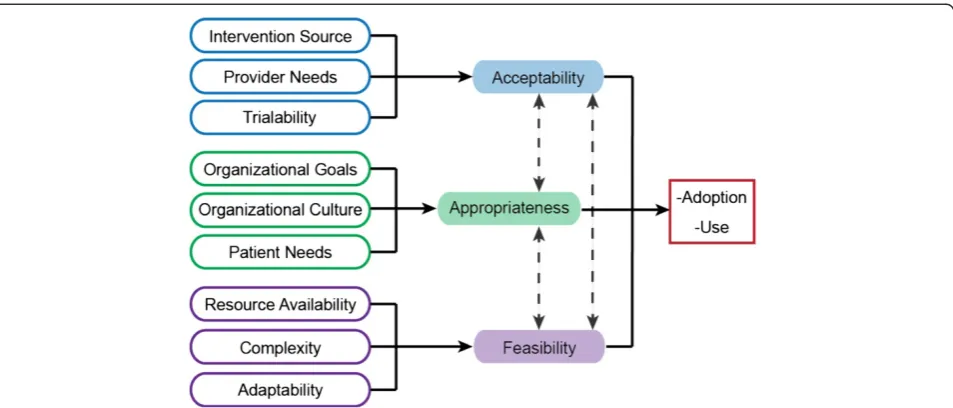
Domain delineation enhances construct validity by redu-cing theoretical contamination in measures [19, 20]. Key steps involve developing conceptual definitions that dis-tinguish the focal construct from related constructs and creating a nomological network (i.e., theoretically speci-fying relations among constructs). We offer the follow-ing provisional conceptual definitions and nomological network, which we will refine with input from our inter-national advisory board. Acceptability refers to the ex-tent to which an innovation or evidence-based practice (EBP) is attractive, agreeable, or palatable [17]. Appropri-ateness refers to the extent to which an innovation or EBP is suitable, fitting, or proper for a particular purpose or circumstance [17]. Feasibilityrefers to the extent to which an innovation or EBP is practical or possible to use. Generally, we view acceptability in terms of innovation-individual (provider) fit, appropriateness in terms of innovation-task fit and innovation-values (so-cial) fit, and feasibility in terms of innovation-system fit. We include in our nomological network (Fig. 2) ante-cedent constructs that have high relevance for only one focal construct, rather than multiple constructs, in order
Table 1Pragmatic dimensions
Required criteria Definition
Important to stakeholders Involve stakeholders from outset and on an ongoing basis
Burden is low for both respondents and staff
Usually brief and inexpensive
Actionable Can correct identified problems or point to a specific intervention need
Sensitive to change Can be used longitudinally to track progress and detect intervention effects
to keep the network from becoming too complex and to guide the design of materials in the structural validity test.
Item generation
We will generate 10 items per construct assuming that half of the items will not survive psychometric testing and that 4–6 items per construct produce scales with sufficient internal consistency [21]. We will take a de-ductive approach to item generation [21], whereby we use the construct definitions and nomological network to ascertain whether items from existing measures ad-equately capture the theoretical content of the construct. We will write new items as needed to obtain 10“direct measures”of each construct [22].
Substantive validity
Substantive validity is “the extent to which a measure is judged to be reflective of, or theoretically linked to, some construct of interest.” [23] When substantive validity is demonstrated for several constructs simultaneously, dis-criminant content validity is also demonstrated. Using procedures described by Huijg and colleagues [24], we
predict two outcomes: (1) experts will assign 60 % or more of the generated items to their intended con-structs, and (2) experts will exhibit substantial agree-ment in their assignagree-ments.
Design and sample We will recruit 30 PhD-trained implementation researchers and 30 implementation-experienced stakeholders through SIRC and our inter-national advisory board to participate in a web-based
survey. Involving both groups from the outset increases the likely relevance of the measures to stakeholders [2].
Data collection and measures The participants will complete a web-based survey in which the three con-structs are defined and the 30 items (10 per construct) are listed in a random order. The participants will assign each item to the construct(s) they perceive the item measures. They will rate their confidence in each as-signment from 0 % for “not at all confident” to 100 % for “extremely confident.” Correct assignments (i.e., items assigned to intended constructs) will be coded 1 (a“match”). Incorrect assignments will be coded−1 (“no match”). Each assignment will be multiplied by its confi-dence rating. Thus, weighted assignments will range from−1 to 1. To assess inter-rater agreement in item al-locationacrossconstructs, for each expert, we will assign items to the constructs for which the expert gave the highest confidence rating. The resulting data matrices will have 30 rows (i.e., the items) and 30 columns (i.e., the experts). To assess inter-rater agreement in item al-location withinconstructs, we will score the 30 items a 1 or 0 for each construct separately (reflecting whether or not it was assigned to the construct) and for each ex-pert separately. The resulting data matrices will have 30 rows (i.e., the items) and 30 columns (i.e., the experts).
Data analysisTo assess substantive validity, we will use one-sample, one-tailedt tests to determine whether the item represents the intended construct. The estimated power for a one-sample, one-tailedttest with 60 partici-pants and a medium effect size (Cohen’s d = 0.5) is 98.5 %. To formally assess the validity of the implemen-tation outcome conceptual model, we will test a
factor confirmatory factor analysis model (CFA) wherein each set of 10-item measures will be loaded onto their respective latent factors (i.e., acceptability, appropriate-ness, or feasibility), with any non-significant correlations or indicator variable factor loadings of <0.50 trimmed from the final model. Power analysis evaluating overall model fit was conducted using the root mean square error of approximation (RMSEA) test of close fit [25], which assumes a null hypothesis of close fit (RMSEA = 0.05) and an alternative hypothesis deter-mination of marginal fit (RMSEA = 0.08) estimates power at 84.6 % with a sample size of 60 partici-pants (sample described above).
Structural validity
Structural validity refers to the extent to which the inter-relationships among items measuring a construct in accord with the expected internal structure of the construct [26]. Wepredict three outcomes: (1) the con-structs can be measured as unitary factors; (2) the mea-sures are correlated yet distinct; (3) the meamea-sures can detect known differences in construct levels, a form of known-groups validity.
Design and sample We will use a 3 × 2 factorial between-subjects design in which we manipulate the three constructs at two levels (high versus low) in vi-gnettes depicting a mental health clinic about to adopt a new evidence-based assessment tool (e.g., Patient Health Questionnaire) and the reactions of stakeholders work-ing there. We will recruit a convenience sample of 240 counselors belonging to the American Mental Health Counselors Association (AMHCA).
Data collection and measures In a web-based survey, the participants will read one of six randomly assigned vignettes and rate the acceptability, appropriateness, and feasibility of using the new assessment tool as they be-lieve the stakeholders at the clinic would rate it. Items will be randomly ordered within and across vignettes to avoid ordering effects.
Data analysis We will test the first two predictions by fitting a three-factor CFA model, forcing items to load on a specified factor but allowing factors to correlate. We will use standardized factor loadings to construct scales and compute correlations among scales, corrected for attenuation due to measurement error. Using the RMSEA test of close fit [25], the estimated power with a sample size of 240 is 100 %. Correlations less than 0.85 will be taken as evidence of discriminant validity. To test the third hypothesis, we will conduct a 3 × 2 analysis of variance (ANOVA) to determine whether the constructs varied as expected by the manipulation of information in
the vignettes; the achieved power for this analytic test with 240 participants and a medium effect size (f= 0.25) is 85.7 %. Significant main effects will indicate that the participants could distinguish high versus low levels of the three constructs.
Reliability assessment
Reliability, the precision of a measure, is a necessary condition for validity [27]. We predict that our measures will demonstrate sufficient inter-item [21] and test-retest reliability. We also predict that our measures will dem-onstrate sensitivity to change, one of Glasgow and Riley’s required criteria for pragmatic measures [2].
Design and sample We will use a variant of a 3 × 2 fac-torial within-subjects design in which half of the study participants in the structural validity test will be ran-domly assigned to receive the same vignette they re-ceived earlier (test-retest reliability); the other half will be assigned to receive the exact opposite vignette they received earlier (sensitivity to change). For example, a participant who earlier received a vignette in which the factors were high-high-low would receive a vignette in which the factors are low-low-high. We will stratify the random assignment across vignettes to ensure balance in the conditions for the test-retest and sensitivity analysis.
Data collection and measures We will use the same data collection procedures and measures that we used in the structural validity test, with an additional question about how long it took to complete the ratings (a pragmatic measure should take less than 2 min to complete) [2]. The web-based survey will be sent 5 days following the struc-tural validity test. This interval should minimize practice and fatigue effects.
Data analysis We will assess inter-item consistency using Cronbach’s alpha. Scales demonstrating alpha coef-ficients greater than 0.70 will be considered reliable. We will assess test-retest reliability using paired ttests and Pearson correlation coefficients. Scales demonstrating non-significant paired t test and correlations greater than 0.70 will be considered reliable. We will assess sen-sitivity to change using repeated measures ANOVA with one between-group factor at two levels (same vignette versus opposite vignette) and one within-group factor at two levels (first versus second survey administration).
Predictive validity
Therefore, we hypothesize that positive perceptions of acceptability, appropriateness, and feasibility are associ-ated with adoption and early use of an innovation or EBP. We will test the predictive validity of our measures in a provider-based research network that routinely adopts multiple innovations and EBPs every year in clin-ical trials and implements trial results into clinclin-ical practice.
Study setting The Community Clinical Oncology Pro-gram network (CCOP) is a national provider-based re-search network that engages community-based physicians in National Cancer Institute (NCI) clinical trials in order to advance the science of cancer prevention, control, and treatment and translate research results into better care [30]. In 2014, the CCOP network combined with the NCI Community Cancer Centers Program to form a new network, the NCI Community Oncology Research Pro-gram (NCORP). NCORP physicians choose which clinical trials to adopt and use (i.e., offer to their patients and en-roll them).
Design and sampleWe will use a cross-sectional design and sampling frame of 2520 NCORP physicians in three oncology specialties: hematology, medical, and radiation. Using a list of NCORP physicians provided by Nation Cancer Institute Division of Cancer Prevention (NCI/ DCP) and data from the American Medical Association (AMA) Physician Masterfile (see below), we will draw a random sample of 600 active NCORP physicians, strati-fied by NCORP organization and medical specialty.
Data sources and measures We will survey physicians to obtain data on their perceptions of acceptability, ap-propriateness, and feasibility of an innovative clinical practice embedded in a clinical trial. We will obtain data on the physicians’adoption and use of the clinical trial from the NCORP organizations’ administrators, who routinely report such data to NCI/DCP. We will meas-ure adoption as a binary variable indicating whether a physician enrolled any patients on the clinical trial and use as the number of patients a physician enrolled. We will obtain data on physicians’ demographics, medical specialty, and years in practice from the AMA Physician Masterfile, which includes data for more than 1.4 million physicians, residents, and medical students in the US.
Data collection We will identify for each oncology spe-cialty a clinical trial that departs significantly from rou-tine clinical practice (i.e., an innovation). Shortly after NCORP organizations activate the trials, we will mail a survey to the sampled physicians asking them to rate the acceptability, appropriateness, and feasibility of enrolling their patients in the trial.
Data analysis We will conduct a three-factor CFA, cre-ate scales from standardized factor loadings, compute inter-item consistency for the scales, and compute corre-lations among scales corrected for attenuation due to measurement error. These results will indicate whether our measures exhibit comparable structural validity, reli-ability, and discriminant validity in the field as they do in the lab. We will test our hypothesis by testing a structural equation model in Mplus 7 [31] using the three latent factors from the three-factor CFA as ex-ogenous predictors, and adoption and use as the en-dogenous outcomes. The estimated power [25] for the model is 100 %.
Aim 3: identify CFIR- and IOF-linked measures that demonstrate both psychometric and pragmatic strength
Introduction
The objective of Aim 3 is to establish the psychometric and pragmatic quality of quantitative measures used in implementation science. We predict that only measures of implementation outcomes [17], and not those of other implementation-relevant constructs, will be both high in psychometric quality and pragmatic strength (Fig. 1). To test our prediction, quantitative measures of CFIR [16] and IOF [17] constructs will be rated to establish psy-chometric and pragmatic strength.
Research design
Building on our preliminary work, we will (a) refine the EBA criteria, (b) extract the relevant data from the lit-erature, (c) rate each measure using the EBA criteria, and (d) summarize the data.
Refine evidence-based assessment criteria
We will modify our established EBA rating criteria in two ways. First, we will add specifiers to the predictive validity criterion to clarify which implementation out-come (acceptability, feasibility, appropriateness, adop-tion, penetration, cost, sustainment, fidelity) measures have been demonstrated to predict. Second, we will add the pragmatic rating criteria from Aim 1 to reveal crit-ical gaps in the implementation measures landscape.
Data extraction (cleaning, coding): highlighting EBA relevant data
Data analysis: rating data obtained through extraction
The trained research specialists and task force mem-bers will rate the psychometric and pragmatic quality of measures by applying the refined EBA criteria to the highlighted measure packets and submitting their ratings via an online survey. The research specialists will rate all measures. The task force members will only rate measures with moderate evidence of reli-ability (e.g., internal consistency) and validity (e.g., structural validity) as determined by the research specialists. Based on our pilot work, we anticipate that no more than 200 measures will meet this mod-erate evidence of psychometric quality. We will adopt a “worst score counts” methodology [32] when applying the EBA criteria. This implies that when rating a measure based on multiple original research articles, the worst score obtained on internal consistency, for instance, would be the “final” rating the measure would receive on that criterion. Two-point discrepancies between research specialist and task force member ratings will be resolved by the in-vestigative team.
Data summarization and interpretation
The EBA criteria have quantitative anchors associated with the qualitative descriptions (e.g.,“no evidence”= 0,
“minimal/emerging”= 1, “good”= 2). This allows for the generation of head-to-head comparisons of measures within constructs, which will serve as a tool for re-searchers and stakeholders in identifying psychometrically strong, pragmatic measures. To inform the measurement-focused research agenda (which constructs and domains are saturated with high-quality, pragmatic measures; which are underdeveloped), we will summarize the EBA ratings across measures within domains and constructs and locate each construct within the four quadrants (see Fig. 1). We will interpret the measure quality profiles and the results of the four-quadrant grid in collaboration with our international and stakeholder advisory boards.
Trial status
At the time of submission, both the international ad-visory board and the implementation scientist task force have been engaged. The stakeholder panel is formed and nominations for our stakeholder task force have been collected and rank ordered to achieve balance in our representativeness.
Discussion
Innovation
No research, to our knowledge, has attempted to sys-tematically produce and identify pragmatic implementa-tion science measures. In addiimplementa-tion, the only existing pragmatic criteria were generated in the absence of
stakeholder involvement. Pragmatic implementation sci-ence measures could be useful for assessing organizational needs and contexts (to select and deploy implementation strategies), monitoring strategy impacts, and refining im-plementation processes to improve outcomes. The result-ing ratresult-ing criteria are innovative because they will provide a method for systematically evaluating pragmatic measure strength, which will inform measure development, evalu-ation, and selection.
In addition, the aim to develop new measures of im-plementation outcomes, focusing on acceptability, ap-propriateness, and feasibility is innovative because no valid, reliable, pragmatic measures exist for these con-structs. Given their implications for predicting the likeli-hood of uptake of EBPs, these constructs are critically in need of systematic measurement development. This work will also establish a novel, rigorous method for measure development that takes into account pragmatic measure qualities.
Finally, the proposed evaluation of a comprehensive array of existing measures is innovative because it moves beyond the traditional approach of evaluating measures based only on their psychometric properties and will re-veal four quadrants (Fig. 1) delineating measure strength. Although other reviews of measurement have been published [4, 5], no systematic review, empirical rating of this scale and degree of comprehensiveness has been conducted in implementation science.
Limitations
Impact
Identification and application of evidence-based imple-mentation strategies requires the availability of psycho-metrically strong, pragmatic measures. The interrelated set of aims in the current project will yield methods and measures for advancing the field. The resulting prag-matic rating criteria may gain widespread use, not only in implementation science but also in related fields. For example, Beidas et al. [33] recently used Glasgow and Riley’s pragmatic criteria [2] as inclusion criteria for a re-view of patient symptom measures. In addition, the de-velopment of three new reliable, valid, and pragmatic measures of implementation outcomes will position re-searchers to identify strategies that promote adoption. The comprehensive assessment of psychometric and pragmatic qualities of over 420 measures will enable re-searchers and stakeholders to make use of high-quality existing measures and contribute new measures in underdeveloped areas. Moreover, our work may reveal measurement-focused reporting standards. This proposal reflects necessary steps in our research program with the eventual goal of developing an online battery of reli-able, valid, and pragmatic implementation science mea-sures. With SIRC as our platform (>520 international members) and the close involvement of nine world-renowned implementation scientists, the findings and outcomes of this set of studies have the potential for high impact.
Abbreviations
AMA:American Medical Association; AMHCA: American Mental Health Counselors Association; ANOVA: analysis of variance; CCOP: Community Clinical Oncology Program; CFA: confirmatory factor analysis;
CFI: comparative fit index; CFIR: Consolidated Framework for Implementation Research; EBA: evidence-based assessment; EBP: evidence-based practice; GEM: Grid-Enabled Measures; ICC: intraclass correlation; IOF: Implementation Outcomes Framework; NCI: National Cancer Institute; NCI/DCP: Nation Cancer Institute Division of Cancer Prevention; NIH: National Institute of Health; NIMH: National Institute of Mental Health; RMSEA: root mean square error of approximation; SIRC: Society for Implementation Research Collaboration; SRMR: standard root mean square residual.
Competing interests
The authors declare that they have no competing interests.
Authors’contributions
CCL is the principal investigator for the described study. BJW and CS are both co-investigators. CCL, BJW, and CS collaboratively conceptual-ized and designed the study, with CS leading design and implementa-tion of Aim 1, BJW leading design and implementaimplementa-tion of Aim 2, and CCL leading design and implementation of Aim 3. Each investigator led the writing of their respective aims for the manuscript, with BJW composing the initial draft of the background and CCL drafting the discussion section. SF compiled the initial draft of the manuscript through proposal section integration. All authors reviewed and provided feedback for this manuscript. The final version of this manuscript was approved by all authors.
Acknowledgements
Research reported in this publication was supported by the National Institute of Mental Health of the National Institutes of Health under Award Number R01MH106510. The preparation of this manuscript was also supported, in kind, through the National Institutes of Health R13 award entitled,
“Development and Dissemination of Rigorous Methods for Training and Implementation of Evidence-Based Behavioral Health Treatments” granted to PI: KA Comtois from 2010–2015. Dr. Bryan J. Weiner’s time on the pilot studies supporting the parent grant was supported by the following funding: NIH CTSA at UNC UL1TR00083.
Author details 1
Department of Psychological and Brain Sciences, Indiana University, 1101 E. 10th St., Bloomington, IN 47405, USA.2Department of Psychiatry and Behavioral Sciences, School of Medicine, Harborview Medical Center, University of Washington, 325 9th Ave, Box 359911, Seattle, WA 98104, USA. 3
1102-C McGavran-Greenberg Hall, University of North Carolina at Chapel Hill, 135 Dauer Drive, Campus Box 7411, Chapel Hill, NC 27599-7411, USA. 4
Department of Psychology, University of Montana, 32 Campus Dr., Skaggs Bldg. 202, Missoula, MT 59812, USA.
Received: 23 June 2015 Accepted: 30 June 2015
References
1. Grimshaw J, Eccles M, Thomas R, MacLennan G, Ramsay C, Fraser C, et al. Toward evidence-based quality improvement. J Gen Intern Med. 2006;21:S14–20.
2. Glasgow RE, Riley WT. Pragmatic measures: what they are and why we need them. Am J Prev Med. 2013;45:237–43.
3. Lewis CC, Fischer S, Weiner BJ, Stanick C, Kim M, Martinez RG. Outcomes for implementation science: an enhanced systematic review of instruments using evidence-based rating criteria. Implement Sci, In Press.
4. Chor KHB, Wisdom JP, Olin S-CS, Hoagwood KE, Horwitz SM. Measures for predictors of innovation adoption. Adm Policy Ment Health Ment Health Serv Res. 2014:1–29. Epub.
5. Chaudoir SR, Dugan AG, Barr CH. Measuring factors affecting implementation of health innovations: a systematic review of structural, organizational, provider, patient, and innovation level measures. Implement Sci. 2013;8:22.
6. Rabin BA, Purcell P, Naveed S, Moser RP, Henton MD, Proctor EK, et al. Advancing the application, quality and harmonization of implementation science measures. Implement Sci. 2012;7:119.
7. Hunsley J, Mash EJ. Developing criteria for evidence-based assessment: an introduction to assessments that work, Guide assess work. 2008. p. 3–14. 8. Weisz JR, Ng MY, Bearman SK. Odd couple? Reenvisioning the relation
between science and practice in the dissemination-implementation era. Clin Psychol Sci. 2014;2:58–74.
9. Graham ID, Logan J, Harrison MB, Straus SE, Tetroe J, Caswell W, et al. Lost in knowledge translation: time for a map? J Contin Educ Health Prof. 2006;26:13–24.
10. Brown SR. Q methodology and qualitative research. Qual Health Res. 1996;6:561–7.
11. Michie S, Abraham C, Eccles MP, Francis JJ, Hardeman W, Johnston M. Strengthening evaluation and implementation by specifying components of behaviour change interventions: a study protocol. Implement Sci. 2011;6:10.
12. Pill J. The Delphi method: substance, context, a critique and an annotated bibliography. Socioecon Plann Sci. 1971;5:57–71.
13. Hasson F, Keeney S, McKenna H. Research guidelines for the Delphi survey technique. J Adv Nurs. 2000;32:1008–15.
14. Dajani JS, Sincoff MZ, Talley WK. Stability and agreement criteria for the termination of Delphi studies. Technol Forecast Soc Change. 1979;13:83–90. 15. Lewis C, Borntrager C, Martinez R, Weiner B, Kim M, Barwick M, et al. The
society for implementation research collaboration instrument review project: a collaborative methodology to promote rigorous evaluation. Implement Sci. 2015;10(1):2. under review.
16. Damschroder LJ, Aron DC, Keith RE, Kirsh SR, Alexander JA, Lowery JC. Fostering implementation of health services research findings into practice: a consolidated framework for advancing implementation science. Implement Sci. 2009;4:50.
18. Wisdom JP, Chor KHB, Hoagwood KE, Horwitz SM. Innovation adoption: a review of theories and constructs. Adm Policy Ment Health Ment Health Serv Res. 2014;41(4):480–502.
19. DeVellis RF. Scale development: theory and applications, vol. 26. USA: Sage Publications; 2011.
20. Viswanathan M. Measurement error and research design. Thousand Oaks, CA: Sage; 2005.
21. Hinkin TR. A brief tutorial on the development of measures for use in survey questionnaires. Organ Res Methods. 1998;1:104–21.
22. Nunnally JC. Bernstein: psychometric theory. New York: McGraw-Hill; 1994. 23. Anderson JC, Gerbing DW. Predicting the performance of measures in a
confirmatory factor analysis with a pretest assessment of their substantive validities. J Appl Psychol. 1991;76:732.
24. Huijg JM, Gebhardt WA, Crone MR, Dusseldorp E, Presseau J. Discriminant content validity of a theoretical domains framework questionnaire for use in implementation research. Implement Sci. 2014;9:11.
25. MacCallum RC, Browne MW, Sugawara HM. Power analysis and determination of sample size for covariance structure modeling. Psychol Methods. 1996;1:130.
26. Messick S. Validity of psychological assessment: validation of inferences from persons’responses and performances as scientific inquiry into score meaning. Am Psychol. 1995;50:741.
27. Kerlinger Fred N, Lee Howard B: Foundations of behavioral research.
N Y2000.
28. Donnelly J, Trochim W. The research methods knowledge base. Ohio: Atomic Dog Publishing; 2007.
29. Rogers E: M. Diffusion of innovations. New York: Free Press; 2008. 30. Minasian LM, Carpenter WR, Weiner BJ, Anderson DE, McCaskill-Stevens W,
Nelson S, et al. Translating research into evidence-based practice. Cancer. 2010;116:4440–9.
31. Muthén LK, Muthén BO. Mplus. Compr Model Program Appl Res Users Guide. 2012;5:E22.
32. Terwee CB, Mokkink LB, Knol DL, Ostelo RW, Bouter LM, de Vet HC. Rating the methodological quality in systematic reviews of studies on measurement properties: a scoring system for the COSMIN checklist. Qual Life Res. 2012;21:651–7.
33. Beidas RS, Stewart RE, Walsh L, Lucas S, Downey MM, Jackson K, et al. Free, brief, and validated: standardized instruments for low-resource mental health settings. Cogn Behav Pract. 2015;22(1):5–19.
Submit your next manuscript to BioMed Central and take full advantage of:
• Convenient online submission
• Thorough peer review
• No space constraints or color figure charges
• Immediate publication on acceptance
• Inclusion in PubMed, CAS, Scopus and Google Scholar
• Research which is freely available for redistribution