R E S E A R C H
Open Access
Understanding professional advice networks
in long-term care: an outside-inside view of
best practice pathways for diffusion
Lisa A. Cranley
1*, Janice M. Keefe
2, Deanne Taylor
3, Genevieve Thompson
4, Amanda M. Beacom
5,
Janet E. Squires
6, Carole A. Estabrooks
7, James W. Dearing
8, Peter G. Norton
9and Whitney B. Berta
10Abstract
Background:Interpersonal relationships among professionals drive both the adoption and rejection of consequential innovations. Through relationships, decision-makers learn which colleagues are choosing to adopt innovations, and why. The purpose of our study was to understand how and why long-term care (LTC) leaders in a pan-Canadian interpersonal network provide and seek advice about care improvement innovations, for the eventual dissemination and implementation of these innovations.
Methods:We used a mixed methods approach. An online survey was sent to senior leaders in 958 LTC facilities in 11 Canadian provinces and territories. Participants were asked to name up to three individuals whose advice they most value when considering care improvement and practice innovations. Sociometric analysis revealed the structure of provincial-level advice networks and how those networks were linked. Using sociometric indicators, we purposively selected 39 key network actors to interview to explore the nature of advice relationships. Data were analyzed thematically.
Results:In this paper, we report our qualitative findings. We identified four themes from the data. One theme related to characteristics of particular network roles: opinion leaders, advice seekers, and boundary spanners. Opinion leaders and boundary spanners have long tenures in LTC, a broad knowledge of the network, and share an interest in advancing the sector. Advice seekers were similarly committed to LTC; they initially seek and then, over time, exchange advice with opinion leaders and become an important source of information for them. A second theme related to characterizing advice seeking relationships as formal, peer-to-peer, mentoring, or reciprocal. The third and fourth themes described motivations for providing and seeking advice, and the nature of advice given and sought. Advice seekers initially sought information to resolve clinical care problems; however, over time, the nature of advice sought expanded to include operational and strategic queries. Opinion leaders sought to expand their networks and to solicit information from their more established advice seekers that might benefit the network and advance LTC.
Conclusions:New knowledge about the distinct roles that different network actors play vis-a-vis one another offers healthcare professionals, researchers, and decision- and policy-makers insights that are useful when formulating best practice dissemination strategies.
Keywords:Diffusion of innovations, Long-term care sector, Mixed methods, Professional advice seeking networks
* Correspondence:[email protected]
1Lawrence S. Bloomberg Faculty of Nursing, University of Toronto, Toronto,
Ontario, Canada
Full list of author information is available at the end of the article
The diffusion of innovations relies on the communication of both descriptive and evaluative information among people [1, 2]. One tenet of innovation diffusion theory is that while descriptive information is mostly accessed via impersonal channels of communication such as websites and specialty media, evaluative information is primarily exchanged interpersonally, from person to person, as ad-vice or example [1]. Knowledge about innovations in healthcare is more likely to be gleaned from members of professional social networks than from the information that is available through academic journals, published guidelines, and conference presentations [3–6]. Social net-work analysis has been used to understand how advice about innovations moves through a network and to de-velop“network interventions”[7]. Such interventions can enhance the efficiency of innovation dissemination by al-tering the network structure [8, 9] or expedite a desired behavioral change [7, 10, 11]—like increasing the uptake of an evidence-based practice—by tapping into the exist-ing network structure.
Opinion leadership and boundary spanning are key roles within a professional social network. Opinion leaders, because of their credibility in terms of expert-ise, trustworthiness, and accessibility, are central to communication structures and information flow [12]. The reasons for conferral of informal opinion leader status can vary by setting and innovation [1,8]. Bound-ary spanners move knowledge and information from group to group across a network, thus helping to pollin-ate groups with new ideas for opinion leaders to consider and playing the heterogenous function of communicating innovations across networks by bridging network gaps (e.g., structural holes) [13,14].
Quantitative approaches to social network analysis af-ford an“outsider view”of networks, mapping and meas-uring “aspects of social relations in a systematic and precise fashion” ([15], p.5). Qualitative approaches are less common and afford an“insider view,” exploring the subjective meaning of a network to members and eluci-dating the reasons for individual behavior [16]. In mixed methods studies of social networks, these complemen-tary approaches are brought together to offer a particu-larly rich “outside-inside view” of social relations and a nuanced understanding of the structure of the network and the forces that produce it [16,17].
In Canada, long-term care (LTC) facilities are governed by each province or territory. Many jurisdictions delegate operations oversight, including regulatory compliance, to regional health authorities [18]. These deliver public healthcare, and their boards are accountable to the provin-cial health ministry [19]. LTC facilities may be public not-for-profit, voluntary (e.g., faith-based) not-for-profit, or private (for-profit or not-for-profit) [20]. The fragmen-ted governance of the Canadian LTC system likely
increases the “stickiness” [21] of best practices and de-creases cross-jurisdictional diffusion. As with the USA, the care needs of residents in the Canadian LTC system are becoming increasingly complex resulting from multi-morbidities [22,23]. Facility leaders are increasingly chal-lenged to find innovative ways to respond to these needs and sustain acceptable levels of care quality [24]. While one source of practice innovations lies in the experiences and knowledge of other facility leaders, and other profes-sionals, in the LTC system in Canada, the fragmented
gov-ernance of the system appears to constrain the
development of a porous system-wide network and de-creases the likelihood of cross-jurisdictional diffusion [20]. We conducted a two-phased study using a mixed methods approach to understand the relations and inter-actional processes of a pan-Canadian advice seeking net-work of professionals in the residential LTC sector. Our chief motivation was to inform future cross-jurisdictional LTC best practice dissemination efforts through insights about extant advice seeking among LTC directors, i.e., through identification of“pathways”for diffusion to occur. In the first phase of the study, we examined advice net-works both within and across 11 Canadian provinces and territories in Atlantic and Western and Northern Canada. We completed a formal, quantitative social network ana-lysis of the advice seeking networks among senior LTC leaders working in these jurisdictions; these results are published in a prior issue of this journal [20]. In the sec-ond phase of the study, we aimed to better understand the nature of the advice relationships, the characteristics of those who hold key roles in the network—opinion leaders, boundary spanners, and advice seekers—and the types of advice sought and given. The present article focusses on findings from this second, qualitative phase of our study.
Methods
Participant selection
Our qualitative sample selection was informed from our social network survey data analysis. In the quantita-tive phase, we sent an online survey to one senior leader (e.g., Director of Care, Director of Nursing) in each of the 958 LTC facilities operating across eight provinces and three territories in Atlantic and Western and Northern Canada. Because survey response rates were low (< 30%) in Newfoundland and Labrador, Yukon, and Nunavut, we excluded those provinces and territories from the interview sampling plan. In the sur-vey phase of the study, we asked:“Whose advice do you most value about delivery of quality care, care
improve-ment and innovation?” We approached senior leaders
importance. Named individuals were not restricted to peers working in other facilities, and individuals in government, corporate management, consulting, and academic research were named. We then generated sociograms using the sur-vey data; these were maps of relationships in the interper-sonal advice network of each province or territory accompanied by metrics measuring the network position and role of each member [20].
We used this survey data analysis to purposively iden-tify three types of potential interview participants based on network position and role.Opinion leaders serve as sources of advice and of examples of how they responded to a given innovation and were selected by identifying the actors in each provincial/territorial net-work with the highest in-degree centrality scores (num-ber of incoming ties from others in the network).
Boundary spanners connect sociometrically distinct groups in the network and were selected by identifying the actors in each network with the highest between-ness centrality scores (the frequency with which an actor is positioned on the shortest path between other
actors in the network) [25]. Boundary spanners who
connected people from different provinces or people with different professional roles (e.g., senior leaders in LTC facilities vs. in regional and provincial govern-ments) were prioritized as interview participants, be-cause we were interested in insights on how barriers presented by fragmented governance, and professional silos, are overcome by such individuals.1Advice seekers
were defined as actors in each provincial network who had not already been selected as opinion leaders and boundary spanners and who sought advice from at least
one opinion leader or boundary spanner.2 From our
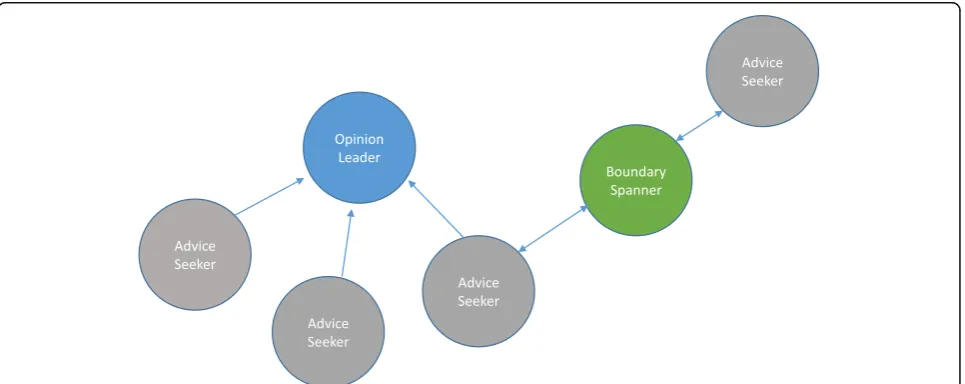
survey, there were 1140 members of the pan-Canadian interpersonal advice network, of whom 462 were advice seekers, 50 opinion leaders, and 51 boundary spanners [20] (note that these role-types were not exclusive, such that one member of the network could be an advice seeker, opinion leader, and boundary spanner simultan-eously, and all boundary spanners were by definition also advice seekers). Using this initial sampling frame, we then began contacting potential interview partici-pants from each category of network role in each prov-ince and territory (Fig.1).
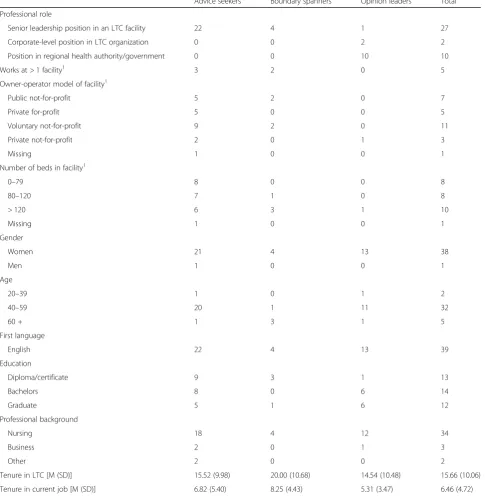
We completed 39 interviews: 13 with opinion leaders (3 Atlantic, 10 West/North), 22 with advice seekers (6 Atlan-tic, 16 West/North), and 4 with boundary spanners (2 At-lantic, 2 West/North) (Table 1). Interviews lasted on average 38 min (range, 18–74 min). All 39 participants were similar in age, 38 of 39 were female, all indicated English as their first language, and most had nursing back-grounds. Mean sample characteristics are similar to those reported from the online survey respondents [20]. All ad-vice seekers and boundary spanners held senior leadership positions in LTC facilities. Ten opinion leaders held posi-tions in government. Boundary spanners had the longest tenure in LTC (20 years on average) and in their current job (8 years on average) (Table2).
Data collection
Qualitative data were collected using a semi-structured interview guide informed by Rogers’ work on roles of social ties and communication channels in innovation diffusion [1]. The interview guide was piloted with three Atlantic advice seekers to test the questions and language used. Pilot interview data were not transcribed
Table 1Summary of sampling frame by role
SNA role Members of network
identified from survey data
Number of potential participants in interview sample
Number of completed interviews
Advice seeker 462 69 22
Opinion leader 50 32 13
Boundary spanner 51 40 4
Table 2Demographic characteristics of interview participants
Advice seekers Boundary spanners Opinion leaders Total
Professional role
Senior leadership position in an LTC facility 22 4 1 27
Corporate-level position in LTC organization 0 0 2 2
Position in regional health authority/government 0 0 10 10
Works at > 1 facility1 3 2 0 5
Owner-operator model of facility1
Public not-for-profit 5 2 0 7
Private for-profit 5 0 0 5
Voluntary not-for-profit 9 2 0 11
Private not-for-profit 2 0 1 3
Missing 1 0 0 1
Number of beds in facility1
0–79 8 0 0 8
80–120 7 1 0 8
> 120 6 3 1 10
Missing 1 0 0 1
Gender
Women 21 4 13 38
Men 1 0 0 1
Age
20–39 1 0 1 2
40–59 20 1 11 32
60 + 1 3 1 5
First language
English 22 4 13 39
Education
Diploma/certificate 9 3 1 13
Bachelors 8 0 6 14
Graduate 5 1 6 12
Professional background
Nursing 18 4 12 34
Business 2 0 1 3
Other 2 0 0 2
Tenure in LTC [M (SD)] 15.52 (9.98) 20.00 (10.68) 14.54 (10.48) 15.66 (10.06)
Tenure in current job [M (SD)] 6.82 (5.40) 8.25 (4.43) 5.31 (3.47) 6.46 (4.72)
Source authors’analysis,LTC(long-term care)
1
or analyzed. Data were collected via telephone inter-views conducted between fall 2015 and spring 2016 by at least one researcher and one student trainee. Partici-pants were asked to describe their relationships and types of advice sought and how these changed over time; their motivations for entering into and sustaining relationships; and characteristics of individuals from whom they sought advice (e.g., advice seekers were asked to describe characteristics of opinion leaders and/or boundary spanners). Interviews were audio-re-corded and transcribed verbatim, and informed consent was obtained before data collection.
Data analysis
Data were analyzed using thematic analysis [26]. Data analysis was concurrent and iterative with data collec-tion [27]. Transcripts were assigned to two researchers who first read them individually to become familiar with the data and to capture initial analytic thoughts and ideas. Next, two individuals systematically coded each transcript to identify and describe phenomena found in the text, line by line. We then met as a team and each team member presented their perspectives as part of the consensus coding process across a subset of transcripts. This approach was repeated until all tran-scripts were coded. Concurrently, codes were collated into categories and grouped into themes. While our inter-view guide was informed by Rogers’work on innovation diffusion theory [1], specifically social ties and communi-cation channels—and so in this sense contributed a de-ductive component—we also invited participants to offer
additional comments not grounded in innovation diffu-sion theory. When we undertook our thematic analysis, we set the theoretical framing“aside”and conducted our thematic analysis inductively such that the themes emerged from the data. Methodological rigor was ensured through comparison and discussion of emerging categor-ies identified independently by two or more researchers and through the use of categories and themes that were robust and supported by data from an array of partici-pants. Data collection and analysis continued until satur-ation was achieved, i.e., no new insights or themes emerged from our analysis [28]. NVivo10© software was used to manage the data.
Study results
Four key themes, with embedded sub-themes, emerged from our analysis of the interview data: (1) opinion leader and boundary spanner characteristics; (2) charac-terizing advice seeking relationships; (3) motivations for providing and seeking advice; and (4) the nature of ad-vice given or sought.
Opinion leader and boundary spanner characteristics Opinion leader characteristics
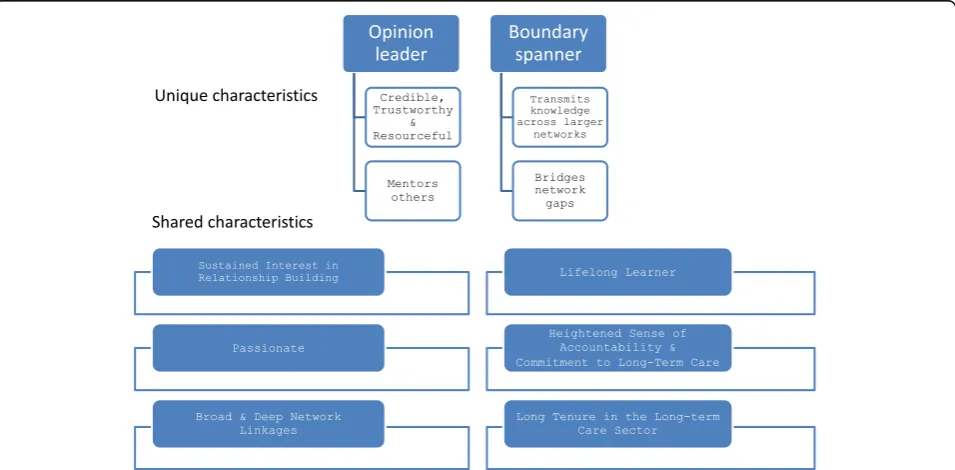
Advice seekers consistently described opinion leaders as well-connected with broad and deep network linkages, diligent in maintaining their connections over their career trajectories, and continuously building more linkages (Fig.2). Opinion leaders had other attributes that attracted advice seekers: they were seen as reliable, credible, and
trustworthy, with reputations as action-oriented,
conscientious, approachable, forthcoming, knowledgeable, and willing to share. One advice seeker noted:
It’s based on her expertise. You just know that she knows, and if she doesn’t know, she’ll find out how to get that information for you. She’s very supportive. I can’t overstate this enough, she’s just very fresh and vibrant. Really plugged in. So it’s that personal characteristic of her, as well, that you want to seek her out. (West/North).
Opinion leaders’ networks were not static, but in a constant state of construction and re-construction. They expressed the need to constantly add to and refresh their stores of knowledge, information, and advice, and so they worked continually to build their networks:
I think it’s valuable to share insights and to share experiences…ideas to grow from…we need to stay on top of best practice. And we need to stay on top of educating ourselves and others, the best we can, to care for them. Move away from old ideas. (Opinion Leader, Atlantic).
While opinion leaders were not asked to describe them-selves, some of the experiences that they shared regarding their efforts in their networks showcased the characteristics ascribed to them by advice seekers. Opinion leaders expressed what we came to refer to as a heightened sense of “systemness,” that is, they were interested in—and ap-peared to feel that it is their responsibility to—help progress the care and operations of the LTC system well beyond their own organization and its more narrow interests. For example, some participants described system planning and developing system-wide policies. Many opinion leaders also had remarkable foresight, and they expressed the import-ance of mentoring others in their networks in the interests of developing future leaders in LTC.
Boundary spanner characteristics
Advice seekers described boundary spanners in a man-ner similar to that of opinion leaders: they were pas-sionate about improving the LTC sector generally, they were approachable and had a good reputation, they were willing to share knowledge, they were lifelong learners, and they consciously and continually worked to build their network connections (e.g., seeking formal networking opportunities to build and maintain con-nections by attending conferences and through active membership in organizations/associations). They too were described as having a heightened sense of system-ness (Fig. 2). Another notable characteristic was their long tenure both in LTC and their current job, which they acknowledged as key for those seeking advice from
them because they understood the LTC system. A key defining characteristic of boundary spanners was that they strengthened the network by bridging gaps in the network and they sought to transmit information broadly across the network, information that otherwise would not get shared among network members.
Characterizing advice seeking relationships
Building advice seeking relationships had three sub-cat-egories: types of advice seeking relationships, evolution of advice seeking relationships, and outcomes of advice seeking relationships.
Types of advice seeking relationships
We found four types of advice seeking relationships: for-mal, peer-to-peer, mentoring, and reciprocal. Formal
ad-vice seeking relationships resulted from hierarchy
relationships (e.g., reporting relationships) and were rou-tine, regular, and structured. Advice seekers identified fewer of these than informal relationships, and frequently, a formal opinion leader-advice seeker relationship evolved over time to an informal one. More often, advice seeking relationships originated from existing, longstanding peer--to-peerrelationships as a result from working together for several years and continued to be fostered through pro-motions and changes in job positions over the years. In some instances, advice relationships emerged from men-toring roles, whereby someone started in a new role and was mentored by a more senior/experienced individual and this relationship continued over time. While formal and mentoring relationships were both structured (e.g., based on seniority), formal relationships were leadership positions that may or may not have included mentoring roles. Reciprocity is a characteristic that most often ap-plied to peer-to-peer relationships, but also characterized mentoring relationships that were sustained and evolved over time. Initially, many mentoring relationships began as a one-way advice seeking relationship yet over time evolved intoreciprocaladvice seeking relationships:
She [opinion leader] had a background in infection control. So questions…around…what they’re doing as best practice…[were the original focus]…Now…we actually bounce things off each other as well. So it’s not as one-way as four years ago. (Advice Seeker, Atlantic).
Evolution of advice seeking relationships
to problem solve. Many of the advice seekers described how advice evolved from urgent problem solving to seek-ing and exchangseek-ing strategic and clinical advice. Fre-quency of advice sought also changed, with more informal advice seeking as comfort grew and trust built. General orienting knowledge and advice was also sought by those newly entering into LTC as leaders, or those adjusting to a change in organization or location, who needed general knowledge to orient themselves to the LTC sector or their new role. As some advice seekers became more familiar with LTC and established in their new contexts, the advice that they sought shifted to include advice on strategic/op-erations or clinical matters. Frequency also changed as ad-vice seekers became more established in a role or sector and increased their network breadth to rely less exclu-sively on the original opinion leader:
[advice seeking] is less frequent…I think the confidence level…has grown to where I don’t find I need to seek the advice as often. If we do connect, oftentimes it’s more of a social nature…But there’s still those times where I would go to her, and I feel comfortable to say that I have no problem phoning her up. (Advice Seeker, West/North).
Direction of advice or information flow changed over time, often beginning as one-way exchanges but gener-ally evolving to two-way (reciprocal) exchanges. Many opinion leaders expected reciprocity from advice seekers: when they gave advice or shared information, they also solicited it to build their stock of knowledge of potential use to others in their network.
Outcomes of advice seeking relationships
There were four main outcomes of advice seeking
re-lationships: problem resolution, application of new
practice, co-learning and knowledge exchange, and
broadened/strengthened networks. Problem resolution
was the most commonly described outcome and was often accompanied by application of a new practice—
clinical or management/operational. As a result of the trust built between the actors in the advice seeking re-lationships, these relationships formed a valued con-duit for seeking solutions for problems emerging in the system. Often, the ability to problem solve was based on historical knowledge within the organization and knowing how to navigate the LTC system:
Sometimes we would go to her [opinion leader], just to ask,“have you heard of any other homes having these same problems and how did they deal with it?” Because she was involved globally, with all 30 homes
–more than likely, she’s heard of an instance where it’s happened. So she was able to give some advice,
based on learnings from other homes. (Advice Seeker, West/North).
In other instances, the opinion leader shared unsoli-cited knowledge of a new practice with advice seekers, i.e., not necessarily in response to the presentation of a problem. These were adopted; seemingly, some of the barriers to innovation adoption were overcome simply because of the trust imbued in the opinion leader on the part of the advice seeker. This trust allowed for more reciprocal learning and collaboration and less protectionism over knowledge. While knowledge ex-change and broadening/strengthening networks tended to occur largely at the provincial level (i.e., attending conferences), there was evidence of network leaders drawing on their networks in other provinces. Net-works were leveraged to enhance co-learning and knowledge exchange, fostering a less insular perspective on problem resolution:
…Over the last 10 years, I think people are getting very creative and–and reaching out, not just in the provinces or the territories themselves, to say,“what are you doing and how can we share?”Like we should not be doing this alone. And there’s so much good stuff going on out there, right? And this is a great opportunity. It’s good to see. (Opinion Leader, West/North).
Networks were strengthened by the conversations which allowed for both building rapport and offering a safe place to discuss difficult situations. Sharing information and of-fering the opportunity to speak and be heard provided many of the network actors a sense of community where the particularities of LTC were understood among col-leagues. The collegiality facilitated informal conversations that supported the formation of new ideas and the confi-dence to try new approaches.
Motivations for providing and seeking advice Motivations for providing advice
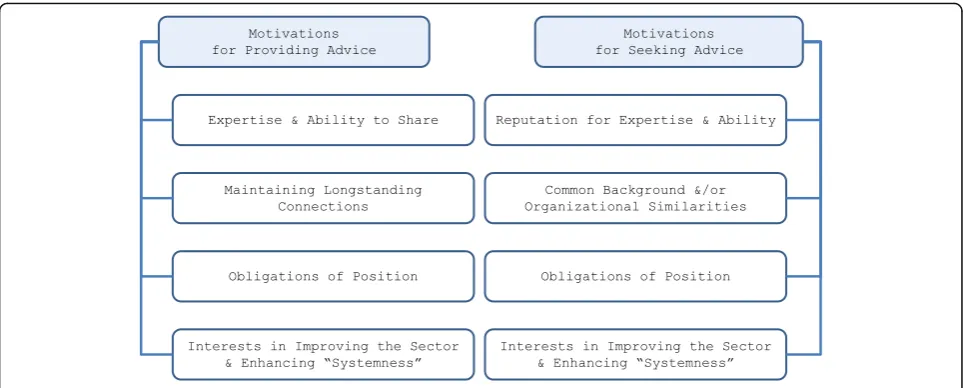
Motivations for providing advice were both altruistic and purposeful for opinion leaders. Generally, they re-ferred to experiencing satisfaction from helping others and sharing their expertise (Fig.3). They articulated an enduring passion not only in advancing the interests of their organization but to contributing to improving and advancing the LTC system, consistently expressing an enhanced sense of“systemness.”
One opinion leader stated:
for people- especially with dementia and palliative care in long-term care settings. (West/North).
Motivations for seeking advice
Opinion leaders’ reputed expertise motivated the initial contacts made by advice seekers. Similarities in back-ground, experiences, and LTC facility size were also factors that led advice seekers to seek certain opinion leaders:
She’s been recognized as…a good director of nursing
…And it’s also a large home…which is important to me, because it’s really hard when you’re almost 200 beds, to be comparing what somebody’s doing in a 30 or 40 bed home…She was approachable…in certain areas, she’s got the answers. She…comes from a strong clinical background…Plus she’s got some good leadership skills. She’s…not afraid to…make hard decisions…(Advice Seeker, Atlantic).
Opinion leaders’ heightened sense of systemness was also a motivator for seeking advice:
…the way she looked at long-term care and thought about long-term care certainly has made me much more comfortable in seeking…her input and her ad-vice in different areas. Because I know how she feels about the sector, you know, her passion for it. And her knowledge of it. (Advice Seeker, Atlantic).
Nature of advice given or sought
Two types of advice were given and sought: reactive and proactive.
Reactive advice
Reactive advice was generally transmitted or given informally, when an advice seeker contacted an opinion leader to assist in resolving a problem or help them think through an issue. These problems were generally practical, but they ranged widely, from family concerns/relations to clinical questions to accreditation and regulations to human resource issues (Fig. 4).
Proactive advice
Advice seekers acknowledged that it was important to routinely confer with opinion leaders to adhere to standards of care and keep abreast of relevant pol-icies. Proactive advice was generally, and understand-ably, offered in a formal format, e.g., e-mailed or
written communications, in standing committees
among Directors of Care or LTC facility administra-tors. Often, the opinion leaders giving proactive ad-vice were in governance or oversight positions:
I am proactive in the sense that I host regular meetings for all the directors of nursing to attend. And in those meetings, oftentimes our agenda is heavily laden with policies that are coming, that are new, with development related to standards and accreditation that we need to meet. So I think there is that proactive part of it. I also try to, at those meetings, be proactive in bringing some best practices forward. So if - for example, I’ve come across a leading practice related to dementia care, I will try to share that to that team at those
meetings, in order to broaden their knowledge base and keep them abreast of whatever developments there are. (Opinion Leader, West/North).
Discussion
Our study aim was to understand how and why LTC leaders in a pan-Canadian interpersonal network provide and seek advice about care improvement innovations, in order to design more effective dissemination and imple-mentation programs. We discuss our main findings within the context of the extant literature and offer im-plications for future dissemination strategy and research.
The dynamic nature of advice seeking relationships A common thread that ran through each of the four themes identified in our results was the dynamic nature of the advice networks we studied. We observed that (a) the network roles of opinion leader, boundary spanner, and advice seeker can be more complementary and over-lapping than traditionally portrayed in the diffusion lit-erature, (b) people can assume different roles in the network over time, and (c) advice relationships can change over time. Most relationships that we examined began as peer-to-peer and evolved over time, solidified by a common appreciation for resident-centeredness and an earnest desire to improve and advance LTC. Report-ing or formal authority relationships, in which the flow of advice began as unidirectional, evolved into reciprocal relationships, and advice seekers eventually exchanged knowledge and information with opinion leaders.
This finding both echoes and expands upon the results of previous theoretical and empirical research. Scholars studying advice relationships in professional networks have observed that such relationships are often recipro-cal, especially in contexts with less formal hierarchy, where everyone possesses some knowledge of value to network members [29,30]. In two cross-sectional studies of health care professionals, for example, Keating and colleagues found that reciprocity was a significant
predictor of advice ties [31], and Zappa found that reci-procity characterized 93% of such relationships [32]. Our research is consistent with these findings. However, it adds longitudinal insights: although reciprocity has been a much-studied characteristic of network relationships, only a small proportion of studies on professional net-works have been longitudinal or have queried relational history [33]. Even in the diffusion literature, which ad-dresses an inherently dynamic process, studies that cap-ture the long-term evolution of advice relationships over professional careers, beyond the diffusion of a single new practice or innovation, are rare. Our finding that among LTC professionals, such advice relationships often become increasingly reciprocal over time and that the initially distinct roles of advice source and seeker eventually blur and overlap represents an expansion in our understanding of the dynamics of roles and reci-procity in advice networks.
Critical roles in advice seeking networks
In a second main finding from our results, the opinion leader characteristics, described by advice seekers, highlighted the impact that the former have in support-ing the interpersonal advice seeksupport-ing networks to im-prove the LTC sector. Opinion leaders in our study shared many characteristics identified in previous social network studies: they were perceived as influential, trust-worthy, and credible [12, 34, 35]; they were a near-peer friend; [36] and they were accessible [8, 35]. They were also inherently relational and keen to mentor—skills that are important to sustain and strengthen advice networks. However, we observed additional attributes: opinion leaders were described—and self-described—as sharing a strong sense of systemness and as being motivated by an interest in advancing LTC generally.
Prior research on opinion leaders offers related, but not identical, observations. For example, in his review of the diffusion of innovations, Rogers noted that opin-ion leaders are often more “cosmopolitan” than their colleagues, with greater exposure to the bigger picture of advances in their profession beyond the focal advice network, and in some studies have displayed a strong
sense of “altruism” toward fellow network members
[1]. Studies of collective action networks and why
people contribute to public goods—such as quality
im-provement in the LTC system—have observed that
people with more connections in a communication network, such as opinion leaders, are more likely to support the “collective good” in that network [37]. Scholars studying organizational behavior have ob-served associations between active participation in a
professional network and performing “interpersonal
citizenship behavior”in that network [38]. The charac-teristics of cosmopolitanism, altruism, support for the collective good, and interpersonal citizenship behavior are derived from differing empirical contexts and re-search literature but describe attitudes and behaviors similar to, and perhaps overlapping with, a person’s sense of“systemness,”i.e., a feeling of responsibility to help advance a sector beyond one’s own organization and its more narrow interests. Our observation that a key trait of opinion leaders in our study was their
“sense of systemness” contributes to the disparate yet related findings in the literature and suggests that fu-ture research on opinion leaders in professional advice networks might usefully pursue confirmation and inte-gration of these concepts.
Consistent with characterizations in other studies [13, 25, 39], we observed that boundary spanners in Canadian LTC networks communicated advice that might well otherwise be stuck within sub-networks. In the social network theory literature, boundary span-ners are important conduits of heterogeneous know-ledge and advice between groups in networks or from network to network: innovations that originate in one group and might never be shared or transmitted more broadly across the larger network were it not for boundary spanners [13]. Boundary spanners in our study were key to strengthening the network by bridging net-work gaps, and they actively built their connections over their long tenures in LTC, acquiring a keen understanding of changes in the sector over time. Their relationships with diverse groups of people and their historical know-ledge of the network [40] suggest that boundary spanners are likely valuable informants in designing effective dis-semination strategies and identifying deficiencies in an existing network (e.g., unrealized ties) as well as playing critical roles to moving innovations from group to group, company to company, province to province.
The importance of reactive problem-solving in the diffusion process
A third main finding from our results was that informal, reactive problem-solving played a major role in driving advice relationships, and thus best practice dissemin-ation, in the LTC sector. Our participants identified problem resolution as the most common outcome of ad-vice relationships and pointed to reactive adad-vice—advice about a best practice that directly responded to a specific problem articulated by the advice seeker—as one of the two forms of advice exchanged in the network. Informal, reactive problem-solving stands in contrast to the pro-active sharing of best practices, often in formal, didactic settings. While our participants reported that the latter form of advice exchange also occurred regularly, our re-sults highlight the need for dissemination planners to recognize that the diffusion process will always likely be driven by a combination of“push” and “pull,” proactive and reactive forces [3]. To expect that a best practice can be effectively disseminated entirely through formal, proactive communication of the practice is unrealistic. As our network members reported, best practices are often offered by an opinion leader as a potential solution to an advice seeker’s problem. This finding supports simi-lar observations by schosimi-lars who have applied complexity theory and systems theory to dissemination interventions. This line of research emphasizes a collaborative, negoti-ated approach tailored to local problems, as opposed to top-down replication of the best practice, allowing for local sensemaking, self-organizing, and adapting of the practice to different contexts during the dissemination and implementation process [5,41]. For example, a study of whole systems change in health care found that when opinion leaders perceived and communicated a new prac-tice as a potential solution to multiple problems experi-enced locally throughout an organization or system, wide-scale change was more likely to occur [42].
Implications for the dissemination of innovations
seekers about innovations, they can be given stock infor-mation about a focal practice innovation for dissemin-ation to advice seekers; this is the classic way in which opinion leaders have been utilized [1, 7]. Note, however, that Dearing cautions that dissemination planners should not attempt to co-opt the judgment of opinion leaders:
“Opinion leaders are perceived as expert and trustworthy precisely because of their relative objectivity regarding in-novations. Indeed, most of their judgments about innova-tions are negative …Innovations perceived as radical are especially likely to be rejected by opinion leaders and, thus, are better targeted first to innovators who are sources of information for the opinion leaders” ([8] p. 514).
Second, when the goal is not to disseminate a specific practice, but rather to support and prime a network for future dissemination initiatives, opinion leaders in the existing interpersonal advice network can also be re-cruited to aid intervention planners. Our results indi-cated that opinion leaders were good sources for identifying the next generation of opinion leaders, pos-sibly from among highly active and experienced advice seekers. In doing so, they can perform a form of net-work intervention Valente refers to as“alteration” (e.g., adding or deleting network members) [7], but they can do so from within the network, rather than an external program planner trying to impose a change upon the network. Our results also indicated that opinion leaders can contribute to initiatives that enhance systemness, including socializing network newcomers to the system. In these two ways, opinion leaders can help to develop and maintain a network’s capacity for innovation diffu-sion over time.
Third, knowing that networks and their members con-stantly evolve, plans can be made accordingly. Opinion leaders and other key actors in a network may change formal hierarchical positions or informal network roles, or retire, disrupting the network and dissemination plan-ning. However, the finding that network roles evolve im-plies that opinion leadership and boundary spanning are not inherent or immutable personality traits, but rather are behaviors that can be supported and encouraged, particularly with the engagement of a network’s active advice seekers.
Lastly, structures and opportunities should be devel-oped to support opinion leaders to disseminate effective practices in the LTC sector. In comparison to many US states, Canada’s LTC care system is publically regulated and many of the opinion leaders in our study were pub-lic employees tasked with insuring that effective prac-tices were disseminated. Other opinion leaders, perhaps similar to the US governance model, were managers of clinical care for head office corporations. They too had a professional role to ensure dissemination of best
practices. Efforts should be made to ensure that man-agers of these complex systems have, at minimum, sup-port for communication and networking activities. The opinion leaders’ passion to improve quality of care for LTC residents and improve quality of the work environ-ment (i.e., systemness) could be harnessed by LTC facil-ities, corporations, or regulatory entities by deliberately developing structures and opportunities to enable and support opinion leaders to undertake dissemination. These supportive structures and opportunities need not be costly or time-intensive.
Implications for research
Few studies have followed the evolution of a professional advice network in a particular sector over time. Future research should further explore the nature of comple-mentary and fluid network roles. Based on the results of the present study, we hypothesize that active advice seekers in the network can become opinion leaders over time. This finding needs additional confirmation and elaboration of specific boundary conditions. Future re-search should further explore whether or not there are differences in how evidence is exchanged based on its source, i.e., research evidence compared to evidence based on experience. Further research could also include a comparison of respondents and non-respondents and discuss their attributes, network position, and drawbacks to network participation. Future studies should also use mixed methods designs which allow for a more complete understanding of professional advice seeking relation-ships and network structures. A major implication from this study is that opinion leaders and boundary spanners both can serve as on-ramps to best practice pathways for diffusion.
Limitations
As in most network studies that collect data on relation-ships via survey self-report, there is potential for re-sponse bias. Individuals who responded to our survey and participated in qualitative interviews may be more enthusiastic and engaged about quality improvement in-novations and more connected within the advice net-work than those who did not respond. Our study is therefore not well equipped to address questions about barriers or drawbacks to network participation.
Conclusions
and a common value of providing the best care across the sector. New knowledge about the distinct roles that net-work actors play in dissemination offers policy-makers a set of insights that can be used for future dissemin-ation efforts.
Endnotes
1
Note that the formula for the betweenness central-ity metric is such that in order to have a high score rela-tive to others in the network, an actor must have at least one outgoing and one incoming tie from other actors (i.e., be both an advice seeker and an advice source). For this reason, all boundary spanners in our study were sur-vey respondents, and thus, all held the professional role of senior leader in an LTC facility.
2
All survey respondents were considered advice seekers because they had at least one outgoing tie (e.g., Directors of Care, Directors of Nursing).
Abbreviations
LTC:Long-term care
Acknowledgements
We wish to thank those who participated in the interviews. We also thank Erin McAfee who, along with one team member, conducted the interviews, and Pamela Fancey Associate Director of the Nova Scotia Centre on Aging, Mount Saint Vincent University, Halifax NS for providing guidance throughout the qualitative data collection and analysis. We wish to acknowledge our full TREC study team:
Investigators
Principal Investigator: Carole A Estabrooks; Co-Principal Investigators: James Dearing, Janice Keefe. Co-Investigators: Jennifer Baumbusch, Whitney Berta, Lisa Cranley, Greta Cummings, Malcolm Doupe, Liane Ginsburg, Les Hayduk, Jennifer Knopp-Sihota, Margaret McGregor, Jingbo Meng, Peter Norton, Joanne Profetto-McGrath, Colin Reid, Malcolm Smith, Janet Squires, Gary Teare, Genevieve Thompson, Adrian Wagg.
Decision Makers
Principal Knowledge User: Heather Cook. Knowledge Users: Carol Anderson, Marian Anderson, Karen Bloemink, Debra Boudreau, Marlene Collins, Lorraine Dacombe-Dewar, Heather Davidson, Yvette Deleff, Hana Forbes, Jodi Hall, Heather Hanson, Cheryl Holt, Victorine Lafferty, Lori Lamont, Don McLeod, Cathy Morton-Bielz, Leanne Rein, Linda Resteau, Eleanor Risling, Perry Sankarsingh, Corinne Schalm, Irene Sheppard, Deanne Taylor, Gina Trinidad. Trainees
Amanda Beacom, Stephanie Chamberlain, Lauren MacEachern, Erin McAfee.
Funding
This study was funded by the Canadian Institutes of Health Research, Partnerships for Health System Improvement (MOP #318861). Additional partner funding was provided by the Nova Scotia Health Research Foundation, Alberta Innovates Health Solutions, the Michael Smith Foundation for Health Research, and Research Manitoba.
Availability of data and materials
The data supporting the conclusions of this article are housed in the secure and confidential Health Research Data Repository (HRDR) in the Faculty of Nursing at the University of Alberta (https://www.ualberta.ca/nursing/ research/supports-and-services/hrdr/ research-supports-and-services/hrdr), in accordance with the health privacy legislation of relevant health jurisdictions. Data specific to this manuscript can be requested through the TREC Data Management Committee ([email protected]) on the condition that researchers meet and comply with the Translating Research in Elder Care (TREC) and HRDR data confidentiality policies.
Authors’contributions
JMK, JES, CAE, JWD, PGN, and WBB contributed to the conception and design of the study. CAE and JMK secured the CIHR funding and, with assistance of key team members in the provinces, secured the partner funds. LAC, JMK, AMB, CAE, JWD, and WBB collaborated on the sampling frame for data acquisition. LAC, JMK, and WBB assisted with conducting the interviews. LAC, JMK, DT, GT, and WBB conducted the data analysis. All authors contributed to the conceptual discussions and interpretation of the analytic results, and WBB and LAC drafted the manuscript. AMB and JWD provided substantive edits, and JMK, DT, GT, JES, CAE, and PGN provided detailed editorial revisions. All authors read and approved the final manuscript.
Ethics approval and consent to participate
We obtained ethics approval for the study from all participating Canadian universities (University of Alberta, Health Research Ethics Board- Health Panel Pro00050958; University of British Columbia, H14-02543; University of Saskatchewan, 14-370; University of Manitoba, H2014:370; Mount Saint Vincent University, 2014:043). We also received ethics and operational approvals and research licenses from all participating provincial and territorial health authorities.
Written informed consent was obtained from study participants prior to data collection.
Consent for publication
Not applicable.
Competing interests
The authors declare that they have no competing interests.
Publisher’s Note
Springer Nature remains neutral with regard to jurisdictional claims in published maps and institutional affiliations.
Author details
1Lawrence S. Bloomberg Faculty of Nursing, University of Toronto, Toronto,
Ontario, Canada.2Nova Scotia Centre on Aging and Department of Family Studies and Gerontology, Mount Saint Vincent University, Halifax, Nova Scotia, Canada.3Research Department, Interior Health Authority, Kelowna British Columbia and School of Nursing, Faculty of Health and Social Development, University of British Columbia (Okanagan campus), Kelowna, BC, Canada.4Rady Faculty of Health Sciences, College of Nursing, University of Manitoba, Winnipeg, Manitoba, Canada.5Carroll School of Management, Boston College, Chestnut Hill, MA, USA.6Ottawa Hospital Research Institute and Faculty of Health Sciences, School of Nursing, University of Ottawa, Ottawa, Ontario, Canada.7Faculty of Nursing, University of Alberta, Edmonton Clinic Health Academy, Edmonton, Alberta, Canada.8Department of Communication, Michigan State University, East Lansing, MI, USA. 9
Department of Family Medicine, University of Calgary, Calgary, Alberta, Canada.10Dalla Lana School of Public Health, Institute of Health Policy, Management and Evaluation, University of Toronto, Toronto, Ontario, Canada.
Received: 20 July 2018 Accepted: 17 January 2019
References
1. Rogers EM. Diffusion of innovations. 5th ed. New York: Free Press; 2003. 2. Dearing JW, Cox JG. Diffusion of innovations theory, principles, and practice.
Health Aff. 2018;37:183–190.
3. Dearing J, Smith D, Larson R, Estabrooks CE. Designing for diffusion of a biomedical intervention. Am J Prev Med. 2013;44:S70–6.
4. Gorman PN. Information needs of physicians. J Am Soc Inf Sci. 1995;46:729–36. 5. Greenhalgh T, Robert G, Bate P, Macfarlane F, Kyriakidou O. Diffusion of
innovations in health service organizations: a systematic literature review. Malden: Blackwell; 2005.
6. Whelan E, Teigland R. Transactive memory systems as a collective filter for mitigating information overload in digitally enabled organizational groups. Inf Organ. 2013;23:177–97.
7. Valente TW. Network interventions. Science. 2012;337:49–53. 8. Dearing J. Applying diffusion of innovation theory to intervention
9. Valente TW, Davis RL. Accelerating the diffusion of innovations using opinion leaders. Annals, AAPSS. 1999;566:55–67.
10. Valente TW, Pumpuang P. Identifying opinion leaders to promote behavior change. Health Educ Behav. 2007;34:881–96.
11. Badham J, Kee F, Hunter RF. Simulating network intervention strategies: implications for adoption of behaviour. Netw Sci. 2018;6:265–80. 12. Flodgren G, Parmelli E, Doumit G, Gattellari M, O'Brien MA, Grimshaw J,
Eccles MP. Local opinion leaders: effects on professional practice and health care outcomes. Cochrane Database Syst Rev. 2011;8:CD000125.
13. Burt RS. Structural holes. Cambridge: Harvard University Press; 1992. 14. Reagans R, McEvily B. Network structure and knowledge transfer: the effects
of cohension and range. Admin Sci Q. 2003;48:240–67.
15. Edwards G. Mixed methods approaches to social networks analysis. National Center Research Methods 2010.eprints.ncrm.ac.uk/842/. Accessed 16 Oct 2017.
16. Fuhse J, Mutzel S. Tackling connections, structure, and meaning in networks: quantitative and qualitative methods in sociological network research. Qual Quant. 2011;45:1067–89.
17. Baker WE. The social structure of a national securities market. Am J Sociol. 1984;89:775–811.
18. Berta W, Laporte A, Wodchis WP. Approaches to accountability in long-term care. Healthc Policy. 2014;10:132–44.
19. IPAC: Healthcare governance models in Canada: a provincial and territorial perspective. National Summit. 2013.http://neltoolkit.rnao.ca/sites/default/files/ Healthcare%20Governance%20Models%20in%20Canada_
A%20Provincial%20Perspective_Pre-Summit%20Disscussion%20Paper%20March%202013.pdf. Accessed 30 Sept 2017. 20. Dearing J, Beacom A, Chamberlain SA, Meng J, Berta WB, Keefe JM, et al.
Pathways for best practice diffusion: the structure of informal relationships in Canada’s long-term care sector. Implement Sci. 2017;12:11.
21. von Hippel E. Sticky information and the locus of problem solving: implications for innovation. Manag Sci. 1994;40:429–39.
22. Chappell NL, Penning MJ. Understanding health, health care, and health policy in Canada: sociological perspectives. Don Mills: Oxford University Press; 2009.
23. Cohen M, McLaren A, Sharman Z, Murray S, Hughes M, Ostry A. From support to isolation: the high cost of BC’s declining home care support services. 2006.https://www.policyalternatives.ca/sites/default/files/uploads/ publications/BC_Office_Pubs/bc_2006/support_to_isolation_summary.pdf. Accessed 20 Sept 2017.
24. Cloutier D, Cox A, Kampen R, Kobayashi K, Cook H, Taylor D, Gaspard G. A tale of two sites: lessons on leadership from the implementation of a long-term care delivery model (CDM) in Western Canada. Healthcare. 2016;4:3. 25. Freeman LC. Centrality in social networks: conceptual clarification. Soc
Networks. 1979;1:215–39.
26. Miles M, Huberman M, Saldana J. Qualitative data analysis: a methods sourcebook. 3rd ed. Thousand Oaks: Sage Publications, Inc; 2014. 27. Braun V, Clarke V. Using thematic analysis in psychology. Qual Res Psychol.
2006;3:83.
28. Fusch PI, Ness LR. Are we there yet? Data saturation in qualitative research. Qual Rep. 2015;20:1408–16.
29. Nebus J. Building collegial information networks: a theory of advice network generation. Acad Manag Rev. 2006;31:615–37.
30. Rank ON, Robins GL, Pattison PE. Structural logic of intraorganizational networks. Organ Sci. 2010;21:745–64.
31. Keating NL, Ayanian JZ, Cleary PD, Marsden PV. Factors affecting influential discussions among physicians: a social network analysis of a primary care practice. J Gen Intern Med. 2007;22:794–8.
32. Zappa P. The network structure of knowledge sharing among physicians. Qual Quant. 2011;45:1109–26.
33. Ahuja G, Soda G, Zaheer A. The genesis and dynamics of organizational networks. Organ Sci. 2012;23:434–48.
34. Lam SS, Schaubroeck J. A field experiment testing frontline opinion leaders as change agents. J Appl Psychol. 2000;85:987–95.
35. Borgatti SP, Cross R. A relational view of information seeking and learning in social networks. Manag Sci. 2003;49:432–45.
36. Booth A, Knox AB. Participation in adult education agencies and personal influence. Sociol Educ. 1967;40:275–7.
37. Marwell G, Oliver P. The critical mass in collective action: a micro-social theory. Cambridge: Cambridge University Press; 1993.
38. Bowler WM, Brass DJ. Relational correlates of interpersonal citizenship behavior: a social network perspective. J Appl Psychol. 2006;91:70–82. 39. Stovel K, Shaw L. Brokerage. Annu Rev Sociol. 2012;38:139–58. 40. Krackhardt D. Assessing the political landscape: structure, cognition, and
power in organizations. Admin Sci Q. 1990;35:342–69.
41. Lanham HJ, Leykum LK, Taylor BS, McCannon CJ, Lindberg C, Lester RT. How complexity science can inform scale-up and spread in health care: understanding the role of self-organization in variation across local contexts. Soc Sci Med. 2013;93:194–202.