R E S E A R C H
Open Access
A review of selected research priority setting
processes at national level in low and middle
income countries: towards fair and legitimate
priority setting
Mark Tomlinson
1*, Micky Chopra
2, Naeema Hoosain
3and Igor Rudan
4,5Abstract
Background:It is estimated that more than $130 billion is invested globally into health research each year. Increasingly, there is a need to set priorities in health research investments in a fair and legitimate way, using a sound and transparent methodology. In this paper we review selected priority setting processes at national level in low and middle income countries. We outline a set of criteria to assess the process of research priority setting and use these to describe and evaluate priority setting exercises that have taken place at country level. Based on these insights, recommendations are made regarding the constituents of a good priority setting process.
Methods:Data were gathered from presentations at a meeting held at the World Health Organization (WHO) in 2008 and a web-based search. Based on this literature review a number of criteria were developed to evaluate the priority setting processes.
Results:Across the countries surveyed there was a relative lack of genuine stakeholder engagement; countries varied markedly in the extent to which the priority setting processes were documented; none of the countries surveyed had a systematic or operational appeals process for outlined priorities; and in all countries (except South Africa) the priorities that were outlined described broad disease categories rather than specific research questions. Conclusions:Country level priority setting processes differed significantly in terms of the methods used. We argue that priority setting processes must have in-built mechanisms for publicizing results, effective procedures to enforce decisions as well as processes to ensure that the revision of priorities happens in practice.
Background
It is estimated that more than $130 billion is invested globally into health research each year, and the amount has been increasing steadily over the past decade [1]. In spite of this, request for funds far exceeds available resources. We have described elsewhere how a relative lack of transparency, accountability to high-level goals and strategic directions, and difficulties in determining where particular research fits in the process of knowl-edge translation have led to significant imbalances in investing [1].
Increasingly, there is a need to set priorities in health research investments in a fair and legitimate way, using a sound and transparent methodology. Research can play a critical role in the response to global health chal-lenges, but with limited resources guidelines are needed to assist defining the priorities for health research investments. The explicit and rational setting of priori-ties for investment in research is now accepted as an integral part of any research management process [2] National research priority setting, if it includes a regio-nal and internatioregio-nal perspective can also feed into and drive regional and international agendas rather than ‘respond’to the agendas suggested by others. A number of countries have embarked upon explicit national health research priority exercises but there has been
* Correspondence: [email protected]
1Department of Psychology, Stellenbosch University, South Africa
Full list of author information is available at the end of the article
little systematic assessment and analysis of the processes followed or the outcomes.
In 2008, a workshop on Priority Setting Methodologies in Health Research was held at the World Health Organi-zation (WHO) in Geneva. The workshop objective was to develop practical proposals for user friendly methodolo-gies for priority setting in health research for application in low and middle income countries. In this paper we review current research priority setting processes at national level in selected low and middle income coun-tries. We outline a set of criteria to assess the process of research priority setting, use these to describe and evalu-ate priority setting exercises that have taken place at country level, and finally conclude with a discussion of the ingredients of a good priority setting process
Establishing criteria to assess research priority setting initiatives
At its core, priority setting involves adjudicating between different dimensions that require understanding and application of specific values. Some of the dimen-sions which conflict include: benefit, evidence, cost, effi-ciency, equity, equality, benefit to a country’s economy, severity of disease, prevalence of disease, solidarity, pro-tection of the vulnerable, and more. In a pluralistic society we will never have complete agreement about what decisions to make, or about what outcomes are correct or preferable. As a result, an ethical framework that emphasizes the process by which priority setting occurs is needed, rather than an outlining of simple rules or outcomes [4]. The focus of an ethical priority setting process then becomes one of a focus on fair pro-cess and a shift away from what decisions are made to how decisions are made [5]. According to Daniels and Sabin [6] the extent to which it is clear how decisions were arrived at(transparency) is crucial.
Another key feature in such contexts is the legitimacy of those who establish and participate in the priority set-ting process.Legitimacy refers to the moral authority of decision makers (what are the conditions for when a group, organization or person should be given the task of setting priorities), whilefairnessrefers to the moral acceptability (when is there sufficient reason to accept that the decision made are fair) of the decision making process [6,7]. Since the specific value drivers for health research prioritization may vary depending upon the context, these prioritization decisions must be made at the country level, rather than at a global level. The ele-ments of legitimate and fair priority setting should pro-vide a guiding framework for developing a decision making process and methodology. Martin [3] has stated that the guiding principles in this process should be one of inclusivity in order to ensure as wide participation as possible.
In terms of legitimacy and fairness Bruni and collea-gues have argued that the public is the most important stakeholder in the health care system [8]. Following Kapiriri and colleagues, the term“stakeholders”refers to all individuals and/or groups who have an interest in the prioritization of health investments and could thus be a large and heterogeneous group [9]. But the involve-ment of the public must be genuine and they must not be left feeling that what they have to say has not been heard or taken into account when coming to a decision - a form of token deliberation. Legitimacy and fairness require a comprehensive communication strategy that should map the context, identify target audiences, frame and portray the initiative and be explicit about the pro-cess. Processes that protect the agenda from political, economic and environmental shocks while still allowing room for change and adaptation (an “appeal mechan-ism” and a robust feedback loop) are important. This process of revision based on appeal must include expli-cit mechanisms for revising decisions based on emerging issues or arguments. It should include fora for alterna-tive stakeholder viewpoints. Ideally the process should also include a dispute resolution mechanism that reduces hostility, is non-adversarial and that avoids ‘win-ners and losers’. Walton et al [4] and Martin [3] have outlined a number of criteria to consider in a priority setting process:
1.Documentation and legitimacy: Was the priority setting process well documented, transparent and replic-able? Was the decision making process clearly stated and decisions and the reasons for decisions broadly pub-licized? Was the priority setting process a fair and legiti-mate one? Does the method/s used include a process of compiling and using the best available information including that of national context (political, environ-mental, economic and health) allowing for a realistic priority setting process and eventual implementation?
2.Stakeholder involvement: Did the process involve the widest range of context-specific stakeholders?
3. Revision/Appeals: Was there a mechanism for revising decisions and was there a mechanism for dis-pute resolution?
4.Leadership: Were leaders responsible for ensuring that the first three elements are met, and were they responsible for monitoring, evaluating, and improving the decision making processes.
The objective of this paper is to test these criteria (fra-mework) so as to establish the extent to which national priority setting processes incorporate these principles.
Methods
used in the search were “priority setting” AND “national” AND“level”. Presenters at the Geneva meet-ing were also approached after the workshop for addi-tional information. In many cases country experiences have not been well documented and as a consequence data were limited. These data were still included so as to provide a sense of the number of low and middle income countries that have engaged in some form of national priority setting.
Results
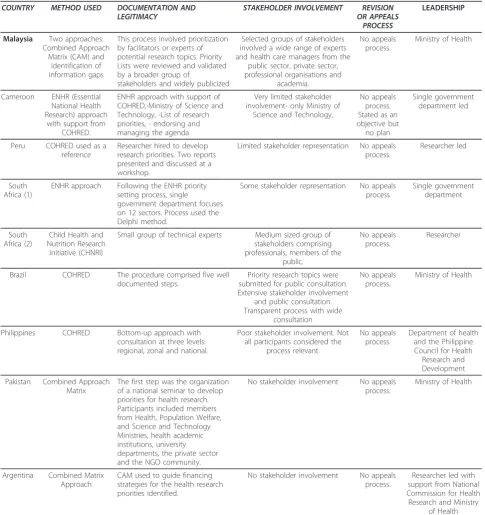
Country presentations (and additional material from presenters) at the Geneva meeting were surveyed and analysed for the following countries - Malaysia, Camer-oon, South Africa, Peru, Brazil and Argentina. The web search resulted in a total of 83 articles of which 67 were not relevant (not related to health or not about priority setting at all). Of the remaining 16 articles, 7 dealt with priority setting in rich countries; one article considered priority setting in a low and middle income country (Uganda) but at the district rather than national level; 5 were theoretical papers on priority setting; and one described the global response at national level to influ-enza pandemics. Table 1 presents summary details of the country experiences surveyed.
1. Method used
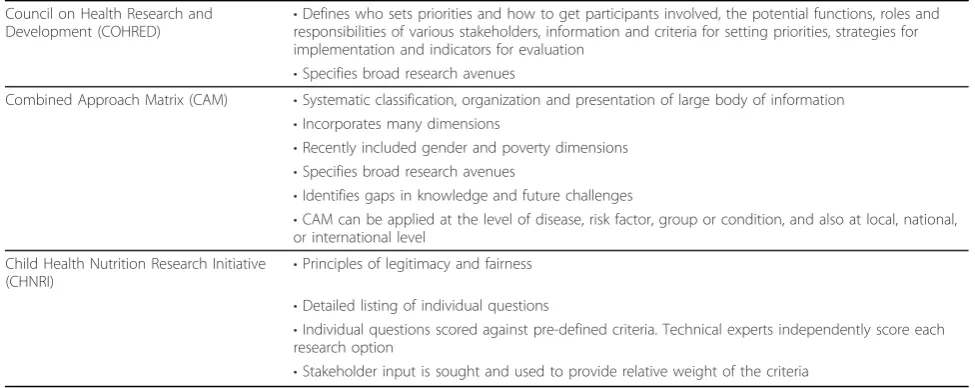
Methods used by the countries in their priority setting processes ranged from ones developed by the countries themselves to the use of existing methodologies. These included the Combined Matrix Approach CAM) [10]; the Council on Health Research and Development (COHRED) [11]; and the Child Health and Nutrition Research Initiative (CHNRI) [12]. Table 2 provides a summary of the three methodologies.
2. Documentation and legitimacy
Legitimacy and fairness require a comprehensive com-munication strategy which ultimately facilitates transpar-ency. This should map the context, identify target audiences, frame and portray the initiative, be explicit about the process, ensure the use of appropriate lan-guage, and identify the communication vehicles appro-priate for target audiences. Countries varied markedly in the extent to which the priority setting processes were documented. Some countries such as Malaysia and Bra-zil have well documented processes. Malaysia was highly transparent and devoted a website to the priority setting process with specific details on how stakeholders were chosen, as well as the timetable of the process. One of the strengths of the Malaysia process is the fact it was the only exercise that has been repeated allowing for comparison across time to assess changing priorities. Brazil was successful in that it ensured transparency
firstly, by guaranteeing a high level of public consulta-tion, and secondly, by documenting processes which were accessible on the internet. In South Africa there was a measure of transparency in the scoring system in that the method facilitated the scores of individuals being available [13].
Outside these three countries there was poor transpar-ency in terms of how the priority setting process was described, how members of the committee were chosen, or who they represented. Cameroon and Argentina for example, have poorly documented processes with diffi-cult public access. In the case of Cameroon, the under-lying rationale for priority setting and its importance are well articulated but there is no sense of the process, or any description of the priorities decided upon. In terms of legitimacy and fairness, the paucity of detail about the priority setting process and the lack of transparency was common across many of the countries.
2. Stakeholder involvement
The composition of stakeholder groups is normally con-sidered to be country-specific, and includes groups such as government, funders, scientists, civil society, NGO’s, non-scientist clinicians (physicians and nurses), health managers, academics, industry (broadly considered), patients and ethicists. The guiding principle in this pro-cess is one of inclusivity in order to ensure as wide par-ticipation as possible. Ongoing stakeholder deliberation should be encouraged, allowing for equitable voice, con-structive debate and conflict resolution [14]. In the countries surveyed there is commonly no stakeholder involvement in a systematic and meaningful way. In some countries such as Peru there is no stakeholder involvement while in Cameroon stakeholder involve-ment is described as important but there is little evi-dence of this or whether mechanisms have been (or are being) put in place in order to ensure that it does hap-pen. Malaysia on the other hand has a well developed system of inviting stakeholder input, mainly of experts and professionals involved in the public health system. However, there appears to be little involvement from user groups or members of the public, whereas Brazil appears to have significant stakeholder consultation by ensuring involvement in research priority topics by members of the public.
3. Revision and appeals
alternative stakeholder viewpoints. None of the coun-tries surveyed had a systematic or operational appeals process to facilitate changing or rejecting particular decisions. The fact that the priority setting process in Malaysia has been repeated suggests that decisions made during previous rounds can be considered and revised based on changing needs. In most countries the priority setting process is a once off event.
4. Leadership
The two countries that appear to have the most well developed national priority setting mechanisms in place (Malaysia and Brazil), were also the two countries with the most senior levels of leadership guiding (and answerable) to the process. In both cases, priority setting was guided by the Health Ministries in the respective countries with senior representation throughout. In
Table 1 Summary of country experiences COUNTRY METHOD USED DOCUMENTATION AND
LEGITIMACY STAKEHOLDER INVOLVEMENT OR APPEALSREVISION PROCESS
LEADERSHIP
Malaysia Two approaches: Combined Approach
Matrix (CAM) and identification of information gaps
This process involved prioritization by facilitators or experts of potential research topics. Priority Lists were reviewed and validated by a broader group of
stakeholders and widely publicized
Selected groups of stakeholders involved a wide range of experts and health care managers from the
public sector, private sector, professional organisations and
academia.
No appeals process.
Ministry of Health
Cameroon ENHR (Essential National Health Research) approach
with support from COHRED.
ENHR approach with support of COHRED,-Ministry of Science and Technology, -List of research priorities, - endorsing and managing the agenda
Very limited stakeholder involvement- only Ministry of
Science and Technology,
No appeals process. Stated as an objective but
no plan
Single government department led
Peru COHRED used as a reference
Researcher hired to develop research priorities. Two reports presented and discussed at a workshop.
Limited stakeholder representation No appeals process.
Researcher led
South Africa (1)
ENHR approach Following the ENHR priority setting process, single
government department focuses on 12 sectors. Process used the Delphi method.
Some stakeholder representation No appeals process
Single government department
South Africa (2)
Child Health and Nutrition Research Initiative (CHNRI)
Small group of technical experts Medium sized group of stakeholders comprising professionals, members of the
public.
No appeals process.
Researcher
Brazil COHRED The procedure comprised five well documented steps.
Priority research topics were submitted for public consultation. Extensive stakeholder involvement
and public consultation. Transparent process with wide
consultation
No appeals process.
Ministry of Health
Philippines COHRED Bottom-up approach with consultation at three levels: regional, zonal and national.
Poor stakeholder involvement. Not all participants considered the
process relevant.
No appeals process.
Department of health and the Philippine Council for Health
Research and Development
Pakistan Combined Approach Matrix
The first step was the organization of a national seminar to develop priorities for health research. Participants included members from Health, Population Welfare, and Science and Technology Ministries, health academic institutions, university departments, the private sector and the NGO community.
No stakeholder involvement No appeals process.
Ministry of Health
Argentina Combined Matrix Approach
CAM used to guide financing strategies for the health research priorities identified.
No stakeholder involvement No appeals process.
Researcher led with support from National Commission for Health Research and Ministry
Malaysia, the priority lists were reviewed and validated by a broad group of stakeholders, while in Brazil the priority lists were submitted to a more limited group of stakeholders. In the case of countries where the process was led by researchers only one country (South Africa) approached stakeholders for their input.
Discussion
This article outlines the priority setting processes of a selected group of low and middle income countries and measures these processes against a set of criteria. Malay-sia and Brazil were the countries that fared best when their priority setting processes were judged against the criteria. Across all countries there was little evidence of how audiences were targeted and whether information fora were held in order to disseminate findings and appropriate knowledge. While many countries state the importance of dissemination and monitoring the imple-mentation and impact of the agenda, there was little evi-dence of any mechanisms to ensure that this in fact happens. In addition, feedback to participants is in most cases limited. Linked to this was the frequent principle (across countries) of stating the importance of stake-holder engagement. Again, there was little evidence of the mechanisms for achieving this. The relative lack of genuine stakeholder engagement in priority setting pro-cesses in surveyed countries has implications for whether there has been a consideration of the widest range of relevant values [3]. Ultimately, this compro-mises the‘buy in’of stakeholders.
Both Brazil and Malaysia had high level government involvement in the process. This was not the case in many of the other countries. High level leadership is central if national level priority setting processes are going to prove transformational. The overall leadership
structure may vary between countries, may be desig-nated in law, and may involve collaboration between dif-ferent ministries. The leader/s of the priority setting initiative should be respected within the research com-munity, have the relevant experience and have credibil-ity amongst constituents. Furthermore, as part of ensuring political buy in, space should be created for government leaders (such as, for example, the Minister of Health, Minister of Finance, Minister of Science and Technology, Prime Minister etc) to suggest priorities and to feel that they are part of the priority setting pro-cess. This is also important in terms of revisions and appeals as a greater number of champions within the political arena will ensure that processes are transparent and that changes in any one party will not render the entire process vulnerable.
According to Kapiriri and colleagues [9] fair priority setting requires that four conditions are met - relevance, publicity, revisions and enforcement. In none of the countries surveyed were the conditions of revision and enforcement met. In no country was there an effective appeals process. The ‘rolling 5-year plan’of Malaysia came closest to an active appeals process. One of the consequences of this is that opportunities allowing for equitable voice, constructive debate and conflict resolu-tion did not exist. For example, despite their significant stakeholder involvement, the priority setting process that Brazil engaged in is quite instructive.
Experiences from countries that have engaged in priority setting exercises indicate that a number of guid-ing principles may be helpful in ensurguid-ing balance. One consideration is to intentionally include only individuals withdiverse and relevant experiences and viewpoints as opposed to including representatives from a variety of societies and associations. In the interests of agreement
Table 2 Structured priority setting methodologies
Council on Health Research and
Development (COHRED) •
Defines who sets priorities and how to get participants involved, the potential functions, roles and responsibilities of various stakeholders, information and criteria for setting priorities, strategies for implementation and indicators for evaluation
•Specifies broad research avenues
Combined Approach Matrix (CAM) •Systematic classification, organization and presentation of large body of information •Incorporates many dimensions
•Recently included gender and poverty dimensions •Specifies broad research avenues
•Identifies gaps in knowledge and future challenges
•CAM can be applied at the level of disease, risk factor, group or condition, and also at local, national, or international level
Child Health Nutrition Research Initiative (CHNRI)
•Principles of legitimacy and fairness
•Detailed listing of individual questions
•Individual questions scored against pre-defined criteria. Technical experts independently score each research option
it may be beneficial to have some stakeholders as ex officio participants in order that they can contribute their views but are not involved in actual decision making. Another useful strategy is the establishment of a communication channel with neighboring coun-tries about the priority setting process. This serves as a gesture of goodwill, but may also aid the priority setting process. This is pertinent in the case of coun-tries without comprehensive Burden of Disease data, but where neighboring countries may have relevant (similar) data.
With regard to themonitoring and evaluation of the priority setting process the guiding principle should fit in with the framework of legitimacy and fairness. The monitoring and evaluation plan should take into consid-eration the processes, outcomes and impacts including the values established by stakeholders. So while in Peru there was a recommendation to create a National Health Research Committee to monitor research and guide spe-cific research agendas this has not been implemented. Peer review mechanisms and tools need to be developed to support monitoring and evaluation, and there needs to be investment in robust health systems, including health information systems and national health accounts that can collect reliable information for informed deci-sion making. The monitoring and evaluation framework should also include a framework that includes stake-holder perceptions of the process which identifies strate-gies for improving the process.
The expected outcome of the methodology or tool application needs to be explicitly stated from the outset. Countries should consider a strategy that allows for tracking of direct and indirect impacts of resource allo-cation. Elements may include questions around what research has been done, what were the research find-ings, what policy or system changes were influenced by the research, and what was the overall effect of the prioritization? In the context of the inclusivity that is being highlighted by the priority setting process, accountability is critical and including tangible outcomes designed specifically to ensure accountability must be included.
In terms of networks, these would ideally be com-prised of researchers in the public and private sectors, decision-makers in governments, and civil society. Most importantly, the very act of priority setting can provide valuable direction for the allocation of public and pri-vate research funds into areas of strategic importance. It can also serve to strengthen the role of national stake-holders as stewards of the national research agenda.
Conclusions and recommendations
With more than $130 billion being invested globally into health research each year, setting priorities in health
research investment at all levels is an increasing phe-nomenon. The lack of stakeholder involvement was a common finding in the survey. Countries have used a variety of approaches to include different stakeholders. One consideration is to intentionally include only indivi-duals with diverse and relevant experiences and view-points as opposed to including representatives from a variety of societies and associations. An approach that commonly works well is to establish a small Executive Committee that guides the process and decision making; while a larger decision making group (comprised of sta-keholders) would then be charged with implementing the chosen methodology and to make decisions. An Advisory Council comprising a much larger number of stakeholders (possibly separated into smaller groups) might also be created in order to advise, deliberate, pro-vide viewpoints, and to propro-vide support to the smaller decision making groups. Another useful strategy is the establishment of a communication channel with neigh-boring countries about the priority setting process. This serves as a gesture of goodwill, but may also aid the priority setting process.
An effective priority setting process for health research should take into account the Paris Declaration on Aid Effectiveness which is a broad international consensus about how to make aid more effective, while at the same time providing assistance to countries to develop their priorities and development plans [15]. Following the principles of harmonization and alignment with regard to a national health policy framework will help to facilitate consistency, synergy and effective implementa-tion. It will also encourage broader external cooperation by potential donors and relevant stakeholders.
A strategy to advocate and disseminate appropriate knowledge - throughout the life of the process - would serve several objectives such as sharing of information, encouraging accountability, supporting a system for tracking, providing a platform for debate and attracting the research community. Priority setting is an iterative process, where each step of the process, each evalua-tion and feedback loop improves on the earlier one. Priority setting processes must be repeated, and pre-vious rounds considered in later iterations. Priority set-ting processes must have in-built mechanisms for publicizing results, effective procedures to enforce decisions, establish an appeal process as well as pro-cesses to ensure that the revision of priorities happens in practice.
Author details
1Department of Psychology, Stellenbosch University, South Africa.2UNICEF,
New York, USA.3Health Systems Research Unit, Medical Research Council,
South Africa.4Croatian Centre for Global Health, University of Split Medical School, Croatia.5Centre for Population Health Sciences, University of
Authors’contributions
MT attended the consultative workshop and has taken a major role in writing the submitted paper and approved the final version. MC attended the consultative workshop and has taken a major role in writing the submitted paper and approved the final version. NH conducted the literature search and has taken a major role in writing the submitted paper and approved the final version. IR attended the consultative workshop and has taken a major role in writing the submitted paper and approved the final version.
Competing interests
The authors declare that they have no competing interests.
Received: 13 October 2009 Accepted: 15 May 2011 Published: 15 May 2011
References
1. Rudan I, Chopra M, Kapiriri L, Gibson J, Ann Lansang M, Carneiro I, Ameratunga S, Tsai AC, Chan KY, Tomlinson M, Hess SY, Campbell H, El Arifeen S, Black RE:Setting priorities in global health research investments: Universal challenges and conceptual framework.Croatian Medical Journal2008,49:307-317.
2. Alliance for Health Policy and Systems Research:Sound choices: Enhancing capacity for evidence-informed health policy.Geneva: Alliance for Health Policy and Systems Research/World Health Organization; 2007. 3. Martin DK:Stakeholder engagement in priority setting.World Health
Organization Consultative Workshop. Geneva, April 10-11, 2008. World Health Organization: Geneva.
4. Walton NA, Martin DK, Peter EH, Pringle DM, Singer PA:Priority setting and cardiac surgery: A qualitative case study.Health Policy2007,80:444-458. 5. Daniels N:Accountability for reasonableness: Establishing a fair process for priority setting is easier than agreeing on principles.British Medical Journal2000,321:1300-1301.
6. Daniels N, Sabin J:Limits to health care: fair procedures, democratic deliberation and the legitimacy problem for insurers.Philosophy and Public Affairs1997,26:303-350.
7. Singer PA, Martin DK, Giacomini M, Purdy L:Priority setting for new technologies in medicine: qualitative case study.British Medical Journal
2000,321:1316-1318.
8. Bruni RA, Laupacis A, Martin DK:Public engagement in setting priorities in health care.Canadian Medical Association Journal2008,179:15-18. 9. Kapiriri L, Tomlinson M, Gibson J, Chopra M, El Arifeen S, Black RE, Rudan I:
Setting priorities in global child health research: Addressing the value of stakeholders.Croatian Medical Journal2007,48:618-627.
10. Ghaffar A, de Francisco A, Matlin S, editors:The combined approach matrix: a priority-setting tool for health research.Geneva: Global Forum for Health Research; 2004.
11. The Working Group on Priority Setting:Priority setting for health research: lessons from developing countries.Health Policy and Planning2000, 15:130-136.
12. Rudan I, Gibson JL, Ameratunga S, El Arifeen S, Bhutta ZA, Black M, Black RE, Brown KH, Campbell H, Carneiro I, Chan KY, Chandramohan D, Chopra M, Cousens S, Darmstadt GL, Meeks Gardner J, Hess SY, Hyder AA, Kapiriri L, Kosek M, Lanata CF, Lansang MA, Lawn J, Tomlinson M, Tsai AC, Webster J:Setting Priorities in Global Child Health Research Investments: Guidelines for implementation of the CHNRI Method.Croatian Medical Journal2008,49:720-733.
13. Tomlinson M, Chopra M, Sanders D, Bradshaw D, Hendricks M, Greenfield D, Black RE, El Arifeen S, Rudan I:Setting priorities in child health research investments for South Africa.PLoS Medicine2007,4(8):e259.
14. Kapiriri L, Norheim OF, Martin DK:Fairness, accountability for reasonableness. Do the views of priority setting decision makers differ across health systems and levels of decision making?Social Science and Medicine2008,68:766-773.
15. Organisation for Economic Cooperation and Development:The Paris Declaration on Aid Effectiveness.[http://www.oecd.org/dataoecd/11/41/ 34428351.pdf], (accessed Dec 12, 2009).
doi:10.1186/1478-4505-9-19
Cite this article as:Tomlinsonet al.:A review of selected research priority setting processes at national level in low and middle income countries: towards fair and legitimate priority setting.Health Research Policy and Systems20119:19.
Submit your next manuscript to BioMed Central and take full advantage of:
• Convenient online submission
• Thorough peer review
• No space constraints or color figure charges
• Immediate publication on acceptance
• Inclusion in PubMed, CAS, Scopus and Google Scholar
• Research which is freely available for redistribution