R E S E A R C H
Open Access
Bridging the gaps among research, policy and
practice in ten low- and middle-income countries:
Development and testing of a questionnaire for
researchers
David Cameron
1,2, John N Lavis
1,3,4,5, G Emmanuel Guindon
1,4, Tasleem Akhtar
6, Francisco Becerra Posada
7,
Godwin D Ndossi
8, Boungnong Boupha
9,10*, Research to Policy and Practice Study Team
Abstract
Background:A questionnaire could assist researchers, policymakers, and healthcare providers to describe and monitor changes in efforts to bridge the gaps among research, policy and practice. No questionnaire focused on researchers’ engagement in bridging activities related to high-priority topics (or the potential correlates of their engagement) has been developed and tested in a range of low- and middle-income countries (LMICs).
Methods:Country teams from ten LMICs (China, Ghana, India, Iran, Kazakhstan, Laos, Mexico, Pakistan, Senegal, and Tanzania) participated in the development and testing of a questionnaire. To assess reliability we calculated the internal consistency of items within each of the ten conceptual domains related to bridging activities (specifically Cronbach’s alpha). To assess face and content validity we convened several teleconferences and a workshop. To assess construct validity we calculated the correlation between scales and counts (i.e., criterion measures) for the three countries that employed both and we calculated the correlation between different but theoretically related (i. e., convergent) measures for all countries.
Results:Internal consistency (Cronbach’s alpha) for sets of related items was very high, ranging from 0.89 (0.86-0.91) to 0.96 (0.95-0.97), suggesting some item redundancy. Both face and content validity were determined to be high. Assessments of construct validity using criterion-related measures showed statistically significant associations for related measures (with gammas ranging from 0.36 to 0.73). Assessments using convergent measures also showed significant associations (with gammas ranging from 0.30 to 0.50).
Conclusions:While no direct comparison can be made to a comparable questionnaire, our findings do suggest a number of strengths of the questionnaire but also the need to reduce item redundancy and to test its capacity to monitor changes over time.
Introduction
Describing efforts to bridge the gaps among research, policy and practice and monitoring changes over time in the nature and extent of engagement in bridging efforts could prove highly useful to those calling for and fund-ing these efforts in low- and middle-income countries (LMICs), those supporting the strengthening of capacity to plan and undertake these efforts, and those seeking
to learn from others engaged in particularly innovative efforts. The health ministers and heads of national dele-gations from 58 countries who participated in the Min-isterial Summit on Health Research have good reason to want to know whether and how researchers, policy-makers and healthcare providers are responding to their call to collaborate in efforts to bridge the gaps among research, policy and practice [1]. Similarly the World Health Assembly has good reason to want to know whether and how members states and WHO itself are responding to their call to develop mechanisms to * Correspondence: [email protected]
9National Institute of Public Health, Vientiane, Lao People’s Democratic
Republic
bridge these gaps [2]. Questionnaires could assist those seeking to describe and monitor changes in researchers’, policymakers’, and healthcare providers’bridging efforts.
In this paper we describe how we developed and tested the questionnaire used in the first phase of a three-phase study in ten countries. This phase involved surveying researchers who were involved in the produc-tion of research on one of two health topics in six coun-tries (China, Ghana, India, Laos, Mexico, and Senegal) and on one health topic in four countries (Iran, Kazakh-stan, PakiKazakh-stan, and Tanzania). The selected health topics, all of which are interventions that are well sup-ported by systematic reviews, include: 1) insecticide-treated materials such as bed nets to prevent malaria; [3,4] 2) intrauterine devices as part of the contraceptive methods mix offered to expand women’s and couples’ family-planning choices; [5-7] 3) oral rehydration ther-apy to prevent dehydration in children with diarrhoea; [8-10] and 4) DOTS strategy to control tuberculosis [11-13]. We describe elsewhere the findings from our survey of researchers as well as the second phase of the study, which involved surveying healthcare providers whose practice related to one of the four topics [14-16].
While there have been many questionnaires developed to describe researchers’bridging activities in single high-income countries such as Canada [17-19], as well as to describe a select range of bridging activities of organiza-tions such as guideline-producing organizaorganiza-tions and health technology assessment (HTA) agencies [20], including one that included a range of LMICs [21], we are not aware of a questionnaire focused on researchers’ engagement in bridging activities related to high-priority topics (and the potential correlates of their engagement) having being developed and tested in a range of LMICs.
Methods
Questionnaire development
Conceptual domains and question/item selection
We drew on the World Report on Knowledge for Better Health and four existing questionnaires to identify con-ceptual domains to be covered by the questionnaire [17,18,22-24]. One of the existing questionnaires had been piloted in four of the participating countries in 2002-2003 and the findings and their implications dis-cussed at a workshop in June 2003. For the conceptual domains related to researchers’activities to bridge the gaps among research, policy and practice, which we call knowledge transfer and exchange (KTE) activities, we identified ten conceptual domains that can be grouped into three broad categories: 1) producer-push efforts (which includes what is“transferred”to target audiences outside the scholarly community; to whom and with what investments in fine-tuning the approach to them; by whom and with what investments in supporting their
efforts; how, and specifically using what“passive” strate-gies, interactive strategies related to the research pro-cess, and interactive strategies outside the research process; and with what evaluations of the efforts); 2) efforts to facilitate user-pull (which includes both strate-gies that provide access to research and stratestrate-gies that develop target audiences’ capacity to use research); and 3) exchange efforts (which includes how target audi-ences are involved in research and KTE processes). For the conceptual domains related to potential system-level, organizational and individual correlates of researchers’engagement in bridging activities, we identi-fied eight conceptual domains that can be grouped into four broad categories: 1) system-level correlates (which includes the state of research knowledge on the topic; barriers to and facilitators of KTE; and access to parti-cular sources of information); 2) system-level and orga-nizational correlates (which includes support for research and KTE both when respondents began con-ducting research on the topic and over the time that they conducted research on the topic); 3) organizational correlates (which includes support for KTE activities within the respondent’s organization); and 4) individual correlates (which includes the nature of the respondent’s own research and their views about who is responsible for undertaking KTE activities).
We also drew on the four existing questionnaires
mentioned above to identify questions/items
Response scales
We retained two five-point ordinal response scales for existing items and used the same scales for modified or new items. For questions addressing the frequency with which a respondent undertook KTE activities the scale was never, rarely, occasionally, frequently, and always (with each response category defined using examples in the introductory section of the questionnaire). For ques-tions addressing views (i.e., potential system-level, orga-nizational and individual correlates of engagement in KTE activities) the scale was strongly disagree, disagree, neither agree nor disagree, agree, and strongly agree. (Given that there may be cultural or other factors that influence whether the top response category is used, the survey data can likely best be presented as a proportion with the top two response categories combined.) For three countries we also measured frequency of engage-ment in specific KTE activities by asking the number of times during a typical 12-month period the respondent (or their organization) undertook the activities. For select other questions we used yes/no/don’t know response categories, fill-in-the-blank responses or open-ended responses.
Translation
The original English-language questionnaire was used in Ghana, India, Pakistan, and Tanzania, WHO’s expert translation service translated the questionnaire for China (Mandarin), Kazakhstan (Russian), Mexico (Span-ish), and Senegal (French), and country teams translated the questionnaire for Iran (Persian) and Laos (Lao). We made minor wording changes to accommodate differ-ences in local word use or to correct minor errors in translation, piloted the draft questionnaire in each coun-try and among contacts in other countries, and cor-rected any minor wording issues identified during pilot testing. (An English-language version of the survey instrument is provided as Additional File 1.)
Sample and questionnaire administration
We describe elsewhere our approach to identifying a sample of researchers and administering the question-naire [14]. Briefly, we defined researchers as individuals who spent at least 10% of their time doing research, which includes the production, synthesis, and sharing of research. We contacted 544 researchers, received 368 completed questionnaires, for a response rate of 68%. Survey work was completed in all ten countries between April 2004 and April 2005. We used the 308 question-naires completed by individuals who indicated that they undertook KTE activities (but not exclusively commer-cialization activities) in the hope that research on the topic would be considered and/or acted upon outside the scholarly community, for a response rate of 64% [(368-60)/(544-60)] among those who indicated that they met this criterion (Table 1).
Reliability
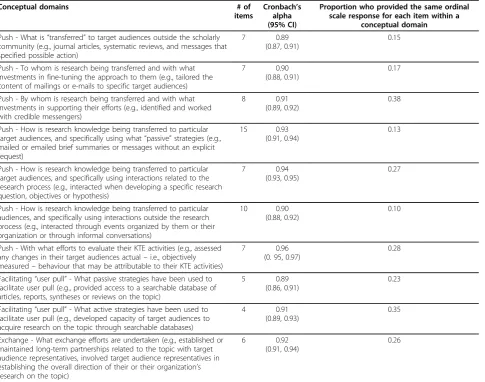
We calculated the internal consistency of items within each of the ten conceptual domains related to KTE activities and select conceptual domains related to potential correlates of these activities (specifically Cron-bach’s alpha) as a measure of the extent to which the questionnaire measures each of these conceptual domains in a reproducible manner [25]. We also calcu-lated the proportion of respondents who provided the same ordinal scale response for each item within a con-ceptual domain (e.g., always chose the response ‘’ fre-quently’’ when asked about what is transferred) as an indirect check on whether the grouping of conceptually related items may have contributed to a pattern response. We did not conduct an exploratory factor ana-lysis due to our relatively small sample size (N = 308) and we did not examine test-retest reliability.
Validity
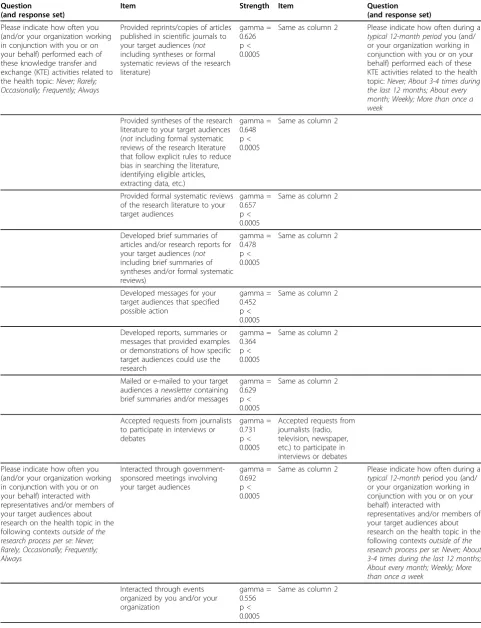
We convened several teleconferences with country teams and a workshop with country team representa-tives to assess whether, on the face of it, the question-naire appeared to be measuring the desired conceptual domains (i.e., face validity) and to assess whether the questionnaire attempts to measure all of the relevant and important elements of complex conceptual domains that do not lend themselves to being measured directly (i.e., content validity). We assessed construct validity in two ways: 1) by calculating the correlation between scales and counts (i.e., criterion-related measures) for the three countries that measured frequency of engage-ment in specific KTE activities in both ways; and 2) by calculating the correlation between different but theore-tically related (i.e., convergent) measures for all coun-tries [26,27].
Results
The internal consistency of items within each of the ten conceptual domains related to KTE activities was very high (with Cronbach’s alphas ranging from 0.89 [0.86-0.91] for efforts to facilitate ‘’user pull’’ using passive strategies to 0.96 [0.95-0.97] for efforts to evaluate KTE activities), indicating that the questionnaire measures each of these conceptual domains in a reproducible manner but with some degree of item redundancy (Table 2). The proportion of respondents who provided the same ordinal scale response for each item within a conceptual domain ranged from low (with proportions less than 20% for four of ten conceptual domains) to relatively high (with 35% of respondents providing the same ordinal scale response for all efforts to facilitate
conceptually related items may have contributed to a pattern response and hence to higher than expected internal consistency of items within each conceptual domain. For some conceptual domains related to poten-tial correlates of KTE activities, pattern response was extremely rare. For example, fewer than 1 in 100 respondents provided the same ordinal scale response for the conceptual domain related to views about the nature of their own research, which included both posi-tively and negaposi-tively framed items.
The questionnaire-development process (specifically the use of previously tested items and several teleconfer-ences with country teams to review both conceptual domains and specific items) yielded consensus before embarking on data collection that the questionnaire appeared to be measuring the desired conceptual domains (i.e., face validity) and attempted to measure all of the relevant and important elements of complex con-ceptual domains such as push efforts (i.e., content valid-ity). The workshop with country team representatives yielded consensus after completing data collection that the questionnaire had both face and content validity. The only concerns raised at the workshop regarding face validity pertained to the use of specific terminology
–1) systematic review even though it was defined in the questionnaire; 2) messages for researchers’target audi-ences that specified possible action even though three examples of alternative terminology were provided in the questionnaire; and 3) credible messenger even though it was defined in the questionnaire– and both the accuracy of its translation and its comprehension by respondents, however, each concern was raised by at most two countries.
The correlation was moderate to high and consistently statistically significant between scales and counts (i.e., criterion-related measures) for the three countries that measured frequency of engagement in specific KTE activities in both ways, indicating good construct validity and the redundancy of having both types of measures in the questionnaire (Table 3). Eight of eleven pairs of items that measure the same KTE activity but in differ-ent ways showed high levels of association (gamma ≥ 0.50) and three pairs show moderate levels of associa-tion (gamma≥0.30). The correlation was moderate and consistently statistically significant between different but theoretically related (i.e., convergent) measures for all countries (Table 4). One of five pairs of conceptually related items show a high level of association and four pairs show moderate levels of association.
Discussion Principal findings
We have developed a questionnaire focused on researchers’engagement in a broad range of activities to bridge the gaps among research, policy and practice on high-priority topics and the potential correlates of their engagement, translated the questionnaire into seven lan-guages, and examined its reliability and validity in ten LMICs. The questionnaire can be modified to focus on different high-priority topics simply by changing the description of the topic in the introduction to the ques-tionnaire because all subsequent questions refer in gen-eric terms to “the health topic.” The questionnaire’s strengths are the high internal consistency within con-ceptual domains covered by the questionnaire and the questionnaire’s face, content and construct validity. Its Table 1 Response rates by country and health topic
Country Insecticide-treated nets to prevent malaria
Intrauterine devices for contraception
Oral rehydration therapy to prevent dehydration in children with diarrhea
TB-DOTS to treat patients with
tuberculosis
Total
China - 25/25 - 25/36 50/61
Ghana 16/20 - 3/6 - 19/26
India - - 16/40 17/59 33/99
Iran - - - 24/37 24/37
Kazakhstan - 29/30 - - 29/30
Laos 20/22 18/20 - - 38/42
Mexico - 22/50 - 26/40 48/90
Pakistan - 13/37 - 13/37
Senegal 16/16 - 18/18 - 34/34
Tanzania 20/28 - - - 20/28
All 72/86 94/125 50/101 92/172 308/
484
principal weaknesses are item redundancy and pattern response within select conceptual domains, which can be addressed by removing select items within each of the nine conceptual domains and also possibly by mix-ing items from different conceptual domains. In future administrations of the questionnaire, close attention should be paid to specific terminology, such as systema-tic reviews, messages, and credible messengers, to ensure a common level of comprehension across countries.
While no direct comparison can be made to another similarly focused questionnaire that has been developed and tested in a range of LMICs, the questionnaire-devel-opment process drew on four questionnaires developed to describe researchers’bridging activities in single high-income countries, two of which also showed high inter-nal consistency of items within several conceptual domains related to KTE activities [17,18]. Our question-naire aimed to be more comprehensive than these four
questionnaires in both its breadth and depth, however, its depth appeared to come partially at the expense of some degree of item redundancy within select concep-tual domains. The questionnaire can be used to describe and monitor changes in researchers’, policymakers’and health care providers’bridging efforts.
Strengths and limitations of the study
The strengths of the study include: 1) the breadth of countries engaged in developing and testing the ques-tionnaire; 2) the mix of teleconferences before data col-lection and a workshop after data colcol-lection to assess face and content validity; and 3) the explicit examination of both internal consistency and construct validity (using both criterion and convergent testing). The limitations of the study include: 1) the inability to conduct an exploratory factor analysis due to our relatively small sample size; 2) the lack of test-retest reliability testing, which should be examined before the questionnaire is used to monitor changes over time in the nature and Table 2 Internal consistency and pattern response
Conceptual domains # of
items
Cronbach’s alpha (95% CI)
Proportion who provided the same ordinal scale response for each item within a
conceptual domain
Push - What is“transferred”to target audiences outside the scholarly community (e.g., journal articles, systematic reviews, and messages that specified possible action)
7 0.89
(0.87, 0.91)
0.15
Push - To whom is research being transferred and with what investments in fine-tuning the approach to them (e.g., tailored the content of mailings or e-mails to specific target audiences)
7 0.90
(0.88, 0.91)
0.17
Push - By whom is research being transferred and with what investments in supporting their efforts (e.g., identified and worked with credible messengers)
8 0.91
(0.89, 0.92)
0.38
Push - How is research knowledge being transferred to particular target audiences, and specifically using what“passive”strategies (e.g., mailed or emailed brief summaries or messages without an explicit request)
15 0.93
(0.91, 0.94)
0.13
Push - How is research knowledge being transferred to particular target audiences, and specifically using interactions related to the research process (e.g., interacted when developing a specific research question, objectives or hypothesis)
7 0.94
(0.93, 0.95)
0.27
Push - How is research knowledge being transferred to particular audiences, and specifically using interactions outside the research process (e.g., interacted through events organized by them or their organization or through informal conversations)
10 0.90
(0.88, 0.92)
0.10
Push - With what efforts to evaluate their KTE activities (e.g., assessed any changes in their target audiences actual–i.e., objectively measured–behaviour that may be attributable to their KTE activities)
7 0.96
(0. 95, 0.97)
0.28
Facilitating“user pull”- What passive strategies have been used to facilitate user pull (e.g., provided access to a searchable database of articles, reports, syntheses or reviews on the topic)
5 0.89
(0.86, 0.91)
0.23
Facilitating“user pull”- What active strategies have been used to facilitate user pull (e.g., developed capacity of target audiences to acquire research on the topic through searchable databases)
4 0.91
(0.89, 0.93)
0.35
Exchange - What exchange efforts are undertaken (e.g., established or maintained long-term partnerships related to the topic with target audience representatives, involved target audience representatives in establishing the overall direction of their or their organization’s research on the topic)
6 0.92
(0.91, 0.94)
Table 3 Assessment of construct validity using criterion-related measures
Question (and response set)
Item Strength Item Question
(and response set)
Please indicate how often you (and/or your organization working in conjunction with you or on your behalf) performed each of these knowledge transfer and exchange (KTE) activities related to the health topic:Never; Rarely; Occasionally; Frequently; Always
Provided reprints/copies of articles published in scientific journals to your target audiences (not
including syntheses or formal systematic reviews of the research literature)
gamma = 0.626 p < 0.0005
Same as column 2 Please indicate how often during a
typical 12-month periodyou (and/ or your organization working in conjunction with you or on your behalf) performed each of these KTE activities related to the health topic:Never; About 3-4 times during the last 12 months; About every month; Weekly; More than once a week
Provided syntheses of the research literature to your target audiences (notincluding formal systematic reviews of the research literature that follow explicit rules to reduce bias in searching the literature, identifying eligible articles, extracting data, etc.)
gamma = 0.648 p < 0.0005
Same as column 2
Provided formal systematic reviews of the research literature to your target audiences
gamma = 0.657 p < 0.0005
Same as column 2
Developed brief summaries of articles and/or research reports for your target audiences (not
including brief summaries of syntheses and/or formal systematic reviews)
gamma = 0.478 p < 0.0005
Same as column 2
Developed messages for your target audiences that specified possible action
gamma = 0.452 p < 0.0005
Same as column 2
Developed reports, summaries or messages that provided examples or demonstrations of how specific target audiences could use the research
gamma = 0.364 p < 0.0005
Same as column 2
Mailed or e-mailed to your target audiences anewslettercontaining brief summaries and/or messages
gamma = 0.629 p < 0.0005
Same as column 2
Accepted requests from journalists to participate in interviews or debates
gamma = 0.731 p < 0.0005
Accepted requests from journalists (radio, television, newspaper, etc.) to participate in interviews or debates
Please indicate how often you (and/or your organization working in conjunction with you or on your behalf) interacted with representatives and/or members of your target audiences about research on the health topic in the following contextsoutside of the research process per se:Never; Rarely; Occasionally; Frequently; Always
Interacted through government-sponsored meetings involving your target audiences
gamma = 0.692 p < 0.0005
Same as column 2 Please indicate how often during a
typical 12-monthperiod you (and/ or your organization working in conjunction with you or on your behalf) interacted with
representatives and/or members of your target audiences about research on the health topic in the following contextsoutside of the research process per se:Never; About 3-4 times during the last 12 months; About every month; Weekly; More than once a week
Interacted through events organized by you and/or your organization
gamma = 0.556 p < 0.0005
extent of KTE activities; and 3) the lack of an external measure of engagement in KTE activities (perhaps obtained through selective participant-observation or the use of other qualitative methods) that would have allowed us to examine the presence and magnitude of a social desirability bias within specific conceptual domains.
Conclusions
The use of this questionnaire or a modified version of it could prove useful to those calling for and funding efforts
to bridge the gaps among research, policy and practice in LMICs, those supporting the strengthening of capacity to plan and undertake these efforts, and those seeking to learn from others engaged in particularly innovative efforts. The additional testing of this or a modified ver-sion of the questionnaire should include test-retest relia-bility and comparisons against external measures.
Competing interests statement
The authors declare that they have no competing interests.
Table 3: Assessment of construct validity using criterion-related measures(Continued)
Interacted through informal conversations with your target audiences
gamma = 0.556 p < 0.0005
Same as column 2
Table 4 Assessment of construct validity using convergent measures
Question (and response set)
Item Strength Item Question
(and response set)
Please indicate how often you (and/or your organization working in conjunction with you or on your behalf) performed each of these knowledge transfer and exchange (KTE) activities related to the health topic:Never; Rarely; Occasionally; Frequently; Always
Provided reprints/copies of articles published in scientific journals to your target audiences (notincluding syntheses or formal systematic reviews of the research literature)
Gamma = 0.296 p = 0.008
Had access to at least five scientific journals indexed in
otherinternational reference databases (e.g., Medline, PubMed or the equivalent for your field) (full text paper or full text electronic)
Please indicate whether you had access to the following sources of information when you were involved in research on the health topic and in knowledge transfer and exchange (KTE) activities related to the health topic:No; Yes
Same as above gamma =
0.410 p < 0.0005
Had access to at least five scientific journals published locally, nationally or regionally (full text paper or full text electronic)
Provided formal systematic reviews of the research literature to your target audiences
gamma = 0.333 p = 0.006
Same as above
Please indicate how often you (and/or your organization working in conjunction with you or on your behalf) interacted (e. g., through teleconferences or face to-face meetings involving a small number of people) with representatives and/or members of your target audiencesin each of the following stages of the research processfor all research projects related to the health topic with which you have been involved:Never; Rarely;
Occasionally; Frequently; Always
Interacted when developing a specific research question, objectives or hypothesis
gamma = 0.502 p < 0.0005
Involved representatives and/or members of your target audiences in establishing the
overall direction of researchon the health topic conducted by you and/or your research organization
Please indicate how often you (and/or your organization working in conjunction with you or on your behalf) performed each of these knowledge transfer and exchange (KTE) activities related to the health topic:Never; About 3-4 times during the last 12 months; About every month; Weekly; More than once a week
Please indicate how often you (and/or your organization working in conjunction with you or on your behalf) performed activities (e.g., conducted workshops or seminars) to increase the capacity of your target audiences to use research on the health topic:Never; Rarely; Occasionally; Frequently; Always
Developed capacity of target audiences toacquireresearch on the health topic through searchable databases (e.g., MedLine, Cochrane, ... Index Medicus...., LILACS)
gamma = 0.398 p = 0.001
Had access to at least five scientific journals indexed in
otherinternational reference databases (e.g., Medline, PubMed or the equivalent for your field) (full text paper or full text electronic)
Additional file 1: McMaster University/World Health Organization Questionnaire on Knowledge Transfer and Exchange in the Health Sector. Questionnaire that was developed and tested.
Click here for file
[ http://www.biomedcentral.com/content/supplementary/1478-4505-8-4-S1.DOC ]
Acknowledgements
Members of the Research to Policy and Practice (RPP) Study Team include (in addition to the named authors): Steven J. Hoffman (Canada); Guang Shi and Tinglin Qiu (China); Eric J.A. Osei and Kudjoe Dovlo (Ghana); P. Ramachandran and C.A.K. Yesudian (India); Hossein Malek-Afzali, M. Dejman, K. Falahat, M. Baradaran, E. Habibi, H. Kohanzad, M. Nasehi and S. Salek (Iran); A.A. Akanov, B.S. Turdaliyeva, N.K. Hamzina, K.A. Tulebaev, T.I. Clazhneva, and G. Battakova (Kazakhstan); Sengchanh Kounnavong and Latsamy
Siengsounthone (Lao People’s Democratic Republic); Leticia Alfaro Ramos and Israel Mejia (Mexico); M. Mubashir A. Khan (Pakistan); Mintou Fall Sidibe, Awa Sidibe, and Djiby Ndiaye (Senegal); Julius Massaga (Tanzania); and Ritu Sadana and Tikki Pang (World Health Organization).
The Alliance for Health Policy and Systems Research funded part of all phases of the project, both McMaster University and the World Health Organization provided substantial in-kind donations of staff time and other resources, and the Global Development Network funded an early phase of the project. JNL receives salary support as the Canada Research Chair in Knowledge Transfer and Exchange. GEG is supported by a Social Sciences and Humanities Research Council of Canada (SSHRC) Canada Graduate Scholarship (CGS). The views expressed in this paper are those of the authors and do not represent the views of the above organizations. We thank the technical experts who provided support to one or more phases of the study and the participants in the project workshop that was held in Geneva to discuss the data-collection process, interim findings, and potential implications for dissemination and next steps. We also thank Shyama Kuruvilla, Andrew Kennedy and Carol D’Souza who provided scientific input in one or more phases of the study, as well as Prince Dhillon who assisted with the final set of analyses and the preparation of tables.
Author details
1Centre for Health Economics and Policy Analysis, McMaster University,
Hamilton, Ontario, Canada.2Department of Economics, McMaster University,
Hamilton, Ontario, Canada.3McMaster Health Forum, Hamilton, Ontario,
Canada.4Department of Clinical Epidemiology and Biostatistics, McMaster
University, Hamilton, Ontario, Canada.5Department of Political Science, McMaster University, Hamilton, Ontario, Canada.6Pakistan Medical Research
Council at Khyber Medical College, Pakistan.7Council on Health Research for Development, Mexico City, Mexico.8Tanzania Food and Nutrition Centre, Dar
es Salaam, Tanzania.9National Institute of Public Health, Vientiane, Lao People’s Democratic Republic.10Council of Medical Sciences, Ministry of
Health, Vientiane, Lao People’s Democratic Republic.
Authors’contributions
DC and JL: 1) contributed substantially to conception and design, acquisition of data, and analysis and interpretation of data, 2) drafted the article and revised it critically for important intellectual content, and 3) gave final approval of the version to be published. GEG, TA, FB-P, GN and BB: 1) contributed substantially to conception and design, acquisition of data, and/ or analysis and interpretation of data, 2) provided feedback on the article; and 3) gave final approval of the version to be published. Members of the Research to Policy and Practice Study Team: 1) contributed substantially to acquisition of data; 2) reviewed drafts of the article; and 3) gave final approval of the version to be published.
Received: 21 October 2008
Accepted: 29 January 2010 Published: 29 January 2010
References
1. World Health Organization:The Mexico Statement on Health Research: Knowledge for Better Health: Strengthening Health SystemsGeneva, Switzerland: World Health Organization 2004.
2. World Health Assembly:Resolution 58.34 on the Ministerial Summit on Health ResearchGeneva, Switzerland: World Health Organization 2005.
3. Lengeler C:Insecticide-treated bed nets and curtains for preventing malaria.Cochrane Database Syst Rev2004,2:CD000363.
4. Gamble C, Ekwaru JP, ter Kuile FO:Insecticide-treated nets for preventing malaria in pregnancy.Cochrane Database Syst Rev2006,2:CD003755. 5. Fortney JA, Feldblum PJ, Raymond EG:Intrauterine devices: The optimal
long-term contraceptive method?.Journal of Reproductive Medicine1999,
44:269-274.
6. Hubacher D, Grimes DA:Noncontraceptive health benefits of intrauterine devices: A systematic review.Obstetrical and Gynecological Survey2002,
57:120-128.
7. Grimes D, Schultz KF, Van Vliet H, Stanwood N:Immediate post-partum insertion of intrauterine devices.Cochrane Database Syst Rev2003,1: CD003036.
8. Hahn S, Kim Y, Garner P:Reduced osmolarity oral rehydration solution for treating dehydration due to diarrhoea in children: Systematic review.
BMJ2001,323:81-85.
9. Murphy C, Hahn S, Volmink J:Reduced osmolarity oral rehydration solution for treating cholera.Cochrane Database Syst Rev2004,4: CD003754.
10. Hartling L, Bellemare S, Wiebe N, Russell K, Klassen TP, Craig W:Oral versus intravenous rehydration for treating dehydration due to gastroenteritis in children.Cochrane Database Syst Rev2006,3:CD004390.
11. Volmink J, Garner P:Systematic review of randomised controlled trials of strategies to promote adherence to tuberculosis treatment.BMJ1997,
315:1403-1406.
12. Volmink J, Garner P:Directly observed therapy for treating tuberculosis.
Cochrane Database Syst Rev2006,2:CD003343.
13. World Health Organization:WHO Report 2005: Global Tuberculosis Control: Surveillance, Planning, FinancingGeneva, Switzerland: World Health Organization, 2005 2005.
14. Lavis JN, Guindon GE, Cameron D, Boupha B, Dejman D, Osei EJA, Sadana R, Research to Policy and Practice Study Team:Bridging the gaps among research, policy and practice in ten low- and middle-income countries: Survey of researchers.Canadian Medical Association Journal. 15. Guindon GE, Lavis JN, Becerra-Posada F, Malek-Afzali H, Shi G,
Yesudian CAK, Hoffman SJ, Research to Policy and Practice Study Team:
Bridging the gaps among research, policy and practice in ten low- and middle-income countries: Survey of health-care providers.Canadian Medical Association Journal.
16. Guindon GE, Lavis JN, Boupha B, Shi G, Sidibe MF, Turdaliyeva B, Research to Policy and Practice Study Team:Bridging the gaps among research, policy and practice in ten low- and middle-income countries: Development and test of questionnaire for health-care providers.Health Research Policy and Systems2010,8:3.
17. Landry R, Amara N, Lamari M:Climbing the ladder of research utilization: Evidence from social science research.Science Communication2001,
22:396-422.
18. Lavis JN, Robertson D, Woodside JM, McLeod CB, Abelson J:How can research organizations more effectively transfer research knowledge to decision makers?.Milbank Quarterly2003,81:221-248.
19. Ouimet M, Amara N, Landry R, Lavis J:Direct interactions medical school faculty members have with professionals and mangers working in public and private sector organization: A cross-sectional study.
Scientometrics2007,72:307-323.
20. Burgers JS, Grol R, Klazinga NS, Makela M, Zaat J, AGREE Collaboration:
Towards evidence-based clinical practice: An international survey of 18 clinical guideline programs.International Journal for Quality in Health Care
2003,15:31-45.
21. Lavis JN, Oxman AD, Moynihan R, Paulsen E:Evidence-informed health policy: 1. Synthesis of findings from a multi-method study of organizations that support the use of research evidence.Implementation Science2008,3:53.
22. World Health Organization:World Report on Knowledge for Better Health: Strengthening Health SystemsGeneva, Switzerland: World Health Organization 2004.
24. World Health Organization:National Health Research Systems Analysis: Questionnaire to Individuals within the National Health Research System
Geneva, Switzerland: World Health Organization 2003.
25. Cronbach LJ:Essentials of Psychological TestingNew York, USA: Harper & Row 1970.
26. Streiner D, Norman G:Health Measurement Scales: A Practical Guide to their Development and UseNew York, USA: Oxford University Press 1995. 27. Campbell D, Fiske D:Convergent and discriminant validation by the
multitrait-multimethod matrix.Psychological Bulletin1959,56:81-105.
doi:10.1186/1478-4505-8-4
Cite this article as:Cameronet al.:Bridging the gaps among research, policy and practice in ten low- and middle-income countries: Development and testing of a questionnaire for researchers.Health Research Policy and Systems20108:4.
Submit your next manuscript to BioMed Central and take full advantage of:
• Convenient online submission
• Thorough peer review
• No space constraints or color figure charges
• Immediate publication on acceptance
• Inclusion in PubMed, CAS, Scopus and Google Scholar
• Research which is freely available for redistribution