Senior High School Students’ Comprehension and Interest in Science
Content: Example of Participating in First-Hand Experimental Activities
Pei-Hsuan Hsieh
*Institute of Information Management, National Cheng Kung University No. 1 University Road, Tainan 701, Taiwan
1. Introduction
In order to transform Taiwan’s science-related courses in primary and secondary schools into exploratory and experimental curricula, the government usually contributes to equipping and funding educational units with complete sets of hardware and software. This study is part of an integrated research project comprising three sub-projects (Project I, II, III) and assists in the provision of science-related courses oriented
toward exploratory approaches and
experimentation in cooperation with Taiwan’s National Laboratory Animal Center (NLAC). Both the NLAC and the members involved in Project II and III form a team responsible for providing science-related teaching and learning materials, such as lecture slides and photos and experimental modules. This study (Project I) is responsible for developing multi-media assisted learning materials, i.e., two-dimensional (2D) animations based on the materials provided by the NLAC and the other two sub-projects.
Prior studies have proposed that science-related course teaching materials containing concrete evidence, specifically multi-media
*Corresponding author: [email protected] 2017 UTHM Publisher. All right reserved.
penerbit.uthm.edu.my/ojs/index.php/jst
animations or virtual objects, have significant effects on student learning [4, 5]. This purpose of this study is to assist the NLAC with evaluating the effectiveness of these materials, to confirm the readiness of the experimental modules designed by the NLAC, Project II and Project III, and to support schools with updating their content for science courses, especially in the area of experimentation. Meanwhile, this study (Project I) helps develop required 2D animations for the experimental modules. Therefore, the purpose of this study is three-fold. First, this study is intended to investigate whether animated materials are an aid to students participating in experiments as well as whether they are helpful in increasing students’ learning comprehension when receiving exploratory and experimentally-oriented science content as provided by Projects II and III. Second, this study is to verify whether students with different learning characteristics obtain different levels of comprehension ability after exposure to science-related content and
participation in the experiment. The students
participating in this project are expected to understand scientific concepts well after they are involved in actual hand-on practical sessions that Abstract: The purpose of this study is to investigate three questions: First, it examines whether students’ understanding of science increases after exposure to scientific content with animations and the provision of experience with practical scientific activities. Second, according to the Kolb Scale, an effort is made to determine which type of learning characteristics lead to higher degrees of understanding of science after engaging in practical scientific activities. Third, the study is used to investigate whether student willingness to engage in science-related work in the future is correlated with their levels of understanding of science. A total of 154 students from six senior high schools were invited to be participants. The results showed that most of the students exhibited significant improvement in their understanding of science after they were involved in actual experimental processes with animated content. The students having accommodator-type learning characteristics had higher levels of understanding of science as well as greater willingness to pursue science-related work in the future. However, the results indicated that legitimate experimental processes may help enhance student comprehension in terms of scientific content. There is no indication that they affect arousal of scientific interest and willingness to follow a science-related path as a future career.
Keywords: Scientific experiment, multi-media assisted learning, learning comprehension, learning
8 allow them to fully experience scientific
experimentation. Kolb’s [2] Learning Style Inventory based on the experiential learning theory is thus considered in this study to determine the types of student learning characteristics [1, 5, 6, 7]. Kolb’s experiential learning theory has been acknowledged by academics, and the Kolb’s Learning Style Inventory has been widely used in various studies. Third, this study investigates whether or not participation in carefully designed experiments elevates students’ interest in science-related careers as has been indicated in prior studies [8, 9], who suggest that a causal relationship exists between students’ past learning experiences, such as enjoyment, performance, and satisfaction, and their future career choices.
Finally, in the process of developing animated materials, this study (Project I) provides the NLAC and the members of the other two sub-projects (Projects II and III) with concrete suggestions for amending the teaching materials and experimental modules of science-related courses. In addition, this study contributes to increasing comprehension in students learning advanced biomedical technology content, and the students’ interests related to pursuing science-related occupations may also be increased after participating in the current integrated research project.
2. Reasons for Multi-Media Animation-Assisted Learning
Multi-media assisted learning has become a common trend in education due to contributions that focus on personalized acquisition, provision of hands-on sessions, and instructor assistance [4, 5, 10]. Also, animation can present a richer experience than pure textual or statistical graphs since it triggers learners’ curiosity, encourages them to focus continuously on learning, and enhances motivation [11, 12, 13]. In a learning environment with extensive texts, students may have difficulty concentrating for extended periods of time. Contrarily, according to Mayer’s cognitive theory of multimedia learning, if texts are combined with animations in a multi-media
animation-assisted learning and teaching
environment [3, 30],the process of learning and
teaching gains expansion of attention spans due to exposure to differing patterns and stimuli.
In addition, multi-media assisted learning contributes to effective comprehension of content and helps students retain the objectives of the
experiments [6, 11, 14, 15, 16, 17]. With the interactive features of computerization, learners can change the displays on their screens through manipulating the software interface. Prior studies have indicated that the result of continuous interaction between learners and multi-media
instruction, especially animations, allows
learners to acquire and retain scientific concepts through an increased understanding of scientific content. Thus, multi-media assisted learning can convey the content vividly through pictures and animations and allows students to practice computer-aided learning in daily life.
Prior studies mention that multi-media animation-assisted learning can also enhance the quality of learning [18, 19, 20]. Specifically, for
teachers, the computer-aided teaching
environment allows adaptable instructional flexibility by allowing insertion of additional activities that support the individual differences in students [1, 5, 6, 7]. By properly using multi-media tools for instructional design, any teaching materials can systematically or even nonlinearly display a concept in accordance with the needs of learners after being integrated with images, sound, and texts. Learner enjoyment [21, 22] and satisfaction [23, 24, 25] can then be increased in such a learning environment. Finally, a future orientation towards science can be expected in students after they are involved in a multi-media animation-assisted learning environment process [8, 9].
Overall, multi-media animation-assisted
learning, which is significantly different from traditional teaching methods, increases students’ learning motivation and teaching effectiveness. Animation can draw learners into the instruction and maintain their motivation to learn. Students who used an online multi-media teaching system to acquire knowledge from animated content offer more positive comments than those engaged in traditional learning environments, and these students are able to maintain high degree of satisfaction with the online multimedia teaching system interface, meet their learning needs, and experience learning effectiveness. In addition, many studies confirm that adding multi-media to instructional content helps students gain competence with content effectively and also helps them retain the content details, affording logical, effective avenues for learning and raising the personal satisfaction related to such tasks.
9 reform relies on support from the Taiwanese
government (i.e., the Ministry of Education) to co-ordinate planning the country's future for education, which is known as the White Paper on Education. Taiwan’s future educational goal is to promote the concept of lifelong learning in academic institutions dedicated to reforming science courses. Therefore, to add micro-nano or Biomedical Technology Engineering and other related science curricula to primary and secondary educational programs allows the promotion of this concept as well as speeding up the development of informal educational materials for curricula. Informal educational materials for curricula can appear in various forms, such as texts, images, videos, and so on, and most are free for individuals to download. For instance, the National Science and Technology Museum developed a set of micro-nanotechnology animations for its websites
(http://nano.nstm.gov.tw/), which welcome
visitors of all ages.
3. Methodologies
This study (Project I) cooperated with the NLAC, Project II and Project III to provide
science-related teaching content and
experimental modules, especially in the subject of biomedical technology, along with the development of two-dimensional animated learning materials. Based on the purpose of this study and the literature review, several quasi experiments were carried out with senior high school students to participate in exploratory and experimental learning processes. The students participated in this study in a context designed as a classroom lecture setting, but they were encouraged to ask questions about any confusing scientific concepts by viewing the animations at any time, and they had hands-on sessions to get involved in the actual scientific experiments.
3.1 Research participants
The study participants comprised 154 students from six senior high schools, consisting of 32 male students (one all-male school, Group A), and 23 females (three all-female schools, Group B). The remaining two schools are co-educational senior high schools (Groups C and D). All students participating in the groups received an invitation to attend scientific lectures and conduct real experiments based on the recommendation of their science teacher. Even
though the different groups received different numbers of scientific lectures and experimental modules depending on the amount of time the science teachers had available to devote to this study, the level of difficulty for each scientific lecture and experimental module was controlled to establish the reliability of the data collection processes.
3.2 Research tools
This study measures students’ learning styles according to the Kolb Learning Style Inventory [1], the most commonly-used method used in education and business. According to Kolb [2], every learner transitions through four stages of “experiential learning”: Concrete experience (CE), to reflective observation (RO), to abstract conceptualization (AC), and finally to active experimentation (AE). These four stages represent categories of two different dimensions (perceptions of information and processing of information), and has been further categorized into four different types of learning styles: Converger (AE & AC), Diverger (CE & RO), Assimilator (RO & AC), and Accommodator (CE & AE).
This study evaluates students’ learning performance by comparing results from tests that were distributed before and after the experiments. The tests comprised multiple-choice questions for each experimental module, where the students had to correctly respond to most of the questions to verify their comprehension. The questions appearing in the post-test were the same as those in the pre-test. In addition, the post-test included two additional nine-point Likert-type survey questions regarding: (1) the level of satisfaction with the experiment, (2) the level of similarity between the experiment and daily experience, and two open-ended questions regarding: (1) feelings and opinions about the experiment, (2) identification of the most difficult parts of the experiment, and one yes-no question, regarding attitudes toward pursuing careers in science-related fields. In addition to the animated materials designed in this study (Project I) to enhance students’ understanding of science, these survey questions contribute to revising the scientific lectures and experimental modules developed by the NLAC, Projects II and III.
3.3 Research procedures
10 the NLAC, Project II and Project III members
considered designs for the teaching materials and experimental modules, their graphic content, and the manner and timing of presenting 2D animation to the students in a pilot study. Detailed descriptions of the processes for designing the 2D animations do not appear due to limited space, but are available upon request. Then, science teachers from six high schools were invited to recommend students participating in the Scientific Exploration of Biomedical Engineering Technology Experiment through registration (May to September 2011). After receiving the registrations from high school students for participation in the study (September to December 2011), the registered students completed a learning characteristics scale and a pre-test of the experimental module to form a baseline of knowledge before scheduling participation in the scientific experiment. At the scheduled time, after absorbing the scientific
lectures containing multi-media animated
materials, the student participants were guided to carry out the actual scientific experiments. During the experiment, videos recorded the students’ learning processes and their learning reflections were recorded via digital pens. After the experiment, the students and science teachers were invited to interview. In addition, the students responded to a post-test in a survey form containing the same pre-test questions, two nine-point Likert-type survey questions, two open-ended questions, and one yes-no question. As the registered students’ responses to the open-ended questions were analyzed, suggestions for the amendments of all developed scientific lectures and experimental modules were provided to the members of the NLAC and Project II and Project III (January to April 2012). Then, the back-translation technique was adopted for the students’ open-ended responses to ensure the accuracy of the Chinese to English translation. About two years later (2012-2014), all data were completely organized and were reported as this study’s findings. It should be noted that due to the constrictions of available space, the qualitative data from the video recordings, reflective thoughts, and interview transcripts are not reported here, but can be provided upon request.
4. Research Results
Two parts of the research results are reported here. The first part is the analysis results of the participating students’ learning outcomes as
judged by the scores obtained from the pre- and post-tests, which reveal whether or not the concept of the experimental module remained unclear or vague. The second part of the analyses is the results of the students’ learning characteristics and their willingness to engage in science-related occupations.
4.1 Students’ learning performances
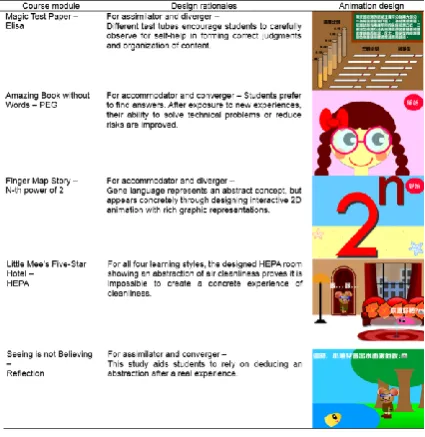
According to the students’ responses to the two open-ended questions, the terminology presented and defined in the scientific lectures prior to conducting the experiments were difficult to comprehend. The 2D animated design (Table l) does assist with understanding the terminology when included in the lecture session before the experiment.
Table 1 Screen shots of 2D animation designs
11 Table 2 Scores on pre- and post-tests
4.2 Students with different learning styles
According to Kolb [2], personal experience and scientific exploration of experimental modules should enable students to experience the four stages of learning: CE- Provide specific materials in the course lectures and instructional materials provided by the lecturer, and the lecturer’s remarks should be clear and intriguing. RO- Provide a few questions to lead students to think, enable them to conduct the experiment based on past experience with conducting scientific experiments, accumulated knowledge, and finding solutions to problems. AC- Provide group discussion opportunities so that students can observe other students’ thinking during the learning process. AE- Provide a sufficient length of time for each experiment, so individual thinking and implementation leads to initiatives for experimentation and observations that lead to in-depth knowledge.
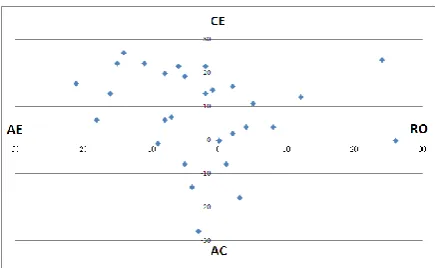
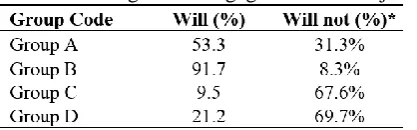
Figures 1 to 4 display the scatter plots of four groups of students’ learning styles. Obviously, Group A and B (CE and AE orientations) have similar accommodator-type learning styles. Both groups of students have interest in actively conducting experiments, and approximately ten students from both groups have a reflective observation learning style (RO). Notably, Table 3 shows that most Group B students (91.7%) demonstrate willingness to consider pursuing science-related careers in the future since they significantly prefer to conduct active experiments as compared to the students in Group A. The scatter plot of the learning styles of Group C’s students represents a large difference compared to the other groups. Group D students have somewhat similar learning styles to those in Group A since both groups have outliers representing the abstract conceptualization and reflective observation learning style. Thus, Group D demonstrates a low percentage, in fact the lowest, willingness to pursue careers in science.
Fig. 1 Scatterplot of Group A students’ learning styles (unit: score)
Fig. 2 Scatterplot of Group B students’ learning styles (unit: score)
Fig. 3 Scatterplot of Group C students’ learning styles (unit: score)
12 Table 3 Willingness to engage in scientific jobs
* The total percentage does not reach 100% due to some students’ lacking definitive preferences.
5. Discussion and Conclusions
This study verified the fact that the effects of multi-media animation such as 2D animated designs have a significant impact on the students’
learning performance. This finding is consistent
with the assumptions proposed by Mayer’s
cognitive theory of multimedia learning [3]
suggesting that learning materials should be provided in varied ways for different types of auditory and visual learners. In this study, the students’ comprehension obviously improves through exposure to the 2D animated designs provided during the lectures and during sessions for experimentation. However, there was only one group (Group C) where most students’ post-test scores were lower than their pre-post-test scores. This was probably due to their style of learning science and resulted in their holding negative attitudes toward listening to the lectures and their low interest in completing the experiments. According to Kolb’s experiential learning theory [6, 7], every student has his/her preferred learning style. This study did find that the four groups of participating students indeed had different learning styles. In addition, the types of learning styles determine the degree of understanding of science. The only group (Group C) receiving lower scores in the post-test did not have the accommodation learning style (AE-CE) as was the case for Groups A and B, nor did they have the convergence learning style (CE-RO) style as was the case for Group D. Notably, both Groups A and B indicated interest in actively conducting experiments, and approximately ten students from these groups exhibited a reflective observation (RO) learning style. Finally, this study found that most Group D students preferred to obtain concrete experiences in the learning processes, similar to Groups A and B (CE orientations), and their learning performance improved after exposure to the animated materials, but they had low willingness to engage in science-related careers. This finding implies that no correlation exists between willingness to engage in science-related careers and the degree
to which students understand science. In addition, concrete experiences can be regarded as
important components when developing
animated materials for scientific lectures and experimental modules.
Based on the results, different multi-media
learning tools have different levels of
effectiveness in contexts of science-related learning [26, 27, 28, 29]. The purpose of using multi-media learning tools is to effectively assist students in order to enhance their interest in learning and improve their learning performance. As students embrace the context of scientific experiments, they may change their minds and consider careers in science-related endeavors in
the future. This study’s future direction is to
provide students with a totally experiential learning context, such as three-dimensional (3D) animations, virtual objects in 3D space, or developing augmented reality materials to
develop deep levels of enjoyment and
satisfaction from conducting experiments and to improve learning performance.
Acknowledgement
This research received grants from the National Science Council (NSC 1002515S006 006 -MY2). Researcher wants to express the special thanks to National Laboratory Animal Center (NLAC), Distinguished Prof. Yu-Cheng Lin (also Chair of Project II) from the Dept. of Engineering Science, National Cheng Kung University (NCKU), and Prof. Wang-Long Li (also Chairs of Project III) from the Dept. of Material Science and Engineering, NCKU.
References
[1] Kolb, D. A. (1976). Learning Style Inventory.
McBer and Co, Boston.
[2] Kolb, D. A. (1985). Experiential Learning:
Experience as the Source of Learning and Development. Prentice-Hall, Inc.,
Englewood Cliffs,New Jersey.
[3] Mayer, R. E. (2009). Multimedia learning
(2nd ed), Cambridge University Press, New York.
[4] Moreno, R. (2007). “Optimizing learning
from animations by minimizing cognitive load: Cognitive and affective consequences of signaling and segmentation methods” in
Applied Cognitive Psychology, Vol. 21. pp. 765-778.
13 “Effectiveness of using graphic animation
courseware for students with cognitive styles
and spatial visual abilities” in Journal of
Technical Education and Training, Vol. 3. No. 1 pp. 47-58.
[6] Hsieh, P. H. and Dwyer, F. (2009). “The
instructional effect of online reading strategies and learning styles on student
academic achievement” in Educational
Technology & Society, Vol. 12. No. 2 pp. 36-50.
[7] Ke, F., Lin, H. F. and Ching, Y. H. (2006). “Effects of animation on multi-level learning
outcomes for learners with different
characteristics: A meta-analytic assessment
and interpretation” in Journal of Visual
Literacy, Vol. 26. No. 1 pp. 15-40.
[8] Hampden-Thompson G. and Bennett, J.
(2011). “Science teaching and learning activities and students' engagement in
science” in International Journal of Science
Education, Vol. 35. No. 8 pp. 1-19.
[9] Tai, R. H., Liu, C. Q., Maltese, A. V. and Fan,
X. (2006). “Planning early for careers in
science” in Education Forum, Vol. 312. pp.
1143-1144.
[10] Ayres, P. and Paas, F. (2007). “Making
instructional animations more effective: A
cognitive load approach” in Applied
Cognitive Psychology, Vol. 21. pp. 695-700.
[11] Hwang, I., Tam, M., Lam, S. and Lam, P.
(2012). “Review of use of animation as a
supplementary learning material of
physiology content in four academic years” in The Electronic Journal of e-Learning, Vol. 10. No. 4 pp. 368-377.
[12] Kim, Y. H. (2010). “Effects of utilizing
animation prior to fundamental nursing practice on learning motivation and
self-directedness in student nurses” in Journal of
Korean Academy of Fundamentals of Nursing, Vol. 17. No. 2 pp. 240-248.
[13] Rosen, Y. (2009). “The effects of an
animation-based on-line learning
environment on transfer of knowledge and on motivation for science and technology
learning” in Journal of Educational
Computing Research, Vol. 40. No. 4 pp. 451-467.
[14] Lin, H. (2011). “Facilitating learning from
animated instruction: Effectiveness of
questions and feedback as attention-directing
srategies” in Educational Technology &
Society, Vol. 14. No. 2 pp. 31-42.
[15] Owens, R. and Dwyer, F. (2005). “The
effect of varied cueing strategies in complementing animated visual imagery in
facilitating achievement of different
educational objectives” in International
Journal of Instructional Media, Vol. 32. No. 4 pp. 373-384.
[16] Paas, F., Van Gerven, P. W. M. and Wouters,
P. (2007). “Instructional efficiency of animation: Effects of interactivity through mental reconstruction of static key frames” in
Applied Cognitive Psychology, Vol. 21. pp. 783–793.
[17] Wu R. Y. and Wu, H. M. (2008). “The
impact of animated instructional material’s learner control modes and multimedia
modality combinations on learning
effectiveness and learning time” in Journal
of National Taiwan Normal University: Mathematics & Science Education, Vol. 53. No. 1 pp. 1-26.
[18] Gavrilova, L. (2013). “Influence of music
art multimedia production on professional competence of the future music teachers” in
Communications in Computer and Information Science Volume, Vol. 347. pp. 195-211.
[19] Guo, Y. C., Diez, C. R. and Lou, S. J. (2015).
"Learning effects and learning satisfaction of different character trait groups through
blended animation instruction" in Journal of
Computers and Applied Science Education, Vol. 2. No. 1 pp. 1-23.
[20] Mutiara, D., Zuhairi, A., Kurniati, S. and
Terbuka, U. (2007). “Designing, developing, producing and assuring the quality of multi-media learning materials for distance learners: Lessons learnt from Indonesia's
Universitas Terbuka” in Turkish Online
Journal of Distance Education, Vol. 8. No. 2 pp. 95-112.
[21] Aleck Lin, C. H., Fernandez, W. and Gregor,
S. (2010). “Designing for enjoyment and informal learning: A study in a museum
context” in PACIS 2010 Proceedings, Paper
90.
[22] Tanner Jackson, G., Dempsey, K. B. and
McNamara, D. S. (2011). “Short and long term benefits of enjoyment and learning
within a serious game” in Artificial
Intelligence in Education: Lecture Notes in Computer Science, Vol. 6738. pp. 139-146.
[23] Gerkin, K. L., Taylor, T. H. and Weatherby,
F. M. (2009). “The perception of learning and satisfaction of nurses in the online
14
Professional Development, Vol. 25. No. 1 pp. 8-13.
[24] Lim, D. H., Morris, M. L. and Kupritz, V.
W. (2007). “Online vs. blended learning: Differences in instructional outcomes and
learner satisfaction” in Journal of
Asynchronous Learning Networks, Vol. 11. No. 2 pp. 27-42.
[25] Zai, B., Jamaludin, R. and Hosam, A. S.
(2011). “Perceived satisfaction levels and
student learning performance towards
second life virtual environment for learning
the Islamic concepts” in Australian Journal
of Basic and Applied Sciences, Vol. 5. No. 9 pp. 1860-1864.
[26] Chao, R. M., Liu, H. H., Chiu, H. H. and Lu,
L. H. (2006). “Research on teaching, learning satisfaction and results of free online Wiki Education platform of music collaborative
composition” in The International Journal of
Arts Education, Vol. 4. pp. 125-150.
[27] Tan, C. C., Chen, C. M. and Lee, H. M.
(2013). “Using a paper-based dgital pen for supporting english courses in regular classrooms to improve reading fluency” in
International Journal of Humanities and Arts Computing, Vol. 7. pp. 234-246.
[28] Warnock, S. H., Boykin, N. J. and Tung, W.
C. (2011). “Assessment of the impact of smart board technology system use on
student learning, satisfaction, and
performance” in Journal of Reseach in
Education, Vol. 21. No. 1 pp. 1-20.
[29] Wen, J. R., Chuang, M. K. and Kuo, S. H.
(2012). “The learning effectiveness of integrating e-books into elementary school science and technology classes” in
International Journal of Humanities and Arts Computing, Vol. 6. pp. 224-235.
[30] Mayer, R. E. (2010). “Seeking a science of
instruction” in Instructional Science, Vol. 38.