ORIGINAL ARTICLE
Volume 8 Issue 1 2016DOI: 10.5959/eimj.v8i1.377 ARTICLE INFO
Submitted: 29-05-2015 Accepted: 10-03-2016
Exploring Students’ Self-Directed Learning in
Problem-Based Learning
Reem Rachel Abraham, Syukri Hassan, Muhamad Ulul Ahlam Damanhuri, Nur Raudhah Salehuddin
Melaka Manipal Medical College (MMMC), Manipal Campus, Manipal University, Karnataka, India
ABSTRACT
Introduction: The present study examined the extent to which problem-based learning (PBL) as a learning context indirectly influences the attributes of self-directed learning process (SDL) indicated in Candy’s four dimensional model of SDL. The model has four components related to SDL; personal autonomy (PA), self-management in learning (SML), independent pursuit of learning (IPL), and the learner control of instruction (LI). The study also investigated aspects of PBL that supports the development of SDL in medical students. Method: Undergraduate medical students at Melaka Manipal Medical College (MMMC), Manipal Campus, Manipal University, India were requested to respond to a questionnaire focusing on Candy’s model of SDL, on a 4 point Likert scale (4 = Strongly agree, 3 = Agree, 2 = Disagree, 1 = Strongly disagree). For the first four items, they were requested to indicate the reasons for the scores they have given. Additionally, students were also requested to mention two or three attributes of PBL that supported SDL, in the same questionnaire. Results: Among the domains, the mean score was found to be highest for personal autonomy, followed by self-management of learning, learner control of instruction and independent pursuit of learning. Three items belonging to the domains, self-management of learning and personal autonomy (spend more time [3.18], more effort in learning [3.19], take more responsibility in learning PBL topics [3.12]) had the highest mean scores compared to other items. All items had a mean score more than 2.5, except two items. Students also indicated that in PBL, as learning is triggered by a case, and as it helped in linking concepts, it motivated learning. Conclusion: This study provided baseline data regarding the level of SDL in PBL, of undergraduate medical students. The reported level of SDL in PBL as indicated by attributes associated with all four domains of SDL seem to be quite satisfactory.
Keywords: Problem-based learning, Self-directed learning, Undergraduate medical students
CORRESPONDING AUTHOR Dr. Reem Rachel Abraham, Professor Department of Physiology, Melaka Manipal Medical College (Manipal Campus) Udupi, Karnataka, 576 104, India | Email: [email protected]
Introduction
Through problem-based learning (PBL) students undertake the responsibility for their own learning and thereby improve their self-directed learning (SDL) skills. Knowles described SDL as a process in which individuals take the initiative with or without the help of others in diagnosing their learning needs, formulating goals, identifying human and material resources, choosing and implementing appropriate learning strategies and evaluating learning
initially confronted with a case, which is then followed by generation of learning issues, hypotheses and learning objectives by students (brainstorming phase). During this phase, students are engaged in SDL as they themselves take the initiative to identify the learning goals in the PBL context. This is followed by a period of self-study in which students learn the topics/concepts and then come for the reporting phase. This period in which self-directed learning happens is where the students actually decide upon what to learn, how much to learn, and how to learn. In a PBL setting, the tutorial group discussion and the individual learning process play an important role in structuring students’ learning (13). Research reports that students should be guided on aspects of how to involve themselves during the self-directed learning period so as to make the reporting phase (presentation session) more meaningful (13). Furthermore, strategies students employ during the SDL phase in PBL has an impact on achievement of expected outcomes (14, 15).
Candy (2) defines four dimensions of SDL: personal autonomy, self-management in learning, independent pursuit of learning, and the learner control of instruction. Personal autonomy refers to freedom of choice of students and the ability to realistically appraise own shortcomings as a learner. He also states that personal autonomy is contextual, that is it varies in different contexts. Self-management is the willingness as well as the ability of students to manage their own learning. Learner control of instruction refers to organisation of information instruction in formal settings, that is, control over aspects of instructional situation. It is the amount of control, the learner can assume in the learning process in a classroom setting. Independent pursuit of learning is about learning that happens outside formal educational settings. It is about the learner’s decision on how to engage in learning. Candy (2) asserts that learning always occurs in a social context, and therefore the quality of help one can
get from others is an important indicator of independent pursuit of learning.
Even though reports on various factors influencing PBL are available, research on how PBL facilitates self-directed learning is crucial, as stated by Dolmans (16). Keeping this in mind, our study aimed to explore the extent to which PBL as a learning context indirectly influence the attributes of SDL indicated in Candy’s four dimensional model of SDL.
Methods
The present study was conducted among second year undergraduate medical students (n = 112) of Melaka Manipal Medical College (MMMC), Manipal University, India and the study design was cross-sectional. The study was approved by Institutional Ethics Committee, Manipal University, India.
Educational Context
The undergraduate medical program at MMMC offers the Bachelor of Medicine and Bachelor of Surgery (MBBS) program, which is five years in duration. Students spend the first two and a half years in Manipal, Karnataka, India, and the remaining time in Malaysia. The curriculum is divided into four blocks (teaching units) and the subject’s anatomy, physiology, and biochemistry are taught in first year and Pathology, Pharmacology, Microbiology and Forensic Medicine are taught in second year. There are two admission intakes per year: one in March and the other in September. PBL was introduced in the curriculum from September 2006 admissions onward and a subject-wise approach was adopted till 2014.
and through collaborative learning. Each PBL group consisted of 12 to 14 students and one facilitator who is the subject expert. The groups were shuffled every block, in order to provide students with varied learning experiences with different groups. Assessment of PBL sessions were conducted separately for both sessions. In the brainstorming session it was mainly active participation of students in the group discussion and for presentation session, assessment was based on active participation in the group discussion, presentation style and accuracy of the content presented by students. Eighteen PBL sessions were implemented for this study sample over a span of two years.
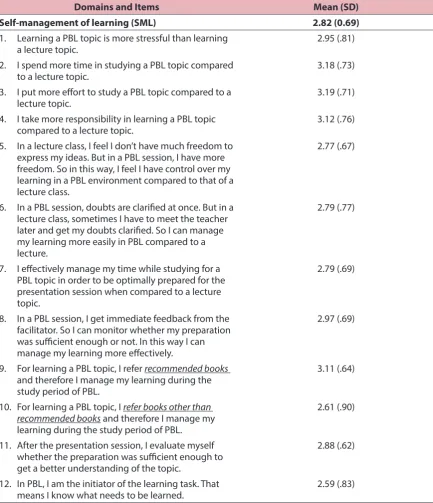
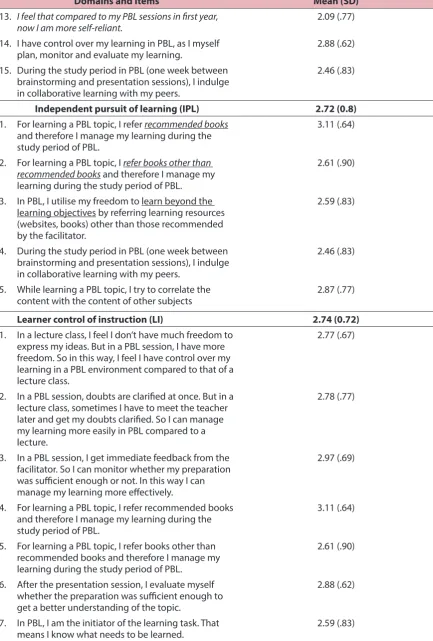
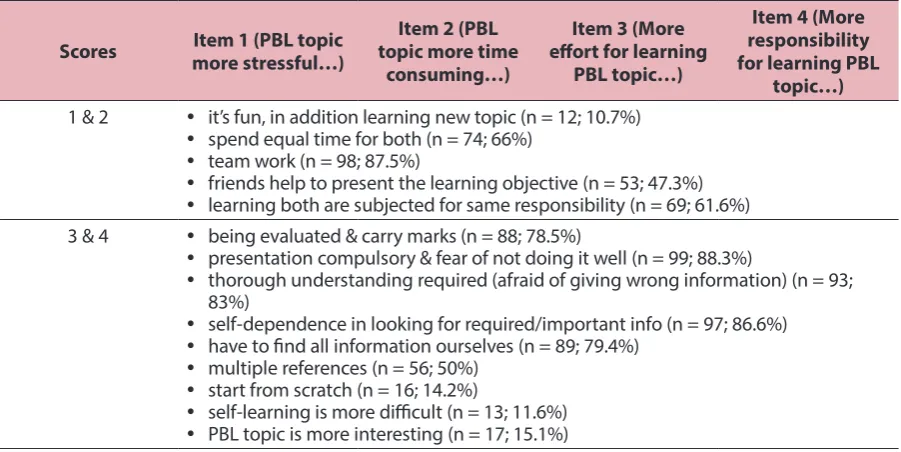
Following a thorough literature search, a questionnaire was developed (Table 1) which had 18 items focusing on the SDL model reported by Candy. Self-management of learning (SML), personal autonomy (PA), independent pursuit of learning (IPL), and learner control of instruction (LI) had 15, 8, 5 and 9 items respectively (indicated in Table 1). The questionnaire was validated (content validity) by two faculty members who were not part of the study. The validated questionnaire was distributed to second year students (n = 112) in the fourth block. They were requested to indicate their responses in the questionnaire on a 4 point Likert scale (4 = Strongly agree, 3 = Agree, 2 = Disagree, 1 = Strongly disagree). For the first four items, they were requested to indicate the reasons for the scores they have given. Additionally, students were also requested to mention two or three attributes of PBL that supported SDL, in the same questionnaire. These students were chosen as the study sample as the authors felt that these students have experienced PBL in first year as well as second year and therefore will have sufficient learning experience in order to respond to the questionnaire.
Data was summarised using mean and standard deviation. Responses to the question on attributes of PBL that
supported SDL were analysed by identifying the themes and determining the number of respondents for each theme.
Results
The response rate was 100%. Mean scores for the items and the domains are depicted in Table 1. Among the domains, the mean score was found to be highest for personal autonomy, followed by self- management of learning, learner control of instruction and independent pursuit of learning. Three items belonging to the domains, self-management of learning and personal autonomy (spend more time [3.18], more effort in learning [3.19], take more responsibility in learning PBL topics [3.12]) had the highest mean scores compared to other items. All items had a mean score more than 2.5, except two items. One item which is a positive statement belonging to self-management of learning
and learner control of instruction (I feel
from learning SDL topics for regular SDL sessions, students felt that learning PBL topics requires in-depth study (presentation purpose) and full understanding and memorisation of every detail. They also felt that learning PBL topics is more fun as there is no critical reading compared to reading for a test and there is no restriction in searching for information. In response
to the question regarding aspects of PBL that supported self-directed learning, the responses obtained were not related to ‘SDL’ in PBL. Students in general indicated that in PBL, as learning is triggered by a case, it stimulated their interest to learn, and as PBL helped in linking concepts it stimulated their learning.
Table 1: Mean (±SD) scores for the domains and items
Domains and Items Mean (SD)
Self-management of learning (SML) 2.82 (0.69) 1. Learning a PBL topic is more stressful than learning
a lecture topic. 2.95 (.81)
2. I spend more time in studying a PBL topic compared
to a lecture topic. 3.18 (.73)
3. I put more effort to study a PBL topic compared to a
lecture topic. 3.19 (.71)
4. I take more responsibility in learning a PBL topic
compared to a lecture topic. 3.12 (.76)
5. In a lecture class, I feel I don’t have much freedom to express my ideas. But in a PBL session, I have more freedom. So in this way, I feel I have control over my learning in a PBL environment compared to that of a lecture class.
2.77 (.67)
6. In a PBL session, doubts are clarified at once. But in a lecture class, sometimes I have to meet the teacher later and get my doubts clarified. So I can manage my learning more easily in PBL compared to a lecture.
2.79 (.77)
7. I effectively manage my time while studying for a PBL topic in order to be optimally prepared for the presentation session when compared to a lecture topic.
2.79 (.69)
8. In a PBL session, I get immediate feedback from the facilitator. So I can monitor whether my preparation was sufficient enough or not. In this way I can manage my learning more effectively.
2.97 (.69)
9. For learning a PBL topic, I refer recommended books
and therefore I manage my learning during the study period of PBL.
3.11 (.64)
10. For learning a PBL topic, I refer books other than recommended books and therefore I manage my learning during the study period of PBL.
2.61 (.90)
11. After the presentation session, I evaluate myself whether the preparation was sufficient enough to get a better understanding of the topic.
2.88 (.62)
12. In PBL, I am the initiator of the learning task. That
means I know what needs to be learned. 2.59 (.83)
Domains and Items Mean (SD) 13. I feel that compared to my PBL sessions in first year,
now I am more self-reliant. 2.09 (.77)
14. I have control over my learning in PBL, as I myself
plan, monitor and evaluate my learning. 2.88 (.62)
15. During the study period in PBL (one week between brainstorming and presentation sessions), I indulge in collaborative learning with my peers.
2.46 (.83)
Independent pursuit of learning (IPL) 2.72 (0.8) 1. For learning a PBL topic, I refer recommended books
and therefore I manage my learning during the study period of PBL.
3.11 (.64)
2. For learning a PBL topic, I refer books other than recommended books and therefore I manage my learning during the study period of PBL.
2.61 (.90)
3. In PBL, I utilise my freedom to learn beyond the learning objectives by referring learning resources (websites, books) other than those recommended by the facilitator.
2.59 (.83)
4. During the study period in PBL (one week between brainstorming and presentation sessions), I indulge in collaborative learning with my peers.
2.46 (.83)
5. While learning a PBL topic, I try to correlate the
content with the content of other subjects 2.87 (.77)
Learner control of instruction (LI) 2.74 (0.72) 1. In a lecture class, I feel I don’t have much freedom to
express my ideas. But in a PBL session, I have more freedom. So in this way, I feel I have control over my learning in a PBL environment compared to that of a lecture class.
2.77 (.67)
2. In a PBL session, doubts are clarified at once. But in a lecture class, sometimes I have to meet the teacher later and get my doubts clarified. So I can manage my learning more easily in PBL compared to a lecture.
2.78 (.77)
3. In a PBL session, I get immediate feedback from the facilitator. So I can monitor whether my preparation was sufficient enough or not. In this way I can manage my learning more effectively.
2.97 (.69)
4. For learning a PBL topic, I refer recommended books and therefore I manage my learning during the study period of PBL.
3.11 (.64)
5. For learning a PBL topic, I refer books other than recommended books and therefore I manage my learning during the study period of PBL.
2.61 (.90)
6. After the presentation session, I evaluate myself whether the preparation was sufficient enough to get a better understanding of the topic.
2.88 (.62)
7. In PBL, I am the initiator of the learning task. That
means I know what needs to be learned. 2.59 (.83)
Domains and Items Mean (SD) 8. I feel that compared to my PBL sessions in first year,
now I am more self-reliant. 2.09 (.77)
9. I have control over my learning in PBL, as I myself
plan, monitor and evaluate my learning. 2.88 (.62)
Personal autonomy 3.19 (0.72)
1. I spend more time in studying a PBL topic compared
to a lecture topic. 3.18 (.73)
2. I put more effort to study a PBL topic compared to a
lecture topic. 3.19 (.71)
3. I take more responsibility in learning a PBL topic
compared to a lecture topic. 3.12 (.76)
4. I effectively manage my time while studying for a PBL topic in order to be optimally prepared for the presentation session when compared to a lecture topic.
3.79 (.69)
5. In PBL, I utilise my freedom to learn beyond the learning objectives by referring learning resources (websites, books) other than those recommended by the facilitator
2.59 (.83)
6. In PBL, my intention is only to have a superficial understanding of the topic, so I just memorise content for the learning objectives.
2.09 (.77)
7. After the presentation session, I evaluate myself whether the preparation was sufficient enough to get a better understanding of the topic.
2.88 (.62)
8. While learning a PBL topic, I try to correlate the
content with the content of other subjects. 2.87 (.77)
Table 2: Reasons for the scores indicated for items 1 to 4 (Total number of responses n = 112; 100%)
Scores more stressful…)Item 1 (PBL topic topic more time Item 2 (PBL consuming…)
Item 3 (More effort for learning
PBL topic…)
Item 4 (More responsibility for learning PBL
topic…) 1 & 2 y it’s fun, in addition learning new topic (n = 12; 10.7%)
y spend equal time for both (n = 74; 66%)
y team work (n = 98; 87.5%)
y friends help to present the learning objective (n = 53; 47.3%)
y learning both are subjected for same responsibility (n = 69; 61.6%) 3 & 4 y being evaluated & carry marks (n = 88; 78.5%)
y presentation compulsory & fear of not doing it well (n = 99; 88.3%)
y thorough understanding required (afraid of giving wrong information) (n = 93; 83%)
y self-dependence in looking for required/important info (n = 97; 86.6%)
y have to find all information ourselves (n = 89; 79.4%)
y multiple references (n = 56; 50%)
y start from scratch (n = 16; 14.2%)
y self-learning is more difficult (n = 13; 11.6%)
y PBL topic is more interesting (n = 17; 15.1%)
Discussion
This paper examines the indirect influence of PBL as a learning context for students’ directed learning, with Candy’s self-directed model as a framework. Previous studies reported that context has a strong influence on learning (2, 17). The advantage of PBL as a learning context for fostering SDL skills is that it will pave the way for students to deal with real life situations in a better way in future and also prepare themselves for better self-directed learners (18). According to the present study, students seem to possess the aspects pertaining to all four components of SDL mentioned in the above model. Students seem to be spending more time and effort and assuming more responsibility in learning PBL topics when compared to lecture topics. They postulate reasons such as the demand of more self-learning in understanding of topics and the fact that PBL is assessed, for the perceptions reported above. This awareness and understanding of one’s own learning process is fundamental to SDL. This awareness will enhance the facilitation of components of SDL such as becoming organised and developing the ability to retrieve information (self-management), to develop the ability to set goals and exercise freedom of choice in achieving them (personal autonomy), and to develop self-efficacy in the learning process (learner control of instruction).
Medical students experience a packed curriculum and majority of them may not learn content beyond the learning objectives. However, students’ interpersonal interaction for learning (Item no:17; During the study period in PBL [one week between brainstorming and presentation sessions], I indulge in collaborative learning with my peers), as well as sense of ownership of learning (Item no:14; In PBL, I am the initiator of the learning task. That means I know what needs to be learned), seems to be positive in the present study. In a PBL context, students should be entrusted with the freedom to select the learning
are expected to read mainly from the recommended book(s) and assessment is also only based on content from those books. In spite of the fact that, students are aware of the learning objectives as well as the type of learning resources they need to utilise, it did not hinder their interest for collaborative learning and also the curiosity to learn beyond curriculum requirements.
Another pertinent factor reported in the literature that affects students’ SDL in PBL is the tutorial group functioning (20). Visschers-Pleijers et al. (21) reported the cardinal role of elaboration and co-construction of knowledge in the tutorial group functioning. In the present PBL context, most often, a crucial component of PBL that is lacking, which many facilitators have observed, is discussion within the tutorial group. Even though students are assessed on their active participation in the discussion both during brainstorming and presentation sessions, they are satisfied that they have brought out most of the learning objectives (in brainstorming) which are pre-identified by the facilitator and have presented the topic (in presentation). As mentioned earlier, in the present PBL context, as students are aware of the learning objectives and the recommended learning resources, they do not show interest to go into the deeper aspects of the case through collaborative learning. This hinders the process of elaboration and co- construction of information and this in turn affects the effective functioning of tutorial groups. This affects the quality of their self-directed learning with respect to the social aspects of learning (IPL) and ownership in learning (LI).
The process of ‘reflection’ on self-directed learning process is another cardinal factor required for structuring SDL during PBL (12, 22). In the present study it was encouraging to observe that students reflect on their SDL process in PBL (after the presentation session, I evaluate myself whether the preparation was sufficient enough to get a better understanding of the topic; I have control over my learning in PBL, as I myself plan, monitor and evaluate my learning). Silen (12) reported that if students have the behaviour of reflecting on their SDL process they would acquire new ‘informed eyes’ to get a better understanding of the problem when they return for the presentation session. She stresses that metacognitive analyses of the learning process is of paramount importance for the feeling of sense of ownership of learning (12).
Conclusions
The present study revealed that although majority (> 75%) of students were found to have aspects related to all four components of SDL mentioned in Candy’s model, some behaviours related to independent pursuit of learning as well as learner control of instruction were found to be below the expected level. This finding indicated that tutorial group functioning in the present PBL context, and case design are the areas which needs refinement. Deep processing of information has to be promoted by rendering students the freedom to choose what they learn with respect to the case. However, the process of reflection on SDL seems to be happening among majority of students.
References
1. Knowles M. Self-directed learning: a guide for teachers and learners. Chicago: Follett; 1975.
2. Candy PC. Self-direction for lifelong learning: a comprehensive guide to theory and practice. San Francisco: Jossey-Bass; 1991.
3. Song L, Hill JR. A conceptual model for understanding self-directed learning in online environments. Journal of Interactive Online Learning. 2007;6:27–41.
4. Blumberg P, Michael JA. Development of self-directed learning behaviors in a partially teacher-directed problem-based learning curriculum. Teach Learn Med. 1992;4:3–8.
5. Distlehorst LH, Dawson E, Robbs RS, Barrows HS. Problem-based learning outcomes: the glass half-full. Acad Med. 2005;80:294–299.
6. Evensen DH. Observing self-directed learners in a problem-based learning context: two case studies. In: Evensen DH, Hmelo CE, editors. Problem-based learning: a research perspective on learning interactions. Mahwah, NJ: Erlbaum; 2000, p. 263–297.
7. Loyens SMM, Magda J, Rikers RMJP. Self-directed learning in problem-based learning and its relationships with self-regulated learning. Educ Psychol Rev. 2008;20:411– 427.
9. Rankin JA. Problem-based medical education-effect on library use. Bull Med Libr Assoc. 1992;80:36–43.
10. Abraham RR, Pallath V, Kamath G, Kamath A, Ramnarayan K. Learning approaches of undergraduate medical students to physiology in a non- and partially PBL-oriented curriculum. Advan Physiol Edu. 2008;32:35–37.
11. Li Su-Ting T, Paterniti DA, Patrick JT, West DC. Successful self-directed lifelong learning in medicine: a conceptual model derived from qualitative analysis of a national survey of pediatric residents. Acad Med. 2010;85:1229–1236.
12. Silen C, Uhlin L. Self-directed learning – a learning issue for students and faculty! Teaching in Higher Education. 2008;13:461–475.
13. Van Den Hurk MM, Dolmans DHJM, Wolfhagen IHAP, Van Der Vleuten CPM. Testing a causal model for learning in a problem-based curriculum. Adv Health Sci Educ Theory Pract. 2001;6:141–149.
14. Mamede S, Schmidt HG, Norman GR. Innovations in problem-based learning: what can we learn from recent studies? Adv Health Sci Educ Theory Pract. 2006;11:403–422.
15. Zimmerman B. Self-regulated learning and academic achievement: an overview. Educational Psychologist. 1990;25:3–17.
16. Dolmans D, Gijbels D. Research on problem-based learning-future challenges. Med Educ. 2013;47:214–218.
17. Tessmer M, Richey RC. The role of context in learning and instructional design. Educ Technol Res Dev. 1997;45:85–115.
18. Barrows HS, Tamblyn R. Problem-based learning: an approach to medical education. New York: Springer; 1980.
19. Schmidt HG. Assumptions underlying self-directed learning may be false. Med Educ. 2000;34:243–245.
20. Gijselaers WH, Schmidt HG. The development and evaluation of a causal model of problem-based learning. In: Norman Z, Schmidt HG, Ezzat E, editors. Innovation in medical education: an evaluation of its present status. New York: Springer Publishing Company; 1990, p. 95– 113.
21. Visschers-Pleijers AJSF, Dolmans DHJM, de Leng BA, Wolfhagen IHAP, van der Vleuten CPM. Analysis of verbal interactions in tutorial groups: a process study. Med Educ. 2006;40:129–137.