DOI: http://dx.doi.org/10.15282/ijsecs.3.2017.10.0032
138
A GLOBAL AFRICAN BUFFALO OPTIMIZATION
M. A. K Azrag*, T. A. Abdul Kadir, J.B. Odili, M. H. AEssam
Faculty of Computer Systems & Software Engineering, Universiti Malaysia Pahang, Kuantan 26300, Malaysia
E-mail: [email protected]
ABSTRACT
In this paper, a modified version of the African Buffalo Optimization algorithm with emphasis on global search is proposed. Two different equations with the values of their upper and lower boundaries are selected to be tested. The experimental result illustrates the difference in performance between the modified and the original ABO algorithm toward the optimum solution. At the end of all experimental procedures, it was observed that the Global African Buffalo Optimization (GABO) converges very quickly towards the optimal solution with a few buffalos. However, the experimental result show that GABO convergence still needs improvement as it tends to have unpromising convergence towards the end of a large iteration. In any case, GABO is a promising optimization method.
Keywords: African Buffalo Optimization, Global African Buffalo Optimization, Convergence Speed, Sphere Function, Rosenbrock Function
INTRODUCTION
Within the past few decades, Nature-inspired optimization algorithms have increasingly been gaining popularity in the areas of scientific and engineering research all over the world (Rauff, 2015). This development has thrilled many researchers and they have deduced various reasons for it. Some researchers argue that these Algorithms are successful because they were developed to replicate some of the most successful dynamics in biological, physical and chemical processes which occur naturally (Gandomi & Alavi, 2012; Priami, 2009). With this situation, the issue of choice of algorithm always surfaces (since there exists so many to choose from) whenever the need for optimization arises (Huang & Lam, 2002). There is this general understanding among researchers that the choice of the ‘best’ algorithm to solve a problem should largely be based on the nature of problem being faced. The No free lunch optimization theorem reinforced this line of thought (Wolpert & Macready, 1997; Xu, Caramanis, & Mannor, 2012). In fact, there is no agreement on the recommended principles guiding the choice of algorithms when faced with large-scale, nonlinear optimization problems (Ellison, Finn, Qin, & Tang, 2015).
139 Mohmad Kahar, 2016).
The rest of this paper is organized thus: section two discusses the modified African Buffalo optimization with emphasis on global search (GABO), section three explains the experimental setup and discussion of results while section four draws conclusions from the study.
THE WORKING OF THE GABO
With the ability of the buffalos to recognize the global best position in a standard ABO algorithm at step 3 (Odili, Kahar, & Anwar, 2015), the buffalos were made to perform a re-search of the best position found by the ABO buffalos to ensure that the global best position are the same and as close enough to the global optimum solution as possible. This can be seen in step 4. With this idea, some modifications of the standard ABO algorithm are proposed. The modified algorithm selected the best position which has already been found by the ABO buffalos and then set them as the best position to be tested by considering the lower and the upper values of the herds’ best (𝒃𝒈𝒎𝒂𝒙). After this, the algorithm then starts to search towards the optimum global solution. In step 5 if the global optimum solution was found, then ABO move to step 6 if not, it repeats steps 2-5. But the Step 6 in GABO is asking to ensure the global best is reached if not repeat step 2-6 (This is the primary difference between ABO and GABO). Step 7 outputs the optimum values which means the best minimum values. In this way, the buffalos can search for more domains. The Pseudocode of the proposed GABO is presented in Figure 1:
1- Randomly initialize the buffalos to nodes within the solution space;
2- Update the buffalo’s exploitation using:
𝒎𝒌′ = 𝒎𝒌 + 𝒍𝒑𝟏(𝒃𝒈 – 𝒘𝒌) + 𝒍𝒑𝟐(𝒃𝒑. 𝒌 − 𝒘𝒌 )
where 𝒎𝒌 and 𝒘𝒌 represents the exploitation and exploration moves
respectively of the kth buffalo (k=1, 2…. N); 𝒍𝒑𝟏and 𝒍𝒑𝟐 are learning
factors; 𝒃𝒈 is the herd’s best fitness and 𝒃𝒑 , the individual buffalo’s best
location.
3- Update the exploration fitness of the buffalos using:
𝒘𝒌′ =(𝒘𝒌+ 𝒎𝒌)
𝒓𝒂𝒏𝒅
4- Set the best position 𝑏𝑝 to be the new dimension of the global best position
𝑏𝑔𝑚𝑎𝑥.
5- Is the global best position found and 𝑏𝑔𝑚𝑎𝑥 is updating? Yes, go to 6. If No,
go to 2-5
6- If the stopping criteria is not met, go back to algorithm step 2, else go to 6
7- Output best solution.
140
The performance of GABO was greatly improved with the introduction of the search for the optimum global solution of the best position that has already been found by buffalos into the original version of ABO. This improvement was evident through the experimental study carried out on the benchmark problem of Sphere and Rosenbrock functions. To further illustrate the relevance of this study, the experimental results with the two non-linear tested functions used in by are reported and discussed (Shi & Eberhart, 1999).
EXPERIMENTAL SETUP
For comparison, two nonlinear functions used in are used here. The first function is the Sphere function described by equation (1):
𝒇(𝒙) = ∑𝒏 𝒙𝟐
𝒊=𝟏 (1)
Where 𝑥 = [𝑥1, 𝑥2, … , 𝑥𝑛] is an n-dimensional real-valued vector. The second function is the
Rosenbrock function described by equation (2):
𝒇𝟏(𝒙) = ∑𝒊=𝟏𝒏 (𝟏𝟎𝟎(𝒙𝒊− 𝒙𝒊𝟐)𝟐+ (𝒙𝒊− 𝟏)𝟐) (2)
Following the suggestion in (Shi & Eberhart, 1999) and for the purpose of comparison, the lower and upper values are selected to be as the original values. Table 1 lists the initialization of the upper and lower values of the two function.
Table 1. The Lower and Upper Values
Function Lower and Upper Values
𝒇 [-10 10]
𝒇𝟏 [-5 10]
Utilizing the original parameters of ABO to evaluate the GABO algorithm, different population sizes were used for each function and these population sizes are 10 original; 20 and 30 buffalos. The maximum number of iteration is set to 100 original: 200, and 300 and the dimension is 5. Each algorithm was tested 3 times to get the get the Mean global best position.
EXPERIMENTAL RESULT AND DISCUSSION
141
algorithm. The results in Tables 3 & 4 are obtained when the iteration is 100.
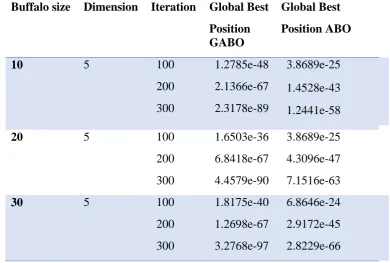
Table 2. ABO & GABO results for Sphere
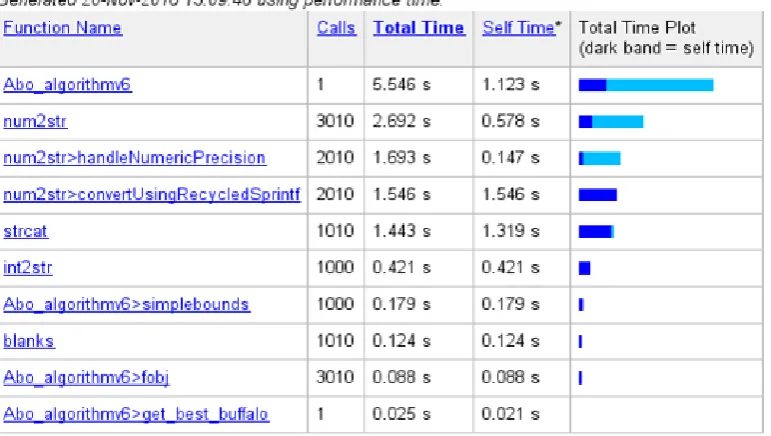
Looking at Table 2 where Sphere was tested using ABO and GABO on a 5-dimensional space with 10, 20, 30 buffalos and 100, 200, 300 iterations, the global best position of GABO has very good result that is almost twice as good as the result of ABO. Moreover, the convergence speed of GABO toward the optimum values are faster than those of ABO as plotted in Tables 3 and 4. Moreover, it is easy to observe that GABO convergences quickly in both functions but slows its convergence speed down when reaching the optimum. It takes 0.028s to get the best global position while ABO takes 0.025s as can be seen clearly in Tables 3 and 4. Finally, the total performance speed of the both algorithm is 5.546s with 100 iterations for ABO and 4.972s only for GABO. This result in Tables 3 & 4 was taken when the iteration is 100. Similarly, the GABO takes self-time 1.081s while ABO takes self-time 1.123s this may be due to the function simplicity.
Buffalo size Dimension Iteration Global Best Position GABO
Global Best Position ABO
10 5 100
200
300
1.2785e-48
2.1366e-67
2.3178e-89
3.8689e-25
1.4528e-43
1.2441e-58
20 5 100
200
300
1.6503e-36
6.8418e-67
4.4579e-90
3.8689e-25
4.3096e-47
7.1516e-63
30 5 100
200
300
1.8175e-40
1.2698e-67
3.2768e-97
6.8646e-24
2.9172e-45
142
Table 3. Different Iterations results: ABO Convergence speed 100 iteration -Sphere
Table 4. Different Iterations results: GABO Convergence speed 100 iteration -Sphere
143
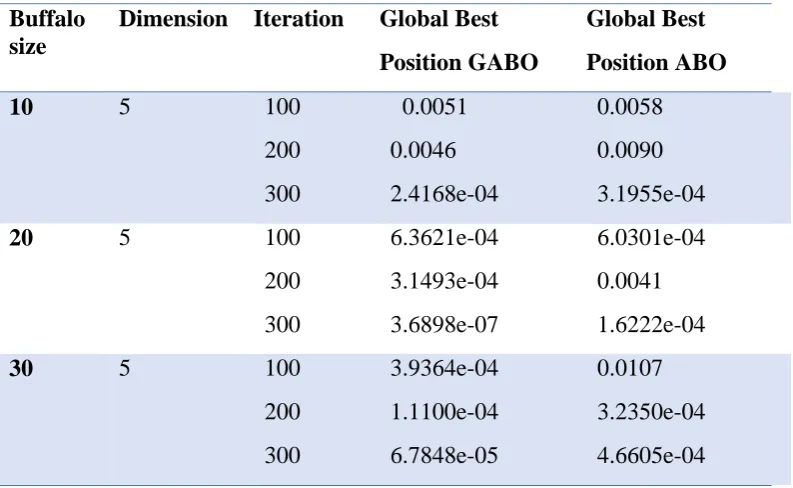
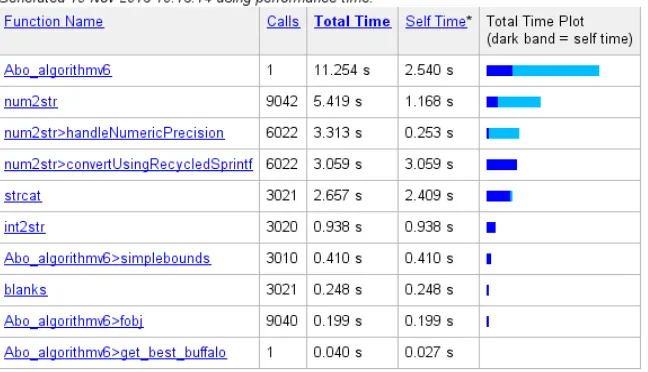
in Table 5. Moreover, the convergence speed of GABO toward the optimum values are faster than ABO as plotted in Tables 6 and 7. However, it was observed that the GABO convergences quickly under both function but will slow its convergence speed down when reaching the optima. It took 0.040s to get the best global position while ABO took 0.028s as can be seen clearly in Tables 3and 4. Finally, the total time performance speed of the both algorithm is 12.1018s with 300 iterations for ABO and 11.254s only for GABO. This result in Figures 6 & 7 was taken when the iteration is 300.
Table 5. Rosenbrock Result: GABO/ABO Convergence speed with different iteration
Table 6. Different Iterations results: GABO Convergence speed 300 iteration Rosenbrock Buffalo
size
Dimension Iteration Global Best Position GABO
Global Best Position ABO
10 5 100
200
300
0.0051
0.0046
2.4168e-04
0.0058
0.0090
3.1955e-04
20 5 100
200
300
6.3621e-04
3.1493e-04
3.6898e-07
6.0301e-04
0.0041
1.6222e-04
30 5 100
200
300
3.9364e-04
1.1100e-04
6.7848e-05
0.0107
3.2350e-04
144
Table 7. Different Iterations results: ABO Convergence speed 300 iteration Rosenbrock
CONCLUSION
145
separable and non-separable functions to further validate the search capacity of GABO. Moreover, there is need to apply GABO to other optimization search landscapes such as urban transportation problems, job scheduling, dynamic modeling, vehicle routing etc.
ACKNOWLEDGEMENT
The authors appreciate the Faculty of Computer Systems and Software Engineering, Universiti Malaysia Pahang, Kuantan 26300, Malaysia for funding this research study.
REFERENCES
Ellison, C. L., Finn, J., Qin, H., & Tang, W. M. (2015). Development of variational guiding center algorithms for parallel calculations in experimental magnetic equilibria.
Plasma Physics and Controlled Fusion, 57(5), 054007.
Gandomi, A. H., & Alavi, A. H. (2012). Krill herd: a new bio-inspired optimization algorithm. Communications in Nonlinear Science and Numerical Simulation, 17(12), 4831-4845.
Huang, H.-J., & Lam, W. H. (2002). Modeling and solving the dynamic user equilibrium route and departure time choice problem in network with queues. Transportation
Research Part B: Methodological, 36(3), 253-273.
Odili, J. B., Kahar, M. N., & Noraziah, A. (2016). Solving Traveling Salesman’s Problem Using African Buffalo Optimization, Honey Bee Mating Optimization & Lin-Kerninghan Algorithms. World Applied Sciences Journal, 34(7), 911-916.
Odili, J. B., & Kahar, M. N. M. (2015a). African Buffalo Optimization (ABO): a New Meta-Heuristic Algorithm. Journal of Advanced & Applied Sciences, 03(03), 101-106. Odili, J. B., & Kahar, M. N. M. (2015b). Numerical Function Optimization Solutions Using
the African Buffalo Optimization Algorithm (ABO). British Journal of Mathematics
& Computer Science, 10(1), 1-12.
Odili, J. B., Kahar, M. N. M., & Anwar, S. (2015). African Buffalo Optimization: A Swarm-Intelligence Technique. Procedia Computer Science, 76, 443-448.
Odili, J. B., & Mohmad Kahar, M. N. (2016). African Buffalo Optimization Approach to the Design of PID Controller in Automatic Voltage Regulator System. National Conference for Postgraduate Research, Universiti Malaysia Pahang, September, 2016, 641-648.
Priami, C. (2009). Algorithmic systems biology. Communications of the ACM, 52(5), 80-88. Rauff, J. (2015). Nature-Inspired Optimization Algorithms. Mathematics and Computer
Education, 49(3), 208.
Shi, Y., & Eberhart, R. C. (1999). Empirical study of particle swarm optimization. Paper presented at the Evolutionary Computation, 1999. CEC 99. Proceedings of the 1999 Congress on.
Wolpert, D. H., & Macready, W. G. (1997). No free lunch theorems for optimization. IEEE
transactions on evolutionary computation, 1(1), 67-82.