[Abbas * et al., 6(2): February, 2019]
ISSN: 2349-5197
Impact Factor: 3.765
I
NTERNATIONAL
J
OURNAL OF
R
ESEARCH
S
CIENCE &
M
ANAGEMENT
EXPERIMENTAL
INVESTIGATION
OF
PROCESS
PARAMETERS
ON
DIMENSIONAL ACCURACYIN MULTI-POINT FORMING PROCESS USING
ANOVA ALGORITHM
Tahseen Fadhil Abbas
*1, Karem MuhsonYounis
2& Khalida Kadhim Mansor
3*1,2&3
Department of Production Engineering and Metallurgy / University of Technology, Baghdad,
Iraq
DOI: 10.5281/zenodo.2560456
Abstract
The multi-point forming (MPF) process is a modern pliable manufacturing technique utilized successfully in many industrial applications. In this work, the effect of many forming parameters was investigated which are blank holder, rubber cushion thickness and forming speed. Also, the influence of these parameters on the dimensional accuracy was studied, where the blank (sheet) material is brass with 0.71 mm thickness. This work concentrated on the development of predicted models to estimate the dimensional deviation using analysis of variance (ANOVA) to minimize the deviation of dimension in the multipoint forming process. Arithmetic minimum dimensional deviation was used as response parameter to assess the dimensional accuracy of multi-point formed parts. The data required was generated, compared and evaluated to the proposed models that obtained from the experiments.
Keywords: Multi-point forming (MPF) process, Forming parameters, Dimensional accuracy, Analysis of variance (ANOVA)
Introduction
Normally, a metallic sheet component is shaped by using certain dies produced according to the part’s form and dimensions. The design method of a die is a repeated process of trial and error; it causes important lead times and expenses in the dies manufacturing. This traditional process is proper for a higher production rate, since the dies cost can be participated through the mass production of products. Nevertheless, the pliable die and die less forming operations for a tiny size have been evolved, because the need of customer is too varied, thus resulting in a smaller size of lot. [1,2]
In the process of MPE, the used pins are designed in a method, which is not depending on each other, and are modified simply. Consequently, governing the height of pin may produce an uninterrupted operating surface. In the MPF process, the die’s curved surface is produced by using an enormous number of pins. In such approach, independent pins are utilized in place of conventional dies. [3]
[Abbas * et al., 6(2): February, 2019]
ISSN: 2349-5197
Impact Factor: 3.765
I
NTERNATIONAL
J
OURNAL OF
R
ESEARCH
S
CIENCE &
M
ANAGEMENT
Fig. (1): Schematic diagram of MPF with blank-holder.[4]
Literature Review
A series of experiments has been conducted in the design of experiments for investigating the influence of forming variables, such as blank holder, thickness of polymer and forming speed on the dimensional accuracy.
Wei Liu et al. (2010) [5]investigated the effects of spring-back and elastic cushion non-uniform deformation beyond the unloading upon the accuracy of the formed work-part. Results of simulation depicted the effectively suppress generation of dimples when using elastic cushion, but they have an influence upon the accuracy of the formed work-part. Otherwise, the spring-back beyond the release of load is less, and the influence of the inconsistent elastic cushion deformation on the accuracy of the multi-point forming work-part is greater than the effect of spring-back. An approach depending upon the repeated corrections in accordance with the results of numerical simulation was suggested for compensating the inconsistent elastic cushion deformation and the spring-back to improve the precision of MPF process.
A. A. Tolipov et al. (2017)[6] studied the effect of the cushion pad on the metal formation by its influence on the elimination of defects in this method, and it was obtained that utilizing the cushion A90 led to decrease the wrinkling and the peak deviation.
Babak Beglarzadeh (2017)[7] used a multi-point forming process to form Al alloy 2024 with a primary dimension of 300 mm × 300 mm sheet to offer a pliable approach to form a metal. Finite elements were simulated through ABAQUS/EXPLICIT 6.14.1. Through increasing of the elastic layer hardness, the minimum required thickness of elastic layer proliferates. Furthermore, the increment of the blank holder force is directly related with the hardness enhancement of polyurethane layer. The MPF experiments of aluminum sheet were conducted, and the forming process comparisons between simulation functions and experimental parts were carried out, which indicated that products of aluminum possess an adequate shape and surface precision.
[Abbas * et al., 6(2): February, 2019]
ISSN: 2349-5197
Impact Factor: 3.765
I
NTERNATIONAL
J
OURNAL OF
R
ESEARCH
S
CIENCE &
M
ANAGEMENT
create an error in the shape of the formed work-part, and the blank holder can decrease/remove the dimples, which occasionally occur in the work-part.
Experimental Work
3.1. Material and Process
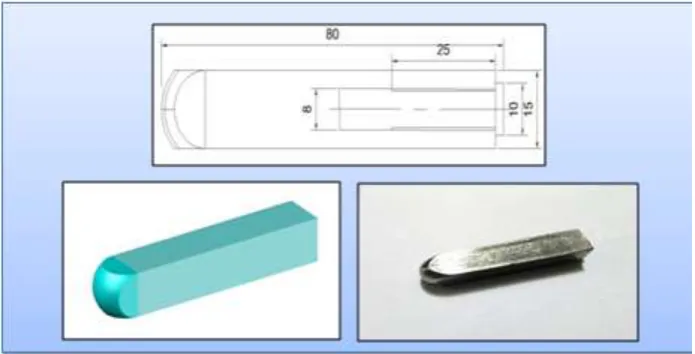
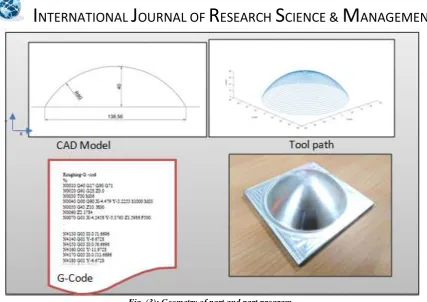
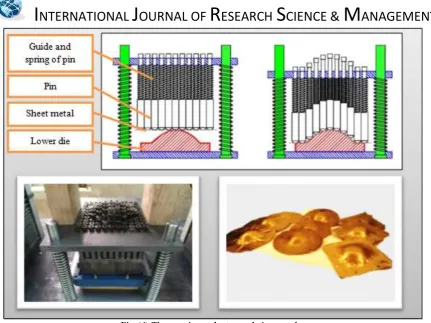
In this work, nine samples of brass (65-35) with thickness 0.71mm were used to perform the experiments. The geometry of forming tool is shown in figure (2),while the geometry of final product is illustrated in figure (3). The experimental work was applied using oil lubricant on a C-tek three-axis CNC milling machine (KM-80D)having a peak rotational speed of (6000) rpm and a feed rate of (10) m/min. The required CNC programs for the part and the tool path were achieved to manufacture the CAD model that used as the lower die. The experimental work was conducted on a workpiece having a hem-spherical shape. Chemical analysis and mechanical properties of blank sheet (brass 65-35) are listed in tables (1 & 2), respectively. Figure (4) elucidates the schematic of a multi-point forming die and the final nine products.
[Abbas * et al., 6(2): February, 2019]
ISSN: 2349-5197
Impact Factor: 3.765
I
NTERNATIONAL
J
OURNAL OF
R
ESEARCH
S
CIENCE &
M
ANAGEMENT
Fig. (3): Geometry of part and part program.
Table (1): Chemical composition of Brass 65-35 sheet (ISOworkpiece- Cu Zn 65-35 426/1).
[Abbas * et al., 6(2): February, 2019]
ISSN: 2349-5197
Impact Factor: 3.765
I
NTERNATIONAL
J
OURNAL OF
R
ESEARCH
S
CIENCE &
M
ANAGEMENT
Fig. (4):The experimental setup and nine samples
One of the most important tests of product is the dimensional accuracy that was examined by using NC-milling machine that evinced in figure (5).
Fig. (5):NC milling machine and measurement probe
3.2. Plan of Experiments
[Abbas * et al., 6(2): February, 2019]
ISSN: 2349-5197
Impact Factor: 3.765
I
NTERNATIONAL
J
OURNAL OF
R
ESEARCH
S
CIENCE &
M
ANAGEMENT
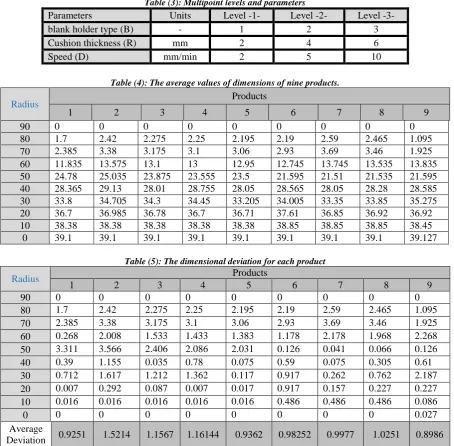
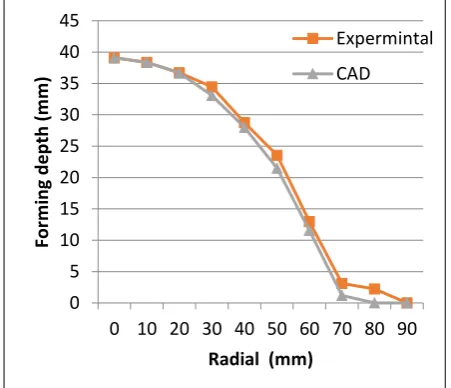
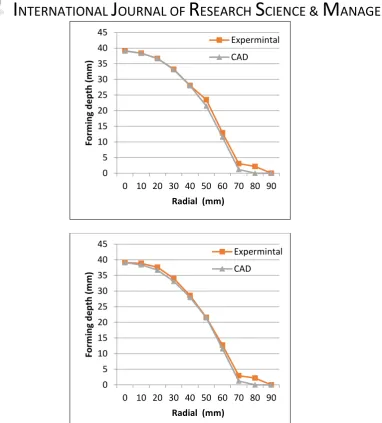
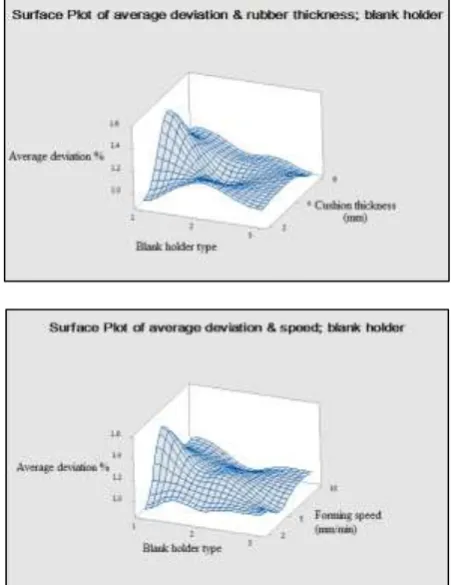
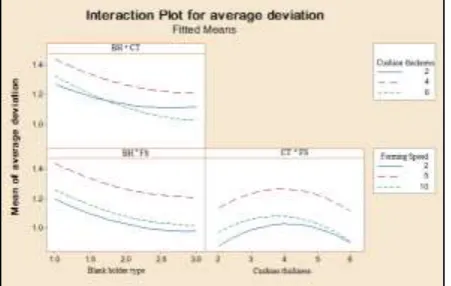
The powerful tool for improving the productivity is Taguchi method that has been extensively used during the research and development in the recent years with lower cost for producing good quality parts quickly. In this method, a special design of orthogonal arrays with a small number of experiments is employed. Taguchi method for (3) input factors with(3) levels was utilized for the applied experiments. To define the nine trial conditions, (6) degrees of freedom (dof) needed for this study and Taguchi’s (L9) orthogonal array were employed. The used levels and process parameters are given in table (3).Table (4) presents the results of testing nine products (nineteen samples for each one), whereas table (5) demonstrates the dimensional deviation for each sample. The average response and replicated twice values for each of the nine trials or process designs were used for this work. Table (6) depicts the present work and the average of dimensional deviation, and figures (6, 7 and8) clarify the relationship between experimental data and product design (CAD model) for nine products and the location of (nineteen samples).While figures (9 and 10) exhibit the relationship between process parameters and average deviations.
Table (3): Multipoint levels and parameters
Parameters Units Level -1- Level -2- Level -3-
blank holder type (B) - 1 2 3
Cushion thickness (R) mm 2 4 6
Speed (D) mm/min 2 5 10
Table (4): The average values of dimensions of nine products.
Radius Products
1 2 3 4 5 6 7 8 9
90 0 0 0 0 0 0 0 0 0
80 1.7 2.42 2.275 2.25 2.195 2.19 2.59 2.465 1.095
70 2.385 3.38 3.175 3.1 3.06 2.93 3.69 3.46 1.925
60 11.835 13.575 13.1 13 12.95 12.745 13.745 13.535 13.835
50 24.78 25.035 23.875 23.555 23.5 21.595 21.51 21.535 21.595
40 28.365 29.13 28.01 28.755 28.05 28.565 28.05 28.28 28.585
30 33.8 34.705 34.3 34.45 33.205 34.005 33.35 33.85 35.275
20 36.7 36.985 36.78 36.7 36.71 37.61 36.85 36.92 36.92
10 38.38 38.38 38.38 38.38 38.38 38.85 38.85 38.85 38.45
0 39.1 39.1 39.1 39.1 39.1 39.1 39.1 39.1 39.127
Table (5): The dimensional deviation for each product
Radius Products
1 2 3 4 5 6 7 8 9
90 0 0 0 0 0 0 0 0 0
80 1.7 2.42 2.275 2.25 2.195 2.19 2.59 2.465 1.095
70 2.385 3.38 3.175 3.1 3.06 2.93 3.69 3.46 1.925
60 0.268 2.008 1.533 1.433 1.383 1.178 2.178 1.968 2.268
50 3.311 3.566 2.406 2.086 2.031 0.126 0.041 0.066 0.126
40 0.39 1.155 0.035 0.78 0.075 0.59 0.075 0.305 0.61
30 0.712 1.617 1.212 1.362 0.117 0.917 0.262 0.762 2.187
20 0.007 0.292 0.087 0.007 0.017 0.917 0.157 0.227 0.227
10 0.016 0.016 0.016 0.016 0.016 0.486 0.486 0.486 0.086
0 0 0 0 0 0 0 0 0 0.027
Average
Deviation 0.9251 1.5214 1.1567 1.16144 0.9362 0.98252 0.9977 1.0251 0.8986
[Abbas * et al., 6(2): February, 2019]
ISSN: 2349-5197
Impact Factor: 3.765
I
NTERNATIONAL
J
OURNAL OF
R
ESEARCH
S
CIENCE &
M
ANAGEMENT
“Table (6):Methodology of Taguchi’s (L9) orthogonal array and response value“
Process Parameters
Exp. No. Blank holder type Cushion thickness Speed Average deviation
1 1 1 1 0.9251
2 1 2 2 1.5214
3 1 3 3 1.1567
4 2 1 2 1.16144
5 2 2 3 0.9362
6 2 3 1 0.98252
7 3 1 3 0.9977
8 3 2 1 1.0251
9 3 3 2 0.8986
0 5 10 15 20 25 30 35 40 45
0 10 20 30 40 50 60 70 80 90
Fo rm in g d e p th (m m )
Radial (mm)
Expermintal CAD 0 5 10 15 20 25 30 35 40 45
0 10 20 30 40 50 60 70 80 90
Fo rm in g d e p th (m m )
Radial (mm)
Expermintal
[Abbas * et al., 6(2): February, 2019]
ISSN: 2349-5197
Impact Factor: 3.765
I
NTERNATIONAL
J
OURNAL OF
R
ESEARCH
S
CIENCE &
M
ANAGEMENT
Fig. (6):Dimensional accuracy of radial displacement using blank holder (1) with different cushion thicknesses (2,4 and6)
0 5 10 15 20 25 30 35 40 45
0 10 20 30 40 50 60 70 80 90
Fo
rm
in
g d
e
p
th
(m
m
)
Radial (mm)
Expermintal
CAD
0 5 10 15 20 25 30 35 40 45
0 10 20 30 40 50 60 70 80 90
Fo
rm
in
g d
e
p
th
(m
m
)
Radial (mm)
Expermintal
[Abbas * et al., 6(2): February, 2019]
ISSN: 2349-5197
Impact Factor: 3.765
I
NTERNATIONAL
J
OURNAL OF
R
ESEARCH
S
CIENCE &
M
ANAGEMENT
Fig. (7):Dimensional accuracy of radial displacement using blank holder (2) with different cushion thicknesses (2,4 and6)
0 5 10 15 20 25 30 35 40 45
0 10 20 30 40 50 60 70 80 90
Fo
rm
in
g d
e
p
th
(m
m
)
Radial (mm)
Expermintal
CAD
0 5 10 15 20 25 30 35 40 45
0 10 20 30 40 50 60 70 80 90
Fo
rm
in
g d
e
p
th
(m
m
)
Radial (mm)
Expermintal
[Abbas * et al., 6(2): February, 2019]
ISSN: 2349-5197
Impact Factor: 3.765
I
NTERNATIONAL
J
OURNAL OF
R
ESEARCH
S
CIENCE &
M
ANAGEMENT
0 5 10 15 20 25 30 35 40 45
0 10 20 30 40 50 60 70 80 90
Fo
rm
in
g d
e
p
th
(m
m
)
Radial (mm)
Expermintal
CAD
0 5 10 15 20 25 30 35 40 45
0 10 20 30 40 50 60 70 80 90
Fo
rm
in
g d
e
p
th
(m
m
)
Radial (mm)
Expermintal
[Abbas * et al., 6(2): February, 2019]
ISSN: 2349-5197
Impact Factor: 3.765
I
NTERNATIONAL
J
OURNAL OF
R
ESEARCH
S
CIENCE &
M
ANAGEMENT
Fig. (8):Dimensional accuracy of radial displacement using blank holder (3) with different cushion thicknesses (2,4 and6)
0 5 10 15 20 25 30 35 40 45
0 10 20 30 40 50 60 70 80 90
Fo
rm
in
g d
e
p
th
(m
m
)
Radial (mm)
Expermintal
[Abbas * et al., 6(2): February, 2019]
ISSN: 2349-5197
Impact Factor: 3.765
I
NTERNATIONAL
J
OURNAL OF
R
ESEARCH
S
CIENCE &
M
ANAGEMENT
Fig. (9):The relationship between process parameters and average deviations.
Fig. (10):The relationship between each process parameter and the mean average deviation.
3.3 Prediction of forming process parameters
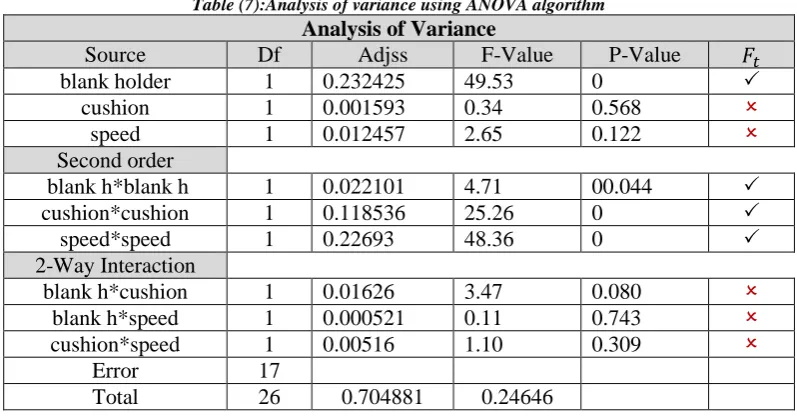
Taguchi’s algorithm has been used to predict the influence of input parameters on the response value, estimate the equation that contributes between each forming parameter and the average response value in second order,as illustrated in equation (1), and to optimize the present work from the given data (blank holder (BH), cushion thickness (CT) and forming speed (FS)) with respect to the dimensional deviation. Table (5) lists the final prediction value using Taguchi’s algorithm, while table (7) present the analysis of variance using ANOVA algorithm.
Average deviation = 0.455 - 0.274 BH + 0.3286 CT + 0.1773FS + 0.0607 BH2- 0.03514 CT2 - 0.01310 FS2-
0.01841 BH*CT - 0.00163 BH*FS- 0.00257 CT*FS …..(1) Level of confidence (F-value) =95% =0.95
Level of significance (P-value) =5% = 0.05
1- P-value
P < 0.05 → Significant P > 0.05 → Non- Significant
2- Fisher value (F-value)
F > FT (from table) Critical tabulated FT=4.4513
Percent of contribution % = 𝐴𝑑𝑗 𝑠𝑠
𝑇𝑜𝑡𝑎𝑙 𝐴𝑑𝑗 𝑠𝑠∗ 100 % ….(2)
Percent of contribution %
[Abbas * et al., 6(2): February, 2019]
ISSN: 2349-5197
Impact Factor: 3.765
I
NTERNATIONAL
J
OURNAL OF
R
ESEARCH
S
CIENCE &
M
ANAGEMENT
Forming speed= 5.054%
Results and Discussion
Results of the present work represent the effect of various variables of forming parameters (blank holder (BH), cushion thickness (CT) and forming speed (FS)) with respect to the dimensional accuracy in forming parts of Brass (Cu Zn 65-35) using multi-point forming process. The results from the experimental work using ANOVA algorithm are indicated in Figures (9 and 10). The influence of two input parameters are represented in each curve; otherwise the parameter was kept constant.
The effect of blank holder on the dimensional accuracy at the different cushion thicknesses and forming speeds was found with respect to the range of forming parameters used at the cushion thickness (6mm), and the third type of blank holder gives the best dimensional accuracy, see figures (6 ,7 and 8). The final result was estimated, and the empirical model of each forming parameter with respect to the dimensional accuracy was obtained using Taguchi’s algorithm. The contribution of blank holder types, cushion thickness and forming speed with respect to the dimensional accuracy is (94.303, 0.645 and 5.054) %, respectively.
Table (7):Analysis of variance using ANOVA algorithm
Conclusions
The current research reviewed some important aspects related with surface quality in sheet metal forming with special emphasis on the brass alloy. Based on the results of this work on the surface quality in multi-point forming process using ANOVA algorithm, the following conclusions can be drawn:
1. In multi-point forming process, the process parameters (blank holder types, cushion thickness and forming speed) are the main factors that effect on the dimensional accuracy.
2. The results of ANOVA Algorithm and the effectiveness experiments confirm that the developed empirical models for the output responses provide the predicted values and show an excellent fit of these response factors that are close to the experimental values, at (95%) confidence level.
3. The blank holder type (2) gave the minimum dimensional deviation up to (94.303%).
4. The low forming speed gave the low dimensional deviation, because it gives enough time for the metal to reorganize the atoms and thus reduce the strength of the metal resistance to the forming force, and the effectiveness range is up to (5.054%).
5. The effect of cushion thickness on the dimensional accuracy was the lowest, and the effectiveness range is up to (0.645%).
Analysis of Variance
Source
Df
Adjss
F-Value
P-Value
𝐹
𝑡blank holder
1
0.232425
49.53
0
cushion
1
0.001593
0.34
0.568
speed
1
0.012457
2.65
0.122
Second order
blank h*blank h
1
0.022101
4.71
00.044
cushion*cushion
1
0.118536
25.26
0
speed*speed
1
0.22693
48.36
0
2-Way Interaction
blank h*cushion
1
0.01626
3.47
0.080
blank h*speed
1
0.000521
0.11
0.743
cushion*speed
1
0.00516
1.10
0.309
Error
17
[Abbas * et al., 6(2): February, 2019]
ISSN: 2349-5197
Impact Factor: 3.765
I
NTERNATIONAL
J
OURNAL OF
R
ESEARCH
S
CIENCE &
M
ANAGEMENT
Nomenclature
BH: Blank Holder. CT: Cushion Thickness. FS: Forming Speed.
References
[1] Zhong-Yi Cai, Ming-Zhe Li,and Xi-Di Chen, Digitized die forming system for sheet metal and springback minimizing technique, Int. J. Adv. Manuf. Technol., (2006) 28: 1089-1096.
[2] Mingzhe Li, Yuhong Liu, Shizong Su, and Guandgquan Li, Multi-point forming a flexible manufacturing method for a 3-d surface sheet, Journal of Materials Processing Technology, 87 (1999): 277-280. [3] Cai Zhongyi, and Li Mingzhe, Optimum path forming technique for sheet metal and its realization in
multi-point forming, Journal of Materials Processing Technology, 110 (2001): 136-141.
[4] Tan Foxing, Li Mingzhe, Cai Zhongyi,and Li Xiangji, Formability analysis on the process of multi-point formin for titanium alloy retiary sheet,Int. J. Adv. Manuf. Tecbnol., (2009) 41:1059-1065.
[5] Wei Liu, Yu-Yong Yang and Ming-Zhe Li, Numerical simulation of multi-point stretch forming and controlling on accuracy of formed workpiece, Int J Adv Manuf Technol (2010) 50:61–66.
[6] A. A. Tolipov, A. Elghawail, M. Abosaf, S. Shushing, D. Pham and K.Essa, Experimental research and numerical optimisation of multi-point sheet metal forming implementation using a solid elastic cushion system, Conference Paper, Department of Mechanical Engineering, School of Engineering, University of Birmingham, UK, July 2017.
[7] Babak Beglarzadeh, An experimental and numerical study of forming parameters affection on multi-point deep drawing process, International Journal of Advanced and Applied Sciences, 4(1) (2017): 90-95. [8] Tahseen Fadhel Abaas, Karem Mohsen Younis and Khalida Kadhim Mansor, Die Design of Flexible
![Fig. (1): Schematic diagram of MPF with blank-holder.[4]](https://thumb-us.123doks.com/thumbv2/123dok_us/8457888.1707449/2.595.110.486.136.397/fig-schematic-diagram-of-mpf-with-blank-holder.webp)