Mahesh et al. World Journal of Engineering Research and Technology
PERFORMANCE ANALYSIS OF HORIZONTAL HANDOFF IN Wi-Fi
AND WIMAX WIRELESS NETWORKS
Mahesh Chandra Bhatt,*1 Naval Kishor Chaudhary2 and Darshan Sati3
1
Department of Computer Science & Engineering Bipin Tripathi Kumaon Institute of
Technology Dwarahat Almora 263653, Uttarakhand India.
2
Department of Electronics & Communication Engineering Bipin Tripathi Kumaon Institute
of Technology Dwarahat Almora 263653, Uttarakhand India.
3
Department of Electronics & Communication Engineering Bipin Tripathi Kumaon Institute
of Technology Dwarahat Almora 263653, Uttarakhand India.
Article Received on 05/03/2016 Article Revised on 25/03/2016 Article Accepted on 14/04/2016
ABSTRACT
In this paper we investigate the performance of horizontal handoff
within Wi-Fi (Wireless Fidelity) WiMAX (Worldwide Interoperability
for Microwave Access). For this first we create the Wi-Fi and
WiMAX wireless networks using ns2 (Network Simulator-2). The
Traffic type is considered as CBR (Constant Bit Rate), modulation for
Wi-Fi is QPSK and for WiMAX is 16QAM. The performance of
horizontal handoff is measure in term of packet received by receiver,
packet loss and the average throughput. The numerical and graphical illustration is carried out
for better understand of the result.
KEYWORDS: Wireless Network, Wi-Fi, WiMAX, Horizontal Handoff, NS-2.
I. INTRODUCTION
Wireless network technology has gained the popularity due to its ability to provide the
ubiquitous information access to the users on the move. In wireless networks mobile users
are connected to the best available networks that are best fit according to their service
requirement. Efficient mobility management is required to support mobility across the access
networks, where the handoff is main element of mobility management. Handoff maintains
World Journal of Engineering Research and Technology
WJERT
www.wjert.org
SJIF Impact Factor: 3.419the link between the mobile terminals with base station. Handoff is a function that transmits
signal between the same type and different type of networks. At the time of handoff the
communication may be interrupted between the mobile terminals due to high packet loss.[1]
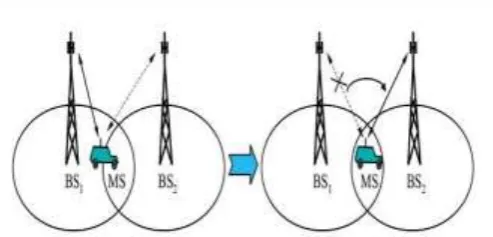
The transformation of a going session from one cell to another cell in the same type of
networks called horizontal handoff. Horizontal handoff is between Base Stations (BS),
Access Points (AP) which uses the same radio access technology, called intra-technology
handover.[2]
A mobile node moves with the single network technology from one access point to another
access point in a horizontal handoff. A horizontal handoff is traditional technology. Another
handoff is vertical handoff. Vertical handoff occurs in different type of networks. When a
mobile user is moving from GSM (Global System for Mobile Communications) based
network to the UMTS (Universal Mobile Telecommunications System), based network here
the access technologies are changed so the handoff in this case is vertical handoff.
Figure 1: Horizontal and Vertical Handoff.
The hard handoff is used when the communication channel is released first and after the
releasing the new channel is acquired. For users it means a short disconnection or halt of
communication. Hard handoff is used by the systems which use TDMA (Time Division
Multiple access) and FDMA (Frequency Division Multiple Access) such as GSM and
GPRS (General Packet Radio Service).
The soft handoff is different from hard handoff, soft handoff establishes multiple connections
with neighboring cells. Soft handoff is used by the CDMA (Code Division Multiple
Access) systems where the cells use some frequency band using different code words.
In vertical handoff first MN (mobile node) should search and a new available wireless
network or receive the service advertisements which are broadcasted by different wireless
technologies.[3]
II. SIMULATION
A. Simulation Set-up for Horizontal Handoff In Wi-Fi
The simulation is carried out using ns-2 the version is ns-2.35. The operating system is used
Ubuntu 12.04 LTS.[4] To illustrate the performance we have configured Wi-Fi networks for
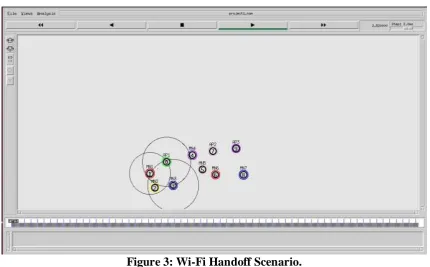
simulation. In our simulation Wi-Fi networks have three access points (AP) and seven mobile
nodes (MN). The AP1, AP2, AP3 are the three access points and MN1, MN2, MN3, MN4,
MN5, MN6, MN7 are the seven mobile nodes. The MN1, MN2, MN3 are connected to
AP1, the MN4, MN5, MN6 are connected to AP2 and MN7 connected to AP3.
Figure 3: Wi-Fi Handoff Scenario.
The transfer of data is done between the MN3 and MN1 by using the CBR traffic type. The
MN3 moves from AP1 to AP2.
First MN3 sends the packets to MN1 by the AP1. When the MN3 starts moving away from
the range of AP1 and at a particular point MN3 out from the range of AP1 at that point
Table 1: Simulation Parameters for Wi-Fi.
Parameters IEEE 802.11
Modulation QPSK
Area 1200 x 1200m
Network Wireless Network
Nodes 10(3-APs,7-Mobile Nodes)
Node Speed 2m/s,4m/s,6m/s
Simulation Time 600s,300s,200s
Traffic Type CBR
Packets to Send 300
Bit Rate 32kbps,64kbps,128kbps
B. Simulation Set-up for Horizontal Handoff In WiMAX
The National Institute of Standards and Technology (NIST) designed a NIST-mobility patch
that are already includes the WiMAX modules. These modules are used to define the
characteristics for simulating its interface.[5]
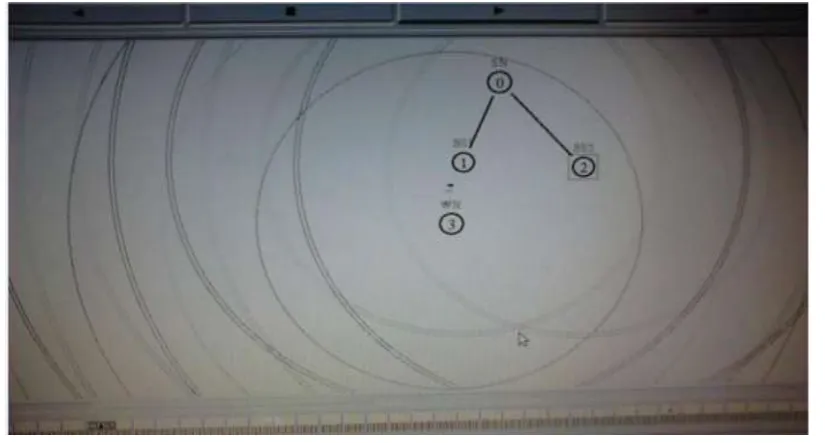
In our simulation WiMAX networks have two base stations (BS), one sink and one mobile
node. The transfer of data is done between the mobile node (WN) and the sink node (SN)
by using CBR traffic. The sink node connected to the both base stations. The mobile node
sends the packets to sink node by BS1. When the mobile node (WN) start moving from the
range of BS1 to BS2 at the particular point handoff occurs and after the handoff mobile node
sends the packets to sink node by BS2.
Table 2: Simulation Parameters for Wimax.
Parameters IEEE 802.16
Modulation 16QAM
Area 670 x 670m
Network Wireless Network
Nodes 4(2-BS,1-Mobile Node,1-SinkNode)
BS Radius 20m
Node Speed 1m/s,3m/s,4m/s Simulation Time 70s,60s,50s Simulation Time 70s,60s,50s
Traffic Type CBR
Packets to Send 300 Packets to Send 300
Bit Rate 256kbps, 512kbps
C. Packet dropped for horizontal handoff in Wi-Fi Networks
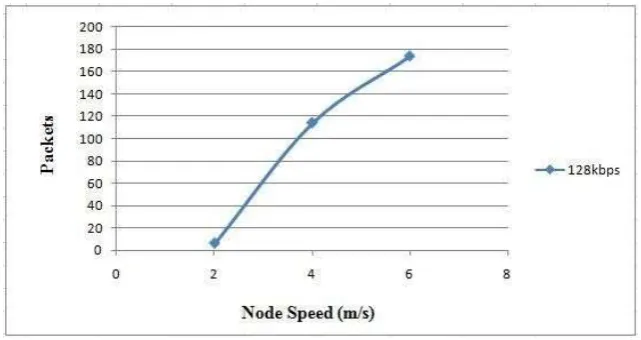
In our simulation, packet drops are calculated versus different speed of the mobile node. The
data rate is 128kbps and the simulation time is 300s. The graph defines that when the speed
of mobile node increases the packet drop also increases.
Figure 6: Packet Dropped (128kbps).
RESULT ANALYSIS
A. Average throughput for horizontal handoff in Wi-Fi
Networks
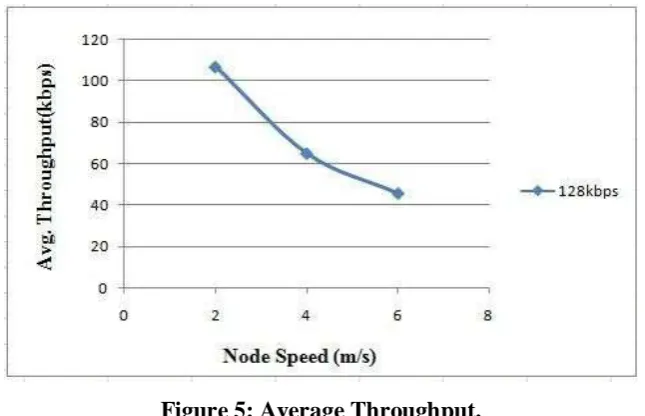
Throughput is the average rate of successful message delivery over a communication
channel. The throughput is usually measured in terms of kbps. The graph of average
Figure 5: Average Throughput.
Fig. 5 defines the average throughput, the data rate is 128 kbps and the simulation time is
300s. The graphs defines that the when the speed of mobile node increases then the
average throughput decreases.
B. Packet received for horizontal handoff in WiMAX Networks.
Figure 7: Packets received by the receiver.
Fig. 7 shows that the packet received by the receiver side (sink node). Graph clearly indicates
that for low speed and low data rate the handoff takes place smoothly and the packet
received by the receiver is too high. But as the speed increases the number of packets
decreases at receiver side. For 1mbps speed the number of packets received by receiver is
around 300. At speed of 4mbps the number of packets received by receiver is 26. The
Packet drop for horizontal handoff in WiMAX Networks.
Figure8. Packet Dropped (512kbps)
Fig. 8 shows that the packet dropped at the horizontal handoff in the WiMAX networks. The
graph indicates that the packet drop increase with the speed of the node.
CONCLUSION
Performance analysis of horizontal handoff within Wi-Fi and WiMAX is done by ns-2. In
this paper we studied the behavior of the node with different –different speeds at different
data rates. We investigated that how the horizontal handoff occur in Wi-Fi and WiMax
networks. During the time of handoff it is defined by the graphs how handoff affects different
parameters in networks.
For the simulation of handoff in Wi-Fi and WiMAX we used simulator ns-2. The versions of
ns-2 we used are ns2.35 and ns2.29. Simulator ns-2 is the valuable tool for simulation of
networks.
REFERENCES
1. Sahana Bhosale and R.D Daruwala, ―Experimental Analysis of Horizontal and Vertical
Handovers in Wireless Access Networks using NS2,‖ World Congress on Information
and Communication Technologies, Aug 2011; pp.126.
2. Iyad Alkhayat, ―End-to-End Mobility Solution for Vertical Handoff between
Heterogeneous Wireless Networks,‖ IEEE/ACS International Conf. on Computer
3. L. Nithyanandan and I. Parthiban, ―Vertical Handoff in WLAN-WiMAX-LTE
Heterogeneous Networks through Gateway Relocation,‖ International J. of Wireless &
Mobile Networks, Aug 2012; 4: 4.
4. ―The network simulator tool,‖ ns-2, http://nsnam.isi.edu/nsnam/.
5. ―The Network Simulator NS-2 NIST add-on—IEEE 802.21 model (based on IEEE
P802.21/D03.00),‖ National Institute of Standards and Technology (NIST), January 2007.
6. Sewon Jung and Chaewoo Lee, ―Wireless LAN Handoff Module Implementation to
OPNET Simulator and Handoff Performance Analysis,‖ 6th International Conf. on
Commun. (ICC), June 2009: pp. 151-156.
7. Bhaskar Ashoka, David Eyers and Zhiyi Huang, ―Handover Delay in Mobile WiMAX: A
Simulation Study,‖ 12th International Conf. on Parallel and Distributed Computing,
Applications and Tech., Oct 2011: pp. 305-312,
8. K. O. Nithya, ―Packet Loss Rate Optimization in Heterogeneous Wireless Networks using
Channel Scanning Technique,‖ International Journal of Engineering Research &
Technology (IJERT), April-2015; 4: 04.
9. IEEE 802.16E-2006, IEEE Standard for Local and Metropolitan Area Networks, Part 16:
Air Interface for Fixed Broadband Wireless Access Systems, Amendment for Physical