Professor, FFS&FE,Georg-August-U.of G., G¨ottingen, Germany. Ph./FAX: +49[0]551 39-3471/9787 2Scientist,3Professor, Department of Forest Management, Beijing Forestry University, China
Abstract.Approximately 3000 million ha of the world’s forests have been classified as productive, and
are subject to some kind of management. Considering their environmental and social importance, the managed forest ecosystems are not receiving as much scientific attention as the few remaining unmanaged ones. This is especially true in the growing urban landscapes where managed forest ecosystem provide a range of important services. Most societies today demand integrated and wide-ranging approaches to forest management that address social, ecological, and economic goals. These demands can be met if simplistic philosophies and unverified doctrines are replaced by new paradigms that require a wider understanding of social demands and natural system dynamics. In theory, involving science directly in the management of a wooded ecosystem appears to be logical, but the practical implementation of this idea is not a trivial task. This paper presents a theoretical framework for the science-based management of a forested landscape that includes three key elements: forest design, research and demonstration and harvest event analysis. This framework is introduced, explained by means of examples, and supported by concrete evidence. The paper is based on an updated version of Gadow (2005) (Gadow 2005. Science-based forest design and analysis. P. 1-19 in Proc. FORCOM 2004. Japan Society of Forest Planning Press. Utsonomiya University), and it is not intended as a manifest, but as a contribution to a much-needed discussion about forest management as a scientific discipline.
Keywords:survival, growth and yield, relative spacing, self-thinning
1
Introduction
Forests are estimated to cover almost 30 percent of the continental surface area of the world. They rep-resent a remnant wilderness of high recreational value in densely populated societies, a threatened natural re-source in some regions and a renewable reservoir of es-sential raw materials for the wood processing industry. An area of approximately 3000 million ha, or 23 percent of the continental surface area, has been classified as pro-ductive forest (Solberg, 1996). Most of this area is man-aged under some type of rotation forest management system. Continuous cover forest management systems, which are characterized by selective harvesting, uneven-aged structures and the use of natural regeneration, are most frequently found in densely populated industrial-ized regions where forests represent a last wilderness, that is not only used commercially, but also for outdoor recreation and other non-commercial purposes.
During the past 200 years, the scientific discipline known as forest management has developed a rich as-sortment of methods for ensuring the sustainable use of
the forest resources. Technical developments and greater complexity of decision-making have resulted in an in-creasing number of disciplines joining the forestry teach-ing and research institutions, such as forest genetics, for-est biometrics, forfor-est climatology or forfor-est policy. The result was a remarkable expansion of the research and teaching activities of the forestry faculties during the second half of the 20th century. More recently, however, several of the basic sciences (e.g. genetics, mathemati-cal statistics, physics, chemistry, politimathemati-cal science) have also become involved in forest research. The outcome of these developments is increased specialisation, which has generated many new insights. These very positive developments have often taken the limelight. However, there are also negative effects, including fragmentation of research and loss of a common focus, and a blurred image of forestry as a scientific discipline. Thus, it is important that these challenges are addressed. There is a need for new theoretical concepts that can facilitate and guide the development of coherent approaches in forest research. In view of the enormous practical con-sequences of forest management, we propose that such
Copyright c2009 Publisher of the International Journal ofMathematical and Computational Forestry & Natural-Resource Sciences
a theory should cover three aspects:
a) forest design, which refers to the development of a coordinated, spatially explicit design of future forest development;
b) research and demonstration, which involves the establishment and analysis of field experiments and the additional use of such experiments in demon-strating the effects of particular treatments to an interested public;
c) harvest event analysis, which deals with the pre-emptive analysis of harvest events and their ex-pected effects.
Because of the long-term consequences of harvest-related modifications of forest ecosystems, we propose that this framework represents a comprehensive ap-proach to sustainable forest management. The three components are complementary and can facilitate the direct involvement of the different scientific disciplines in the design and daily management of a natural resource, such as a forest ecosystem. The ultimate objective of forest research is to generate information that is useful for management. An important objective of forest man-agement, on the other hand, is to utilize all research information that is useful. These two objectives are not always easy to match in a scientific environment that rewards highly specialized investigation.
As the name implies, the purpose of the research and demonstration concept is to gather empirical observa-tions about the resource and at the same time to present useful information to an interested public. Most of the long-term field experiments designed and managed by forest scientists are available for demonstrating the ef-fects of specific silvicultural treatments to an interested public.
A harvest event involves a dramatic modification of forest structure and forest value that cannot be re-scinded. Forest density is reduced with associated effects on the microclimate, the ground vegetation and nutrient cycles. Harvest event analysis provides good opportuni-ties for research and teaching by linking the disciplines in a coherent analysis. Evidence of such opportunities was provided in a teaching module entitled “Analysing a Harvest Event,” which has been part of the undergrad-uate curriculum at the University of G¨ottingen in Ger-many for a number of years. Harvest event analysis is also useful for management by improving transparency and enhancing professional credibility. Evidence of its usefulness was provided by a particular management sys-tem practiced in South African timber plantations.
It is often postulated that forest management should be sustainable, be based on validated research results,
conform to acceptable environmental standards, and be transparent to the public. This contribution presents a proposal of how these objectives can be achieved, using the potential of forest design, research and demonstra-tion and harvest event analysis.
2
Forest Design
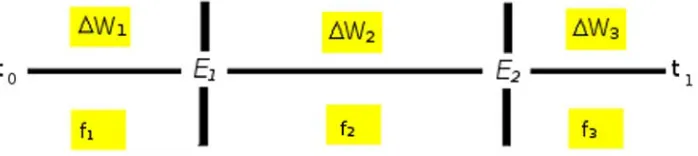
A forested landscape typically consists of geograph-ical units that are known as stands or compartments. Each stand may follow a variety of management paths through time. A management path is a unique succes-sion of growth periods, interrupted by harvest events and unexpected environmental hazards. Accordingly, at least three processes have to be considered when simu-lating a management path for the time period t0 .. t1 (Fig. 1): the harvest events (Ei) at time i, the natural growth (ΔWj) and unplanned hazards (rj) in response to the events during the period j.
A harvest event is the only component of forest devel-opment that can be controlled, and the effects of specific harvest events can be evaluated within a medium- or longterm context. Each is a part of a chain of activities (Kramer, 1988, p. 186) and the analysis of forest man-agement paths is therefore an important task of forest research. Growth and hazard models are needed to sim-ulate a management path for any arbitrary initial state. But equally essential are quantitative models of future harvest events, which describe the effect of a thinning on forest value and structure.
2.1 Estimating Tree Growth. Scientists involved in the study of forest growth are engaged in develop-ing practical forecastdevelop-ing tools, proposdevelop-ing concepts for effective data gathering, and recognizing fundamental principles of forest dynamics. A growth model implies some generalisation, based on a synthesis of specific case studies. Sometimes, this allows a better under-standing of complex interactions between specific popu-lation structures and change processes in an ecosystem. Growth models provide an essential scientific basis for the medium- and long-term planning of forest develop-ment. They may be developed for different needs and classified according to the level of resolution. The fol-lowing simplified classification is sometimes used in the literature:
a) Whole stand models are used to describe the devel-opment of a population of trees in reaction to spe-cific treatments and site conditions. A Whole Stand Model provides information about means (such as the dominant stand height) and area-based vari-ables (basal area or stem number per ha)1.
Figure 1: Schematic representation of a particular management path during the time window t0 .. t1. An arbitrary path is characterized by harvest events (Ei) at time i, and by natural growth (ΔWj) and unplanned hazards (rj) in response to, and between, these events.
b) Representative tree models provide a somewhat finer level of resolution. Trees with similar at-tributes are grouped and treated as one tree, the Representative Tree. These models are applicable when distributions of tree attributes, such as diam-eters, are available2.
c) Individual tree models represent an even finer level of resolution. They describe the growth of a spe-cific tree, usually in response to its competitive sta-tus. The competition effect may be described with distance-dependent or distance-independent meth-ods3.
The density-dependent whole stand models are re-sponsive to changes in site and forest density. The accu-racy of projections can be easily evaluated and the spec-ification of different types of harvest events is a simple matter. A density-dependent whole stand model thus combines the advantages of a yield table with those of a high-resolution model. However, its use so far has been limited to monocultures. Multispecies forests require representative tree models or individual tree models. In addition, gap simulators are evolving as a useful mod-eling tool. An exhaustive description of growth models would distract from the focus of this paper. An excel-lent review of growth modeling is provided by Ritchie (1999). A widely used, spatially explicit, growth model-ing system, which can be used to examine different for-est management scenarios, is “OPTIONS”. This system is applied in Canada and various regions in the United
and Gadow (1993); Hui (1997); Gurjanov et al. (2000); S´ anchez-Orois et al. (2001); Vilˇcko et al. (2003); Cieszewski (2002 ; 2003) ; Corral et al. (2004).
2Examples of representative tree models are given by Gadow (1984); Forss et al. (1996); Westphal (1997); Hessenm¨oller et al. (2001); Schr¨oder et al. (2002); Trincado et al. (2003); Sanchez-Orois et al. (2003); Temesgen and Gadow (2004).
3Examples of individual tree growth models are presented by Sterba (1990); Kramer (1994); St¨uber (1996); Sch¨ubeler (1997); Lee and Gadow, (1997); Schr¨oder and Gadow (1999); Schmidt (2001); Pretzsch (2001); Hessenm¨oller (2002); Hessenm¨oller and Elsenhans (2002); Tewari and Gadow (2008); Van Laar et al. (2003); Lee et al. (2004); Albert (2004).
States by the forest industry and local governments (see Cieszewski et al., 2004a,b; Low et al., 2003; Liu et al., 2009; Mang et al., 2009)
2.2 Estimating Potential Hazards. In ancient times, those who brought bad news often ran the risk of losing their head. This fear seems to exist to the present day. According to Bungartz (2004) companies are usually not very devoted to analysing potential haz-ards and risks. Due to the long production periods, and the great variety of biological, economic and technical hazards that can influence forest development, the anal-ysis of uncertainty and risk is an important task of forest management. This may appear to be logical, but prac-tical applications of risk analysis are surprisingly rare when compared, for example, to studies of forest growth. According to the United Nations Department of Hu-manitarian Affairs (1992), risk is defined as the expected loss due to a particular hazard for a given area and ref-erence period. An expected loss may be calculated as a product of the damage and its probability. Example: The probability of a spruce tree being damaged by wind increases with increasing tree size (Thomasius, 1988). The damage itself (in monetary terms) is the result of an increase in the harvesting costs and a decrease in the log price (Waldherr, 1997). Thus, a potential haz-ard presents a risk if it occurs with a probability greater than zero and if its occurrence will cause damage to a valuable object (Yoshimoto, 2001).
young forests. In forestry, contrasting with agriculture, short-term modifications of production systems are not possible (Lindner, 2000). This has been demonstrated by Reed and Errico (1985, 1986) who evaluate the long-run effects of a fire hazard on long-long-run timber yields and optimal harvest scheduling.
2.3 Modeling Future Harvest Events. Growth
models estimate the development of a forest stand be-tween harvest events. Harvest event models are needed to translate forestry language (e.g. low thinning, group selection) into spatially explicit removal algorithms. These algorithms mimic the expected modification of forest structure, which is compatible with the words that are used to describe a particular harvest event (Albert, 1999; 2002 (153-161)). They are very important ele-ments of simulators, which are used to generate alterna-tive forest management paths4.
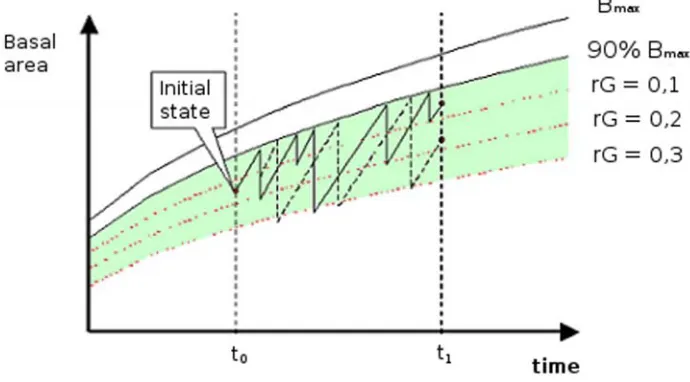
Theoretically, the number of possible paths for a par-ticular stand may be very high. For example, if we as-sume that only two options, thinning or no thinning, are possible in each one ofnyears, then the number of paths within a time window of n years is equal to 2n. Hin-richs (2006) used a method for generating paths, which is based on the maximum density of a forest (Bmax). A harvest event takes place when the maximum density Bmax or a relative density like 90 percent of Bmax is reached (Fig. 2).
At the start of the simulation and after each growth period, the simulated density is compared with the maximum permissible density. The number of harvest events, the maximum allowable density during a particu-lar growth period, and the thinning weights may be pre-scribed. Assuming a constant thinning type, the number of possible paths is equal to:
maxDF i=minDF
n(rG)·n(%Bmax)i (1)
where: minDF is minimum number of thinnings; maxDF is maximum number of thinnings; n(rG) is the number of thinning weights; and n(%Bmax) is number of maximum densities.
A path is only accepted if it remains within the al-lowed management space for the entire duration of the time window. Because of practical constraints, the num-ber of paths is usually much less than implied by eq. (1).
2.4 Forest Design. The design of a forested land-scape is an active process, which evaluates the spatially
4Examples of studies in connection with harvest event mod-els were presented by Zucchini and Gadow (1995); F¨uldner et al. (1996); Hui (1997); Daume et al. (1998); Gadow and Hui (1998); Staupendahl (1998); Albert (1999); Hessenm¨oller (2002); Albert (2002).
explicit effects of human activities on future develop-ments. An accepted theoretical basis for any arbitrary landscape is the Multiple Path Model, which assumes that a forested region is made up of spatial units known as stands. The task of designing the development of the landscape is simply to find the optimum combination of management paths in the different stands. Among the often-great number of possible forest designs, we select the one that maximizes some utility.
It is possible to compare the different combinations of stand paths and to identify the most desirable one. This concept is easy to understand. It also provides an excel-lent basis for incorporating knowledge from various sci-entific disciplines. The goal is to maximize or minimize an objective functionZ=cx, subject to constraints of the form Vx = b, where x is a vector of stand areas following a particular development path,cis a vector of utilities associated with the paths,V is a coefficient ma-trix andbis a vector of constants representing available inputs or required outputs. The structure is sufficiently general to allow a great variety of specifications, includ-ing particular spatial objectives for specific time periods. This is an active field of research pursued by a number of scientists. A useful overview of forest-level manage-ment planning in North America during the period 1950-2001 is provided by Bettinger and Chung (2004). Many methodological details have been published5.
Two successful examples of systems that have been used for many years to generate an optimum design of a forested landscape are MAX-MILLION (Clutter, 1968; Ware and Clutter, 1971) and MELA (Kilkki and Siito-nen, 1976; Siitonen et al., 1996; NuutiSiito-nen, 2000). The JLP algorithm in MELA (Lappi, 1992) uses the general-ized upper bound technique, which makes it possible to deal with very large forest areas of up to 50000 stands. MELA has become an important forest planning tool in Finland. It is used by forest companies as well as small forest owners (Redsven et al., 2004). MONSU is an-other spatially explicit planning system, which is based on Multiple Path theory (Pukkala, 2008). MONSU has been adapted to a variety of design situations in differ-ent countries. Specific growth and hazard models are introduced for a particular case study, but the general concept remains to be valid.
3
Research and Demonstration
Credible forest management is based on empirical re-search. The aim of the early field experiments, which were established during the 19th century, was to
Figure 2: The management space (the shaded area) is defined by the maximum allowed density (e.g. 90% ofBmax), the thinning weight (rG= proportion of basal area removed) and the length of the time window (t0 , t1).
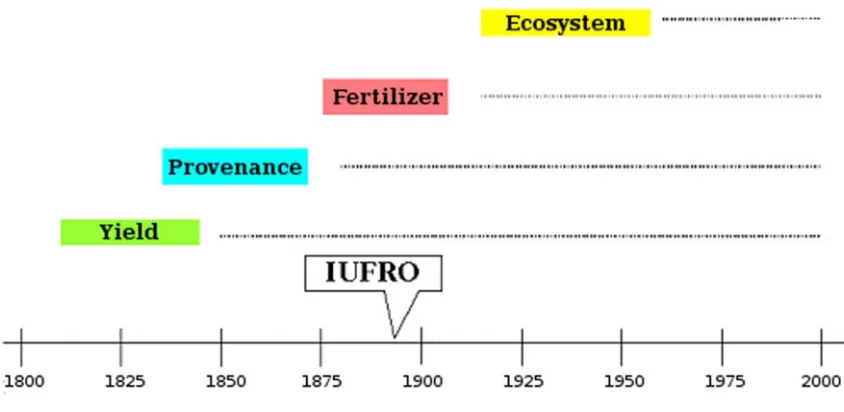
sure timber yields on different growing sites in response to specific thinning treatments. Some of these exper-iments have been re-measured for over a century, pro-viding valuable information on long-term developments (Fig. 3). The information to be gathered in forest ex-periments has to be weighed against the estimated cost of collecting it. Available resources are limited and time is also a major constraint.
The validity and effectiveness of an experiment is in-fluenced by its design and execution. Thus, attention to the planning of field experiments is important. The ultimate objective of forest research is to generate in-formation that is useful for management. An objective of forest management, on the other hand, is to utilize research information that is useful. These two objec-tives are not always easy to match in an increasingly fragmented scientific environment that rewards highly specialized investigation. A possible solution may be found in the establishment of a system of observational field trials, so-called Research and Demonstration Ar-eas. As the name implies, the purpose of a research and demonstration area is to gather empirical observations about the resource and at the same time to present the information to an interested audience.
According to N¨ollenheidt (2000) a Research and Demonstration Plot represents the core area (ranging in size between 0.1 and 1.0 ha) within a management demonstration stand. Roschak (1998) used a research and demonstration plot of 0.6 ha to provide detailed in-formation about the species and size distributions, the spatial structure and the changes caused by a harvest event. Assessments are not limited to one discipline.
Re-search and demonstration areas can be used to obtain comprehensive empirical data about forest development in response to specific treatments. Their size is often related to the operational areas required by forest man-agement. Large plots are more common, for example, in North America; small areas may be more suitable in Europe where forestry is practiced on a smaller scale.
4
Harvest Event Analysis
A harvest operation modifies the spatial structure, the species composition and the value of the standing crop. Forest density is reduced with associated effects on the microclimate, the ground vegetation, the genetic struc-ture and nutrient cycles. An analysis of a harvest event provides good opportunities for research and teaching by linking the disciplines. It is also useful for management by improving transparency and enhancing professional credibility. The modifications caused by a harvest event are abrupt and often drastic, and it has been observed that foresters, when given the same set of silvicultural instructions, are not always unanimous in their judg-ments when marking trees for removal (Zucchini and Gadow, 1995). This results in a great variation of pos-sible outcomes. Harvest event analysis is a method de-signed to monitor management activity. However, the concept requires that forest assessments coincide with harvest events. A practical approach involves an assess-ment after the trees have been marked for removal and before they are removed (Fig. 4).
un-Figure 3: Approximate beginning of different types of field studies during the past 150 years (after M˚arell and Leitgeb, 2004). The International Union of Forest Research Organisations (IUFRO) was established during the last decade of the 19th century, with the initial objective of improving the coordination of field experiments in Europe.
certain, and it is easier to put into practice the often-postulated Adaptive Management approach by imple-menting a harvest event analysis system.
The purpose of a harvest event analysis is to evalu-ate changes. A change from one stevalu-ate to another can be evaluated by measuring the differences between the two. This is not difficult, if only the diameter distributions are considered. To measure the proportion of distribu-tion X, which has to be changed to make it identical to distributionY, we only need to add up the absolute dif-ferences between the relative frequencies of distribution X andY, and divide the sum by 2. However, measuring the difference between two species distributions is not such a trivial problem. Gregorius et al. (2003) proposed to use:
Δ = min a,b
ˆ
s(a, b)·d(a, b) (2)
whered(a, b) is a suitable measure of the differences be-tween the attributes (e.g. tree species) aand b; s(a, b) is an arbitrary shift-transformation of the relative fre-quencies of attribute a in the populationX, such that the distributionX is equivalent toY; ˆs is the transfor-mation weighted with the difference between a and b, which transforms the distribution X at minimum cost into the distribution Y, a typical transportation prob-lem of linear programming. Consider an example with two stands, both featuring several tree species, which occur in different relative proportions. To make both stands identical in terms of their species distributions, we can try to obtain a measure of their distance. Unlike
in the diameter distribution example mentioned above, it is possible to transfer species from standito standjin several different ways. To obtain a unique solution, we need to apply an optimisation approach. The objective function, for example, could aim at minimizing the total distance between the two species distributionsiandj:
min→Z = m
i n
j
distanceij·Xij (3)
subject to n
j Xij ≤availablei
and m
Figure 4: A harvest event may be evaluated in terms of a change in forest density, forest structure and forest value. The diagram shows a hypothetical forest section, which may be modified by a harvest event in two different ways; different shadings represent different tree species; crossed trees are those marked for harvesting.
used to measure distances between tree species. An in-teresting source is P.F. Stevens’ website on the phyloge-netics of the angiosperms (version 9 of June 2008). The study by Li et al. (2004) is an example of an analysis that specifically deals with forest trees. By quantify-ing the n(n-1)/2 distances between n tree species, and assuming that the natural species distribution can be de-fined, it would be possible to evaluate a harvest event in terms of its potential to transform a given forest to one that is more natural, in terms of the species distribution after the harvest.
Harvest event analysis is a concept that has already been successfully applied on a large scale in commercial timber plantations where economic success depends on the timing and intensity of harvest operations (Gadow and Bredenkamp, 1992). Harvest event analysis has also been practiced in a multi-disciplinary teaching module at the University of G¨ottingen in Germany. Many dis-ciplines participate in this particular teaching module, which has been an important part of the curriculum for a number of years. Students mark the trees that will be harvested in a particular stand and then carry out detailed analyses of the effect of the removals on ge-netic structure and biodiversity, economics, radiation, soil compaction and nitrogen processes. This particu-lar module not only facilitates, but also enforces and strengthens the much-needed disciplinary interchange. Thus, the application of harvest event analysis has shown that it can be used as a new and effective platform for involving the basic sciences directly in the evaluation of forest management.
5
Conclusions
Considering their environmental and social impor-tance, it seems that the managed forest ecosystems are not receiving as much scientific attention as the few
re-maining unmanaged ones. This is especially true for the managed wooded areas within urban landscapes where forests represent a last remnant wilderness that is not only used commercially, but also for outdoor recreation and other important uses. Multiple uses on the same land (in contrast to spatial segregation of land use) is preferred in many densely populated societies that have a limited land base. These societies today demand inte-grated and wide-ranging approaches to forest manage-ment that address social, ecological, and economic goals (Gadow and Pukkala, 2008)6. In theory, to involve sci-ence directly in the management of wooded ecosystems appears to be logical, but the practical implementation of this idea is not a trivial task. A practical theoret-ical framework for the science-based management of a forested landscape includes three elements: forest de-sign, research and demonstration and harvest event anal-ysis.
An important task of the science of Forest Manage-ment is to recognize, describe and evaluate the great va-riety of possible forest developments. This means that all the potentially acceptable paths need to be generated for all the stands within a forested landscape. Compared with the main task of generating a set of feasible combi-nations of paths, the search for the optimum solution is a relatively easy problem. This problem can be solved us-ing a variety of efficient search algorithms. The Finnish MELA system and Pukkala’s MONSU system (Pukkala, 2008) are two examples of successful applications of the Multiple Path Theory.
A second important element of science-based forest management is the research and demonstration area. Research and demonstration areas may be used to gather
empirical observations about a variety of changes result-ing from forest management activities or natural pro-cesses. At the same time these areas can be used to demonstrate different types of silviculture in the field. The concept can be used to make accessible some of the wealth of information that is available within an increas-ingly specialized and fragmented scientific landscape.
The third element of science-based forest manage-ment involves an analysis of harvest events. A har-vest operation modifies the spatial structure, the species composition and the value of the standing crop. For-est density is reduced with associated effects on the microclimate, the ground vegetation and nutrient cy-cles. The modifications caused by a harvest event are abrupt and sometimes drastic. Harvest event analysis is not only interesting for scientists, but also useful for management by improving transparency and enhancing professional credibility. Evidence of its practicability was demonstrated by the large-scale application of thin-ning control in South African plantations. An analysis of a harvest event provides good opportunities for re-search and teaching by linking the disciplines, and evi-dence of its usefulness is provided in the project-based teaching module, “Analyse eines Forstlichen Eingriffs” at G¨ottingen University in Germany.
The appropriate design of a forested landscape re-quires ongoing empirical research to improve growth and hazard predictions for different climate scenarios. Re-search is also needed to model future harvest events. Three processes have to be considered when generating a path for a given time window: the harvest events, the natural growth and unplanned hazard events. Each forest stand within a wooded landscape offers a multi-tude of silvicultural treatment options that need to be evaluated using the experience of the different scientific disciplines. The selection of a particular management path depends on the relative importance of the different objectives and on the forest-wide constraints. Simplis-tic philosophies and unverified doctrines are increasingly replaced by new paradigms that require a wider under-standing of social demands and natural system dynam-ics. The allowable management space is not defined by idealistic silvicultural dogmas, but by the current poten-tial of a particular stand. In this sense, the traditional scientific discipline known as forest management can make a substantial contribution to the sustainable use of forest resources. The Multiple Path theory of forest de-sign is a logical extension of the traditional paradigms of age-class normality and longterm planning. Unlike ecosystem management, multiple path design has a clear structure: what to manage, where to manage, how to manage (Zeide, 2001). In many regions of the world, this theory may be readily implemented using effective tools that have been developed by forest scientists.
Acknowledgements
We are thankful for constructive comments received from Dr. Boris Zeide and two anonymous referees.
References
Albert, M. 1999. Analyse der eingriffsbedingten Struk-turver¨anderung und Durchforstungsmodellierung in Mischbest¨anden. Dissertation, Institut f¨ur Waldin-ventur und Waldwachstum, University G¨ottingen. Hainholz-Publishers, Vol. 6: 201 S.
Albert, M. 2002. Zur Prognose der Z-Baum-Auswahl in Mischbest¨anden - ein regelbasierter Algorithmus f¨ur waldbauliche Prognose- und Entscheidungsmodelle. Allgemeine Forst- und Jagdzeitung, 173 S.
Albert, M. 2004. Modifikationen des BAL-Konkurren-zindex zur Prognose des Durchmesserzuwachses in Mischbest¨anden. Annual meeting of the German growth and yield research group in Schl¨agl.
Bettinger, P., J. Sessions, and K. Boston. 1997. Using tabu search to schedule timber harvests subject to spatial wildlife goals for big game. Ecol. Modell. 94: 111-123.
Bettinger, P., and W. Chung. 2004. The key literature of, and trends in, forest-level management planning in North America, 1950-2001. The International Forestry Review. 6: 40-50.
Bettinger, P., and Y.H. Kim. 2008. Spatial opti-misation - computational methods. P. 107-136 in Designing Green Landscapes, Gadow, K.v and T Pukkala (Eds.). Vol. 15 of the book series ”Manag-ing Forest Ecosystems”, Spr”Manag-inger, Dordrecht.
Bradshaw, H.W., B.H. Holmquist, S.A Cowling, and M.T. Sykes. 2000. The effect of climate change on the distribution and management ofPicea abies
in Southern Scandinavia. Can. J. For. Res. 30: 1992-1998.
Bravo, F., V. LeMay, R. Jandl, and K. v. Gadow. 2008 (Eds.). Managing forest ecosystems - the challenges of climate change. Vol. 17 of the book series ”Man-aging Forest Ecosystems”, Springer, Dordrecht.
Bungartz, O. 2004. Eine Risikokultur schaffen. Frank-furter Allgemeine Zeitung v. 6. 9. S. 22.
model and scant subalpine fir data. For. Sci. 49(4): 539-554.
Cieszewski, C.J., K. Iles, R.C. Lowe, and M. Zasada. 2004a. Proof of concept for an approach to a finer resolution inventory. P. 67-74 in Proceedings of the 5th Annual Forest Inventory and Analysis Sympo-sium. McRoberts et al. (Eds). USDA For. Ser. Gen. Tech. Rep. WO-69. Washington, DC:
Cieszewski, C.J., M. Zasada, B.E. Borders, R.C. Lowe, J. Zawadzki, M.L. Clutter, and R.F. Daniels. 2004b.: Spatially explicit sustainability analysis of long-term fiber supply in Georgia, USA. For. Eco. Man. 187(2-3): 345–359.
Clutter, J.L. 1968. MAX-MILLION – a computerized forest management planning system. School of For-est Resources, Univ. of Georgia, Athens GA, USA.
Corral R.J., G. J. ´Alvarez, G.A. Ru´ız, and K. v. Gadow. 2004. Compatible height and site index models for five pine species in El Salto, Durango (Mexico). For. Eco. Man. 201: 145-160.
Daume, S., K. F¨uldner, and K. v. Gadow. 1998. Zur Modellierung personenspezifischer Durchforstungen in ungleichaltrigen Mischbest¨anden. Allgemeine Forst- und Jagdzeitung 169(2): 21-26.
Forss, E., K. v. Gadow, S. Saborowski. 1996. Growth models for unthinned Acacia mangium plantations in South Kalimantan, Indonesia. J. Trop. For. Sci. 8(4): 449-462.
F¨uldner, K., S. Sattler, W. Zucchini, and K. v. Gadow. 1996. Modellierung personen-abh¨angiger Auswahlwahrscheinlichkeiten bei der Durchforstung. Allgemeine Forst- und Jagdzeitung 167(8): 159-162.
Gadow, K. v., and B.V. Bredenkamp.1992. Forest Management. Academica Press, Pretoria.151 p.
Gadow, K. v., and G. Y. Hui, 1998. Modelling thin-nings in even-aged plantation forests. Plant Re-search and Development 47/48: 98-107.
Gadow, K. v. 1984. The relationship between diam-eter and diamdiam-eter increment in Pinus patula. In
Grey, D. C., Schonau, A. P. G., Schutz, C.J. and
analysis. P. 1-19 in Proc. FORCOM 2004. Japan Society of Forest Planning Press. Utsonomiya Uni-versity.
Gadow, K. v., and T. Pukkala. 2008 (Eds.). Designing green landscapes. Vol. 15 of the book series ”Man-aging Forest Ecosystems.” Springer Verlag, Dor-drecht. 301 p.
Garc´ıa, O. 1984. New class of growth models for even-aged stands: Pinus radiatain Golden Downs Forest. New Zealand J. For. Sci. 14: 65-88.
Garc´ıa, O. 1991. Linear programming and related ap-proaches in forest planning. New Zealand J. For. Sci. 20 (3): 307-331.
Gregorius, H.R., E. M. Gillet, and M. Ziehe, 2003. Measuring differences of trait distributions between populations. Biometrical Journal 45(8): 959-973.
Gurjanov, M., S. S´anchez-Orois, and J. Schr¨oder. 2000. Grundfl¨achenmodelle f¨ur gleichaltrige Ficht-enreinbest¨ande - Eine vergleichende Analyse. Cen-tralblatt f¨ur das gesamte Forstwesen. 117. Jahrgang. Heft 3/4, S.187-198.
Hessenm¨oller, D., and A.S. Elsenhans. 2002. Zur Sch¨atzung des Zuwachses bei Rotbuche (Fagus syl-vatica L.). Allgemeine Forst- und Jagdzeitung 173 J, (11/12): 216-222.
Hessenm¨oller, D. 2002. Modelle zur Wachstums-und Durchforstungssimulation im G¨ottinger Kalk-buchenwald. Dissertation, Institut f¨ur Waldinven-tur und Waldwachstum, University G¨ottingen. 134 S.
Hessenm¨oller, D., G. L¨udemann, J. Nagel, and K. v. Gadow, 2001. Untersuchungen zum potentiellen Wachstum der Douglasie in Nordwestdeutschland. Forst & Holz 56 (12): 366-369.
Hinrichs, L., 2006: Automatisierte Generierung von Behandlungspfaden f¨ur Mischbest¨ande. Allgemeine Forst- u. Jagdzeitung 177 (5): 77-85.
Hui, G. Y. 1997. Wuchsmodelle f¨ur die Baumart Cunninghamina lanceolata. Dissertation, Institut f¨ur Waldinventur und Waldwachstum, University G¨ottingen: 138 p.
Kilkki, P. and M. Siitonen. 1976. Principles of a forest information system. P. 154-163 in Proceedings of IUFRO XVI World Congress, Division IV.
Kramer, H. 1994. Untersuchungen ¨uber den Wachs-tumsgang von Einzelb¨aumen in ungleichalten Mis-chbest¨anden mit Hilfe der Stammanalyse. Forst und Holz 283-287.
Kramer, H. 1988. Waldwachstumslehre. Verlag Paul Parey, Hamburg und Berlin. 374 S.
Lappi, J. 1992. JLP: a linear programming package for management planning. The Finnish Forest Re-search Institute. ReRe-search Papers 414.
Lee, W.-K, K. v. Gadow, D.-J. Chung, and J.-L. Lee. 2004. Individual tree dbh-growth in Pinus densi-floraandQuercus variabilismixed stands in central Korea. Ecol. Modell. 176: 187-200.
Lee, W.K, and K. v. Gadow. 1997. Iterative Bes-timmung der Konkurrenzb¨aume inPinus densiflora
Best¨anden. AFJZ 168(3/4): 41-45.
Li R.Q., Z.D. Chen, A.M. Lu, D.E. Soltis, P.S. Soltis, and P.S. Manos. 2004. Phylogenetic relationships in Fagales based on DNA sequences from three genomes. International Journal of Plant Sciences 165(2): 311-324.
Lindner, M. 2000. Developing adaptive forest manage-ment strategies to cope with climate change. Tree Physiology 20: 299-307.
Liu, S., C.J. Cieszewski, R.C. Lowe and M. Zasada, 2009: Sensitivity analysis on long-term fiber supply simulations in Georgia. SJAF. [In Press].
Lowe, T., C.J. Cieszewski, M. Zasada, and J. Zawadzki, 2003: Distributing FIA inventory information onto segmented Landsat Thematic Mapper images strat-ified with industrial ground data. P. 111-116 in Proceedings of the 4th Annual Forest Inventory and Analysis Symposium. McRoberts et al. (Eds.). USDA For. Ser. North Central Research Station. Gen. Tech. Rep. NC–252
M˚arell, A., and E. Leitgeb, 2004. European long-term research for sustainable forestry. www.enfors.org. Appendix MC4-8a.
Meng, Q., C.J. Cieszewski, and M. Madden. 2009. Large area forest inventory using Landsat ETM+: a geostatistical approach. ISPRS Journal of Pho-togrammetry and Remote Sensing. In Press.
Murray, D.M., and K. v. Gadow. 1993. A flexible yield model for regional timber forecasting. SJAF 17(3): 112-115.
N¨ollenheidt, D. 2000. Untersuchungen zur Konzeption von Weiserfl¨achen. Dipl. thesis, Univ. G¨ottingen: 83 p.
¨
Ohman, K., and L.O. Eriksson. 1999. Creating contin-uous areas of old forest in long-term forest planning. Can. J. For. Res. 30:1917-1823.
Park, T.S. 1990. Republic of Korea. P. 231-246 in Forestry Resources Management Report of the APO Symposium on Forestry Resources Manage-ment. Asian Productivity Organization, Tokyo, Japan.
Pretzsch, H. 2001. Modellierung des Waldwachstums. Parey Buchverlag Berlin: 341 S.
Pukkala, T. 2008. Integrating multiple services in the numerical analysis. In Designing Green Land-scapes. Gadow, K. v., and T. Pukkala (Eds.). Vol. 15 of the book series ”Managing Forest Ecosys-tems.” Springer, Dordrecht: p. 137-170.
R¨ais¨anen, J., U. Hansson, A. Ullerstig, R. D¨osher, L.P. Graham, C. Jones, M. Meier, P. Samuelsson, and U. Will´en. 2004. European climate in the 21st century – regional simulations with two driving global mod-els and two forcing scenarios. Climate Dynamics 22: 13-31.
Redfern, D., and S. Hendry. 2002. Climate change and damage to trees caused by extremes of tem-perature. Forestry Commission Bulletin, Forestry Commission, Edinburgh, No. 125: 29-39.
Redsven, V., A. Anola-Pukkila, A. Haara, H. Hirvel¨a, K. H¨ark¨onen, L. Kettunen, A. Kiiskinen, L. K¨arkk¨ainen, R. Lempinen, E. Muinonen, T. Nuu-tinen, O. Salminen, and M. Siitonen. 2004. MELA 2002 Reference Manual (2nd edition). The Finnish Forest Research Institute. 606 p.
Reed, W.J., and D. Errico. 1985. Assessing the long-run yield of a forest stand subject to the risk of fire. Can. J. For. Res. 15: 680-687.
- Eine Untersuchung zur Bedeutung schnellwach-sender Baumarten im naturnahen Waldbau. Project report, for Gesellschaft zur F¨orderung schnellwachsender Baumarten in Norddeutschland e.V.: 37 p.
S´anchez-Orois, S., H. Kotz´e, and J. Corral-Rivas. 2003. Ein kompatibles Modell f¨ur die Fortschrei-bung von Durchmesserverteilungen. Annual meet-ings band des deutschen Verbandes Forstlicher Forschungsanstalten, Sektion Ertragskunde. S. 243-255.
S´anchez-Orois, S., M. Gurjanov, and J. Schr¨oder. 2001. Analyse des Grundfl¨achenzuwachses gleichal-triger Fichtenreinbest¨ande. Allgemeine Forst- und Jagdzeitung, 172, 3, S. 51-59.
Schmidt, M. 2001. Prognosemodelle f¨ur ausgew¨ahlte Holzqualit¨atsmerkmale wichtiger Baumarten. Dis-sertation, Institut f¨ur Waldinventur und Waldwach-stum, University G¨ottingen. 302 S.
Schr¨oder, J, and K. v. Gadow. 1999. Testing a new competition index for Maritime pine in Northwest-ern Spain. Can. J. For. Res. 29: 280-283.
Schr¨oder, J., R. Rodr´ıguez, and G. Vega-Alonso. 2002. An age-independent basal area increment model for Maritime pine trees in Northwestern Spain. For. Eco. Man. 157: 55-64.
Sch¨ubeler, Dirk. 1997. Untersuchungen zur stan-dortabh¨angigen Wachstumsmodellierung bei der Fichte. Dissertation, Institut f¨ur Waldinventur und Waldwachstum, University G¨ottingen: 183 p.
Shaver, G.R., J. Canadell, F.S. Chapin III, J. Gure-vitch, J. Harte, G. Henry, P. Ineson, S. Jonasson, J. Mellilo, L. Pitelka, and L. Rustad. 2000. Global warming and terrestrial ecosystems – a conceptual framework for analysis. Bioscience 50(10): 871-882.
Siitonen, M., K. H¨ark¨onen, H. Hirvel¨a, J. J¨ams¨a, H. Kilpel¨ainen, O. Salminen and M. Teuri. 1996. MELA Handbook - 1996 Edition. The Finnish For-est Research Institute. Research Papers 622. 452 p.
teilung von Fichtenreinbest¨anden. In: Kenk, G. (Ed.): Proceedings of the annual meeting of the German growth and yield research group in Keve-laer, 25.-27. May 1998: 116 - 127.
Sterba, H. 1990. Validit¨atspr¨ufung des Einzelbaum-simulators f¨ur Fichten-Kiefern-Mischbest¨ande. Tagungsbericht. Dt. Verb. Forstl. Forschungsanstalten - Sektion Ertragskunde 101-117.
St¨uber, V. 1996. Analyse der Versuchsfl¨ achenbehand-lung und Einzelbaumentwickachenbehand-lung am Beispiel des L¨archen-Provenienzversuches Escherode. Allge-meine Forst- und Jagdzeitung 167(1/2): 28 - 34.
Temesgen, H, and K. v. Gadow. 2004. Generalized height-diameter models. European Journal of For-est Research 123: 45-51.
Tewari, V.P. and Gadow, K. v., 2008: Modelling po-tential density limiting survival, stand density and basal area growth for pure even-aged Dalbergia sis-soo stands in a hot arid region of India. Forests, Trees and Livelihoods, 2008, Vol. 18, pp. 133–150.
Thomasius, H. 1988. Stabilit¨at nat¨urlicher und k¨unstlicher Wald¨okosysteme sowie deren Beeinfluss-barkeit durch forstliche Maßnahmen. Allgemeine Forst- und Jagdzeitung No. 43: 1037-1043.
Trincado, G. V., P.R Quezada, and K. v. Gadow, 2003. A comparison of two stand table projection meth-ods for young Eucalyptus nitens (Maiden) planta-tions in Chile. For. Eco. Man. 180: 443-451.
T¨urker, M.F. 2007. Importance of the Turkish forestry sector in the national economy: an input-output analysis. P. 190-194 in Cross-Sectoral Pol-icy Developments in Forestry. Y.C. Dub´e and F. Schmith¨usen (Eds.). CABI, Oxfordshire, UK.
Van Laar, A., M. Rois Diaz, and K. v. Gadow. 2003. Zum Jugendwachstum in einem Buchenmischbe-stand. Allgemeine Forst- und Jagdzeitung 174(7): 131-136.
Vil`eko, F., S. S´anchez, and L. Hinrichs. 2003. Anal-yse von Managementoptionen f¨ur einen Buchenbe-stand. Projektbericht f¨ur die Landesforstverwal-tung Rheinland-Pfalz, 51 S.
Waldherr, M. 1997. Risikoverluste und Erntealter. AFZ/Der Wald 206-207.
Ware, G.O, Clutter, J.L. 1971. A mathematical pro-gramming system for the management of industrial forests. For. Sci. 17(4): 428-445.
Wenk, G., V. Antanaitis, and S. Smelko. 1990. Waldertragslehre. Deutscher Landwirtschaftsver-lag. Berlin: 448 S.
Westphal, B. 1997: Beschreibung und Modellierung des Wachstums von Japanl¨archen. Dissertation, Insti-tut f¨ur Waldinventur und Waldwachstum, Univer-sity G¨ottingen: 143 p.
Yoshimoto, A. 2001. Risk analysis in the context of timber harvest planning. In Gadow, K. v. (ed.): Risk Analysis in Forest Management. Kluwer Aca-demic Publishers: 113-147.
Zucchini, W, K. v. Gadow. 1995. Two indices of agree-ment among foresters selecting trees for thinning. Forest and Landscape Research 1: 199-206.