through aeo'alle
HELEN ARMSTRONG AND DEBBIE ROBBINS
THE ADVANCED LANDSCAPE DESIGN STUDIO for post-graduate students of Landscape Architecture is the culmination of ideas from a number of design studios at the Queensland University of Technology (QUT). The Design Through Debate studio was designed to precipitate innovations by exploring a series of propositions, through abstract forms of representation and using the processes of debating. For the students, it provides an opportunity to strengthen the design-theory nexus through the exploration of cultural theory and production, thus enriching the design process and their eventual landscape architectural practices. This requires a conceptual shift in order to expand the tools of ideational development and representation, so that new ways of seeing are generated. The method employed to induce this shift is based on Schon's Reflective Practitioner techniques of reflection-in- and -on-action.
Introduction
D
ESIGN THROUGH DEBATE has been developed as a creative work. Itoffers a theoretical approach to the design studio, which grapples with critical analyses of philosophical and site-related issues, using creative processes in an episodic and iterative way. The Russian Constructivists' notion of (dialogicality and representational tools' (King I996, p 69) informs a choreographed sequence of debated propositions, represented in abstract form. The design outcomes and the studio discourse are used as a process of , reflection-in-action' alternating with 'reflection-on-action' (Schon I983).
Reflection-in-action is explored through the traditional notion of debate, where opposing propositions are put forward and then defended through argumentation. In this studio, propositions are translated into a non-literary 'design' form using the medium of abstraction and metaphor to represent the complex issues under consideration. By a process of iteration, the central design problem is seen from a range of perspectives through highly creative abstract representations. A lecture series on cultural theory is run in parallel with the studio.
The studio involves three major phases: first, reflection-in-action through the interaction of a group of students/designers as they develop master plans informed by the Design Through Debate abstract exercises; second, a reflective essay,
whereby students are encouraged to reflect upon the theoretical sources and rework the concepts into creative semiotics linked with their master plans. This is an interesting variation of Schon's (I983) 'reflection-in-practice'. The final phase is the synthesis of these processes as an individual creative design and a studio exhibition of all the design outcomes. In keeping with the notion of debating ideas, the students also prepare an electronic journal (ejournal) with a chat site. Editing and reporting for the journal assists in the reflective process.
The research proposition is that debated positions can be rendered into a design medium as abstract forms which, through a process of creativity and 'crystallisation' (Richardson I99+), provide insights normally unavailable. The
DDDDrilClCl
Professor Helen Armstrong
Professor of Landscape Architecture at the Queensland University of Technology (QUT)
BSc (Syd) GradDipLA) MLArch
(NSW) MILA
Brisbane) Queensland) Australia Telephone: (0061) 7 38642671 Fax: (OMI) 738641809
Email: [email protected]
Debbie Robbins Landscape Architect AD Vis Arts) BBB) GDLA Brisbane) Queenslana) Australia Telephone: (0061) 732072074 Fax: (0061) 732075947 Email: [email protected]
KEY WORDS Creativity Debate
Design research Design studios Landscape design
New forms and programmes Reflective practice
Reflectivtion-in-action Reflection-on-action
University of the 21st Century Urban landscape
60
concept of debate had particular relevance in this studio, which focused on new forms of the 'knowledge industry'. This concept was stimulated by divergent positions about cities of the future, presented at a national planning conference, and the conflicting aspirations for civic places in Brisbane.
The studio, as a refereed studio, is presented as a creative work in itself It uses a particular structure of coded headings, the bar chart, which is the key to the processes occurring in each stage of the studio. The studio process has been presented in a chronological sequence of activities to show the iterative development of ideas:
" New Urban Connection - the studio. " Exploring Theory - the design-theory nexus.
@ Emerging Ideas - the events one, two and three.
" From Speculation to Design Ideas - the master plans. " The Reflective Essay - the essay.
" Embedding Ideas into Landscape - the individual designs.
Recording, documentation and synthesis of the studio are presented in different ways. The students' exploratory work is referred to as 'raw text'. This is a carefully reviewed synthesis of the text embedded in the student presentations of the 'events', each of which was developed from selected cultural studies readings (in particular Ryan's (1996) The Cartographic Eye and Sadler's (1998) Situationist City). The raw text derived from the events is displayed in a boxed format and in the illustrative designs the students produced.
The other central technique used in recording the studio is the use of the process known as reflection-in-action and reflection-on-action derived from Schon (1983) and Taylor (1996). Each of the studio processes follows the same format, whereby the task is explained, undertaken and then reflected upon.
BREAKING THE CODE
The code is presented as a horizontally extended icon. It consists of two bars -one an armature of fixed length, the other a roving weighted signifier. Below the bars are seven boxes, indicating where activity occurs.
I:!IDDDDDD
Reflection-in-Action
DDDDlilClCl
I
individual deSign~Reflection-on-Action ~ClClCI~CI
The studio processes move from group activities and reflections to individual action and reflection. This is conveyed by the position of the weighted signifier. When students are undertaking individual designs, there is intense concentration both in-and on-action. An eye indicating the upper gaze, which denotes engagement in-action, distinguishes some boxes. An eye indicating the lower gaze signifies contemplation.
Variation between the size of the icon indicates a heading hierarchy. The boxed-heading icon explains the design stages of the studio, while the smaller icons indicate reflective interpretation, both in- and on-action. Having located the studio in a particular context, namely as a creative work in its own right, the Design Through Debate studio unfolds as a crucible of ideas.
Figure I: site aerial - river connections
A new studio
Figure 2: forum space - city (in) tensions
" The studio is a place to explore the design-theory nexus. .. The studio is a place for the emergence of ideas.
@ The studio is a place to debate propositions about the urban field.
The Design Through Debate studio was designed to precipitate innovations by
exploring a series of debates through abstract forms of representation. The design paradigm, which enables designers to render propositions into abstract form, draws from contemporary art, cultural theory and the new critical geographies (Frow and Morris 1993). The studio, programmed as three phases, confirmed that abstract responses to debate destabilised rational processes and released the designer from a single focused trajectory. The nature of this studio is relevant to designing in the public realm, where issues are diverse and interpreted in complex ways.
New urban connections
Drawing from contemporary concerns about cities and their future, the studio explored the emerging tensions between economically driven urban proposals and those based on other forms of capital (Bourdieu 1983).
STUDIO FOCUS
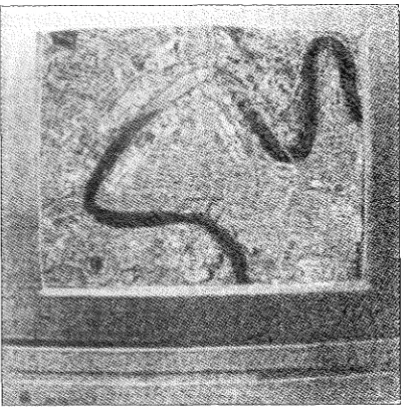
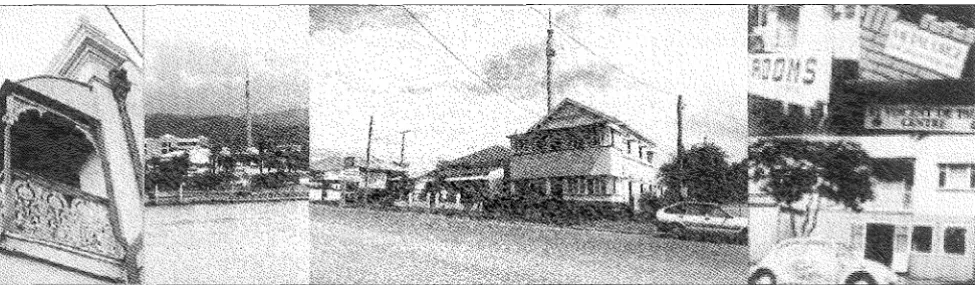
The studio explored the pressures related to 'knowledge' as a new commercial enterprise and the concerns about cities as civil societies (Blakely 1998 and Cox 1998). The City of Brisbane was identified as a study area. Two of Queensland's major universities, the University of Queensland (UQ) and the Queensland University of Technology (QUT), are closely associated with Brisbane's Central Business District (CBD) and an adjacent post-industrial landscape, all of which are connected along a river (see Figures 1 and 2).
CONTEXTUAL MILIEU
62
Figure 3,' psychogeography -river connections
master plan projects, connecting the river to the city through a number of pleasant campus spaces; the redevelopment of the central city mall; and, the increasing pressures of gentrification occurring within inner city suburbs (see Figure 3). As these city spectacles were being proposed in City Hall, new concepts for cities of the 21st century were being discussed at the Royal Australian Planning Institute Conference (RAPI 1998).
The tension between the planning discourse and the exuberance of city burgher initiatives raised issues which provided rich material for exploration and debate within the studio. In contrast to the conventional process of analysing site-related problems through rational deduction, the process of understanding the issues was achieved by taking discrete aspects of the problem and transforming them through abstraction. Students presented the abstractions for peer review and discussion, which is similar to the concept of design as reflection-in-action (Schon 1983).
THE STUDIO STRUCTURE
The studio structure that supported this inquiry enabled the process of exploring, assembling and debating to occur in a syncopated rhythm of ' design-reflect ion-design'. The programme that facilitated this process was structured in three phases: first, a set of exploratory events and the development of a master plan; second, a reflective essay; and, last, an individual design. All three phases culminated in a public exhibition. Theoretical input occurred throughout the studio as a continuous series of guest lectures and selected readings. Students were also recording and reflecting on the studio outcomes in the form of an interactive ejournal.
THE EJOURNAL - WWW.PLAS.BEE.QUT.EDU.AU.RIVER/HOME/
The ejournal experiment succeeded on a number of levels: as a peer-reviewed reflection-on-action process; as a virtual record of studio proceedings; and, as an interactive conference site. Implementation of the ejournal required the students to be part of a production team of editors, publicists and recording journalists. Throughout the evolution of the studio, the richness of discourse and conceptualisation was lost at times in the translation to the ejournal. An effort was made to keep the journal in a raw state, similar to the intensity of the studio process. Like all high experiences of collective creativity, some of the rich narratives of the student presentations remained as evanescent moments in the studio, later metamorphosing as vivid designs.
Exploring theory
The orchestration of the theoretical input was central to the design of the studio. It included an extended bibliography, selected readings for the Design Through Debate events, the lecture series and a reflective essay. Initially, there were short focused injections of provocative theoretical discourse associated with the Design Through Debate events. The reflective essay was paced to occur after the collective energy involved in preparing group master plans. This was a period of gestation and reflection before embarking on the individual designs. Equally important was the discourse in the studio where ideas were debated with consistent reference to contemporary cultural theory. The design outcomes were clearly influenced by the rich theoretical terrain.
CULTURAL VALUES LECTURE SERIES
A series of lectures on late 20th century cultural landscapes acted as a critique of the issues surrounding current urban initiatives. The following is a selection of key lectures:
Aboriginal Landscapes - Victor Hart Oodgeroo Unit QUT
Cities on Rivers - Professor Richard Hayward
Ownership and Demarcation - Professor Brian Hannigan The Writers' Brisbane - Melissa Lucashenko
Contested Terrains - Professor Helen Armstrong The Campus and the City - Professor Richard Hayward Brisbane's Expos - Jeannie Sim
Image v Identity - Sally-Anne Atkinson The City as Spectacle - Jennifer Craik
An Exploration of the Antipodean - Simon Ryan
A documented summary can be found on the ejournal.
Emer;ging ideas
An immersion in theory surfacing as abstract form.
Concepts of territory are the focus of much inquiry in current cultural theory -territory as place, intellectual -territory as commodity, the act of colonising and the act of resistance in the form of new urban tribalism (Sandercock 1998). The studio sought to deconstruct and then reconstruct the notion of territory through a series of events.
.. Constituents of Territory: " Creating Territory: .. Defining New Territory:
Whose River?: debates on ownership and key connections.
The new connection: UQQUT - as a design charrette.
The University of the 21st century: a design debate on colonising the knowledge territory.
The studio became a place where the process of abstraction and metaphor enabled a form of critical practice known as crystallisation or multifaceted reflection to occur (Richardson 1994).
t!looBItiB
Whose River?
t!lDDDDDD
Reflection-in-Action
Whose River?
DDDDriJOO
Reflection-on-Action
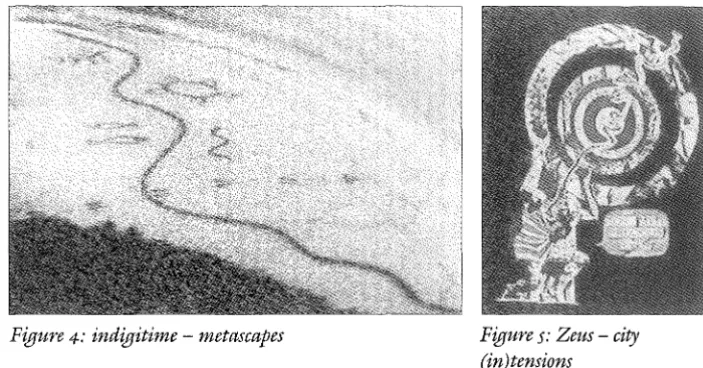
Figure 4: indigitime - metascapes
Constituents of territory
Whose River?Figure 5: Zeus - city (in) tensions
Multiple readings of the river in history were constmcted using slices of time. Abstract representations generated empathy with the history of the river in the form of either 'innocent', untheorised mimetics or socially complex semiotic representations.
A student installation on the riverbank told of the Aboriginal tribes and their relationship with the river (see Figure 4).
The temporal orbits of Zeus, weighted with the guilt of diminishing respect for nature, represented the gradual decline in the health of the river: Kodak Beach with its Wlm of sand and lens of concrete; the simulacmm, a river next to a river, sanctioned 'the spectacle city' (see Figure 5).
These renderings, often explored with cynicism, mark the beginnings of a conceptual alteration. The palimpsest of territories was understood through a process of becoming existential insiders (Relph I976). The awareness of the way territory is inscribed, generated by abstraction and metaphor, opened the door to speculations about a new language for emerging territories.
Creating territory
The UQQUT CharretteIn a university collaboration, the Charrette involved students from QUT and UQ
in the production of a cultural map. The intention was to create a new form of university by reconstituting fragments of territory within the project site (see Figure 6). The new place of learning, UQQUT, was explored in a small concrete courtyard, halfway between the two universities.
Figure 6: fragments - city connections
THE RAID
Nine groups of six people map the territory/cultural landscape by riding) driving or trelllling through the locales and gathering elements as symbols of place. Symbols are
seen as meanings and metaphors from edges and transition zones) terrains and territories) shrines and rendezvous) pathways and connections) barners and voids and mar/un and points of significance. This was the territory ofUQQUT - the combined
university mapping Brisbane, mapping the links between UQ and QUT and mapping the universities as places within the river city. In limited time we tried to explore the intimacy of place though the eyes ofuQQUT.
THE TERRITORIES
... created on a concrete car park canvas.
Up river down river across river on the south side on the north side and bridging both sides. The map showed marked cultural) social and physical dijfirences and many
antipodean tribes of people using the space, joined and divided by the river.
Rich-poor ... old-new ... urban (sub)urban landscape ... working
landscape-residential landscape .. , UQQUT ...
UQ-QUT as binary opposites (traditional-modern). UQQUT as a combined university.
What makes a university? Was this a university? Are they isolated bastions of
knowledge no longer and must they be fully immersed in the corporate world? What then will the ties between UQ and QUT (or in fact any of the tertiary education facilities in Brisbane) and the city be? There has always been the physical ties between
UQ and QUT - a road, a river, a cosmopolitan suburb. There is some kind of tangible relationship between two universities sharing the same territory and a similar uncertain future.
Tallen from the ejournal-wJVJv.plas.bee.qut.edu.au.river/home/
Reflection-an-Action
DD0i50
Uni of the 21 SIC
OOOOIUDD
Reflection-an-Action
66
At this point in the studio, the concept of paradox and uncertainty was beginning to emerge through assembled installations. Although the fluidity of installations disintegrated the entrenched territory of the sandstone versus redbrick universities, the process of mapping nevertheless provided an unexpected insight into the way the two existing institutions were currently perceived. The traditional sandstone university in its park-like setting maintained its presence while the redbrick university became indistinguishable from the high-rise of the CBD. Interesting plays on being antipodean, stimulated by Ryan's The Cartographic Eye (1996), continued throughout the design responses. The Charrette highlighted the disparity between the institutions as binary opposites and the resulting tension occurring when attempting to merge the two.
Defining new territory
The University of the 2Ist Century
The site can be stereotyped into intellectual and pragmatic divisions regarding elitism, anti-elitism, scholarship and training, sandstone and redbrick. The university system is also under scrutiny as it adopts corporate strategies and rationalisations, increasing the likelihood of , tick-a-box' graduates as opposed to scholars. The changing nature of knowledge as economic capital is in tension with the social capital of a civil society.
Debating the Urban Propositions
1 Cities will become the universities of the future.
2 Universities will become the civil societies of the future.
Two keynote papers were presented at the RAPT conference entitled 'Embracing Change' in Brisbane, July 1998:
.. 'The Challenge for Planners: Regions and Cities in the Next Century', Ed Blakely. .. 'Can Social Capital Make Societies More Civil?', Eva Cox.
The two speakers presented challenges for the University of the 21st century. The students responded through abstract assemblages and raw text - presenting 'Barbie' as 'student of the real world' and Eva Cox's 'Perfect World' and 'Storming the Citadel'.
This debate expressed visually and textually the implications for future landscape design within cities. Layers of meaning were peeled off to reveal a sequence of debates which gradually evolved as reflections on new urban forms.
The first proposition situates 'Barbie' as 'student of the real world' where she is dismembered in her quest for knowledge. It is the 'new universiry' fragmented across the urban field which acts as the surgeon's knife (see Figure 7). The potential disassembling of the university structure and of Barbie herself highlights the negative impacts of fragmented universities. The student body is now separated from its soul, the collective, thus preventing its potential as generator of societal change. In this way, the institutions through their new fractured form win power over the student collective, weakening its resistance to current fiscal and political strategies.
( ... decentralise ... plug into the city ... )
Pooling resources ... bringing commerce into the university ... who)s to say that the building next door can)t be an office block.)
( ... and ipJs a commodity ... everything is geared towards the production of knowledge) the
new role of the city as a result of the Internet is to sell knowledge.)
The city being twisted and contorted for the production of knowledge.)
( ... with cyberspace there is little need for unilJersity.)
<No need for a centralised university) a virtual world) a social sphere.)
Technology has in a more paradoxical way created a more fundamental need for social contact.)
( ... the absolute need for physical contact is reducing.)
( ... The old paradigm of the centre and the periphery do not exist) no maJ;ginal edges ... )
(Social capital is not lost - just moving around.)
There is tension within the general populace universities are not held in great regard -should we put it in the centre of the city ?t
'A. fascism model ... Civility can only be achieved through conformity) no diversity in education) a united university system.>
Taken from the ejournal- www.plas.bee.qut.edu.au.river/home/
t!loooklo
New ways of Seeing:
OOODIiJOD
Reflection-on-Actlon
t!loooklD
68
Figure 7: dismembered - city (in)tensions Figure 8: lmi/city - river connections
The second proposition proposed that universities are seen to be the last bastions in which to mobilise large-scale social action, using a captive student body. They can then be seen as isolated from the concerns of the general population. In this instance, storming the citadel would seem an action which would promote a wider inclusion of society into universities and universities into society (see Figure 8).
The three abstract events completed the Design Through Debate phase of the design process. The energy and focus on finding different ways of seeing contemporary urban issues was intense. Highly creative responses to the abstract exercises produced insights into the problem that could not have emerged from a rigorous analysis process. The sense of expectation within the studio was palpable, as all participants closely followed the explanations of complex and confusing abstract representations in order to enter each designer's mind. The moments of silence followed by intense questioning and debate were clear indications that reflective design, as research, involves multiple and shifting realities and that awareness evolves and becomes transformed as an iterative process. This is design as research.
From speculation to design ideas
Design ideas moved from the debated propositions into the urban fabric as master plans. Some were clearly aligned to either position one or two, while others sought a compromise. The more interesting design ideas were those which explored an emerging third-space. The master plans occupied four positions:
" University as civil society - Design outcomes adopting this position revolved around community empowerment and ecological concerns.
€I Univer/City as knowledge commodity - Design outcomes derived from this position showed innovative approaches, which were reflections on a highly technological future.
€I Consensus position - This position explored planning practice within current planning paradigms with a focus on consensus.
.. An emerging third-space - These proposals moved design into a third realm through creativity and innovation. Although they absorbed elements of both propositions, they did not achieve a consensus or blending. Instead they created something new, a politicised hybrid which challenges norms and conventions.
These proposals used similar sophisticated processes and modes of communication in seeking solutions to the problems of technology, education, the urban field and the imminent change through ideological or theoretical positions. They explored a third-space through new form and programmes, as intervention into the city. Ways of seeing explores the third-space using a psycho-social projection of the 'viewed', the 'viewer' and the 'view' as a way to connect the city, the viewer and the universities. This proposal explores the role of the viewer as urban fianeur, or voyeur, and the 19th century notion of panorama and diorama.
Figure 9: collision park - ways of seeing
Brisbane is viewed with its past and present factors, which have influenced its patterns of development and evolution. Able to see the views of others in fragments of words read and heard and images remembered, the viewer has a commanding view of the whole: a new view of a familiar scene. The view is our future vision for Brisbane, which draws upon the collation of what has been viewed) with the perceptions and ideologies of the viewer.
Taken from the ejournal- Mvw.plas.bee.qut.edu.au.rivetlhome/
Brisbane city as a 'home' has been created with facilities that play on traditional ideas of public and private spheres. There are three new parks: Collision Park - the arts and science centre (see Figure 9); the Cine-path - an outdoor lounge room to
relax and observe; and, the Roma Street 'Public Baths' for communal ablution, 'Brisbane's Bathroom'.
Reflection-on-Action
Figure [0: cine-path - ways of seeing
City [injtensions
C!DDDDDD
Reflection-in-Action
The design explores what the city as home might be like, what the act of inscribing activities of the private home into the public city could achieve. It aligns itself with Baudelaire's text and his predictions about the commodification of everyday life. This scheme seeks to subvert commodification by investing the city with the meanings of home. The proposal can be read as the feminisation of the city, where the viewer experiences a view as perceptions of the existential insider, rather than judgements of an analytical outsider. Drawing from cultural studies (Frow and Morris I993) and the new critical geographies (Soja I996), the city is read through text, film, photography and television. It is clear that the scheme seeks to engage in 'the mutual erosion' of home and city (King I996, p 96). There is a risk in encoding home onto the city; the last place left to raid is the home.
At times the design is done with a hyper-real edge as a cine-path projects intimate moments of the everyday onto gigantic screens. Thus, the space becomes the city's lounge room (see Figure IO). The overt domestication of city space is in striking contrast to the current self-aggrandising corporate use of space. A Foucauldian reading of the space would explore the voyeurism of the commanding eye. However, this design subverts its gaze through the empowering acts of the everyday.
The city (in)tensions master plan was entirely media driven. It explored the third-space in the form of a media hybrid projected into existing city forms, in both programmed and unprogrammed space. The concept of semiotic excess was carried through into the visual presentation (see Figure II).
The master plan accepted change as imminent and played with the possibilities of exploiting and subverting the context in three ways. In the first location, InfoBank was used to colonise existing corporate offices. This was done by deconstructing the mirrored boxes of the 1980s corporate culture using disruptive interventions - the tectonic plates (see Figure I2). In a second location, the mediatheque creates a public exposition space for the display of information as a free resource (see Figure
I3). The third location is the raw Expo, which challenges the commodified CBD on the other side of the river. This location colonises existing streets as spaces for activities such as experimental marketing, research co-operatives, exhibition and studio space, state-of-the-art transport nodes, a high design street and free space
(see Figure I4).
Figure II: semiotic excess - city (in)tensions
Figure I2: infobank - city (in)tensions Figure I3: mediatheque - city (in)tensions
Figure I4: raJV expo - city (in)tensions
This scheme embodies the disruptive agenda of the avant-garde as it pierces and slices open the glass-mirrored cylinders of corporate headquarters and returns them to the public as an exposition space, the InfoBank. Paradoxically, by subverting the corporate hegemony, the method of subversion employs the aggressive forwardness and verve of the male avant-garde whilst achieving an empowering and thereby feminist act.
The reflective essay
Following the intense period of collaborative work, the students were able to reflect individually on the cultural landscape of the site. Students immersed themselves in exploring the concept of cultural landscape through a written and illustrated paper. This was in effect a gestation period where the development of ideas through further research and considered reflection were able to surface as potential designs.
Embedding ideas into landscape
After the master plan phase and the reflective journal, the students focused on a site-specific aspect of their master plan. Three individual designs explored spaces for Brisbane of the 21st century - 'Redefining Space', 'Raise the Park' and '(Re)interpreting Reality'.
' ... creative) non-passive) challenging spaces for Brisbane: circa 2000. Unprogrammed space, experimental space, exploration of ideas, free space, temporal space, ephemeral space, land use juxtaposition, fleeting moments change .. :
Taken from the ejournal-1Vlvw.plas.bee.qut.edu.au.river/home/
City [in]lensions
OOOOr;:]1:l1:l
Reflection-an-Action
t!ll:loolill:l
l!ID DODD
Rellection·in·Action - Raw Text
Figure IS: the park - Rebecca Short
72
Incorporated in this park are two major ideas - truly ephemeral landscape and stark
ju,'Ctaposition within landscape. The other crucial factor is time. The whole design is hinged from a timeline which guides the next decade for the space.
The programme involves demolishing a swathe of land through a recently designed
riverside park, Southbank, by extending a block of the CBD city grid across the river
to intersect with the differently aligned South Brisbane grid (see Figure IS).
This elegant )ree) space is unexpected. It is a strong anti-monument statement which
demands innovation and creativity. Here, space is stripped back to its most basic useable form - mounded grass cut only by a road and a railway line (two existing urban pulses). It forms a strong contrast to the orchestrated environment of Southbank
around it. Lebbeus Woods's comment that 'Freespace is a new spatial manifestation of the boundaries of individual autonomy ... (Landscape) Architecture must initiate events ... the (Landscape) Architect ... is ... an instigatrn; an agitatrn; an active participant.>
Designers> notes I998 taken from the ejournal
Free space is the first step in this process. It acts as the instigator. It confronts. It is the catalyst. It is the crucial initial stage for changing the landscape of the mind. There
are five phases to this design: I. Free space - previously described. 2. Tribal landscape,
No I - I believe it is important to speak about the word, tribe ... and tribal. Some
people in the class were concerned about the negativity, exclusiveness and even discriminative side of the word. I, on the other hand, believe it to have a very positive meaning. Any sort of tribe, be it historical, modern, or urban, creates a rich and vibrant culture or elements of culture of their own, differing from others. This space is their exhibiting ground - the place to share this richness with others. Wooden boxes; tent embassy; wire houses; old timber relocated pub (see Figure 16).
I'd also imagine the space to have a cinematic feel - being so versatile and temporary and ... quite inspired by the film still artist, Cindy Sherman - who uses film stills to evoke a point of narrative, tension or mood - in a way this landscape
Figure I6: stage 2 - Rebecca Short Figure I7: sugar cane - Rebecca Short
could have the same value. l Productive landscape - This creates contrast and
contradiction and above all will be unusual and exciting. It is sugar-cane (see Figure 17).4. Tribal landscape, NO.2 - building on phase two 5. Ecological- This ecological
landscape redefines the space again by revealing a natural process. It retro-fits the original drainage line from South Brisbane to the river along the same line as the productive landscape. This natural process is manipulated into an orchestrated beauty - natural beauty married with constructed beauty (see Figures 18 and 19). It combines art and ecology - what I believe to be the most pure form of landscape archi tecture.
This project has a beginning and an end as described in these five phases. But it should not stop here. It should remain. the space in Brisbane for land-use e:>vperimentation. It should continue to be a space interpreted by professionals and the community ... and continue to be different and challenge the people of Brisbane.
Figure I8: ecological landscape -Rebecca Short
~., .... "t~ t"t- _",I;,. ,,01:,. !11",
.. ,.,,'1~ ~ ... "",l .... ,.l r"<-nl:,
Figure I9: Gross pollutant trap - Rebecca Short
Designerf notes I998 tallen from the eJournal
This design proposes an anarchic commentary on space with its demolishment of a swath of Brisbane's major theme park. Unlike the unoccupied space of 'Terrain Vague', the void is created. The destruction can be likened to an acid 'spilt' on an elaborate picture plate: it corrodes the image underneath, leaving a pitted plane which is re-etched with different oeuvres.
It is a fully programmed space which nevertheless seeks to give its participants freedom in a highly controlled world.
This idea falls consciously into a democratic debate concerning freedom of speech, a space for insurgent citizenship (Sandercock 1998), or in this case the
Redefining Space
DDDDIli:lClCl
Reflection-in-Action - Raw Text
l
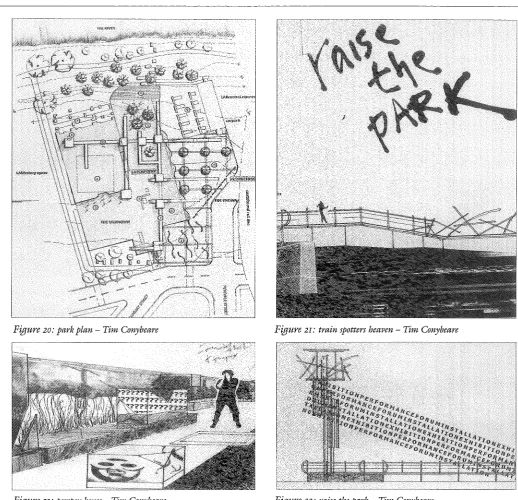
Figure 20: park plan - Tim Conybeare Figure 2I: train spotters heaven - Tim Conybeare
Figure 23: perspex boxes - Tim Conybeal'e Figure 22: raise the park - Tim Conybeare
pARK is an experimental field; a playground for interventionist artistic gestures, pranks and discovering the million possibilities of the city (see Figures 20 and 22). Central to the plan, the remnant concrete foundation from the forgery
plant is retained. An interjection of an elevated skeletal plane (the walkway) ... existing, provides the scaffolding through which the container is exposed. A central spine divides the known from the unknown, inverted now through the subversive course of history within which laboratory XYZ sits. PAIU( represents a cynical manipulation of the fabric of an urban landscape of utter boredom and banality.
Designers> notes I998 taken from the ejoumal
freedom to act and be free. The programme for this space is a democratic framework which allocates the site to different groups or 'tribes'.
The metaphor for this park involves hypermedia as the 'unanchored container' which will transform the city through 'idea generation' and create a new 'natural' resource base. The design includes a telematic media laboratory 'XYZ' which uses the park as the exoskeleton of institutionalised research development. The walls of the institutional container are de-constructed on the site, leaving a grid of elevated walkways to expose a skeletal structure through which to view the city in new ways (see Figures 21 and 25). The landscape design utilises the concept of unprogrammed space as a liberation from convention - society makes its own space. Its spontaneous agenda is highly influenced by the Situationists International (SI) and
their notions of 'derive - a drift down the streets in search of a sign of attraction or repulsion' (Marcus 1998). The forms within the park respond to an intellectualised response to SI manifesto where manipulation of space opens many possibilities: cracks in foundations are beds for vegetal protrusions; a pole-space with scaffolding and demountable platforms is to be arranged at will; walls are spaces for defacement; perspex boxes are crammed with the laboratory'S handiwork (see Figures 23, 24-and 26).
Figure 24: the edge - Tim Conybeare Figure 2S: exoskeleton - Tim Conybeare
Figure 26: pole space - Tim Conybeare
Raise the park
DDDDIilDD
[rejinlerpreting reality
!:!lDDDDDD
Reflection-in-t\ction - Raw Texl
[re jinterpreting reality
DDDDl!:ILILI
Reflection-on-Action
The world we inhabit is limited by the dimensional context of time and space. It is
difficult for our minds to grasp the dimensionless reality of existence. This system of identity is designed to transmit information about the everyday city and its people
without regard to the natural limits of time and space. This concept is one that stays close to the perceptions of the individual and their relationship to urban space, not only in physicalised space but exploring the hyper-reality of the mind through media
space. The design is an attempt to identify and develop a more sensitive experiential language based on the subjective imaging of the visual landscapes we interact with
and carry within. It is a landscape of abstracted visual, physical and aural elements which reflects a spatial and temporal mapping process. These are woven throughout the landscape to generate a linear sequential spatial arrangement to reveal the multiple realities of our culture.
The design is a journey in space and time. A journey accompanied by curiosity and intrigue about the unknown) it creates expectation and intensity of perceptions.
For those who rush through spaces consumed with their specific task at hand: the journey is a storyj ... a story always assumes control, it knows its course, it knows
what matters, it knows where it begins and ends. However, for those who wander like Baudelaire's flaneur, the journey becomes a daydream as daydreams are quite
different: they don't have that dramaturgical control. What it has is a kind of subconscious guide who wants to get on, no matter where; every dream is going somewhere but who can say where? Something in the subconscious knows, but you can only discover it if you let it take its course ... this is 'drifting ... not the shortest line between two points but a zigzag.
This design lies in the void between the logical and illogical. It is a journey made up
of artifice, artefact, the unexpected, the necessary, innovation, interaction, reality and illusion. This landscape is a connection between the sensory perceptions of feeling and seeing. It is a vision of our everyday city as a dynamic structure made up
of transient fluid connections between people, places and situations. It is an opportunity to explore the intimate landscape) the fundamental patterns and
motivations, behind Brisbane's urban form.
Designers> notes I998 taken from the ejournal
The design situates itself above a subterranean rail line linking QUT and UQ. As such, it becomes a space which is constructed by demolition - a constructed void. Its elongated shape uses what Debord would call 'constructed situations' (Debord,
Figure 27: Urban musical - Kim Watson Figure 28: Image Mirage - Kim Watson
Fig 29: Time Void - Kim Watson
in Marcus I998, p I64-) to collect, interpret and amplify the flows and tissue of the everyday. These acts seek to defamiliarise in order to transform consciousness of commodified space through sensory bombardment of the human experience.
Major events are held in areas which are dispersed throughout the linear corridor and joined by a serpentine path. The image mirage is where form and function follow the ideologies of chance through the play of reflection and projection on the translucent materials of the space. This acts as a screen for the comings and goings of the everyday (see Figure 28). The time void is the hermetic environment of chance made manifest - noise, random and profane, is the essence of possibility (see Figure 29). Inspired by a daydream, a tensile zigzag structure marks the beginning of the urban musical from which flow the echoes of urban music. The sounds and related images reflect and refract off this acoustic formation (see Figure 27). This design offers the continual exaggeration of aural, visual and tactile elements, and it subverts the monument by including it in the nonsensical display of the everyday experience. This design is exciting in the way difficult and complex theories become reality through designed form.
The studio outcomes
This studio required a conceptual shift through the exploratory use of metaphor. In this case, it was structured around the concept of debate in order to expand the tools of ideational development and representation. The studio also sought to include the knowledge and relevancy of cultural theory, and its associated production, to enrich the realm of landscape architectural practice. Some students were reluctant to take this method beyond abstract studio 'events' and into the reality of landscape design. In most cases, this was caused by a kind of design 'default' where deeply ingrained design processes negated the chance to explore the nexus between design and theory. This was a missed opportunity because the new design studios introduce contemporary cultural theory in order to provide a theoretical base from which to engage in the risk-taking activity of design (Krog I983). Those students who were willing to engage in the terror of uncertainty made highly original conceptual advances in the realisation of different forms of theory as landscape designs.
The research and scholarship outcomes
reflections-in-and -on-action which highlighted the interplay between critical dialogue reflections-in-and artistic processes. The critical dialogue was most active during reflections on the series of 'events' designed to develop new ways of thinking. The reflection revealed that the process of transforming issues into metaphor results in a different form of understanding to that derived from rational processes.
Originality and creativity were manifested in student work as unusual and advanced urban propositions to address the issues of the growing 'knowledge industry'. The works themselves were highly creative - entirely innovative physical and social environments derived from the combination of landscape design theory, cultural studies and the new critical geographies. Such designs challenge orthodoxies, commodification and conventional spatial configuration through different notions of park/space/place/society. The originality of the designs is therefore a form of new knowledge.
The design outcomes and the research development continue the tradition of the Russian Constructivists' 'laboratory work' (Cooke I989), in that they contribute to the body of research material which will be available to other designers. The next step is to strengthen design awareness throughout the wider community by disseminating the fruits of design research through inclusive forums which spark design discourse. This will ensure such material continues to be tested and useful.
BIBLIOGRAPHY
Blakely, E 1998 The Challenge for Planners: Regions and Cities in the Next Century, Key Note Address at Royal Australian Institute of Planning Conference, Embracing Change,
Brisbane; Australia.
Bourdieu, P 1983 The Field of Cultural Production. Cambridge, UK: Polity Press. Cooke, C 1989 Constructivist Precursors, in Papadakis, A, Cooke, C, and Benjamin, A (eds), Deconstruction OmnibltS Volume,
pp II-19. New York: Rizzoli.
Cox, E 1998 Can Social Capital make Societies more Civil?, Key Note Address at Royal Australian Institute of Planning Conference, Embracing Change, Brisbane;
Australia.
Frow, J and Morris, M 1993 Australian Cultural Studies: A Readel: Sydney: Allen &
Unwin.
Gregory, H 1996 The Brisbane River Story: Meanders through Time. Brisbane: Australian
Marine Conservation Society.
King, R 1996 Emancipating Space. New York:
Guilford.
Krog, S 1983 Creative Risk Taking, Landscape ArcJJitecture 73(3), pp 72-76.
LANDSCAPE REVIEW 1999:5(2)
Lyotard, J-F 1997 The Postmodem Condition: A Report on Knowledge (trans Geoff Bennington
and Brian Massumi). UK: Manchester University Press.
Marcus, G 1998 Lipstick Traces. Cambridge,
Massachusetts: Harvard University Press.
Relph, E C 1976 Place and Placelesmess.
London: Pion.
Richardson, L 1994 Writing: a method of inquiry, in Denzin, N and Lindon, Y,
Handbooli of Qualitative Research, pp 516-529. Thousand Oaks: Sage.
Ryan, S 1996 The Cartographic Eye.
Cambridge: Cambridge University Press.
Sadler, S 1998 The Situationist City.
Cambridge, Massachusetts: MIT Press.
Sandercock, L (ed) 1998 Making the Invisible Visible. California: University of California Press.
Schon, D 1983 The RefiectiJlf Practitioner. NY: Basic Books.
Soja, E 1996 Thirdspace, JOllmeys to Los Angelvi and other Real and Imagined Places. Malden,
MA: Blackwell.
Taylor, P 1996 Doing Reflective Practitioner Research in Arts Education, in Taylor, P (ed),