Development of Rapid Continuous Dyeing Process for
Heavy-Weight Nylon 6,6 Carpet
Hongming Dong, PhD1, Wallace Carr, PhD2, Fred L. Cook, PhD2, Sunghyun Nam, PhD3
1
The Boeing Company, Seattle, WA UNITED STATES
2
Georgia Institute of Technology, Atlanta, GA UNITED STATES
3
USDA, New Orleans, LA UNITED STATES
Correspondence to:
Wallace Carr email: [email protected]
ABSTRACT
An improved continuous dyeing process for coloration of heavy-weight (60-70 oz/yd2), residential nylon 6,6 carpet is reported. By inserting a slot steam applicator after the dye pad and before the box steamer to preheat the carpet to around 180°F (greater than the nylon wet glass transition temperature of ~150°F), the required dwell time of the padded carpet in the atmospheric steamer is greatly reduced (0.3-0.5 of normal). The improved continuous coloration process provides a route to beck-quality, level-dyed, heavy-weight nylon 6,6 carpets at production speeds 2-3X those of conventional lines.
INTRODUCTION
The carpet industry for many years has sought to convert the coloration of heavy weight (60-70 oz/yd2 face fiber) residential nylon carpet from batch processes (i.e., becks) to continuous processes. However, on current dye pad (or slot apply)-nip-steam-wash continuous dye lines, the slow speeds necessary to adequately process heavy weight carpets (10-15 yard/min), dictated by the longer dwell times required in the box steamer to achieve levelness and full dye penetration/fixation, is a costly detriment to productivity compared to processing light-to-medium weight nylon carpets on the same continuous lines (30-40 yard/min process speeds) [1].
The slot steam applicator employed in the research was initially marketed as the Machnozzle® (MN) by Brugman Machinefabrick BV, Holland [2]. Previous research conducted at Georgia Tech revealed that the MN slot steam applicator suffices as the sole energy source for fixation of the dye for low wet-pick-up (~85%) foam dyeing of nylon carpet [3], and as a fabric drying device [4]. The MN rapidly pre-heats the padded carpet and thus reduces the required
dwell time in the box steamer, consequently increasing process line speeds as it brings the necessary energy to bear in a short time frame to raise the saturated carpet temperature after dye application (typically 375% wet pickup of dye liquor with the standard Kuster Fluidyer Slot Applicator ®) to the desired temperature of 180°F.
The effects of incorporation of the MN on the required box steaming times of heavy-weight nylon 6,6 carpet at various dye loadings (light, medium and dark shades) were evaluated. Dye utilization and fixation with the developed process line versus the conventional line were compared and the potential increase in process speed determined.
EXPERIMENTS Materials
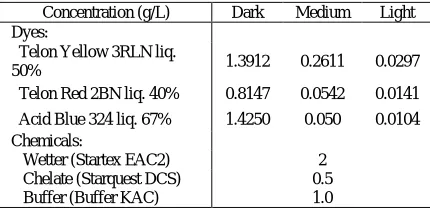
Heavy-weight, tufted nylon 6,6 carpet (pile yarn weight 65 oz/yd2), acid dyes and auxiliary chemicals were provided by Mohawk Industries, Inc., as well as dye formulation for three shades - light, medium, and dark (Table I). Nylon 6,6 was selected as the carpet face fiber, as it is more crystalline and therefore less easily dyed than the other predominant tufted face fiber, nylon 6.
TABLE I. Dye formulations for nylon 6,6 carpet.
Concentration (g/L) Dark Medium Light Dyes:
Telon Yellow 3RLN liq.
50% 1.3912 0.2611 0.0297
Telon Red 2BN liq. 40% 0.8147 0.0542 0.0141
Acid Blue 324 liq. 67% 1.4250 0.050 0.0104 Chemicals:
Wetter (Startex EAC2) 2
Chelate (Starquest DCS) 0.5
Experimental Setup
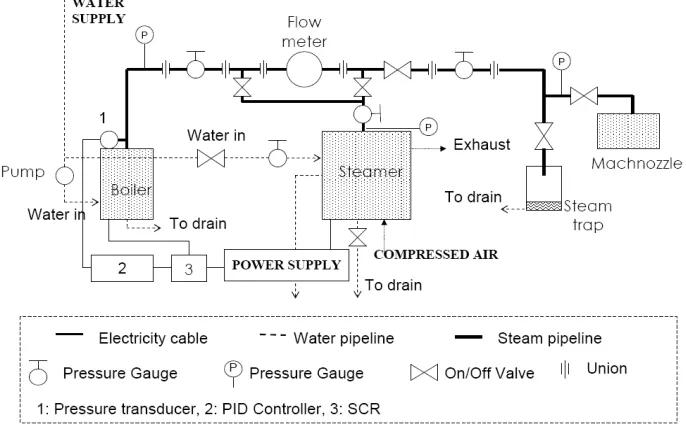
A schematic of the experimental setup is shown in
Figure 1. Steam was provided by a boiler (Chromalox CES 60) controlled using a pressure transducer (Omega PX-4200), a proportional-integral-derivative (PID) controller (Chromalox 2104), and a silicon-controlled rectifier (SCR) (Chromalox MaxPac II). A ball valve was used to adjust the steam flow rate to a 16-inch-wide MN slot steam applicator (Brugman Machinefabrik BV,
Holland) and box steamer (Mid-South Metalworks, Dalton, Georgia). Steam flow rates were measured using a vortex steam flow meter (OMEGA FV-500B). A conveyer belt with adjustable speed was utilized to obtain different dwell times under the preheating device. Metal shims with various thicknesses were used to adjust the steam slot opening width.
FIGURE 1. Schematic of experimental setup.
Experimental Approach
A roll of carpet was cut into 12 inch by 12 inch test samples. The individual carpet sample was weighed, soaked in 3L of dye solution for 30 seconds, and then passed through a set of squeeze rollers two or three times to give a wet pick-up of ~375% (in the range of 370-380%). The required steaming time for a saturated sample receiving no pre-heating was determined and used as a basis for evaluating the effect of preheating. Samples were placed in the atmospheric batch steamer for a range of dwell times and then color measurements were made. The data on carpet color versus time were used to establish color standards for evaluating the effects of MN preheating. Then tests on samples preheated using the MN were conducted. The saturated sample was preheated by passing the face of the padded carpet at various proximities to and underneath the slot steam applicator (slot length of 12 inches), followed by steaming in an atmospheric box steamer. Samples were steamed over a range of times. The dyed carpet sample was then washed in cold water, and the water was removed by vacuuming until wet pick-up
reached approximately 100%. The sample was then dried using a tumble home dryer (max. temperature of about 160 °F) and conditioned for at least four hours in a standard testing laboratory (70°F and 65% RH) before color measurements were made. All tests were replicated at least three times.
Color Measurements
Dye fixation was evaluated by measuring the CIE L*, a* and b* color values of the face and back of the dyed carpets using a Hunterlab Reflectometer Ultrascan XE. Five different locations on each sample were selected and measured. L* represents the lightness of the color (L*= 0 indicates black and
L* = 100 indicates pure white), a* represents the position between red and green (negative value indicates green while positive value indicates red), and b* represents the position between yellow and blue (negative value indicates blue and positive value indicates yellow). The standard reference samples not exposed to MN pre-steaming were prepared by varying the steaming times in the atmospheric steamer until dye utilization and fixation for each shade was optimized. Color differences (Del E*) were calculated to represent the relative extent of dye fixation and shade development between the reference (steamer only) and MN pre-heated samples:
(
* *) (
2 * *) (
2 * *)
2 *r r
r a a b b
L L E
Del = − + − + − (1)
L*a*b* and Lr*ar*br* are the color values of MN pre-heated test samples and steamer only reference samples, respectively.
RESULTS AND DISCUSSION
Dyeing Fixation in Atmospheric Steamer
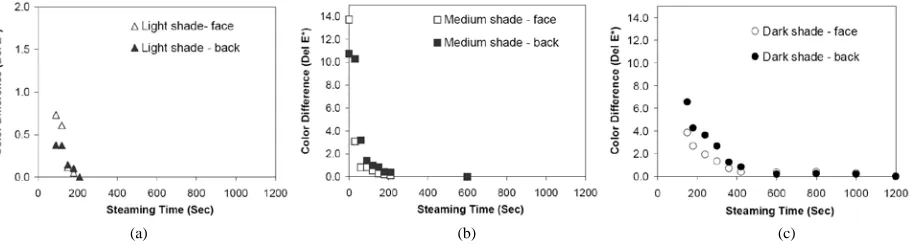
Dyeing tests without pre-steaming were first conducted to determine the required steaming time for complete dye utilization and fixation in the atmospheric steamer for light, medium and dark shades. The color differences measured on the carpet face and back are shown as a function of steaming
time in Figure 2. The color differences (Del E*) were based on the samples dyed at steaming times of 210, 600 and 1200 seconds for light (Figure 2-a), medium (Figure 2-b) and dark shades (Figure 2-c), respectively. Test results showed that ∆E was small (less than 0.5 units) for times equal to or greater than 150, 180, and 600 seconds for light, medium and dark shades, respectively, and these samples were selected as “steamer only” reference samples. As expected, the test results demonstrated that the dyeing of dark shades was the most challenging, as a much longer steaming time was required to reach maximum dye utilization and fixation than those for light and medium shades.
Optimal Parameters for MN Slot Steam Applicator
Effect of MN Location Relative to Carpet Face
The effect of the MN location relative to the carpet face was evaluated for the medium shade. The location of the MN steam applicator slot relative to the carpet tuft pile tips was varied at a fixed steam flow rate per unit slot length of 7.5 lb/hr-inch. Three values of +0.25 in. above the carpet pile tips, 0 in. (the slot just touching the pile tips), and -0.25 inches below the pile tips were used. As shown in Table II, the surface shades achieved did not vary greatly with the mounting position for steaming times of 60, 90 and 120 seconds, but the color differences for the back shades at “0” position were smallest at the steaming times of 90 and 120 seconds, about 0.2 and -0.5, respectively. As mentioned in the previous section, the standards for the color measurements were the “steamer only” reference samples steamed for 180 seconds for medium shades.
(a) (b) (c)
TABLE II. Effect of slot applicator position relative to carpet surface for medium-shade dye fixation (slot opening of 17.5 mil, and flow rate per unit slot length of 7.5 lb/hr-inch).
Machnozzle position (in)
Steaming time (sec)
Face Back
L* a* b* ∆ E* L* a* b* ∆ E*
Steaming only 180 67.3 3.4 20.3 0.0 69.5 2.0 16.6 0.0
-0.25 60 67.3 3.4 19.7 0.5 73.3 1.3 12.8 5.4
90 67.9 3.4 19.6 0.8 70.3 1.9 15.9 1.1
120 67.8 3.3 19.5 0.9 70.0 1.9 16.4 0.6
0.0 60 67.5 3.4 19.8 0.6 73.2 1.3 13.0 5.8
90 67.3 3.4 20.1 0.3 70.0 1.9 16.3 0.2
120 67.2 3.4 20.1 0.4 69.6 2.0 16.8 -0.5*
0.25 60 67.7 3.4 20.0 0.5 72.7 1.3 13.2 4.8
90 67.6 3.4 20.2 0.3 70.1 1.8 15.6 1.2
120 67.6 3.4 20.2 0.3 69.8 1.8 15.9 0.8
* Negative differences indicate a darker color than the reference sample
TABLE III. Effect of slot opening for medium-shade dye fixation (steam flow rate per unit slot length of 7.5 lb/hr-inch, “0” inch MN position).
Slot opening, mils (Steam speed, m/s)
Steaming time, sec
Face Back
L* a* b* ∆ E* L* a* b* ∆ E*
Steaming only 180 67.3 3.4 20.3 0.0 69.5 2.0 16.6 0.0
6 60 67.9 3.3 20.2 0.5 69.8 2.0 16.0 0.5
(411) 90 67.9 3.4 20.4 0.4 68.1 2.3 17.4 -1.7*
11.5 60 68.2 3.4 19.5 1.1 70.8 1.8 15.3 1.8
(214) 90 67.9 3.3 19.9 0.6 70.1 1.9 16.0 0.7
17.5 60 67.5 3.4 19.8 0.6 73.2 1.3 13.0 5.8
(141) 90 67.3 3.4 20.1 0.3 70.0 1.9 16.3 0.2
21.5 60 67.3 3.6 19.5 0.6 72.2 1.7 13.6 3.6
(115) 90 67.4 3.6 19.7 0.6 70.6 2.0 15.7 0.9
* Negative differences indicate a darker color than the reference sample
MN presteaming thus accelerated dye fixation and the required process steaming time was mainly dictated by that required for dye migration, exhaustion and fixation on the “back tufts” of the carpet. At the “0” slot location, the dye liquor penetrated deeper and more efficiently throughout the cross-section of the carpet construction (including through the “back tuft” yarns), exhibiting the optimum dye utilization and fixation. For the +0.25 inch slot location, the air entrained by the steam jet may have been the reason for the slightly lower effectiveness of MN preheating. For the -0.25 inch slot location, the steam jet appeared visually to blow some dye liquid out of the carpet back. Dye foam was also generated, which was not observed for the 0 and +0.25 inch slot locations. The optimum location of the slot relative to the surface of the carpet pile tips was thus concluded to be “0” inch distance, i.e., the slot just touching the tuft yarn tips.
Effect of MN Slot Opening
The effect of the MN slot opening was evaluated for the medium shade and steaming times of 60 and 90 seconds. The MN slot opening was varied while maintaining steam flow rate per unit slot length at 7.5 lb/hr-inch and with the MN location relative to the carpet face at the 0 inch slot location. A MN slot opening of 6 mils (smallest value used in this study,
mils, the back shade of the sample for a steaming time of 90 seconds was even darker than the reference sample (steaming time of 180 seconds). The reason for this effect may be attributed to the higher steam jetting speed for the smaller slot opening (see Table III). Steam jetting at a higher
speed would be expected to penetrate deeper into the carpet sample and condense at a lower position in the structure, resulting in heating the sample up faster. The steam jet also facilitates dye distribution throughout the structure.
TABLE IV. Effect of steam flow rate per unit slot length on medium-shade dye fixation for medium shade (slot opening of 6 mils, “0” inch MN position, steaming time of 60 seconds).
Steam flow rate per unit slot length
(lb/hr-inch) (Steam speed, m/s)
Conveyor belt
Speed (ft/min) Face Back
L* a* b* ∆ E* L* a* b* ∆ E*
Steaming only for 180 second 67.3 3.4 20.3 0.0 69.5 2.0 16.6 0.0
7.5 (411)
6 67.9 3.3 20.2 0.5 69.8 2.0 16.0 0.5
6.25 (373)
5 68.1 3.3 19.6 1.0 71.1 1.7 14.9 2.3
5.0 (274)
4 68.0 3.3 19.6 1.0 70.9 1.8 15.1 2.0
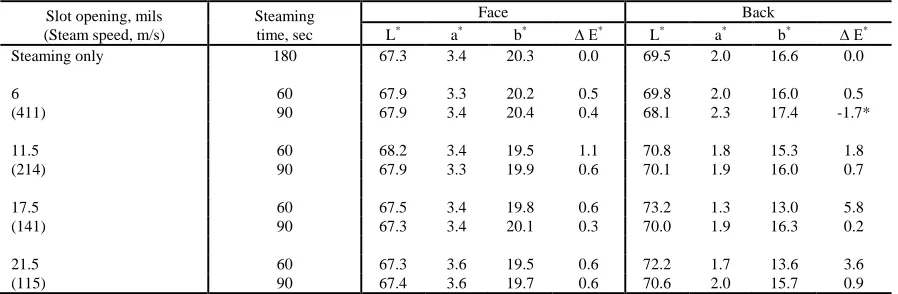
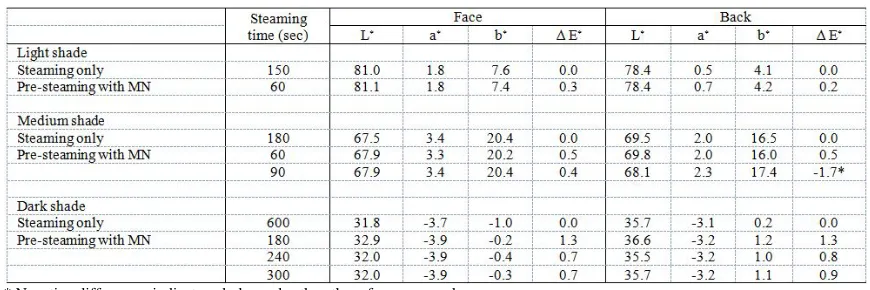
TABLE V. Color values and differences between carpet samples with pre-steaming using a MN Steam Slot Applicator and the reference (steamer only) samples (steam flow rate per unit slot length of 7.5 lb/hr-inch, slot opening of 6 mils, and “0” inch MN position).
* Negative differences indicate a darker color than the reference sample
Effect of Steam Flow Rate per Unit Slot Length
The effect of the steam flow rate per unit slot length was evaluated for the medium shade and steaming time of 60 seconds. The steam flow rate per unit slot length was varied while maintaining MN slot opening at 6 mils. For these tests, the mass of steam applied to a unit surface area of the carpet was held constant. This was achieved by adjusting the belt speed of the conveyor carrying the sample under the MN. For example, steam flow rates per unit slot length of 5 lb/hr-inch to 7.5 lb/hr-inch, the conveyor belt speed was 4 ft/min and 6 ft/min, respectively. After pre-steaming at the various steam flow rates per unit slot length, the samples were steamed for 60 seconds. The color values of the dyed samples are shown in Table IV. The highest steam flow rate per unit slot length gave the lowest color difference, Del E* value, credited to the steam jet speed. Since the
slot opening was held constant, the steam jet speed increased with steam flow rate per unit slot length, as shown in Table IV. The higher steam jet speed resulted in the steam penetrating deeper into the carpet sample, resulting in accelerated heating of the sample.
Effects of Pre-steaming Using Slot Steam Applicator on Dye Fixation
Carpet samples, pre-steamed using the MN slot applicator set at optimum operational conditions (“0” inch MN location relative to the carpet face, 6-mil slot opening, and 7.5 lb/hr-inch steam flow rate per unit slot length), were dyed in light, medium, and
dark shades. Table V summarizes the color
steam applicator reduced the required dye fixation steaming times in the atmospheric box steamer to 60, 60 and 240 seconds (from 150, 180 and 600 seconds for the steamer-only dyed carpets) for the light, medium and dark shades, respectively. Preheating via applying steam through a slot steam applicator onto the carpet after the dye applicator was shown to potentially increase continuous, heavy weight nylon 6,6 carpet dye line process speeds by a factor of 2.5-3.0. MN pre-steaming reduced required steaming times by a factor of 2.5 for darker shades. For the dark shade, the required time in the steamer after the pre-steamer was longer than that for the light and medium shades; however, the required steamer-only time for the dark shade was also much longer, and the slot steam applicator can decrease the steaming time significantly for all shades.
Confirmation of the lab test line results on a pilot dyeing line is now warranted. In the lab tests, test samples were not sufficiently large enough in either dimension to assess the effect of the preheating on side-to-side or end-to-end color levelness. In addition, all the tests were conducted with the preheating device mounted outside of the atmospheric steamer, which limits the heat up rate due to the presence of air. Locating the steam applicator pre-steamer inside of a pilot-scale atmospheric steamer should yield even further reductions in required dye fixation steaming times for coloration of heavy face weight residential carpets.
CONCLUSION
Preheating via applying steam through a slot applicator onto the tufted carpet face after the dye applicator was shown to potentially increase continuous, heavy weight nylon 6,6 carpet dye line process speeds by a factor of 2.5-3.0. Test samples were not sufficiently large to assess the effect of the preheating on side-to-side or end-to-end color levelness. All tests were conducted with the preheating device mounted outside of the atmospheric steamer which limited the heat up rate due to the presence of air. Future mounting of the pre-steamer inside of a pilot-scale atmospheric steamer should yield even further reductions in required dye fixation steaming times for coloration of heavy face weight residential carpets. It should be mentioned that the slot steam applicator speeds up the heating (or steaming) process, but theoretically the same total amount of steam should be required to raise the carpet temperature using the slot steam applicator in conjunction with the box steamer as that in the box steamer only. However, the efficiency of atmospheric box steamers is typically low (usually
less than 50%) [6]. Thus if the productivity of the dye line can be increased, the thermal efficiency of the box steamer may be increased per pound of carpet dyed via incorporation of the slot steamer in the line.
ACKNOWLEDGMENTS
This research was funded by the Georgia Traditional Industries Program (TIP) for Polymer, Fiber and Fabric Products (PFFP). The authors thank Mr. Jim Williams of Mohawk Industries, Inc., Mr. Wayne Pettyjohn of the Georgia Power Company and Mr. Bill Pasley of the Southern Company for their help and efforts in completing this research.
REFERENCES
[1] Carr, W. W., et al., TIP-PFFP Research Report - Development of a Viable, Effective Process for Continuous Dyeing of Heavy-Weight Carpet, Atlanta, Georgia, 2009.
[2] Brugman, H., “Method For Treating a Textile Web With Steam,” U.S. Patent 4137045, Jan. 30, 1979.
[3] Keller, J. W., Continuous Foam Dyeing of Carrier Polyester and Nylon Carpets, M. S. Thesis, Georgia Institute of Technology, 1984.
[4] Carr, W.W., et al., “Assessing the Machnozzle as a Predrying Device," Textile Chemist and Colorist, Vol. 15, No. 8, 1983, pp 21-26. [5] James, L. C., Alteration of Moisture Profiles in
Moving Porous Velocity Vapor Steam, Ph.D. Thesis, Georgia Institute of Technology, 1993.
[6] Williams, J., Private Communication, 2008.
AUTHORS’ ADDRESSES Hongming Dong, PhD
The Boeing Company PO Box 3707 MC 06-FW Seattle, WA 98124-2207
Wallace Carr, PhD Fred L. Cook, PhD
Georgia Institute of Technology 801 Ferst Drive
Atlanta, GA 30332 UNITED STATES
Sunghyun Nam, PhD
USDA