F O R P U B L I C B E N E F I T
Edited by Trevor Cooper
.
.
F O R P U B L I C B E N E F I T
F O R P U B L I C B E N E F I T
Churches cared for by Trusts
Edited by Trevor Cooper
© Copyright the authors and photographers 2014. All rights reserved.
ISSN: 1460-4213
ISBN: 978-0-946823-25-3
Published 2014 by the Ecclesiological Society c/o The Society of Antiquaries of London Burlington House
Piccadilly London WIV 0HS
The Ecclesiological Society is a registered charity. Charity No. 210501.
www.ecclsoc.org
Ecclesiology
Today
Issues 49 & 50 for December 2013 & July 2014
published September 2014
Journal of the
Ecclesiological Society
C
o n t e n t s
Chairman’s letter 3
1 Introduction: the what and why of Church Trusts 5
Appendix:Single-building Trusts not otherwise described 15
Part 1: MULTI-BUILDING TRUSTS
2 The work of the The Churches Conservation Trust
by Crispin Truman 18
3 The Friends of Friendless churches
by Matthew Saunders 36
4 Ipswich Historic Churches Trust: a personal view
by Trevor Cooper 52
5 Norfolk Churches Trust
by Trevor Cooper 64
6 The Norwich Historic Churches Trust
by Nicholas Groves 70
7 The Scottish Redundant Churches Trust
by Victoria Collison-Owen 84
8 Addoldai Cymru – the Welsh Religious Buildings Trust
by Neil Sumner and Gruff Owen 96
9 The Historic Chapels Trust
by Roland Jeffery 106
Part 2: SINGLE-BUILDING TRUSTS, ETC
Where no author is shown, the article is written by the editor
10 Barlaston Old Church, Staffordshire
by James Hall 116
11 The Puritan Chapel, Bramhope, near Leeds
by Clive Fox 118
12 Brampton Old Church, Brampton, Cumbria
by Robert Allan 122
13 The Horsefair project at the New Room, Bristol
14 The Coombe Keynes Trust, Coombe Keynes, Dorset
by Peter Brachi 132
15 Fernham Village Trust, Oxfordshire
by Becky Payne 136
16 The sometimes unhappy story of Fordham St Mary, Norfolk
by Robert Walker 142
17 Ickworth Church Conservation Trust 146 18 The Melton Old Church Society 154 19VIEWPOINT: St Andrew’s, Mickfield, Suffolk
by Mark Wright 158
20 St Mary’s, No Mans Heath,Warwickshire
by Anne Barney 166
21 Plumpton, Northamptonshire
by William Sitwell 170
22 St Mary’s, Rokeby, Co. Durham
by Sir Andrew Morritt 174
23 St Thomas’s church, Ryde, Isle of Wight: the story so far 178 24 The Friends of St Peter’s, Sibton, Suffolk 182 25 St Margaret’s Chapel of Ease Trust, Southolt, Suffolk
by Carolyn Evans 188
26 St James’s church,Warter,Yorkshire 194 27 St Nicholas’s,Wattisham, Suffolk
by David Cooper 198
28 Yarpole Community Project, within St Leonard’s,
Yarpole, Herefordshire 202
Part 3: IDEAS, DEVELOPMENTS, STATEMENTS 29 Church Trusts and the Cathedral and Church Buildings
Division of the Church of England
by Gabriel Byng 211
30 Pilgrim churches: a possibility for the Church in Wales
by Alex Glanville 215
31 Diocesan Trust churches: an innovative scheme
from the Diocese of Norwich 219 32 Festival churches: a step towards sustainable
rural ministry into the future
by Anna Norman-Walker 221
33 Four imaginary case studies, set in the future
by Trevor Cooper 224
34Heritage Lottery Fund Grants for Places of Worship:
eligibility of churches looked after by charitable Trusts 228 35 The Listed Places of Worship Grant Scheme 229
OBITUARY & BOOK REVIEWS
OBITUARY:The Revd Dr Michael Peel (1931–2014) 231
Dear Fellow Member
Here is a jumbo volume of Ecclesiology Today, being the joint edition for December 2013 and July 2014. With this publication we have virtually caught up with our production cycle.The next edition will be dated December 2014, and we will do our best to keep to tempo and mail it to you in December or January.
This volume is devoted to church buildings owned or otherwise cared for by Trusts. It concentrates on churches which have not been converted for an alternative full-time use. Instead, these buildings have their interiors kept more or less intact, because someone, somewhere thinks they are worth keeping as they are, for public benefit.
There are a good number of such buildings: at least 435 Church of England churches alone are looked after in this way, and an unknown number of churches and chapels of other denominations and countries – an estimated 80 or more Church of Scotland churches, for example are cared for by single-building Trusts.
So these Trusts are looking after a significant proportion of our ecclesiastical heritage, and that proportion will grow in future.
There is enormous variety in this volume, both as regards the church buildings, and the groups looking after them, and we are grateful to the more than twenty authors who have contributed. I hope that you find something here to interest you. Perhaps, like me, you will emerge with a new respect for these Trusts, and the entrepreneurial, dogged and devoted spirit that shines through so many of their stories.
I would be very grateful to be notified of additional single-building church and chapel Trusts in England and Wales, using the contact address at the rear of this volume.
v v v
While this volume was in preparation, we heard the sad news of the death of the Revd Dr Michael Peel, the previous but one Chairman of Council. I did not know Michael well, but was always impressed with both his natural courtesy and deep knowledge of matters ecclesiological. I am pleased that Paul Velluet, who followed Michael as Chairman of Council, has been able to write a brief obituary to put on record something of Michael’s life and work. Our sympathies go to his wife and family in their loss.
Trevor Cooper Chairman of Council
THIS VOLUME CONCENTRATES on churches cared for by charitable Trusts, where the Trust has full repairing responsibility for the building, and the purpose of the Trust is the long-term preservation of the building for public benefit.
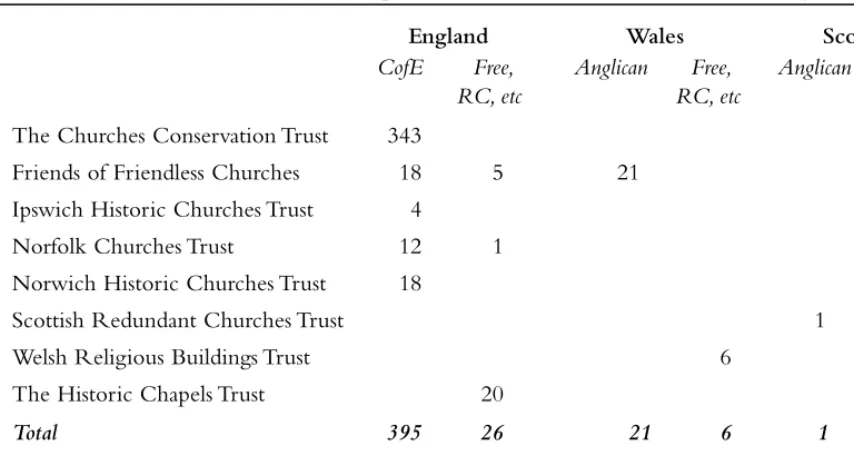
Hundreds of historic church and chapel buildings no longer needed for worship are already cared for by Trusts (see Table 1, overleaf). Over the coming years it is likely that fewer church buildings will be needed for regular worship and Trusts are likely to take over the care of some of the more historic ones. In addition, as discussed later, Trusts may have a role looking after churches which are not being closed.
So we need to ask, how well does the Trust model work? What does it mean for the buildings? Where does the money come from? Are these Trusts sustainable? Is this a model which deserves to be rolled out more widely?
As will become clear, I believe that the answers are broadly positive.The model most certainly can work, and often does. But there are issues, some of them systemic, which need to be borne in mind.
This introduction attempts to pull out some of the themes emerging from the individual chapters in this volume.After a brief survey of the types and numbers of Trusts, I will discuss single-building Trusts looking after closed churches, then look more briefly at multi-building Trusts, and will finally discuss whether Trusts might look after churches which are still open.
A quick word about scope. All specialist multi-building Trusts are included. Amongst the single-building Trusts, I have concentrated on Trusts looking after Church of England buildings in a ‘quiet’ way, a term explained later. Within these, a few estate churches are included (chapters 10 and 22), though I have not made any particular effort to track them down. I have excluded ruins, and proprietary and private chapels. I have somewhat regretfully excluded buildings owned by the National Trust or English Heritage, and also those which have been physically moved to a museum; regretfully, as they may well have something to teach us about interpreting these buildings to visitors.
Types and numbers
The Trusts fall into two types. The first is multi-building Trusts, each of which cares for a number of closed churches or chapels. They are described in Part 1 of the volume. Between them these multi-building Trusts look after some 455 churches and chapels of all denominations, across Great Britain (Table 1).
The second type is the single-building Trust, a local (often a
Trevor Cooper
community) Trust looking after just one church or chapel. A number of single-building Trusts looking after Church of England (CofE) buildings are described in Part 2 of the volume, along with a few other single-building organisations of interest. There are further examples in the Appendix to this introduction, including a number of non-CofE examples. The figures in the Table for this type of Trust will certainly be an underestimate, as no one holds a reliable master list for England and Wales; the Scottish figures may be more accurate.
Adding up the first column in the Table shows that there are 435 Church of England buildings known (by me) to be looked after by Trusts.To put this in context, this is almost a quarter of the Church of England churches which have been closed since 1969. These Trust churches would form a good-sized diocese.
Single-building Trusts and closed churches
In this section I will discuss single-building Trusts looking after closed CofE churches.Tracking down the various Trusts has been difficult, but I have been in contact with a reasonable number, and some of these conversations led to the chapters in Part 2 of the book, on which this part of the Introduction is based.
Table 1: Number of churches and chapels looked after by charitable Trusts in England and Wales
England Wales Scotland
CofE Free, Anglican Free, Anglican Free, RC, etc RC, etc RC, etc
The Churches Conservation Trust 343
Friends of Friendless Churches 18 5 21
Ipswich Historic Churches Trust 4
Norfolk Churches Trust 12 1
Norwich Historic Churches Trust 18
Scottish Redundant Churches Trust 1 6
Welsh Religious Buildings Trust 6
The Historic Chapels Trust 20
Total 395 26 21 6 1 6
Single-building Trusts 40+ 5+ 5+ 2+ ? 80–100
(‘Quiet’ buildings: see note)
CofE = Church of England; Free = Free Churches; RC = Roman Catholic. For the first eight rows, see the relevant chapters in this volume.
Selection of ‘quiet’ churches
My focus has been those Trusts which are directly responsible for repairs and insurance and all other running costs of the building. Except in a few instances of particular interest, I have not included cases where the Trust is responsible for only part of the building, or has no direct responsibility for it.
For this investigation I have been most interested in cases where the closed church is being looked after for its own sake, in a ‘quiet’ way, respecting the original use of the building, rather than being converted to provide a new income-generating purpose. So I have for the most part excluded cases where the interiors have been purposefully converted to generate revenue – for example, converted to a theatre, a cafe, an exhibition space, rehearsal studio, concert hall, bookstore, museum, heritage centre, village hall, and so on. Such buildings rely on a quasi-commercial business model for long-term sustainability, and although relatively common and important as a model, the issues are rather different from those which interested me in this study, where I wanted to look at ‘quiet’ churches with no obvious source of income. Perhaps not surprisingly, the majority of my ‘quiet’ churches are rural.
These Trusts vary. But they often have points in common. For example, they do not seem very often to be looking after Grade I buildings, perhaps because churches of such importance have tended to go to other caretakers. There are exceptions: Mickfield (chapter 19), is one example. But on the whole these buildings have been saved because they are important to people locally, whatever their grade of listing.
Mostly these Trusts lease their buildings from the diocese at a peppercorn rent, rather than own them freehold. The buildings have usually been freed of the legal effects of consecration, which would otherwise have restricted their use – this is, incidentally, a purely legal move: there is no ‘service of deconsecration’. There are, however, different arrangements between the Trusts over graveyards (which can be costly to maintain) and regarding access (see for example Wattisham, chapter 27).
Use of the buildings
Given that I had selected these single-building Trusts because they looked after their buildings in a ‘quiet’ way, I fully expected their approach to be rather conservative, taking on the building as they found it, and freezing it more or less unchanged.
have introduced facilities well before this became fashionable. Others, such as Sibton (an unusual Friends group, chapter 24) have introduced neat solutions in sensitive spaces. Some, of course, have left the building as it is, for example at Brampton Old Church (chapter 12). On the whole, these ‘quiet’ Trusts take a pragmatic but cautious approach, avoiding dramatic change, yet often modifying the building to be usable on occasions.
The majority of these single-building Trusts hold a few services per year, at Christmas and other major festivals, the lease usually placing a restriction on how many services are held, presumably to avoid competition with a neighbouring parish.
I have the strong impression that many of those attending these services are not regular churchgoers: these are communal events. Also, of course, they raise funds. One has to ask, over the longer term will this habit of holding services die away as nostalgia for the past use of the building grows more distant? Will these ‘quiet’ church buildings eventually lose the associations originally attached to them and turn into quasi-concert-halls? My personal view is that this may happen, but only slowly. However I cannot help noticing that Southolt’s Summer Service contains hymns, but little else requiring religious affirmation (chapter 25); and No Man’s Heath (chapter 20) has found that visitors like simply to sit quietly in the decorated and candlelit church during the Christmas period. Perhaps these are early signs of change.
In some cases, such as Plumpton (chapter 21) the main use of the building seems to be holding services from time to time. But most Trusts use their building for a number of other fund-raising events during the year, such as lectures, music evenings, and film nights, a creative mix of activities designed to attract people and donations. Food and drink frequently make an appearance at these events, and as rapidly disappear.
No doubt there is the same mix of motivations as in most charitable fund raising. I sense that after the initial excitement of restoring the church (many churches are in bad condition when taken over – a subject in itself), the building itself acts as a firm reminder to continue with organising events. Gradually the events take on a life of their own, and seem often to be attended not by a small coterie of staunch ‘regulars’ but by people often living some distance away, with no deep commitment to the building. One side effect is that although these Trusts may sometimes have no formal local accountability (of the type that is typical of a village hall), most of them seem to be open and porous in their activities, and thus indirectly influenced by a wide group of stakeholders.
slowly changing.The Trust may have been set up to block the sale or demolition of the building, or to maintain access to a churchyard.The initial aim, then, was often to keep memory alive by keeping the building available – though there are important exceptions, such as Warter (chapter 26). But as new blood came on board, and as the population turned over, this begun to seem less important and the use of the building for occasional community purposes grew in importance. I cannot prove this is happening and I may be wrong; but the reader may perhaps sense this change in some of the chapters.
The Trusts I spoke to are genuinely proud of their buildings and of their role in maintaining them for public benefit, and most make an effort to keep the buildings open, or name a keyholder. This is easier in those cases where the church is in the grounds of a house converted to a hotel, as at Bramhope (chapter 11), or Babington and Ettington, listed in the Appendix. But most of them are not marketed as ‘destination’ sites, and there is wide variation in the amount of interpretative material provided, such as guide books
Money
Money does not arrive by magic, and the need for it is clearly a major driving force. Some Trusts have a membership structure, but I was surprised how many do not, and rely instead on donations and people attending events via a mailing list.
The costs of maintaining the building are typically around four or five thousand pounds per year, some higher, some lower. As I have shown elsewhere, most churches only have large repair bills once every few decades, so a relatively low annual budget for repairs is not surprising. For the most part these Trusts are not putting money aside for future very large bills (one exception is Ickworth, chapter 17) and are by default assuming that they will find a way to raise very large sums of money when the need arises. The cost of insurance was often mentioned. This is to insure for full repair, as (I believe) is often required by the lease from the diocese. It is not clear to me that one would actually want to replicate some of these buildings if they were destroyed, the requirement then perhaps being for a replacement meeting space, not a copy of the destroyed building. Matthew Saunders discusses this in his article on the Friends of Friendless Churches (chapter 3). However, full insurance may possibly be made necessary by the Trust deeds or the requirements of the local planning authority.
Sustainability
A small number of single-building Trusts are known to have failed - there are a couple of examples in the Appendix. There are a number of reasons why Trusts might struggle and perhaps fail. One is, of course, the lack of funds, particularly when a large repair bill is faced.
However I believe that the most common pressure is finding new people to take the cause forward, as described at Fordham (chapter 16) and Coombe Keynes (chapter 14). A few single-building Trusts in this volume are certainly facing a shortage of people to do the work. It is interesting that Victoria Collison-Owen has identified the same problem in Scotland (chapter 7).
One wonders whether a tie-up, formal or informal, between the Trust and the Parish Council might be one way of providing some degree of long-term continuity. (It is currently illegal for Parish Councils to make grants to livingchurches, under the Local Government Act 1894: I am not sure whether this prohibition also applies to closed churches.)
Longevity of single-building Trusts
It is important to appreciate that my sample may be biased: there were many Trusts who did not respond to my approach, and I wonder if some of those are facing difficulties which they did not want to publicise. Furthermore very few single-building Trusts have been around long enough for us to understand how stable they are over any significant period of time. So we simply do not have the knowledge to comment with any certainty on the typical longevity or performance of a single-building Trust.
We can say, though, that a significant number do get past their twenty-year mark and are still going strong. My general feeling is that in a very uncertain world, this form of self-help is at least as stable as relying on Local Authority ownership (see for example the case of Ryde, chapter 23), or as relying on the organs of central Government, as we will see in the next section.
Multi-building Trusts and closed churches
So far I have been looking at single-building Trusts. The next, rather briefer, section considers eight multi-building Trusts in Great Britain which look after closed churches and chapels.
governments have increasingly squeezed it financially.As a result it has actively been seeking to broaden its financial base.
The other multi-building Trusts vary in size from more than forty buildings (the Friends of Friendless Churches) to four, previously five (the Ipswich Historic Churches Trust). None of these other Trusts has a statutory duty, and they have a range of funding relationships with government and other public authorities.
Purposes
One interesting difference between these Trusts lies in how they see their purpose – though I must emphasise that what follows is my personal analysis. It seems to me that there is a spectrum from ‘curatorial’ – that is, preserving a portfolio of good buildings, passing them on unchanged to future generations; to ‘repurposing’ – a rather unpleasant neologism conveying the idea that an existing building is converted for a new purpose, perhaps drastically so, whilst trying not to lose what is important about it. The Trusts can perhaps be split into three groups. The first group is more or less curatorial. In this group are the Friends of Friendless Churches and the Norfolk Churches Trust.At the other end of the spectrum are two groups who actively seek to find new uses for all or most of their buildings – the Ipswich Historic Churches Trust and the Norwich Churches Trust. It is surely no coincidence that the first two Trusts mainly look after rural churches, whereas the second two work in an urban environment, where population density make it more likely that a new use will be found, together with the necessary investment, and that if a new use is not found, there will be vandalism. It may be no coincidence that the first two have a strong membership base, the latter two less so; though the direction of causality is not obvious. The third group is of three Trusts – the Scottish Redundant Churches Trust, the Welsh Religious Buildings Trust and the Historic Chapels Trust.These were founded relatively recently on one tenet (curatorial), and took on expensive long-term commitments on that basis; now the world has changed, funding streams are turning against this principle, and the Trusts are having to move to a different model (repurposing). This is not an easy transition, especially if there is an existing portfolio of buildings in poor condition acquired on the curatorial principle.
buildings on their merits (these are my words). Thus, for a small number of its buildings it has worked with a range of partners to invest heavily in the building for brand new uses, though at my request, these are not discussed in their article in this volume (chapter 2), as our focus here is rather different. (Details of these cases can be found on the Trust’s website.) So this organisation stretches along the spectrum.
Comparison of multi- and single-building Trusts
The multi-building Trusts have some obvious advantages compared to single-building ones, for example continuity and expertise. On the other hand, a multi-building Trust will tend to lack local knowledge; and it also risks ‘freeloading’ by individual churches: that is, locals having use of a building free of charge, because it is funded from the centre – explaining why it can be difficult for this form of Trust to hand its buildings back.
Given this, it is not surprising that the multi-building Trusts have attempted to acquire some of the characteristics of a single-building Trust, mainly by encouraging local Friends groups and similar, and giving them a degree of autonomy. This is an area where I suspect the different multi-building Trusts could usefully learn from each other.
What is surprising is that many of the single-building Trusts I have spoken to show little sign of trying to acquire the advantages of a multi-building Trust.They seem to go it alone. For example, few if any of the ‘quiet’ single-building Trusts have joined the Association of Preservation Trusts (www.ukapt.org.uk), or made use of the extensive help that is available from that body.There is room for improvement here, for existing Trusts, and perhaps as a requirement for new ones.
Trusts looking after open churches
Churches used for special services only
The Trusts described in this volume mostly look after closed churches – closed in the sense that they are no longer used for regular worship.
One idea that seems to have been gaining ground recently is that a church building could stay open, but could cease holding regular services of worship. It would however remain in use for major festivals, and for weddings, funerals and baptisms, for a total of at least six services per year, which is the minimum required by some grant schemes.The choice of services might be in the hands of the local community, and funded by them.
independent legal personality, it would probably fall under the aegis of the diocese or other church authority.
In discussing this idea, such buildings are described variously as ‘festival churches’ (see chapter 32) , ‘pilgrim churches’ (chapter 30), ‘celebration churches’ (by the diocese of Lincoln, not printed in this volume), ‘shrine churches’ (diocese of Ely) or ‘Trust churches’ (chapter 31). Richard Halsey’s article in Ecclesiology Today
45 (2012), explored the idea in some depth.
Thus in rural parishes where attendance is very low a church could be converted to festival/pilgrim/celebration/shrine/Trust status without actually closing it, closure often being the trigger for objections and resistance. Under this arrangement, the church would still be there, still maintained, still within sight of the diocese, and still occasionally holding services.
This of itself would not save much money, probably mainly the variable cost associated with heat and light for services, and a small proportion of a stipendiary priest. So who would pay the ongoing costs? Would it be the existing tiny congregation, despite having no services in their church? Or perhaps those living nearby (if there are any) might contribute - would they be willing? Or there could be a central Trust pot of money, to which people are invited to contribute (though this would mirror the activities of some existing bodies).All in all, this is an interesting idea, and well worth exploring, but I do think that the question of how to widen the pool of supporters is fundamental.
PCC paying for use of church building
There is another model, which might signal the future. In two cases, (Fernham and Yarpole, chapters 15 and 28), the Trust is responsible for a church building which has not been closed, and is still used for regular worship, and the Parochial Church Council (PCC) makes a financial contribution for use of the building.
Under such arrangements, the PCC reduces its cost base and any worries as to future costs, and the Trust has access to the church building for community use.
Imaginary worlds
And now to enter the realm of the imagination.
It is not hard to at least conceive of a different motivation for a Trust, though I know of no actual examples – namely a Trust which had no interest in using a building for community purposes, but simply wanted to preserve an exceptionally important building for the sake of the nation. In such a case, why not release the PCC of any responsibility for the building, put it in the hands of a preservation Trust, and allow the PCC to rent it back, without closing the church?
Some years ago I explored this and other ideas in a series of four imaginary case studies, here printed as chapter 33. Two further thoughts emerged from those musings – first, that ownership by a Trust could make church closure less traumatic; and secondly that perhaps we would benefit from an overarching Trust to provide a backstop for individual single-building Trusts. The list of legal options provided in the CBC’s article (chapter 29) might add useful flexibility to some of these early ideas.
Conclusion
It seems to me that the evidence from this volume is that Trusts are capable of looking after closed church buildings in a way that preserves their integrity and is sustainable at least over the medium term. In addition Trusts can have a role in looking after living church buildings. There are just two examples in this volume, but I would expect this model to become more common. Perhaps surprisingly, the major threat to single-building Trusts is not money, but replacing their people. Conversely, the major threat to multi-building Trusts most certainly is money, as they can be heavily reliant on a small number of public funders whose priorities can and do change.
Perhaps Trusts are best not seen as a solution but as a mechanism
– a mechanism for thinking about options, raising funds, directing enthusiasm, bringing together expertise, managing projects, keeping things running, and making sure everyone stays on board. They are a mechanism for involving others who share similar values and will support the cause; for maintaining some fixity of purpose beyond the desires of any one individual; for demonstrating the popularity and validity of the cause to funders; for focusing on the longer term; and for seeking public rather than private or commercial benefit.
APPENDIX
: Single-building Trusts not
otherwise described in this volume
This is a list of Trusts (mostly charitable Trusts) looking after single church or chapel buildings which do not have separate chapters in the body of this volume. It is intended to include only buildings which are used occasionally (‘quiet’ churches). It excludes ruins, buildings moved to a museum location, and those owned by the National Trust or English Heritage. All these Trusts are active to the best of my knowledge, unless I indicate otherwise.
There will be errors.There will also be omissions, probably many of them. I would be very grateful to be notified of either, using the contact address at the rear of this volume.
ENGLAND
:
CHURCH OF ENGLANDSt Margaret, Babington, Somerset.In hotel grounds. All Saints, Burghclere, Hampshire.Status not known. St Bartholomew’s, Covenham, Lincolnshire
Church of the Assumption, East Wittering, Sussex.
Trust appears to be inactive.
Ellerton Priory (St Mary and St Lawrence), Ellerton, East of Yorkshire. www.ellertonpriory.co.uk Ettington Old Church,Warwickshire.In hotel grounds.
See http://warwickshirechurches.weebly.com/ettington-park---holy-trinity.html
St Mary, Iwerne Steepleton St Andrew, Lilstock, Somerset Lyscombe Chapel, Dorset.
Was ruinous, repaired, atmospheric shell; open.
Old Murston Church, Murston, Kent.Trust appears inactive; no further details. See http://tinyurl.com/oldmurstonchurch St Mary the Virgin, Perivale, London Borough of Ealing.
Active, organises concerts. St Mary, Rimswell,Yorkshire
Rycote Chapel, Rycote, Oxfordshire.Chapel regularly open. http://rycote.bodleian.ox.ac.uk/visiting
All Saints, Santon, Norfolk
Holy Trinity, Sunk Island,Yorkshire.Status not known. St James,Titsey, Surrey.Associated with an estate. St John,Toller Whelme, Dorset
St Peter and St Paul,Tunstall, Norfolk.
Nave in ruins, chancel preserved.
St Peter’s, Ufton Nervet, Berkshire
ENGLAND
:
NONCONFORMISTBilly Bray’s Three Eyes Chapel, Baldhu, Cornwall. www.billybray.org.uk/
Clovelly Methodist Chapel, Clovelly, Devon. www.methodistheritage.org.uk/clovelly.htm Gwythian chapel, Cornwall.
www.gwithianchapel.org.uk
Osmotherly Chapel,Yorkshire.Restored chapel; used for services. www.methodistheritage.org.uk/osmotherley.htm
Raithby Chapel.Privately owned; occasional services. www.methodistheritage.org.uk/raithbybyspilsby.htm Tewkesbury Old Baptist Chapel. www.johnmooremuseum.
org/our-collections/old-baptist-chapel.html
SCOTLAND
Clachan Church, Applecross,Wester Ross.
www.visit-applecross.org/pagex.asp?bioid=33640 Crichton Collegiate Church, Midlothian.
www.crichtonchurch.com/ Edderton Old Kirk, Easter Ross.
www.spanglefish.com/eddertonoldkirk/ Kineff Old Kirk, Aberdeenshire.
www.kinneffoldchurch.co.uk/ Kirkaldy Old Kirk, Fife.
www.kirkcaldyoldkirktrust.org.uk/ Nigg Old Church, Easter Ross.
www.niggoldtrust.org.uk/
Tealing Kirk Heritage Centre Trust.Trust failed; building at risk. http://tinyurl.com/tealingchurch
WALES
St Michael’s, Betws-y-Coed, Snowdonia. www.stmichaelsbyc.org.uk/
Llandegwning church near Botwnnog, Gywnedd. ww.tremadog.org.uk/content/projects.php St Julitta’s, Capel Curig, Snowdonia.
www.stjulittas.org
Carnguwch church near Llithfaen, Gwynedd.
No further information.
Ceredigion chapel, Machynlleth, Powys.
Apparently cared for by a museum. No further information.
www.methodistheritage.org.uk/theoldchapel.htm Burnett’s Hill Chapel, Martletwy, Naberth, Pembrokeshire.
www.burnettshill.co.uk/ St Mary’s,Warren, Pembrokeshire.
Part 1
IN SAVING THEIR HISTORIC BUILDINGS, communities are strengthened and in their turn become better able to protect their environment in the future. Beautiful public spaces make for beautiful communities.
For the last half century, relatively generous state funding has put our historic churches in good condition, but those days look to be numbered and we face a major challenge to secure their future.
History holds the answer: in medieval times the parish church was the centre of all community life. Mixed, secular community, arts and worship use and much wider community engagement will also provide sustainability in the future.There is a widespread consensus on this now in the UK, but a good deal of uncertainty about how you go about it and there have been both successes and failures.
Churches are essentially community buildings and so any solution which is going to last has to be community led. Parish churches in particular have been kept going by local people for a thousand years or more, and it is local people who are going to be the main support for the next thousand. At The Churches Conservation Trust in our own small way, we are striving to develop such solutions.
The CCT
The Churches Conservation Trust (CCT) is the national charity protecting historic churches at risk. We have saved over 340 beautiful buildings which attract almost two million visitors a year. With our help and with support they are kept open and in use – living once again at the heart of their communities (Fig. 1). The churches in our care are English parish churches of particular historic significance which are no longer needed for regular worship by the Church of England.
The Trust is funded by a wide variety of sources, of which donations and grants are an increasingly important part. Some 50% of its funding comes in a grant from the Government and the Church Commissioners, a proportion which has dropped from 70–80% in recent years.The grant was frozen for a decade and the DCMS contribution has dropped steeply since 2010.
The Trust’s £6m annual budget pays for the maintenance and repair of all our churches. A small staff team, based mostly in the regions, provides specialist historic church management and supports 1,500 volunteers who keep CCT’s churches open and active.
Crispin Truman
Crispin Truman is Chief Executive of The Churches Conservation Trust.
Saving historic churches strengthens communities:
the work of the The Churches Conservation Trust
Description
Cares for more than 340 churches no longer needed for regular worship by the Church of England.
Founded
1969
Location
Owns buildings throughout England.
Access
Varies; many are open during the day.
Website
The Collection
The Trust owns 345 Grade I and II* listed Anglican churches, a number which is increasing by two or three a year. Even before a church is placed in our care we start to consider the conservation needs together with the potential of each building in terms of community and other use. Based on location and support within the community and from other local partners we can begin to assess options for opening the church and seeing it in use. With a huge range of churches in our care, from tiny rural gems in parts of the country where the locals moved away centuries ago, to significant small town churches and massive Victorian buildings suffering vandalism and arson in inner urban areas, the considerations can be very different.
With smaller rural churches our priority is to promote the church as a place for visitors to enjoy whilst encouraging local people to hold occasional events and services. With the larger churches we seek partners – including Friends’ groups - to work with us to manage and use the church on a regular basis.
Our strategy
A lot of our work involves conserving a very special collection. But there is much more to do if we are to keep these buildings for the future. Faced with reduced funds, an increasing number of churches at risk and several additional churches each year, our strategy has to be about engaging a wider constituency of support and sustaining our buildings through widespread local activity.
Our current strategic aims are shown in the box. In practice that means there are a wide range of small, medium and large projects which are at various stages of development, including:
• Conservation repairs – (there has been no let-up here) • Tourism and visiting
• Education and learning • Arts/cultural uses • Community use
• Volunteering and local management • Craft skills training
Community solutions
not always necessary and it is often very subtle changes which are needed. As has been said,‘a new use must be in conversation with the original use and not obliterate it’.
The key principles of wider engagement, partnership and locally-led ‘visioning’ apply across the diverse situations historic church buildings find themselves in. However the practicalities vary hugely and at CCT we approach each church building individually, though we have a number of different models depending on size, context and location.
One way in which we work with the local community is through Friends groups. Many of our churches have groups of individuals who care passionately about the future of their local church and are keen to use the church as their own.These groups are independently constituted and our relationship with them is as partners.We draw up a formal partnership agreement in which we agree a shared vision as to how the church is to be protected and used in the long-term and which places responsibilities on each partner for its management and financing.
In other situations CCT has its own, directly-managed volunteer team who will provide the visitor welcome and run the church for the Trust.
Our churches play host to a wide range of activities from the traditional – carol services, cake sales, art exhibitions, classical concerts and theatre – to the unusual, for example, our new initiative ‘champing’ which allows camping in church.
Sharing stories
In recent years we have become more focused on telling our story. This can be general PR promoting the CCT and specifics about what we do; working with schools to bring history alive; or through the churches themselves, by interpreting the stories of our churches onsite in an accessible way for visitors.
We aim through PR to promote CCT in various ways such as through fun campaigns like our current ‘Great Church Bake Off ’ competition. This raises awareness amongst those who may not know about CCT already and who may not be aware of the beautiful historic churches on their doorsteps. We also promote
Current strategic aims of the CCT
Inspire
people to visit, enjoy, understand and use our
churches
Sustain
our churches: conserve and adapt them for
twenty-first century use
the more serious side of our work, such as conservation projects and tourism initiatives. The more people who are aware of what we do, the more likely we are to generate support.
At the heart of our National Plan for Learning is the Explorer Church Partnership (ECP) project. This is facilitated by three regional Heritage Learning Officers based in Bristol, Cambridge and Leeds, and it encourages schools to engage with their local CCT church through a bespoke programme of access and activities. In this way the staff, students and wider school communities have the opportunity to develop a greater understanding and sense of pride in these buildings, which stand at the heart of their communities.
The Trust has recently developed an interpretation plan to ensure that the way we tell stories in our churches is engaging for visitors (Fig. 2).We are starting with pilot projects which we will then roll out to more churches. For example, in St Peter’s church, Sandwich a recent project, funded by the Heritage Lottery Fund, included the addition of new interpretation panels telling the story of the church through images of key events in the history of the town; the panels engage visitors as soon as they enter the church and allow them to interpret the story in their own way.
Some may ask why provide interpretation when the economic pressures on repairing the estate are so great? As one of the leading operators of heritage attractions, we need to connect people with our heritage so that people keep visiting and coming back to our sites, and are keen to contribute and participate as volunteers, donors and ambassadors: from which our profile and income rise and our estate becomes sustainable. Good – proportionate and relevant – interpretation is a powerful tool for engagement.
v v v
We warmly invite people to join one of our annual gift schemes and be kept informed about our work and our plans for the future. Full details of the various schemes are on our website. For example, for as little as £3 a month you can join our Supporters scheme. As well as knowing your gift will make an enormous difference to the work of CCT, you will also enjoy a number of benefits including:
• Priority booking and discounts for our Historic Church Tours, craft skills courses and occasional conferences; • Special discounts for other heritage attractions; • A bi-annual newsletter and a bi-annual bulletin giving
you an exclusive insight into our work and plans for the future;
• A complimentary copy of our annual review;
• Special discounts on CCT merchandise, such as Christmas Cards.
Supporter gift memberships are available for both individual and joint supporters. For more details, see our website www. visitchurches.org.uk
Christchurch, Waterloo, Merseyside
Old Christchurch,Waterloo (Fig. 1) is an imposing church which has for over 100 years served as a landmark building in this once prosperous seaside resort. Known locally as Waterloo Cathedral and the Mariners Church, on a clear day its majestic Old Red Sandstone tower can be seen as far away as Anglesey.
The church was disused for many years and World War II bombing and later vandalism took its toll (Fig. 3). In 1998 the church was vested into CCT’s care and in 1999 the Friends of Old Christ Church, Waterloo were formed with the aim of working with and assisting the Trust in the care and preservation of the contents and church. The Friends (www.oldchristchurch. moonfruit.com/) have been so successful at organising events and raising money (Figs 4 & 5) that they are now looking to become a Charitable Incorporated Organisation. However the church currently faces huge repair liabilities and CCT and the Friends are working together to apply for funding to ensure the future of this building.
Fig. 3 (right): Old Christchurch, Waterloo, Merseyside, a photograph taken in 1996 showing the effect of vandalism on the building.The building was taken into the care of the CCT in 1998.
Fig. 4 (opposite top): A farmers’ market in Old Christchurch.
St Michael & All Angels, Princetown, Devon
St Michael and All Angels’ church at Princetown on Dartmoor (Fig. 6) is the only church in England to have been built by prisoners of war.
In the last year CCT has worked with local volunteers and funders to conserve the east chancel window (Figs 7 & 8) which was donated in 1904 , a group which is still in existence today.The harsh Dartmoor weather had affected the delicate painted detail of the stained glass window and water ingress had caused the internal bars of the window to bow and leak.This has become the first CCT project to be entirely externally funded with a combination of donations and grants (from the Heritage Lottery Fund, the National Society United States Daughters of 1812 and other sources). The conservation project included a range of learning opportunities including a conservation internship and educational workshops with Princetown Primary School.
Funding has allowed us to secure a range of new heritage visitor information (Fig. 2) with the support of the community and volunteers who play such an important role in the church, putting St Michael’s firmly on the Dartmoor tourist trail.We have also joined the local tourism initiative, the ‘Dartmoor Partnership’.
What was particularly encouraging about this project was how CCT was able to work in a focused way with a small dedicated group of volunteers who all had important roles to play, working to a tight schedule; and how with the help of overseas support the team worked creatively within the conditions imposed by the church.
St Peter’s, Sudbury, Suffolk
This vast medieval church dominates the town of Sudbury from the top of Market Hill (Fig. 9). In 1976 ownership of the building passed to the CCT and in the same year the Friends of St Peter’s, Sudbury was formed with the aim of keeping the building open, in good order and enabling its use for the benefit of the community in partnership with the Trust.
Since then the Friends Group (www.stpetersudbury.co.uk) has developed a programme of events all year round (Figs 10 & 11). There are about 50,000 visitors a year, mostly from people attending these events. Events include the popular Kettle & Fish – a peaceful café / information environment, musical concerts and a farmers’ market.The Friends raise income to cover most of the running costs and visitor donations provide CCT with unrestricted income to care for other churches.
Fig. 9 (below): St Peter’s, Sudbury, Suffolk, from the market square. (Simon Knott,
www.suffolkchurches.co.uk)
Fig. 10 (top right): Christmas 2013 at St Peter’s, Sudbury.
St Peter’s, Preston Park, Brighton, East Sussex
St Peter’s is a small medieval church (built in about 1250) which originally served the tiny village of Preston, now part of Brighton (Fig. 13). The Friends of St Peter’s group (www.stpeterspreston park.co.uk) was formed in 2007, after the church had been closed for several years, and there are now about seventy members. A committee of eight meets regularly to plan events, working in partnership with the CCT and using the Trust’s fundraising events programme for ideas.
The church is important as it contains three medieval wall paintings (Fig. 12), which, although damaged in a fire in 1906, can still be understood with the help of earlier drawings. The group has raised money to have one of these cleaned and conserved, by holding an annual book, cake and plant sale, which this year raised £575.
Seven volunteers each have a key and are responsible for opening and closing the church on the same day each week. The church is open 365 days a year, even on Christmas Day, and people write in the Visitors Book how much they appreciate this (Fig. 14). Many couples return on their wedding anniversaries, as much as sixty years after the event.
St Peter’s stands at one end of a large public park, and is next to Preston Manor, which is now a museum. In the summer the museum visitors also come into the church, and this increases donations.
This year St Peter’s will hold an exhibition for ‘Not Forgotten’ (The Great War Centenary) on which they have been working for more than a year.
Fig. 12 (right):Wall painting on the east wall of the nave at St Peter’s, showing the martyrdom of St Thomas Becket.To the right is a priest celebrating Mass, and to the left the soldiers hack at St Thomas, who kneels in the centre of the picture. (Budby, www.flickr.com)
Fig. 13 (opposite top): St Peter’s, Preston Park, Brighton, Sussex, from the south-west.
List of CCT churches
Abbotsley, Cambridgeshire (St Margaret’s Church) Adderley, Shropshire (St Peter’s Church)
Akenham, Suffolk (St Mary’s Church) Albury, Surrey (Church of St Peter & St Paul) Aldwincle, Northamptonshire (All Saints’ Church) Allerton Mauleverer, North Yorkshire
(St Martin’s Church)
Allexton, Leicestershire (St Peter’s Church) Alton Priors,Wiltshire (All Saints’ Church) Ashley, Hampshire (St Mary’s Church) Avon Dassett,Warwickshire
(Church of St John the Baptist)
Ayston, Rutland (Church of St Mary the Virgin) Badley, Suffolk (St Mary’s Church)
Barnetby-le-Wold, Lincolnshire (St Mary’s Church) Barton Bendish, Norfolk (St Mary’s Church) Battlefield, Shropshire
(Church of St Mary Magdalene) Becconsall, Lancashire (Old Church) Beeby, Leicestershire (All Saints’ Church) Berechurch, Essex (St Michael’s Church) Berwick Bassett,Wiltshire (St Nicholas’ Church) Berwick,Wiltshire (St Leonard’s Church) Billesley,Warwickshire (All Saints’ Church) Birdforth, North Yorkshire (St Mary’s Church) Blackburn, Lancashire (Holy Trinity Church) Blatherwycke, Northamptonshire
(Holy Trinity Church)
Bolton, Lancashire (All Souls’ Church) Booton, Norfolk
(Church of St Michael the Archangel)
Bothenhampton, Dorset (Holy Trinity Old Church) Botolphs,West Sussex (St Botolph’s Church) Bradstone, Devon (St Nonna’s Church) Brandiston, Norfolk (St Nicholas’ Church) Brentingby, Leicestershire (St Mary’s Church) Bridgnorth, Shropshire (St Leonard’s Church) Bristol, Bristol (Church of St John the Baptist) Bristol, Bristol (Church of St Thomas the Martyr) Bristol, Bristol (St Paul’s Church)
Brockley, Somerset (St Nicholas’ Church)
Brookthorpe, Gloucestershire (St Swithun’s Church) Brougham, Cumbria (St Ninian’s Church)
Broughton, Buckinghamshire (St Lawrence’s Church) Brownsover,Warwickshire
(Church of St Michael & All Angels) Buckenham, Norfolk (St Nicholas’ Church) Buckland, Hertfordshire (St Andrew’s Church) Bungay, Suffolk (St Mary’s Church)
Burham, Kent (St Mary’s Church) Burley, Rutland (Holy Cross Church)
Burringham, Lincolnshire
(Church of St John the Baptist)
Burwell, Lincolnshire (St Michael’s Church) Buslingthorpe, Lincolnshire (St Michael’s Church) Bywell, Northumberland (St Andrew’s Church) Cadeby, South Yorkshire
(Church of St John the Evangelist)
Cambridge, Cambridgeshire (All Saints’ Church) Cambridge, Cambridgeshire (St Peter’s Church) Cameley, Somerset (St James’ Church)
Capel, Kent (Church of St Thomas a Becket) Capel-le-Ferne, Kent (St Mary’s Church) Carrington, Greater Manchester
(St George’s Church)
Catmore, Berkshire (St Margaret’s Church) Chadshunt,Warwickshire (All Saints’ Church) Charfield, Gloucestershire (St James’ Church) Cheam, Surrey (Lumley Chapel (St Dunstan’s)) Chichester,West Sussex
(Chapel of St John the Evangelist) Chickney, Essex (St Mary’s Church) Chilton, Suffolk (St Mary’s Church)
Chiselhampton, Oxfordshire (St Katherine’s Church) Church Norton,West Sussex (St Wilfrid’s Church) Churchill,Worcestershire (St Michael’s Church) Chute Forest,Wiltshire (St Mary’s Church)
Clapton-in-Gordano, Somerset (St Michael’s Church) Claydon, Suffolk (St Peter’s Church)
Clixby, Lincolnshire (All Hallows’ Church)
Colchester, Essex (St Leonard-at-the-Hythe Church) Colchester, Essex (St Martin’s Church)
Colemore, Hampshire
(Church of St Peter ad Vincula)
Conington, Cambridgeshire (All Saints’ Church) Cooling, Kent (St James’ Church)
Copley,West Yorkshire (St Stephen’s Church) Coston, Norfolk (St Michael’s Church)
Cotham, Nottinghamshire (St Michael’s Church) Covehithe, Suffolk (St Andrew’s Church)
Coverham, North Yorkshire (Holy Trinity Church) Cowthorpe, North Yorkshire (St Michael’s Church) Cranford, Northamptonshire (St Andrew’s Church) Croome D’Abitot,Worcestershire
(Church of St Mary Magdelene)
Deene, Northamptonshire (St Peter’s Church) Derby, Derbyshire (St Werburgh’s Church) Draycot Cerne,Wiltshire (St James’ Church) Duxford, Cambridgeshire (St John’s Church) East Bradenham, Norfolk (St Mary’s Church) East Heslerton, North Yorkshire
(St Andrew’s Church)
East Peckham, Kent (St Michael’s Church) East Ruston, Norfolk (St Mary’s Church) East Shefford, Berkshire (St Thomas’ Church) Eastleach Martin, Gloucestershire
(St Michael & St Martin’s Church)
Edlesborough, Buckinghamshire (St Mary’s Church) Edlington, South Yorkshire (St Peter’s Church) Edmondthorpe, Leicestershire
(Church of St Michael & All Angels) Edworth, Bedfordshire (St George’s Church) Ellough, Suffolk (All Saints’ Church) Elston, Nottinghamshire (Elston Chapel)
Elworthy, Somerset (Church of St Martin of Tours) Emborough, Somerset (
Church of The Blessed Virgin Mary) Esher, Surrey (St George’s Church) Everleigh,Wiltshire (St Peter’s Church)
Evesham,Worcestershire (St Lawrence’s Church) Exeter, Devon (St Martin’s Church)
Falinge, Greater Manchester (Church of St Edmund) Farndish, Bedfordshire (St Michael’s Church) Feltwell, Norfolk (St Nicholas’ Church)
Fisherton Delamere,Wiltshire (St Nicholas’ Church) Fledborough, Nottinghamshire (St Gregory’s Church) Fleet Marston, Buckinghamshire (St Mary’s Church) Fordwich, Kent (Church of St Mary the Virgin) Freefolk, Hampshire (St Nicholas’ Church) Frenze, Norfolk (St Andrew’s Church) Friarmere, Lancashire (St Thomas’ Church) Furtho, Northamptonshire
(St Bartholemew’s Church)
Fylingdales, North Yorkshire (St Stephen’s Church) Garthorpe, Leicestershire (St Mary’s Church) Gloucester, Gloucestershire (St Nicholas’ Church) Goltho, Lincolnshire (St George’s Church) Goodnestone, Kent (St Bartholomew’s Church) Great Steeping, Lincolnshire (All Saints’ Church) Gunton, Norfolk (St Andrew’s Church)
Guyhirn Chapel, Cambridgeshire (Guyhirn Chapel) Haceby, Lincolnshire (St Barbara’s Church)
Hales, Norfolk (St Margaret’s Church)
Halifax Haley Hill,West Yorkshire (All Souls’ Church) Halstead, Essex (Holy Trinity Church)
Haltham-on-Bain, Lincolnshire (St Benedict’s Church)
Hardington Bampfylde, Somerset (St Mary’s Church) Harewood,West Yorkshire (All Saints’ Church) Hartley Wintney, Hampshire (St Mary’s Church) Hartwell, Buckinghamshire
(Church of The Assumption)
Haugham, Lincolnshire (All Saints’ Church) Heaton Norris, Lancashire (Christ Church)
Heckingham, Norfolk (St Gregory’s Church) Hellington, Norfolk (Church of St John the Baptist) Higham, Kent (St Mary’s Church)
Hockwold, Norfolk (St Peter’s Church) Holcombe, Somerset (St Andrew’s Church) Holdenby, Northamptonshire (All Saints’ Church) Holme Lacy, Herefordshire (St Cuthbert’s Church) Hove, East Sussex (St Andrew’s Church)
Icklingham, Suffolk (All Saints’ Church) Idmiston,Wiltshire (All Saints’ Church) Imber,Wiltshire (St Giles’ Church)
Inglesham,Wiltshire (Church of St John the Baptist) Ipswich, Suffolk (Church of St Mary-at-the-Quay) Ireby, Cumbria (Old Chancel)
Islington, Norfolk (St Mary’s Church) Itchen Stoke, Hampshire (St Mary’s Church) Kedleston, Derbyshire (All Saints’ Church) King’s Lynn, Norfolk (St Nicholas’ Chapel) Kingerby, Lincolnshire (St Peter’s Church) Kingsbury, London (St Andrew’s Church) Kingsdown, Kent (St Catherine’s Church)
Kirk Sandall, South Yorkshire (St Oswald’s Church) Knotting, Bedfordshire
(Church of St Margaret of Antioch) Knowlton, Kent (St Clement’s Church)
Lambourn Woodlands, Berkshire (St Mary’s Church) Lancaster, Lancashire
(Church of St John the Evangelist) Langport, Somerset (All Saints’ Church) Lassington, Gloucestershire (St Oswald’s Tower) Lead, North Yorkshire (St Mary’s Church) Leeds,West Yorkshire
(Church of St John the Evangelist) Leicester, Leicestershire (All Saints’ Church) Leigh Delamere,Wiltshire
(Church of St Margaret of Antioch) Leigh,Wiltshire (All Saints’ Church) Linley, Shropshire (St Leonard’s Church) Little Barford, Bedfordshire (St Deny’s Church) Little Bromley, Essex (Church of St Mary the Virgin) Little Cawthorpe, Lincolnshire (St Helen’s Church) Little Hormead, Hertfordshire
(Church of St Mary the Virgin)
Little Somborne, Hampshire (All Saints’ Church) Little Stanmore, London (Chandos Mausoleum
(St Lawrence’s Church)) Little Washbourne, Gloucestershire
(St Mary’s Church)
Little Wenham, Suffolk (All Saints’ Church) Little Witchingham, Norfolk (St Faith’s Church) Littleborough, Nottinghamshire
Llanrothal, Herefordshire
(Church of St John the Baptist)
Long Stanton, Cambridgeshire (St Michael’s Church) Longford, Shropshire (Talbot Chapel)
Low Elswick,Tyne & Wear (St Stephen’s Church) Low Marnham, Nottinghamshire
(St Wilfrid’s Church) Lower Basildon, Berkshire
(St Bartholomew’s Church)
Lower Gravenhurst, Bedfordshire (St Mary’s Church) Lower Sapey,Worcestershire
(St Bartholemew’s Church) Luddenham, Kent (St Mary’s Church) Luffincott, Devon (St James’ Church) Macclesfield, Cheshire (Christ Church) Maddington,Wiltshire (St Mary’s Church) Markham Clinton, Nottinghamshire
(Milton Mausoleum)
Michaelchurch, Herefordshire (St Michael’s Church) Mongewell, Oxfordshire
(Church of St John the Baptist) Moreton Jeffries , Herefordshire (no dedication) Moulton, Norfolk (St Mary’s Church)
Nether Cerne, Dorset (All Saints’ Church)
Newnham Murren, Oxfordshire (St Mary’s Church) Newton Green, Suffolk (All Saints’ Church)
Normanby-by-Spital, Lincolnshire (St Peter’s Church) Normanton, Lincolnshire (St Nicholas’ Church) North Barningham, Norfolk (St Peter’s Church) North Cockerington, Lincolnshire
(St Mary’s Church)
North Huish, Devon (St Mary’s Church) North Stoke,West Sussex
(Church of St Mary the Virgin)
Northampton, Northamptonshire (St Peter’s Church) Northover, Somerset (St Andrew’s Church)
Norwich, Norfolk
(Church of St John Maddermarket) Norwich, Norfolk (St Augustine’s Church) Norwich, Norfolk (St Laurence’s Church) Nuneham Courtenay, Oxfordshire
(All Saints’ Church)
Oborne, Dorset (St Cuthbert Old Chancel) Offord D’Arcy, Cambridgeshire (St Peter’s Church) Old Dilton,Wiltshire (St Mary’s Church)
Old Langho, Lancashire (St Leonard’s Church) Oldbury-on-the-Hill, Gloucestershire
(St Arild’s Church)
Orcheston,Wiltshire (St George’s Church) Otterhampton, Somerset (All Saints’ Church) Oxhey, Hertfordshire (Oxhey Chapel)
Ozleworth, Gloucestershire (Church of St Nicholas of Myra) Paddlesworth, Kent (St Benedict’s Church) Parracombe, Devon (St Petrock’s Church) Parson Drove, Cambridgeshire
(Church of St John the Baptist) Patshull, Staffordshire (St Mary’s Church) Pendock,Worcestershire (no dedication)
Pensford, Somerset (Church of St Thomas a Becket) Pilling, Lancashire (Church of St John the Baptist) Pitstone, Buckinghamshire (St Mary’s Church) Portland, Dorset (St George’s Church) Potsgrove, Bedfordshire (St Mary’s Church) Preston Candover, Hampshire
(St Mary the Virgin Old Church) Preston Deanery, Northamptonshire
(Church of St Peter & St Paul)
Preston Gubbals, Shropshire (St Martin’s Church) Preston Park, East Sussex (St Peter’s Church) Princetown, Devon
(Church of St Michael & All Angels) Privett, Hampshire (Holy Trinity Church) Puxton, Somerset (Holy Saviour’s Church) Redbourne, Lincolnshire (St Andrew’s Church) Redgrave, Suffolk (St Mary’s Church)
Revelstoke, Devon
(Church of St Peter the Poor Fisherman) Richards Castle, Herefordshire
(St Bartholemew’s Church)
Rickinghall Superior, Suffolk (St Mary’s Church) Roecliffe, North Yorkshire (St Mary’s Church) Rollestone,Wiltshire (St Andrew’s Church) Roseland, Cornwall (St Anthony’s Church) Saintbury, Gloucestershire (St Nicholas’ Church) Saltfleetby, Lincolnshire (All Saints’ Church) Sandwich, Kent (St Mary’s Church) Sandwich, Kent (St Peter’s Church) Sapiston, Suffolk (St Andrew’s Church) Satterleigh, Devon (St Peter’s Church) Saundby, Nottinghamshire
(Church of St Martin of Tours) Seavington, Somerset (St Mary’s Church) Shimpling, Norfolk (St George’s Church)
Shipton Sollars, Gloucestershire (St Mary’s Church) Shirburn, Oxfordshire (All Saints’ Church)
Shorncote, Gloucestershire (All Saints’ Church) Shotley, Northumberland (St Andrew’s Church) Shrewsbury, Shropshire
(Church of St Mary the Virgin) Skelton-cum-Newby, North Yorkshire
Skelton-in-Cleveland, North Yorkshire (All Saints’ Church)
Skidbrooke, Lincolnshire (St Botolph’s Church) Snarford, Lincolnshire (St Lawrence’s Church) South Cowton, North Yorkshire (St Mary’s Church) South Elmham, Suffolk (All Saints’ Church) South Somercotes, Lincolnshire (St Peter’s Church) South Tidworth,Wiltshire (St Mary’s Church) Spetchley,Worcestershire (All Saints’ Church) Stainburn, North Yorkshire (St Mary’s Church) Stamford, Lincolnshire (St John’s Church)
Stanstead Abbotts, Hertfordshire (St James’ Church) Stansted Mountfitchet, Essex
(Church of St Mary the Virgin)
Stanton, Suffolk (Church of St John the Baptist) Stanwick, North Yorkshire
(Church of St John the Baptist) Stapleford, Leicestershire
(Church of St Mary Magdelene) Steeple Gidding, Cambridgeshire
(St Andrew’s Church)
Stirchley, Shropshire (St James’ Church)
Stocklinch Ottersey, Somerset (St Mary’s Church) Stockwood, Dorset (St Edwold’s Church) Stonham Parva, Suffolk
(Church of St Mary the Virgin) Stratford Tony,Wiltshire
(Church of St Mary & St Lawrence) Strensham,Worcestershire
(Church of St John the Baptist) Stretford, Herefordshire
(Church of St Cosmas & St Damian) Stretton-en-le-Field, Leicestershire
(St Michael’s Church)
Sudbury, Suffolk (St Peter’s Church)
Sunderland,Tyne & Wear (Holy Trinity Church) Sutton Mallet, Somerset (no dedication) Sutton Veny,Wiltshire (St Leonard’s Church) Swaffham Prior, Cambridgeshire
(Church of St Cyriac & St Julitta) Swingfield, Kent (St Peter’s Church) Tarleton, Lancashire (St Mary’s Church) Tarrant Crawford, Dorset (St Mary’s Church) Tetbury, Gloucestershire (St Saviour’s Church) Theddlethorpe, Lincolnshire (All Saints’ Church) Thornton, Buckinghamshire
(Church of St Michael & All Angels)
Thornton-le-Moors, Cheshire (St Mary’s Church) Throapham, South Yorkshire (St John’s Church) Thurgarton, Norfolk (All Saints’ Church) Thurlbear, Somerset (St Thomas’ Church)
Torbryan, Devon (Holy Trinity Church) Tortington,West Sussex
(Church of St Mary Magdalene) Uphill, Somerset (St Nicholas’ Church) Upper Eldon, Hampshire
(Church of St John the Baptist)
Upton Cressett, Shropshire (St Michael’s Church) Upton, Northamptonshire (St Michael’s Church) Upton, Somerset (St James’Tower)
Vale of Lune, Cumbria (St Gregory’s Church) Vange, Essex (All Saints’ Church)
Waithe, Lincolnshire (St Martin’s Church) Wakerley, Northamptonshire
(Church of St John the Baptist) Waldershare, Kent (All Saints’ Church) Wallingford, Oxfordshire (St Peter’s Church) Walpole, Norfolk (St Andrew’s Church) Warburton, Cheshire (St Werburgh’s Church) Warminghurst,West Sussex
(Church of The Holy Sepulchre) Washbrook, Suffolk (St Mary’s Church) Waterloo, Merseyside (Christ Church)
Wensley, North Yorkshire (Holy Trinity Church) Wentworth, South Yorkshire (Holy Trinity Church) West Bergholt, Essex (St Mary’s Church)
West Dean,Wiltshire (Borbach Chantry) West Harling, Norfolk (All Saints’ Church) West Ogwell, Devon (no dedication) West Stourmouth, Kent (All Saints’ Church) West Walton, Norfolk (St Mary’s Bell Tower) Whenby, North Yorkshire (St Martin’s Church) Whitcombe, Dorset (no dedication)
Wiggenhall, Norfolk (Church of St Mary the Virgin) Willingale Spain, Essex (St Andrew’s Church) Wilton,Wiltshire (St Mary’s Church)
Winterborne Came, Dorset (St Peter’s Church) Winterborne Tomson, Dorset (St Andrew’s Church) Wintringham, North Yorkshire (St Peter’s Church) Withcote, Leicestershire (Withcote Chapel) Wolfhamcote,Warwickshire (St Peter’s Church) Worcester,Worcestershire (St Swithun’s Church) Wordwell, Suffolk (All Saints’ Church)
Wormsley, Herefordshire (St Mary’s Church) Wroxeter, Shropshire (St Andrew’s Church) Yarburgh, Lincolnshire
(Church of St John the Baptist) Yatton, Herefordshire (The Chapel)
Development
THE DATE OF THE FOUNDATION OF THE FRIENDS is critical – 1957. That was a good twelve years before the Redundant Churches Fund (known since 1994 as the Churches Conservation Trust) emerged. They in fact shared a common founder – Ivor Bulmer-Thomas, that romantic, uncompromising Welshman, whose passion drove him to weep publicly at the sight of a church of Saxon origins under demolition in Chichester. In 1957 Ivor and The Friends were virtually alone. There was no nation-wide or formal ‘safety net’ at all.When churches shut, they came down (Fig. 1). As it was, the reality of the history of The Friends in their first 18 years was that although they could in theory take buildings into care, finances precluded it – the first vesting did not come until 1974, by which time the Redundant Churches Fund (RCF) was up and running (with Ivor as its first Chair) and already had a score of vestings to its own name.
Ivor told the world that he expected The Friends to wither on the vine following the arrival of the RCF, its Big Sister.When he was in charge of both no doubt he must have had a soft spot for an organisation like the Friends where, then as now, the Trustees were largely autonomous in their decision-taking whereas the RCF could not be acquisitive (being instructed on what they could take by the Church Commissioners). In fact The Friends have grown to the extent that we now have 47 vestings – not least because in 1993 The Friends were formally recognised as the equivalent in Wales of the Churches Conservation Trust (CCT), which can only cover England. We now own 20 Welsh churches on the back of an agreement by which Cadw provide 70% and the Church in Wales 30% of the cost of taking redundant Anglican churches in the six Welsh dioceses into care.
We can also take private chapels, where the CCT cannot, and we have two of those. Indeed, until the arrival of the Historic Chapels Trust (HCT), redundant Nonconformist chapels of note either faced the demolition man or the compromises of conversion. Hence the vesting with us in 1986 of the Grade II* listed Strict and Particular Baptist Chapel of 1792 at Waddesdon, in Bucks. And the much more recent vesting in 2011, of our one and only Catholic church – W. D. Caroe’s rather eccentric convent chapel of 1930 to St Mary of the Angels at Brownshill near Chalford, tucked away in the hills of the Stroud Valleys. It came to us because the HCT is not at present in expansive mode. (Both Waddesdon and Brownshill are our only examples of purchase,
Matthew Saunders
Matthew Saunders is Director of the Friends of Friendless Churches, and Secretary of the Ancient Monuments Society.
The Friends of Friendless churches
Description
The Friends look after more than forty former places of worship, half in England, half in Wales. Most are medieval; all are listed.
Established
1957
Location
Owns buildings in England and Wales.
Access
Most are open during the day.
Website
and Brownshill was only so indirectly – the villagers were so anxious not to be alienated from a building that meant so much to them that they chipped in to buy the chapel from the Roman Catholic diocese of Clifton and then pass the building to us.) We paid £6,000, after an appeal, for Waddesdon but all other vestings have been passed over gratis – indeed one, Thornton le Beans in Yorkshire, granted to us in 2010, came with a dowry, modest but timely, from the Church Commissioners, and the diocese of York. The figure was commuted from the cost of demolition, an expense the two parties were spared by our willingness to take the building off their hands.
Under the arrangements in Wales,The Friends are now proud owners of buildings of unchallenged national distinction such as Derwen in Clwyd, Llanelieu in the Black Mountains, Llanfaglan, overlooking Caernarfon Bay, Llanfair Kilgeddin in Monmouth-shire, Manordeifi, in Pembrokeshire and Ynysynhaearn near Pentrefin in Gwynedd, nearly all of them with that elusive badge of distinction, a plate in the relevant Pevsner. Indeed one of them, Henry Wilson’s Brithdir Church, near Dolgellau, has been included among the 30 greatest buildings in the country, given 4 star status in Simon Jenkins’Wales, Churches, Houses, Castles of 2008. For a very small organisation, with no full-time exclusive staff, this can seem a daunting responsibility.