International Conference on Applied Computer Science (ACS’10). Athens: WSEAS Press. Yan, Z. (2009). Limited knowledge and limited resources: Children’s and adolescents’ understanding of
the Internet. Journal of Applied Developmental Psychology, 30, 103-115. Silvermann, D. (2013). Doing qualitative research. London: Sage.
SMART Technologies (2009). Creating classrooms for everyone. Retrieved March 12, 2014 from http://downloads01.smarttech.com/media/research/whitepapers/ interactivewhiteboardsanduniversaldesignforlearningjan20.pdf
SMART Technologies (2006). Interactive whiteboards and learning: Improving student learning out-comes and streamlining lesson planning. SMART Technologies. Retrieved March 12, 2014 from http://downloads01.smarttech.com/media/education/pdf/interactivewhiteboardsandlearning.pdf Švaříček, R., & Šeďová, K. (2007). Kvalitativní výzkum v pedagogických vědách [Qualitative Research
in Educational Sciences]. Praha: Portál.
Vanderlinde, R., Aesaert, K., & van Braak, J. (2014). Institutionalised ICT use in primary education: A multilevel analysis. Computers & Education, 72, 1–10. DOI: 10.1016/j.compedu.2013.10.007 Wastiau, P., Blamire, R., Kearney, C., Quittre, V., Van de Gaer, E., & Monseur, C. (2013). The use of
ICT in education: A survey of schools in Europe. European Journal of Education, 48, 11–27. DOI:10.1111/ejed.12020
Advised by Laima Railienė, University of Šiauliai, Lithuania
Received: June 30, 2014 Accepted: August 23, 2014
Martin Skutil PhD., Associate Professor, Institute of Primary and Pre-primary Education, Faculty of Education, University of Hradec Králové, Hradec Králové, Czech Republic. E-mail: [email protected]
DEVELOPING SPATIAL ABILITY USING
3D MODELING IN LOWER SECONDARY
SCHOOL
Andrej Šafhalter
Lower Secondary School Anice Černejeve Makole, Slovenia
E-mail: [email protected]
Srečko Glodež, Boris Aberšek, Karin Bakračevič Vukman
University of Maribor, Maribor, Slovenia
E-mail: [email protected], [email protected], [email protected]
Abstract
In recent years 3D modeling has been increasingly utilized during product design in lower secondary schools as well. Its greatest advantage over classical technical drawing and 2D drawing software lies in the fact students are able to observe the object they are designing from all the viewpoints of a virtual three-dimensional space. Since thinking and visualization in the process of object design also appear in three dimensions, the mental manipulation and guesswork required from students in order to add another dimension to an object pictured on a level plane are no longer necessary.
Additionally, 3D modeling has a range of contributions to the cognitive development of children, which was also the subject of this research. The central question raised was whether students are able to im-prove their spatial ability by using modeling tools. The research included 196 students aged between 11– 15 years, of which 95 were placed in the experimental group and 101 in the control group. Spatial ability was measured using pre-test and post-test.
Key words: 3D modeling, cognitive development, spatial ability, visualization. Introduction
For many years technical design classes in Slovenian lower secondary schools used ci-ciCAD software or manual drawing with a pencil on paper in various projections. In recent years 3D computer modeling has been gaining ground. The biggest advantage of 3D modeling in comparison with technical drawing and drawing using the ciciCAD tool is the fact that stu-dents are able to see the object they are designing from all angles in a virtual three-dimensional space. When designing a product one thinks three-dimensionally (Field, 2004) and has no need of mental manipulation and of imagining how an object shown in a plane on a piece of paper or on a computer screen would look like from different sides. When making a product students must once again perform a transformation, this time from 2D to 3D. When designing with 3D modelers, one does not encounter such problems. If isometric projection is a virtual display of a three-dimensional image of an object on a two-dimensional medium, then 3D modeling is a portrayal of a model in a virtual three-dimensional space.
Volume 61, 2014
114 to visualize (Antič, 2011). As stated by Mancini (Mancini, 2011), imagination is “an ability that enables creative thinking. In this process explicit notions become imaginative images which the creative mind can more easily operate with, combine and select” (Mancini, 2011, p. 70). Visualization has two meanings: it is the activity, process or method of creating that which one sees and something that presents the final goal of visualization in the process of creating the visible. 3D modeling presents 3D computer visualization in a virtual three-dimensional space. In technical design classes it enables students to view an object from a random angle.
An experiment conducted in 2008 among forty technical school students aged 18 to 20 (Martin-Dorta, Saorin and Contero, 2008), showed that 3D modeling improves spatial ability.
Also interesting is a comparison of spatial ability between genders and its improvement due to 3D modeling. According to certain research studies (Martin-Dorta, Saorin and Contero, 2008) and findings (Sorby, 2006; Sorby, 2007; Sorby, 2009), males possess better spatial abili-ties, whereas according to others (Basham, 2007; Koch, 2006; Titze, Heil and Jansen, 2008), the differences are minimal or non-existent.
As Gardner states (Gardner, 2010), better spatial abilities of males could be attributed to evolutionary factors. Hunting, foraging for food and bringing it back to the community was a predominantly male activity and it is reasonable to expect it could have contributed to the development of spatial abilities, though this remains speculation (Kolb and Whishaw, 2014). Since no tests were conducted at the time, exactly why differences occurred in the evolution of the male and female brain will likely never be known. McGee (McGee, 1979) claimed that spa-tial ability was inherited through a recessive gene on the X-chromosome. Some explanations (Kolb and Whishaw, 2003) state that spatial ability might be influenced by hormones, which is supposedly reflected more in adults than in children, since great hormonal changes take place during puberty. The factors influenced by hormones (Kolb and Whishaw, 2014) are located in the brain, most likely in the neuron networks that are otherwise responsible for spatial ability. The male and female brains (Zaidi, 2010) also have different anatomy. Thus, in the male brain the right hemisphere is thicker than in the female one, which could explain why males possess better spatial ability. On the other hand the left hemisphere, which is responsible for language, is thicker in the female brain. Research (Sabbatini, 2000) has also shown that the right inferior parietal lobule is connected with the understanding of spatial relations and relations among in-dividual parts of objects, whereas the left lobule is connected with the perception of time, speed and mental manipulation or rotation of 3D objects in the brain.
The benefits of 3D modeling for the cognitive development of a child as regards spatial ability are presented in the described research. Thus the basic question is whether 3D modeling has a positive impact on the spatial ability of students aged between 11 and 15. Furthermore, the aim is to determine spatial ability with regard to the gender of the students and the respective differences in the development of this ability due to 3D modeling.
Methodology of Research
General Research Characteristics
in the 21 century Volume 61, 2014 115 In each of the above-mentioned school years different students participated in the control and experimental group. The experiment was conducted in the technical field.
Sample of Research
The research involved 196 students from 11 Slovenian lower secondary schools. Of these, 95 (48.5%) presented the experimental group and 101 (51.5%) the control group. Males were slightly predominant; there were 107 of them, which stood for 54.6%, whereas the number of females was 89 or 45.4%.
The sample was non-random, students were chosen from schools that conducted the extracurricular activity of 3D modeling. Statistical analysis was performed on a representative sample of 196 students.
Instrument and Procedures
The study was based on an experimental approach to empirical pedagogical research. A single-factor experiment was conducted with groups of students as control groups. The experi-mental factor had two modalities: a control group, which contained students who were not tak-ing part in the 3D modeltak-ing extracurricular activity and who used the “classic” method durtak-ing the product design stage, i.e. a pencil and a sheet of paper, and an experimental group, which contained students who were participating in the 3D modeling extracurricular activity. During the extracurricular activity they made models based on a rectangular and isometric projection, and objects from the environment and buildings. The experimental group of students used the SketchUp software tool for 3D modeling.
Prior to the start of the experiment the spatial ability of students was tested using the hy-brid spatial ability test 1 (pre-test). After the experiment had been conducted the spatial ability of students was likewise tested using the hybrid spatial ability test 2 (post-test). Both tests con-tained the same sets of assignments, 14 in total, with a maximum of 16 points. The spatial abil-ity test was compiled based on the known groups of spatial abilabil-ity tests: PRT (Picture Rotation Test), Form Board Test, The Punched Holes Test (Paper Folding Test), DAT: SR (Differential Aptitude Test: Space Relations), The Surface Development Test, MRT (Mental Rotation Test), PSVT: R (Purdue Spatial Visualization Test: Rotations) assignments, where mental manipula-tion had to be applied in order for these assignments to be solved correctly. The tests determined the understanding of relations between individual geometric shapes rotated in a plane and be-tween objects rotated in a virtual 3D space.
To establish the reliability of the pre-test and post-test, the Cronbach alpha (α) coefficient was used along with the outcome of factorization, taking into account the rule rtt ≥ √h2.
The established Cronbach coefficient of 0.745 and percentage of variance explained by common factors of 57.5 (rtt ≥ 0,758) shows that the tests of spatial ability were within the boundaries of acceptable reliability. Objectivity was assured by providing testers with precise testing instructions (introductory instructions, range of allowed tools, withholding of assis-tance, criticism or commendation). Students were allowed 35 minutes to solve the test. The cri-teria of the test assessment were unified. A trial test was done during pilot research in the school year 2010/2011, and included 22 students (10 male and 12 female) of which 14 represented the experimental group and 8 the control group.
Data Analysis
Volume 61, 2014
116 Results of Research
The differences between the experimental and the control group in the total score of the pre-test of spatial ability are shown in Table 1.
Table 1. The result of the t-test for examining the differences in the total spatial ability score between students of the experimental group (EG) and the control group (CG) prior to the experiment.
Group N Arithmetic mean Standard Deviation
Test for homogeneity of
vari-ances Test for differences in arith-metic means
F Sig. t Sig. (2-tailed)
EG 95 7.62 2.718
0.002 0.965 -1.956 0.052
CG 101 8.38 2.686
The hypothesis on the homogeneity of variances, on which the use of a t-test had been based, was justified (F = 0.002; Sig. = 0.965). As demonstrated by the result of the t-test at the pre-test of spatial ability, there were no statistically significant differences between the students of the experimental group and the control group (t = -1.956; Sig. (2-tailed) = 0.052).
Table 2 shows the differences at the post-test of spatial ability for students of the experi-mental and the control group.
Table 2. The result of the t-test for examining the differences in the total spatial ability score between students of the experimental group (EG) and the control group (CG) after the experiment.
Group N Arithmetic mean Standard Deviation
Test for homogeneity of
vari-ances Test for differences in arith-metic means
F Sig. t Sig. (2-tailed)
EG 95 10.32 2.826
5.292 0.022 6.393 0.000
CG 101 7.39 3.566
Since the hypothesis on the homogeneity of variances, on which the t-test had been based, was not justified (F = 5.292; Sig. = 0.022), the result of the approximation method of the t-test was referred to. It showed (t = 6.393; Sig. (2-tailed) = 0.000) that a statistically significant difference did exist between the students of the experimental and the control group in the total score of the spatial ability test.
in the 21 century Volume 61, 2014 117 Table 3. The result of the t-test for examining the differences in the spatial
abil-ity score between the initial and final state.
Test
(total) N Arithmetic mean Standard Devia-tion
Test for differences in arithmetic means
t df Sig. (2-tailed)
Pre-test 95 7.62 2.718
-10.818 94 0.000
Post-test 95 10.32 2.826
The result of the t-test for differences in arithmetic means showed that there were statisti-cally significant differences between the initial and final state of the total spatial ability score (t = -10.818; df = 94; Sig. (2-tailed) = 0.000).
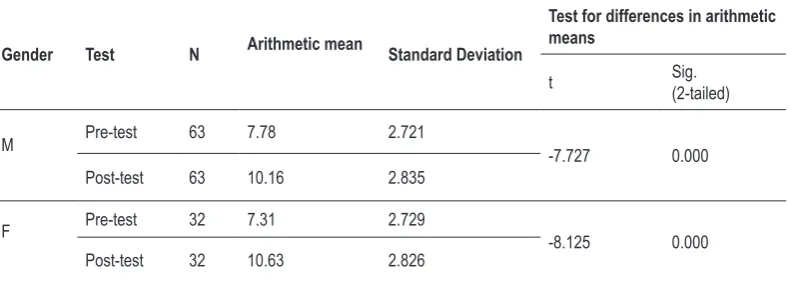
The differences between the results of the pre-test and post-test of spatial ability for both genders are shown in Table 4.
Table 4. The result of the t-test for examining the differences in scores between the initial and final state for males (M) and for females (F).
Gender Test N Arithmetic mean Standard Deviation
Test for differences in arithmetic means
t Sig. (2-tailed)
M Pre-test 63 7.78 2.721 -7.727 0.000
Post-test 63 10.16 2.835
F Pre-test 32 7.31 2.729 -8.125 0.000
Post-test 32 10.63 2.826
The result of the t-test for differences in arithmetic means showed that there were statisti-cally significant differences between the pre-test and post-test of spatial ability both in the case of men (t = -7.727; Sig. (2-tailed) = 0.000) and in the case of females (t = -8.125; Sig. (2-tailed) = 0.000).
Volume 61, 2014 118
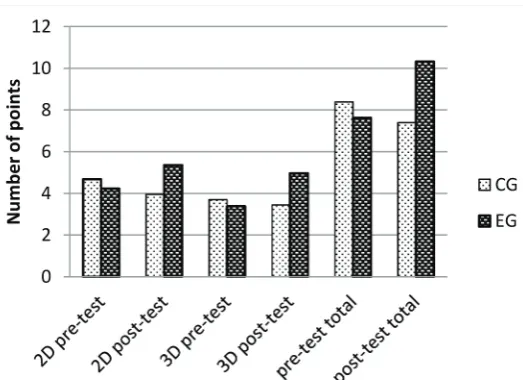
Figure 1: Arithmetic mean of attained points at individual levels of the pre-test and post-test of spatial ability of the control group (CG) and the ex-perimental group (EG).
On average the males of the experimental group scored 2.38 points more at the post-test than at the pre-test, whereas females scored 3.32 more points. It has been ascertained that both males and females showed progress at the post-test in comparison with the pre-test. In general, the activity had a positive impact on both genders regarding spatial ability.
Discussion
As a previous group of authors already established (Martin-Dorta, Saorin and Contero, 2008), 3D modeling can have a positive impact on the development of spatial ability, though their research was based on students aged 18 to 20 years as opposed to the research described here. This makes it highly probable that the tested students were already in the phase of formal-logical thinking (Bakračevič, 2000), as opposed to research in which participating students were aged 11 – 15. Furthermore, in the activity of 3D modeling, the role of the teacher certainly has a considerable influence on the process, since familiarization with the modeler is quicker and, as Basham established (Basham, 2007), teacher assistance is a deciding factor in the stu-dents’ achievement of added value.
in the 21 century Volume 61, 2014 119 Conclusions
The main finding of the pedagogical experiment is the proven positive impact of 3D modeling on the spatial ability of s in lower secondary school, ages 11 to 15. Progress in spatial ability due to 3D modeling was detected in both genders, and was even greater in the case of females. The described research involved students from eleven to fifteen years of age; further studies could try to determine the progress in spatial ability and its progress due to 3D model-ing in younger students as well, since it is known that spatial ability develops gradually and depends on several factors. In the 2013/2014 school year the elective subject of drawing in ge-ometry and technical class began to be implemented in Slovenia for the first time in accordance with a renewed curriculum and encompasses solely 3D modeling. The curriculum has been approved by the Ministry of Education, Science and Sport.
Acknowledgments
The authors acknowledge the support of the Ministry of Education, Science and Sport of Republic of Slovenia and European Social Fund in the frame of the Project: “Innovative pedagogy 1: 1 in the light of competences of the 21st century” on Faculty of Natural Sciences of University of Maribor.
References
Antič, I. (2011). Slovar tujk [Dictionary of Foreign Words]. Tržič: Učila International.
Bakračevič Vukman, K. (2000). Razvoj mišljenja v odrasli dobi [Cognitive Development in the Adult Age]. Maribor: Pedagoška fakulteta Maribor.
Basham, K. Lynn. (2007). The effects of 3-dimensional CADD modeling software on the development of spatial ability of ninth grade Technology Discovery students. Louisiana State University and Agricultural & Mechanical College.
Brizendine, L. (2007). Ženski možgani [The Female Brain]. Ljubljana: Modrijan.
Field, D. A. (2004). Education and training for CAD in the auto industry. Computer-Aided Design, 36 (14), 1431–1437.
Gardner, H. (2010). Razsežnost uma: Teorija o več inteligencah [The Scope of the Mind: Multiple Intel-ligence Theory]. Ljubljana: Založba Tangram.
Koch, D. S. (2006). The effects of solid modeling and visualization on technical problem solving. Virginia Polytechnic Institute and State University.
Kolb, B., Whishaw, I. Q. (2003). Fundamentals of human neuropsychology, Fifth Edition. New York: Worth publishers.
Kolb, B., Whishaw, I. Q. (2014). An introduction to brain and behavior, Fourth Edition. New York: Worth publishers.
Mancini, L. (2011). Vizualizacije filozofskih konceptov [Visualization of Philosophical Concepts]. Ljubl-jana: Akademija za likovno umetnost in oblikovanje v Ljubljani.
Martin-Dorta, N., Luis Saorin, J., Contero, M. (2008). Development of a fast remedial course to improve the spatial abilities of engineering students. Journal of Engineering Education, 97 (4), 505–513. McGee, M. G. (1979). Human spatial abilities: Psychometric studies and environmental, genetic,
hormo-nal, and neurological influences. Psychological Bulletin, 86, 889–918.
Sabbatini, R. M. E. (2000). Are there differences between the brains of males and females? Brain & Mind Magazine, October/December.
Volume 61, 2014
120 Sorby, S. A. (2007). Developing 3D spatial skills for engineering students. Australasian Journal of Engi-neering Education, 13 (1), 1-11.
Sorby, S. A. (2009). Educational research in developing 3-D spatial skills for engineering students. Inter-national Journal of Science Education, 31 (3), 459-480.
Titze, C., Heil, M., Jansen, P. (2008). Gender differences in the mental rotations test (MRT) are not due to task complexity. Journal of Individual Differences, 29 (3), 130-133.
Zaidi, Z. F. (2010). Gender differences in human brain: A review. The open Anatomy Journal, 2, 37-55.
Advised by Laima Railienė, University of Šiauliai, Lithuania
Received: June 18, 2014 Accepted: August 26, 2014
Andrej Šafhalter Lower Secondary School Anice Černejeve Makole, Slovenia. E-mail: [email protected]
Srečko Glodež PhD., Professor, Faculty of Natural Sciences and Mathematics, University of
Maribor, Koroška 160, 2000 Maribor, Slovenia. E-mail: [email protected]
Boris Aberšek PhD, Professor, Head of Institute for Contemporary Technology, Faculty of
Natural Sciences and Mathematics, Koroška 160, 2000 Maribor, Slovenia. E-mail: [email protected]
Website: http://tehnika.fnm.uni-mb.si
Karin Bakračevič Vukman PhD., Professor, Department of Psychology, University of Maribor, Koroška 160, 2000 Maribor, Slovenia.