A Study on Just-in-Time Implementation
in Portugal: Some Empirical Evidence
Maria Rosário Mota Oliveira Alves Moreira Faculdade de Economia,
Universidade do Porto – UP, Portugal E-mail: [email protected]
Rui Alberto Ferreira dos Santos Alves Faculdade de Economia,
Universidade do Porto – UP, Portugal E-mail: [email protected]
Abstract
The objective of this paper is to find how far the Just-in-Time system is being implemented by Portuguese manufacturing firms, as well as assessing its perception and its potential benefits by managers. First, several studies about the implementation of the Just-in-Time system in various countries over the past 25 years are reviewed, and then the descriptive survey research is reported. Data were collected from a mail questionnaire sent to a few hundred firms in Portugal. The findings show that the surveyed firms view the Just-in-Time system as a way to reduce inventories, to increase quality, and to eliminate waste. Despite this good perception, less than 6% of the surveyed firms have the necessary conditions to successfully implement a Just-in-Time system. A significant practical implication of this study is that Portuguese firms should use Just-in-Time as a philosophy rather than as a solution for operations-related problems. Another contribution is to point out the most common difficulties for its implementation, so that Portuguese firms that want to do it can be prepared to overcome those difficulties.
Keywords: just-in-time, descriptive survey
Introduction
management philosophy, and since the 1980s many non-Japanese firms began adopting it. Indeed, as regional and global competition increases, efficient operations are paramount.
As early as 1982, Schonberger (1982a), identified higher quality, lower inventory levels, improved throughput times and shortened response times as some of the benefits of in-Time. According to Inman and Mehra (1993), the main advantages of the Just-in-Time philosophy are lower costs, better quality, and higher competitive advantage. But the most consistent benefit found in empirical studies is a reduction in inventory levels and/or an increase in inventory turnover (Toni and Nassimbeni, 2000; Cua et al., 2001; Kaynak and Pagán, 2003).
There are, however, some conditions or pre-requisites to successfully implement this management philosophy, such as quick and economic setups (to allow small lot sizes) and a uniform production rate (to ensure schedule stability). These conditions are presented by several authors (e.g., Golhar and Stamm, 1991; Zhu et al., 1994; Ahmad et al., 2004; Schonberger, 2007), adding other elements such as a pull control system, flexible employees, preventive maintenance, supplier long-term relationships, and quality circles. Golhar and Stamm (1991), conducted an extensive literature review and identified four basic principles of the Just-in-Time management philosophy: (i) elimination of waste, (ii) employee involvement, (iii) supplier long-term relationships, and (iv) total quality control. These principles, and the implementation conditions, provided the foundation for the survey research design presented in Section 3.
Several studies on Just-in-Time practices and its implementation have been conducted, first in developed countries (e.g., United States, United Kingdom, Japan, Australia, Canada) and later in developing countries (e.g., Mexico, Egypt, Ghana, India, Malaysia, Saudi Arabia). This paper presents a field study of Just-in-Time in Portugal. Its objectives are to report the results of a descriptive survey research (Forza, 2002) conducted in Portugal to assess local implementation of Just-in-Time practices.
An important contribution of this paper is that it adds to the empirical database of Just-in-Time practices and its implementation in Portuguese firms, allowing one to know how manufacturing managers are aware of this management philosophy and its potential benefits. Another contribution is to find the most common difficulties for Just-in-Time implementation, so that Portuguese firms can be prepared to overcome them. As this study is exploratory in nature, no hypotheses are presented for rigorous statistical testing. Instead, some preliminary findings with regard to the above issues are highlighted.
Literature Review
As previously mentioned, in the late 1970s, early 1980s many non-Japanese firms began adopting the Time philosophy. Subsequently, many studies dealing with Just-in-Time implementation in several countries have been conducted and reported.
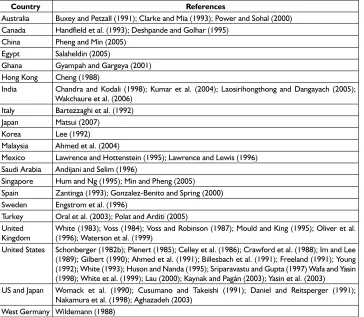
Table 1 presents a non-exhaustive list of such empirical studies, with the countries sorted in alphabetical order. These studies were collected searching international bibliographic databases (such as Academic Search Complete and Business Source Complete - EBSCO, EconLit, Economia y Negocios, Regional Business News, Science Direct, Em erald, Ingenta Select, and Scopus) using the search capabilities of those databases (by word in the subject, abstract or title fields). A search on the World Wide Web using Google Scholar complemented the previous list of references.
As can be seen in Table 1, the first studies date back to 1982 and 1983, and were conducted in the United States and the United Kingdom by Schonberger (1982b), and White (1983), respectively. These two countries deserved a lot of attention over the years, espe cially the United States, and other studies followed.
Table 1 - Studies relating to Just-in-Time implementation in several countries.
Country References
Australia Buxey and Petzall (1991); Clarke and Mia (1993); Power and Sohal (2000) Canada Handfield et al. (1993); Deshpande and Golhar (1995)
China Pheng and Min (2005) Egypt Salaheldin (2005)
Ghana Gyampah and Gargeya (2001) Hong Kong Cheng (1988)
India Chandra and Kodali (1998); Kumar et al. (2004); Laosirihongthong and Dangayach (2005); Wakchaure et al. (2006)
Italy Bartezzaghi et al. (1992) Japan Matsui (2007) Korea Lee (1992) Malaysia Ahmed et al. (2004)
Mexico Lawrence and Hottenstein (1995); Lawrence and Lewis (1996) Saudi Arabia Andijani and Selim (1996)
Singapore Hum and Ng (1995); Min and Pheng (2005) Spain Zantinga (1993); Gonzalez-Benito and Spring (2000) Sweden Engstrom et al. (1996)
Turkey Oral et al. (2003); Polat and Arditi (2005) United
Kingdom White (1983); Voss (1984); Voss and Robinson (1987); Mould and King (1995); Oliver et al. (1996); Waterson et al. (1999) United States Schonberger (1982b); Plenert (1985); Celley et al. (1986); Crawford et al. (1988); Im and Lee (1989); Gilbert (1990); Ahmed et al. (1991); Billesbach et al. (1991); Freeland (1991); Young (1992); White (1993); Huson and Nanda (1995); Sriparavastu and Gupta (1997) Wafa and Yasin (1998); White et al. (1999); Lau (2000); Kaynak and Pagán (2003); Yasin et al. (2003) US and Japan Womack et al. (1990); Cusumano and Takeishi (1991); Daniel and Reitsperger (1991);
In the 1980s, besides the several studies on the U.S. and the U.K., there were also papers about the implementation of Just-in-Time in West Germany and Hong Kong in 1988. Most of the studies reported in the 1990s were conducted in developed countries, such as Australia, Canada, Italy, Korea, Spain, Sweden, etc. Similar studies in develop-ing countries (China, Egypt, India, Mexico, Turkey, etc) are more recent, most of them already in the 21st century. Most of the reported studies provide empirical evidence about
Just-in-Time implementation and practices.
Research Methodology
A survey questionnaire was used to obtain the data used in this research. This methodology has been used by several researchers in global manufactur ing planning and con trol (e.g., Handfield and Withers, 1993).
Convenience sampling (Forza, 2002) was selected, and the electronic, metal parts, and paint manufacturers (ISIC codes 3210, 3813, 2891, 2422, 3521) were chosen due to the availability of data that allowed us to send them a postal questionnaire.
The questionnaire was sent to the manufacturing or general manager of the selected firms. The criteria to select the firms were the number of workers and annual sales. The mean number of employees in each industry and the mean sales value were first com-puted, and any firm that had simultaneously more than a half of those values was se lected with the purpose of avoiding small and non-representative firms. Thus, the ques tionnaire was mailed to 384 companies (293 from the metal parts industry, 53 from the electronic materials industry and 38 from the paint manufacturers).
The questionnaire was developed to collect three types of information: (1) general information about the firm, including its charac teristics and the industry it belongs to; (2) information that would allow an assessment of the extent to which the responding firm is using Just-in-Time; (3) information that would allow an assessment of the extent to which the respondent is familiar with the Just-in-Time system.
The design and administration of the questionnaire followed Salant and Dillman’s total design method as closely as possible (Salant and Dillman, 1994). The initial question naire was pre-tested on operations management professors and questionnaire survey builders and, after incorporating their comments and suggestions, an intermediate ver sion was tested on a small group of firms in order to eliminate any ambiguous and/or misleading questions. Thus, five firms were randomly chosen and the questionnaire was tested with the top manufacturing managers through per sonal interviews.
it contained one question about the production con trol system (question 11), the pro-duction lot size (question 20), the set-up times (question 21) and the knowledge and use or not use of Just-in-Time (question 25 and 26). Detailed infor mation about each ques tion is presented in the Appendix, together with the answers’ codifi cation.
In total, 142 questionnaires were received (103 from the metal parts industry, 20 from the electronic materials industry, and 14 from the paint manufacturers; 5 questionnaires did not answer questions 1 and 2). The response rate was 37%, which is better than in similar studies reported in the literature (e.g., Cheng, 1988; Bartezzaghi et al., 1992; Lee, 1992; Clarke and Mia, 1993; Lawrence and Hottenstein, 1995 and Lawrence and Lewis, 1996). However, 11 questionnaires had to be discarded because many answers were left blank, and so only 131 questionnaires could be used. Returns mirrored the composi tion of the original sample, indicating no systematic response bias.
The answers to eight questions (questions 9, 11, 12, 13, 16, 18, 20 and 22) had to be codified because they were categorical. Eleven of them were binomial (yes/no) and were entered into the analysis through the use of a 0-1 code. Five were continuous (the answers of questions 3, 4, 5, 6 and 17), and their values were consid ered. The answers to questions 1 and 2 indicate the firm’s main activities and were used to distinguish the question naires among industries.
Main Results
Being a descriptive survey, the questionnaires were analyzed using descriptive statistics and no attempt was made to test any hypotheses. The results are based mainly on the aggregate data obtained from the 131 sets of responses.
The answers to the binomial and the dichotomic questions are presented in Figures 1 and 2. It can be seen in Figure 1 that most firms (87.5%) experience no seasonality, 74.6% of them don’t need extra work, and 85.7% have flexible workers, thus having some of the necessary conditions for a Just-in-Time system. However, most firms (71.8%) still use a push method to control production (Figure 2).
Quality is a major concern; in spite of the fact that less than half of the firms have a product and/or process certification, quality is considered more important than price (Figure 2), and almost all the firms surveyed had some kind of inspection mechanism to detect defectives (Table 2). In most cases (around 85%) suppliers deliver in time and there are efforts to reduce setup times. Although used by less than one third of the firms, the Just-in-Time system is quite well known by 86.5% of them.
0 20 40 60 80 100
7. Seasonality
8. Need of extra work10. W
orkers' flexibility
14. Quality certification 15. Inspection
19. Timely deliveries 21. Setup time reduction
23. P
reventive maintenance
24. Quality circles25. JIT knowledge
26. JIT use
Questions
(%)
Yes No
Figure 1 - Answers to yes-no questions.
Quality Push
method
Price Pull
method
0 20 40 60 80 100
Question 11 Question 12
(%)
Figure 2 - Answers to dichotomic questions.
saying they have a Just-in-Time system to control their opera tions, have a non-uniform production rate, are using the push control system, have em ployees with low flexibility, do not have any quality control system, or have large pro duction lots.
Table 3 presents statistical data regarding the number of workers, sales and inventory values, and the number of suppliers of the responding companies. The number of work-ers ranged from 17 to 3,686, with a mean of 190. Annual sales ranged from 8,000 euros to 312,500 million eu ros, with a mean of 4,750 million euros. In both work-in-process and final products inventory the mean was high for companies that were trying to im plement the Just-in-Time system. Even though the average number of suppliers across all firms was Table 2 - Answers to some questions from firms that say they use JIT.
Question Answer Frequency Percentage
7 Seasonal products 5 13.8
9 Low employee flexibility 8 22.2
11 Use push control system 22 61.1
15 Any quality control system 6 16.7
high (85 sup pliers for the main raw material), there was a significant pro portion (40%) that had 10 or fewer suppliers.
Table 4 records data concerning the responding firms’ manufacturing system profile. It can be seen that few firms (less than 25%) purchased raw materials in periods longer than Table 3 - Statistical data of the responding firms.
Question Mean Mode Std. Dev. Min Max
Number of employees 190 40 375 17 3,686
Sales value (106 euros) 4,750 50,000 32,755 8,000 312,500
Final products inventory value (106 euros) 5,745 0 37,335 0 350,000
Work-in-process inventory value (106 euros) 4,400 500 30,640 0 275,000
Number of suppliers 85 10 321 1 3,000
Table 4 - Manufacturing system profile of the responding firms.
Answers Code Frequency Percentage
Workers’ specialization Low 1 26 20
Medium 2 89 69
High 3 14 11
Total 129 100
Firm position in terms of quality Inferior 1 0 0
In the mean 2 59 45
Superior 3 72 55
Total 131 100
Where control is made At beginning 1 10 10
Several phases 2 81 78
At end 3 12 12
Total 104 100
Raw material purchases frequency <1 week 1 15 12
[1,2] weeks 1.5 33 27
]2,4] weeks 3 45 37
[1,3] months 9 26 21
>3 months 30 4 3
Total 123 100
Production lot <1 day 1 18 18
[1,10] days 5 34 35
]10,20] days 15 18 18
]20,30] days 25 18 18
>40 days 40 10 11
Total 98 100
Machine breakdown frequency Every day 1 8 7
[2,5] days 3 9 8
]5,10] days 8 8 7
]10,30] days 20 22 20
[1,3] months 60 21 19
]3,6] months 150 20 18
> 6 months 270 23 21
4 weeks; of the remaining firms, roughly half purchased every 2 to 4 weeks and the other half every 2 weeks or less. In some cases the production lot was large enough to last for 20 or more days; however, more than half of the firms used lots that lasted only for 10 days or less. The time between machine break downs is also an important issue; some firms experienced frequent failures, but for the majority the time between ma chine breakdowns exceeded one month.
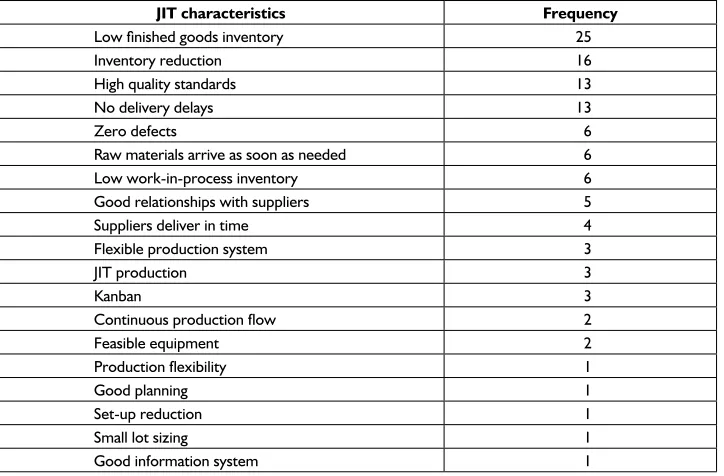
Question 25 asked firms about their knowledge about the Just-in-Time system. If the answer were affirmative, they were asked about its most important characteristic. Table 5 presents the most important characteristics mentioned by managers, sorted by their relative impor tance. It can be seen that 47 firms (about 42%) pointed out inventory re-duction (in general, finished goods, and work-in-process) as the most important charac-teristic. For 15 firms (about 13%) good relationships with sup pliers and/or timely deliv-eries are important issues, while 19 firms (about 17%) mentioned high quality standards and/or zero defectives as a major concern.
Table 5 - Most important characteristics of the Just-in-Time system.
JIT characteristics Frequency
Low finished goods inventory 25
Inventory reduction 16
High quality standards 13
No delivery delays 13
Zero defects 6
Raw materials arrive as soon as needed 6
Low work-in-process inventory 6
Good relationships with suppliers 5
Suppliers deliver in time 4
Flexible production system 3
JIT production 3
Kanban 3
Continuous production flow 2
Feasible equipment 2
Production flexibility 1
Good planning 1
Set-up reduction 1
Small lot sizing 1
Good information system 1
Conclusions
Among all the respondents only 7 firms, less than 6%, fulfill all the previously mentioned conditions.
Concerning the managers’ awareness about the Just-in-Time system, the data showed that most of the sam ple companies were concerned primarily with its operational ele ments, such as reduction of inventories, quality improvement, and relationships with suppliers. So, managers do not view the Just-in-Time system as a global management philosophy nor do they recognize strategic motivations for its implementation.
It has also provided empirical data which indicate that managers are aware of the im-portance of quality, since almost all of the firms have an inspection system to detect de-fectives. However, very few of them are certified and quality circles practically do not exist. Further, most Portuguese firms do not have all the necessary conditions to suc cessfully implement a Just-in-Time system.
This study has also shown that Portuguese firms have the following basic perspectives about the Just-in-Time system: it is perceived as a tool to reduce inventories, to increase quality and to eliminate waste, it highly depends on suppliers’ performance, it helps im-prove quality and thus reduce scrap and defectives, and it is a tool for production plan ning and control.
From the analysis of the aggregate data obtained from the 131 sets of responses, the most common difficulties for the implementation of the Just-in-Time system in Portugal are: (i) most firms (more than 70%) still use a push method to control production; (ii) some firms purchase raw materials in periods longer than 4 weeks (one possi ble expla nation is that suppliers are not con sidered as partners and a safety stock is kept to face poor supplier delivery perform ance); (iii) in both work-in-process and final products inventories the mean value was high for companies that were trying to implement Just-in-Time.
This study has some limitations. The main goal of the questionnaire survey was to find out whether Portuguese firms that have, apparently, operational conditions to adopt a Just-in-Time system, do use it. No information is available to assess what is specific about Portuguese firms, and what its impact is on the success of Just-in-Time imple mentation, and to compare Portuguese practices with other countries.
These limitations provide clues for future research: to find what is particular about Por-tugal and other recently developed countries, and what can be learned from those set-tings, and to establish a link between this study and the studies presented about other countries.
Acknowledgements
References
Aghazadeh, S. (2003), “JIT inventory and competition in the global environment: a comparative study of American and Japanese values in auto industry”, Cross Cul tural Management, Vol. 10, No. 4, pp. 29-42.
Ahmad, A. & Mehra, S. & Pletcher, M. (2004), “The perceived impact of JIT imple mentation on firms financial/growth performance”, Journal of Manufacturing Tech nology Management, Vol. 15, No. 2, pp. 118-130.
Ahmed, S. & Hassan, M. & Taha, Z. (2004), “State of implementation of TPM in Small and Medium Industries: A survey study in Malaysia”, Journal of Quality in Maintenance Engineering, Vol. 10, No. 2, pp. 93-106.
Ahmed, N. & Tunc, E. & Montagno, R. (1991), “A comparative study of US manufac turing firms at various stages of just-in-time implementation”, International Journal of Production Research, Vol. 29, No. 4, pp. 787-802.
Andijani, A. and Selim, S. (1996), “The practice of production control techniques in the manufacturing sectors in the Eastern Province of Saudi Arabia”, International Jour nal of Production Economics, Vol. 43, No. 2-3, pp. 251-259.
Bartezzaghi, E. & Turco, F. & Spina, G. (1992), “The impact of the just-in-time ap proach on production system performance: a survey of Italian industry”, Interna tional Journal of Operations & Production Management, Vol. 12, No. 1, pp. 5-17.
Billesbach, T. (1991), “A study of the implementation of just-in-time in the United States”, Production and Inventory Management Journal, Vol. 32, No. 3, pp. 1-4.
Buxey, G. and Petzall, S. (1991), “Australian automobile industry: JIT production and labour relations”, Industrial Management and Data Systems, Vol. 91, No. 1, pp. 8-9. Celley, A. & Clegg, W. & Smith, A. et al. (1986), “Implementation of JIT in the United
States”, Journal of Purchasing and Materials Management, Vol. 22, No. 4, pp. 9-15. Chandra, S. and Kodali, R. (1998), “Justification of just-in-time manufacturing systems
for Indian industries”, Integrated Manufacturing Systems, Vol. 9, No. 5, pp. 314-323. Cheng, T. (1988), “The just-in-time production: a survey of its development and
percep-tion in the Hong Kong electronics industry”, Omega, Vol. 16, No. 1, pp. 25-32.
Clarke, B. and Mia, L. (1993), “JIT manufacturing systems: use and application in Australia”, International Journal of Operations & Production Management, Vol. 13, No. 7, pp. 69-82.
Crawford, K. & Blackstone, J. & Cox, J. (1988), “A study of JIT implementation and operating problems”, International Journal of Production Research, Vol. 26, No. 9, pp. 1561-1568.
Cusumano, M. and Takeishi, A. (1991), “Supplier relations and management: a survey of Japanese, Japanese-Transplant and U.S. auto plants”, Strategic Management Journal, Vol. 12, No. 8, pp. 563-588.
Daniel, S. and Reitsperger, W. (1991), “Management control systems for JIT: an empiri cal comparison of Japan and the US”, Journal of International Business Studies, Vol. 22, No. 4, pp. 603-617.
Deshpande, S. and Golhar, D. (1995), “HRM practices in unionized and non-unionized Canadian JIT manufacturing firms”, Production and Inventory Management Journal, Vol. 36, No. 1, pp. 15-19.
Engstrom, T. & Jonsson, D. & Medbo, L. (1996), “Production model discourse and ex periences from the Swedish automotive industry”, International Journal of Opera tions & Production Management, Vol. 16, No. 2, pp. 141-158.
Forza, C. (2002), “Survey research in operations management: a process-based perspec-tive”, International Journal of Operations & Production Management, Vol. 22, No. 2, pp. 152-194.
Freeland, J. (1991), “A Survey of just-in-time purchasing practices in the United States”, Production and Inventory Management Journal, Vol. 32, No. 2, pp. 43-50.
Gilbert, J. (1990), “The state of JIT implementation and development in the USA”, In-ternational Journal of Production Research, Vol. 28, No. 6, pp. 1099-1109.
Golhar, D. and Stamm, C. (1991), “The just-in-time philosophy: A literature review”, International Journal of Production Research, Vol. 29, No. 4, pp. 657-676.
Gonzalez-Benito, J. and Spring, M. (2000), “JIT purchasing in the Spanish auto compo-nents industry. Implementation patterns and perceived benefits”, International Jour-nal of Operations & Production Management, Vol. 20, No. 9-10, pp. 1038-1061.
Gyampah, K. and Gargeya, V. (2001), “Just-in-time manufacturing in Ghana”, Industrial Management and Data Systems, Vol. 101, No. 3, pp. 106-113.
Handfield, R. (1993), “Distinguishing features of just-in-time systems in the make-to order/assemble-to-order environment”, Decision Sciences, Vol. 24, No. 3, pp. 581-602. Handfield, R. and Withers, B. (1993), “A comparison of logistics management in Hun gary,
China, Korea, and Japan”, In: Whybark, D. and Vastag, G. (Eds), Global manu facturing practices: a worldwide survey of practices in production planning and control, Elsevier, Amsterdam, pp. 213-232.
Hum, S. and Ng, Y. (1995), “A study on just-in-time practices in Singapore”, Interna tional Journal of Operations & Production Management, Vol. 15, No. 6, pp. 5-24.
Im, J. and Lee, S. (1989), “Implementation of just-in-time systems in US manufacturing firms”, International Journal of Operations & Production Management, Vol. 9, No. 1, pp. 5-14.
Inman, R. and Mehra, S. (1993), “Financial justification of JIT implementation”, Inter-national Journal of Operations & Production Management, Vol. 13. No. 4, pp. 32-39. Kaynak, H. and Pagán, J. (2003), “Just-in-time purchasing and technical efficiency in the
US manufacturing sector”, International Journal of Production Research, Vol. 41, No. 1, pp. 1-14.
Kumar, V. & Garg, D. & Mehta, N. (2004), “JIT practices in Indian context: A survey” Journal of Scientific and Industrial Research, Vol. 63, No. 8, pp. 655-662.
Laosirihongthong, T. and Dangayach, G. (2005), “A comparative study of implementa tion of manufacturing strategies in Thai and Indian automotive manufacturing com panies”, Journal of Manufacturing Systems, Vol. 24, No. 2, pp. 131-143.
Lau, R. (2000), “A synergistic analysis of joint JIT-TQM implementation”, International Journal of Production Research, Vol. 38, No. 9, pp. 2037-2049.
Lawrence, J. and Hottenstein, M. (1995), “The relationship between JIT manufacturing and performance in Mexican plants affiliated with US companies”, Journal of Op erations Management, Vol. 13, No. 1, pp. 3-18.
Lawrence, J. and Lewis, H. (1996), “Understanding the use of just-in-time purchasing in a developing country: the case of Mexico”, International Journal of Operations & Production Management, Vol. 16, No. 6, pp. 68-90.
Lee, C. (1992), “The adoption of Japanese manufacturing management techniques in Korean manufacturing industry”, International Journal of Operations & Production Management, Vol. 12, No. 1, pp. 66-81.
Matsui, Y. (2007), “An empirical analysis of just-in-time production in Japanese manu-facturing companies”, International Journal of Production Economics, Vol. 108, No. 1-2, pp. 153-164.
Min, W. and Pheng, L. (2005), “Economic order quantity (EOQ) versus just-in-time (JIT) purchasing: an alternative analysis in the ready-mixed concrete industry”, Construction Management and Economics, Vol. 23, No. 4, pp. 409-422.
Monden, Y. (1998), Toyota Production Systems: an integrated approach to just-in-time, Engineering and Management Press, 3rd edition.
Mould, G. and King, M. (1995), “Just-in-time implementation in the Scottish electronics industry”, Industrial Management and Data Systems, Vol. 95, No. 9, pp. 17-22.
Oliver, N. & Delbridge, R. & Lowe, J. (1996), “Lean production practices: international comparisons in the auto components industry”, British Journal of Management, Vol. 7 (Special Issue), pp. S29-S44.
Oral, E. & Mistikoglu, G. & Erdis, E. (2003), “JIT in developing countries-a case study of the Turkish prefabrication sector” Building and Environment, Vol. 38, No. 6, pp. 853-860. Pheng, L. and Min, W. (2005), “Just-in-time management in the ready mixed concrete
industries of Chongqing, China and Singapore”, Construction Management and Economics, Vol. 23, No. 8, pp. 815-829.
Plenert, G. (1985), “Are Japanese production methods applicable in the United States?”, Production and Inventory Management Journal, Vol. 26, No. 2, pp. 121-129.
Polat, G. and Arditi, D. (2005), “The JIT materials management system in developing countries ”, Construction Management and Economics, Vol. 23, No. 7, pp. 697-712. Power, D. and Sohal, A. (2000), “An empirical study of human resource management
strategies and practices in Australian just-in-time environments” International Jour-nal of Operations & Production Management, Vol. 20, No. 8, pp. 932-958.
Salaheldin, S. (2005), “JIT implementation in Egyptian manufacturing firms: some em-pirical evidence”, International Journal of Operations & Production Management, Vol. 25, No. 4, pp. 354-370.
Salant, P. and Dillman, D. (1994), How to conduct your own survey, New York, NY, John Wiley & Sons.
Schonberger, R. (1982a), “Some observations on the advantages and implementation issues of just-in-time production systems”, Journal of Operations Management, Vol. 3, No. 1, pp. 1-11.
Schonberger, R. (1982b), “The transfer of Japanese manufacturing management ap-proaches to U.S. industry”, Academy of Management Review, Vol. 7, No. 3, pp. 479-487. Schonberger, R. (2007), “Japanese production management: An evolution-With mixed
success”, Journal of Operations Management, Vol. 25, No. 2, pp. 403-419.
Sriparavastu, L. and Gupta, T. (1997), “An empirical study of just-in-time and total quality management principles implementation in manufacturing firms in the USA”, International Journal of Operations & Production Management, Vol. 17, No. 12, pp. 1215-1232.
Toni, A. and Nassimbeni, G. (2000), “Just-in-time purchasing: an empirical study of op-erational practices, supplier development and performance”, Omega, Vol. 28, No. 6, pp. 631-651.
Voss, C. (1984), “Japanese manufacturing management practices in the UK”, Interna tional Journal of Operations & Production Management, Vol. 4, No. 2, pp. 31-38.
Wafa, M. and Yasin, M. (1998), “A conceptual framework for effective implementation of JIT”, International Journal of Operations & Production Management, Vol. 18, No. 11-12, pp. 1111-1124.
Wakchaure, V.D. & Venkatesh, M.A. & Kallurkar, S.P. (2006), “Review of JIT practices in Indian manufacturing industries” 2006 IEEE International Conference on Man agement of Innovation and Technology 2, art. no. 4037191, pp. 1099-1103.
Waterson, P. & Clegg, C. & Bolden, R. et al. (1999), “The use and effectiveness of modern manufacturing practices: a survey of UK industry”, In ternational Journal of Production Research, Vol. 37, No. 10, pp. 2271 – 2292.
White, M. (1983), “The Japanese style of production management in Britain”, Interna-tional Journal of Operations & Production Management, Vol. 3, No. 3, pp. 14-21. White, R. (1993), “An empirical assessment of JIT in U.S. manufacturers”, Production and
Inventory Management Journal, Vol. 34, No. 2, pp. 38-42.
White, R. & Pearson, J. and Wilson, J. (1999), “JIT manufacturing: a survey of imple mentation in small and large US manufacturers”, Management Science, Vol. 45, No. 1, pp. 1-15. Wildemann, H. (1988), “Just-in-time production in West Germany”, International Jour nal
of Production Research, Vol. 26, No. 3, pp. 521-538.
Womack, J. & Jones, D. & Roos, D. (1990), “The machine that changed the world: the story of lean production”, Rawson Associates, New York.
Yasin, M. & Small, M. & Wafa, M (2003), “Organizational modifications to support JIT implementation in manufacturing and service operations”, Omega, Vol. 31, No. 3, pp. 213-226.
Young, S. (1992), “A framework for successful adoption and performance of Japanese manufacturing practices in the United States”, Academy of Management Review, Vol. 17, No. 4, pp. 677-700.
Zantinga, J. (1993), “Improvements in Spanish factories: towards a JIT philosophy?”, International Journal of Operations & Production Management, Vol. 13, No. 4, pp. 40-49.
Zhu, Z. & Meredith, P., & Makboonprasith, S. (1994), “Defining critical elements in JIT implementation: a survey”, Industrial Management and Data Systems, Vol. 94, No. 5, pp. 3-10.
Biography
Professor. She has been teaching Operations Research and Operations Management at Management Department of Faculdade de Economia, since 1996.
Rui Alberto Ferreira Santos Alves graduated in Economics at Universidade do Porto in 1974. After a few years of work experience, he moved to Rochester, USA, where he obtained a MS degree in Operations Research in 1986 and a PhD in Business Administration in 1988 from the William E. Simon Gradu ate School of Business Administration. He is presently Associate Professor in the Management Department of Faculdade de Economia, Universidade do Porto.
Appendix: Questionnaire and Answers’ Codification. Question Description
1 Firm’s activity Firm’s main activity 2 Other activities Firm’s other activities 3 Employees Number of employees
4 Sales value Sales value in thousands of euros (at the end of the year) 5 Final products
inventory Final products inventory value in thousands of euros (at the end of the year) 6 Work-in-process
inventory Work-in-process inventory value in thousands of euros (at the end of the year) 7 Seasonality 1, if the firm has seasonal products;
0, otherwise
8 Work over time 1, if the firm needs employees to work over time; 0, otherwise
9 Workers’ specialization
1, if workers have low specialization; 2, if they have medium specialization; 3, if they have high specialization
10 Workers’ adaptation 1, if workers can easily perform other tasks; 0, otherwise
11 Push-Pull method 1, if production control is made from the beginning to the end (push); 2, if production control is made from the end to the beginning (pull) 12 Quality vs Price 1, if quality (conformance) is more important than price in the specific firm’s
market;
2, if price is more important than quality (conformance) in the specific firm’s market
13 Position of quality 1, if the firm has relative “less quality” than its competitors; 2, if the firm has the same quality as its competitors; 3, if the firm has relative “more quality” than its competitors 14 Quality certification 1, if the firm has a product or process certification;
0, otherwise 15 Quality control
mechanism
1, if the firm has a mechanism to control the quality of the process; 0, otherwise
16 Control phase 1, if the control is made at the beginning of the production process;
2, if the control is made after more than one phase of the production process; 3, if the control is made at the end of the production process
17 Suppliers of raw
materials Number of raw materials suppliers 18 Purchases frequency
(for the most important raw materials suppliers)
1, if the purchase frequency is less than 1 week; 1.5, if the purchase frequency is between 1 and 2 weeks; 3, if the purchase frequency is between 2 and 4 weeks; 9, if the purchase frequency is between 1 and 3 months; 30, if the purchase frequency is more than 3 months
19 Timely deliveries 1, if the most important suppliers deliver materials on or before the due date; 0, otherwise
20 Production lot size 1, if the production lot corresponds to less than 1 day of sales; 5, if the production lot is between 1 and 10 days of sales; 15, if the production lot is between 10 and 20 days of sales; 25, if the production lot is between 20 and 30 days of sales; 40, if the production lot is more than 30 days of sales
Question Description 22 Equipment
break-down frequency ( average of all machines)
1, if breakdowns occur every day;
3, if breakdowns occur between 2 and 5 days; 8, if breakdowns occur between 5 and 10 days; 20, if breakdowns occur between 10 and 30 days; 60, if breakdowns occur between 1 and 3 months; 150, if breakdowns occur between 3 and 6 months; 270, if breakdowns occur in more than 6 months 23 Preventive
maintenance 1, if the firm has a preventive maintenance system;0, otherwise 24 Quality circles
(teams) 1, if workers have periodic meetings with the operations/production manager to discuss subjects about the process quality; 0, otherwise
25 JIT knowledge 1, if the firm knows what JIT production system is → open answer: which are the JIT most important characteristics
0, otherwise
26 JIT use 1, if the firm has implemented the JIT system; 0, otherwise