Research on Degumming and Fixing Sericin to Obtain
Sericin-fixed Souple Silk Yarns without Formaldehyde
Geon Yong Park, PhD, Hyun Chel Kim, PhD
Chungwoon University, Fashion Design & Textile Engineering, Hongseong-gun, Chungnam-do, KOREA
Correspondence to:
Geon Yong Park email: [email protected]
ABSTRACT
In order to obtain sericin-fixed souple silk yarns, various conditions of degumming and fixing sericin were investigated. When raw silk yarns were degummed with solutions of soap and sodium carbonate and then fixed with sericin-fixing agents, degumming losses of 6-17% were attained. The degumming losses attained by degumming and fixing simultaneously in a solution of soap and sodium carbonate containing sericin-fixing agents were in the range of 6-9 percent. By one-step degumming with detergent after fixing sericin, sericin-fixed souple silk yarns were also obtained. In the case of two-step degumming successively twice at 60°C for 30 minutes and at 80°C for 30 minutes with detergent after fixing sericin at 60-80°C for 15 minutes with melamine and formaldehyde, the degumming losses were in the range of 7-13% and sericin removal was uniform. Two-step degumming was very effective for the elimination of free formaldehyde from silk yarns fixed with melamine and formaldehyde.
INTRODUCTION
Sericn is a water-soluble globular protein derived from the silkworm Bombyx mori. The total amount of hydroxy amino acids in sericin is 45.8%, that of polar amino acids is 42.3%, and that of nonpolar amino acids is 12.2%[1]. It was reported that three different fractions were obtained from sericin based on their relative solubility and histological staining [2].The most readily soluble fraction shows random coil conformation. The two outer layers are removed by alkali, while the third layer, which intimately attached to the fibroin, is very difficult to remove and requires longer duration [3]. Random coil structure is soluble in hot water and as the temperature lowers the random coil structure it converts to β-sheet structure[4, 5]. Boiling off in an alkaline soap solution is the most popular degumming method [6]. Sericin swells in the presence of surfactants like anionic or nonionic detergents, which aid the removal of sericin. Degumming at high temperature under high pressure with water
removes only the outer layer of sericin; the inner layer of sericin in contact with the fibroin fibers is not removed[7].
Varying amount of sericins can be retained purposely to produce different textures of silk fibers or fabrics. This type of silk, in which only 5% to 16% of silk weight is removed, is called a souple silk. Souple fabrics have a much softer hand and a whiter appearance compared with raw silk fabrics [8]. Both the abrasion resistance and the drape coefficient of silk decreased with increasing degumming ratio, and fixing sericin was required in the case of partially degummed silk fabrics due to their low colorfastness [9]. Sericin is removed heterogeneously from raw silk during the degumming process. That is, some areas of silk fiber retain large amounts of sericin, whereas the sericin of other areas is nearly completely eliminated [10]. This uneven removal of sericin, which is a main obstacle in the development of partially degummed silk, can cause uneven luster and unlevel dyeing. Thus, it is necessary to improve the homogeneity of degumming [11].
In this research, various conditions of degumming and fixing sericin were investigated in order to obtain the sericin-fixed and uniformly degummed souple silk yarns without free formaldehyde. It is expected that this research can contribute to the commercialization and popularization of Hanbok.
MATERIALS AND METHODS Material
Raw silk yarn (21 denier, China) bundles were prepared by folding 25 cm of yarns in half. Melamine, formalin (a 35% solution of formaldehyde), sodium carbonate, acetic acid, urea, and acetylacetone were reagent grade. Soap is a commercial Marceilles soap, alkaline detergent is a commercial synthetic detergent whose brand name is Hanspoon (LG Household & Health Care Ltd., Korea), and softener (cationic surfactant) was a commercial softener with the brand name Pigeon (Pigeon Ltd., Korea).
Degumming
A set of three silk yarn bundles, each of which was weighed before degumming, was treated at the same time. Degumming of silk yarn bundles was carried out in a solution of degumming agents such as soap, sodium carbonate and synthetic detergent at a set temperature for a set time, and a liquor-to-fiber weight ratio was 50:1. The degummed silk yarn bundles were washed with water at 40°C for 10 minutes followed by rinsing with cold water, dried at 80°C for 30 minutes in a hot-air drying machine, and weighed respectively. The degumming loss of the silk yarns is defined as:
where 𝑊𝑊𝐷𝐷0 is the weight of raw silk yarns and 𝑊𝑊𝐷𝐷t is the weight of degummed silk yarns.
Fixing Sericin
A set of three raw silk yarn bundles, each of which was weighed before fixing sericin, was treated at the same time. The reported weight of each sample is the average of three bundles in a set. A fixing solution of 0.011 M melamine and 0.033 M formaldehyde was prepared with 1.4 g/L melamine and 2.9 g/L of formalin in a molar ratio of 1:3 (melamine:formaldehyde). The liquor-to-fiber weight ratio was 50:1. Sericin fixing was performed at a set temperature and for a set time. The sericin-fixed silk yarn bundles were washed with water containing 5% owf urea at 40°C for 10 minutes followed by rinsing with cold water, then dried at 80°C for 30 minutes in a hot-air drying machine, and weighed.
Elimination of Free Formaldehyde
When raw silk yarns were degummed and then fixed with sericin-fixing agents of melamine and formaldehyde or when raw silk yarns were degummed and fixed simultaneously in a degumming solution containing sericin-fixing agents, the silk yarns were treated with 5% owf detergent and 10% owf urea at 60°C for 10 min to eliminate free formaldehyde in degummed and sericin-fixed silk yarns prior to washing with water.
Polarization Microscopy
A polarization microscope (OPTIPHOT-2-POL of Nikon Co.) was used for observing the surface structures of fixed and degummed silk yarns. Photographs were taken by magnifying to 200 times actual size.
Determination of Free Formaldehyde
Test specimens of degummed and sericin-fixed silk yarns, weighing 2.5 g, were prepared for determining the amount of free formaldehyde by means of a water extraction method (ISO 14184-1). The concentration of formaldehyde in solutions used to produce a calibration curve was 0.15-3.00 mg/L. The weighed specimen was put into 250 mL flask and 100 mL of water was added in the flask. The flask was placed in an ultrasonic extraction apparatus at 40°C for 30 minutes. Five ml of the extracted specimen solution was put into a tube and 5 ml of the calibration solutions of formaldehyde were put into tubes. Five mL of acetyl acetone reagent was added to each tube. The tubes were kept in a water bath at 40°C for 30 minutes and then at room temperature for 30 minutes. Meanwhile, 5 mL of acetylacetone reagent was added to 5 mL of water for a blank solution. The absorbances were measured at a wavelength of 412 nm using UV-Visible spectrophotometer (Agilent Cary 8454).
RESULTS AND DISCUSSION
Fixing Sericin after Degumming Raw Silk Yarns
In order to obtain sericin-fixed souple silk yarns, raw silk yarns were degummed with the solutions of soap and sodium carbonate, and then fixed with the sericin-fixing solution of 0.033 M formaldehyde or 0.011 M melamine/0.033 M formaldehyde (Figure 1). The degumming behaviors are shown in Figure 2 and
FIGURE 1. The process of fixing sericin of degummed silk yarns after degumming raw silk yarns.
As shown in Figure 2, the degumming losses of raw silk yarns fixed after degumming at 80°C for 15 minutes with 10-20% owf soap, 5% owf sodium carbonate, or 5% owf soap/2-5% owf sodium carbonate were in the range of 6-16 percent. But in the case of fixing sericin after degumming at 80°C for 15 minutes with 10% owf sodium carbonate, the degumming losses were more than 18%. After degumming, sericin was removed slightly during the fixing process.
FIGURE 2. Degumming loss of raw silk yarns degummed at 80°C for 15 minutes and then separately fixed at 60°C for 30 minutes with 0.033 M formaldehyde or fixed at 80°C for 30 minutes with 0.011 M melamine/0.033 M formaldehyde.
FIGURE 3. Degumming loss of raw silk yarns degummed at 80°C for 30 minutes and then separately fixed at 60°C for 30 minutes with 0.033 M formaldehyde or fixed at 80°C for 30 minutes with 0.011 M melamine/0.033 M formaldehyde.
Figure 3 shows the degumming losses of raw silk yarns which were degummed at 80°C for 30 minutes with various degumming solutions and then fixed. The degumming losses attained by fixing sericin after degumming with soap or 5% owf sodium carbonate were in the range of 7-17 percent. Sericin was almost completely removed by degumming with 10% owf sodium carbonate or 10% owf soap/10% owf sodium carbonate due to sufficient concentration of sodium carbonate. The degumming loss attained by fixing sericin after degumming with 5% owf sodium carbonate was about 17%, which is somewhat beyond the range of the degumming loss required for souple silk yarns. Therefore, in order to obtain souple silk yarns by degumming at 80°C for 30 minutes, it is necessary to set the concentration of sodium carbonate below 5% owf.
Simultaneous Treatment of Degumming and Fixing Sericin
Another attempt to obtain sericin-fixed souple silk yarns was the simultaneous treatment of degumming and fixing sericin of raw silk yarns in a solution (Figure 4).
FIGURE 4. The simultaneous treatment of degumming and fixing sericin of raw silk yarns in a solution.
FIGURE 5. Degumming loss of raw silk yarns degummed and
When raw silk yarns were degummed and fixed simultaneously at 80°C for 30 minutes with degumming solutions containing sericin-fixing agents, the degumming behaviors are shown in Figure 5. The degumming losses of raw silk yarns degummed and fixed simultaneously were in the range of 6-9 percent. The difference between the degumming loss attained by degumming with only 10% owf soap and that attained by degumming and fixing sericin simultaneously with 10% owf soap containing sericin-fixing agents was very small, which indicates that sericin-fixing agents in 10% owf soap solution cannot fix sericin impregnably. But while the degumming loss attained by degumming with only 5% owf sodium carbonate was about 16%, those attained by degumming with 5% owf sodium carbonate containing sericin-fixing agents were 8-9%, a significant difference. Also, similar results were shown in the case of degumming with 5-10% owf soap/2-5% owf sodium carbonate. From these results, it is expected that the significant decrease of degumming loss resulted from the simultaneous treatment of degumming and fixing sericin with 2-5% owf sodium carbonate solutions containing sericin-fixing, because fixing is preferred during the simultaneous treatment. Additionally, it is assumed that sodium carbonate in a solution of degumming and fixing sericin may act not only as a degumming agent to remove sericin but also as a catalyst to enhance the fixation of sericin.
One-step Degumming of Sericin-fixed Silk Yarns after Fixing Sericin
The third experiment to obtain sericin-fixed souple silk yarns was carried out by one-step degumming after fixing sericin (Figure 6).
FIGURE 6. The process of one-step degumming of sericin-fixed silk yarns after fixing sericin.
Alkali added in degumming bath may hydrolyze sericin very rapidly to bring about the uneven removal of sericin. Soap degumming is difficult due to bubbling during the process and soap removal after degumming. Detergent is more convenient for use and the treatment time of detergent degumming is considerably shorter than that of soap degumming [9]. Thus for this experiment, synthetic detergent was used for degumming agent.
FIGURE 7. Degumming loss of raw silk yarns degummed at 80°C for 15 or 30 minutes with 15% owf detergent after fixing with 0.033 M formaldehyde or 0.011 M melamine/0.033 M formaldehyde at 40°C for 15-45 minutes.
FIGURE 8. Degumming loss of raw silk yarns degummed at 80°C for 15 or 30 minutes with 15% owf detergent after fixing with 0.033 M formaldehyde or 0.011 M melamine/0.033 M formaldehyde at 60°C for 15-45 minutes.
In Figure 8, the degumming losses of raw silk yarns degummed at 80°C for 15-30 minutes with 15% owf detergent after fixing at 60°C for 15-45 minutes with 0.033 M formaldehyde were in the range of 5-9%, and those degummed after fixing with 0.011 M melamine/0.033 M formaldehyde were in the range of 4-7 percent. Degumming after fixing sericin at 60°C for 45 minutes resulted in the degimming losses of about 4% due to the strong fixation of sericin.
FIGURE 9. Degumming loss of raw silk yarns degummed at 80°C for 15 or 30 minutes with 15% owf detergent after fixing with 0.033 M formaldehyde or 0.011 M melamine/0.033 M formaldehyde at 80°C for 15-45 minutes.
Figure 9 shows the degumming losses attained by degumming after fixing at 80°C. Though the fixing temperature was much higher, the degumming losses were overall similar to those of degumming after fixing at 60°C (Figure 8). But in the case of degumming after fixing at 80°C for 45 minutes, sericin removal was only slightly higher than in the case of degumming after fixing at 60°C for 45 minutes.
Two-step Degumming of Sericin-fixed Silk Yarns after Fixing Sericin
To obtain impregnably sericin-fixed souple silk yarns with sericin is partially and uniformly removed, a final experiment was planned to fix sericin with solutions of melamine and formaldehyde, and then to degum twice at different temperatures (Figure 10).
FIGURE 10. The process of two-step degumming of sericin-fixed silk yarns after fixing sericin.
Sericin contains inorganic matter which can make the handle of degummed harsh[15]. It was expected that treating raw silk with acid before degumming to remove inorganic matter could improve the handle of degummed silk and assist the uniform and sufficient removal of sericin during degumming. Meanwhile, the rate of forming methylolmelamine can be catalytically accelerated by either bases or acids[16]. In this experiment, to determine whether acid added during sericin-fixing solution promote degumming or act as a catalyst to enhance the fixation of sericin similar to sodium carbonate, acetic acid was added to the sericin-fixing solutions.
Cationic softeners work by coating the surface of fibers with a thin layer [17]. They have lubricant properties and are electrically conductive. It is considered that cationic softener may bind by electrostatic attraction to the negatively charged groups on the surface of sericin and assist in the uniform fixation of sericin. In this experiment, the effect of softener added in sericin-fixing solution was also investigated. The fixing solutions of melamine and formaldehyde (molar ratio of 1:3 or 1:6) contained acetic acid and softener as shown in Table I.
TABLE I. Sericin-fixing solutions of melamine and formaldehyde containing acetic acid and softener.
Name M3F M3Fa M3Fas M6F M6Fa M6Fas
Melamine (M) 0.011 0.011 0.011 0.0055 0.0055 0.0055
Formaldehyde (M) 0.033 0.033 0.033 0.033 0.033 0.033
Acetic acid
(% owf)
Softener
(% owf)
- 10 10 10
- - 10
-10
10
-FIGURE 11. Degumming loss of raw silk yarns degummed successively twice at 60°C for 30 minutes with 5% owf detergent and at 80°C for 30 minutes with 15% owf detergent after fixing sericin at 40°C for 15 minutes with sericin-fixing solutions in Table I.
As shown in Figure 11, by two-step degumming at 60°C for 30 minutes with 5% owf detergent and at 80°C for 30 minutes with 15% owf detergent after fixing at 40°C for 15 minutes, the degumming loss significantly increased compared to one-step degumming due to the removal of sericin, which was incompletely fixed. The degumming loss attained by fixing sericin with melamine and formaldehyde of 1:3 molar ratio (M3F) was a little smaller than that of 1:6 molar ratio (M6F), and also the degumming loss attained by fixing with sericin-fixing solution containing acetic acid (M3Fa) was the largest in the three sericin-fixing solutions.
FIGURE 12. Degumming loss of raw silk yarns degummed
successively twice at 60°C for 30 minutes with 5% owf detergent and at 80°C for 30 minutes with 15% owf detergent after fixing sericin at 60°C for 15 minutes with sericin-fixing solutions in Table I.
Figure 12 shows the degumming losses attained by two-step degumming at 60°C with 5% owf detergent and at 80°C for 30 minutes with 15% owf detergent
after fixing sericin at 60°C for 15 minutes. The degumming losses were in the range of 7-13%, which were much smaller than those after fixing sericin at 40°C for 15 minutes.
The degumming losses in fixing sericin with melamine and formaldehyde containing acetic acid (M3Fa, M6Fa) significantly increased to 12-13% as compared with 7-9% in fixing sericin with melamine and formaldehyde (M3F, M6F). Through addition of acetic acid into fixing solution, a comparatively large amount of sericin was removed during the degumming process. It is assumed that while the sodium carbonate in the fixing solution of melamine and formaldehyde can assist in cross-linking sericin molecules with methylolmelamine compounds during the fixing process (Figure 5), the acetic acid in the fixing solution of melamine and formaldehyde may act as a retarder to fixing sericin.
FIGURE 13. Degumming loss of raw silk yarns degummed
successively twice at 60°C for 30 minutes with 5% owf detergent and at 80°C for 30 minutes with 15% owf detergent after fixing sericin at 80°C for 15 or 30 minutes with sericin-fixing solutions in Table I.
The degumming losses attained by fixing sericin with the fixing solution containing acetic acid (M3Fa) were much larger than those attained by fixing sericin without acetic acid (M3F). Therefore, the acetic acid in the fixing solution of melamine and formaldehyde may act as an inhibitor or a retarder to the fixation of sericin, which can be explained as shown in Figure 14.
FIGURE 14. Methylolation reaction between melamine and formaldehyde in water (A), protonation by addition of a proton to an N-atom in the triazine ring of melamine (B), and reversible reaction of formation and decomposition of protonated methylolmelamine catalyzed by acid (C).
In the methylolation reaction of Figure 14 (A), melamine reacts with formaldehyde in water producing methylolmelamine compounds. The methylol group in methylolmelamine reacts with hydroxyl group in sericin to cross-link and fix sericin. But in the case of adding acid in the aqueous solution of melamine and formaldehyde, as shown in Figure 14 (B), the proton of acid attacks a N-atom in the triazine ring of melamine by nucleophilic addition to protonate melamine, which can lead to the deactivation of melamine [18]. In Figure 14 (C), preceding the proton transfer from the amino group to carbonyl oxygen the acid donates a proton to carbonyl oxygen prior to proton abstraction from the amino group. This leads to the protonation and decomposition of methylol-melamine[19].Thus, it is assumed that the acid catalyzed protonation of the triazine ring in melamine and the acid catalyzed decomposition of methylolmelamine may partially inhibit the fixation of sericin. By adding both softener and acetic acid to the fixing solution, the degumming losses slightly decreased compared to those attained with the solution with added acetic acid.
Polarization Microscope Images
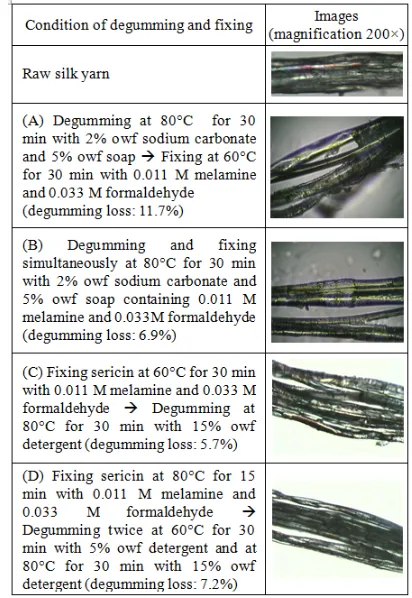
Polarization microscope images of degummed and sericin-fixed silk yarns treated with the various conditions of degumming and fixing sericin are shown in Table II. It was reported that sericin could
be classified into three fractions of sericin A, sericin B, and sericin C depending on their solubility[20]. Sericin A is the outermost layer and is a readily soluble fraction of random coil conformation. Sericin B is the middle layer. Sericin C is the innermost layer adjacent to fibroin and is insoluble in hot water.
TABLE II. Polarization microscope images of degummed and
sericin-fixed silk yarns.
As shown in Table II (A), in the case of fixing sericin after degumming at 80°C for 30 minutes with 2% owf sodium carbonate and 5% owf soap (degumming loss of 11.7%), sericin was unevenly removed. Part of sericin was completely removed, probably due to the removal of sericin C due to the rapid alkaline hydrolysis of sericin. In the case of the simultaneous treatment of degumming and fixing at 80°C for 30 min with sodium carbonate and soap containing melamine and formaldehyde in Table II (B)
In the case of one-step degumming after fixing sericin at 60°C for 30 minutes with melamine and formaldehyde of Table II (C) (degumming loss of 5.7%), sericin was somewhat uniformly removed and some unremoved fragments of sericin were attached to filaments, probably due to the removal of weakly fixed sericin A and the residue of impregnably fixed sericin A due to degumming at 80°C for 30 minutes with 15% owf detergent. In the case of two-step degumming after fixing sericin at
80°C for 15 minutes with melamine and
formaldehyde of Table II (D) (degumming loss of 7.2%), sericin was uniformly removed, probably due to more complete removal of sericin A.
Comparison to Free Formaldehyde
Free formaldehyde was extracted from sericin-fixed souple silk yarns obtained through various conditions of degumming and fixing sericin. The amounts of free formaldehyde determined are shown in Table III.
TABLE III. Degumming loss (%) and the amount of free formaldehyde (mg/kg) according to the condition of degumming and fixing sericin (A: degumming loss, B: the amount of free formaldehyde).
Condition of degumming and fixing A B
Degumming at 80°C for 30 min with 2% owf sodium carbonate and 5% owf soap Fixing at 60°C for 30 min with 0.033 M formaldehyde
11.9 4.9
Degumming at 80°C for 30 min with 2% owf sodium carbonate and 5% owf soap Fixing at 60°C for 30 min with 0.011 M melamine and 0.033 M formaldehyde
11.7 2.8
Degumming and fixing simultaneously at 80°C for 30 min with 2% owf sodium carbonate and 5% owf soap containing 0.033M formaldehyde
7.0 3.7
Degumming and fixing simultaneously at 80°C for 30 min with 2% owf sodium carbonate and 5% owf soap containing 0.011 M melamine and 0.033 M formaldehyde
6.9 1.2
Fixing sericin at 60°C for 30 min with 0.011 M
melamine and 0.033 M formaldehyde
Degumming at 80°C for 15 min with 15% owf detergent
4.9 0.5
Fixing sericin at 60°C for 30 min with 0.011 M
melamine and 0.033 M formaldehyde
Degumming at 80°C for 30 min with 15% owf detergent
5.7 0.2
Fixing sericin at 60°C for 15 min with 0.011 M
melamine and 0.033 M formaldehyde
Degumming twice at 60°C for 30 min with 5% owf detergent and at 80℃ for 30 min with 15% owf detergent
7.3 0.0
Fixing sericin at 80°C for 15 min with 0.011 M
melamine and 0.033 M formaldehyde
Degumming twice at 60°C for 30 min with 5% owf detergent and at 80°C for 30 min with 15% owf detergent
7.2 0.0
All the amounts of free formaldehyde listed in Table III were below 5 mg/kg. In the case of degumming twice at 60°C for 30 min with 5% owf detergent and at 80°C for 30 min with 15% owf detergent after fixing sericin at 60-80°C for 15 minutes with 0.011 M melamine and 0.033 M formaldehyde, free formaldehyde was not detected. From this result, it is evident that two-step degumming was most effective in the elimination of free formaldehyde from silk yarns fixed with melamine and formaldehyde.
CONCLUSION
By fixing sericin after degumming with soap and sodium carbonate, by degumming and fixing simultaneously in a solution of soap and sodium carbonate containing sericin-fixing agents, and by one-step degumming with detergent after fixing sericin, sericin-fixed souple silk yarns were obtained. In the case of two-step degumming successively at 60°C for 30 minutes and at 80°C for 30 minutes with detergent after fixing sericin at 60-80°C for 15 minutes with melamine and formaldehyde, the degumming losses were in the range of 7-13% and sericin was uniformly removed due to efficient and uniform removal of sericin A. Adding acetic acid to the fixing solution significantly increased the degumming losses. Overall, degumming loss decreased as the fixing temperature and time increased due to effective fixation of sericin. Degumming loss also increased as temperature and time increased due to more efficient removal of sericin during the degumming process. The two-step degumming process eliminated of free formaldehyde from silk yarns fixed with melamine and formaldehyde.
ACKNOWLEDGEMENT
This research has been financially supported by Chungwoon University, Republic of Korea (2013).
REFERENCES
[1] Padamwar, M. N.; Pawar, A. P.; Silk sericin and its applications: A review; Journal of Scientific & Industrial Research 2004, 63, 323-329.
[2] Rouette, H. K.; Lindner, A.; Schwager B,
Encyclopedia of Textile Finishing; Springer: Berlin, 2001, 496-497.
[3] Robson, R. M.; Handbook of fiber chemistry; Marcel Dekker: New York, 1998, 415–465. [4] Zhu, L. J.; Yao, J.; Youlu, L.; Structural
[5] Huddar, P. H.; A study of natural and synthetic compound with reference to chemistry of formation of silk in silkworm; University of Pune: India, 1985, 23-75.
[6] Gulrajani, M. L.; Degumming of silk; Review of Progress in Coloration and Related Topics 1992, 22, 79–89.
[7] Zhang, Y. Q.; Shen, W. D.; Tao, M. L.; Zhou, W. L.; Ma, Y.; Production method of water soluble sericin; China Patent, CN 1477141A, 2004-04-25.
[8] Choudhury, A. K. R.; Textile preparation and dyeing; Science Publishers: Enfield, 2006, 231-236.
[9] Lee, E. M.; Lee, H.J.; Yoo, H. J.; The physical properties and dyeability of degummed and sericin fixed silk fabrics; Journal of the Korean Society of Clothing and Textiles
2003, 27, 517-523.
[10] Ko, J. S.; Yoon, K.; Ki, C. S.; Kim, H. J.; Bae, D. G.; Lee, K. H.; Park, Y. H.; Um, I. C.; Effect of degumming condition on the solution properties and electrospinnablity of regenerated silk solution; International Journal of Biological Macromolecules 2013,
55, 161-168.
[11] Kim, H. J.; Chung, D. E.; Um, I. C.; Effect of Processing Conditions on the Homogeneity of Partially Degummed Silk Evaluated by FTIR Spectroscopy; International Journal of Industrial Entomology 2013, 26, 56-60. [12] Park, G. Y.; Half-degumming Behaviors of
Raw Silk Yarns Degummed with Soap and Alkalis; Journal of the Korean Society of Dyers and Finishers 2010, 22, 349-355. [13] Park, G. Y.; A study on the sericin fixation of
raw silk fibers by fixing with the mixtures of various amines and formalin; Journal of the Korean Society of Dyers and Finishers 2009,
21, 67-72.
[14] Park, G. Y.; The sericin fixation of raw silk fabrics by fixing with the mixture of melamine and formalin; Journal of the Korean Fiber Society 2009, 46: 30-34. [15] Hiro, K. H.; Silk processing techniques and its
application; Textile Research: Tokyo, 1988, 55-57.
[16] Lewin, M.; Sello, S.B.; Chemical processing of fibers and fabrics in Handbook of fiber science and technology (Part A); Dekker: New York and Basel, 1983, 57-64.
[17] Lee, J. M.; Kim, J. W.; Kim, K. J.; Koo, K.;
Textile finishing; Hyungseul: Seoul, 2004, 494-499.
[18] Berge, A.; Mejdell, T.; Melamine formaldehyde compounds. The active species in acid catalyzed reactions; Polymer
2006, 47, 3249–3256.
[19] Li, T.; Xie, X.; Du, G.; Mechanism of the water-catalysed addition between melamine and formaldehyde: a theoretical investigation; Progress in Reaction Kinetics and Mechanism 2014, 39, 103-114.
[20] Takasu, Y.; Yamada, H.; Tsubouchi, K.; Isolation of three main sericin components from the cocoon of the silkworm, Bombyx mori; Bioscience Biotechnology and Biochemistry 2002, 66, 2715-2718.
AUTHORS’ ADDRESSES Geon Yong Park, PhD Hyun Chel Kim, PhD
Chungwoon University
Fashion Design & Textile Engineering Daehakgil-25