MDA Based Multiplatform Mobile Application Modeling with
Platform Compliant User Interfaces
L’UBOŠSTARÁ ˇCEK1
VALENTINOVRANI ´C2
Institute of Informatics and Software Engineering Faculty of Informatics and Information Technologies
Slovak University of Technology in Bratislava Bratislava, Slovakia
1
2
Abstract.Applications for mobile devices (mobile applications) represent a specific segment of the soft-ware market in which development of applications for multiple platforms is far more articulated issue than in applications intended for common computers. While multiplatform mobile application develop-ment tools, such as Marmalade, MoSync or Xamarin, generate quite usable (software) platform specific code out of its general representation developed upon something that might be considered as a super-platform, the user interface exhibits peculiarities that have to be addressed manually. Otherwise, the user interface will probably fail to meet the given platform compliance criteria that may result in worsening user acceptance of the application or even in not being accepted to the application marketplace at all. In this paper, an approach to design multiplatform mobile application at model level that employs OMG’s MDA (Model Driven Architecture) to generate platform compliant user interfaces while still taking ad-vantage of multiplatform tools to develop application logic is proposed. Navigation in mobile application user interfaces is modeled using UML state machine diagrams. A model-to-model transformation for the Android platform has been created and applied to a real application model.
Keywords: mobile applications; user interface; multiplatform; UML; MDA; state machine diagrams; software product lines.
(Received August 28th, 2014 / Accepted January 22th, 2015)
1 Introduction
Applications for mobile devices—commonly known as mobile applications—represent a specific segment of the software market in which development of the ap-plications for multiple platforms is far more articulated issue than in applications intended for common com-puters. The notion of platform is usually being related to operating systems and software frameworks, which are very diverse on mobile devices, but it can comprise mobile device hardware properties, too. In other words, we can distinguish between software and hardware plat-form. Some software platforms are capable of running
on different hardware platforms.
The migration to another platform is sometimes achieved by adapting the application, but if the need to run the application on several platforms is known from the beginning, it’s possible to proceed deliberately and employ appropriate techniques to what is called multi-platform1mobile application development.
Hardware platform variability, such as display res-olution or the very presence of some hardware compo-nents like camera, keyboard, GPS, gyroscope, or even SIM card, seems to be well managed by application
Staráˇcek and Vrani´c MDA Based Multiplatform Mobile Application Modeling with Platform Compliant User Interfaces 35
code. Software platform variability comprises dealing with application logic and user interface. Nowadays there is a huge expansion of quite different multiplat-form development tools. They differ in the technology approach, e.g. web-to-native wrappers, runtime exe-cution environment, source code translators, supported platforms, or target audience [5, 10].
While multiplatform mobile application develop-ment tools, such as Marmalade, MoSync or Xamarin, generate quite usable (software) platform specific code out of its general representation developed upon some-thing that might be considered as asuperplatform, the user interface exhibits peculiarities that have to be ad-dressed manually. Otherwise, the user interface will probably fail to meet the given platform compliance cri-teria that may result in worsening user acceptance of the application or even in not being accepted to the appli-cation marketplace at all.
In this paper, an approach to design multiplatform mobile application at model level that employs OMG’s MDA (Model Driven Architecture) to generate platform compliant user interfaces while still taking advantage of multiplatform tools to develop application logic is pro-posed. The rest of the paper is structured as follows. Section 2 presents the outline and context of the ap-proach. Section 3 describes in details the role of MDA in the approach. Section 4 deals with navigation model-ing in user interfaces. Section 5 brmodel-ings some evaluation results. Section 6 discusses related work. Finally, Sec-tion 7 concludes the paper and proposes further work.
2 Multiplatform Mobile Application Modeling:
The Approach Overview
The multiplatform mobile application development tools allow to develop mobile applications for multiple platforms simultaneously. Thanks to these tools it is possible to design improved multiplatform mobile ap-plication architecture. This architecture employs one multiplatform application core on all platforms in com-bination with the platform specific user interface. This architecture, depicted in Figure 1, requires a minimum of source code and can fulfill requirements on adapta-tion of the user interface according to convenadapta-tions that user interfaces must adhere to in order to be platform compliant.
The approach to multiplatform mobile application modeling proposed in this paper is depicted in Figure 2. The first step consists of designing a platform indepen-dent model (PIM) of the multiplatform mobile appli-cation being developed including navigation. In the next step, this PIM is processed by the corresponding model-to-model (M2M) transformations resulting in a
Figure 1:Architecture of multiplatform mobile application (adopted from [17]).
platform specific model (PSM) generated for each tar-get platform.
PIM
M2M transformation
for each target platform M2M
transformation for multiplatform
core
User interface PSM (for each target platform) Application
logic PSM (for multiplatform
core)
modeling
Figure 2:An overview of the approach to multiplatform mobile ap-plication modeling.
The approach fits into a broader context as depicted in Figure 3. This assumes model-to-text transforma-tions for each target platform to generate user interface source code on one hand, including navigation, while on the other hand, this code has to be merged with the platform specific code generated from the multiplat-form application logic implementation by the appropri-ate mobile application multiplatform tool.
The following two sections explain the details of user interface and application logic structural modeling in the context of MDA (Sect. 3) and modeling the navi-gation aspect of user interfaces Sect. 4.
3 Employing MDA to Achieve Platform
Com-pliant User Interfaces
pos-M2T transformation for multiplatform core UserPinterface code (forPnative userPinterface library) Application logicPcode (for multiplatform SDK) deployment Multiplatform application development tool Android application iOS application Win.PPhone application other platform application finalization and merging Multiplatform application code deployment deployment deployment Application logicPPSM (forPmultiplatform core) UserPinterface PSM (forPeachPtargetP platform) M2T transformation for each target platform finalization and merging coding
Figure 3:The context of the approach.
sibility to apply MDA to application logic modeling is embraced, too.
3.1 MDA
MDA (Model Driven Architecture), an Object Man-agement Group standard, targets multiplatform model driven application development in general. MDA starts with a platform independent model (PIM) which is be-ing adapted to the target platform through a series of transformations that result in creating one or more plat-form specific models (PSM).
Multiplatform mobile application development tools enable to implement platform specific user inter-faces that meet the given platform compliance criteria by providing access to native user interface libraries. However, this means that the user interface for each platform has to be implemented separately. Here, we employ MDA to design the user interface once for mul-tiple platforms and then to generate the corresponding platform specific models.
At the platform independent model level, the appli-cation is modeled without any platform specific proper-ties. The application elements are relieved of the tech-nical details of their realization. The PIM elements are marked with stereotypes from the UML profile that de-fines their basic semantics. The elements can be further configured by adding special attributes to them bear-ing thearg stereotype. Marking elements with
stereo-types and providing them with thearg stereotyped at-tributes defines (partly) how these elements are to be transformed into a PSM by an M2M transformation.
QVT (Query/View/Transformation) is a standard defined by the Object Management Group for model transformations. The approach proposed here employs Eclipse M2M Operational QVT implementation.
An M2M transformation has to be designed for each target mobile platform including the transformation for the multiplatform development tool being used in the implementation phase since each tool is different.
3.2 UML Profile
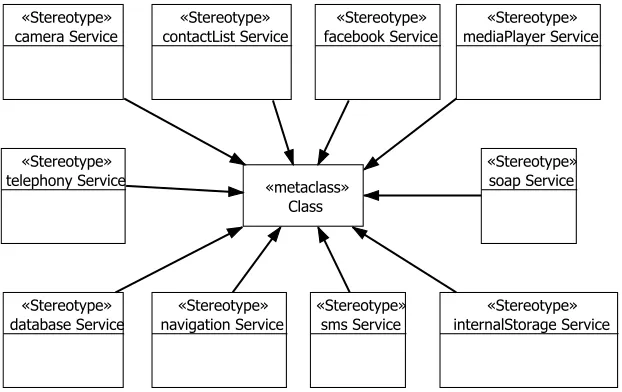
The UML profile designed for the purposes of the ap-proach to multiplatform mobile application design pro-posed here contains stereotypes applicable to the in-stances of theClassUML metaclass (Figs. 4 and 5) and to thePropertyUML metaclass (Figure 6).
For example, one of the stereotypes applicable to theClassmetaclass isui View. The classes in PIM that model the base user interface usage should be marked with this stereotype. In the M2M transformation for the Android platform, all the classes marked asui View
would be transformed into the classes that extend the Android Activity class with the addition of the cor-responding methods likeonCreate(),onResume(), on-Pause(), etc. In the iOS transformation, the transfor-mation would end up with theUIViewController class, while in Windows Phone transformation the PhoneAp-plicationPageclass would be employed.
One of the stereotypes applicable to the Property
metaclass is ui ListView. This stereotype represents a list of items that appear in the user interface and it should be applied to the property of some class that rep-resents a user interface (e.g.ui View). On Android, this would be represented by an instance of theListView
class. On iOS,UITableView would be used, while on Windows PhoneListBoxwould be employed.
Staráˇcek and Vrani´c MDA Based Multiplatform Mobile Application Modeling with Platform Compliant User Interfaces 37
«Stereotype»
ui View «Stereotype»ui MapView «Stereotype»ui MultiView
«Stereotype» ui MultiVIewItem «Stereotype»
ui MainMenuView «metaclass»
Class
«Stereotype» ui ListViewItem
Figure 4:The UML profile with stereotypes applicable to theClassUML metaclass instances that constitute the user interface.
«metaclass» Class
«Stereotype» navigation Service
«Stereotype» internalStorage Service
«Stereotype» soap Service
«Stereotype» database Service
«Stereotype» camera Service
«Stereotype» contactList Service
«Stereotype» facebook Service
«Stereotype» mediaPlayer Service
«Stereotype» telephony Service
«Stereotype» sms Service
Figure 5:The UML profile with stereotypes applicable to theClassUML metaclass instances that constitute multiplatform services.
3.3 Element Configuration
Some user interface elements could be transformed into PSM in several ways. Consider theui MultiView
stereotype, which represents an element that includes multiple views. On the Windows Phone platform, this element would be transformed into an element called
Panorama View. This element may contain a main menu, but it doesn’t have to since on the Android and iOS platforms the main menu should never be a part of aui MultiView element. To be able to deal with this situation, theui MultiView element should be config-urable. The configuration is performed by addingarg
stereotyped attributes into the component. Thus, if a
Panorama View should include a main menu on the Windows Phone platform, then a MainMenu type
at-tribute namedtrue bearing aarg stereotype would be added into the PIM element marked with theui Mul-tiView stereotype that would subsequently have to be handled in the Windows Phone PSM transformation.
«Stereotype»
uikListView «Stereotype»uikButton «Stereotype»uikTextView «Stereotype»uikTextArea
«Stereotype» uikEditText
«Stereotype» uikImageView
«Stereotype» uikRadioButton
«Stereotype» uikRatingBar «metaclass»
Property «Stereotype»
arg «Stereotype»SeekBar
Figure 6:The UML profile with stereotypes applicable to thePropertyUML metaclass instances.
for example, adding the GPSLocation type attribute named true bearing the arg stereotype to the naviga-tion Serviceelement will indicate that thegetLocation()
method should be implemented and that it would return the location given by the GPS module.
3.4 User Interface Stereotypes
All defined user interface stereotypes are listed here. These are the stereotypes applicable to theClassUML metaclass instances that form the user interface and what they are used to denote:
• ui View—the base view of the user interface hier-archy, already described in this section
• ui MapView—the view that contains a map, each major mobile platform vendor (Google, Apple, Microsoft) has its own implementation of maps
• ui MultiView—the view that contains multiple views, displays one view simultaneously and can switch between these views; on some platforms, various realization options are possible for this el-ement (e.g. sliding views with or without text page indicator or tabbed views on Android etc.), so a special argument that would enable switching these options would be needed
• ui MultiViewItem—a view that is contained inui MultiView element, should be connected with the correspondingui MultiViewelement using aggre-gation
• ui MainMenuView—very similar toui View; the only reason for defining this stereotype is that on Windows Phone the main menu may be a part of
theui MultiViewelement, but on Android and iOS it can’t
• ui ListViewItem—a view that is forming a single item of a list displayed byListView; it should be connected with the corresponding element that in-cludes ui ListView with aggregation; if the cor-responding element contains several ui ListView
fields, then ui ListViewItem element should con-tain a special attribute that would identify the cor-responding ui ListView instance (e.g. «arg»list1 ListViewID)
These are the stereotypes applicable to theProperty
UML metaclass instances and what they are used to de-note:
• ui ListView—view that shows items in a scrolling list, may be horizontal or vertical; displayed items are represented by aui ListViewItemelement
• ui Button—a standard button view
• ui TextView—a standard text view
• ui TextArea—a text view that contains multiple lines of text
• ui SeekBar—a visual progress indicator in the op-eration while the user can touch the thumb and drag left or right to set the current progress level
• ui RatingBar—an extension of ui SeekBar that shows a rating in stars
• ui RadioButton—a standard radio button
Staráˇcek and Vrani´c MDA Based Multiplatform Mobile Application Modeling with Platform Compliant User Interfaces 39
• ui EditText—an extension ofTextViewthat is ed-itable by the user
• arg—a special attribute
All the instances to which any of the stereotypes listed is applied, except for theargstereotype, are user inter-face elements.
These are the stereotypes applicable to the Class
UML metaclass instances that represent service ele-ments and are part of the multiplatform core of the mo-bile application being developed, as well, as what are these stereotypes used to denote:
• camera Service—a service that handles the mobile device camera
• contactList Service—a service that handles access to the contacts stored in the mobile device
• facebook Service—an access to the Facebook API
• mediaPlayer Service—handle playing of au-dio/video media files
• soap Service—a service element that would im-plement web services using SOAP protocol
• internalStorage Service Handle data stored in in-ternal storage of a mobile device
• sms Service—handle SMS managing (e.g. read, write, send, delete, etc.)
• navigation Service—handle a GPS module and navigation generally (e.g. navigation by network)
• database Service—a service element that would implement access to the database
• telephony Service—handle telephony services (e.g. making a call, getting signal strength, etc.)
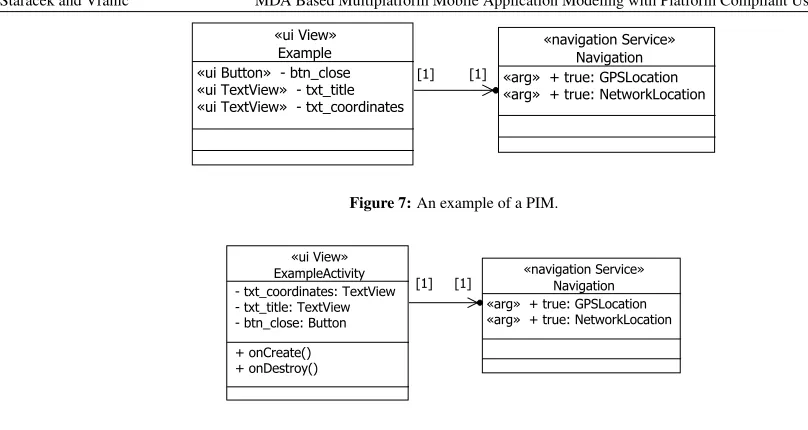
Consider an example of a PIM depicted in Figure 7 that models a simple application displaying location co-ordinates of a mobile device containing a label and the closing button. Suppose this PIM has to be transformed into an Android PSM by the Android M2M transforma-tion. The user location is obtained bynavigation Ser-vicementioned earlier in this section.
After processing this PIM by the Android QVT transformation created for the purposes of the approach proposed here, the Android PSM would be generated as depicted in Figure 8.
A snippet of the Android QVT transformation that is responsible for the transformation of the given example is depicted in Figure 9.
modeltype UML uses"http://www.eclipse.org/uml2/2.0.0/UML";
transformation Android_PSM_transformation (in model : UML, out model1 : UML);
main() {
--map all modelelements
model.rootObjects()[Model]->mapModel(); }
mappingModel::Model() : Model {
--concatenate "Android"tomodel name name := self.name + 'Android';
--query all modelelementsof type"Class"with stereotype --thatstarts with"ui View"stringand process themwith -- UIViewmapping
ownedType += self.getOwnedTypes()[Class] ->select(c|c.getAppliedStereotypes() ->exists(s|s.name.startsWith("ui View"))) ->map UIView();
}
mappingClass::UIView() : Class {
name := self.name + 'Activity';
ownedAttribute += self.attribute
->map attributes(); --map all attributes ownedOperation += objectOperation{
name := 'onCreate'; }; -- add "onCreate"method
ownedOperation += objectOperation{
name := 'onDestroy'; }; -- add "onDestroy"method
}
mappingProperty::attributes() : Property {
name := self.name;
--resolving typeofattributes bystereotypes if(self->exists(c|c.getAppliedStereotypes() ->exists(s|s.name.startsWith("ui Button"))))
then {
type := objectClass{
name := "Button"; };
} endif;
if(self->exists(c|c.getAppliedStereotypes() ->exists(s|s.name.startsWith("ui TextView"))))
then {
type := objectClass{
name := "TextView"; };
} endif; }
Figure 9:A snippet of the Android QVT transformation.
The M2M transformation should preserve the stereotypes. This is important for the code generation, which itself is out of the scope of this work.
Figure 7:An example of a PIM.
Figure 8:An Android PSM.
example, one might run the Android M2M transforma-tion on the PIM, and then run the multiplatform tool M2M transformation on the obtained Android PSM re-sulting in a complete PSM.
4 Mobile Application Navigation Model
In the previous section we focused mainly on the mo-bile application structure. A very important aspect of the mobile application user interface design is navi-gation. Navigation can successfully be modeled us-ing UML state machine diagrams [4] and we employ this approach to model navigation in mobile application user interfaces.
In the navigation model, eachui View element is modeled as a state of the state machine diagram where names of the states and the correspondingui View ele-ments must match. A state machine diagram transition represents the user interface element instance that ini-tiates navigation change between ui Views connected with this transition. Therefore,ui Views must contain all the given user interface element instances that are represented as transitions coming out of the state that represents the givenui Viewelement.
The transition syntax in UML state machine dia-grams is [11]:
event[guard expression]/action
User interface elements are mapped onto transitions by setting an event of the given transition to be the same as the name of the user interface element.
Each user interface element can handle multiple in-put events that can initiate different navigation changes.
Therefore, navigation model has to include the informa-tion about which input event (onClick,onLongCLick,
onKeyPressed, etc.) initiates the given navigation change. The user interface elements in the navigation model would not initiate other actions than navigation changes, thus input event can be put into the navigation model as an action of given state machine diagram tran-sition that represents the given user interface element.
On different platform user interface elements may initiate different navigation changes by their input event, which makes navigation model platform specific. This opens two possibilities: to make one navigation model for each target platform or to express all naviga-tion transinaviga-tions in one model and distinguish their plat-form adherence with tagging. Assuming that the most of the navigation transitions would be shared between target platforms, the second possibility is more appro-priate. A platform specific transition would be tagged by setting a precondition in the guard expression in it as:
platform==<target_platform>
To sum up, a transition in the navigation model would be described as:
user interface element’s name[target platform]/input event
Staráˇcek and Vrani´c MDA Based Multiplatform Mobile Application Modeling with Platform Compliant User Interfaces 41
user interface elements, thus an appropriate stereotype, like ui View, ui MainMenuView, or similar, has to be applied to it. There is a transition from the MainMenu-View1 state to the MainMenuItemView1 state. This transition is specified as:
btn_menu_item1[platform==iOS]/onClick
Therefore, MainMenuView1 should contain a user interface element named btn_menu_item1 that— when clicked—would initiate displaying MainMenu-ItemView1 on the iOS platform.
NavigationModelExample
btn_menu_item1[platform==iOS]/onClick Effect
btn_menu_item1[platform==iOS]/onClick Effect
MainMenuView1
MainMenuItemView1
Figure 10:A user interface navigation model.
5 Evaluation
The approach to mobile application modeling pro-posed here was demonstrated on several—so to say— fabricated examples in previous sections. However, the approach was also applied to a real mobile application case. This application is a generalized version of a real application developed by the iNeed developer team.2
The original application was intended to be an “ency-clopedia” of beer and breweries located in Slovakia and Czech Republic. For the purposes of this work, the ap-plication was adjusted to be able to cover any products and its user interface was simplified.
The Android M2M transformation proved its usabil-ity and abilusabil-ity to generate arbitrary PSM from PIM, which speaks in favor of the possibility to define M2M transformations for any mobile platform. In the An-droid M2M transformation, an element with theui Mul-tiViewstereotype produced multiple elements that form
ui MultiView on the Android platform. Also, all other elements specific to the Android platform were trans-formed into their corresponding platform specific form. Without the proposed approach, this would have to be performed manually.
Extending the proposed approach to a new platform requires designing and implementing the corresponding
2http://ineed.sk/
M2M transformation for this platform. However, if the platform is not supported by the multiplatform develop-ment tool that is intended to be employed in the imple-mentation phase, there are two possible solutions. The first one is to change the multiplatform development tool to one that would support all required platforms. Since changing the tool may require adaptation of isting M2M transformations, this option may be too ex-pensive, but if such M2M transformations are available, this possibility is recommended.
The other possibility is to write an M2M transfor-mation that would generate the application model on a new platform in its native API. This would require:
• the M2M transformation to change the architecture of the application in PSM from multiplatform to single platform, so it would transform services to a platform specific form
• to use its integrated development environment (e.g., Xcode for iOS) in the implementation phase
6 Related Work
A multiplatform mobile application designed accord-ing to our approach can be considered to be a soft-ware product line. Although common softsoft-ware product lines represent different software products with shared components among them and with some product spe-cific components, the software product line here is con-stituted by one product adapted to multiple platforms. However, there are shared components in the multiplat-form core library and product specific components that represent the user interface. Several authors have ad-dressed the software product line approach in mobile application domain [1, 8, 14, 16]. One of the mostly discussed topics is how high heterogeneity in mobile platforms may lead to a significant increase of software variability. Improved multiplatform mobile application architecture that employs the software product line ap-proach also brings advantages like decrease in time to market, increase in productivity, and quality improve-ment [15].
Dolog and Nejdl [4] proposed an approach for gen-erating navigation sequences in web based systems. In this paper, Dolog’s idea of navigation modeling us-ing UML state machine diagrams has been applied and adapted to the domain of mobile applications. Specif-ically, it was necessary to design methods for marking target platform and add the event type into state ma-chine diagram transitions (described in Sect. 4).
mobile platform [9]. They employ software product lines as an additional layer of abstraction to cover var-ious hardware properties of mobile devices on single platform, while our approach employs software product lines to deal with the heterogeneity of mobile platforms since device fragmentation is successfully managed by application code.
Balagtas-Fernandez et al. [3, 2] provided a tool called Mobia Modeler that allows the development of fully functional software applications for mobile plat-forms by employing MDA. Mobia Modeler has a user friendly user interface, which make developing process more intuitive and it also prevents users from perform-ing invalid actions. The tools employs MDA with code generation techniques (XMLT) to improve time to mar-ket and development complexity.
Porubän et al. [12, 13] reported they created the Graphical User Interface Interaction Language using their annotation based parser generator that signifi-cantly simplifies development of domain-specific lan-guages. This could be seen as an alternative to graphical modeling employed in our approach.
7 Conclusion and Further Work
In this paper, an MDA based approach to multiplatform mobile application modeling with platform compliant user interfaces has been proposed. The approach ad-dresses the problem of inadequate support for platform specific user interface features in existing multiplatform mobile application development approaches.
The approach employs MDA’s platform indepen-dent models (PIM) to express a multiplatform user in-terface along with a part or whole application logic (op-tional). Platform independent models are marked with general user interface and application logic stereotypes contained in the UML profile for modeling multiplat-form mobile application proposed in this paper.
Both user interface and application logic elements can be configured by adding the corresponding at-tributes bearing the arg stereotype. By this, the UML profile for modeling multiplatform mobile application remains relatively stable.
Navigation represents an important aspect of user interface modeling. For this, state machine diagram based approach known from web modeling [4] has been applied.
Each target platform has to be covered by the cor-responding model-to-model transformation that trans-forms a platform independent model to a platform spe-cific one (PSM). For this, QVT can be used and it was actually used to demonstrate the approach: a model-to-model (M2M) transformation for the Android platform
was developed.
The approach is presented on examples. Further-more, it was successfully applied to create a plat-form independent model of a real mobile application to which the proposed Android M2M transformation has been applied to get the corresponding platform specific model. This has proved the applicability and usability of the Android platform M2M transformation. The sit-uation with a missing M2M transformation for a given platform has also been evaluated (see Sect. 5).
The context in which this approach to multiplatform application modeling is proposed—presented in Fig-ure 3 (Section 2)—embraces code generation by model-to-text MDA transformations. This is certainly one way to extend the approach. Another area we would like to target is providing a common user interface to mobile devices participating in complex event process-ing [7, 6].
Acknowledgments
The work reported here was supported by the Scientific Grant Agency of Slovak Republic (VEGA) under the grant No. VG 1/1221/12.
This contribution/publication is also a partial re-sult of the Research & Development Operational Pro-gramme for the project Research of Methods for Ac-quisition, Analysis and Personalized Conveying of In-formation and Knowledge, ITMS 26240220039, co-funded by the ERDF.
References
[1] Alves, V. Identifying variations in mobile devices. Journal of Object Technology, 4(3):51–56, Apr. 2005.
[2] Balagtas-Fernandez, F., Tafelmayer, M., and Hussmann, H. Mobia Modeler: Easing the cre-ation process of mobile appliccre-ations for non-technical users. InProceedings of 15th Interna-tional Conference on Intelligent User Interfaces, IUI ’10, pages 269–272, Hong Kong, China, 2010. ACM.
[3] Balagtas-Fernandez, F. T. and Hussmann, H. Model-driven development of mobile applica-tions. InProceedings of 23rd IEEE/ACM Interna-tional Conference on Automated Software Engi-neering, ASE ’08, pages 509–512, L’Aquila, Italy, 2008. IEEE Computer Society.
Staráˇcek and Vrani´c MDA Based Multiplatform Mobile Application Modeling with Platform Compliant User Interfaces 43
web-based systems. In Proceedings of 6th In-ternational Conference on the Unified Modeling Language, UML 2003, volume LNCS 2863, San Francisco, USA, Oct. 2003. Springer.
[5] Jones, S., Voskoglou, C., Vakulenko, M., Mea-som, V., Constantinou, A., and Kapetanakis, M. Cross-platform developer tools 2012. Technical report, Vision Mobile, Feb. 2012.
[6] Lang, J., Jantošoviˇc, M., and Polášek, I. Re-usability in complex event pattern monitoring. In Proceedings of 10th Jubilee International Sym-posium on Aplied Machine Intelligence and In-formatics, SAMI 2012, Herl’any, Slovakia, 2012. IEEE.
[7] Lang, J. and Janík, J. Reactive distributed sys-tem modeling supported by complex event pro-cessing. In Proceedings of 3rd Eastern Euro-pean Regional Conference on the Engineering of Computer Based Systems, ECBS-EERC 2013, Bu-dapest, Hungary, 2013. IEEE Computer Society.
[8] Muthig, D., John, I., Anastasopoulos, M., Forster, T., Dorr, J., and Schmid, K. GoPhone—a software product line in the mobile phone domain. Techni-cal report, Fraunhofer IESE, 2004.
[9] Myllymaki, T., Koskimies, K., and Mikkonen, T. On the structure of a software product-line for mobile software. InSoftware Infrastructures for Component-Based Applications on Consumer De-vices (in conjunction with EDOC 2002, pages 85– 91, Sept. 2002.
[10] Ohrt, J. and Turau, V. Cross-platform develop-ment tools for smartphone applications. Com-puter, 45(9):72–79, 2012.
[11] OMG. OMG Unified Modeling Language (OMG UML), superstructure, version 2.4.1. Technical re-port, 2011.
[12] Porubän, J., Forgáˇc, M., Sabo, M., and Bˇehálek, M. Annotation based parser generator. Computer Science and Information Systems Journal (Com-SIS), 7(2):291–307, 2010.
[13] Porubän, J., Sabo, M., Kollár, J., and Mernik, M. Abstract syntax driven language develop-ment: Defining language semantics through as-pects. InProceedings of International Workshop on Formalization of Modeling Languages (FML ’10), ECOOP 2010, pages 6–10, Maribor, Slove-nia, 2010. ACM.
[14] Rosa, R. E. V. and Lucena, V. F., Jr. Smart com-position of reusable software components in mo-bile application product lines. InProceedings of 2nd International Workshop on Product Line Ap-proaches in Software Engineering, PLEASE ’11, pages 45–49, Waikiki, Honolulu, HI, USA, 2011. ACM.
[15] SEI. Software product line overview. http://
www.sei.cmu.edu/productlines/.
[16] White, J. and Schmidt, D. C. Model-driven product-line architectures for mobile devices. In Proceedings of 17th Annual Conference of the International Federation of Automatic Control, Seoul, Korea, 2008.
[17] Xamarin Inc. Building cross platform
ap-plications. http://docs.xamarin.com/
![Figure 1: Architecture of multiplatform mobile application (adoptedfrom [17]).](https://thumb-us.123doks.com/thumbv2/123dok_us/8364239.1672784/2.612.326.501.358.504/figure-architecture-multiplatform-mobile-application-adoptedfrom.webp)