Forestry & Natural-Resource Sciences Last Correction: Oct. 24, 2019
CONIFER RETENTION AND HARDWOOD MANAGEMENT
AFFECT INTERPLAY BETWEEN HARVEST VOLUME AND
CARBON STORAGE OVER 100 YEARS IN
DOUGLAS-FIR/TANOAK: A CASE STUDY
J.P. Berrill
1, K. Boston
21
School of Forest Resources, University of Maine, Orono, ME, USA
2Humboldt State University, Arcata, CA, USA
Abstract.Modern forest management involves tradeoffs between harvest intensity and carbon storage in live trees. A key component is how non-merchantable tree species are treated. We simulated forest growth and yield over a century of multiaged management in a mixed stand in northern California. Pre-treatment basal area comprised 136 ft2ac−1 (31 m2 ha−1) non-merchantable hardwood and 73 ft2 ac−1(17 m2ha−1) merchantable conifer. Individual-tree selection harvest was simulated for various conifer BA retention levels at 20-year harvest return intervals. Silvicultural prescriptions promoted conifer dominance by retaining only 5 ft2ac−1 (1.1 m2ha−1) hardwood BA at each harvest. Alternatively, retaining 50% of hardwood BA
at each harvest slowed the conversion to conifer dominance. Higher BA retention favored per-acre growth and storage of carbon in live trees. Lower BA retention sacrificed per-acre wood volume growth, but sizeable early conifer harvests ensued. The FORSEE growth and yield model did not predict the expected positive responses of conifer tree growth to treatments that eliminated hardwoods, suggesting it may not adequately simulate benefits of hardwood management. Therefore, our projections of growth and harvest yield should be regarded as conservative when evaluating forest restoration and management options in terms of growth, yield, and carbon dynamics.
Keywords: Carbon sequestration, forest carbon, FORSEE, hardwood sprouting, multiaged man-agement, partial harvesting, uneven-aged silviculture, variable retention.
1
INTRODUCTION
Forest management and restoration of conifer domi-nance has the potential to offset greenhouse gas (GHG) emissions via enhanced carbon sequestration and storage in healthy, resilient, fire-resistant, productive, conifer-dominated forests (Berrill and Han 2017). Reducing GHGs to 1990 levels statewide by the year 2020 is the primary objective of the California Global Warming So-lutions Act of 2006 (AB 32). We expect forest car-bon projects to provide GHG emission reduction ben-efits via timber harvesting to produce long-lived solid-wood products that store carbon instead of letting trees in overstocked stands die, decay, and release carbon to the atmosphere. We also expect GHG emission reduc-tion benefits by retaining higher rates of forest growth and carbon sequestration by returning species composi-tion to the more productive historical condicomposi-tions where fast-growing, long-lived conifers dominated. High
trans-action costs may prevent smaller landowners from en-tering carbon markets (Jenkins 2018; Kelly and Schmitz 2016), but all landowners should understand how their management decisions affect carbon dynamics and how they might enhance carbon sequestration and storage in trees.
1.1 Restoring conifer dominance
California’s Coast Range has forests dominated by redwood (Sequoia sempervirens) towards the coast, and drier upland forests located further inland that were once dominated by coast Douglas-fir (Pseudotsuga men-ziesii var. menziesii). These upland forests have been harvested one or more times, with reforestation gen-erally favoring re-sprouting hardwoods such as tanoak (Notholithocarpus densiflorus) that reoccupy the site more consistently than naturally-regenerating Douglas-fir seedlings (Tappeiner et al. 2007). Tanoak
competi-Copyright©2019 Publisher ofMathematical and Computational Forestry & Natural-Resource Sciences
tion impacts the growth of Douglas-fir (Devine and Har-rington 2008; HarHar-rington and Tappeiner 2009) and for-est productivity overall (Berrill and O’Hara 2014, 2016). Tanoak also creates a potential forest health risk via dis-ease and wildfire risk (Varner et al. 2017).
There is disagreement on how to best mitigate tanoak’s impact on the maintenance of conifers stock-ing levels; whether tanoak trees should be eliminated completely, or partially, using herbicides, or cut and al-lowed to re-sprout from cut stumps. If conifer growth could be enhanced by only removing a small portion of the hardwood competition, landowners would enjoy re-duced treatment costs and other benefits of maintaining a hardwood component such as wildlife habitat and mast production (Raphael 1987), and post-disturbance slope stabilization coming from root systems that re-sprout (Stokes et al. 2009). Hardwood removal also has the po-tential to alter forest carbon dynamics and fire behavior. Herbicide-killed tanoak that remain standing will decay, break down, and fall gradually. Conversely, cut tanoak that are not extracted from the forest instantly become surface fuels, and we expect their re-sprouting stumps to transition from patchy surface fuels into vertical lad-der fuels as they grow taller (Sugihara 2006, Valachovic et al. 2011; Forrestel et al. 2015). Resprouting hard-woods can be sprayed or prevented from re-sprouting using cut stump treatments (Ashton and Kelty 2018), but the most cost-efficient method of hardwood removal is to kill standing trees by stem-injection frill treatment (Caffereta and Yee 1991). Efficacy of frill treatments improved with the introduction of imazapyr (Minogue 1997).
There is interest in restoring conifer dominance in these Coast Range forests, but low conifer stocking and other factors such as remoteness from forest products processing facilities reduce income and profit from tim-ber harvesting that are needed to fund treatments. Ad-ditional sources of income supplementing or replacing timber revenue may give landowners flexibility to accom-plish restoration goals without resorting to heavy cut-ting. For example, sale of carbon offsets predicated on maintaining higher stand density could fund the reduc-tion in tanoak density and planting of conifer seedlings in the understory. The income from carbon sales may allow landowners to reduce or defer their conifer har-vesting activities in the near term, allowing them to maintain higher stand densities and therefore enhance per-acre forest growth (Oliver and Larson 1996; Berrill and Han 2017).
1.2 Carbon vs. timber revenues
The advent of forest carbon projects in California raises questions about tradeoffs between management
for timber and ecosystem services such as carbon stor-age over long time horizons. Of particular interest is how stand density and species composition affect this tradeoff. Answering these questions requires long-term future projections from forest growth and yield models. We use model output (yield tables) and other allomet-ric equations and conversion factors to estimate forest product yields and carbon sequestration and storage ser-vices (Bettinger et al. 2009; Malmsheimer et al. 2011). Consideration of economics and capital budgeting makes heavier earlier cutting for timber revenue appear favor-able, particularly when discount rates are high. How-ever, the potential revenue stream coming from carbon sequestration and storage may be compromised, since stands with lower densities (fewer trees) sequester less carbon per acre. Additionally, heavier cutting of mer-chantable tree species leaves fewer of these trees to ac-crue volume for future harvests. Thus, the need is for a projection of forest growth and yield under different silvicultural regimes to describe the tradeoffs between forest products and services, and how this might change over time, among forests with different structure and composition (Weiskittel et al. 2011).
quantify production and services, and compare different approaches to forest management.
The goal of this simulation study was to quantify products and services derived from different multiaged management approaches to restoring conifer dominance in unmanaged naturally-regenerated forests. Our spe-cific objectives were to examine the influence of different conifer retention scenarios and different treatments con-trolling competing hardwoods on stand growth, harvest volumes, and carbon storage with partial harvesting on a 20 year cutting cycle over a 100-year modeling period. We modeled conifer harvests and carbon storage in live trees and sawn timber, and how these changed over time. Prescriptions were designed to reestablish conifer dom-inance by preferentially cutting hardwoods, and pro-moting natural regeneration of merchantable conifers through partial harvest disturbances. We also developed “no conifer harvest” scenarios which involved cutting or culling hardwood with herbicide without any conifer har-vest (avoiding operational and permitting costs associ-ated with timber harvesting), and a no-treatment bench-mark against which to compare all other treatments. We hypothesized that growth and yield responses under-stood through the results of field-based studies on stand density management and treatment response would be adequately represented in the predicted outcomes of var-ious simulations.
2
METHODS
2.1 Growth and yield modeling
To generate estimates of basal area (BA) development, harvest yields, and carbon dioxide equivalent (CO2e)
in live biomass and sawn timber, forestry students at Humboldt State University used FORSEE (Build 26, released February 2015) to model stand growth, yield, and carbon. FORSEE is a growth and yield model ap-proved by the California Air Resources Board for carbon offset projects (http://www.arb.ca.gov). The distance-independent individual-tree model allows users to sim-ulate growth and yield of pure and mixed even-aged and multiaged stands of species native to California’s Coast Range. The model restricts growth of trees and regeneration according to a competition factor based on canopy cover from trees with crowns of similar or higher stature. We used stand data representative of unmanaged stands on relatively poor sites throughout the Coast Range (mixed conifer-hardwood, dominated by tanoak and Douglas-fir) and relatively low site class (Douglas-fir site index 114 ft (35 m) at base age 50 yrs) to represent the pretreatment condition (FORSEE Stand DR3D 41). The 18-acre (7.3 ha) stand was rep-resented by four plots with individual tree growth
mod-eled separately within each plot then aggregated into one yield table.
Multiaged management on private land along the north coast of California involves marking timber for harvest according to a silvicultural prescription such as “retain X ft2 ac−1 conifer BA, and do Y with
hard-wood”. The students simulated stand growth and har-vests on a 20-year cutting cycle over 100 years, for a range of residual conifer densities (in terms of conifer BA retained). Each student was assigned one conifer retention level: BA 40, 50, 60, 70, 80, 90, 100, 110, 125, 150, 175, or 200 ft2ac−1and two hardwood retention
sce-narios: retain 5 ft2 ac−1 hardwood BA or retain 50% of hardwood BA (i.e, retain every other hardwood). Cull hardwoods were either cut and re-sprouted, or killed with herbicide (no re-sprouting) for comparison. The hardwood treatments were simultaneously scheduled to coincide with the individual-tree selection conifer har-vests. We assumed this disturbance resulted in natu-ral regeneration of 30 tpa (74 stems ha−1) Douglas-fir,
and re-sprouting of cut hardwoods in some scenarios. For comparison, each students simulated a cut, no-treatment control, and a no-cut chemical-only control of hardwoods in the “chemical only” treatment simu-lated in FORSEE by thinning to leave 5 ft2 ac−1
hard-wood without cutting any conifer, then growing the (now conifer-dominated) residual stand for 100 years.
We made the following assumptions with respect to modeling harvesting and regeneration with FORSEE: harvest treatments were applied at the beginning of 5-yr modeling time-steps; sprout regeneration was set to zero to reflect planned application of herbicides to un-wanted hardwood; Douglas-fir seedlings were introduced into model runs after each stand entry. FORSEE har-vest routine settings focused cutting on hardwood trees or conifer trees with the lowest crown ratio. Other de-fault model values were used for seedling and sprout re-generation.
2.2 Carbon calculations
The students copied yield tables into a spreadsheet where we converted cubic stemwood volume per acre predicted using FORSEE into pounds by applying a fac-tor of 26.77 for conifer (Douglas-fir) and 30.14 for hard-woods (mainly tanoak) (California Air Resources Board 2015). We converted pounds to metric tons using a fac-tor of 0.000453592 and CO2e using factor 1.8333,
exp(−0.3737−1.8055/(dbh×2.54)) and hardwood =
e(−0.3065−5.424/(dbh×2.54)). Next we averaged met-ric tons per acre of CO2e stored above ground in live
trees for each 20-yr period between harvest treatments (e.g., at time 0, 5, 10, 15, and 20 yrs) throughout the 100-yr modeling period.
By applying regional mill efficiency data for north coastal California softwoods (× 0.675) to CO2e in
cubic harvested stemwood volumes, we divided this carbon pool into 67.5% wood products and 32.5% sawmill residues. We adjusted the wood prod-uct volume (× 0.97) to reflect regional recovery rate of 97% in long-lived solid-wood lumber prod-ucts (Regional Mill Efficiency Data.xls and Harvested Wood Products worksheet in Area Assessment Data File.xls; www.arb.ca.gov/cc/capandtrade/protocols/-usforest/usforestprojects 2015.htm.
2.3 Pre-treatment conditions
Before harvest in Year 0, the young stand had BA of 209 ft2 ac−1(50 m2ha−1) (all species), but only had 73 ft2 ac−1 (17 m2 ha−1) conifer BA. The conifers out-sized the hardwoods, with 13.8 in (35 cm) quadratic mean diameter (qmd) for conifers (70 tpa; 173 stems ha−1) versus only 5.0 in (12.7 cm) qmd for hardwoods
(1013 tpa; 2675 stems ha−1). Hardwoods outnumbered
conifers>14:1. Stand density index (SDI) for all species combined was 454 (1121 metric) or 76% of maximum SDI for Douglas-fir (Reineke 1933). Standing volume was 11.7 MBF ac−1with the majority (10.4 MBF ac−1)
being conifer volume. Site index for Douglas-fir was 114 ft at base age 50 years, which is at the high end of the range for site class III (King 1966; Krumland and Eng 2005).
3
RESULTS
3.1 Conifer basal area retention
Since hardwoods dominated the pre-treatment stand, there were few conifers available for harvest. In year 0, conifer harvesting could only be performed when pre-scriptions called for retention below the pre-treatment conifer BA of 73 ft2ac−1(Figure 1). At the next harvest,
in year 20, conifers had grown, allowing for more conifer harvesting. However, only in year 40 was there enough conifer BA to allow for harvesting under prescriptions with relatively high conifer retention. In the absence of conifer harvests, prescriptions with high conifer re-tention only allowed for hardwood treatments. Total harvest volume summed over 100 years was maximized at conifer retention levels around 60-80 ft2 ac−1 (14-18
m2 ha−1) BA. Above these levels of conifer retention, a steady increase in carbon storage in live trees and
long-Figure 1: Harvest volumes (thousand board feet; MBF) (A) and 100-year average carbon storage in live trees and long-lived solid-wood products (B) according to conifer retention at 20-year harvest intervals, assuming reten-tion of 5 ft2 ac−1 hardwood at each harvest, no hard-wood sprouting (chemical control of hardhard-wood), and 30 tpa Douglas-fir natural seedling regeneration after each harvest. Note: unequal intervals of BA retention on x-axis.
lived solid-wood products came at the expense of harvest volume in years 0 and 20. Conversely, with conifer re-tention below 50 ft2 ac−1 (11 m2 ha−1) stand BA was
so low that 100-year harvest volume and carbon storage fell sharply (Figure 1).
3.2 Rate of conversion to conifer dominance
Removing all but 5 ft2ac−1hardwood BA at each
en-try quickly left the residual stand in a conifer-dominated state. Conversely, the gradual conversion achieved by only removing/retaining 50% of hardwood BA at each conifer harvest enhanced live tree CO2e storage versus
when only 5 ft2 ac−1 of hardwood was retained at each
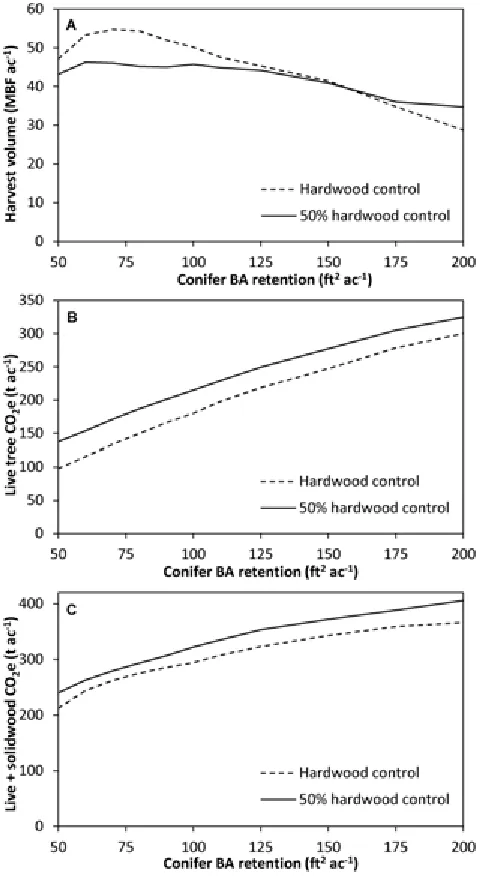
vol-Figure 2: Total harvest volume (A) and average car-bon storage in live trees (B) combined with solid-wood products (C) over 100-year modeling period for range of conifer retention levels plus cutting either 50% of hard-wood BA or a more intense hardhard-wood control prescrip-tion retaining only 5 ft2ac−1of hardwood BA at harvest in year 0, 20, 40, 60, and 80. Assumptions: no hardwood sprouting (chemical control of cull hardwood), and 30 tpa Douglas-fir natural seedling regeneration after each harvest.
umes summed over 100 years. Only controlling 50% of hardwood BA at each entry had a negative impact on the total conifer harvest when compared against the more aggressive hardwood control, but only for prescriptions
retaining up to 125 ft2ac−1of conifer BA at each entry. At higher levels of conifer retention, the total conifer har-vest volume was similar under each hardwood treatment prescription (Figure 2B). The enhancement in 100-year live tree CO2e by retaining 50% of the hardwood BA
at each entry outweighed the enhanced CO2e storage in
long-lived solid-wood products associated with greater conifer harvests at the lower (5 ft2 ac−1) hardwood
re-tention. The combined live-tree and solid-wood carbon storage was around 7-9% greater when 50% of hardwood BA was retained, as opposed to retaining only 5 ft2ac−1
hardwood BA at each entry (Figure 2C).
3.3 Influence of hardwood control
Inexplicably, when hardwoods were cut and allowed to re-sprout from cut stumps, the total conifer har-vest volume over 100 years was greater than when the hardwoods did not re-sprout (Figure 3A). Unexpect-edly, carbon storage in live trees was comparable in stands with/without re-sprouting hardwoods at all lev-els of conifer retention (Figure 3B). As a consequence, the combined carbon storage in live trees plus long-lived solid-wood products was the same or greater when hardwoods re-sprouted after cutting compared against the hardwood control prescription when herbicide-killed hardwoods did not re-sprout. Specifically, carbon stor-age was 6-7% greater without the more-aggressive hard-wood control at conifer retention levels >100 ft2 ac−1 (23 m2 ha−1) BA (Figure 3C).
4
DISCUSSION
In this mixed conifer-hardwood forest type, the model predicted that total harvest volume over 100 years was maximized at conifer retention levels around 60-80 ft2
ac−1 BA. We expect conifer regeneration to maintain
vigor at these relatively low stand densities (Reineke 1933; Berrill and O’Hara 2009; Berrill et al. 2013; O’Hara 2014). Above these levels of conifer retention, a steady increase in carbon storage in live trees and long-lived solid-wood products come at the expense of harvest volume in years 0 and 20. High conifer BA retention led to greater per-acre wood volume growth, but little to no conifer harvesting occurred for 20-40 years. Conversely, lower conifer retention levels allowed for more harvest-ing earlier in the 100-year modelharvest-ing period. Douglas-fir trees are expected to maintain vigor at low densi-ties (Drew and Flewelling 1979; Long and Daniel 1990); however, conifer retention below 50 ft2 ac−1 BA had
high-Figure 3: Total harvest volume (A) and average car-bon storage in live trees (B) combined with solid-wood products (C) over 100-year modeling period for range of conifer retention levels and retaining only 5 ft2 ac−1 of hardwood BA at harvest in year 0, 20, 40, 60, and 80, and 30 tpa Douglas-fir natural seedling regeneration with/without hardwood sprouting (with/without chem-ical control of cull hardwood) after each harvest.
density prescriptions with equivalent long-term harvest yields plus greater revenues from carbon.
Thus, an illogical model prediction was identified where more conifer volume was available for harvest under prescriptions without herbicide control of hard-woods. These simulation results do not agree with
data collected in field experiments where hardwoods re-sprouting after cutting had a detectable negative impact on growth of conifer seedlings (Harrington et al. 1991; Berrill et al. 2018). Chemical control of hardwoods en-hanced survival and development of planted Douglas-fir seedlings (Helgerson 1990). Redwood trees in multiaged stands have shown substantial positive growth responses to the control of competing hardwoods by stem injection of herbicide (Howe 2014; Berrill and Howe 2018). Young even-aged Douglas-fir responded well to herbicide release (Radosevich et al. 1976). Less is known about the re-sponse of multiaged Douglas-fir to hardwood control, such as prescriptions simulated in our study. Therefore, a priority for future research is to study the response of multiaged Douglas-fir trees and regeneration to removal of competing hardwoods.
Hardwood control practices have evolved, but the regional growth and yield model FORSEE is not de-signed or calibrated to predict responses to these treat-ments. Contemporary hardwood treatments such as frill treatment with imazapyr were not being applied in stands where data were collected for model develop-ment (Minogue 1997; DiTomaso et al. 2004). Addi-tionally, multiaged management is being widely applied whereas the models were developed with predominantly even-aged stand data (Krumland 1982). In response to these data deficiencies, we have initiated field studies and long-term experiments at various sites to quantify treatment responses. Data from these studies will al-low us to better calibrate existing models or develop new growth and yield models that account for hardwood competition and simulate a wider range of silvicultural prescriptions designed to meet timber production objec-tives and provision other ecosystem products and ser-vices such as carbon sequestration and storage.
but the low-density residual stand then would store and sequester less carbon. Then, at each subsequent harvest entry, progressively higher retention would enhance car-bon storage because more live trees would be retained. Higher retention would also enhance carbon sequestra-tion and future harvest revenues because higher residual stand density leads to greater volume production (Oliver and Larson 1996; Berrill and O’Hara 2009). Even if for-est owners and managers do not participate in carbon markets, our findings show how their management deci-sions affect carbon dynamics and how carbon sequestra-tion and storage might be enhanced.
5
CONCLUSION
In this mixed conifer-hardwood forest, the regional model approved for use in carbon offset projects did not predict a positive response among residual conifers to hardwood control treatments. This finding was counter to our expectations and recently published studies in other forest types, suggesting that the model should be validated or refitted with repeat measures data from stands that have undergone various levels of hardwood control and partial harvesting.
ACKNOWLEDGEMENTS
We thank the Humboldt State University forestry class FOR 430/530 of fall 2017 for assistance with FORSEE modeling. Support for this study was provided by the McIntire-Stennis Cooperative Forestry Research Program
References
Ashton MS, Kelty MJ. 2018. The Practice of Silvicul-ture: Applied Forest Ecology, 10th Edition. John Wi-ley and Sons, New York, NY. 776 p.
Berrill JP, Han HS. 2017. Carbon, harvest yields, and residues from restoration in a mixed forest on Califor-nia’s Coast Range. Forest Science 63(1): 128-136.
Berrill JP, O’Hara KL. 2009. Simulating multiaged coast redwood stand development: Interactions between regeneration, structure, and productivity. West. J. Appl. For.24(1): 24-32.
Berrill JP, O’Hara KL. 2014. Estimating site productiv-ity in irregular stand structures by indexing basal area or volume increment of the dominant species.Can. J. For. Res.44(1): 92-100.
Berrill JP, O’Hara KL. 2016. How do biophysical factors contribute to height and basal area development in a mixed multiaged coast redwood stand? Forestry 89: 170–181.
Berrill JP, Howe RA. 2019. Multiaged redwood responds well to partial harvest and herbicide treatments.Can. J. For. Res. https://doi.org/10.1139/cjfr-2019-0142.
Berrill JP, Jeffress JL, Engle JM. 2012. Coast red-wood live crown and sapred-wood dynamics. Pp. 473-484 in Standiford RB, Weller TJ, Piirto DD, Stuart JD. (tech. coords.). Proc. of Coast redwood forests in a changing California: a symposium for scientists and managers. USDA Forest Service Gen. Tech. Rep. PSW-GTR-238. Albany, CA. 675 p.
Berrill JP, Beal CB, LaFever DH, Dagley CM. 2013. Modeling young stand development towards the old-growth reference condition in evergreen mixed-conifer stands at Headwaters Forest Reserve, California. Forests 4(2): 455-470.
Berrill JP, Dagley CM, Gorman AJ, Obeidy, CS, Pow-ell HK, Wright JC. 2018. Variable-density Retention Promotes Spatial Heterogeneity and Structural Com-plexity in a Douglas-fir/Tanoak Stand. Curr. Trends in For. Res.1: 1-9.
Bettinger P, Boston K, Siry JP, Grebner DL. 2009. For-est Management and Planning. Academic Press, New York. 331 p.
California Air Resources Board. 2015. Compliance Offset Protocol U.S. Forest Projects (forestpro-tocol2015.pdf). California EPA. Available online at: https://www.arb.ca.gov/cc/capandtrade/offsets-/offsets.htm >U.S. Forest Projects (June 25, 2015); last accessed Aug. 3, 2019.
D’Amato AW, Jokela EJ, O’Hara KL, Long JN. 2017. Silviculture in the United States: An Amazing Period of Change over the Past 30 Years.J. For.116(1): 55-67.
Devine WD, Harrington TB. 2008. Belowground com-petition influences growth of natural regeneration in thinned Douglas-fir stands.Can. J. For. Res.38(12): 3085-3097.
DiTomaso JM, Kyser GB, Fredrickson EA. 2004. Con-trol of black oak and tanoak in the Sierra Cascade Range.West. J. Appl. For. 19(4): 268-276.
Drew TJ, Flewelling JW. 1979. Stand density manage-ment: an alternative approach and its application to Douglas-fir plantations.For. Sci. 25(3): 518–532.
Harrington TB, Tappeiner JC. 2009. Long-term effects of tanoak competition on Douglas-fir stand develop-ment.Can. J. For. Res.39(4): 765-776.
Howe RA. 2014. Coast redwood response to herbicide treatment of tanoak. M.Sc. thesis, Humboldt State University, Arcata, California. 91 p.
Jenkins DH. 2018. Carbon offsets: a viable opportunity for forest landowners? The Consultant 2018: 22-27. Available oonline at: http://www.nxtbook.com/nay-lor/AFFA/AFFA0017/ last accessed Aug. 1, 2019.
Jenkins JC, Chojnacky DC, Heath LS, Birdsey RA. 2003. National-scale biomass estimators for United States tree species.For. Sci.49(1): 12-35.
Jones DA, O’Hara KL. 2012. Carbon density in managed coast redwood stands: implications for forest carbon estimation.Forestry 85(1): 99-110.
Kelly EC, Schmitz MB. 2016. Forest offsets and the California compliance market: Bringing an abstract ecosystem good to market. Geoforum 75: 99-109. https://doi.org/10.1016/j.geoforum.2016.06.021
King JE. 1966. Site index curves for Douglas fir in the Pacific Northwest. Weyerhaeuser For. Rep. No.8 Wey-erhaeuser For. Res. Cntr. Centralia, Wash. 49p.
Krumland, B. 1982. A tree-based forest yield projection system for the north coast region of California. Ph.D. Dissertation. University of California, Berkeley. 188 p.
Krumland B, Eng H. 2005. Site Index Systems for Ma-jor Young-Growth Forest and Woodland Species in Northern California. California Forestry Report No.4, April 2005. CAL FIRE. 220p.
Long JN, Daniel TW. 1990. Assessment of growing stock in uneven-aged stands.West. J. Appl. For.5: 93–96.
Malmsheimer RW, Bowyer JL, Fried JS, Gee E, Izlar RL, Miner RA, Munn IA, Oneil E, Stewart WC. 2011. Managing forests because carbon matters: integrating energy, products, and land management policy.J. For. 109(7S): S7–S50.
Melson S, Harmon ME, Fried JS, Domingo J. 2011. Es-timates of live-tree carbon stores in the Pacific
North-west are sensitive to model selection.Carbon Balance Manage.6(2): 1-16. 10.1186/1750-0680-6-2.
Minogue, PJ. 1997. Introduction to imazapyr herbicide for forest vegetation management in California.Proc. For. Veg. Manag. Conf. 18: 1-7.
O’Hara KL. 2014.Multiaged silviculture: Managing for complex forest stand structures. Oxford University Press, Oxford, UK. 213 p.
Oliver CD, Larson BC. 1996.Forest stand dynamics. Up-date edition. John Wiley & Sons, Inc. 520 p.
Raphael MG. 1987. Wildlife-tanoak associations in Douglas-fir forests of northwestern California. Pp. 183-189 in Plumb TR, Pillsbury NH (tech coords), Proceedings of the symposium on multiple-use man-agement of California’s hardwood resources; 1986. General Technical Report PSW-GTR-100. Pacific Southwest Research Station, U.S. Department of Agri-culture, Forest Service, Albany, California.
Reineke LH. 1933. Perfecting a stand-density index for even-aged forests.J. Agr. Res.46: 627-638.
Stokes A, Atger C, Bengough AG, Fourcaud T, Sidle RC. 2009. Desirable plant root traits for protecting nat-ural and engineered slopes against landslides. Plant Soil 324(1-2): 1-30. https://doi.org/10.1007/s11104-009-0159-y
Sugihara NG. 2006.Fire in California’s ecosystems. Uni-versity of California Press, Berkeley, CA. 596 p.
Tappeiner JC, Maguire DA, Harrington TB. 2007. Silvi-culture and Ecology of Western U.S. Forests. Oregon State University Press, Corvallis, OR.
Valachovic YS, Lee CA, Scanlon H, Varner JM, Glebocki R, Graham BD, Rizzo, DM. 2011. Sudden oak death-caused changes to surface fuel loading and potential fire behavior in Douglas-fir-tanoak forests.For. Ecol. Manage.261(11): 1973-1986.
Varner JM, Kuljian HG, Kreye JK. 2017. Fires without tanoak: the effects of a non-native disease on future community flammability. Biological Invasions 19(8): 2307–2317.