INTRODUCTION
The high-density urban areas are
character-ized by the presence of significant areas (in km2)
of impervious surfaces, e.g. routes of car com
-munication, pavements and roofs of the buildings [Chang et al., 2004]. They cover approximately 80% of the total area [Kaye et al., 2006]. The roofs of buildings are made of various materials and the majority of runoff from their surface (with the ex
-ception of green roofs or roofs made of natural materials) is a source of pollution in the environ
-ment [Polkowska and Namieśnik, 2008]. Typical materials used for roofing are ceramic tiles, metal sheets (steel, aluminum, zinc-titanium, copper), thermally bonded tar paper, bituminous shingle. In some buildings from the 1960s and 1970s, the roof coverings made of eternit (containing asbes
-tos fibers) may also occur. However, in Poland,– in accordance with the Resolution no. 122/2009 of the Council of Ministers from July 14th, 2009
durability and aesthetics are important during the designing stage of buildings and selection of the finishing materials. Copper is a versatile material, valued, very durable and used in construction for centuries. Nevertheless, it is a heavy metal, which can be a threat for the aquatic ecosystem in water receivers if the concentration is too high [Snad
-don and Treblay, 2011]. The cover made of tar paper is a kind of preliminary roofing. It is a rela
-tively cheap solution, especially recommended when the final roofing coverage is delayed until the next season. The roofing made from ceramic tiles is also a frequently used solution due to the durability of this material – which is estimated to be 100 years.
Rainwater becomes contaminated already during precipitation [Ociepa et al., 2010]. The analysis of rainwater samples taken during the first stage of precipitation gives indirect infor
-mation on the state of air quality [Tsakovski et al., 2010]. Many contaminants are deposited
Published: 2018.05.01
Volume 19, Issue 3, May 2018, pages 45–51
https://doi.org/10.12911/22998993/85410
Assessment of Trace Metals Leaching During Rainfall Events
from Building Rooftops with Different Types of Coverage
– Case Study
Nicole Nawrot
1*, Ewa Wojciechowska
11 Gdańsk University of Technology, Faculty of Civil and Environmental Engineering, Department of Sanitary Engineering, ul. Narutowicza 11/12, 80-233 Gdańsk, Poland
* Corresponding author’s e-mail: [email protected]
ABSTRACT
Runoff water is an important medium transporting various types of pollution originating from the atmosphere and washed out from roofing materials. The study presents a quality assessment of runoff from different roofs in the context of trace metal concentrations. The analysed rooftops were covered with copper, tar paper and ceramic tile. The quality of the rain water collected at the same time satisfies the demands of the first grade of cleanliness according to (Journal of Laws, 2016 item1187). The highest content of copper was leached from the copper roof, containing 10.23 mg∙dm-3. In the case of zinc, the highest concentration of 15.52 mg∙dm-3 was present in the runoff
from the roof covered with thermally bonded tar paper. The amount of trace metals in the ceramic roof runoff was the lowest and only for zinc slightly exceeded 1.47 mg∙dm-3 – the value determined for II class of purity. In the
paper, the different levels of heavy metals leaching from different roofing materials have been confirmed.
from roofs, in addition to providing information on the condition of the atmospheric air, also al
-lows for the analysis of contaminants leached from the materials constituting the roof cover
-ing. The runoff from roofs may constitute an undesirable source of point pollution [Chang et al., 2004] with a composition depending on the composition of rainwater, roof age [Wallinder et al., 2001], type of coverage, inclination, location and meteorological factors [Evans et al., 2006]. The analysis carried out by Tsakovski et al. [2010] showed the content of zinc within runoff from the roof covered with galvanized sheet was on an average level of 0.066 mg∙dm-3, while in
the case of the roof covered with ceramic tiles, it ranged from 0.038 to 0.112 mg∙dm-3. Polkowska
and Namieśnik [2008] reported the zinc concen -tration at the level of 4.900 mg∙dm-3 in the
run-off from the roof covered with asbestos cement sheets, while the highest lead content – 0.102 mg∙dm-3 – was recorded for runoff from a flat
roof covered with tar paper. The highest content of cadmium occurred in the runoff from ceramic tiles – 0.037 mg∙dm-3, whereas copper was de
-tected only in the samples of water coming from the roofs covered with tar paper and ceramic tiles [Polkowska and Namieśnik, 2008]. The highest concentrations of pollutants in runoff from vari
-ous types of surfaces are detected in the first stage of run-off (so-called first flush). The research con
-ducted for various roofing materials suggests that each type of coverage requires different quantity and duration of the first rainwater runoff, until the quality of the rainwater flowing from the roof is improved [Kim et al., 2005]. The rainwater runoff from the roofs of the buildings and a large part of surface runoff in the Gdańsk Oliwa district is discharged to the rainwater drainage system, and then by rainwater outlets to the nearby receiver – Oliwa Stream (Jelitkowo Stream), where 13 re
-tention tanks are located. Oliwa Stream flows out directly to the Gulf of Gdańsk in Jelitkowo dis
-trict, where the beach for inhabitants and tourists is organized in the summer.
MATERIALS AND METHODS
Three buildings with the different types of roofing located in Gdańsk Oliwa district were se
-lected – copper roof (M) – inclination angle 60°, roof covered with thermally bonded tar paper (P) – inclination angle 5° and ceramic roof tile (C) – 45° angle of inclination. The samples were col
-lected during the rain events, which took place in the summer of 2017. The following heavy met
-als were selected for analysis: zinc, copper, alu
-minum, lead and cadmium. The content of trace metals in rainwater samples (taken during the rain episodes into a glass bottle with a wide spout) was also analyzed.
The amount of rainfall and weather conditions for the selected rain events are shown in Table 1. The amount of rainfall was obtained for the Oliwa IBW PAN station – the data was provided by the municipal company Gdańskie Wody in Gdańsk [http://pomiary.gdmel.pl/].
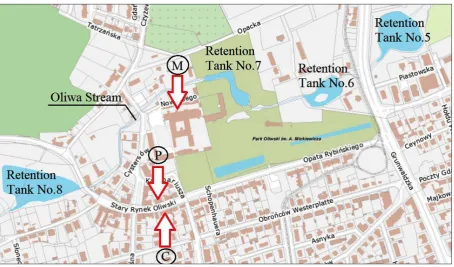
The buildings are located at a distance of 150 m in a straight line from each other. The location of buildings is shown in Figure 1. For compari
-son purposes, a rainwater sample (WD) was also taken while collecting the first sample from the roof (nearby the Oliwa Cathedral). The samples were collected during three precipitation episodes (each sample in triplicate) in the period from June to August 2017, by collecting the outflow from the roof at the outlet from the external vertical gutter (outlet directly to the surface).
On the basis of the knowledge of roof dimen
-sions, the intensity of rainwater runoff from roofs
QD was determined in accordance with the fol
-lowing formula (1):
Q
D= r ∙ C ∙ A
[dm
3∙ s
−1]
(1)where: r – intensity of atmospheric precipitation, [dm3∙s-1∙m-2] (r=0.0173 dm3∙s-1∙m-2, for the
duration of precipitation T=15 min, prob
-ability p = 20% and the frequency of rain c = 5, according to the formula Bogdanow
-icz and Stachy [Kotowski A., et al., 2010]
Table 1. Weather conditions and precipitation for IBW PAN station
Precipitation
event Temperature [°C] Cloud cover [%]
Total rainfall height [mm] In the day of a rainfall
episode In the day before the rainfall episode
1 – June 19 40 – 60 6.6 0.0
2 – July 19 60 – 80 7.8 0.1
C – runoff coefficient, [-], C = 1.0 (ac
-cording to PN-EN 12056–3: 2002)
A – effective roof area, [m2]
In the case of simplified conditions (when no correction is made due to the influence of wind), the effective roof surface is determined in accor
-dance with the formula (2):
A
=
L
R∙
B
R[
m
2]
(2)where: LR – length of the roof from which water
is drained, [m]
BR– width of the roof from the gutter to its top, [m]
For the analyzed buildings the flow rate of runoff from roofs QD was, respectively:
a) Oliwa Cathedral (M): QD = 29.4 dm3∙s-1
b) Building at Stary Rynek street 19 (P):
QD = 7.3 dm3∙s-1
c) Building at Stary Rynek street 3 (C):
QD = 3.5 dm3∙s-1
The samples were collected to half-liter, glass bottles in the initial phase of precipitation (during the first 15 minutes of rainfall), then transported to the laboratory (within of 4 hours from collect
-ing) and filtered using 0.45 pore diameter syringe filters. Afterwards, 10 ml of the test sample was
nitric acid. In brief, 3 test tubes filled with runoff from the roof were prepared from each measur
-ing point, i.e. from each half-liter bottle, which ensured proper control of the results during the measurement using spectroscopy. Subsequently, the trace metals concentrations (Zn, Cu, Pb, Cd and Al) were measured by inductively coupled plasma-mass spectroscopy (MS). The ICP-MS spectrometer is equipped with a standard ICP quartz burner, nebulizer, nickel cones. Samples and standards are given using a peristaltic pump. The spectrometer is optimized daily using a so
-lution of 10 μg∙dm-3 (Mg, Cu, Rh, Cd, In, Ba,
Ce, Pb, U) in 1% HNO3. The samples were ana
-lyzed in a liquid form by means of a dosing sys
-tem consisting of a sprayer and a mist chamber. ELAN 9000 contains a quadrupole mass distribu
-tion system in the range of 1 to 269 atomic mass units (amu). An RF generator with a frequency of 40 MHz is used in the power range from 500 to 1600W. The ETP two-stage detector enables op
-eration in pulse and analog signal measurement modes (measuring range from 1 to 109 counts/s). It includes a vacuum maintenance system com
-prising a vacuum and turbulent pump. The results are produced in μg∙dm-3.
The assessment of the quality of collected wa
-ter samples was carried out using the classifica -Figure 1. Location of sampling points from roofs:
Minister of July 21, 2016 (REM) on the method of classification of uniform surface water bodies. The classification included in REM was chosen due to the fact of a specific rainwater drainage system in Gdańsk, where the Oliwa Stream is a re
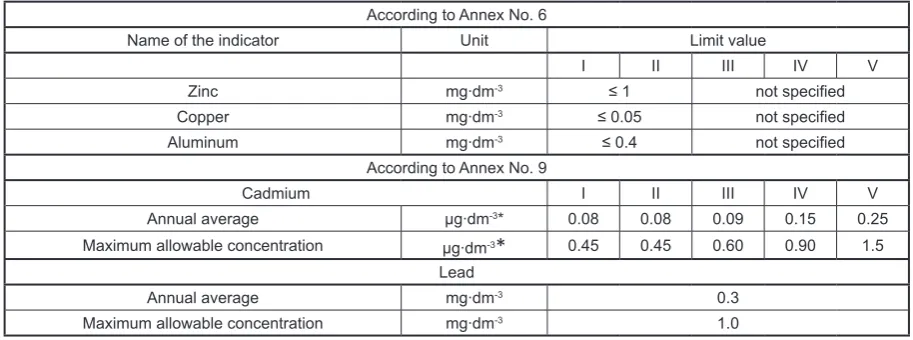
-ceiver for the rainwater drainage system; thus, the runoff from roofs can have a significant impact on the temporary content of trace metals in water of Oliwa Stream. According to Annexes No. 6 and No. 9 to the Regulation [Journal of Laws, 2016 item 1187] limit values for the metals tested are at the level shown in Table 2. Class I corresponds to the waters with very good chemical status, class II – waters with good chemical status, while the waters of III, IV, V class are considered for aver
-age to bad chemical status.
RESULTS AND DISCUSSION
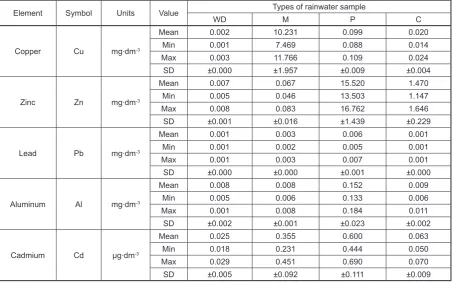
The statistical analysis and average content of analyzed heavy metals in mg∙dm-3: Zn, Pb, Cu, Al
and Cd in µg∙dm-3 – in rainwater samples (WD),
runoff from copper roof (M), roof cover with thermally bonded tar paper (P) and ceramic tiles (C) are shown in Table 3.
Zinc
The rainwater samples collected during rain
-fall episodes are characterized by the lowest con
-centrations of heavy metals. The highest content of zinc was observed in the runoff from the roof covered with tar paper – 15.520 mg∙dm-3. The
concentration of Zn in runoff from ceramic tile roof also exceeded the II class of cleanliness, ac
-cording to REM. The research carried out in Texas by Chang et al. [2004], comparing the quality of runoff from roofs with different coverage, shows the highest concentrations of zinc for a wooden shingle roof – median 9.717 mg∙dm-3 and galva
-nized iron – median 8.219 mg∙dm-3. However, the
maximum content of zinc in the runoff from the roof covered with galvanized iron was 212.330 mg∙dm-3 [Chang et al., 2004]. In the study con
-ducted in Gdańsk in 2003–2004, the highest concentration of zinc was observed in roof run
-off covered with asbestos cement sheets – 4.900 mg∙dm-3 [Polkowska and Namieśnik, 2008].
Aluminum
The aluminum concentrations in the samples from all types of roofing materials were very low – 4 to 40 times less than the reference value for II class of cleanliness, according to REM. The high
-est concentration was noted for the roof covered with thermally bonded tar paper, which may be dependent on considerable material roughness of this kind of material and the smaller roof incli
-nation angle compared to other roofs. It is esti
-mated that the average aluminum content in the atmosphere in urban areas is 10–7–5∙10–6 mg∙dm-3.
The major sources of aluminum in urban area are traffic, atmospheric dust, products of fuel com
-bustion; thus, deposition (wet and dry) can also be an explanation for the presence of aluminum in samples of runoff from roofs. Other studies indicate higher aluminum content for the roofs covered with wooden shingle – 0.224 mg∙dm-3
and galvanized iron – 0.194 mg∙dm-3 comparing
to the values obtained for Gdańsk. In the case of
Table 2. Criteria for assessing the quality of inland surface water and others according to Annexes No. 6 and No. 9 to the Environmental Minister Regulation [Journal of Laws,2016 item 1187]
According to Annex No. 6
Name of the indicator Unit Limit value
I II III IV V
Zinc mg∙dm-3 ≤ 1 not specified
Copper mg∙dm-3 ≤ 0.05 not specified
Aluminum mg∙dm-3 ≤ 0.4 not specified
According to Annex No. 9
Cadmium I II III IV V
Annual average µg∙dm-3* 0.08 0.08 0.09 0.15 0.25
Maximum allowable concentration µg∙dm-3* 0.45 0.45 0.60 0.90 1.5
Lead
Annual average mg∙dm-3 0.3
aluminum sheet, the average aluminum content in the runoff was only 0.169 mg∙dm-3 [Chang et al.,
2004]. This is the evidence of low leaching ability of the main building material – aluminum – dur
-ing the atmospheric precipitation.
Copper
The copper concentration in the runoff from copper roof showed definitely a different result than corresponding aluminum content in the run
-off from roofs covered with aluminum sheet. The observed value – 10.231 mg∙dm-3, exceeds the
limit value specified for II class of cleanliness ac
-cording to REM by 200 times. The research con
-ducted by Sakson et al. [2014] in Łódź in 2009– 2013 confirms the high copper content in the run
-off from copper roofs and other metal roofs. The maximum copper concentration observed was 6.993 mg∙dm-3. The tests carried out in New Zea
-land [Charters F.J. et al., 2016] for 24 episodes of precipitation, among others for copper roofs and sacred architecture, indicates a significant copper leaching with rainwater runoff in the first phase of rain as well as in the final stages. The aver
-age value was 1.298 mg∙dm-3, and the maximum
Charters et al. [2016] clearly proves that the ex
-ternal copper transport (atmospheric deposition) in the case of copper roofs can be practically eliminated. In addition, it should be noted that the analyzed copper roof in Gdańsk Oliwa is covered with a coating of patina. Numerous studies indi
-cate that the runoff from old copper roofs (cov
-ered with patina) and new ones, without the final product of atmospheric corrosion of copper and its alloys, differ in the concentration of copper leached out of the roof. The research conducted by Pennington and Webster-Brown [2010] shows that the concentration of Cu in the outlet from the roof covered with patina is about 35% lower than in the case of the new copper roof. In the runoff from new roofs in New Zealand, concentrations of 1.000–6.830 mg∙dm-3 were observed, while for
copper roofs covered with patina they were lower and amounted to 0.773–4.000 mg∙dm-3 [Penning
-ton and Webster-Brown, 2010].
The copper concentration in the runoff from the roof covered with thermally bonded tar paper also exceeded the limit for II class of cleanliness; however, in this case, it is possible to assume that copper originated from the atmospheric contami
-nation with this element, probably as a result of
Table 3. Basis statistics of trace metalsin samples: WD – rainwater, M – runoff from copper roof, P – runoff from thermally bonded tar paper and C – runoff from ceramic tile samples
Element Symbol Units Value Types of rainwater sample
WD M P C
Copper Cu mg∙dm-3
Mean 0.002 10.231 0.099 0.020
Min 0.001 7.469 0.088 0.014
Max 0.003 11.766 0.109 0.024
SD ±0.000 ±1.957 ±0.009 ±0.004
Zinc Zn mg∙dm-3
Mean 0.007 0.067 15.520 1.470
Min 0.005 0.046 13.503 1.147
Max 0.008 0.083 16.762 1.646
SD ±0.001 ±0.016 ±1.439 ±0.229
Lead Pb mg∙dm-3
Mean 0.001 0.003 0.006 0.001
Min 0.001 0.002 0.005 0.001
Max 0.001 0.003 0.007 0.001
SD ±0.000 ±0.000 ±0.001 ±0.000
Aluminum Al mg∙dm-3
Mean 0.008 0.008 0.152 0.009
Min 0.005 0.006 0.133 0.006
Max 0.001 0.008 0.184 0.011
SD ±0.002 ±0.001 ±0.023 ±0.002
Cadmium Cd µg∙dm-3
Mean 0.025 0.355 0.600 0.063
Min 0.018 0.231 0.444 0.050
Max 0.029 0.451 0.690 0.070
Lead
The lead concentrations measured in the run
-off from the roofs in Gdańsk Oliwa district were significantly lower than the recommendations is
-sued by the Environmental Minister (REM). The highest lead content – 0.006 mg∙dm-3 – was ob
-tained in the runoff from the roof covered with tar paper. In the study of Namieśnik and Polkowska [2008], a similar level of lead concentration was found in the runoff from this type of roofing – av
-erage leaching level – 0.001 mg∙dm-3. The highest
lead content obtained for the runoff from the roof covered with tar paper (in comparison to other materials) may be related to the roughness and small inclination roof angle, which widely facili
-tates deposition and accumulation of impurities.
Cadmium
The highest concentration of cadmium in the runoff from the analyzed roofs was recorded for the roof covered with thermally bonded tar pa
-per, copper roof and ceramic tiles, respectively. All of the analyzed samples met the conditions for the I class of cleanliness specified in REM. The obtained values are much lower than those observed by Namieśnik and Polkowska [2008], amounting to 3.700 µg∙dm-3 for the runoff from
ceramic roof tiles.
Potential impact of HM washed from the roofs on surface water receivers
High concentration of copper found in the runoff from the roof covered with copper can be a
cause for concern about the further spread of
cop-per in the environment. In the Old Oliwa district, where the research was conducted, there are more roofs with coatings or at least elements of copper. The runoff from the roofs is discharged into the rainwater drainage system. The rainwater drain
-age systems flow out to the Oliwa Stream. In stud
-ies carried out by Wojciechowska et al. [2017] and Nawrot et al. [2017], increased concentrations of copper were measured in the bottom sediments collected from the retention tank No.5, located in Oliwa district. Due to the decreased flow veloc
-ity in the retention tanks, sedimentation of sus
-pensions solids occurs within them. Suspended solids transport other pollutants, such as heavy metals adsorbed on their surfaces [Gajewska et al., 2013, Obarska-Pempkowiak et al., 2015]. The concentration of copper at the measurement point located near the inflow to the retention tank was
88.79 mg∙kg-1 d.m.; this corresponds to the con
-tamination of sediments at moderate to signifi
-cant level, according to the German classification LAWA [1998]. It can be stated that in the case of the analyzed Stara Oliwa district, the copper roofs contribute quite significant Cu loads to the storm water runoff and constitute a source of cop
-per in the environment. While the quality of water in the Oliwa Stream in respect to trace the metal content corresponds to the I class, according to REM [Wojciechowska et al., 2017], in the case of the sediments deposited for longer periods of time (dredging tanks at intervals once every 4–7 years), the trace metals are deposited and can act as potential sources of contamination in the urban catchment area.
CONCLUSIONS
1. The runoff from roofs can be a source of trace metals in the environment due to leaching dur
-ing precipitation, contribut-ing to non-point pollution in the urban catchment area.
2. The runoffs from different types of roofing materials contain various concentrations of heavy metals. In the research conducted in the Gdansk Oliwa district, it was found out that
the highest concentration of copper occurred in
the runoff from the roof covered with copper – the average concentration amounted to 10.231 mg∙dm-3. The highest concentration of lead
– 0.006 mg∙dm-3, cadmium – 0.600 µg∙dm-3,
aluminum – 0.152 mg∙dm-3 and zinc – 15.520
mg∙dm-3 were measured in the runoff samples
from the rafting finished with thermally bond
-ed tar paper. The ceramic tiles roof was char
-acterized by the lowest metals concentrations in the runoff.
3. Copper roofs, which are a frequent kind of cover for sacral architecture or other buildings, are durable, aesthetic and give buildings presti
-gious appearance, can be a threat to the state of the environment due to the significant copper leaching.
Acknowledgements
The work was completed under a GRAM grant, awarded in a competitive procedure by the Dean of the Faculty of Civil and Environmental Engineer
-ing, Gdansk University of Technology. The grants are funded from science funds as specified in Jour
REFERENCES
1. Chang M., McBroom M.W., Beasley R.S., 2004. Roofing as a source of nonpoint water pollu
-tion. Journal of Environmental Management, 73, 307–315.
2. Charters F.J., Cochrane T.A., O’Sullivan A.D., 2016. Untreated runoff quality from roof and road surfaces in a low intensity rainfall climate. Science of the Total Environment, 550, 265–272.
3. Gajewska M., Stosik M., Wojciechowska E., Obarska-Pempkowiak H., 2013. The impact of wastewater treatment technologies on the particle size spectrum in the outflow (in Polish). Rocznik Ochrona Środowiska, 15(11), 1191–1206.
4. http://pomiary.gdmel.pl/
5. Kotowski A., Kaźmierczak B., Dancewicz A., 2010. Modeling of precipitation for sewage siz
-ing (in Polish) PAN Komitet Inżynierii Lądowej i Wodnej Instytut Podstawowych Problemów Tech
-niki, Warszawa.
6. Kaye J., Groffman P., Grimm N., Baker L., Pouyat R., 2006. A distinct urban biogeochemistry? Trends in Ecology and Evolution 21, 192–199.
7. Kim R-H., Lee S., Kim Y-M., Lee J-H., Kim S-K., Kim S-G., 2005. Pollutants in rainwater runoff in
-Korea: their impacts on rainwater utilization. Envi
-ronmental Technology, 26, 411–420.
8. Länderarbeitsgemeinschaft Wasser (LAWA), 1998. Beurteilung der Wasserbeschaffenheit von Flieβgewässern in der Bundesrepublik Deutsch
-land – Chemische Gewässergűteklassifikation. 9. Nawrot N., Matej-Łukowicz K., Wojciechowska
E., 2018. Change of heavy metals concentrations in sediments deposited in retention tanks on Oliwa Stream in Gdansk after the flood incident, Polish Journal of Environmental Studies, in press. 10. Obarska-Pempkowiak H., Gajewska M.,
Wojciechowska E., Pempkowiak J. 2015. Treatment Wetlands for Environmental Pollution Control. Rowiński P. (ed.) GeoPlanet: Earth and Planetary
Sciences. Springer International Publishing, pp. 169. 11. Ociepa E., Kisiel A., Lach J., 2010. Contamination
of rainwater flowing into sewage systems (in Pol
-ish). Proceeding of ECOpole, Vol. 4, No. 2. 12. Pennington S.L., Webster-Brown J.G., 2010.
Stormwater runoff quality from copper roofing, Auckland, New Zealand. New Zealand Journal of Marine and Freshwater Research, 42(1), 99–108. 13. Polkowska Ż., Namieśnik J., 2008. Road and roof
runoff waters as a source of pollution in a big ur
-ban agglomeration (Gdansk, Poland). Ecological Chemistry and Engineering, Vol. 15, No. 3. 14. PN-EN 12056–3:2002. Systemy kanalizacji
grawitacyjnej wewnątrz budynków – Część 3: Przewody deszczowe – Projektowanie układu i obliczenia.
15. Sakson G., Zawilski M., Badowska E., Brzezińska A., 2014. Zanieczyszczenia ścieków opadowych jako podstawa wyboru sposobu ich zagospoda
-rowania, Journal of Civil Engineering, Environ
-ment and Architecture, t.XXXI, z.61 (3/I/14), 253–264.
16. Sneddon, R., Trembly, L., 2011. The New Zea
-land King Salmon Company Limited:Assessment of Environmental Effects – Copper and Zinc. Pre
-pared for The NewZealand King Salmon Company Ltd. Cawthron Report No. 1984, pp. 53.
17. Tsakovski S., Tobiszewski M., Simeonov V., Polkowska Ż., Namieśnik J., 2010. Chemical com
-position of water from roofs in Gdansk, Poland, Environmental Pollution 158, 84–91.
18. Wallinder L.O., Leygraf C., Karlen C., Heijerick D., Janssed C.R., 2001. Atmospheric corrosion of zinc based materials: runoff rates, chemical specia
-tion and ecotoxicity effects, Corrosion Science 43, 809–816.