Volume-6 Issue-1
International Journal of Intellectual Advancements
and Research in Engineering Computations
Automatic wheelchair controller using
Eye ball movement
1
K.Santhakumar,
2V.Kavin Kumar,
3R.Mohan Kumar,
4P.Mohan,
5M.Nadhiya,
1
Associate Professor,
2,3,4,5Students,
Dept of Electronics and Communication Engineering,
Nandha Engineering College, Erode
[email protected]
,
[email protected]
ABSTRACT: Each and every person in this world has a desire to live a normal and peaceful life but accidents, diseases, elder-ship make their desire life into disability. Moreover, there are lots of disabled persons and elders as well as the numbers are increasing day by day. They always need another person help and have to go under some physical therapies under the guidance of certain specialist to recuperate their problems in their day to day life. In this paper the proposed system helps them to move freely & safely and also takes the activities of a therapist without any third party help.
This system is a combination of different features and has the ability to detect the obstacle and provides few kinds of therapies also. A smart wheelchair is developed by using eye ball movement to control the movement of wheelchair and also with microcontroller interfaced system. Besides, an ultrasound system provides the facility of automate the wheelchair for obstacle detection. The aim of our research is to implement many facilities in a single wheelchair at low cost.
KEYWORDS: Eye ball movement, Physical exercise, Microcontroller, Wheel Chair.
I. INTRODUCTION
The idea of using eye ball sensing technology for controlling the motion of the wheelchair is to prove that it can be a unique concept that would stand apart from the rest of the average projects. The use of this new technology in conjunction with a mechanical system in order to simplify everyday life would spark interest in an ever growing modern society. Many people with disabilities do not have the dexterity necessary to control a joystick on an electrical wheelchair [20]. This can be a great for the person who is permanently unable to move any of the arms or legs. They can use their wheelchair easier only using an eye movement
as commands. The aim of this study is to implement an interesting application using eye ball movement recognition system. The methodology adopted is based on grouping a microcontroller with a eye ball sensor kit for isolated input from user. The resulting design is used to control a wheelchair for a handicapped person based on the eye movement [9][10].
There are five options for basic motions of a wheelchair to be applied by the user. The five conditions of the wheelchair can be described as the following:
1) Moving forward from user 2) Moving backward from user 3) Turning to the right
4) Turning to the left 5) Static or stop condition
II.SYSTEM ANALYSIS
EXISTING SYSTEM
The breathing input diplomacy such as keyboard, mouse, and the other input strategy are used to interact with digital instrument. These input devices cannot be operated by disabled persons. In this paper, movement of human eyes is proposed for disabled person for wheelchair movement. These systems are classified into several types.
Bio-potential based method:
Bio-potential based system utilizes prospective energy from user's body behaviour which is acquired by using some special instrument, Such as Electrooculograph, Electromyography and
Electroencephalograph. Search coil can be used for measuring bio-potential. The search coil output can be used as sources of computer input for disabled person [7].
Voice Based method:
Voice Based method uses the user's voice as main input. This voice analysis is used to analyze the user's voice and convert into digital data. The main drawback of this system is vulnerable against noise. Other voices which come outside from user may affect the system [17].
Motion based method:
Motion based method utilizes other normal organ movements to operate the input system. Head and foot can be absorbed by accelerometer sensor and the observed input is used to control the input system [15].
Image Analysis method:
Image Analysis method utilizes camera to get input from user's desire and convert into digital data. Several image processing methods are used to analyze user's input data.
Search coil method:
Search coil method is used to induce voltage with coil including in contact lenses attached to user‟s eyes.
Drawbacks:
Direct sensors attached to user‟s face cause some medical issues.
These methods are relatively costly.
It is in high cost and produce high error rate.
The image analysis method does not insist any load to users and is realized with comparatively cheap cost.
PROPOSED SYSTEM
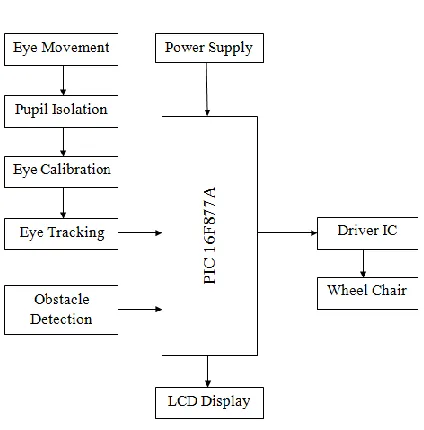
The proposed model uses an eye ball sensor to control wheelchair. Once the movement has been processed and it is given to the microcontroller. The microcontroller process depends upon the feed coding and the output is gives in to the driver circuit. Also, the obstacle detection sensors will be connected to give necessary feedback for proper operation of the robot. The wheelchair will be connected to driving circuit that will move to robot based on eye ball movement.
Advantages:
Independent to move. We don‟t have to depend on someone else to move the chair.
Minimal effort is needed to control the wheelchair.
Adaptable for severity and disability.
Easy to maintain with low power usage.
Easy and convenient to all.
III.BLOCK DIAGRAM
Figure 3.1: Block Diagram
Eye Movement:
Eye movement includes the controlled or uncontrolled movement of the eyes, serving in acquiring, fixating and tracking visual stimuli. Specific systems are used in maintaining passion, when reading and in music reading. A special type of eye movement, rapid eye movement, occurs during REM sleep.
Pupil Isolation:
Eye Calibration:
Calibration in quantity knowledge and metrology is the assessment of measurement standards delivered by a device under test with those of a calibration standard of well-known exactness. Such a standard could be another measurement device of well-known exactness, a gadget generating the quantity to be considered such as a voltage, or a physical artefact.
Eye Tracking:
Eye tracking is the progression of measuring either the tip of observe (where one is looking) or the movement of an eye family constituent to the head. An eye tracker is a device for measuring eye positions and eye organization. Gaze at trackers be used in inspect intended the visual system, in psychology, in psycholinguistics, advertising, as an key in device for human-computer communication, and in result design.
Obstacle Sensors:
Each vehicle characteristics an obstacle detection system, currently based upon a LIDAR laser scanner sensor, to detect obstacles of 7+ centimetres wide within a reach of 40-100 meters. A failsafe detection algorithm is used that scans the area in front of the vehicles „empty‟. The obstacle detection directly plugs-in to the low level motion controllers and can interrupt the navigation task. The obstacle detection algorithms are able to differentiate true obstacles from „ghost‟ substance such as rain, snow or leaves falling from the trees.
Driver IC:
In electronics a driver IC is an electrical conduit or additional electronic constituent used to manage an additional path or constituent, such as a towering power transistor, LCD and numerous others. They are regularly used to regulate current flowing through a path or to control other factor such as additional components several diplomacy in the circuit.
Wheel Chair:
Stimulating wheelchair is a wheelchair that is propelled by means of an electric coast rather than physical power. Motorized wheelchairs are helpful for those incapable to push a physical wheelchair. They may also be used not immediately by people with established mobility impairments, but
also by citizens with cardiovascular and fatigue-based situation.
IV.RESULTS AND DISCUSSION
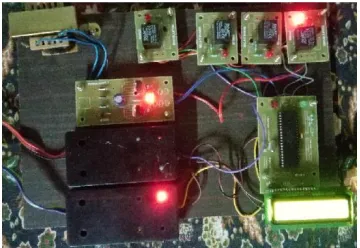
Figure 4.1: Forward Direction
When pupil is moved upwards the controller makes the first and third relay on and moves the wheelchair in forward direction.
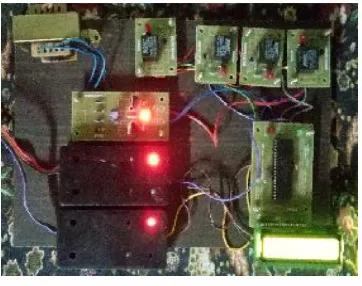
Figure 4.2: Left Direction
When pupil is moved left the controller makes the third relay on and moves the wheelchair in left direction.
When pupil is moved right the controller makes the first relay on and moves the wheelchair in right direction.
Figure 4.4: Stop Operation
When eye is closed the controller makes all relay off and stops the operation of wheelchair temporarily.
V.CONCLUSION
This wheel chair is more efficient and cost effective compared to other methods of control. Different types of therapy facility create a new revolution with this automated system. This system is very useful for a developing country like Bangladesh where most of the peoples are unable to effort the costly therapies from specialists of doctors. With the help of Government this system can be improved and implemented to a higher scale so that the poor and middle class family members can aim such type of system for their welfare and treatment.
REFERENCES
[1]. Jesse Leaman and Hung Manh La, “A Comprehensive Review of Smart Wheel chairs: Past, Present and Future”, IEEE
Transactions on Human-Machine Systems,
pp.1-13, Dec-2017.
[2]. Aartika Sethi, Sujay Deb and Prabhat Rajan, “Smart Mobility Solution With Multiple Input Output Interface”,
International Conference on Signal
Acquisition and Processing, Kuala Lumpur,
pp. 3781-3784, Oct-2017.
[3]. Tunhua Wu, Ping Wang and Yezhi Lin, “A Robust Non-Invasive Eye Control
Approach for Disabled People Based on Kinect 2.0 Sensor”, Applications and
Technology Conference IEEE, Farmingdale,
pp.1-6, July-2017.
[4]. Jeet K.Desai, “Controlling A Wheelchair By Gesture And Wearable Movement”, IEEE
International Conference On Consumer
Electronics (ICCE), Vol.3, no. 2, pp. 34-49,
June-2017.
[5]. Vijaykumar Rajasekaran, Manuel Vinagre and Joan Aranda, “Event Based Control for Sit to Stand Transition Using a Wearable Exoskeleton”, International Conference On
Rehabilitation Robotics pp.400-405, Jan-
2017.
[6]. Christoper Cabrall, Nico Janssen and Joel Goncalves, “Eye Based Driver State Monitor Of distraction, Drowsiness in Automated Driving”, IEEE International
Conference on Systems, Man, And
Cybernetics, pp.1-7, Oct- 2016.
[7]. Fatma Ben Taher, Nader Ben Amor and Mohamed Jallouli, “A Multimodal Wheelchair Control System Based On EEG Signals And Eye Tracking Fusion”,
International Conference on Individual and
Collective Behaviors in Robotics (ICBR),
pp.27-32, Sep- 2015.
[8]. Pablo Gonzalez and Ming-Yang Cheng, “Vision-Based Robotic System For Polyhedral Object Grasping Using Kinect Sensor", Proceeding International
Automatic Control Conference (CACS), The
Evergreen Laural Hotel, Taichung, Taiwan, pp. 71-76, Feb- 2015.
[9]. Dilok Puanhvuan and Sarawin Khemmachotin, “Automated Navigation System For Eye-Based Wheelchair Controls”, The 2014 Biomedical
Engineering International Conference
(Bmeicon-20l4) ,pp. 249 – 253,Vol. 25,
No. 6, July-2014.
[10]. Gunda Gautam, Gunda Sumanth, Karthikeyan K C, Shyam Sundar and D.Venkataraman, “Eye Movement Based Electronic Wheel Chair For Physically Challenged Persons”, International Journal
Of Scientific & Technology Research,
pp.206-212,Vol 3, Issue 2, Feb-2014.
[11]. G.Aravind Kumar, M.Prasanth and K.Sajith Mohamed, “Design And Development Of A Hand-Glove Controlled Wheel Chair Using Zigbee”, International Journal Of
Communication & Instrumentation
Engineering And Development,
pp.78-86,Vol 1 Issue: 2, Jan-2014.
[12]. Dr.Shaik Meeravali and M. Aparna, “Design and Development of a Hand glove Controlled Wheel Chair Based On Mems”, International Journal of
Engineering Trends and Technology
(IJETT), pp.3706-3712, Vol 4, Issue 8, Aug- 2013.
[13]. Sv Anusha, M Srinivasa Rao and P V Ramesh,” Design And Development Of A Hand Movement Controlled Wheel Chair”, Global Journal Of Advanced
Engineering Technologies, Vol 1, Issue 4,
Dec-2012.
[14]. Mohammed Faeik Ruzaij and S.Poonguzhali, “Design and Implementation of Low Cost Intelligent Wheelchair”,
International Conference on Recent Trends
in Information Technology (ICRTIT), pp
468-471,IEEE, Nov-2012.
[15]. Ericka Janet Rechy-Ramirez, Huosheng Hu and Klaus Mcdonald-Maier, “Head Movements Based Control of an Intelligent Wheelchair in an Indoor Environment”,
International Conference on Robotics and
Biomemetics, pp. 1464-1469, June-2012.
[16]. Muhammad Tahir Qadri and Syed Ashfaque Ahmed, “Voice Controlled Wheelchair Using DSK Tms320c6711”,
International Conference on Signal
Acquisition and Processing, pp.217-220,
Vol 2, Dec-2009.
[17]. Masato Nishimori, Takeshi Saitoh and Ryosuke Konishi, “Voice Controlled Intelligent Wheelchair”, Sice Annual
Conference 2007, Kagawa University,
pp. 336-340, Sep-2007.
[18]. G.Paþnik, K.Benkiþ and B.Breþko, “Voice Operated Intelligent Wheelchair – VOIC”, Proceedings of the IEEE International Symposium on Industrial
Electronics, pp 1221-1226, Aug-2005.
[19]. Mohamed Fezari, Badji Mokhtar, Mounir Bousbia-Salah and Mouldi Bedda, “Design of a Voice Control System For A Disabled Person Wheelchair”, Asian Journal Of
Information Technology, pp. 940- 944, Vol
4, Issue 10, June-2005.
[20]. H.R. Singh, A Mobin, S Kumar, S Chauhan and S S Agarwal, “Design and Development of Voice/Joystick Operated Microcontroller Based Intelligent Motorised Wheelchair”,
Tencon 99. Proceedings Of The IEEE
Region 10 Conference, Vol 2, pp. 1573